#WoW – Flex Raids and New Features

The previous post related to my opinion that Warlords of Draenor is bringing very little to the table.  Thinking on that a bit, I realize that WoW’s strongest foot forward has generally been mid-patch and not expansions, with a few exceptions.

Blizzard makes good stories and solid art.  Expansions focus on that and while there are certainly exceptions where the story is horribad, the vast majority is solid if not exceptional given the tools they have at hand.  My opinion here is that time travel is often a poor device for story telling as a premise.  Sci-fi always succeeds when the story is about the people and the context is just there for flavor.  I’m curious as to how WoD will handle that given that the “wibbly wobbly timey wimey stuff” is pretty hard to manage without causing a bunch of retcons.

Blizzard is quite poor at new but really good at updating existing systems.  The resistance requirements from vanilla turned into attunement for BC which turned into gear score later on.  40 man raids turned into 25 and 10, and then Flex.  LFG was a list originally, then automated, then LFR and now a near feature for feature rip from an exiting game mod.  Questing has undergone some big iterations, with the Cataclysm model of stories and MoP’s cinematic/integration story approach.  Leveling curves have been normalized.  Itemization has gone from 4 stats, to 16, to gems everywhere, to gems nowhere, to 8 stats and now RNG stats.  Talents went from the Diablo 2 model, to massive cookie cutter trees, to a rather homogenized flat structure with minimal variance.  Heck, some systems are so poorly thought out they just cut them from the game – reforging is one clear example.

Even the “new” stuff they put it was done in other systems first.  Transmogrification existed in many other games – LOTR and RIFT in particular – and those systems are still better than WoW’s (also in D3 now).  Pet battles is a direct rip from other MMOs and a clear link to Pokemon.  Proving Grounds was done in TSW first and in that game, it’s used as a gating mechanic as it should be.  Brawler’s Guild is an extension of that, with mixed results.

The point I’m trying to make is that Blizzard’s first kick at the can is usually not that hot, if it’s a departure from what’s out there now.  If they are applying incremental improvements on existing systems, then yes, super.  And this is ok.  They have millions of people playing a game, finding areas that they can optimize.  Blizzard has maybe 100 people on system design?  The law of averages says that Blizzard is going to lose.  Any dev would.  My issue is in the amount of time it takes for this beast to change course and actually find what works.

I think that WoW does 3 things better than other companies.  It tells better stories.  The Pet Battle system is best in class.  And Flex raids are the way forward.  It took a mod and a fan site for them to realize that Pet Battles could actually work and if I recall from stats taken in game, there are more people who participate in that activity that any type of raid (LFR — Heroic).  Its’ really rather well done, through a simple interface that’s had some iterations over time.  WoD is bringing new pets, no new systems.

Flex raids are next, or more generally, scaled group content with group caps.  When WoW was on the incline or at least stable in terms of population, the group caps were manageable (after they dropped from 40) but sub-optimal.  The LFR system stemmed from the idea that less than 10% of the population raided in Firelands (<1% heroic) and it made sense to expose more of the story.  LFR numbers were crazy, something around 80%+ of all max level players participate and regular raids were still very low, under 10%.  MMO Champion has all the stats by the way, just lazy to link to dozens of posts.  So Blizzard had an issue.  Clearly people wanted to raid but such a massive drop between models was causing issues… what was the problem?  LFR provided a way to complete content with a variable amount of people, and the system just filled in the holes to reach the thresholds.  The problems with LFR were obvious.  Random people do bad things and it was a “roll of everything!” mentality.  How to get the benefits of LFR (variable groups) and lose the downside (asshats).  In comes Flex.

Flex was added to provide people with non-faceroll content (somewhat on par with Normal) with a variable group of people they knew.  Getting 10 people is still not obvious but having 16 means that you don’t have 6 people picking up snacks for 5 hours while the rest is having fun.  The new Flex system will be applied to everything moving forward except heroic content.  I mean, it’ll be called Flex Heroic but it’s the same challenge as today’s normal.

Here we get into the themepark & sandbox debate.  Themeparks can only fit X people on a ride and rarely will they start without the ride being full.  Sandboxes can acomodate any number of players.  EvE, AA, Darkfall, UO all work with any number of people.  SWTOR, LOTR, FF14, WS and every other themepark can only fit X people.  It’s somewhat interesting that WoW is first out of the gate for a variable themepark size, catching up to 15 years of since UO first did it in mass market…but hey, welcome to 2014!
Raiding – Who’s It For?

I used to raid back in the day.  You know, when we trash meant something and you stayed logged on to farm mats.  Oh, what glorious days it was to raid 5 hours a day, 5 days a week and then farm the other 2 days!  Kids today have it much to easy.  What with the CoD, Destiny, D3 pop-in and play gamestyle.  Where’s the challenge of getting 20-40 cavedwellers to wake up from their late nap to log in? And then proceed to ignore all instructions for the first 45 minutes?  Oh, too easy I tell you, much too easy!

Some odd Wildstar numbers for you here.  So from the horses’ mouth, 120-150 20 man raids, 7 40 man raids that have cleared 3 of the 9 bosses.  The math comes to around 4000 raiders.

Let’s look at WoW for a second, where Raiding is arguably, no longer the top-tier end game activity (pet battles!).  Here’s the link and it accounts for data ~6 months after the raid released.  7.3 million character, 2.3 million accounts, looking at the final tier of raiding, SoO.  70% completed the first boss on LFR, 40% flex, 20% normal, 10% heroic.  50% completed the last boss on LFR, 18% flex, 13% normal, 0.8% heroic.  Assuming the “accounts number”, WoW’s hard mode attracted ~1% of the playerbase.  I’ve mentioned before that WoW’s heroic is pretty close in difficulty to Wildstar’s default raid level.

Back to Wildstar.  Assuming the same 1% ratio (and that’s a very large assumption) they are sitting at around 400k subs, which I think is a pretty decent number.  Of course, it takes magic math to get there.

But the crux of the argument is that their design vision, hardcore 40 man raids, are being consumed by a tiny, tiny fraction of the playerbase.  You’re leaving 99% of the rest of playerbase with next to nothing to do as end-game currently consists of either daily grinds, or getting into the raiding sphere.  Hate on WoW’s LFR as much as you want, they’ve found a way to get 50-70% of their playerbase to USE the material they’ve built.

Now you’re going to LFR for 1 of 2 reasons.  First, and I’m going to assume this is the minority here, to see the story/content through.  Raids, since BWL at least, have had pretty decent narratives.  If you didn’t raid Icecrown, then you’re probably wondering what ever happened to the Lich King after having seen him every 15 minutes while leveling.  Second, they do it for gear.  Gear for gear’s sake, or to get into the real “raiding” that starts at Flex.

Flex for a minute. This to me is the smartest move WoW ever made when it comes to raiding.  There were many months of tweaking, in order to avoid breakpoints but today’s implementation is near perfect.  Solid enough challenge, built for social guilds and allows you to take a night off with the missus.

Back on point, raids are by their very nature exclusive.  They require not only a decent amount of RPG-savvy (stats through gear + good build + good tactics) but also coordination of multiple people over long periods of time (3+ hours).  Sometimes the latter is the hardest part and calling a raid off because you only have 32 people instead of 40 happened often in vanilla.

So while Wildstar has it’s own little problem in that they need something for people to do other than raid, they also need to look at how they can make raiding more accessible so that they aren’t spending millions on content that only 4000 people get to see.

Skill vs Time – A Visual Aid

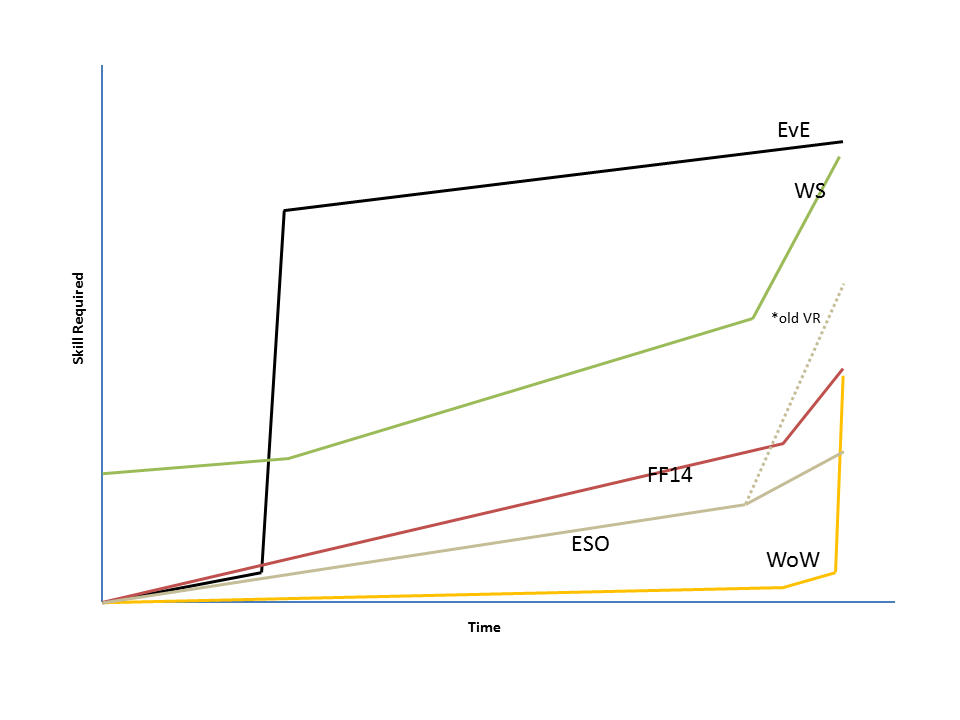
After reading Isey’s post on How to Lose an MMO Gamer in 10 Ways, and after pondering a bit more my previous post on Wildstar, I decided to draw out what I think is one of the larger hurdles for games to succeed – at least on a “massive” scale.  And that’s player skill.

Good game design is a series of meaningful choices.  I don’t think there’s any debate on that.  Where I think the kink in that comes from is in the ability for a person to have a an actual choice and appreciate the results (i.e. the ability to apply a skill and learn a new one).  I’ll go back in time a bit to vanilla Naxx and Heigan the Unclean.  This is the famous “avoid the fire spouts and you can solo me” boss – a dance really.  This was a massive twist in the traditional RPG space, where you just stood there pressing buttons.  Now you actually had to pay attention to the play space and move.  You couldn’t just absorb the damage.  I do know that many guilds at the time used it as a triage for recruits (combined with Thaddius) and it formed a massive skill wall for it’s day.   You either performed it perfectly, or you died.  That model, tried with a slight twist in BC, got the Ol’ Yeller treatment.  For good reason too, it wasn’t a meaningful choice and other than memorization and “no keyboard turners” there was little skill exploited.  WoW since then (with a blip in Cataclysm that they want to forget) has been more and more accessible at the lower end, with harder content for those who want the option.

To me, player progress is important.  Not only improvement itself but the opportunity for improvement and the evidence of improvement.  Huge spikes in difficulty is bad.  Difficult just to be difficult is bad.  No difficulty is bad.  A gradual increase in difficulty, where your progress is both evident and rewarded is the optimal solution.

On to the visual aid I promised!

skillvstime

What I did here was map the player skill required to complete tasks, assuming a time investment.  The skill portion is relative between games, where EvE is certainly the most challenging.  The remaining themeparks are ranked in difficulty, based on my play.  Over each in particular now.

EvE

Everyone has seen the EvE difficulty curve.  The game is rather simple to start, assuming you stay in high-sec and follow the themepark crumbs.  Try to move off that path, either through null-sec or mastering a trade and boom, welcome to excel online.  If you make the transition, you’re gold.  If you don’t, then you’re dead.  EvE has been able to succeed with a supremely polished game after the transition.

Wildstar

No game starts off harder than Wildstar.  Then you start dungeons and the difficulty starts to climb.  Reach max level and the attunement begins, with a massive climb in difficulty. There’s no help to transition between the stages, the difficult is very binary (you die in 1 shot or you take no damage) and the climb at the end is like no other themepark.

FF14

A game with a very gradual increase in difficulty due to skill unlocks being limited and the presence of force grouping at an early stage to progress on the solo train.  You learn to tank, heal, pull, DPS, stun, craft… everything.  And the change at max level is more along the lines of perfecting skills you’ve already acquired.  It’s a very good experience.

ESO

This one is a little odd, in that challenge as you level has no training and very little feedback but the skill level required is pretty low.  Given that there are actual “bad choices” the game design allows you to have a couple and still succeed.  If you make good decisions, then it’s like cutting Jell-O.  That said, at launch the game had a veteran system at level 50 that was significantly harder than the first portion of the game and accounted for 60% of the content.  Bad choices meant you were going to do.  Good choices gave you a 25% chance to die.  That system was drastically changed after 3 months to a more similar difficulty curve.

WoW

I could have drawn 1 line per expansion here but the power curve line is pretty close to this.  Today’s experience from 1 to 89.9 is a joke.  I leveled a Monk to 90 in a week and only died from falling damage.  Dungeons & LFR can be AFKed by 20% of the group and you’re still going to win.  Normal raids have some challenge but the real difficulty is in the heroic raids.  And not heroic raids because of the mechanics but because of the stats the players have on the content.  Remember that power curve line?  The difference in power between expansion launch and 2 months is nearly 25%.  People were clearing MoP raids in Cataclysm raid gear.

Others

I could have added other games, like LoTRO, STO, DCUO, Rift, Neverwinter and DDO where I’ve done the high level stuff.  They are all pretty similar to WoW, with the final spike happening earlier.  I can’t think of one that plateaus before max level – though TSW might be a candidate as it doesn’t really have a max level, just limited action sets.

Summary

I think the comparison between all the games is important for discussion.  Certainly each has their own variables but of you were to look at where players quit the game, I’d bet dollars to donuts it’s where you see a shift in the curve (assuming they get past a trial phase).  Difficulty is good.  Shifts in difficulty must be moderate.  The benefit of that difficulty increase must be evident.  All of the games listed have made changes since launch to their curves (yes, even EvE) except for Wildstar – but it’s also the youngest.  Here’s hoping they get the hint.

WoW – 10 Years Leading the Pack

Bhagpuss found a neat idea from Atl:ernative Chat, that came up with a neat way to recognize WoW’s personal impact.  Reading through his post, I found a fair bit in common and a fair bit of nostalgia as well.  So here goes.

1. Why did you start playing WoW?

I was a pretty big W3 player, was deep into EQ/UO and found the MMO concept pretty decent.  I somehow got into the very early beta and fell aback at the sheer quality compared to what was available.  Interestingly, I found a website about the game (WoW.net I think it was) and wrote some guides for the beta.  Someone found them, offered me a job writing more guides and that sort of cemented me into the game.

It also helped that I had a dozen or sort friends that I converted to play with me.

2. What was your first character?

Dwarf rogue.  I was active with him until MoP too.  I loved Rogues, always have.  They were pretty darn solid DPS class, and at the start weren’t all that glass canon.  I think the best part was stealthing dungeons with a couple other rogues, clearing it out.  BC was prime-time for Rogues.

3. What factors determined your faction choice?

Barrens decided it for me.  I think for quite a few years the starting area for the Horde was horrible.  Westfall and Dun Murogh were amazing in comparison.  I liked the Horde concept and the characters, but the actual gameplay was not fun.

4. What was your most memorable moment?

Good question, hard to think of one off hand.  Clearing MC in vanilla was up top, chess event in Kara too.  My healing shaman ruling AV for a few months is also top of pile.  Hmm, the most memorable are likely the two massive guild implosions I experienced.  One where logistics of MC destroyed us.  A guild of 60 people, we had a bench for raiding and still couldn’t get everyone to show on time.  The other one was related to DKP drama.  Oh the days of loot ninjas!

5. What is your favorite aspect of the game, and is it still the case?

Originally, it was the ease of access along with system integration.  Everything seemed to interconnect with everything else.  Plus the game had a low skill level for entry but a relatively high skill cap.  The first one is gone, completely obliterated through iterative design focused on the second.  I think the game is much, much to simple today and has trained too many people to just faceroll and expected purples.

6. Do you have an area of the game you always return to?

The auction house.  I’ve never found the art in-game to be particularly attractive, just average.  I like the concepts of the zones just not a big fan of the implementation.  I will say that every expansion has been drastically better than the last.  Cata certainly showed that clearly by re-jigging the starter world and making Draenor look like poop.

7. How long have you /played and has it been continuous?

I started at launch, played consistently until a few months into BC.  Since then, I play 2 months starting the expansion then 1 month after the last expansion patch.  That’s a fair amount of time and I’ve enjoyed most of it.

8. Do you read quest text or not?

I do on the first play through.  Blizzard has very good writers and some pretty memorable characters.  It’s really impressive what they are able to communicate without voice.  While over the years there have been MANY conflicts within the lore, overall the quality of the text and stories has been solid.  I think this is the most consistent part of the game.

9. Are there any regrets about the time in game?

I think I played too much at the start but over the years the play time has been sensible.  I rather enjoyed the single player aspect and the “live world” aspect.  I do regret most of my time “farming” gear though and ignoring the social aspects.

10. What effect has WoW had on your outside life?

A lot.  Much more than I would have thought.  I met people through WoW, made a ton of money (off the guides), applied learning to the game, developed a better understanding of system complexities, improved leadership skills.  WoW taking the forefront of my gaming plate for so long gave me an outlet, as an introvert, to try new things without long term consequences.  I’m a firm believer that gaming can provide some significant real world benefits.

Combat and Art Styles

Pegging off Tobold’s post on appropriate art style, I think it bears mention more than just a couple games.  And I won’t really go into what looks better because that’s a very subjective argument.  This is really about the practicalities.

We have WoW art style, with distinct character outlines since the start. However it’s moved away from tab target to smart target, and red/blue markers on the ground. WoD will finally have target outlines as well. It’s evolved.

Neverwinter, a LAS/action game, uses outlines and AE effects given the mouselook aiming features. It’s a more realistic art style, making it damn near impossible to find someone in the thick of things. BUT, since it’s soft lock and AE for nearly everything (including healing), it works.

SWTOR uses cartoon style graphics for a seemingly endless supply of humanoids. I found it a mess in regular PvE but the group instances aren’t too bad as the character types are often different. Plus tab targeting helps drastically.

FF14 uses tab targets and a full skill bar, though in reality few skills. The art style is VERY unique and it’s fairly easy to spot individual players, let alone NPCs in combat. In fact, you rarely have more than 2-3 enemies at once. Of course, with a requirement for focused combat and targeted attacks, this is vital for success

FF14 - Ifrit

ESO is LAS + mouselook. Many attacks are AE or smart target. Every frigging enemy is the same though. PvP turned into meat walls of AE spam because you can’t focus target effectively. It also means many skills lose all value if they aren’t multi-target. Plus everyone blends in together and the background. So it’s less about aiming and responsiveness as it is about mashing AE attacks and hoping the numbers are in your favor.

Big Boy

Big Boy

Wildstar is LAS but tab/free target combat. Everything has an AE target as well, making aiming very important. Plus the character diversity helps you quickly ID the players in the field. The more quickly you can make an assessment, the better your odds.

That's a big gun

That’s a big gun

I guess it boils down to offense vs defense. A more realistic game favors defensive style of play and 2 types of skills. Either you spam and get lucky or you cross that skill gap to “elite” and run amok. FPS shooters I think show that well.

A more cartoon, or rather distinct character set, provides more offensive options as you can’t really hide. Everyone knows who you are and you have more information to make the right decision. It removes the skill gap and includes progression.

I wouldn’t be able to say which has the higher skill ceiling as that is more game-specific. It’s certainly an interesting topic.

Like A Ghost

It appears that Greg Street, aka Ghostcrawler, is leaving Blizzard for other opportunities. Considering he’s been the design face for 3 expansions, this is a big enough deal.

From Vanilla to the end of BC we had one mentality and strategy – integrated and complex systems with little give. WotLK, Cataclysm and MoP were all about separating systems and adding accessibility. WoD is a feather in that cap, from what I’ve gathered so far.

For good and bad, Wow is Greg’s puppy and it will be interesting to see who will be left to pick up.

WoW – Warlords of Draenor

Since I’ve already put in a few hundred hours in WoW and it’s still the giant gorilla in the market, need to have a post right?  Lots of info found here.

In brief form, the game is using the completely new method of telling a story by using time travel. /sarcasm.  Maybe it’s because the devs have heard enough of people moaning that Burning Crusade was the best and they decided to go back.  Maybe they are simply out of bad guys to put up.  Either way, they are recycling a ton of content, adding very little and taking a way a fair amount of the complexity.

Do I think this is a bad move?  Not really.

Players housing is in, sort of.  Dynamic quests are in, sort of.  Item squish is in  (yay!).  Raids are being revamped so that top tier is only 20 players.  I don’t get why anyone would run 25 now, it’s essentially the death stroke. 10 more levels where you become even stronger!  (Some of those skill upgrades are ridiculous.)  No more daily quests.  Item stats change based on spec.  No more gear of no value.  Reforging is gone, enchanting is smaller, less gems too.

I mean, I watched and read a ton of info about the expansion.  I am feeling less enthused here than I was for Pandaria.  Pandaria had a stupid premise but a decent execution on most fronts.  I am looking at Warlords of Draenor and seeing less an expansion but more a major patch.  Then again, after nearly 10 years, it can’t be hit out of the park every time.

Old is the New

Most things in life happen in cycles. These cycles can be long (ice ages) or short (food cravings). Game patterns have their own ebb and flow. People aren’t clamoring for Pac-Man, though it still sells for nostalgic reasons, but there are some elements that function better with simplicity – for a time.

I like public quests. I really like RIFT’s take on them, what with the instant grouping, chat channels and length. I like GW2s versions for the variety but take issue with the lack of social. Wow has the Timeless isles now which is just a bunch of random bosses every other minute. Cut the BS, gimme the loot. EQ didn’t bother with much of that. Every quest was a group quest and it took a zone to make it work.

I float between the models, depending on mood. There are advantages to each and time is a rather serious factor. EQ takes forever to get going but is much more rewarding. GW2 has oodles of choice but everything is a 1 night stand. Wow, well I don’t rightly know right now. They’ve never done something so organic and it really feels out of place.

It’s good that so many MMOS are around giving the playerbase some choice and developers some baseline. People don’t go back to play BF2 but people go back to play UO. The systems might not have been perfect but new games since then haven’t really moved the bar up – just sideways.

Free to Play Foibles

Since Rift is going F2P in June, quite a few people have voiced some concerns over the business model and the long term ramifications.  I think Wilhelm has the most sober approach to it all.  There are quite a few items I would like to discuss here that I think many people have either overlooked or simply not really thought much about.

A subscription game has a relatively assured income model.  You have X players you get X money.  As long as the playerbase is happy, you’re going to bring in money.  This part I don’t really get about RIFT since the quality has always been there but without Hartman at the helm, we all pretty much figured this was going to happen.  WoW makes about $50 million a month and can amortize/invest into future content development.  The thing about themeparks is that the developers determine the content and the players consume it.  Given WoW’s development cycle, you’re paying about $60-$100 per patch and then another $60 per expansion pack.  Take any other themepark F2P game and you can pay much, much less for content – sometimes nothing.  Sandboxes do not have this problem (hence UO still be subscription) and PvP games are pretty close to this.  This is rather clear if you take a step back from the actual game.

Where people tend to trip up a bit is two-fold.  First, a company needs to make money and people have to spend money.  I know, simple.  The thing about making money is that you have to consistently make it.  If you’re selling unlocks for an account, things that last forever, then after a while, people won’t be buying them if they’ve been there for a long time.  You need new players to buy that sort of stuff.  In order to make cash, you need to sell consumables.  In a level-based, gear-based system, what is consumable?  New content is one, but the price tag to develop it is high and you’re not sure to get the money back.  Character customizations work but again, unless you’re overwriting what was there before, you’re not going to have long term success.  Devs have yet to figure out this problem, instead they all rely on lockboxes, which is more or less gambling.

This is where it gets tricky.  As a general rule, people are stupid.  A person is smart, certainly.  Groups of people, in small enough quantities can show smarts – hence guilds.  Large groups, as is evident in any political circle, are as dumb as bricks – if not simply lemmings.  Neverwinter’s spam of who is successfully unlocking mounts in their gambling boxes invariably makes other people think “I can win too”.  Even the lottery is a tax on the stupid as you have a better chance to be hit by lightning twice before winning the lottery once.  People still buy dozens of tickets a week.

So you end up in the situation where developers have yet to find a consumable item that doesn’t make players feel like they are getting gouged (which is why we pay subscriptions right?) and resort to the lowest common denominator.  Which the public happily provides.

A third point that I need to bring up is the comparison to F2P in the Asian market.  The majority of those games are P2W, clearly.  And the majority only stay on the market for 12-18 months.  This is the polar opposite of the western F2P market.  For some reason I can’t yet figure out, our side of the ocean wants free games for years and years and years.  If you’re too cheap to pay 10$ a month for a F2P game, you shouldn’t complain that they are offering items to people who will.  If you’re unable to find things to buy at that price point, which I personally find issue with, then there’s simply a problem with the financial model of the game (*cough* SWTOR *cough*).

While I might think that RIFT could have continued for another 10 years with a subscription model, apparently they were getting enough feedback that F2P games were eating into their profits.  WoW is no different I’m sure.  Someone will have to make the tough decision of either guaranteed income and to weather the F2P storm while the market evolves or to jump into a pool of cannibalistic fish who will do everything to destroy their competition.

Is Free to Play here to stay?  Yes.  Is the current market deployment sustainable? No.  Did the exact same thing happen to subscriptions over the past 5 years?  Hell yes.

How Big is 1.3 Million

According to MMOData, World of Warcraft lost the following:

  • 0.6 Aion
  • 1.2 Runescape
  • 2 Second Life
  • 2.5 EvE
  • 5 Rift
  • 5 LOTRO

And however many are in Star Wars, Star Trek and all the other F2P games.  Also, WoW could lose 1.3 million players for the next 4 years and still have more players than nearly every single MMO on the planet.

WoW, as much as people might hate on it, has been the poster child for making MMOs cool to society.  Gone (mostly) are the days that you were a super geek who lived in your mom’s basement to play online games.  The stereotypical WoW player is seen as your average person on the street.  Somehow that’s a bad thing.  The stereotypical EvE player, you’d likely want to lock up behind bars.

There’s simply too many games out there, with too many payment models for a non-niche game to find the massive success that WoW has achieved.  I don’t see any other game ever hitting 5 million players, let alone 12 million.  It’s still there, still stronger than all its competition and still commands players attention.  What other game do people talk about that haven’t played it in 5 years?