FF14 – Bosses


Quick post on what I think is a darn cool implementation.  Bosses are in “locked” rooms, where you can’t join if you’ve been pushed out.  At first, you’re thinking, why is this needed.  Then you realize that with just 4 people and a decent enough skill level, you’re going to have people die on a boss.  I guess I’ve just been brainwashed by WoW et al.

Neverwinter was the first game I tried where this mechanic was used.  It was needed because dying on bosses was expected.  Here, the bosses in the early instances aren’t too bad but it can get hectic.

The image attached is for the first Trial and it involves Ifrit.  If you don’t have a history of FF games, this means nothing.  To me, I was raised gaming on this IP and I think it’s great.

FF14 - Ifrit


Trials are a bit different in that it’s just a single boss encounter.  That isn’t to say it’s easy.  We died 4 times before taking this guy down due to a single mechanic.  He drops a Nail to the ground, under him, that you need to kill ASAP or it’s a wipe.  The challenge is that a) he’s on top of it, making it hard to target, b) he still deals a LOT of damage and c) it takes about 90% DPS concentration to kill it in time, at level.  And that’s just the instant wipe.  After the nail goes, he fills half the screen in explosions making it a whole WHACK of fun to heal through.   This is where the 2.5s global cooldown shines.  Things happen fast but not so fast that you feel cheated.

I am really enjoying my experience.

FF14 – Part Deux

I liked the movie, shoot me.

A few more hours into FF14 and a few more features have unlocked.  Level 16 now, which seems to have a pattern of 1 class quest every 5 levels, which sometimes unlocks a new skill.  Super.  I rather like the leveling aspect, where activities are unlocked gradually rather than everything at once.  Still no mounts, though travel is pretty easy and the world is full of stuff to do.  Unlocked daily quests at level 10, which I’ve yet to complete.

Based on feedback from other players, I’m skipping on alternate quests and just focusing on the main line for the time being.  I’ll pick up the side quests once I unlock another class.  Currently, I get enough experience to stay on par by completing FATEs, the Hunting Log (which is a neat addition) and the central quests.

The coolest feature, and this might just be me, is the kill chain mechanic.  Kill 2 enemies of your level or higher and you get an experience bonus timer.  That lasts about 80 seconds (well that’s the highest I’ve seen) and any enemy you kill during that time has a 10% increase in experience, cumulative.  The highest I’ve got was 60%.  I can imagine that a group of players could easily hit 150%.  That is such a super smart implementation of group mechanics.

FATEs are fun

FATEs are fun

The group/open world quest system is interesting and bears some discussion.  At any given time on a map, there’s 3-8 FATEs running.  Each has a different expected level, as each zone has a very wide level range.  These provide great experience and are a nice break from regular leveling.  At level, it gives about 20x the experience of a normal enemy.  I like most that the events are just everywhere and offer some variety in enemy flavor.  RIFT has a system for this, with stages, which really was the cornerstone of the game.  It was hit/miss in some places but extremely fun at max level.  GW2, I never really got but many people think it’s great.  I’m quite curious to see how this system is managed at “end game” in FF14.  There seems to be quite a lot of potential.

Long story short, still having fun.  Pace is (much) slower than today’s typical MMO, which is nice.  There’s plenty of content and the world doesn’t seem empty, even after months since re-launch.  That’s a good sign.  I’m under the impression that this is the type of game where the complexities and investments are such that either you buy-in and stick around or just give up.  It would seem difficult for an MMO tourist to get far.

Setting Expectations

Syl gave me a comment on my FF14 starter post with a truism that many of us seem to neglect.

“what’s true though is that it always helps to temper your expectations about any MMO – more pleasant surprises that way.”

In my line of work, setting expectations is often overlooked until you get to end user testing. This is a bad thing since you’re designing in the dark.  Imagine if you were making a water slide but people thought it was going to be a roller coaster.

If I look back 10 years, the MMO market was sparse.  Expectations were more around the D&D format and MUDs, social before mechanics.  WoW comes out and streamlines a bunch of stuff, makes a pile of money too.  Others tried to clone the idea but expectations had already been changed by the time they came out the door.

It’s simple in concept, difficult to implement.  If a product meets or exceeds expectations, odds are you’ll have a good time.  If the product fails to meet expectations, bad things are going to happen.  If your hype cycle doesn’t properly set expectations, then the default one is going to be “industry standard”.  In the MMO world, if you’re a themepark then you’re set up against WoW for content, SWTOR for story, RIFT for player customization, GW2 for public events and a few other tidbits along the way.  Either your game meets those expectations or you are super clear that you are trying something different.

When I try a new MMO, I instantly compare features as I consume them but the expectations from the start are rather sparse.  For example, I think Neverwinter does a super job and doesn’t try to exceed its reach.  When I started playing that game, my expectations were low (partly due to the developer, partly due to lack of hype) and I was extremely pleased with the result.  Comparatively, my expectations for SWTOR were very high because they promised me a pony and gave me a bag of doorknobs.  The 4th pillar was amazing, and I wrote about that extensively, but the rest of the game was really poorly thought out.

Looking at FF14, my expectations were really low.  I know the first version failed miserably and a re-launch rarely works out.  In this particular case, when I logged in, I was familiar with very few of the systems – essentially only the 2.5s cooldown and class swapping.  If you think about it, there was little to no communication about the various systems during relaunch, just word of mouth.  And that word is good.

This is more of an issue with TESO, an established franchise with extremely firm expectations, and WildStar, a new IP but with a rather strong PR campaign about system mechanics.  I feel like TESO cannot possibly meet my requirements to merit the name it’s using and that I know exactly how WildStar is supposed to work before I get to play it.  The idea of discovery is just… gone.  And to be honest, that’s where the thrill is.

FF14 – Starting Off

I’ve heard some good things about FF14 and Rohan’s recent review just pushed me over the edge.  Here follows the tale of my trip to level 9.

First we need to get the game.  There’s no trial option, just a very poorly designed web site.   It could just be me, but advertising a sale from August 27th doesn’t inspire confidence. The pricing scheme for the game is also quite confusing.  Finally, the entire Square Enix account management portion is just… odd.  I need an account to buy something, fine.  I have one related to FF7.  I try that out (with a password reset) and that works fine-ish.  For some reason, my Cart gets uploaded with 3 more games, 2 of which are physical copies.  A few changes later and I have the instructions to move forward.  And the fun is just starting!

Small download later and I get the launcher.  Again, it asks for my account info.  This time, my account info isn’t good.  My email address isn’t registered for a password reset but at the same time, I can’t create an account with that email address because it’s in use.  Uh, ok.  I’ve registered the game to the first account but  I end up creating a 2nd account with another email address to get things to work.   I don’t think I’ve ever seen a game try so hard to not have you log in.

8 gig download later (that is so much smaller than I expected) and we’re raring to go!

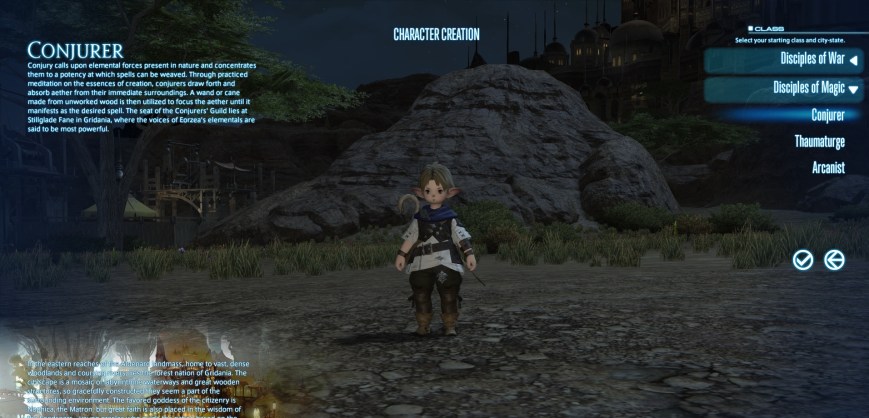
Character creation is ok enough.  5 races, minimal customization.  Or at least, the customization are so minor given gear covers up so much.  It’s more than WoW but a lot less than other game of late.  It looks good though!  What is extremely odd is the class descriptions.  If you check the image below, let me know what you think this class does.
FF14 Character Creation

He’s essentially a healer.  You’d know this from the cut-off button that shows what the character looks like in class gear.  Well actually, you’d only know that if you were a FF fan in the first place as you’re in white robes.  Now, in game you can swap classes but for a starting point, it’s very confusing.

Next steps is the tutorial of sorts.  I think I spent an hour before actually using an attack skill, which is both  unique and single-player-ish.  I start in Gridania, a 2-zone town and get to run errands.  After SWTOR, it’s odd to have quests without voices.  It seems eerily silent.  There are a lot of people in the world and there are few empty places.  That’s great!  Everything looks great too.  I think I’m level 3 by the time I get to attack something and on the first kill, hit level 4.

Combat, as many have pointed out, has a 2.5s cooldown between skills.  This is just over double what many games are bringing to the table today and I really like it.  The game slows down and you get to think about next steps rather than just smash buttons.  Skills are fluid and fun but sparse.  By level 10 I still only have 2 attack skills, but 2 heals and a  shield.  Compared to other games skill bloat issues, this is refreshing.  Reminds me a little bit of Neverwinter.

ffxiv_10292013_212248

This one shows combat at level 6 against a FATE event (open world event a-la Public Quests in WAR, RIFTs in RIFT and events in GW2).  Fates are all over the place, which really makes me think they are just open quests that people can jump in on.  Quests are your typical kill/fetch variety but of interesting note, it’s all auto-looted and apparently 100% quest drops.  I miss seeing stuff to pick up and have yet to get any equipment from drops.  Small things but if you remove loot from anything but quests/crafting, it really changes the way you view loot.  I can’t say I miss it, just feels odd.

By the time I logged off I was level 9 and 3 hours in, with some small parts of zones done.  I still don’t understand travel, crafting (apparently I can only learn it in another capital), cross-class skills, swapping classes and a wide slew of other questions.  It’s like there’s going to be some magic number I’ll reach and then discover it.

Pace-wise the game is slow, which is relaxing.  I can move fluidly between events and there is the impression of a carrot on that stick.  It is really jarring to go back to another game and see the sheer speed of everything.  It’s a completely different design decision, a conscious one, and one that feels properly implemented.

I am missing the need for social interactions so far and the toolsets provided are very poor. I’ll make stronger efforts in that regard in the next session.  So far though, impressions are above expectations.


Architectural Service Design

Now that’s a heading that should make people’s heads hurt.

I’m in the middle of a rather large service design project now and it’s making me think long and hard about similarities in games.  There are 4 main phases; design, migration, steady state and close out.  I am chest-deep in the first one and I talk about this a lot on the blog.  The other three, let’s get a bit more meat on.

Migration is the period between nothing and operational state.  This is paperwork stage, signing agreements and whatnot.  It’s when you buy your ticket to the ride.  Steady State is the day to day activities.  Close Out is when the service is about to be shut down.  There’s a lot of this one lately.  In simple terms, from a design perspective you need to figure out how to minimize impact to users during migration and ensure that steady state meets expectations, otherwise close out happens.  In practice this is more complex since expectations are all over the map for steady state.

If I take a console game as an example (BioShock Infinite or Ni No Kuni), the process of migration is simple enough.  Buy the disk, put it in, patch (maybe) and play.  There are no extra bells and whistles, you’re in.  MMOs you can’t really buy the games anymore, you’re downloading them.  There’s the signup, payment methods (PayPal should be an option everywhere), patching and then you get into the game.  That game part is also a problem since character creation, for many games, is done poorly.  Customization options are often lackluster and irrelevant after a few levels.  Class/race selection usually have a dramatic impact on gameplay but without the context for players to understand.  Someone starting an MMO cold is going to be confused and likely alone.  I went back to SWTOR recently and it took about 4 hours of reading forums and websites to have an idea what was going on.  Barrier of entry is a problem.

Steady state is also a fun one.  Again, the console example has you play a contained experience which is cohesive.  I mean that the game from start to end is logical, systematic and if you play the game you should be able to follow track for all content.  Batman doesn’t suddenly turn into a FPS game half way through. MMOs again have trouble here.  For some reason, many try to make 3 games in one.  First, is the leveling experience.  Heavy on story, exposition, relative balance.  Very lackluster on world integration.  You consume, move on and never really look back or understand your relation to the rest of the world.  Second is the “end game” aspect, where you’ve reached the end of the levelling experience and now have a list of a dozen things you can do.  Hunt knick knacks, get bigger numbers on your equipment, beat big bad guys.  This is, sadly, skinner box material.  Third is PvP.  This is usually a bolt on mechanic, with parallel gameplay and rewards.

 These 3 components are rarely integrated.  Leveling is often-time the only part people want to play since the disconnect at max level is just a wall of grind.  There’s no real progress except for numbers.  I mentioned in the last post that WoW leveling is a face roll of challenge, and then you reach the max level stuff and realize you actually need to use some of those skills you got 50 levels ago. SWTOR is somewhat interesting in that you need to use ALL skills to do leveling content.  PvP, other than a handful of games, has no bearing on PvE.  Since UO took the knife to the problem, no game has really put effort to figure out this problem.  Heck, FireFall has pretty much thrown in the towel even though it was pitched as PvP only.

Games today have a significant challenge to come out of the gate.  First, there are few people entering MMOs cold and they have expectations.  If your game’s Migration phase is different than existing models, it need to be ultra smooth and intuitive or you’re going to lose people.  If you want people to stay around after the leveling portion of the game is done, make sure it is tightly integrated with other systems.  GW2 is a good example where leveling content is also seen as end-game content.  If you want PvP in the game, make the social aspects obvious and integrated.  Have it affect the PvE world and vice versa.   Change zone “availability” based on PvP results and make those zones relevant.

I love the challenge of architectural service design.  I think it’s one of the most complex and overlooked parts of development.  If done well, and expectations are clearly understood, then meeting those same expectations is in the realm of possible.

Challenge is Fun

I’ve been back in SWTOR for a bit, trying out the new content.  Well, new since I left 2 months after launch.  The context for the extra 5 levels (cap of 55 now) is interesting.

See, most themepark expansions add quests in zones to get you to the max level.  WoW gives you so many quests and linear content that you only ever need to complete half of it to reach the cap.  The rest is just wasted.  RIFT had an interesting tactic where there was just enough content, if you took on the grinding quests at the same time.  The amount of time SPENT leveling is also very inconsistent.  Either they rush you to the end or it takes forever.  I personally prefer a more or less linear path in the levels past the tutorial.  GW2 tried this and it worked.  Well for others, not so much myself.

The thing about GW2 is that there is little to no character progress.  From level 4 to level 50, you have essentially the same skills and press the same buttons.  If the process wasn’t linear, I think I would have gone crazy.  The content you go through is always challenging, since it’s nearly always scaled to your level.  I personally have a massive dislike for the challenge in GW2 due to game mechanics (hard to actually see who’s attacking and threat range is massive).  I do like that death is common enough to be a threat.  I just don’t like the reasons that I’m dying.  Like it’s out of my control.  So that game is on the backburner for a while.

SWTOR is different.  Death happens a lot, not so much as GW2 but if you’re pushing the game, you’re going to die.  The new content – Makeb and Oricon – both have exceptionally challenging battles.  The Imprisoned One has a regenerative heal and a fair chunk of skills you need to interrupt.  At level (53) I could not take him down, using every skill I had.  I wasn’t super geared, but more than adequate for the normal content.   The last guy on Makeb, no spoilers, killed me a dozen times before I figured the “dance” of the fight.  It was thrilling to finish it.  Now 55, on Oricon there is a guy called Commander Zoaron.  He is easily the most difficult fight I have seen in the game.  There are 2 skills that must be interrupted, 1 that you need to move out of range, another you need to break out of.  Each hit is like a bus.  10 tried in, multiple strategies, no luck.  Back at the fleet now, filling in some gear spots for another attempt.  Finally down, but just so.

Finally dead.

Finally dead.

WoW, as contrast, I think my Monk died twice from 1-90 in combat, and that was poor planning on my part.  Zero challenge anywhere, rarely a need to use anything more than 2-3 skills.  A druid I started is just stomping through everything.  It’s like I’m a god from the start til the end.  How does anyone understand how the game plays at max level going through this?

In SWTOR’s case, I feel like the challenge is specific to an encounter.  Figure out the puzzle, feel great, move on.  In GW2, I feel like the entire game is this weird structure of puzzle/punishment.  There’s no real way to solve it since it’s so generic.  I really love challenge, especially one that you feel you can overcome and look back upon.  It makes the game a heck of a lot more rewarding.

Syncaine Challenge

Why not, I’m game. Let’s argue what a successful F2P MMO brings to gamers that a subscription will not. 

Honestly, there’s just one answer. The actual game being available.  I think this echo’s Brian’s position.  Let’s break it down though, into chunks that are debateable.

One. There is a finite amount of players willing to spend $15 (or whatever amount) dollars a month on a game.  There are many more who will pay less and a few that will pay more. 

Two. That same finite group will, on average, stick to one sub game at a time. There are exceptions. 

Three. A game needs funding for production, marketing, launch and steady state. This is either through venture capital, crowdfunding, cash stops or subscriptions. The wall of finance to get a game out today is higher than 10 years ago.  Chris Roberts is an outlier.  There are dozens of MMOs on kickstarter that haven’t reached their goal.

Four. The compete with status quo, you have to be as good or better. To beat Wow you need the content and the systems and the social. The first and last are not likely possible with any existing budgets.  The middle one, system design, takes a level of talent that is rare, regardless of funding model.

Five. You need ways for players who want to pay more, to give more. Sub games have incentives/cash stops. F2P games are built on this model.

Six. Market share is never equal. There are 1-3 big guys that have 75% of the pie and everyone else gets a small piece. You cannot gain massive market share at launch, this takes time and word of mouth. 

Seven. You need in-game metrics to target your development to your baseline and revenue streams. If you sold your game as a PvP game and your stats say everyone plays PvE, then you have some serious design problems.  F2P metrics are much more obvious.

Eight. Players have a vested interest in their money. If they have spent $60 in a game and put in dozens of hours and have a social structure, they are extremely unlikely to leave that behind. The “grass is greener” until you’re on that lawn. 

Nine.  Players in all games cannot be entertained forever.  They will wander.  They will wander even more when there’s not price at the door.  If they like what they see, then maybe they’ll stick around. 

Ten. Commitment.  MMO gamers from 10 years ago grew up.  They have jobs and family and other commitments.  20 year olds today do not have the same mentality to gaming we had, since they have way more selection.  It isn’t that $15 is a lot, it’s that you’re vouching that you’re going to get bang for your buck.  F2P let’s you dictate when you’re going to pay and play.


I could probably list another 20 that are related but those cover the basics. The main point is that there are very few MMO players willing to give up what they have for new grounds, at a cost.  This means that the possible playerbase for any new game is significantly smaller than launch projections would suggest. So either you support a launch of 2 million people and know you can only keep 200K, or you find an alternative.  Plus, you need to manage the ghost town after launch – regardless of the business model.

For straight out benefits between F2P and subs, it’s all in the implementation. F2P gives me choice and makes me an empowered consumer. My wallet dictates game development. Are there crappy F2P models?  Heck yes.  Just like there are crappy subscriptions.  I didn’t want pet battles in WoW. I would have preferred something a lot different. But it’s not like they can test that idea. No one in EvE wanted monocles. Few wanted a lot of features from multiple patches. UO has had a long list of “what were they thinking?” moments.

A successful MMO keeps an active community engaged over long periods of time. It provides social economies. It provides content that the playerbase has a voice in. F2P gives MMOs a chance to make money and serve a non-niche target.  It provides a cash-positive experience on a wide range of games that would no longer be around today.  It allows developers to test ideas, sell them at low risk and see what works.

Lego Marvel Heroes

You caught me.  I’m a sucker for Lego and for TellTale games.  Like stupid sucker.  Star Wars, Batman, Indiana Jones, Lord of the Rings.  Got em.  Finished them all to 100% (on PC or console).  Marvel Heroes is the most recent one.  Steam + Big Screen + logitech controller = super cool.

Doc Oc is going down!

Doc Oc is going down!

First, the roster is pretty amazing.  Other games in the series, you were stretching the character base.  How many Uruk hai variants did you need in LOTRO?  Batman even had some weird ones.  You can’t say that so much here as Marvel is just chocked full of characters to pick from.  Each character has a subset of skills.  Strength, range, magnetic, telepathic, digging (really? Wolverine?) and a bunch of others.  Where past games might have had 6-7 skill sets, it feels like a dozen here but I could be off.  Plus, it’s hard to agree on what a skill set is.  I would think Peter Parker is a smart guy but apparently he’s not.

The game is open world, which is nice.  Sort of like LOTRO.  After the first few missions you can explore a fair bit.  Unlock enough and the world just seems massive compared to previous games.  You still need lego bits to unlock things, gold bricks, canisters and the whole wazoo.  I don’t get tired of these mechanics as the story is pretty interesting.

I like the humor in the games.  Sarcastic and self-effacing.  It knows how to make fun of the source material.  Again, not moving far from the pattern in other games just the particular implementation is rather nice.  “Levels” unfurl in a cool way, since they aren’t scripted to any known canon.  You have as much a chance of seeing Doc Oc in a level as you do Hawkeye or Hulk.  And that’s pretty neat.

The zones themselves are still linear but there are more puzzles and more 3d movement.  It really pays to explore off the beaten path.  I love the exploration and “wow that’s cool” moments in video games and this one does the job. It’s also something you can play for 10 minutes and not worry about lost progress.

If you’ve ever played a Lego game or are looking for a  Marvel Heroes roster that’s near complete, this is a sure fire bet.

No More Cable

I come from a poor upbringing and put myself through university/college with limited assistance.  I’ve been working since I was 15 and putting in full time hours since 17.  Typing this I realize I’ve spent half my life working so far.  Depressing really…  Anyways, I know the value of a dollar.  I know what not having a dollar feels like.  It makes me extremely conscious of where I put my money.  The return on investment (ROI) has become a fact of live that I just unconsciously apply to everything.  Gaming fits into this.  F2P fits me in some cases, though I prefer the subscription model since it’s an all-you-can eat affair.

Up in my igloo, we have very limited options when it comes to telecoms and cable providers.  I’m not saying that other countries are better, just that we basically have 2 in urban areas.  Some have only 1.  Yay monopolies!

In recent years, cable prices have gone up by what seems 100%.  Basic cable ran me about $75 a month.  95% of the content in the past 5 years has been either sports, reality TV or news.  The last one, I can get everywhere online and in a better format.  The middle one, I’ve never really been much of a fan and the market saturation is disturbing.  The first one though, that’s the main reason I stayed with cable.  It was hard for me to argue $1000 a year for sports.  So I stopped arguing and cut the cord.

A few things to move me along.  First, I’m in the process of getting an over the air antenna.  That will give me a dozen or so channels for “emergencies”.  I’ve been 2 weeks now without any cable and it’s not as pressing as I’d have thought.  Second, I got a media hub device – Roku 3.  Boxee is an option too but it’s bigger and to really get it to work, you need a strong tech background.  I have that background but I’m lazy and the Roku does enough for me.  Using the myPlex app I can point to my network storage (any NAS will do) and stream from there.  I can also flag stuff on the web through Chrome for streaming later (on any PC, which makes Chrome awesome).

On the Roku I also have a Netflix account with a US proxy service (unblock-us.com).  I can swap between Canada and US with a button.  Free Hulu with that too.  Live365 and Pandora give me music.  Hockey (my sport of choice) is through HockeyStreams.  That one was $100 for the year.  All games, nearly all in HD, no blackouts, can watch a game a week later.  It’s awesome.  My wife installed a Fireplace app too, for those nights of calmness (and my own earphones).  The Roku controller also comes with a headphone jack that mutes the TV.  Hello awesome!

So, instead of paying $1000 for the year, I pay something like $200 for the content I want, when I want it.  I mentioned this to my hockey team over beers last week.  3 of the 8 had already made the swap, 2 were planning it.  These aren’t IT guys.  As broadband internet becomes more common and speeds more acceptable, I just don’t see how cable companies will be able to continue status quo.

Story Matters

Way back when SWTOR (Dec 2011) launched I mentioned that I thought the leveling portion of the game was extremely well done.  It really was like playing KOTOR3 but with multiplayer.  Not MMO multiplayer, just lobby based games really.  There were next to no social tools in game at the time – which I argued was the primary reason it went F2P.

2 years on, or thereabouts, I decided to give the game another shot.  I do hear great things about it now, in terms of social stuff, where the account has value as well as the actual characters.  The Legacy System is  a neat touch that gets expanded every patch.  There are bind on account items that allow a ton of customization with no power creep.  That’s awesome.

So what’s changed?  Clearly, the F2P portion is a big one from my last session.  You can subscribe (which everyone should do for 1 month to get the expansion pack) and that gives you a ton of features that free players need to unlock.  Free players have a lot of limits but the entirety of the leveling game – the best part of the game – is free.  Experience gain is nerfed (~15%), you gain no rested, travel time is longer and there are limits on crafting, credits and what not.  It’s essentially KOTOR3 though, for free.  The stories have been expanded on Makeb and the progress is pretty neat.  I won’t spoil it but the concept is novel and the level gap isn’t a huge thing.  You know WoW’s expansion/raid issue where a raid boss at level 60 is the same difficulty as a rabbit at 61?  That really doesn’t seem to be such the case here.  Hats off on that.

There’s a character/item level dependent group finder now.  That’s a convenience.  You can swap specs out in the field, also good.  The real features are in customization of gear, dyes, vehicles and pets.  I’ve argued long and hard about this being the real venture for F2P, where power is not behind a pay wall, just content.  Every character is unique in their own way.  I wish Marvel Heroes would catch onto this a bit more.  Neverwinter did in the last expansion and WoW has transmogrification (still find that a stupid name).

Social tools still stink though.  There’s missing a summon player button.  It doesn’t prompt you to change instances to meet friends.  Loading screens can be horrendous.  It makes it harder to find and connect with other people.  I was really, really hoping they would have figured this part out by now.

As it is, I’m having fun playing through the story again through a different character’s eyes.  Replayability is super high here when the story is gripping rather than just a different set of class mechanics.  I played WoW recently and this has got to be my biggest gripe.  Leveling is just meh.  You only want to rush through it since there’s not meat to it and you have next to zero impact on the world.  I saved a damn world from demons and I still have to kill 5 boars.  At least in SWTOR your reputation precedes you and the story is cohesive.

I remember 2 months after launch having 2 max players and only PvP to do since everything else was busted.  The game is lightyears (had to fit that in) beyond launch state.  Had it come out with these systems at launch, I really do think history would have given the game a different by-line.  It’s certainly worth a look today and you can’t beat free as a price.  I’ll try to get a few screenshots up in the following days.