Anthem – 2 Weeks Out

I’m writing posts about Anthem for a few reasons.

  • really want BioWare to have some success.
  • I like the coop squad shooter genre, in general
  • I think the game is a bellweather for both EA and gaming-as-a-whole general direction, more so after Bungie split from Activision

Technically, we are 5 weeks out from general release (Feb 22) but we are also technically 2 weeks out from a VIP demo (Jan 25-27), and then a few days later a general demo (Feb 1-3 – a relatively important date).  Which in years past would be called stress tests.  Pretty close.

Anthem, for better or worse, is compared to Destiny and Warframe – sci-fi squad shooters.  (To some extent, the Division as well, but that setting and focus on in-game PvP sets it apart.)  Point is, it’s not new to the market, and it’s competing for eyeballs from games that already have an established user base.  Which begs the question, what user base is BW expecting a) at launch and b) as monthly users?

The Push

As a general rule, people are stupid.  Individuals not so much, but people for sure.  Easily susceptible to peer pressure, and targeted media.  The current state of the US/UK is a pretty solid example of that.  Point here is simply that with a relatively minor investment in marketing, this game could be the general talk of the town.  It’s barely getting a mention.

Sure, IGN has quite a few videos posted from the November alpha.  It’s barely present on “anticipated games” lists.  My gaming feeds get a mention spike every month or so, the most recent one relating to match-making-for-everything.

At this relative time previous, Destiny 2 (even the first one) was in a major media blitz.  TV commercials, articles everywhere, near full saturation.  Maybe EA has plans for Superbowl weekend (the Feb 1-3 date I mentioned earlier)?  It would certainly hit a ridiculous amount of eyeballs, but the costs must be quite insane.

The Gameplay

All I have are videos.  The game looks faster and more movement based that it did before.  There are still some rather massive bullet sponges.  It does not appear that tactics ever matter, simply spamming every ability on cooldown.  Everything is speculation pending actual gameplay experience, so I’ll withhold further comment.

I think the relative few bits of information we have about the game relate to managing expectations.  It is always better to under-promise and over-deliver.  Something that games like Monster Hunter excel at, while Destiny 2 / Division have paid a tremendous toll.  Smart.

The Focus

This summer, Casey Hudson mentioned that the game would never have PvP.  A recent interview stated something a bit different, in that PvP may come at a later date.  The game also comes with matchmaking for all activities.  Of all things, these two items are clear lessons learned from the previous attempt at multi player games from BioWare and one of the largest criticisms with Destiny.  How that is actually implemented is a different matter (either auto-LFG or some sort of group-posting option) will be interesting to see.

Yet a clear focus on one game mode (PvE) is a good thing.  No game can launch with a kitchen sink approach.  Do one thing, do it well.  Grow when the opportunity presents itself.

There are also no lootboxes (smart) and all microtransactions are cosmetic driven.  Maybe, just maybe, this is what will actually be delivered.  I would love to know what I’m buying.

The Future

Speculation only here.  I expect Anthem to have a fair share of issues at launch.  That is simply BioWare’s MO (close to Bethesda).  There will be a massive day 1 patch, and then more along the way.

I don’t expect gangbuster sales, but more of a sleeper hit.  It seems more like it’s targeting word of mouth (which has been generally positive), rather than day 1 sales.  An interesting approach.

My overall expectations for the game were extremely low this time last year.  As the small bits of news have come out, BioWare has done a good job of addressing player concerns.  It is a rather large departure from any new IP launch in terms of marketing, but perhaps this lower investment allows for larger returns.  I do hope it has some success, again in terms of BioWare’s continued existence and in the ideal situation, a more sustainable/conscious approach to game releases.

Players as Content

I would think the trend of the last few years, at least in terms or big games, has been to have players be the actual content.  E-sports wouldn’t exist without this concept.

I make this akin to board games.  As much as I do enjoy your standard competitive games, I much prefer the cooperative ones.  Where Descent is a gold standard for miniature combat such as we see in D&D campaigns, I prefer something like Shadows of Brimstone where everyone at the table is working together.  Instead of trying to outwit a DM (who in 95% of cases knows every bit more of the game than anyone else), you are battling RNG.

Video games are similar in that regard. While there are certainly a lot of coop games, there are so many more competitive games out there.  The difference being that coop games focus on you working together to beat some computer code, and PvP games nearly always focused on defeating the other team (rather than say, achieve the goal faster than the other team).

That distinction is key, as a developer has to put in relatively minor content updates to keep people coming back.  (I won’t bother going into why F2P games have faster content cycles… that should be fairly obvious.)  Less content means less development costs, and a better MAU (monthly use).  In financial terms, it appears to be the best direction.

But then you get into the question of actual game design.  Not all competitive games are designed equally.  MOBAs seem simple, one where simply cloning another model should be an easy way to cash out.  See Infinite Crisis for an example of how that works.  The competitive nature of people is an adrenaline kick of being in the thick of things, having some feeling of control, having fun, winning, and then being able to show that you’ve won.  Each piece of that is important to the whole.

And game design impacts each piece of that puzzle.  Many developers focus on only one part, or perhaps only have skill in one part.  Some take an existing design and then try to insert another model, providing a more monstrous design that either source could achieve alone.

Which does get me back to a previous thought that Anthem would be so much better served without PvP.  BioWare has a horrible track record for that aspect of game design, and their majority player base is not in the game for that reason.

Also related, WoW’s BfA design of PvP everywhere.  Fair to say that BfA is not exactly winning accolades for that decision, and certainly not gaining players for it.  Seems rather to be much more news about the inability for design to balance PvP in relation to the fact that the entire game model is based on PvE.

Long story short, design a game is hard work.  Either coop or competitive is hard enough, and mixing both together is more than the sum of the parts.  People can’t complain that content is broken if it doesn’t exist in the first place.


Frostpunk

It’s like a fancy Pharoah / Cleopatra.  Or Ceasar /  Master of Olympus depending on your age.  That’s nearly 20 years ago since a decent one was made.  Maybe that’s why this one hits the right notes?  Large push from Syncaine to try this one out.

frostpunk_screenshot_01

There’s a lot to keep track of

Up front, this is the game I have the least time played.  Not because it’s bad, just because it’s not the type of game you can just put down and come back to.  It’s a game entirely about momentum.

Basics are simple enough, you run a small city in the ice cold.  You need to shelter, feed, heal the population.  You need to explore, research and build contraptions to do more with less. And you ultimately need to have more hope than discontent, or people won’t do the things you ask them do.

It’s a game of choices, though how hard they are depends on how mechanical you want to become.  If you’re ok with amputees rather than sick folk, since they are less of a draw on resources, then the choice is pretty easy.  If there’s any message to take from the game it’s that Technocracy is a damn cold way to run a group of people.  Survival inherently comes at the cost of humanity, and how far down that slope you want to go is up to you.

While there is some randomness to events, generally the choices you make in one game will be similar in the next.  There’s a generally optimal path to start the building process, at least until you get into the exploration phase.  Tough choices are make/break when it comes to healthy population, ensuring adequate levels of food/heat.  Optimal doesn’t mean the only way mind you, just the one that’s most tolerant of bad luck.  You can select multiple paths along the way, though each brings its own set of challenges.

While both simplistic (smallish map) and complex (buildings are hard to tell apart, many icons), most choices are made from the main screen’s information overlay.  I never felt like the game was hiding something from me, and each choice made was done so with all relevant data present.  There are very few “what’s behind door #2” situations.  And the majority of choices are balanced against each other, either in the immediate choice or in future choices along the path.  Using the amputee example above, eventually you get to select prostheses for your population.

The overall art/music is quite solid. Visually you can see people trudging through the snow.  You get proper sound alerts when things happen.  There are pause and speed-up options.  Day/night cycles.

The game sessions are long, in line with other city builders.  Since all the missions (until recently) were goal based, they vary somewhat in length, but I’ve not seen one under 30 minutes and most are around the hour mark.  A quirk of this genre is that by the mid-point mark you have so many things going on at once, that leaving and coming back from a save can be a challenge.  You are going to miss something and things will start falling apart.  When you do manage to get an entire scenario down in a sitting, it’s an extremely good feeling.  I guess it’s a bit like a board game in that sense.

It’s a solid recommendation.

Final Fantasy X / X-2

I have owned at least a half dozen versions of this game.  Second only to Chrono Trigger (dozens on that one, I’m sure).

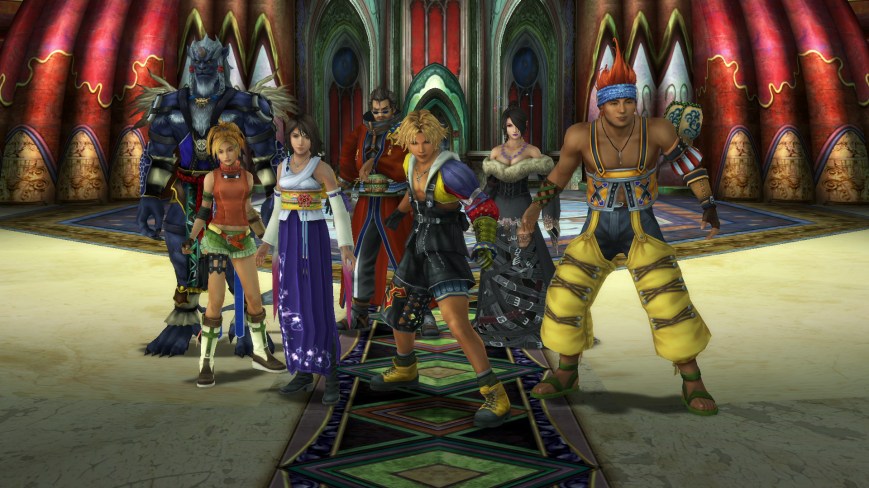
Final_Fantasy_X_Party

The Crew

There’s a special place in my mind for this game, as it was the first to (successfully) move away from the ATB model and really focus on the strategic combat portions.  Character swaps are an integral part of the gameplay, and understanding turn order is key for some battles.  The level of control here is where my issues with FF12/13/15 come into play.

I won’t talk about FFX-2.  There were some neat ideas tried here (notably the foundation for FF12’s kitchen sink approach) but it detracted too much from the previous entry.

I won’t rehash much here on FFX.  If you haven’t played this game from 2001 by now, there isn’t a whole lot more to say.  The PC version is the re-release from 2014, which is the international edition + cheat console.  That means Dark Aeons, expert sphere grid, turbo mode, infinite gil and so on.  What’s good here is that I can play it without any input lag, which is a problem with a lot of games nowdays.  Most games have compensation for it now, but older games were hardcoded and even a 0.1s lag was enough to detract from specific button actions.  Dodging lightning, or getting an Overdrive to connect is painful.

Some high level thoughts

  • The story is more resonant now than it was back then.  A world of continual sorrow, with small patches of hope.  People making choices for things larger than themselves.  Themes of self-sacrifice are all over.
  • The game is bug free and smooth.
  • For the most part, the RNG in this game is fair.  All the instant KO hits are telegraphed.
  • Blitzball randomness of stats is ever annoying.
  • This game is insanely linear for a very long time.  The variety of combat is what keeps it interesting (press A doesn’t work).
  • The FMV cutscenes are still solid (34gb install!!)
  • The in-game engine cutscenes have better art, but are even more jarring in HD.  The acting is bad, the writing is on-par with George Lucas, and the camera angles are all over the place.
  • The music is still captivating.  The Hymn of the Fayth is still haunting.
  • I really do love the chess match of each boss battle. It really is a thinking game.
  • It was smart having three villains – one for Yuna, one for Tidus, and then the general acceptance of fate.

FFX is one of the better in the series, and if you haven’t tried it for a while, or have yet to play any variant, it’s a solid pick.

Slay the Spire

After numerous recommendations and a good price point, I finally picked this one up.  StS is in essence a rogue like card game.  It’s still in Early Access, so there are certainly some new things to come along.  It’s a solid game.

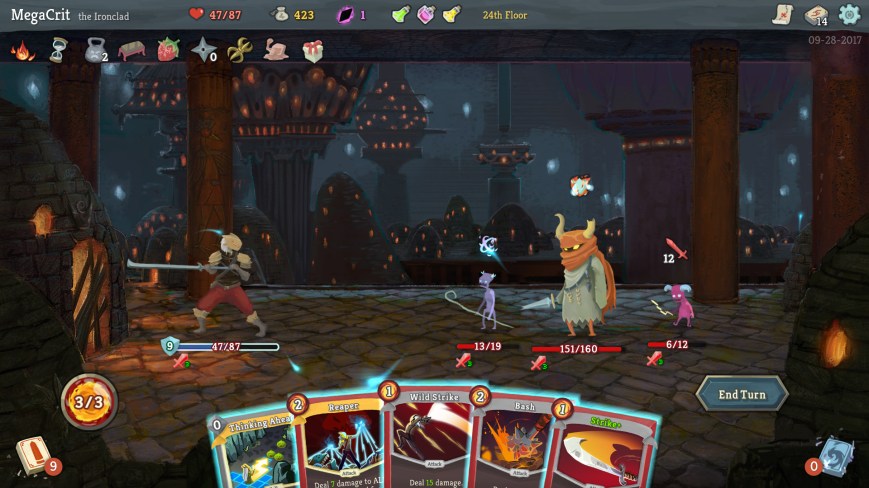
ss_25ed2537de5d4fa71c6d6d5632f21ac21fe4b3bf.1920x1080

One of 3 classes

Merging of genres is always tough.  It’s really hard to get the best of both worlds, since at some point you need to compromise.  Deck building games are about a combination of control and randomness, where player skill is more about knowing which card to play when (and which to add to the deck as well).  Rogues are often luck based, but the best one have an underlying incremental approach where not only do you get better (smarter) but the characters themselves improve.  StS gets really close to both.

I will throw in that I generally enjoy rogue-likes.  Faster than Light (FTL) is at the top of my all-time games.  I much prefer short playtimes, where a game over is both earned and recovered from in relatively short order.

Mechanics are simple enough.  3 classes, with similar starting decks.  Ironclad is about outright damage, Silent is about passive cards, Defect is a mage like class with a more complex set up.  You have a set number of action points per turn, play cards that value up to that.  You always attack first.  Different event types and maps where you get to select progress.  Collect more cards for your deck, or collect relics which provide various permanent boosts for your character.

I’m somewhat drawn to the Silent and prefer a Shiv deck.  That build requires specific cards to be successful in terms of damage.  But Silent damage is burst based, and you need to survive until it’s time.  That requires a lot of block cards, which cause deck bloat.  Which I think is the defining mechanic of StS… in nearly all cases it’s about judicious use of defensive cards since healing is so sparse.  Getting to the final boss of a level (there are 4 levels) with only a small bit of health is a quick way to a game over.  Some enemies are just not going to treat you well.

Balancing your needs, making sure you only have cards that will get played, and picking relics (from bosses) that provide a tangible benefit with minimal downside is key.  It gets more and more complex as you move forward.  That’s a lot of fun.

What’s less fun is the inherent nature of rogues and card games where randomness can undo a lot of hard work.  Losing to RNG is part of life, but it’s especially painful after an hour of investment.  Seeing a run fail because of a bad deck pull, or an event that curses you, or just a bad run of enemies is frustrating.  Dying in a rogue like should provide you some larger benefit aside from the game knowledge.  Playing for 90 minutes, getting a set of bad draws, and losing to RNG makes me stop wanting to play.

Each class has 5 unlocks that are achieved through a points-based system.  Do things, get points, unlock things.  These things are additional card types and additional relics.  This causes RNG to spread wider, meaning generally less chances to get the card/relic you want.  It’s pool bloat I guess.   You could be on a path for a specific deck and then be presented with cards that have no value – multiple times.  I’ve found that the runs become harder the more things get unlocked.  That is a weird feeling.  Especially when the starting state never changes.

I’m not quite sure what would help in this situation.  Maybe when you skip a potion/card/relic you get half the value in gold?  Maybe a starting relic that gives more max HP?  Maybe more reward choices every 5 battles or so?  Save states where you start on floor 2/3?  Playing someone else’s hand in a losing scenario?

Not to say that the game isn’t good.  It really is.  Well worth every penny and you’d get hours of gameplay out of it.  I’ve got enough now that I’ll wait until the next content patch.

Celeste

Mix in some Meat Boy, a story about depression/anxiety, a killer soundtrack, a retro look and smart level design and you get Celeste.  There is a really good reason this was in a people’s game of the year lists.

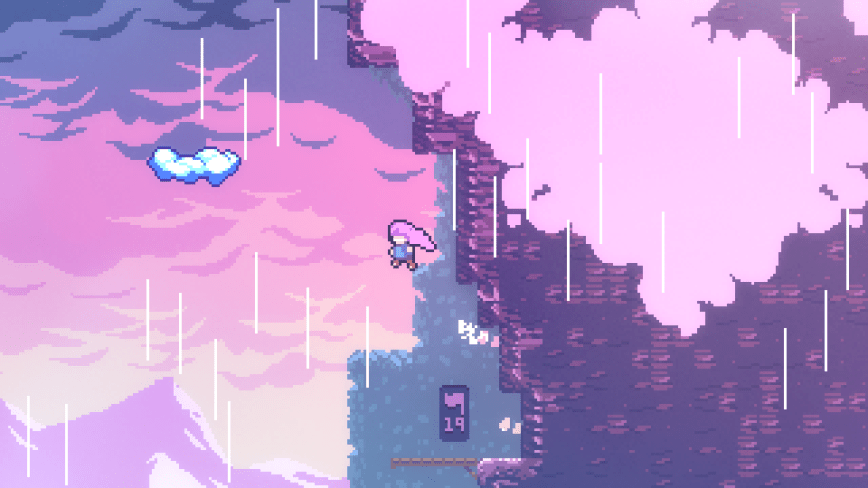
01

Final Climb

I completed all the main levels, 2 of the B levels (harder version of the main), nearly done the Core (zone 8), and have collected over 100 strawberries.  Oh, and nearly 2000 deaths.

Game follows Madeline’s climb up Celeste, a giant mountain filled with all sorts of death traps.  The story is simple enough, she confronts her internal fears and comes out the stronger for it.  There’s no voice over, and the characters themselves are pretty straightforward.  That simplicity is also present in the gameplay.

The controls are basic.  Move, Jump, Hold, and Dash.   The actual gameplay is in the mix of those controls.  First few levels have you take long jumps, then dash to reach a far wall.  The later levels have you double dashing, avoiding lava, throwing yourself on bricks with spikes, recharging the dash in midair, then doing it 3 more times.   It’s surreal how much better you get at the game near the end.  Running back into Zone 1 was a cakewalk.

The actual gameplay mechanics are straightforward.  Avoid falling, spikes, monsters, fire, and similar things.  Die and restart the subzone (which usually takes 5-10 seconds to clear).  Easy in concept, hard in practice.  You can collect strawberries for an additional challenge, though it has no practical benefit other than a slightly different ending (if you make a pie).  Each zone has a cassette tape which unlocks a B-side, a harder variant that has no strawberries.  There are 7 main zones, each with their own themes.  The final one is the Core and is a hell of a challenge.

Celeste is one of those games where you always think “one more try” and then end up spending 30 minutes solving each additional puzzle.  And that’s what it is after all, each screen a puzzle of it’s own to solve.  It’s one of few games where I have to play with the D-pad rather than the analog, as some movements require way more precision in quick succession than my hands can handle.

I would be remiss not to mention the music.  It has that old school synth/midi vibe that fits just perfectly.  Each zone’s theme is well communicated, and the multi-screen boss “fights” feel like a true panic attack.  I’m not “done” with the game, but I do need a bit of a break from the heart racing.

Celeste is one of the few games I’ve ever played where I could not find any faults.  Never crashed, never felt I was cheated, no head scratchers.  It’s a shining example of what gaming can be.  A real must own.

Holiday Break

2 weeks without work, and just some good family time.  It was a bit odd not to blog, as I use it as a mental sieve.  It was still one of the best breaks I’ve had in a very long time.

A few interesting bits to start the week, with some larger posts coming later.

  • Wife got us an NES Classic.  I picked up some wireless controllers right after, since the 3ft cables on a 50″ TV makes no sense.  Whole family has had a turn at it.  Old school controls make for some interesting frustrations.
  • Family took a trip to see the Habs play vs the Canucks.  First time the little ones got to see an NHL game, and I think the bar may be set a bit too high considering we live in Ottawa.  We’ll do it again in the future, it was a super experience.  There’s something about seeing things through a kid’s eyes that makes you appreciate things even more.  Think my wife is going to convert to a Habs fan!
  • My wife bought me some tickets to see the Habs vs Leafs in Feb with a friend.  That’s a hell of a nice gift!
  • Everyone was spoiled for the holidays.  I really have a better appreciation for the family after this holiday break.  Everyday seemed to be just great.  Putting all the work aside and just living in the moment helped.
  • I think we had 1 day off in 2 weeks, where there wasn’t a party, or hosting, or sleepovers, or just things.  That day was spent watching Harry Potter movies.  It felt good to not move.
  • Outdoor rink is being used nearly every day where it’s not raining.  Which seems to be every other day this year.  Massive temperature swings are not fun.
  • Picked up some things from the Steam sale: Celeste, Slay the Spire, FFX/X2, Frostpunk.  All will get a post.  Of them all, Celeste is the must buy.
  • Saw Aquaman with the wife.  Apparently Jason Momoa is good looking.  So I’ve been told daily.  Movie is better than expected.  It’s rare that I take issue with the soundtrack, but it made little sense here.  Felt like Indiana Jones meets Lord of the Rings.  I will say that super hero movies continue to have horrible villains.
  • Pulled my back on Jan 1st.  Got a chest cold 2 days later.  It’s been a rough few days.


So New Year starts and we’ll see where it goes.  Hope everyone had as good a time as I did.

GoW – Story Complete x2

Saturday was the first day of rest I’ve had in 4 months.  Helped a lot that my Friday was my team’s holiday party.  I ended up finishing the God of War main story on Saturday, with a bit of help from my eldest daughter.  Spoilers I guess?

I really enjoy stories with multiple plotlines.  Things happening just below the waves that you can just sense but never really get a full handle on.  The novel American Gods by Neil Gaiman does a tremendous job of this.  I’ve read it a dozen times now.  Each time I seem to find a different detail I missed on the first pass.  Helps that I have a large passion for religious pantheons.

The GoW series had 2 interesting parts for me.  The action combat and set pieces were the gold standard for quite a while.  It took what Prince of Persia started, and then went full Rated-R.  The mechanics were really amazing, but it was the setting that resonated most with me.  Since a small child, I’ve been fascinated with Greek mythology.  Kratos was an amazing vehicle to explore the stereotypes of those gods, the limits of their powers, the visualization of stories thousands of years old.  A fight against Chronos, or inside of Gaia, taking out the sisters of fate…hell even the very first battle in the game against the hydra.  Replace any of those characters with “generic templates” and the game loses the luster.  (a large issue for Darksiders, and to some degree Dante’s Inferno).

When GoW was announced in a nordic setting, I was curious as to how the story would unfold.  GoW3 didn’t leave a whole lot of room… Kratos was ultra penitent and killed himself in atonement (but survived since he’s a god I guess).  To find a calmer Kratos… that would be something.

Reruns are Fun

The first time through I did every side quest I could while on the main quest.  I wanted to absorb it all.  There is a surreal amount of detail in this game, though a large chunk is behind text.  The downside to that approach is that the pacing of the story loses focus.  I’d be all about chasing down a black rune, but then forget why Baldur wasn’t able to find me.  The 2nd time through I told myself I’d only do the core, then do the optional following.  Helpful that I didn’t really need all that extra gear this time!

With a more focused approach, I could appreciate what was going on.  The actions from the last quest were still fresh in my mind.  I could better understand Atreus’ dark path, or Freya’s desperation.  The undercurrents of Odin’s obsession with Jotunheim were more obviously the driving context for everything going on.  The final “twist” wasn’t the nice surprise of the first pass through, but the clear culmination of fate.  It was like I was playing as Fey.  In summary, a much better experience story-wise that the first time through.

Obviously there’s not going to be any DLC for this game.  It had more than enough as a base.  There are some clearer notes that could be in hit in a sequel (all but assured), but it does run the risk of repeating the same beats as the first 3 main-line GoW games.  Odin is as powerhungry and mad as Zeus.  Thor appears to be Kratos’ twin in terms of damage per second.  Tyr’s attempts to find some sense of balance for all, like Athena.  All pantheons run the same large character sets, so the risk is there no matter what.  And Kratos as a character has clearly moved on from wanting to kill gods.

What’s Next

Game-wise I will complete the remainder of the side quests.  There are some nice bits and pieces throughout – like the dwarven king who sacrificed his people to fight monsters.  I could also do with some more Valkyrie fights, since they have very little to do with your offensive power and more with your ability to dodge death incarnate.

Story-wise, there are only bits of speculation.  The last panel in Jotunheim shows Atreus holding someone and a snake-like thing between them.  The runs were translated  but the message could still do with interpretation.  Doesn’t help that the person lying down doesn’t look like the version of Kratos in the other murals.  No one knows who summoned the serpent while Kratos/Atreus were with Freya.  And 3 years have gone by since the trip to Jotunheim and the seeming start of Ragnarok.  How did all the giants in Jotunheim die if the portal was closed?  How did Zeus end up in Helheim?  It’s nice to have both such a clean ending to one game, and enough threads to get another story from it.  It will be hard to match the story told here… let alone surpass it.  Wish the devs all the luck on that.

New Trends are Old Trends

rdv85pcp17421

Missing an arm for Facebook

It’s somewhat surprising how efficient game companies can be at turning their fan bases against them.  I’d say it was a new trend but american car companies certainly specialized in this behavior in the 90s.  KIA & Hyundai never would have had a chance in a real market… they just threw in a no questions asked 7-10 year warranty and took the entire floor of the market.  There are other comparisons…grocery stores, banks, restaurants.  Pretty much any common service where customer service is a big part.

Humble Beginnings

The irony here is that each of these companies was built on a dedicated fan base.  EA in the 90s/00s released seminal games that completely changed the way we view sports.  I still have great memories of SSX.  Blizzard is the main reason we have e-sports due to investment in Korea, let alone modding in Warcraft 3 which gave us MOBAs.   YouTube brought a human element to the internet.  There were mistakes along the road, but the companies clearly had good intentions.  They had clear communications and accepted responsibility.  They empowered their players, and that was returned with praise.

The Slow Fall

Power corrupts.  The speed of the internet causes that corruption to move much faster than in previous markets.  Where it may have taken months or years for a mistake to bleed its way through other industries, it can take only a few hours for a crap storm to hit today.  But why?  It isn’t like all of a sudden everyone decides to be evil.  In my experience it’s due to two main reasons.

First is the sheer size of a team and the natural disconnects from the clients.  All of a sudden you’re so big you need a marketing guru.  Or a QA testers.  Or a new team leader.  Your original team of a dozen can no longer handle the full load and the team needs to grow.  When it grows, people lose connection to both the product, and the ability to interact with the clients.  The identity of a company slowly starts to dilute.  Instead of having ownership of a large part, you are just a cog in the machine, not seeing how that plays into the overall picture.  You get comms people saying “pride and accomplishment”.  That lack of investment in the company, in the brand identity, makes it easier to accept poor decisions as part of the “machine”.  It used to mean something to work for Blizzard… it doesn’t have anymore.

Second, decisions are no longer made with single authority and vision.  They are abstracted, summarized, and packaged for an executive’s decision.  Not to mean that only 1 person should ever make a call, but more so that when decisions are made, they have the right context applied.  Bethesda is a great example.  It’s pretty clear some financials were run on the canvas bags and a call was made to go ultra cheap.  The person who made that decision shouldn’t have had that level of power.  When the people making the decisions are so detached, they are doing so for different motivations.

Investors

As much as Bethesda has been doing a great job of digging up, I think the medal here goes to Blizzard.  In one of J Allen Brack’s first decisions, Heroes of the Storm is going into maintenance mode, and all esports brackets are being cancelled.  Combine this with Diablo Immortal’s tone deaf Blizzcon announcement, and WoW/BfA’s continued inability to communicate to players, and you have a great recipe for resentment.  YouTube’s all-time worst ranked video is their own 2018 Rewind.  That’s impressive!

Clearly the CFO from Activision is the one making the calls now at Blizzard, and everyone else is towing the line to ensure maximum profitability.  Ship more content that can generate $$$ and stop work on maintenance.  I mean, it’s no surprise that the very next article on the Blizzard site is an announcement of a new WoW mount.

What’s Next

These companies aren’t going anywhere soon.  But they are opening the door to competition that simply didn’t have a chance years ago.  Would Fornite had have half the players if EA/Dice didn’t treat their players as ATMs?  There are plenty of lessons learned from just a few years ago with Ford & GM.  The guaranteed income of previous years on reputation alone is going away, and instead will move to a pure transaction-based model.  Rather than a relationship with a company, it will just be numbers.

Fine, if they can manage the balance.  Let the resentment build enough, and it will simply boil over and infect the rest of the client base.  It’s certainly popcorn worthy.

God of War – Redux

Still solid on a 2nd pass.

I do not have nearly as much time to game as I did when I was younger.  Hell, even a year ago.  It is an extremely rare occurrence for me to replay any game, in particular long-form games.  A combination of lack of time, and most games having a very long tail of grind at the end.  Few exceptions here.  For some reason FF games get replayed every 3-4 years, XCOM too.    That and the fact that there’s a plethora of new games that are just sitting in my library, screaming for playtime (Frostpunk, I hear you!)

With God of War winning game of the year, and an outstanding itch for decent combat mechanics after RDR2, it’s back in the chains again for me.  I opted for New Game+, which let’s you keep levels, skills, and all non-story based equipment.  For some reason, that let me keep the chains, which is a massive advantage.  I love the axe, but those chains are an AE cloud of damage that makes you nearly immune to damage for nearly every enemy but bosses.  So while I certainly upped the difficulty of enemies, it’s still easier than the first pass through.

But that’s less to do with the actual difficulty and more to do with me.

No Training Wheels

I played a fair chunk of GoW when it came out.  Killed some Valkyries.  Did all the side quests.  I was good at the game.  Time off has let some rust settle in, but it’s mostly shaken off now.  As with most games, there’s a gradual difficulty curve of enemies as you progress.  There are more of them, with more complex and damaging attacks at the tail.  Well… as a character/player, I’m already at the tail.  There are no skill upgrades left, and any armor boosts are simply numbers, not abilities.  I was trained to avoid damage, so more HP/Armor doesn’t really serve much right now.

Seen It

There’s a spot on my trip to the family cottage up north that still gives me goosebumps, after over 30 years of travel.  The effect is lesser today, but it’s still there.  It’s similar to re-watching a movie for the 30th time (Fifth Element is over that, I’m sure) and you still find parts to appreciate.

GoW is similar, in that I’ve danced this dance, but I still find joys in doing so again.  I look at different details.  I appreciate the background now since I’ve got a pretty solid idea of the foreground.  Facial twitches.  Sounds.  The rhythms of combat.  I’ve seen it all, but I didn’t really appreciate it.  Nice to have that opportunity again.

Puzzles

There are a couple within the game, though nothing terribly complex.  Most everything has to do with ringing bells within a specific timeframe. The challenge the first time was both finding said bells, and then finding the right order to ring them in.  At most 5 minutes of work for some spoils.

Redoing that part, maybe 30 seconds tops.  It’s lost the mystery, since there’s only one solution and once you know it, it never really feels the same again.  A bit like learning the workings of a magic trick.  Or visiting the backroom of a butcher’s shop. Ignorance really is bliss.

Nostalgia

There’s another reason I avoid replaying games.  Often times my memories are a much more positive experience than the actual game presents.  This is certainly easier with standalone games from the 90s/00s.  Goldeneye still plays amazing, but it doesn’t look like I remember.  My memory is selective, and usually focuses on the emotional highs/lows.  Many gamers will recall the fights against Sephiroth, but few remember the motorcycle or snowboarding games from FF7, unless just reminded.

Remind me, I have some Quest for Glory games that need a reload…