What is Niche Today?

I mean really?  Is EvE niche?  They are near 500,000 subscribers.  SWTOR?  They pulled in $132 million and have a few million players.  How about EQ, who was at the forefront for a few years but never hit the million mark?  Maybe Lineage is niche because no one in the west plays?

I read statements about niche products (such as Pantheon) and have to scratch my head.

In 2004, the average MMO player was 26, half had full-time jobs, a quarter had kids.  80% played with someone they knew.  Bell curve that out for 10 years (wow, it’s been a while) and you’re looking at a much older MMO crowd.

The total subscription market has already peaked (in 2011) and has dropped from 22M to 18M.  That’s 2008 levels – so mid WotLK.  A 20% drop is a lot of money.  Now this isn’t in terms of active players, given the rise of F2P.  That market is clearly growing.  WoW made $200M in micro-transactions.  They have about 2M US subscribers, so that’s $300M.  Think about that a second, WoW makes nearly as much money in micros as it does in subscriptions….and they make next to no subscriptions in Asia.

So while subscription games are waning, there’s evidently more people playing and more money to be had.  MMO’s as a genre can no longer be called niche.  Can games within the genre be niche?  Is that from a design perspective or from a market perspective?

Game design is simple.  Get money, make a product, sell product for more than you paid. Any game that doesn’t follow that mentality either gets cancelled or shut down.  Niche, today, just seems like an excuse for when this happens.

Cohesive Design

Going to deviate a bit here, or rather return to a favorite topic – design.

I read the following article on Gamasutra from Stephan Frost on how to manage development of an MMORPG.  It got the brain juices flowing.  First, background.

I work in IT as a lead systems integrator/architect.  My job is to take extremely complex systems and make sure all the pieces fit together, while meeting business, security and functional requirements.  That pretty much means, on budget, on spec and on time.  My current project has about 500,000 clients and a team of about 100 working on it.  Ok, background complete.

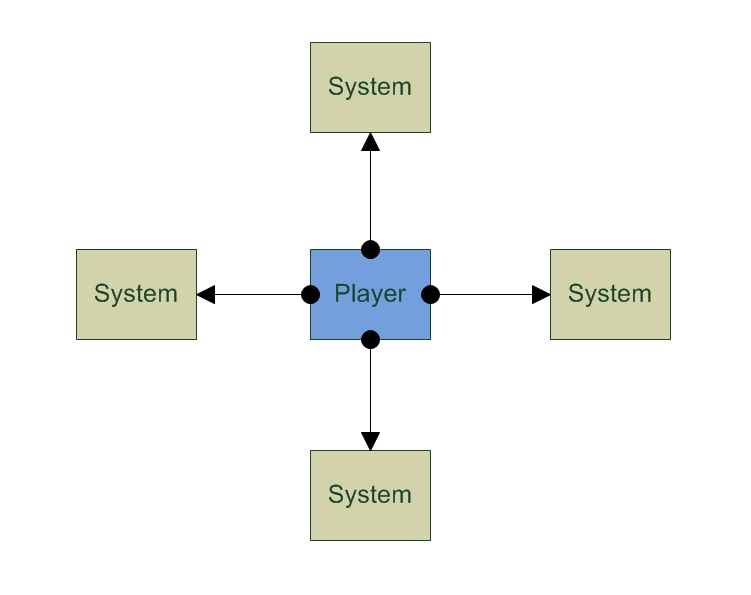
If you played the recent Deus Ex you (and the world) noticed that the boss fights in that game made no sense when compared to the rest of the world.  The former was all run&gun and the latter was extremely open ended.  That’s a lack of systems integration, where people use the same tools, have the same goals but get there in different fashions.  It creates a jarring feel when players go through it.
Independent Design

Independent Design

In the MMO space, there’s the leveling game and the max level game and, for the most part, these systems are also not integrated.  WoW has next to no links between the various systems – pet battles don’t mess with scenarios don’t mess with raids, etc…  It means there’s no conflicts between systems but it also makes it feel as separate games.  GW2 has an interesting approach where all content is auto-leveled.  RIFT links a few systems together, mostly around you know, rifts…

For a team of 100+ people to work together and ensure a cohesive experience for the consumer, they need solid direction.  In IT, certainly architecture, we have Concepts of Operation (ConOps) and architecture designs at the reference, technical and detailed level.  The ConOps gives a high level picture of how the client is going to consume the service and sets expectations.  You’d see raids, housing, crafting, exploration in a ConOps, including how they interlink.  A reference architecture is a ‘behind closed doors’ guide for similar systems.  Say a art style guide, so that all the assets are similar.  A technical architecture is one level deeper, explaining the various components in that system.  A raid guide would say something like, it has 24 people, this type of class diversity, this number of bosses, the expected completion time, and how it interlinks with other systems (tokens, crafting, etc…).  The detailed architecture is explicit in design.  It would be for a single raid, explain the flow of the zone, the boss abilities, themes and so on.

Think about the WotLK expansion and the raids that came from it.  Ulduar and Trial of the Crusader were extreme opposites in terms of detailed design.  Before someone started coding those zones, there had to be a plan for people to connect to and milestones to reach. Raids don’t just magically appear from some code.

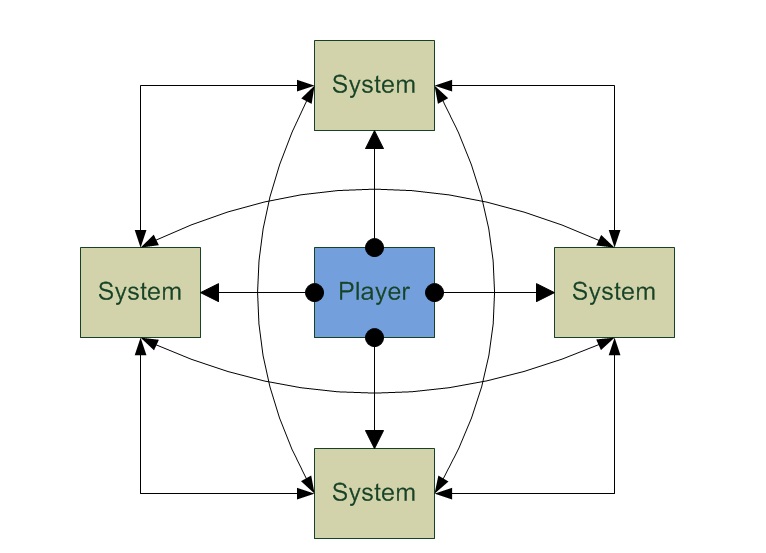
Now think about how an entire game maps out, with 20+ teams working on their various systems.  Classes, crafting, zone design, quest design, lore design, raids, housing, travel, art design.  Either they work in silos for 2 years and meet later on, in a massive clash of conflict or you plan it out right so that each one accounts for the other and there’s an open path of communication.  Jim in the housing group says to the other leads, “Hey, I think it would be great if we could see housing items acquired in other systems.  It would give prestige to players and provide an extra carrot in the other systems”.  “What a great idea! Let’s see how we can work it in.”

Integrated Design

Integrated Design

From a player perspective, it means that each system has an impact on the other and that you can make progress across the entire game, regardless of what system you prefer.  You like to craft?  Well, it’s used in housing, raiding and questing.  You like exploring?  It impacts the world by putting in trade routes and creating new spawns.  It means that when you move from one system to another, you don’t have to learn a completely new game.

I really appreciate Stephan’s post on the matter.  It provides clarity on the complexity of system design.  Hopefully more developers can provide similar insight into their work styles.


Raptr Report

One of the best features (or depressing perhaps) of Raptr is the yearly reports on gaming it provides.  My 2013 report hit my spam box and I just realized it today.  Let’s see what it has to say.

734 hours total…6 games at 50+.

I can’t say I’m surprised by the numbers.  When I play, it’s usually in bursts and that means I leave the game on and do something else.  Diablo 3 is a super example of that, where the game would simply be on in the background.  I wasn’t even playing the core game, I was playing the meta AH trying some strategies on market gaming.  I had some crazy formulas running for a 1 month period and ended up making about 1 billion starting with a pool of 100k.  I never wrote about it mind you, my bad.

Neverwinter is next with 80 hours.  I am pretty sure my blog still comes in the top 10 search results for that game.  It’s a solid game and the reason the numbers are low is… it was a late spring launch game and I was out of gaming completely for nearly 5 months after that.

WoW is at 80.  Same as D3 to be honest with you.  Market gaming, very little else.  I’d go back every major patch, LFR for a week and then tinker around.  Meh.

FF14 at 72.  That’s in 2 months too.  My subscription ended in November and while I’d like to go back, time investment is an issue.  It’s a great game.

Marvel Heroes at 50.  This is actual play time too, so I’d bet that I actually have more in-game time here than I do in D3.  Still installed, still get a few hours a week in there.

Guild Wars 2 at 50.  This was fits and spurts.  Some days went well, others went poorly.  I’m glad it’s successful but it is not for me.

I am curious as to the hours played calculations overall.  Infinite Crisis should be much higher.  Hearthstone as well – I spent well over 2 hours just getting it to work on my tablet (streaming).  Ducktales was a 2 week affair.  Perhaps that means that the other games are also under-reported.

Funny that clearing FF7 is my best achievement.  I guess it just goes to show that I really like gaming.  Here’s looking at 2014!

Start of the Dominos

4 MMOs in one shot.  Is that a grand slam?  As reported in a few spots now, SOE is taking the bold move of shutting down some MMOs.  Pretty much half of their line up, since all that’s left is Planetside 1/2, DCUO and EQ 1/2.  Let’s go over what’s going bye bye.

Free Realms

This was the first, at least to my knowledge, F2P-from-the-start western game.  I’m pretty sure Smedley had his kids design it, what with the significant focus on pets and cusotmization.  It certainly had monetization done right and laid the groundwork for many games to follow.  I honestly thought this was the most successful F2P game in SOE’s lineup but perhaps the playerbase just moved on to less aggressive models.

Star Wars: Clone War Adventures

I actually beta-ed this one.  Just a set of mini games from a lobby.  The best part of Star Wars in 30 years took an arrow to the knee when Lucas cancelled the show.  Selling to Disney certainly did not help with license renewal.  I fully expect a Disney Infinity tie-in by summer.

Wizardry Online

You remember this one, what with the permanent death penalty and absolutely horrible western reception?  No?  Well that makes sense.  This game was pretty much proof that a an Eastern F2P designed game won’t work in the west.  I am surprised it lasted this long as it exemplified pretty much everything western audiences hate about F2P and gaming in general (low risk vs. reward tolerance).

Vanguard

Considering the money SOE threw at this game, I was a little surprised.  Perhaps it’s the result (or cause) of McQuaid’s kickstarter.  I played it for a while and to be honest, it’s a game with great ambition and next to zero follow through.  I find it odd that Istaria is still around and Vanguard is going away, given they both had similar ambitions – just minus the whole “Brad”.  For some time now, I’ve been under the impression that Brad McQuaid got lucky with EQ in that there was no real 3d competition at the time.  He did bring uncompromising vision to the genre, it would have been nice to see that in other games.

What’s it all mean?

Very little to be honest.  All the games were aiming for a market that moved on to greener pastures.  Your MMO is either here, showing signs of life, or it’s dead.  It looks like SOE is throwing a lot of money into EQN/Landmark.  Should be an interesting 2014.

Power Gains

Clearly, I play a lot of games.  I also have a passion for numbers.  Makes for a rather OCD compulsion to maximize output.  I don’t mind, I get pleasure from it.  I used to write guides (the last one was for Marvel Heroes) and that’s paid for this hobby.  What I find as an odd pattern is the oddly non-linear power gains.

Let’s take a step back for a bit.  Older games had no power gains, what you started with was pretty much what you ended up with.  Mario doesn’t get stronger in Zone 8, you just get better at playing with him.  The proliferation of RPGs since then, combined with faster processing power to compute those numbers, means that nearly no game today will release without some power increase over time.

I like the Batman series as the power gains are % based and somewhat linear.  Sure, you might get a bit stronger, say double from the start, but that really doesn’t have a huge impact.  You are exceptionally better at stringing combos and avoiding damage by the time the power unlocks are available, so you really don’t notice all that much.

MMORPGs are different.  You start off dealing say, 10 damage.  It’s a rather linear gain from that point until max level, which we’ll put at 100 damage.  This is base damage, linked to level.  Then we need to factor in your equipment.  Well designed games have gear that increases your output by a noticeable but still marginal increase.  This way, as you gain power at max level, through gear, you’re not turning into some robot god of immortality where all the previous content is irrelevant.

WoW’s power gains are an extreme example.  One piece of gear in MoP is better than some characters had as TOTALs in Lich King.  The numeric increases are so large, that they offset any base level (acquired from just plain leveling) gains.  The item squish coming in WoD is going to try to fix this.  I personally think this is a good thing, as the game will return to a skill-based one rather than a simple numbers game.

I’m watching streams of a space beta, recollecting my time in another beta and trying to come to terms with which one, from a playstyle perspective, seems more prone to a skill-based system rather than a numeric one.  I like skill.  I think gear has it’s place, as a reward for skill, in that once you acquire it, you need to concentrate less on details more on delivery.  It doesn’t make content trivial, or rather should not.  It just takes a bit of the edge off.

I’d like to see a return to brain power, instead of CPU power.  I think we’re ready.

Control Schemes

I’ve been playing video games since Pong and at each iteration, there seems to be a more and more complex control scheme to get things done.  We’ve gone from turning a single know to having 100+ keys to press, sometimes 4-5 at a time.

Back in the day, sometimes the control scheme itself was the game.  Good luck getting Arkanoid/Breakout to work with a crappy mouse.  X-Wing/TIE Fighter with a joystick?  No chance.  Ever try to play street fighter on a controller without 6 attack buttons?  Once you have the controls down, then the game had a completely different light.  Sure, they were challenging as games, but just understanding how to play them was enough of a battle.

I remember the original adventure games, mostly from Sierra.  They were all text entry based, no need for a mouse at all.  Then a few standouts, LucasArts most notably, prompted the adventure game to go into the mouse business.  The game was still an adventure but try to argue that finding the right sequence of words to get things done wasn’t half the battle in the first place.  “Set sights on gun” got me killed in Police Quest for a few weeks.

The Wii / Kinect / Move phase…what a fun 5 years that was.

When we start looking at the MMORPG genre, the original games where pretty limiting.  Mouse was for movement and text was for doing things.  UO was a ton of fun typing in (or more specifically macroing) spells.  Everquest’s skill based system changed the paradigm a bit.  Now you had skill buttons to click with the mouse but the actual timing was pretty simple.  Well, maybe not bards.  WoW was next, at least as a big dog in the playground.

Now comes the age of the keyboard turner.  WASD was the default movement on games for nearly 15 years by this point.  WoW supported it, and built nearly all their mechanics around it.  By then providing challenging content that required ever increasing reflexes, keyboard movement became the next hurdle.  If you didn’t understand circle strafing (which most no one outside of FPS did), then you needed to learn a new skill.  Naxx and the Heigan Safety Dance is a perfect example of an encounter designed around control scheme and nothing else.

WoW’s skill bloat certainly didn’t help anything.  A poor default UI (the UI today is built nearly entirely on community mods) led to complex classes needing automated systems.  HealBot is a super example of a single UI element that combines multiple entries.  With a simple click you can do 4-5 things at once.  Great!  Shitty design that you actually need this mod to play the game though!

SWTOR followed in the skill bloat problem and then tried to make money off the problem with hotbars.  That was the proverbial straw that broke the camel’s back as nearly every other game that’s come out since then has a limited skill bar.  Sure, you still have 20-30 abilities to choose from but you can only ever use a small subset (~10) in any given fight.  This makes it a lot easier on the player to figure out what to do and easier to balance as well.  It makes for a smaller, more intuitive UI.

The next big change was active combat.  This stemmed from a WoW addon that put markers on your screen to avoid certain spots to not take damage.  As the game grew, more and more of these “red circles” showed up to the point where today’s games run near exclusive on that model.  NeverWinter’s combat is all about this.  There’s more active dodging than anything else.  Small amount of skills, plenty of movement, makes for a highly skilled game.

Now we start looking at the next two games coming down the road.  TESO uses a telegraph model, similar to WoW.  It also has a very limited active skill set.  Combat is relatively slow, which allows for some strategy.  Admittedly, this is extrapolated from PR footage but combat so far seems to be more around the “sort of do this” style that thoughtful, targeted motions.  Soft targeting is a large part of this.  Think of shooting a fireball in Skyrim.  The farther away you are, the less likely you are to hit a moving target.  A fireball in WoW hits 100% of the time if you have a target.  Players will have a challenge adapting to this more analog system of “sort of hit” compared to the digital one where “it hit or it didn’t”.

Wildstar uses a hardlock system, telegraph combat and a limited (though seemingly less limited than TESO) combat model.  If you’ve seen any videos it looks like WoW on crack.  There is constant movement, constant attacks and differing types of attacks within the same skill.  Press and hold for more damage, AE attacks (with 5 corresponding colors), multizone attacks (hit 1,2 or 3 times).  Think about that a second.  You need to be constantly moving, which means Mouse + WASD.  You need to be pressing buttons, aiming AE attacks and holding buttons down.  This is mouse + holding keys.

I want you to take a minute the next time you’re at a computer and hold your mouse in one hand, W+S pressed down in the other, then press and hold the 6 key while making circles with the mouse pointer.  We’re really at this point?  What kind of physical skill level is now required to play games?

I’m running out of hands.

All You Need to Know

Recent studies about digital sales in the US, which drives the majority of game development we hear about, shows the spread of targets.  This ignores games from the East and Europe, mostly.

This doesn’t show competition, which is much greater in the F2P field than in the subscription field.  MMORPG’s list of games has F2P ahead by nearly 5:1 in terms of quantity of games (again, not quality).

The point of this post is that video games are a business.  Businesses succeed where the money is and investors are more likely to take a chance in a big pot of money than a smaller one.

There is a ton of money opportunity in the F2P sphere compared to subscriptions.  Same with competition with Mobile and PC DLC.  If you’re wondering why your subscription game isn’t working out, sometimes it isn’t about the game itself but every other game around it.  If a game takes $200 million to make your game and your potential market share is 9%…and you only get a small slice of that 9%… the math is pretty easy to see.

The market has shifted drastically from a few years ago.

Quick Things

Computer capped out, trying hard to get it fixed. Everything is on mobile while commuting. Should be done by end of weekend. You forgot how much crap you accumulate until it’s gone.

I think the following article is an excellent proof that game design today is done wrong. Square announced 2013 finally put Lara Croft in the black.

Think about that a second. A game that sells 4 million+ units barely turned a profit. What kind of budget are these games working with? How can you possibly use a new IP with that kind of budget?

How can the game medium move forward if games can only be successful if they sell 5 million copies. How many games a year sell more than 1 million? 

Just boggles the mind.

There’s Testing and Then There’s Testing

Over the years, I’ve been fortunate enough to be in most every beta I opted in for.  I started it back when beta was actually a beta and not a sales pitch.  Most betas today are so polished that they are really just soft launches and not test platforms.

Then you have stress tests.  I work in the IT field.  Oddly enough, yesterday I was writing up an FRTM and test plan.  Stress tests are for two purposes.  First is authentication (logon screen) and the second is core systems.  Think of it as front door and inside the house.  Stress tests on the front door today should not be public.  There are hundreds of testing options for testing capacity on authentication.  The actual fallout of having your public test this feature is extremely poor press and word of mouth.   NDAs are all fine and dandy but people talk anyhow and a 21 gig character creation tool sells nothing.

What you want from a true stress test is putting a bunch of people inside the house and trying the various appliances.  You want 1000 people trying to PvP.  You want 1000 people to craft at the same time.  You want 1000 people looting at the exact same time.  Your transactional services need to be pushed to capacity and black box testing can only get you so far.

If you want to spend 3 days stress testing and the only thing you’re testing is the logon screen, then you just wasted 3 days.

Launch Windows

The average public beta of a new MMO is 60 days.  This gives some balancing numbers and time to tweak systems.  Most NDA’s drop on public beta to create buzz and word of mouth.  SWTOR is a recent example of a game with such a window, character wipes and a fairly strong NDA.  It was a rather bad beta, compared to previous ones.  RIFT is the complete opposite.  Beta was polished and the core task for testers was balance.  Balance takes time and takes recursive tests and non-logical functions.  That’s why you put people in the game, to do stupid things.

Considering we have a few big MMOs launching this year, I am somewhat curious as to the status of beta windows and NDA drops.  The goal isn’t to put something out the door.  That ship has sailed.   Fingers crossed.

Assassin’s Creed 4

Steam winter sale + pirates = here’s my wife’s money.

I played AC 1&2.  Then it got into a money grabfest of terrible proportions. AC3 looked stupid (apparently played that way until you completed the game) and I skipped it.  But my heart has always been with Pirates!  I played the heck out of that game and anything that allows you to loot and plunder while steering a giant ship in the seas has my vote!

AC4 does away with a  bunch of the crappy stalking missions (still a few mind you) and concentrates on open water warfare and parkour assassinations.  Rather than just a few towns, there are dozens of areas to find.  Islands, towns, forts, shipwrecks.  I unlocked one of the 9 areas on the map (by taking down a fort in a 10 minute battle) and it cleared my map to see all the various objects.  I swear there were twenty things that popped on my screen.  I saw a whale and decided to take a stab.  Poor pun.

Well worth my money.  I’m what appears to be less than 50% complete with 20 hours in.  And being a completionist isn’t some boring affair either.  Collecting even the tiny things, like shanties, is a fun romp through town.

Plus there’s the ship battles.  Plenty of videos of that.  There’s something to be said about taking down 5 ships, a fort, 2 captains, a flag, 3 officers and a war officer.  Tons of fun and highly recommended.