Challenge vs Difficulty

It would seem in most remarkable RPGs there’s an optional boss of some sort that is miles more difficult than anything else in the game.  The omega weapons in Final Fantasy are good examples.  Heroic-only raid bosses in WoW.  Culex in Super Mario: 7 Stars.  Pillars of Eternity is no different, as you get to fight the Adra Dragon after the 15 floor Nua dungeon.  Well, except for a few points.

First, the concept of difficult for difficulty’s sake annoys the crap out of me.  I dislike rigged games, just like playing Mario Kart has cheating AI.  I realize that there’s a fine line between challenging and difficult.  Demon Souls (and other like) are challenging.  You run through enough times and think it through, you can get by.  Difficult games are where you’re randomly put into a challenge with moving parts and have to make decisions that are vastly different than the rest of the game.

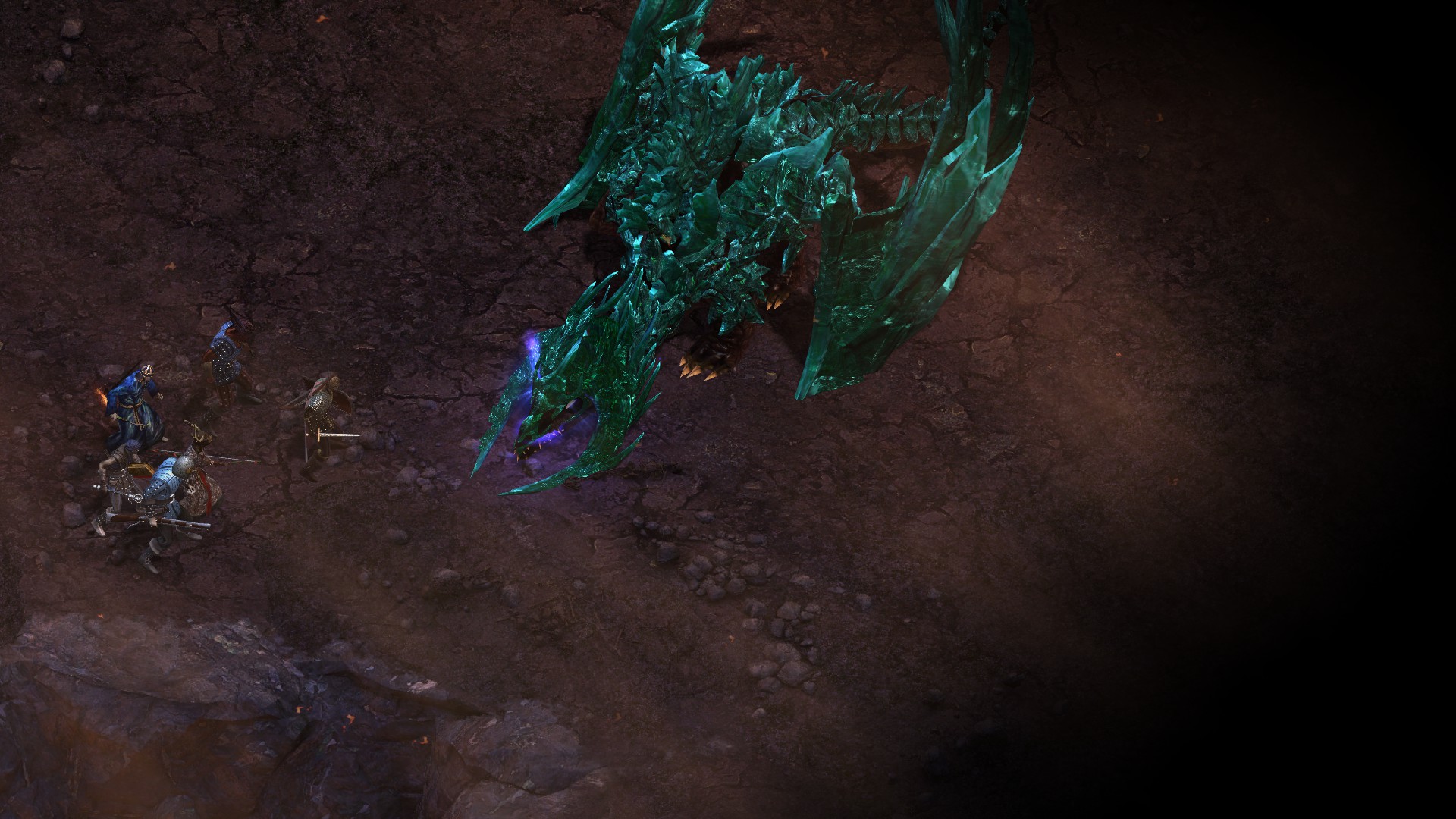
The Adra Dragon is the latter.  See, the 14 floors before that have their own challenges, some pretty tough ones actually.  You need to think your way through, even at max level.  Then you reach floor 15 and the dragon kills 5 of the 6 members in a single attack, an AE attack with no range and extremely large LoS, on a random timer.  Oh, it drops its threat target randomly, and has a hitbox a fraction of the size of its targeting box.  Also, this dragon has the best defense score in the game, miles beyond anyone else and its melee attacks knockdown and deal tremendous damage.  I get it, dragons are supposed to be tough but this particular one is of such a level of difficulty that there is very little sane approach.

It took me over 3 days to pass this checkpoint.  There are really only 2 options present to defeat this.  First, is to have a tank, either a custom one or Eder, and have specced defensively the entire time you progressed.  You then stack every defensive item you can on the tank, buffs, potions, food, you name it.  they lead out, start the conversation and through luck, turn the dragon to face away from the rest of the team.  Bad luck, and no matter what you do, the rest of the team can get hit by an AE attack and wipe you out.  Let’s say luck is in your favor.  You now need to have a priest/healer of some sort nearby to keep the tank topped up.  Everyone else needs to be at range, because there’s a melee distance attack that will 1 shot anyone nearby.  You need to debuff the dragon on all their defenses and buff all the attackers to hit.  If everything goes off well, you have a dead dragon.  If RNG is against you (and remember, the odds are very much not in your favor) then you’re going to reload.

The 2nd option is the cheap way, which is to use a paralyze trap on the dragon, have a chanter who has the quick reload song and equip everyone with ranged high damage (slow) weapons, like arbalests.  If the trap hits (which for some reason has a near 100% hit rate), then it takes 2 rounds of ranged attacks, including many critical strikes, to take down the dragon.  Extremely cheap, still has some element of luck, but it’s a more reliable way to do it.

Did I mention that at higher difficulty levels there are enemies that spawn with the dragon that can mind control your team?

This post isn’t so much to complain about the outright difficulty of the event but that there is such a large disparity between the rest of the game and this particular battle.  There is no level of grinding to get through it.  There is only 1 effective strategy that isn’t “cheesing” and that one requires near perfect execution with favorable RNG.  I don’t mind losing, if I can see that it was something that I did wrong.  I don’t mind hitting a brick wall either, if it means I need to upgrade/improve something in the interim.  I do take issue with a near perfect execution and being the victim of a series of bad rolls and random events outside of my control. I want to learn, not cross my fingers.

Thankfully, this is an isolated event in an otherwise extremely polished game.

New Challenges – RL and Gaming

Now that the weather’s a lot better (we broke some cold records this year) I like to take the time to go outside from the office and breathe some air and see the sights.  From time to time, I’ll take a walk with my boss and have a chat about the goings on.  I also try to have a coffee talk with some old bosses, to see where things are at and bounce some ideas off them.  It’s a sort of basic mentoring process when I think about it.

Quick aside.  When I started doing this, oh about 10 years ago I guess, this was seen as brown nosing.  I get that.  The thing is, if you want to move up in the world, you can’t be looking down or sideways, you have to look up.  To get to where my boss is, I need to know how they got there.  There’s plenty of time for me to get great at the job I’m doing, but at some point I’m going to want to move on.  I guess I’m just bad at sitting in one spot for very long.  My wife is going through a similar process at her work but she ends up caring a whole lot more than I do about the negative folk.  The ones that are comfortable in the job they do, or have aspirations, tend to not really care much or will actively help you out.

Back on track.  I tend to be introspective, seeing what I can tweak/improve/focus on to make me better at what I do and more efficient.  I hate being inefficient and not knowing something.  Drives me bonkers.  I think that’s why RPGs fascinate me so much, you have massive control of the outcome with forethought and repetition.  One recent walk, I had mentioned how my side of the family is extremely thick headed, in that we don’t let things drop very well.  The joke is to tell one of us we can’t do something, just to have us prove that we can.  It’s certainly a dangerous trait but with the appropriate controls can be used as an excellent motivator.  Heck, I’ve made a career of being told no and finding a way.

Which I think applies to many of life’s problems and people’s attitudes towards them.  There’s certainly the adage that men are solution focused when seeing a problem, while women are more empathetic to the sufferer.  Yet it’s a special mind set to move from “that can’t be solved” to “hmm, I wonder if this will work”.  I think as kids we all are in the 2nd camp.  Imagination is everywhere and we have little to no concept of limitations.  As we grow older and hit those speed bumps or road blocks, how we deal with those events shapes the rest of our lives.

It isn’t about getting back up when you get knocked down, truly it isn’t.  That’s pride more than anything else.  It’s about figuring out why you got knocked down in the first place, and then figuring out how to avoid it in the future.  Maybe you’re better off staying on the ground, letting the other person think they’ve won and waiting it out.  Maybe you’re better off jumping up and taking a swing, or running away.  Heck, sometimes it’s about watching someone else get hit to the ground and learning from it.

Recently at work, I’ve been pushing for a particular service to be available to our clients.  The owner of that service (or lack thereof) hasn’t been on-side and I’ve had to manage expectations with clients since.  Clearly I’m being told no we can’t do it, and clearly I’m saying yes we can.  So where the logic applies (we should be doing this for a number of reasons) and the political side does not is the place I’ve landed.  There are quite a few swings my way, that are not made in an obvious fashion.  I’m a rather practical person and this new method of conflict is a heck of a learning experience.   And learning new things is a heck of a rush.

I’ll tie this back into gaming a bit, where the skills I’ve learned to perform a task as separate from those where I learn to work through a problem. Strategy and tactics.  There’s a point in gaming where it’s about repetition of a given task, time and time again, with only a few variants. The typical tank & spank of dungeon let’s say.  From time to time though, there’s some innovative spin to a problem, where the solution is far from apparent. Adaptability rather than randomness.  I find that more comfortable I get with foundational items, the more it becomes second nature, the easier it is for me to try something new.  I can always fall back on what I’m good at but a new challenge is rewarding in its own right.  It’s that challenge/new spin that keeps me interested in games.  It might be hard to find somedays but when you do, there’s a feeling deep inside that only gamers can really appreciate. It’s just interesting to find analogies with the real world.

Mobile Games – Enchanted Cave 2

Without a PC, I’m stuck with mobile gaming on my tablet.  I’ll be blunt, the race to the bottom on mobile apps is pretty disgusting.  There are dozens, if not hundreds, of CoC clones out there, or a card based combat simulator.  I was reading about how the iOS store has 500 apps published per day.  How exactly do you parse quality in that type of environment?  IAP and ad-based games are atrocious.  Sure, there are games where it isn’t in your face but those are pretty far between.

So I tend to find the gems in the paid apps section.  Oh, there’s plenty of garbage in there too but with a refund system, you can always go back and complain about a given app.  The cost is an odd psychological discussion, where I spend $2.35 on a cup of coffee that lasts me 20 minutes but a game that lasts an hour won’t go for more than $2.

I’m not talking about Squeenix’ stupid price point of $15 for 20 year old games.  Those are just bonkers – especially for games that I already OWN just want to use on a different platform (hello emulators!)  There are some pretty good games at the $5 mark though, things that can keep you going for a long time.  And really, it’s important to support the smaller devs who are innovating because once they pick up enough steam, EA is going to come along and copy the crap out of them.

I have a whole whack of interesting ones that I’ve picked up over the past year.  The one I’m on right now is Enchanted Cave 2, a tweak on the rogue-like genre.  You go down a random dungeon and pick up loot, levels and stat boosts.  If you die, you lose it all.  If you escape (with a special item) you get to save some of the progress so far, making the next run a bit easier.  I remember playing the first game a few years ago on Kongregate (for free).  This version had a few more stats, a skill tree that you can put points into as you level, an enchanting sub-system and a crafting system to boot.  I think it was under $3 too. It’s a solid time waster.

It’s unfortunate that I had to go through about 2 dozens games to find one that a) kept my attention past the 15 minute mark, b) wasn’t a near complete clone of another game and c) didn’t have a crazy amount of bugs making the game unplayable.  There’s got to be a bottom to this barrel.

New Rig Shippin’

Last night was about backing up some files.  I had 30 gigs of home movies in a little known folder.  Good thing I caught it!  Once that was done, I ran some additional tests on the video card.  Safe mode had an odd colored bar in the middle of the screen… never a good sign.  I removed the drivers, rebooted and normal mode was fine.  The drivers reinstalled and a reboot later, black screen.  Ah well, I have a local computer replacement shop I think I’ll send it to.

New Rig

That said, I did spend some additional time on the hunt for a new box.  US exchange rate and shipping costs were going to end up somewhere near 22% on the Canadian dollar, so I really wanted something on this side of the water.  Two options.

NCIX was recommended to me by Rohan.  They had some decent rigs available, either a GS70 or a Dominator (I love those names).  Reflex Notebooks has a fair chunk of selection and customization though, and I had my eye on a Sager 8278.

I ended up on the checkout for both sites to compare prices.  NCIX charges shipping and insurance, while both are baked into the Reflex price point.  So while I thought I was saving a fair amount with the former, the final prices were relatively close.

It’s one of those things where you’re looking at the number, realize what it actually means in terms of time spent to make that amount, and then ponder “is this really worth it?”  I am far from being cheap but I do know where my money goes.  Most of my purchases are large purchases, as I prefer quality over quantity.

I ended up picking the Sager as it really came out to the most bang for the buck.  I customized exactly what I wanted, even though the baseline included a GTX970M card (like 3 cards down from top of the line).  I won’t have to pay a cent at the door and in a week or so, I’ll have a new box.

Interim

Meanwhile I’m without a gaming rig, which has been my go-to stress relief lately. It’s somewhat ironic that my work and overtime are the cause of the stress, and are paying for the updated relief.  If I cut down on the former, I’d naturally cut down on the latter.  Still, I have a tablet for some respite.  Weather is nice, more biking is in order…

The Problem with Mods

To start the argument, one of the largest games on the planet (League of Legends) owes its ENTIRE EXISTENCE to mods.  DOTA was a mod for Warcraft 3 and birthed a genre.  Counterstrike is probably the most known about mod and still played professionally – now with scandals!  WoW wouldn’t work without mods and over the years, the most popular have been integrated into the core UI.  And the FPS wouldn’t be here today if it wasn’t for the Doom mods.

So, mods have been here for ages.  They have been free, for the wide majority.  The most popular have been worked on my dozens of people over the years, with it either being based on passion or as a sort of internship for an actual career.  There have always been donations as an option but nearly all of them have avoided the direct money transfer.  The main reason?  EULA.

Who Owns It

See, a mod is using a registered IP, which is owned by a company, who makes money off said game.  They tolerate mods as it keeps the game relevant and can greatly extend sales for minimal effort.  Some games are more restrictive on mods, since it impacts the experience.  If someone were to ask for payment for a mod, using someone else’s IP, then they would be in breach of contract (WoW’s glider mod is a famous example).  It gets even worse when a mod uses another set of mods and asks for money.  You eventually turn into a variant of a pyramid payment system.

A rather simple analogy is sampling in the music industry.  There was a precedent set this year that is going go spiral into all digital media at some point.  Using someone else’s material for your own gain, in part or in whole, is theft.  So you’re stuck with 2 options.  Either you do it for free, or you pay the company who owns the IP.  Option 1 is what we’ve seen for nearly 30 years.  Modding is getting more and more complex (as the games are) and there surely be someway to compensate a quality modder.

Mod Sales

While it doesn’t take a rocket scientist to see that Valve’s implementation of mod sales was flawed, the intent was solid.  Find a way for modders to get some money from their work, in a legitimate fashion.  The problems though, are quite similar to the app store for iOS and Android – quality and quantity.

Both of these systems use a curator model, where applications are tested/vetted and then put on sale.  That requires some overhead and time, naturally.  It also ends up filtering the junk, well some of the junk at least.  User ratings and black magic put games to the top of the list and there’s a search tool to help as well.  You can’t really say market forces are at play here, since Apple and Android hold all the rules.  If you have a complaint about copyright infringement, you can ask for some help.  Well, unless you’re talking about Zynga or EA….

To top it off, if a dev is paying a cut to someone else, that someone else has to earn that money. There’s a tiny drop of difference between the Steam Workshop and the Steam main page, so what exactly were modders paying Steam and Bethesda for?

Valve has never been very good at curating, they’ve always let the players decide on what’s valid.  Greenlight is an example of what works and doesn’t work in that regard.  I don’t think it’s even part of their psyche or business values to judge games on merit.  That conflict is the main reason they disabled mod sales, the water got too deep and too murky for their comfort level.

What Now

Solid question.  Mods are back to being free with donate buttons.  Bethesda and Valve are going back to the drawing board.  My gut would say that a new mechanism around donating (or having an optional price when downloading a mod) would be the next step.  Many modders put in hundreds of hours and I don’t think it’s unreasonable for them to get some compensation for their efforts.  After all, they are the main source of new game ideas…

Are E-Sports a Sport?

I guess it depends on your answer to the following questions.

Is Chess a sport?  Go?  Scrabble?  Poker?

None of those require any physical skill but do require a substantial amount of mental and psychological skill to compete at top levels.

If you’re actually comparing time spent in the sport, then it’s a very interesting argument in favor of e-sports.  US football is only about 10% actual sport, the rest is posturing, cheerleaders and commercials.  I mean, you could watch an entire game in 15 minutes.  Baseball isn’t much better.  Soccer (or actual football) is at the top, naturally.  Hockey – my favorite sport – isn’t too far behind.

E-sports are more akin to baseball, in that there isn’t a time for the game, so much an end goal.  It could be edge of your seat for 30 straight minutes, or it could be junk for everything but a few rushes.  The quality of the match depends largely on the ruleset, the game being played and the skill level of the players (both reflexes and the meta).

I’ve watched a couple SC2 matches and while there’s less action than a MOBA or FPS, the strategy application in that game is impressive.  Macro and micro management is a very hard skill set to refine and does pay dividends after the competitive arena is closed.

While there’s certain financial benefits to pro sports as we normally see them, it’s hard to translate a good basketball skill set to another field.  Leading a raid, playing ladder ranks or hitting the stage in a MOBA final seems to me, to have a larger real-world cross skill impact than a physical sport.  Maybe that’s some compensation for the lack of money in field.  For comparison, in my super lack of depth google search, Messi makes more than all e-sport purses in a year combined.

Still, e-sports are a rather young field and with more time and a larger pool of players, I think there’s a pretty interesting future in line.  I’d certainly like to see more of the “thinking person’s” games available.

Complexity is Good – Part Deux

In which I use different terms for the same argument.

Some readers will have had the chance to buy a house.  When they go shopping for an existing one, or look at houses being built, choices are limited.  You are stuck with the lot, the foundation and the supporting walls.  I had a friend who was shopping and was complaining about the color of the walls.  When I mentioned that they could paint the walls, it was like a new dawn.  In the new developments, you basically get a choice of 5 house types and then your choice of tile.

For those lucky enough not to have gone shopping, nearly everyone has gone through a suburb or development where row after row of houses looks the same.  It’s like a bad movie.

Compare that to 25 years ago where builders would work with architects and planners to custom build a house.  Go to most neighbourhoods built in the 80s or before, and the houses are generally different than each other.  You can certainly still do that today but it’s hard.  You need to find land, an architect, a lawyer, a general contractor and run through enough permits to choke a horse. It’s hard but at the end, you have a house that’s your own.

That’s the argument behind complexity.  Given people the illusion of choice is not really a choice, not when beneath that choice there were dozens of choices taken already.  Imagine being able to make those foundational choices.  Being able to make mistakes and then learning from them.  If there’s no real chance at failure, then there’s no real progress.

Complexity is Good

While I was playing some more Path of Exile, I got to thinking about how this game differs from others.  I mean, they are all just carrot-on-a-stick generators, but some seem to have better looking carrots I guess.  As always, comparisons abound.  The 4 that I think bear comparison right now are Diablo 3, Marvel Heroes, Torchlight 2 and Path of Exile.

I don’t think anyone would disagree that the visceral aspects of Diablo 3 are much better than the others.  Abilities have an impact, monsters are clear and unique and there’s a fair amount of variety in the bosses, if you want there to be.   That feedback is part of the initial draw and it’s something MH, T2 and PoE are not really that good at.  D3 is a rewarding visual experience.

The thing is that feedback system reaches a stopping point, where you’ve seen all the skills and all the bosses.  Maybe it gets you to the end level.  It isn’t a carrot so much as an endorphin push.  You eventually develop immunity to it.  It’s at that point where you start seeing games for what they are – loot pinatas combined with number generators.  And that’s a part that Diablo 3 really is the weakest of the bunch and PoE really stands out.

Loot

Typical loot drops are rarely scanned after a given point.  The amount of gearing options available at max level really boil down to some simple guidelines.  Either it’s a clear upgrade for you, for a friend/alt, or may sell for something decent.  In D3, if it isn’t orange/green, odds are you aren’t going to use it.  There is a massive lack of build diversity in D3 and it is limited mainly by the gearing options.  The unique/set items are so wildly powerful, that some classes are pretty much non-competitive until you reach a specific gearing point.  It also means that you’re ignoring 99% of the gear drops.

In T2 and MH, the build diversity is much higher and that’s due to the way that the gear drops work.  T2 has sets/uniques and MH has about 18 terms for their gear.  But while there are key items that boost a particular feature of a character, nearly any type of high end drop can be an upgrade because each item boosts a random set of skills.  Combined with crafting, drops that are mediocre can be transformed into something very powerful.  I think MH really takes the cake here simply because it has so many possible gearing slots and options but T2 is pretty close in sheer item variance.

PoE is the outlier here and that has to do with the core design of the game.  There is no cash in the game, only a bartering system.  Skill gems are how characters develop abilities and boost their power.  There’s an internal gambling-like system for crafting, where you can take a grey-quality item and turn it into a superb piece of gear (potentially).  All this combined means that you’re always paying attention to the gear drops.  Maybe that piece has 6 slots, maybe that one has 4 links, maybe that one has an innate bonus.  Some types of drops also trade for better items (like a red-blue-green item giving a chromatic orb).  Right now, my weapon is a rare with some rolled mods and skill gem slots.  I’ve had it for over 10 levels.  I’ve had multiple rares since, none have come close to the stats on this thing, in the way that I’ve built my ranger.  The items that I’ve seen that were good, I’ve banked or traded away.

What the end result means is that there is always some form of progress.  D3 loot is a clear black/white upgrade system, just numbers.  MH/T2 has you stop and think a bit as to how the item fits into your build.  PoE goes the extra step and makes you go back to town to tinker with your gear.

Numbers

This is by far D3’s single largest weakness, the simplification of its numbers.  Only 2 numbers really matter (outside of uniques/sets) and that’s weapon DPS and the mainstat (Dex/Str/Int).  I know I am simplifying it, as critical chance/damage and resists have an impact but neither have as much as the first 2 items.  There’s just no way to fix this and it was the foundation of all the problems with the auction house.  A clear delineation of power means that only a small fraction of items have any value.  It also gives an exponential curve to power, where the difference between max level-1 and max level is a number most people can’t count.

T2 values main stat and then skills.  Sure, main hand DPS has value but it’s the other numbers that really impact your skill damage.  Getting a +5 to glaive had a tremendous effect.  This system is the closest to D2 that I’ve seen implemented, and had a large impact on the build diversity.

MH is all about skills, as the item’s innate power is more related to its level requirement than anything else.  Sure, you’re still going to want to look for +energy damage if that’s your bag, but you won’t equip something with +to a defence skill if you’re built for offence.  The power curve here is actually rather linear.  It keeps you coming back as there always seems to be some progress.

PoE has both the passive skill tree (oh lord the options) and skill gems.  This makes for a rather complicated system, where the base stats on an items are as important (if not less so) than the gem sockets, combined with your passive skills.  So let’s say you spec as a dual wielding cold master.  You will be looking for items with +cold damage, a few red sockets and resistances.  Would you swap an item with better base stats for one with 2 less connected gem slots?  Maybe if you were able to find another item to compensate.  I have a rare chest item with 6 green sockets, 5 of them connected.  Those 5 connected skills give me an amazing attack (tornado, piece, GWP, physical damage, faster attacks) that I really don’t want to give up.  I could re-roll a rare with better stats, hoping to get better sockets, but that’s a less than 1% chance.  With so many variables and numbers at play, it really makes you think about what you can actually use and what you’re willing to give up.

Complicated is good

I’m not saying simple games are bad, I’m just saying that I have a penchant for the more complex ones.  I like having to think things through, rather than just bot my way to the end.  It’s also neat that there are options along that simple/complex line.  I would say that folks who give PoE a try, once you get over the first few levels and start finding linked sockets, that’s where you start to see the true complexity of the system.  It isn’t a game where you’re chasing an ilevel, it’s a game where you’re given tools to think through.  And I think in today’s world of simple mechanics, a bit of complexity is a welcome sight.

Path of Exile – Solid ARPG

I like action RPGs.  I can clearly remember high school when Diablo first came out and there was an internet arcade (well, just desktops) a few blocks away.  Our group of friends ended up spending a LOT of time there over the years.  Diablo, Command and Conquer and Warcraft 2.  When high school ended, I found another spot to play, though that was mostly StarCraft by that point.  It’s what really cemented my passion for games and computers I guess.  Now that I think about it, I guess I spent about 6 years doing that…hah.

From that point, I have played the majority of ARPGs that have come out over the years.  Diablo 2 is certainly the one I played the most of but other notables include Darkstone, Nox, Torchlight, Sacred, Dungeon Siege (1 & 2), Marvel Heroes and now Path of Exile.  There are certainly a ton on the console, think of the Zelda series…

While I enjoy Diablo3, well since the RoS expansion at least, there are still some gaps in the game.  I do enjoy Blizzard’s penchant for a simple interface but a complex game but D3 really went a little too deep on the simplification of mechanics for my taste, a massive pendulum swing from initial release.  Torchlight 2 was/is a much better implementation of that model, it’s too bad that after launch the only support was from the community.

Marvel Heroes does scratch an itch and the game is honestly getting more and more complex as time goes by, which is a good thing.  I think it’s a rather solid implementation of the ARPG and the IP and recommend everyone take a pass at it.  It does F2P really well.

Path of Exile

This is the game with the massive skill tree.  It’s a much more hardcore ARPG compared to other games.  Torchlight 2 is really the closest and even that is comparing monkey bars and a minefield.

Now that’s a lot of options

The game is an odd one, as the concept of classes exists but it doesn’t have a massive impact other than some minor stats and the look of your character.  When you select the class, you’re placed in a particular spot on the skill tree, so you may have more Dex nodes around you as a Ranger than as a Marauder for example, though all the nodes are accessible.  With 80 levels and quite a few quests that reward extra skill points, there’s a near stupid amount of customization available.  The kicker here, which is a drastic change from other games, is the complete lack of any respec.  You can roll back a dozen or so points by the tail end but that has minimal impact on the grand scale.

The compensation for this is two-fold.  First is that you can create up to 24 characters and that the leveling process isn’t terribly arduous.  A dozen or so hours to max level, if you’re optimal.  Second is that trading is completely open.  There’s no money for one, so it’s 100% bartering.  But the actual items, they can be changed between anyone at any time, as long as they meet the stat requirements – clearly a model that’s required if you’re going to barter in the first place.  The neat side effect here is that there’s no gold spam, or hackers.

The game also takes a harsh (in comparison) approach to defense and death.  As you increase in difficulty, defense becomes more and more important.  As nimble as you are, you will be taking damage and a solid resistance set is needed.  Dying also causes you to lose experience but not to lose a level.  Stuns, roots and slows are all over the place.  Enemies with big hits, massive spawns, you name it.  It takes a smart build to survive and with so many options, it can seem daunting.

I do need to take a minute to talk about art because if you’re going to play a game for dozens of hours, it needs to look good.  Diablo 3 isn’t unicorns but there’s a fair chunk of enemy variety and clarity around them.  The artstyle is clean enough and varied enough to no strain the eyes and be recognizable.  Maps are generally open, and those that aren’t funnel you to the goal.  Torchlight 2 has a sort of hub/spoke model where the main zones are open but the dungeons are tight/varied.  I like the artstyle but there’s a definite lack of variety in the enemy types.  Marvel Heroes has a ton of art that’s very vibrant.  If they could have added lens flare, you’d see it everywhere.  It makes things pop.  But there’s only about a dozen or so enemies, and they are either human, moloid or insect.  I think that’s more an IP restriction than anything else.  It can get long in the tooth after your 800th yellow humanoid kill in a row.

Path of Exile has a lot of different types of enemies, some of which seem more inspired by horror than fantasy.  The maps are more often closed than open, but offer a lot of branching paths, making for frustrating dead ends.  The map itself isn’t much use as it shows you the building structures (bricks and all, though hollow) rather than a crisp “this is the wall” type of map I’m used to.  The game is also very dark, so you’re not looking for enemies as much as you’re looking for movement.  It’s thematically consistent but more akin to Diablo1 for those with elephant memories.

The meat of the game is in a skill gem system.  Anyone can use any skill as long as they have the attributes to (str/dex/int).  Gems are slotted into items, who have randomly assigned slots.  Slots can be linked, allowing combinations of gems to work together.  My ranger has a tornado shot (a shotgun like attack) linked to a greater projectile (+5 more shots) linked to a pierce (each shot goes through 1 enemy) linked to a physical damage (+50% more damage).  So why Tornado might be a so-so skill, with the appropriate paired gems, it becomes a lawnmower.  There are over 100 skills that can be combined… so have fun with that.

Finally back to the economy basis, stones and gambling.  There are dozens of types of stones that all have a random effect on items.  They may randomize: number of sockets, colors of sockets, links between sockets, the stats on an item.  They can also wipe stats clean, upgrade an item to magic or rare, upgrade a skill gems, upgrade armor quality and a whole lot more.  It is theoretically possible to find a grey-quality item and turn it into a monster of a piece of gear.  That means that every piece has potential value.

There are quite a few more sub-systems I could talk about but they get a fair bit more complex.  And that complexity is something I’ve been looking for, given the more brain dead games of recent years.  Both have their place but right now, Path of Exile is scratching an itch oh so good.

Back-ish

The vacation I took was really quite good.  Being disconnected for a solid week from work and the ‘net really does wonders.  I’m just the right age where the internet was starting to pick up steam while I was a teen, so I clearly remember a time without it.  A week on a cruise ship, staring at the sea, that’s very close to being a teen sitting on porch or at a park doing nothing.  Maybe cathartic.

The downside was that when I got back into the office there were some rather large fires that needed to be put out and that took most of the first week.  It also meant that I wasn’t able to catch up or do work for that time and only last week was I finally able to close a month’s work of work proper.  Top that off with a complete restructure in the organization and it’s making for an interesting time.

An interesting anecdote here.  When my flight landed back home, I needed to make a call to sort some things.  My phone also gives me access to work email.  Anyhoot, I turn the phone on and do the work, but all the while it’s synchronizing with work and personal mail.  It reaches a decent number, somewhere near 200 and I thought it was done.  Well, that was just the personal side, because the work emails blew it out of the water.   Seeing that number grow and grow and grow, it was both fascinating and worrisome, since I knew I’d have to clean it up.

So back to work, back to life and hopefully back to blogging too!

Pillars of Eternity

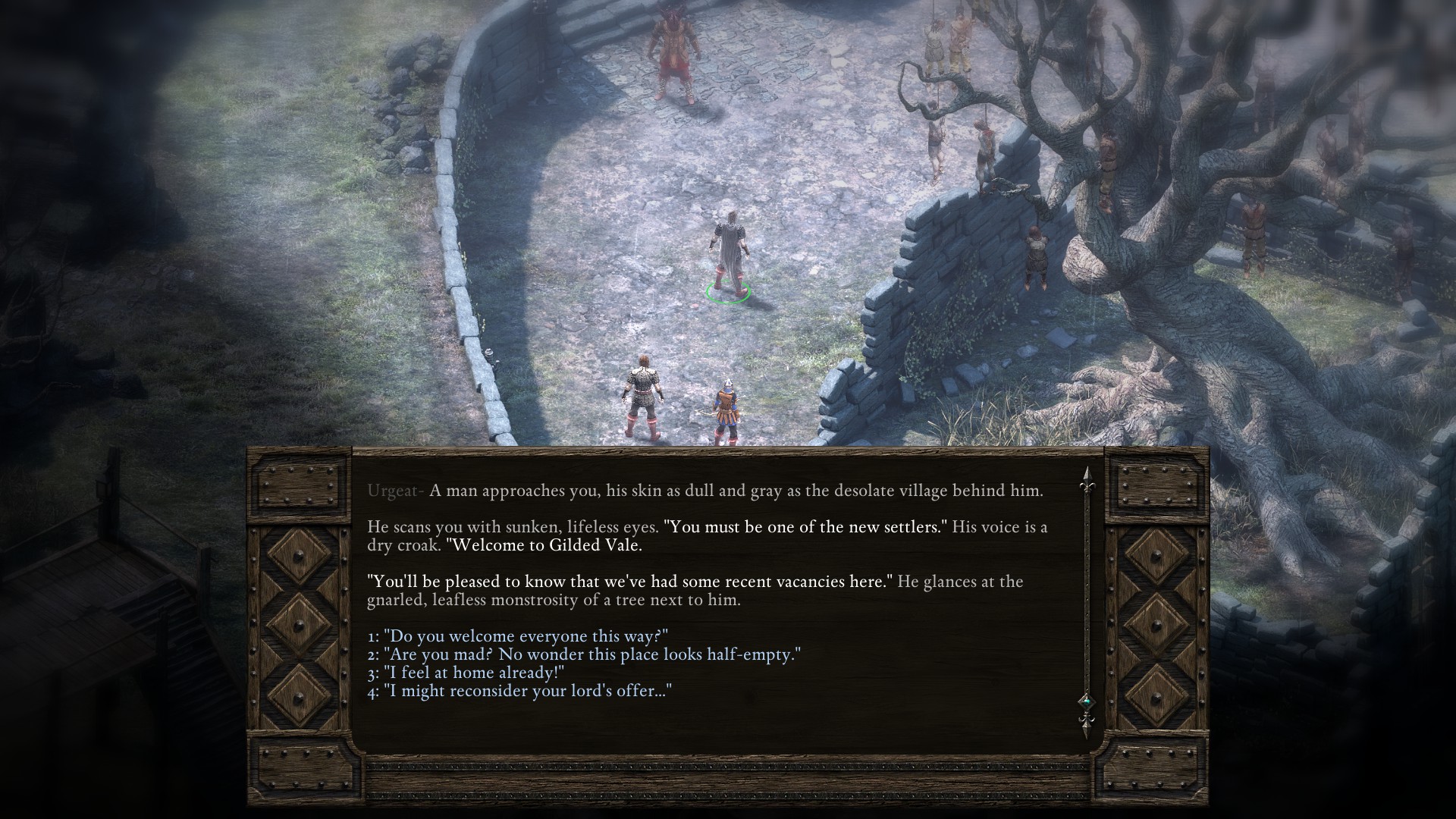
PoE-Gilded Vale

This is really the only game I need to be talking about.  I played the crap out of all of Black Isle’s games, capping well over 200 hours in BG2.  Heck, it might even be more.  I own the BG remake on Android too, so the comparison between the Infinity Engine games and PoE is simple to make.

Gone are the D&D rulesets that were more hindrance than bonus.  In it’s place is a custom ruleset based on a D20 model but actually supports active combat.  The most important improvement for me is the casting/action bar, letting you know when an action will take place, making it miles easier to queue actions and movement.  Stats are a close second, where scumming just doesn’t make sense.  A warrior and a wizard may have the exact same stats, since they are not class specific.  For example, Might increases all damage and all healing.  Intelligence increase the AE and duration.  Constitution is HP and resists.  It’s smart and makes you want to spread the stats around a bit.

Where in the past, Wizards (and their kin) were always seen as the strongest bunch, that is not the case here.  There’s a limit of on the number of times you can rest in the wild and the Wizard takes a big hit here for it.  That’s compared to the Cipher who has skills used every combat that deal as much damage and cause as much disorder.  The Chanter isn’t too far behind with extremely powerful buffs/debuffs for the entire group, just like a Bard, and all passive to boot.  I made a monk (as my BG2 ultimate character was a monk) and I was pleasantly surprised at the power within.  It needs to take damage to survive but that happened most often.  A warrior with a shield is a sight to see mind you, Eder was practically immortal on my playthrough.

PoE - Adra Dragon

Combat itself varies from ho hum to crazy intensity.  There were multiple battles where I got squashed due to poor planning and execution.  There was only 1 fight where I was simply cheesed by the game, and that’s the optional dungeon final boss – the adra dragon.  At max level, with the best gear and skills I could find, he 1 shot the entire group (minus the tank) a bunch of times.  I spent 2 night trying to take him out “clean” but ended up using a petrification trap, a Chant for reload speed, damage buffs and 6x arbalests/guns to take him out.  Dead in 10 seconds.  The rest of the battles, for all their crazyness, were pretty darn fun.

I do have to mention the writing.  It is superb.  Each character is very well flushed out, with a unique point of view on the game.  Eder is wracked with guilt and questions about his brother, Aloth is going slowly insane, Kana is searching for a lost civilization, Durance redemption…The bad guy is also sympathetic in his own way, just like older games.  There are very few black and white decisions here, and there are ripple effects on your reputation across the game world.  Each person’s opinion adds more flavor and keeps the game very interesting.  Even the finale twist (there’s always a twist) is well executed.  A nice touch at the end is a Fallout-like storyboard of what your actions had as a consequence on the world.  I’ll take a few weeks off then make another run I’m sure.

Very highly recommended.