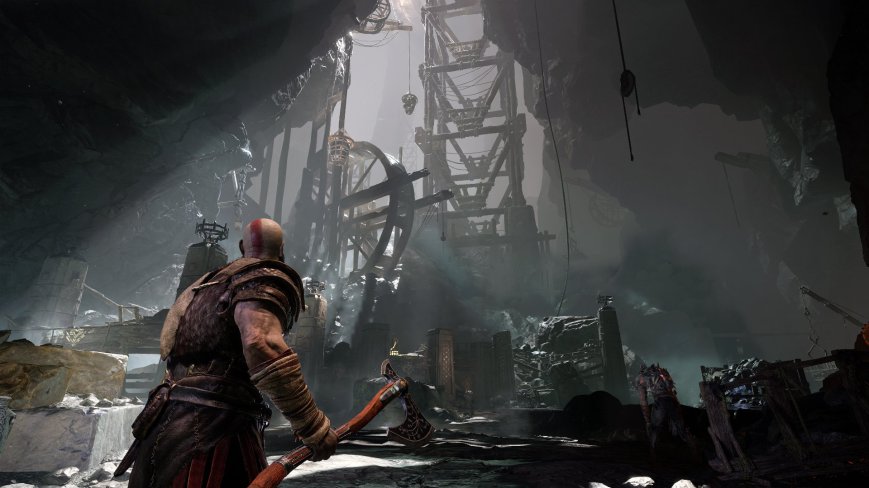
PUBG vs Fortnite

Full disclaimer, I am not a fan of the genre or either game. That said, I can appreciate the development approach to both games.  And is it ever an interesting approach.

PUBG is licensed off Epic.  It’s a B2P with micro transactions.  It was first to the party and was the king’s poop for quite a while.  Unfortunately, it was poorly optimized (read crashes and bugs), had long and empty stretches of nothing happening, and a struggle with customization/individual play styles.  Going for it — it was the only one on the market.

Let’s not dismiss that fact.  PUBG was first to market and spend nearly a year making more money than I could ever count.  It was proof that early access games could work.  It was also proof that early access games require a lot of polish to get ready for prime time.

Epic came in only a few months ago.  It already had the engine and needed a few tweaks to get the BR mode working.  By being 2nd (ish) to the game, they had the ability to play a ton of PUBG, read all the forums, parse their noted, and build something that addressed every single gap.

Let’s time travel a bit shall we?  EQ was the first “major MMO”.  It was on market for a while and made a lot of money.  WoW wasn’t much of a thought at first, but they did something smart.  They hired the EQ top-end guild members to help build their game.  These people came in with minimal game development expertise, but a ton of actual gaming know-how.  WoW addressed nearly every single issue that EQ presented to gamers and provided a level of polish that wasn’t found before.

The irony here is that EQ had plenty of feedback to help address their gaps.  The choices they made to address some and not others is what paved the path for WoW.  It was like a giant beta test for Blizzard’s benefit.


And here we are now, looking at the PUBG vs Fortnite development teams making dramatically different design decisions for the playerbase.  PUBG missed nearly every single development milestone, and is grasping to stay relevant.  Fortnite is going full bore in marketing, the lowest possible denominator.  You know you have a winner when schools are talking about banning it during class.

The lesson here is that it’s meaningless to be first out of the gate if you aren’t actively trying to stay at the top.  PUBG had an unexpected amount of success and no plan to manage it.  Epic played it smart, saw all the foundational mistakes, and built a better product.  Given their size and history, they certainly have a much better chance at staying #1.

That is, until the BR craze dies down and the next big thing hits us all in the head.
 

Weatherman Woes

This has got to be one of the most interesting jobs, right?  Whether you’re right or wrong, it doesn’t appear to matter much.  I’ve seen the same folks on TV/internets giving weather forecasts for years – and even saying what temperature it is currently can be a challenge.  This is more likely due to the large surface area they need to cover, but even so…For example, this weekend was supposed to be rain with a 90% chance from Friday through Sunday.  Most of the daylight hours.  It turned out we had 20 minutes on Friday, a storm overnight, then a sunny day Saturday, and overcast on Sunday.

What was supposed to be a weekend indoors at the cottage turned into a large labour effort in the yard instead.  Physical work always feels good, offsets the office hours nicely.

Friday Game

That said I did get a couple chances to play some Friday.  This is the solitaire/war – like card game for solo players.  I had mentioned that it was a hell of a challenge due to the RNG at the start.  That trends continues.

The game provides you with 4 phases – green, yellow, red, and pirates.  The first 3 phases are growth phases, where you are attempting to grow the power of your deck, by acquiring new cards and getting rid of bad ones.  Each of these phases moves forward once you complete the “challenge deck” – which shrinks in size over time.  The pirate phase is a set of bosses, where your deck is locked and you have to take on 2 large challenges.  The overall goal is to complete both of those challenges, with at your health points remaining.

Each card has a power level (ranges from -4 to +4) and has various skills attached (more health, card swaps, duplication, doubling of power).  The starting state is poor – you have many negative cards.  In order to grow the power of your deck, you need to beat various numerical challenges (e.g. get 2 points across 3 cards). Beating a challenge has you gain that challenge card.  Losing a challenge allows you to sacrifice life points and get rid of poor cards.  In the green phase, you want to do both, though losing is arguable more efficient in the long term.  At best, by the end of this round you have shrunk the challenge deck in half (from 30 to 15).   More likely, you’ve shrunk your hand deck from all negative point cards and acquired 5 challenge cards.

The yellow phase is the same as green, except that you need more points for the same set of challenges.  The goal here is to win as much as possible and shrink that challenge deck as much as possible.  This is hard, since most cards are only 1 power point and you need an average of 1.5 to beat any given challenge.  Skills come into play now, where you swap/boost other cards.

The red phase is attrition.  Whatever challenges remain are nigh impossible to win unless you have the best cards.  The weakest challenge cards from Green are actually the hardest now.  What was a 1 card pull for 0 points, now requires 5.  There are no 5 point cards.

If by the grace of some deity you complete red, you move onto pirate mode.  These require you to draw 6-10 cards to meet specific skill point values.  One has a 10/40 cap, which means you need an average of 4 points per card.  The only way to do this is with specific skill cards – doublers and copy cards.  A near perfect deck.  The other pirates aren’t much better.  Either you attack points are worth less, or you need to fight all the remaining challenge cards, or a set of other handicaps.  So in truth, it isn’t about surviving the first 3 phases.  It’s entirely about preparing for this one.

Across a dozen games:

  • reached yellow majority of times
  • reached red half the time
  • reached pirates a quarter
  • defeated 1 pirate once
  • never defeated both pirates

That 1 pirate victory cost me every single card and life point.  And it was a softball card compared to some others.

There’s some strategic growth to be had, but it’s clear that only a single strategy will work and that the card-to-card tactics require more card counting for success.

Single Player Strength

PCs are dead.  RPGs are dead.  MMOs are dead.  Everything is dead.  In the gaming world, nothing ever dies, it just gets transformed.

God of War (and Isey) put this into perspective for me.  There was arguable a large drought of single player games for a long time.  The big-bandwagon for nearly 10 years was MMO or competitive shooters.  The former genre seems to have peaked, while the latter is moving into the Battle Royale flavor-of-day.

Side-note: I would guess that the large amount of player toxicity in multi-player games is pushing people away.  The big companies are trying to address it, but we’re still plenty of years away from that getting better.

That’s not to say we didn’t have quality single player games – we most certainly did.   But they fell into one of two main categories: shooters or RPGs.  The Mass Effect series (I only count 1 & 2) moved between these 2 models.  Uncharted went from puzzle focus, to action movie mayhem.  Divinity: Original Sin, Pillars of Eternity, Planescape, Tyranny are all quality examples of pure RPGs.  XCOM and Civ are outliers that nearly dominate their own genres.

Not too many puzzlers, though Firewatch and The Witness certainly shine.  Or add a massive indy library of puzzlers.

Why though?

Technology

The obvious one here is that technology has progressed so far that imagination can be transcribed to a game.   Complex numbers can be crunched in fractions of a second.  Amazing AI can provide a level of realism that was not possible only a few years ago.  Graphic fidelity is almost absurd today.  I mean, compare something like Avatar to God of War, Monster Hunter, or Horizon.  The line between game and experience is being blurred further.

Stories

The snowball effect of quality storytelling is taking shape.  Mass Effect, BioShock, Uncharted – all are great examples of risk taking in the story.  Some of them play more like interactive movies but others feel like a choose your own adventure.  Hundreds of hours of options and dialogue are created for a game, and only a small portion will ever see the light of gameplay.  Developers are willing to put in hard branches on the story.  Killing off everyone in town means that you lose all the quests in that town for the rest of the game.  Real, actual, permanence.  Something that nearly all multi-player games are incapable (EvE and perhaps UO excluded).

Cohesion

The kitchen sink approach to gaming was all the rage for a while.  A whole bunch of systems, things to do, but none of it linked together.  Games like Fable tried to bridge that gap, with only marginal success.  Most JRPGs are a single story, joined by multiple smaller settings.  One long corridor where the background changes every few hours.

The forward progress here is in the experience provided to the player, through the characters.  The worlds are fleshed out.  The story line has logic and the areas are thematically linked.  Take the Tomb Raider reboot.  If you took the mechanics/visuals and applied it to previous games, it still wouldn’t work.  What does work, is how the island setting (or mountain in the 2nd game) feel like they exist in a real world.  The set pieces flow with the story, and Laura experiences something memorable in each.  I will remember that zipline down from the tower for a long time.

Choice

Given the player choice, or agency in the game, brings the player into the experience.  There is a very large difference between a sandbox (e.g. any Ubisoft game) with a bunch of tasks, versus an open world with a toolset to deploy as you see fit.  I’ll pick on Horizon here.  Sure, there are tasks and they are thematically similar – hunt, discover, hide.  It could even be the same task; kill a bear-cat robot for example.  It’s the setting and your set of tools that determines how you approach that task.   Are there other monsters around?  Do you have stun ammo?  Fire Arrows?  Is there cover?  Do you have a mount?

God of War provides a similar amount of choice in the various battles.  You can go full offense, play defensively, use Atreus, dive into deep damage from skills, or head the stun route.  Each option is viable, in a given situation.  That level of complexity, variety, and choice means that the game doesn’t feel stale.  The variety of events that you’d get from a human player can now be simulated to great effect in a single player game.

Don’t Call It a Comeback

Single player games never really left.  The cheap availability of networking allowed for multiplayer games to move from the living room sofa to the Internets instead.  That growth shadowed the single player realm, and it kept puttering along.  Now that the multiplayer market has neared (if not passed) it’s peak, it’s a great time to pay attention to excellently crafted single player experiences once again.

God of War – Story Complete

There’s still a fair amount left to complete.  2 more zones, a bunch of Valkyrie (in a later post), a dragon, some quests.  But the story is done.  Minor spoilers I guess inside.

I’ve talked about the early parts of the game.  Kratos and his son Atreus have a quest to spread their wife/mom’s ashes on the highest peak.  They directly meet the world serpent, Mimir, Baldr, Magni and Modi along the travels.  They also meet a pair of dwarven brothers who help with crafting.  The story seems small but ends up growing into a really neat epic tale, that explores the Norse mythology before vikings.  It works.

The meme of “BOY” makes sense in this game.  As much as it applies to Atreus and Kratos’ rough exterior, it also applies to Kratos.  Atreus ends up learning a whole lot given his sheltered upbrining, but it’s Kratos that finally understands his place in the pantheon.  He hides his story from Atreus for most of the game, and in a cathartic moment finally reveals it all.  It’s Atreus’ response to that, and Kratos’ acknowledgement of his past sins that makes this entire arc work.

Along the path they learn about the various nordic gods – in particular about the marital woes of Odin and Freya, the destructive will of Thor, the higher learning of Tyr, and the fate of the Jotun (giants).  You get to see the Bifrost and Yggdrasil.  You get a great feeling that the presented world is integrated and cohesive.  The underlying efforts to integrate the lore – in particular with Mimir’s stories while on the boat – make it feel like the world is lived in, even if there are only a handful of NPCs.

It is also a beautiful game.  I cannot recall any other PS4 game where I saved as many screenshots.  The final shot of the game…wow.  That was someone’s imagination, and someone else’s skill to make it reality.  Superb.

There are 2 main twists in the story.  After the first, there’s a bit of a dip in how Atreus is portrayed, without much justification.  It rights itself eventually and grows a lot from that point.  The final twist I saw coming from earlier on (given that I like Norse mythology and a main part was missing from this story), but the actual reveal is very impressive, and quite sad.  There’s no credit screen either, just a somber Kratos telling Atreus the origin of his name while they walk back towards home.

700px-48_mothersashes-mov-00_11_20_07-still002

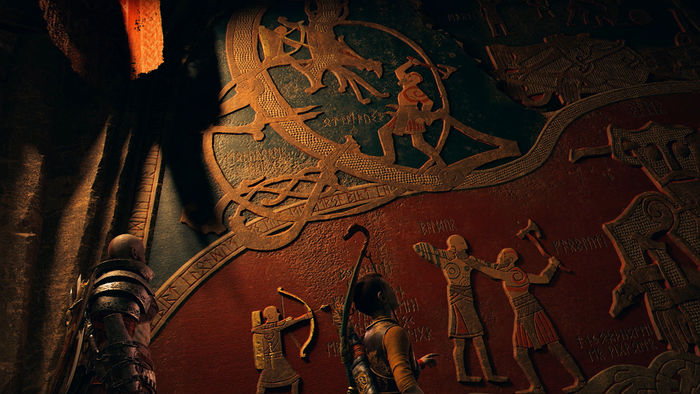
Scene shortly before the end – these murals are great

You don’t actually visit all 9 realms, and I’m ok with this.  The 3 remaining realms are way more complicated and lively than the rest of the game, at least in terms of lore.

I agree with the lead dev, in that the game is story complete and does not need any DLC.  I don’t see how that could ever be adequately contained in typical DLC.  It’s not like Odin’s house is DLC – that’s more like sequel territory.

God of War is so far beyond what the previous GoW provided, and clearly has taken the new single-player story driven mechanics to heart.  It bears note that Naughty Dog bears the burden of this trend swap, what with Uncharted and Last of Us.  Games since then have improved on that model – Horizon and now God of War included.


Long Weekends are the Best

Nothing blew up at the cottage this weekend.  And the weather was great for 2 of 3 days.   All smiles from that front.

Spring cleaning was in full effect though.  A fire burnt all day Sunday while we got rid of dead plants, cleared some space, and chopped some wood.  Moving more stuff around and re-organizing was a workout in itself.  As much as the body is tired afterwards, I need the physical work and sunlight to stay sane.  Office work sucks the life out of me sometimes.  Now nearly everything is set up as we need, only need to drop the boat in the water and we’ll be good for the season.

Three bits of gaming to be had.

God of War

Spoiler.  I found a dead giant whose fingernail was larger than Kratos.  That was cool.  A bit more story progress, including a large plot reveal came about.  There’s an overall dip in the character of Atreus for a while, which has yet to be explained properly.

Of more interesting note is that I’m able to attack Valkyries now.  I’ve taken down 4 now, and they are a heck of a battle.  It’s 90% defense, and counterattacks, meaning a lot of memorization.  It is a massive thrill to take one down.

Friday

The boardgame.  It’s like a combination of solitaire, war, and deck building.  Except the deck building is more RNG than I like.  I’ve gone through a dozen or so rounds now, and only hitting the halfway mark about half the time.  It’s a good fun, but some extremely painful to see a good run come to nothing due to 1 bad card pull.   Still, it’s fun to try new strategies, and for the price you can’t go wrong.

Escape: Zombie City

A manic dice roller, with coop to boot.  I much prefer coop games than competitive ones.  Mainly because it takes more thought and planning for those games to work, and like it or not, even in coop there’s some competitiveness to the game.

Here you are given 5 dices, items to collect, zombies to kill, a map to explore, and a van to drive away.  And 15 tense minutes to accomplish it all.  The base game is ok, but it really requires the expansion pack to shine.  The addition of classes, skills, and more complex map tiles adds some much needed replayability.  The delivery girl and grandma are extremely useful.  Funny that.

I’ve lost a few times, but more often than not end up winning with 3 players.  The rules can be simplified for kids, though they are not all that complex to start.  You can increase the difficulty by changing some of the cards, and that’ll be for the next few runs.

There’s something to be said of 2-4 people rolling like mad against a clock.  Then someone asking for help all the way on the other side of the map.  Controlled chaos is a blast!

Exploration is Fun

I’ve unlocked the 2nd part of the Lake of Nine in GoW, which allows access to most of the side areas.  I know I’m missing 2 abilities – hitting green orbs, and burning some roots without explosions.  Not a big deal.

Rather than continue with the main quest, I decided to take my time to explore the lake.  There are a dozen or so docks around the place, a similar amount of side quests, treasure maps, realm tears to close, chests to loot, and orbs to collect.  There are good and less good parts to this.

The less good to start.  There are some enemies that are dramatically more powerful than me and can (and have) kill me in a single hit.  Most of those battles had me re-try a dozen+ times.  I’ve been able to take them all down, with the exception of Travellers.  Those buggers are walking death machines.  The other fights were all extremely challenging, and I had to get extra creative to get through them.  Atreus being fully upgraded is a MASSIVE benefit.  I should have invested in him earlier.

The good is multi-part.  First, I am much better at the game due to the above difficulty.  When I started exploring, I would end up getting hit every so often.  Now, I can avoid 3 killer enemies at the same time, dodge through multiple hits, and still get in some solid damage.  That feels really good.

The next boost is just plain power increases.  There are some items I’ve collected that improve my baseline stats, extra gear, and extra runes to get stronger.  Numerically, I would say I’m twice as strong as I was before I started.

I’ve also unlocked a bunch of portals that will eventually allow me to teleport across the map, meaning faster travel in the future.  GoW is a big game, so fast travel would be quite beneficial.

Finally, I’ve seen some pretty inventive quests and areas.  There’s some broken pirate ships and an interesting elevator puzzle.  There’s a sea giant that “drowned” out of the water.  There’s the council of Valkyries which looks straight out of a movie.  Fafnir’s quest has you freeing a dragon.  Thor’s statue is next.

Direction

Finding the balance between directed and open gameplay is very tough.  FF14 wasn’t much fun until it opened up.  FF15 wasn’t fun because it was so open.  AC:O has levels, which provides some framing – just that the activities are too similar.  I’m not saying GoW is perfect in that balance, as it clearly wants to have players backtrack later in the game.  I am saying that the open gameplay is purposefully designed, rather than just a bunch of random icons thrown on a map.  It makes it so that there’s additional puzzles around every corner, rather than repeating the same 4-5 steps ad-infinitum.

Kind of relates to what I like in real life truthfully.  I like a foundational stability (structure) but also need the continual challenge of exploration and growth.  Too much structure bores me.  Too much volatility exhausts me.  Always forward.


GoW – Progress

I will say it’s a lot different playing God of War after Assassin’s Creed: Origins.  Combat in both follows the same concept of 1v1, but the mechanics are wildly different.

AC:O has 3 types of enemies.  Archers, melee grunts, and shielded bosses.  Small variations within, but those are the big ones.  The first two are dumb and can only take you down in numbers due to a stun-lock effect.  Shielded bosses are bit tougher, since you either have to break their defense, or dodge attacks to counter.  There are only a few of them in the game.

GoW has melee grunts, sure.  It has ranged attackers as well.  Even shielded bosses.  Then it has ghosts, exploding eyeballs, fast poisoners, kamikaze enemies, flyers, ogres, and trolls.  1 or 2 mistakes and you’re dead.  The game rewards smart play, and severely punishes dumb moves.  And it continually adds new challenges, by adding new enemy types and group combinations.

That’s just enemies.  Then there’s you.

In AC:O your power is directly related to your level and the weapons you have.  The skills are useful, but more as tweaks than pure numbers.  It doesn’t matter what skills you have, if you’re 5 or 10 levels under the enemy, you’re dead.  Some moves you simply can’t avoid (due mainly to Ubisoft’s loose combat controls).

GoW doesn’t care about levels, it cares about gameplay.  I’ve gone into battles against clearly more powerful opponents and still come out the victor.  Investing in runes (special attacks that do AE, Stun, or Damage), gear that has different stat sets and bonuses, or just plain more skills for extra combat options is the way to go.

Example is one skill that let’s you block a ranged attack and shoot it back at an enemy.  Huge quality of life boost.  Or another than let’s you tag 3 enemies for a ranged attack.  Or more stuns from Atreus, or extra healing, or… plenty of things.  It honestly feels like the game provides you a toolbox of options, and it’s up to you to see what fits your style.

gow_launchscreen4-max-1920x1200

In the Mountain

Better example is a recent troll battle.  Normally trolls are drawn out affairs, with a few stages where additional grunts/ranged show up.  It feels like it’s raining fire.  In this particular case, I was able to throw some axes at his head, enter rage mode for some quick damage, then used some high damage runes to bring him down.  Atreus used his Wolf summon to take out the grunts, and I picked up the pieces.  What would normally take 5 minutes was done in 20 seconds, because I used the right tools, at the right time.

Extremely rewarding.


EA Being EA

Quick article regarding EA + loot boxes, in particular after Belgium/Netherlands have banned loot boxes.

Two items stick out to me.

which has helped the company grow year-over-year to $1.25 billion during its last quarter even without releasing a major new game.

Make no mistake, EA is a publicly traded company with a sole goal – making money.  Anything else is bonus.  That they can pull in such a large sum of money is impressive.  I’m actually quite surprised that EA hasn’t jumped 110% on the Battle Royale bandwagon yet… seems a market prime for the taking.  Then again, they’ve avoided MOBAs like the plague.


EA, of course, says it doesn’t think FIFA Ultimate Team and other video game loot boxes are equivalent to slot machines.

First, players always receive a specified number of items in every FUT pack,” the executive explained. “Second, we don’t provide or authorize any way to cash out digital items or virtual currency for real-world money. And there’s no real-world value assigned to in-game items.

I argued the same point in the past, at least in terms of gambling from a legal perspective.  There’s a flaw in this argument though – in that the law itself is changing.  Just like online gambling was unregulated for a very long time, laws eventually caught up.  It’s naive to think that this massive cash cow would not have regulations applied to it.

EA is an american company and has plenty of lobbying power in that country.  Apple, Google, and Microsoft are much larger and lost to a massive degree when trying to fight EU countries when it comes to money.  I am having trouble seeing how this goes any other way that tight international regulations.  That, or the EU stops being a viable gaming market.

That said, I do look forward to EA trying to keep pushing lockboxes.  I have a lot of popcorn around here, and this will be a fun show.

God of War

I mentioned a few weeks ago that the PS4 had clearly won this generation’s console wars.  It’s been 2 years of home runs.  Then God of War comes out.

Side Track

I play on a projection screen in my basement.  I’ve set up the entire thing a long time ago to get a full experience.  The week before my bulb burst (kapow) and I needed to order a new one.  It arrived on the weekend, but it’s pretty clear that the projector itself is busted.  Useable, but there’s a blue band meaning that the internal wheel is broken.  It’s also too dim.

I thought about getting a TV.  The projection screen is about 120′ diagonal.  55′ screens are very cheap.  65’+ are twice the price.  Something even close to comparable was $3000.  I’m good.  A new projector is sub-$1000, assuming you have all the setup available.  Input lag is about 30ms, which isn’t great for twitch work, but enough for 90% of all games.  Research + Amazon = new project here on Friday.

Setting

There are 3 large pantheons that have influenced the west and are no longer “actively” practiced.  Egyptian, Greco-Roman, and Norse.  There are more of them, but they are either smaller (Mesoamerican) or still actively practiced (Hinduism/Buddism).  We don’t see much of these in gaming, except for perhaps Tomb Raider / Uncharted.

Back on track.  Nordic gods are very interesting.  In English society, we celebrate Tyr’s day, Woden’s day, Thor’s day, and Freya’s day.  French, being a Latin tongue, is Greco-Roman instead.  Lots of people are familiar with the term Ragnarok, though few know the level of detail that story actually holds.

Well worth the week or so of Wikipedia sleuthing to dig more out of it.

Start

Kratos is up north in the cold, with a small boy (memes abound), after the death of his wife.  He still has rage issues, though they are focused in this case.  There’s something to be said about the parent/child structure in gaming.  Last of Us really hit this one strong… and God of War is hitting all the right notes.

The tutorial is smooth enough, where you get a basic grasp of the controls by walking around through a temple and back home.  Combat is directed to 1v1, rather than 1vsMasses.  It makes it a lot harder when groups attack you, since you need some situational awareness.  Even more so when you’re facing weak enemies, tanks, and ranged foes at the same time.  It isn’t about button mashing, but about timing, priority targets, and understanding which attacks work on which foes.  I am not ashamed to admit that by the time I unlocked the Lake of Nine, I had died a dozen times.

There are sub-systems of course.  You have skills that are unlocked over time.  Runic attacks that act as special attacks.  Talisman’s for some boosts.  You can craft/upgrade equipment slots in order to make numbers bigger.  I’m sure it’s important, but for the initial portion, it’s superfluous.

There are chests in most nooks.  Most are simple.  Some have minor puzzles – such as smashing targets, or chaining bell strikes.  There’s a benefit to exploring.

And exploring really provides more than item benefits.  The world building here is astounding.  Where Horizon focused on the open world, God of War is like zooming in on a painting.   Each area is crafted with purpose – pits and spiked to hurt enemies, stones to avoid line of sight, twists to make chasers stumble.  All of it beautiful.  All of it massive.

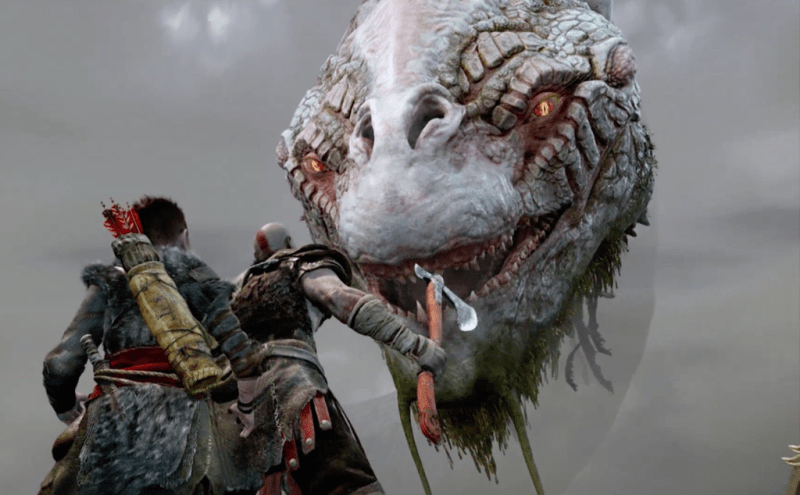
Jormungand

This picture does not do justice to the size of this wyrm.

The entire game is a single shot take.  From the start menu until I stopped it for the night, it felt like a giant film.  It doesn’t feel like you’re playing a game, as it lends a level of intimacy to the game.  It can be tough when you spin around to dodge something, as the screen shifts quickly, but you get used to it.  Long story short – it works.

I mentioned I reached the Lake of the Nine portion, if that means anything to players.  I met another god along the way, a nordic dwarf, a forest witch and 2 massive creatures.  This portion feels like a hub, as its the first time I found a spot I could not traverse.  Meaning backtracking at some point.

I stopped playing because of that big thing above.  I won’t ruin it further but that was enough for my brain to handle for a night.

I am but a smidgen into the game and already extremely impressed.  I would never have imagined that gaming could be this good when I was a kid.

Assassin’s Creed: Origins – Complete

I was Ubisoft-ed.

More specifically, I was impressed for a long time… then the game dragged on with too much clutter.  Like a book with a 6 chapter epilogue.

Plot

We’re far enough in that spoilers don’t really apply.  The game is about the origin of assassins in ancient Egypt.  You play Bayek, a father out for revenge for the death of his child.  You sometimes meet up with your wife Aya (who in a nice twist is better than you at pretty much everything), and go about taking our the pre-Templar Order.  You’re smack in the Ptolemy/Cleopatra timeframe, which is probably the most well-known for most people.  The bad guys have some interesting motivations, and some you can empathize with.  Some go to absurd lengths to “be bad”.  Eh.

The game starts with 5 targets to take out.  Then you realize there’s another 5.  Then you get told there’s another 2.  Then another 2.  Enough already.  There are some ties to the “advanced civilization”, but they are more easter eggs than anything else.  What’s here instead is promise of something better.  Like a new foundation to grow.

I will say that I was disappointed when I played as Aya.  You are restricted in ability and weapon types – all the while knowing that she is by far the better assassin of the two.  It feels like you’re hobbled, rather than empowered.

World Building

Ancient Egypt is a very interesting setting.  This is not that time setting, but instead at the time of Ceasar.  Guess it’ll do.

The actual map of Egypt is massive and impressive.  There are large amazing vistas throughout.  Running through a desert feels exhausting and beautiful at the same time.  The pyramids, tombs, and Pharos lighthouse are well constructed.  It’s impressive to think that these large items were in people’s backyards for thousands of years.

The downside to this setting is the sheer amount of open space.  Where more recent games had a decent mix of horizontal and vertical exploration… AC:O is almost entirely horizontal.  I like the climbing and parkour, and there’s only a bit of it here.  Not much they can do about it really…

Mechanics

It’s level based, and unless you complete side-quests and side-areas, you’re going to be drastically underleveled.  In fact, if you’re not 5+ levels above the current area, you’re in for a bad time.  Phylakes will take you out in 2 hits.  Any fight with more than 3 enemies is likely to do the same.  It’s not fun.

When you are the correct level, and have the necessary tools to be an assassin (sniper bow, chain assassinations, boosted overpower), then the game becomes fun.  Taking out a giant base of enemies from the shadows does not get boring, even after the 50th time.   That part works.

The other parts of the game – like animal hunting, or treasure hunting – I could do without.  There’s no challenge here.  You just go into combat, or press  the scan button to find the loot.

War Elephant battles are a fun mess.  There’s 4 of them (not counting a boss), and they are each a decent challenge in their own way.  They are stupid in their own way as well, since it is the complete opposite of a sneaky assassin.  Instead you’re a single guy, taking on a 15 foot beast, mounted by archers.  Small doses works.

There are tombs to hunt and extremely simple level puzzles.  They have value from a historical perspective so that players learn about Egypt.  Aside from that…

The Stone Circle puzzles are simple “square peg in square hole” events.  They eventually unlock a giant puzzle in the Sphynx for some neat-looking armor (with no in-game effect).

At later levels you can take on the gods themselves (or rather computer generated glitches of them).  All are the same model of shoot arrows into the chest, avoid the red spots, kill the waves of bad guys.  Good way to get gold-level gear I suppose.

I’d guess there are a couple hundred of the map icons with things to do.  Some areas are dense, others sparse.  For a long time it’s fun to just complete a bunch of activities while you’re moving forward.  After a bit, you start having to backtrack or go out of your way. By the time you wrap back to Siwa…you’ve had enough.  I’m sure there are another 10 hours of activities here but I’ve killed enough Hyenas, explored enough tombs, cleared enough guardposts to keep me satiated for a good 2 years.

Overall, the mechanics work ok, but it seems more like the devs were testing ideas than really knowing what to do with them.  It feels like a buffet of options, with hot pockets in one corner, and filet mignon in the other.

Overall

Each AC has one particular item that defines it.  It could be a gimmick, but it’s something that you can stick your memories to.  In AC:O, that item is the level-based structure.  It’s experimental and flawed, but certainly has potential.  The highlight of the experience is the setting.  Egypt is absolutely beautiful, and the devs went to great lengths to put pieces of history and context throughout.  Quite impressive.

The rest of the game is ok – vanilla in a way.  It kept me busy for quite a long time, always wondering what was over the next hill.  I’m happy with the purchase, and overall curious as to what Ubisoft will do with this interesting experiment.