Exploration is Fun

I’ve unlocked the 2nd part of the Lake of Nine in GoW, which allows access to most of the side areas.  I know I’m missing 2 abilities – hitting green orbs, and burning some roots without explosions.  Not a big deal.

Rather than continue with the main quest, I decided to take my time to explore the lake.  There are a dozen or so docks around the place, a similar amount of side quests, treasure maps, realm tears to close, chests to loot, and orbs to collect.  There are good and less good parts to this.

The less good to start.  There are some enemies that are dramatically more powerful than me and can (and have) kill me in a single hit.  Most of those battles had me re-try a dozen+ times.  I’ve been able to take them all down, with the exception of Travellers.  Those buggers are walking death machines.  The other fights were all extremely challenging, and I had to get extra creative to get through them.  Atreus being fully upgraded is a MASSIVE benefit.  I should have invested in him earlier.

The good is multi-part.  First, I am much better at the game due to the above difficulty.  When I started exploring, I would end up getting hit every so often.  Now, I can avoid 3 killer enemies at the same time, dodge through multiple hits, and still get in some solid damage.  That feels really good.

The next boost is just plain power increases.  There are some items I’ve collected that improve my baseline stats, extra gear, and extra runes to get stronger.  Numerically, I would say I’m twice as strong as I was before I started.

I’ve also unlocked a bunch of portals that will eventually allow me to teleport across the map, meaning faster travel in the future.  GoW is a big game, so fast travel would be quite beneficial.

Finally, I’ve seen some pretty inventive quests and areas.  There’s some broken pirate ships and an interesting elevator puzzle.  There’s a sea giant that “drowned” out of the water.  There’s the council of Valkyries which looks straight out of a movie.  Fafnir’s quest has you freeing a dragon.  Thor’s statue is next.

Direction

Finding the balance between directed and open gameplay is very tough.  FF14 wasn’t much fun until it opened up.  FF15 wasn’t fun because it was so open.  AC:O has levels, which provides some framing – just that the activities are too similar.  I’m not saying GoW is perfect in that balance, as it clearly wants to have players backtrack later in the game.  I am saying that the open gameplay is purposefully designed, rather than just a bunch of random icons thrown on a map.  It makes it so that there’s additional puzzles around every corner, rather than repeating the same 4-5 steps ad-infinitum.

Kind of relates to what I like in real life truthfully.  I like a foundational stability (structure) but also need the continual challenge of exploration and growth.  Too much structure bores me.  Too much volatility exhausts me.  Always forward.
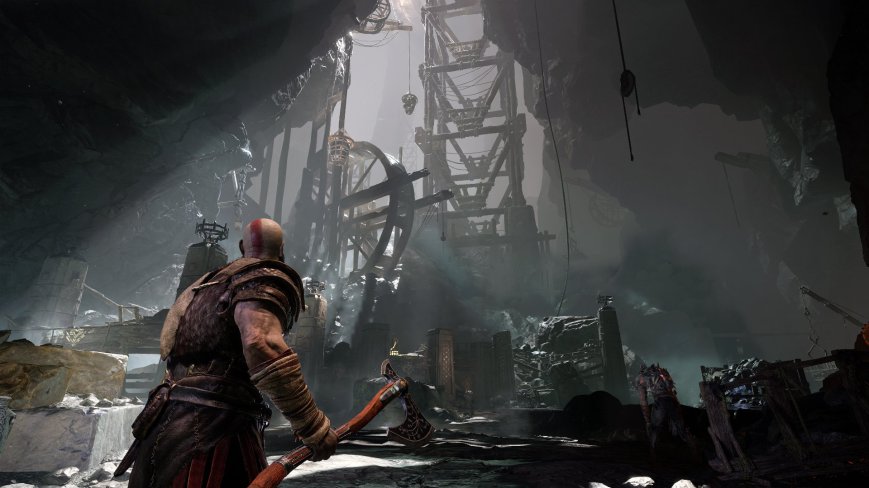


GoW – Progress

I will say it’s a lot different playing God of War after Assassin’s Creed: Origins.  Combat in both follows the same concept of 1v1, but the mechanics are wildly different.

AC:O has 3 types of enemies.  Archers, melee grunts, and shielded bosses.  Small variations within, but those are the big ones.  The first two are dumb and can only take you down in numbers due to a stun-lock effect.  Shielded bosses are bit tougher, since you either have to break their defense, or dodge attacks to counter.  There are only a few of them in the game.

GoW has melee grunts, sure.  It has ranged attackers as well.  Even shielded bosses.  Then it has ghosts, exploding eyeballs, fast poisoners, kamikaze enemies, flyers, ogres, and trolls.  1 or 2 mistakes and you’re dead.  The game rewards smart play, and severely punishes dumb moves.  And it continually adds new challenges, by adding new enemy types and group combinations.

That’s just enemies.  Then there’s you.

In AC:O your power is directly related to your level and the weapons you have.  The skills are useful, but more as tweaks than pure numbers.  It doesn’t matter what skills you have, if you’re 5 or 10 levels under the enemy, you’re dead.  Some moves you simply can’t avoid (due mainly to Ubisoft’s loose combat controls).

GoW doesn’t care about levels, it cares about gameplay.  I’ve gone into battles against clearly more powerful opponents and still come out the victor.  Investing in runes (special attacks that do AE, Stun, or Damage), gear that has different stat sets and bonuses, or just plain more skills for extra combat options is the way to go.

Example is one skill that let’s you block a ranged attack and shoot it back at an enemy.  Huge quality of life boost.  Or another than let’s you tag 3 enemies for a ranged attack.  Or more stuns from Atreus, or extra healing, or… plenty of things.  It honestly feels like the game provides you a toolbox of options, and it’s up to you to see what fits your style.

gow_launchscreen4-max-1920x1200

In the Mountain

Better example is a recent troll battle.  Normally trolls are drawn out affairs, with a few stages where additional grunts/ranged show up.  It feels like it’s raining fire.  In this particular case, I was able to throw some axes at his head, enter rage mode for some quick damage, then used some high damage runes to bring him down.  Atreus used his Wolf summon to take out the grunts, and I picked up the pieces.  What would normally take 5 minutes was done in 20 seconds, because I used the right tools, at the right time.

Extremely rewarding.


EA Being EA

Quick article regarding EA + loot boxes, in particular after Belgium/Netherlands have banned loot boxes.

Two items stick out to me.

which has helped the company grow year-over-year to $1.25 billion during its last quarter even without releasing a major new game.

Make no mistake, EA is a publicly traded company with a sole goal – making money.  Anything else is bonus.  That they can pull in such a large sum of money is impressive.  I’m actually quite surprised that EA hasn’t jumped 110% on the Battle Royale bandwagon yet… seems a market prime for the taking.  Then again, they’ve avoided MOBAs like the plague.


EA, of course, says it doesn’t think FIFA Ultimate Team and other video game loot boxes are equivalent to slot machines.

First, players always receive a specified number of items in every FUT pack,” the executive explained. “Second, we don’t provide or authorize any way to cash out digital items or virtual currency for real-world money. And there’s no real-world value assigned to in-game items.

I argued the same point in the past, at least in terms of gambling from a legal perspective.  There’s a flaw in this argument though – in that the law itself is changing.  Just like online gambling was unregulated for a very long time, laws eventually caught up.  It’s naive to think that this massive cash cow would not have regulations applied to it.

EA is an american company and has plenty of lobbying power in that country.  Apple, Google, and Microsoft are much larger and lost to a massive degree when trying to fight EU countries when it comes to money.  I am having trouble seeing how this goes any other way that tight international regulations.  That, or the EU stops being a viable gaming market.

That said, I do look forward to EA trying to keep pushing lockboxes.  I have a lot of popcorn around here, and this will be a fun show.

God of War

I mentioned a few weeks ago that the PS4 had clearly won this generation’s console wars.  It’s been 2 years of home runs.  Then God of War comes out.

Side Track

I play on a projection screen in my basement.  I’ve set up the entire thing a long time ago to get a full experience.  The week before my bulb burst (kapow) and I needed to order a new one.  It arrived on the weekend, but it’s pretty clear that the projector itself is busted.  Useable, but there’s a blue band meaning that the internal wheel is broken.  It’s also too dim.

I thought about getting a TV.  The projection screen is about 120′ diagonal.  55′ screens are very cheap.  65’+ are twice the price.  Something even close to comparable was $3000.  I’m good.  A new projector is sub-$1000, assuming you have all the setup available.  Input lag is about 30ms, which isn’t great for twitch work, but enough for 90% of all games.  Research + Amazon = new project here on Friday.

Setting

There are 3 large pantheons that have influenced the west and are no longer “actively” practiced.  Egyptian, Greco-Roman, and Norse.  There are more of them, but they are either smaller (Mesoamerican) or still actively practiced (Hinduism/Buddism).  We don’t see much of these in gaming, except for perhaps Tomb Raider / Uncharted.

Back on track.  Nordic gods are very interesting.  In English society, we celebrate Tyr’s day, Woden’s day, Thor’s day, and Freya’s day.  French, being a Latin tongue, is Greco-Roman instead.  Lots of people are familiar with the term Ragnarok, though few know the level of detail that story actually holds.

Well worth the week or so of Wikipedia sleuthing to dig more out of it.

Start

Kratos is up north in the cold, with a small boy (memes abound), after the death of his wife.  He still has rage issues, though they are focused in this case.  There’s something to be said about the parent/child structure in gaming.  Last of Us really hit this one strong… and God of War is hitting all the right notes.

The tutorial is smooth enough, where you get a basic grasp of the controls by walking around through a temple and back home.  Combat is directed to 1v1, rather than 1vsMasses.  It makes it a lot harder when groups attack you, since you need some situational awareness.  Even more so when you’re facing weak enemies, tanks, and ranged foes at the same time.  It isn’t about button mashing, but about timing, priority targets, and understanding which attacks work on which foes.  I am not ashamed to admit that by the time I unlocked the Lake of Nine, I had died a dozen times.

There are sub-systems of course.  You have skills that are unlocked over time.  Runic attacks that act as special attacks.  Talisman’s for some boosts.  You can craft/upgrade equipment slots in order to make numbers bigger.  I’m sure it’s important, but for the initial portion, it’s superfluous.

There are chests in most nooks.  Most are simple.  Some have minor puzzles – such as smashing targets, or chaining bell strikes.  There’s a benefit to exploring.

And exploring really provides more than item benefits.  The world building here is astounding.  Where Horizon focused on the open world, God of War is like zooming in on a painting.   Each area is crafted with purpose – pits and spiked to hurt enemies, stones to avoid line of sight, twists to make chasers stumble.  All of it beautiful.  All of it massive.

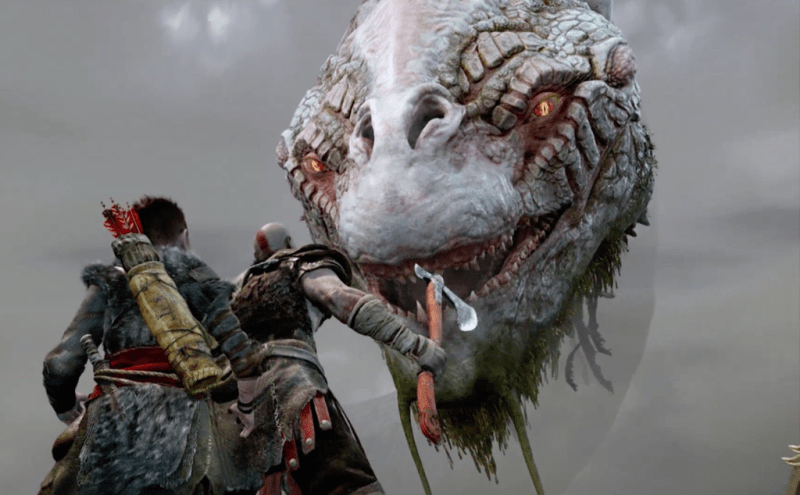
Jormungand

This picture does not do justice to the size of this wyrm.

The entire game is a single shot take.  From the start menu until I stopped it for the night, it felt like a giant film.  It doesn’t feel like you’re playing a game, as it lends a level of intimacy to the game.  It can be tough when you spin around to dodge something, as the screen shifts quickly, but you get used to it.  Long story short – it works.

I mentioned I reached the Lake of the Nine portion, if that means anything to players.  I met another god along the way, a nordic dwarf, a forest witch and 2 massive creatures.  This portion feels like a hub, as its the first time I found a spot I could not traverse.  Meaning backtracking at some point.

I stopped playing because of that big thing above.  I won’t ruin it further but that was enough for my brain to handle for a night.

I am but a smidgen into the game and already extremely impressed.  I would never have imagined that gaming could be this good when I was a kid.

Assassin’s Creed: Origins – Complete

I was Ubisoft-ed.

More specifically, I was impressed for a long time… then the game dragged on with too much clutter.  Like a book with a 6 chapter epilogue.

Plot

We’re far enough in that spoilers don’t really apply.  The game is about the origin of assassins in ancient Egypt.  You play Bayek, a father out for revenge for the death of his child.  You sometimes meet up with your wife Aya (who in a nice twist is better than you at pretty much everything), and go about taking our the pre-Templar Order.  You’re smack in the Ptolemy/Cleopatra timeframe, which is probably the most well-known for most people.  The bad guys have some interesting motivations, and some you can empathize with.  Some go to absurd lengths to “be bad”.  Eh.

The game starts with 5 targets to take out.  Then you realize there’s another 5.  Then you get told there’s another 2.  Then another 2.  Enough already.  There are some ties to the “advanced civilization”, but they are more easter eggs than anything else.  What’s here instead is promise of something better.  Like a new foundation to grow.

I will say that I was disappointed when I played as Aya.  You are restricted in ability and weapon types – all the while knowing that she is by far the better assassin of the two.  It feels like you’re hobbled, rather than empowered.

World Building

Ancient Egypt is a very interesting setting.  This is not that time setting, but instead at the time of Ceasar.  Guess it’ll do.

The actual map of Egypt is massive and impressive.  There are large amazing vistas throughout.  Running through a desert feels exhausting and beautiful at the same time.  The pyramids, tombs, and Pharos lighthouse are well constructed.  It’s impressive to think that these large items were in people’s backyards for thousands of years.

The downside to this setting is the sheer amount of open space.  Where more recent games had a decent mix of horizontal and vertical exploration… AC:O is almost entirely horizontal.  I like the climbing and parkour, and there’s only a bit of it here.  Not much they can do about it really…

Mechanics

It’s level based, and unless you complete side-quests and side-areas, you’re going to be drastically underleveled.  In fact, if you’re not 5+ levels above the current area, you’re in for a bad time.  Phylakes will take you out in 2 hits.  Any fight with more than 3 enemies is likely to do the same.  It’s not fun.

When you are the correct level, and have the necessary tools to be an assassin (sniper bow, chain assassinations, boosted overpower), then the game becomes fun.  Taking out a giant base of enemies from the shadows does not get boring, even after the 50th time.   That part works.

The other parts of the game – like animal hunting, or treasure hunting – I could do without.  There’s no challenge here.  You just go into combat, or press  the scan button to find the loot.

War Elephant battles are a fun mess.  There’s 4 of them (not counting a boss), and they are each a decent challenge in their own way.  They are stupid in their own way as well, since it is the complete opposite of a sneaky assassin.  Instead you’re a single guy, taking on a 15 foot beast, mounted by archers.  Small doses works.

There are tombs to hunt and extremely simple level puzzles.  They have value from a historical perspective so that players learn about Egypt.  Aside from that…

The Stone Circle puzzles are simple “square peg in square hole” events.  They eventually unlock a giant puzzle in the Sphynx for some neat-looking armor (with no in-game effect).

At later levels you can take on the gods themselves (or rather computer generated glitches of them).  All are the same model of shoot arrows into the chest, avoid the red spots, kill the waves of bad guys.  Good way to get gold-level gear I suppose.

I’d guess there are a couple hundred of the map icons with things to do.  Some areas are dense, others sparse.  For a long time it’s fun to just complete a bunch of activities while you’re moving forward.  After a bit, you start having to backtrack or go out of your way. By the time you wrap back to Siwa…you’ve had enough.  I’m sure there are another 10 hours of activities here but I’ve killed enough Hyenas, explored enough tombs, cleared enough guardposts to keep me satiated for a good 2 years.

Overall, the mechanics work ok, but it seems more like the devs were testing ideas than really knowing what to do with them.  It feels like a buffet of options, with hot pockets in one corner, and filet mignon in the other.

Overall

Each AC has one particular item that defines it.  It could be a gimmick, but it’s something that you can stick your memories to.  In AC:O, that item is the level-based structure.  It’s experimental and flawed, but certainly has potential.  The highlight of the experience is the setting.  Egypt is absolutely beautiful, and the devs went to great lengths to put pieces of history and context throughout.  Quite impressive.

The rest of the game is ok – vanilla in a way.  It kept me busy for quite a long time, always wondering what was over the next hill.  I’m happy with the purchase, and overall curious as to what Ubisoft will do with this interesting experiment.


Belgium Nixed Loot Boxes

Relevant article

More specifically, they have come to the decision that loot boxes are gambling, with a particular finger pointing to

  • FIFA 18
  • DOTA2
  • PUBG
  • Rocket League

Further, they need to remove the “almost winning” animations, the ability to chain open loot boxes, and prevent “vulnerable groups” from using them.  This is very similar to a casino effect, where a picture is on the wall.  That doesn’t always work, curious how it will apply to virtual games – user ID I suppose.

This doesn’t mean that lootboxes are illegal, oh no.  It means that selling lootboxes without a gambling license is illegal.

I’d be curious as to the process of getting a license in Belgium.  Canada it’s a rather tough slog, since all gambling is owned by the government (or native tribes).  The US is more about bribes than it is about getting an actual license – plus a massive aversion to anything considered online gambling.

The worst outcome for gaming companies is always legislative compliance.  Governments are notorious for putting everyone through the wringer to get the last cent… and tax evasion is the easiest way to get after a company on international terms.


How game companies comply with this change will be interesting.  Either they modify the entire game, modify it for that region, or stop offering the game in that region seem the most likely scenarios.  My guess is to stop offering based on IP would be the simplest.

What I’m interested in is how this trickles into other nations.  The US was all bluster on this front but no action.  If I was a gaming CFO, I’d be worried about this type of change.  Loot boxes are programmed to prey on the addictive tendencies of players.  There’s a reason they are such a massive cash cow.  Unless China or the US decides to take similar strides… I’d be quite curious to see how this plays out in the long run.  Maybe it’s just a blip on the radar, which would be quite a shame.

Console Wars

There’s a story that Nintendo has enough money stashed away to be unprofitable for a dozen years with no impact.  That works out since every other console seems to have less than ideal sales numbers.  It’s hard to say that they are even in the console wars… aside from connecting to a TV they are really living on their own planet.  I would hazard to guess that people don’t think “PS4, XBOX or Switch”.  They instead think “PS4 or XBOX… and might as well get a Switch”

XBONE

All joking aside, Microsoft took some rather dumb risks at the launch of their console and followed up with rollbacks.  Kinect and always on internet anyone?  Instead of focusing on the ease of gaming experience, they went for integration into other services.  Don’t get me wrong, that’s hyper useful and an actual cross-platform system (XBOX to PC), but it shouldn’t be the focus.

They do have a solid set of free games when you are a subscriber, but is that enough?

Quick, name me 3 games that are only playable on the XBOX?  I’ll help

  • Forza
  • Halo
  • Gears of War
  • PUBG
  • Sea of Thieves

All of which are also on PC, but that isn’t exactly a stellar list.

PlayStation

Sony is hyper competitive and anti cross-platform.  They are often at the front of the “quality media” trend, but that’s expected when you have a backpocket billion dollars in the media / movie business.

Instead, let’s look at the game front.  When the PS4 launched it had a smattering of quality games, and a very large independent game base.  It’s moved on to 1st party exclusives.  Here’s a sample of top tier games.

  • Uncharted
  • Hellblade
  • Yakuza
  • Nioh
  • Street Fighter 5
  • Final Fantasy
  • The Last Guardian
  • Shadow of the Colossus  (remake)
  • Nier Automata
  • Persona
  • Horizon Zero Dawn
  • God of War

Spiderman should be around soon too.

Winner

The ideal state is both quality games and the ability to play with anyone else.  Microsoft does the latter, while both Nintendo and Sony do the former.  Hard to pick a winner here.  Games > integration in my eyes.

But if you’re looking for hours of quality entertainment, it is really hard to dismiss the PS4.  It can play any XBOX game (except the above list) and has a dozen “must own” games to boot.  Then go out and buy a Switch.

EA & BioWare

Casey Hudson is back, with a blog post about the way forward for BioWare as well as Anthem.  Not much there really.

He was the director of the Mass Effect trilogy, which by most accounts was quite solid – minus the ending of the 3rd game.  Ironic that, seeing as how BioWare continues to tout story as a driver.  More of a point against losing Drew Karpyshyn I think.

Aaryn Flynn took over for Andromeda, and well, there’s enough material on that topic already.

What’s neat here is that Casey does have a track record for solid RPGs and there’s some level of confidence that he can deliver that specific experience.  It would be somewhat novel to have a solid story-based shlooter, more like what Borderlands was able to provide.  Destiny sure isn’t it, nor is the Division.

That said, I think most people’s weariness to any BioWare game is the EA taint.  There’s some news going around that they are re-evaluating micro-transactions and their fundamental financial models.  I have as much faith in EA corporate as I do in Zuckerberg’s ability to “fix Facebook”.

SWTOR took a long time to come into it’s own.  There’s a handful of spots to read about it, but it succeeds despite the overlords.  That F2P transition was a turning point as to how not to do it, what with selling action bars for money.  It’s certainly serviceable now.

I do think that Anthem will deliver a good base experience.  I do not think that the financial model and underlying mechanics will be a good experience for gamers.  At this point, it’s really up to Casey to convince everyone listening that Anthem will be the exception to the EA rule.  E3 is a good a place as any.


AC:O Itemization & Combat

Hand in hand, naturally.

The last Assassin’s Creed I played was 4 – Black Flag.  Pirate ships remain awesome.  That said, I missed 2 (3?) iterations between.  Bear with me.

AC uses to operate under a simple set of numbers.  Your level went up and you got stronger.  You received points to spend for additional skills.  It was rather linear and vertical.  AC4 was the same when it came to land-based combat.  On the ship you instead had a tree-like growth, with multiple upgrade paths.  There wasn’t a choice so much as a clear progression path that had many iterations.  e.g. canonball 1 to 2, and so on til 6.

Itemization

AC:O goes MMORPG instead.  There are different weapon types (4 bows and 6 melee if I recall).  Each type has a different benefit – slow and heavy, quick, used for sniper shots…so you eventually find one that fits your playstyle.  They have item levels, commensurate with your player level – e.g. level 20 bows when you are 19-21.  Each has a set of passive boosts.  Fast weapons may set enemies alight, while slow ones have higher crit damage.  On top of that, each item has a quality rating (blue, purple, gold) that changes the value of each passive buff (and may add more).  If you like a weapon, you can pay a fee to increase it’s level – sort of like a favorite I guess.

This takes a bit to get used to, but eventually you’ll find a gold-tiered weapon, with good passives and be willing to sacrifice the item level to keep it.  At the start you’re changing weapons every 5 minutes, later one you’ll stick with the same for hours.  Thankfully you can break down items to save inventory (and improve passive stats for more damage, HP and so on).

The game starts like a loot pinata, but turns into an inventory management chore later on.  Which is really the same issue all loot-based games eventually encounter.

Combat

Previous games were a simple dance.  Block, retaliate, kill.  You could take on 10-20 enemies without much worry – aside from ranged attackers.  Not here.

Combat is focused on the 1vs1, and you are better off “focusing” on a single target to survive.  There’s the meat fodder you can just swing away on, but the other half of the enemies have more to them.  They will have a red glow to their weapon when taking a big swing.  You can either dodge and counter, or have really good timing and deflect and counter.

Dodging works most of the time, but larger enemies need to have their defenses broken – meaning a large swing.  This swing takes time, and during that time you are vulnerable to attack.  Deflecting automatically breaks defense, but the timing is different for different enemy attacks.  On the really tough enemies, they can swing 3-4 times, in a large area.

Now imagine having to face 3, 5 or 10 enemies at the same time.  You end up chain-stunned, and picked apart.  Even facing 2 enemies, you need to be quite quick and nimble.  I found myself dying a half dozen times to a single strong enemy because of these mechanics… trying to learn the specific dance and avoiding new soldiers from joining the battle.  Phylakes are super-enemies in that regard…and alone it’s a real challenge.  99% of the time though, I seem to pull in extra soldiers and die in seconds.

Back to the itemization part.  While slower/longer reach weapons seem neat, in reality they are useless when facing groups of enemies, and require very good timing for hard ones.  There’s little benefit to them, so half the item types go out the window.

Mechanics

Adding to this is that a good 90% of all missions and side missions require you to kill everything in an area.  I can think of the Synchronization points, and the Constellation side quests as the only without combat.  There’s no real ability to sneak past guards because there are just so many of them.  I mean, it’s great that I don’t need to tail someone on some stupid quest with horrible AI, but the puzzle aspect of finding a solid route or just getting out of danger in time is gone.

The core mechanics of AC, killing from the shadows and combat as a last resort, seem a bit confused here.  Enemy pathing is such that you’re better off using a sniper (predator) bow until you run out of ammo, then stalking until you clear the area.  It feels more like Lara Croft than AC.  And if you do end up in combat, it’s a long-drawn affair, where you need space to properly survive.  It’s fun and hectic, but it’s a departure from the bread/butter of AC as I remember it.

I think there are some solid advances in this, it just requires a bit more tweaking.  It would probably work just fine in another game… but those don’t have 10+ years of franchise history behind them.

Open World and Levels

I’m playing some Assassin’s Creed: Origins now.  There’s a lot of good here, which shows that not releasing a game every year is a good path.  It looks amazing, is a massive (MASSIVE!) seamless world, and has some pretty solid mechanics.  I am a huge Egyptian-antiquity fan, and this scratches a good itch.  There are many liberties taken, but overall it does a decent job humazing the time period – specifically the Ptolemic.

Even the tedium is entertaining – hunting various animals, finding treasure, and aligning stars – it all works pretty well.  There’s one nitpick and it’s the trend to apply levels to open world games, as a gating mechanism.

Open Worlds

In this case, I will define an open world as one where most/all of the activities are available at most parts of the game.  You can choose what to do, when you want to.  Ubisoft and Bethesda are the main leads in that front. Legend of Zelda is a great recent example, where the mechanics are open at the start and it’s how you leverage those mechanics to progress.

Story Unlocks

Progress in some open world games is predicated on specific points of the story being complete before moving on.  Nearly all traditional games operate on this concept, where killing a boss opens up the next part of the game.  Traditional Zelda games are like this, where you need say the hookshot in order to progress.  The game grows somewhat organically and it’s the mechanics that modify over time allowing you to go forward.  Some games only have a small handful of these gates (Horizon) to keep the story fresh, while others use the gates to ensure you’re ready for the next challenge (Monster Hunter).

The point here is that you never really feel like you’re held back or hitting a wall, as there’s a logical progression to the game.

Level Unlocks

Progress here is limited to your level.  You can see the area or task, but the underlying numbers prevent you from participating.  You could be level 10 but the enemies are level 20 and kill you in 1 hit.  Many RPGs use this model (FF games with open maps), and plenty of MMOs put “zones” at specific level ranges.  You can access the area, you just can’t do anything once there.

This model can work if the core story/game progress aligns with levels assignment.  What I mean is that if you follow the breadcrumbs of the story line, you can continually progress through levels.  You never feel handicapped level-wise, while participating in the story.  The tail end of Ni No Kuni 2 does a poor job on this front, and there’s a need to grind/side quests to progress in the last 10%.

AC:O does a worse job, since after the first zone, all main-story progress is predicated on you completing ~50% of the nearby side quests to continue.  I don’t know what the level cap is, but after around level 8, this becomes apparent.  The good news is that the side quests/tasks are generally fun.  The bad side is that you’re forced to “explore for ?” to find more of said side activities.  It doesn’t feel natural because they are so far off the main path.  For example, the 2nd zone has you moving North on the main quest.  Half the side quests are actually East/South.  And if you head too far East into the next zone, you get 1 shot.  Ehhh.

Forward

I can see the challenge around providing side tasks in a game that’s level related, to make certain they provide some benefit.  I thought that the solution was already clear – scaling numbers based on your own level.  We all learned that lesson between Oblivion and Skyrim.  That was 7 years ago.

I am truly struggling to see why that model was not applied here, if only because Ubisoft wasn’t able to get the concept of open-world and levels to jive in their operating model.  But the solution exists, so I am in no way worried that this gets addressed in the next iteration.