Learning Through Plateaus

Starts and stops along the way.

I’m a firm believer in the learn/apply/learn model.  You find this model primarily in sports, where there are study sessions, followed by practice, then by games, then repeat.  You rarely find this model in actual schools, which is somewhat ironic.  Schools instead focus on the learn/learn/learn model, with very few instances of practical application, except for one large one at the end of the term.  That final exam rarely has anything to do with much more than ensuring you memorized a textbook.

The flipside is the apply/apply/apply model, where you just brute force your way through a problem.  Sure, this can work if your problem is large hamburger, but there has got to be a cleaner way to finish a plate!  Not to mention the inherent danger of trying something without any concept as to how it works.  How many folks do you know that have electrocuted themselves trying to do some “small repair”?

Outside of fringe cases, you need time to learn, and time to put that study into practice, then learn from that practice.  Without taking the time for that last step is where people hit plateaus.  A plateau in the sense of lack of further progress, where you simply stall moving forward.  In nearly all cases it’s a lack of study of the problem and solutions that holds a person back.

When I initially picked up the guitar, my hands were simply incapable of forming an F bar.  I was twisting my wrist and stretching my fingers, and generally swearing to some old god that I could make this work.  It was a week plus trying to get that thing to work.  I did some reading/watching and found a similar cord that didn’t require a bar, and bob’s your uncle, it works.  It’s not to say that I stopped practicing a bar chord, just that I moved on from that particular plateau onto the next.  A bar B is next.

Nergigante

Of course a game!

The first time I met this guy on PS4, I spent the better part of a week taking him down solo.  I knew his patterns, but there was a particular set of moves that I simply could not avoid – the dive bomb, and front smash/throw (after being hit).  Near constant instant-KO.  With time, I figured out the i-frame dive, which makes you invulnerable to damage.  The catch here, is that you need to have your weapons sheathed.  With Dual Blades, this is a quick animation.

This is not a quick animation with the Charge Blade.  I’m sure I saw grass grow the number of times I tried this.  I failed this quest a half dozen times trying to make the old process work again here.  I tried tweaking my positioning, reading the shade of black on the spikes to predict it… it just wasn’t coming together.  Then I decided to take a small breather than think a bit more.  Brain fart enough, the Charge Blade comes with a shield.

Sure enough, blocking the damage for all his attacks deals minimal damage, and provided a single opening for a SAED.  So for the first 80% of the fight, it was more or less attacking until I was SAED-ready, then waiting to block an attack, then countering with a massive strike.  First attempt failed at the 90% mark, the dive bomb still one shot me and I guess it’s related to the angle of attack.  Second attempt I didn’t faint once.

The old set of tricks were not going to work here, no matter how hard-headed I was to make them fit.  I thought I knew enough, but was clearly proven wrong.  It’s interesting to look back on my mental process for this plateau.  Certainly could have saved some headaches by taking more time to think, than do.  At least I didn’t blow a week like last time, so some bit of progress.
Striking the Mountain

He’s a zone unto himself.

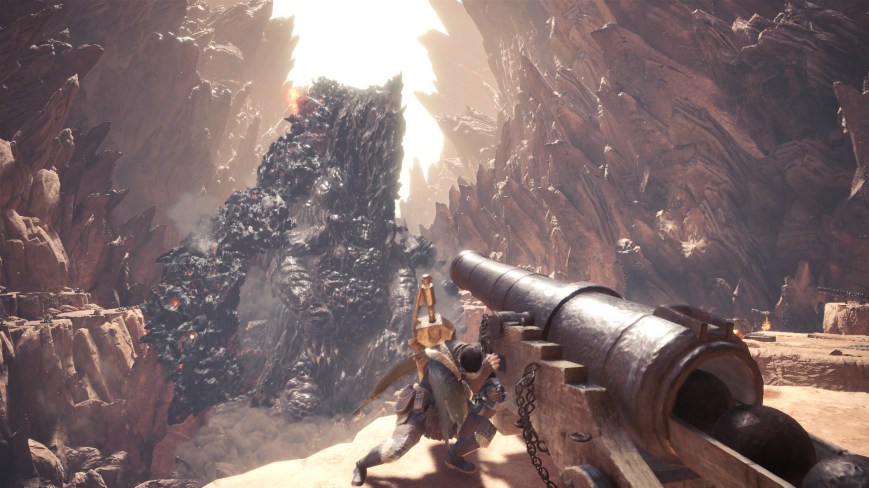
MHW has 3 phases.  Low Rank (LR), High Rank (HR), and Tempered (T).  Each tends to focus on an Elder Dragon – some mean buggers.  Low Rank is all about Zora Magdaros.

mhw-zorah_magdaros_screenshot_006

That’s a walking mountain

The missions with Zora are not at all like other hunts.  They start off on his (it’s?) back where you need to destroy 3 cores that do fire damage.  You also have the option of fighting Nergigante – but that is seriously a bad idea.  While roaming on his back, you can mine a few ore spots, for much needed material to craft some decent gear. The next part varies but the repeatable version includes you shooting canons, a dragonator (a giant spike), and ballistae for about 10 minutes until he finally drops.  The only difficulty here is not dying to the magmacore fire attacks.

If you luck out, you can do this quest 2 more times after the first, and that should give you at least 1 HR piece of Zora armor.  Which is a significant boost.

From here you reach the first major interlude.  The goal of which is to enter HR areas and find some Rathian clues.  Just regular exploring will work, but you’ll need to spend a lot of time doing it.  You can boost this by completing some rank 6 quests.  I’m at this spot now.

If I recall, the game then takes a more open approach following this step.  You’ll get a bunch of optional quests, but the main one will be about finding the 3 elder dragons, killing Nergigante (super death mode), killing the 3 elders, then finally Xeno’jiva.  From that point forward you’ll have access to Tempered monsters.

On paper, I’m about 75% of the way there since I have 7 monster kill quests to go.  In reality… not so much since I’ll need to improve my gear to take on those 7 monsters.

Guard Point

My previous playthrough was focused on Dual Blades.  It was extremely visceral and had little to do with thinking.  Sure, there was a skill ceiling higher than just mashing buttons – but mashing buttons was so fulfilling!  That generated a lot of hard walls to climb.  Anjanath, Pink Rathian, Nergigante… those buggers were death incarnate.  I had to really learn the game mechanics to get past them – in particular monster weaknesses, attack patterns, and the i-frame dodge.  That last one is extremely useful for Nergigante’s attacks that can/will 1-shot you.  If your weapon is sheathed, and you dodge, you’ll actually throw yourself to the ground and be immune to damage for about a second.  Given you need to sheath, it’s not something you can quickly react to.

The Charge Blade has that dodge as well as a thing called Guard Point.  I’m pretty sure the Sword & Shield have this too.  The thing here is that you have 3 particular movements that present your shield in front of you, and if the monster hits that shield they take damage and you take none.  It took a while for me to learn the timing of this, and Diablos is the best one to try this with first.

When I figured out how to properly use Guard Point, my gameplay changed.  I tend to be somewhat conservative, looking for an opening, and then striking.  Effective use of Guard Points means I can go all out, and counter 90% of physical attacks.  And with a boosted shield, I can do even more damage, countered with an immediate SAED.

It took a while to figure out the timing, but wow, does it ever make combat more engaging.


The Memory Game

Games are a series of meaningful choices.  Meaningful.

Snakes and Ladders, Candyland, games of that type have no choices.  It’s entirely random.  Something like Yahtzee has choices based on statistical chance, so the odds certainly favor someone strong in math than just a random roll.  The rolls in one turn have minimal impact on the next turn, just the overall score.  Compare that to say, Risk, where early decisions (and random luck) will impact nearly every other turn that follows.  The complete other side of that is Chess or Go, with no randomness with players who understand the mechanics.

Then we look at replay value, which is often predicated on the number of choices present.  7th Continent is a really good example of a game with a solid set of meaningful choices, but a limited supply.  Once you know that A does B – every time – then you can choose to pick or skip A.  The choice is effectively removed.

I’ve been thinking a lot about meaningful choices lately.  MMOs seem to be going more towards the removal of choice, and focus on randomness.  Single player games are all about choices.  Spider-Man, God of War, Horizon, Zelda… all games where the player is in control of their choices, and there’s a clear line between their actions and the consequences.  In the GoW Valkyrie fights, I never once felt cheated by some random event.  They were extremely hard, and each death was painful, but they were all based on clear choices I made.

Running through MHW anew really brings that point home.  I can remember the large scale items of the game, the systems, the layouts of the maps, the types of enemies, and their general habits.  I know that if I need Ancient Bones… well, I’m only going to find them in one place.  Same with Mosswine.  But the specifics, I don’t remember that part.  For example, I know there’s a campsite in the northern Wastes if you drop down a small cubby hole.  I have no idea what materials are required to actually unlock access to it.  I know that Barroth has a tough armor to crack, but there was a way to get around that without Mind’s Eye that eludes me.

It’s a bit like having a lot of puzzle pieces and the picture on the box is fuzzy.  Knowing something but not quite remembering what it is.  It’s both frustrating since you feel like you should know, and fulfilling when you do get it and get a really solid ahhhhhhh.

Long story short, MHW is more fun now since the frustrations of obtuse mechanics isn’t there anymore.  I can focus on executing my strategy, and then the moment to moment events.  Like having to collect 20 mushrooms and ending up killing a Great Jagras and Pukei-Pukei in the same run.  That just doesn’t seem to get old.  Next up is my previous nemesis, Anjanath.  The fire breathing T-Rex.

Hunting on the PC

I have an aversion to repeating tutorials.  Many of them are built for people who have never picked up a controller before.  While I’m sure those people exist, I am not one of them.  Monster Hunter World however, the “newbie” tutorial lasts about 1 minute and it involves moving up two walls and jumping off a dragon’s head.  There are worse things in life.

The tutorials past that point are almost as obtuse as the game itself.  I still recall my first 10 hours on PS4, still not understanding the basics of just food – let alone elemental effects.  There are even embedded videos to show you how to properly use one of the 14 weapons but not a single one does justice.

I have experience with Dual Blades (by far the most offensively mobile), the Switch Axe (easy controls, decent damage), and the Charge Blade (technical, with highest damage potential).  And that’s with hours and hours of practice.  I decided to give the Charge Blade a go as primary in this run, and woo-boy, do I have rust.

Here’s one of the better tutorials for that weapon.  It’s 18 minutes.

Rust is polite.  The first few fights are simple.  Some generic lizards (Jagras), their ugly uncle (Great Jagras), and then the Kula-Ya-Ku (a slow witted bird).  If you can aim, you can take these buggers out.  And that’s my issue with the Charge Blade – aiming.

MH:W has a dance to battles, a rhythm.  You press buttons in a specific sequence, and depending on the state of animation, you press other buttons.  Charge Blade is really strong on that latter item.  I have a shield charge attack that starts with holding a button… press it too long and it deflates.  Charging my shield requires me actively cancelling another attack.  Charging my sword is the same.  If I time it all perfect, then I get the shield charged, more phials, and can launch ultron mode (super amped elemental discharge – or SAED).  That attack can take out 25% of an enemy’s HP.  And if I time it right, I can get 2 of them off during a single enemy stun.

So the potential is there.  I just need some practice to get back into the groove.   Well that’s a bit of a lie, I was never excellent at the Charge Blade.  Dual Blades were my life source, and I took down every possible enemy with that thing.  The true test for any weapon is Nergigante.  Kill him, and you know how to use a weapon.  I did, but never in a single try.  Always room to improve.

So starts my MH:W journey on PC.  I am 2 quests in, haven’t yet managed to eat dirt, an d have hours and hours of things left to unlock.  Knowing they are there to get, and knowing what the benefits are, that’s making this quite an interesting run through.

More Monster Hunter

With WoW fading from view, I’m looking for something else to fill in bits of time.  I have my PS4 connected to a projector in the basement, but since I’m cheap, I don’t have the online services hooked up.  The time played in MHW on the PS4 was solo only.  I did start a recent replay of Horizons, but that time investment will be in fits and spurts.  God of War is still too fresh for a replay… and I unlocked every bit but 3 Valks in the last run.

The gaming laptop has a wide selection of options.  I completed the new season of D3 in a couple days.  Pillars of Eternity is about half way through.  I have an XCOM2 save that I’m holding off on until some of the interesting DLC stuff is out in a few weeks.  Dead Cells and Cuphead are on the wishlist for a rainy day – which seems to be the only type of day around here lately…

Nope, I’m heading back into the MH World.  It’s been a good 3 months since my last battle, and there are still massive amounts of content that I have yet to see.  It will certainly make the multiplayer aspect of that game an option.  There were quite a few battles that made me tear out my hair.  Tempered Teostra is on that list.  Plus, there’s something about the MH model of continual progression that just works.

The strategic layer of targeting specific monsters and making goals… that hits me right in the good spot.  Unlocking new camps, new pieces of food, finally getting that rare drop… feels good man!  The tactical layer of preparing for a battle, laying out the lines and traps. Then the actual battles have great moment-to-moment energy.  The individual phases of health, the set time periods of a battle in a specific location…it’s hard to get bored on any specific battle since they often have something new to add.

I remember farming a Tempered Jyuratodus (the fish one).  8 battles, 8 different fights.  Bazelgeuse joined a few times to throw me off my game.  The various little bits added make for an enjoyable and repeatable game.

I did dual blades last time.  I’m thinking full switch axe this one.  Always one for the glass canon approach.

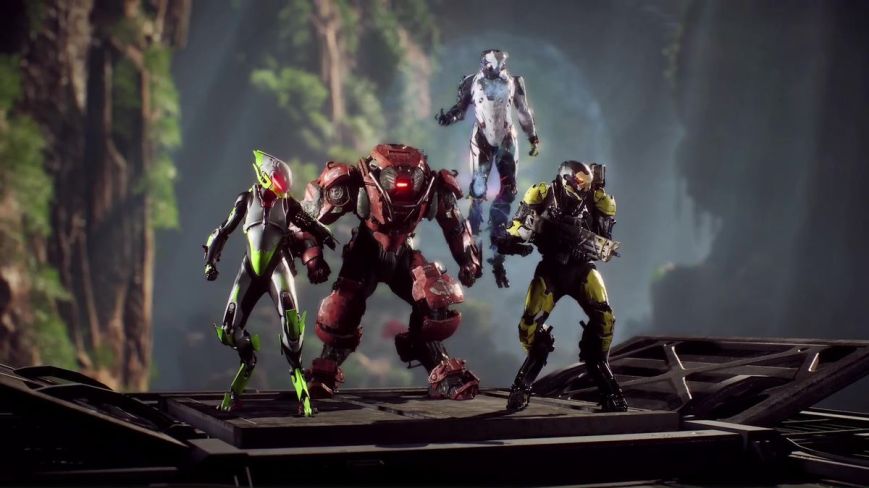
Forecasting – Anthem

Less interesting in the game as I am around the aura of the game.

vlcsnap_2018_06_09_15h08m55s849-0

Love the lens focus trick to make them look like miniatures


Recall that Anthem is launching on Feb 22, 2019.  Also note that while we know there are 4 classes, no one really knows what any of them do.  There are 4 people per server… which is more like Diablo 3 I guess, than Destiny?  No one has seen anything other than the demo level.  There’s been no news since PAX, over a month ago.

Oh, there’s some info on how to pre-order, and that the demo launched on Feb 1, and that early access is 1 week before launch.

I do recall when Anthem was being presented as the bee’s knees.  Not so much a Destiny killer (Destiny did that all on it’s own), but certainly as a competitor in the same vein as say, The Division.

In this age of early access, with media leaks all over the place… it’s easy to have an idea of how a multiplayer game is looking many months ahead of time.  It’s a bit surreal to have no real idea of what’s going on in this game at this point.  I can speculate until my head explodes, but why bother?

While I’m sure the developers are doing all they can to make a great game, we are talking about EA.  The company who makes mint off pre-orders.  Maybe they are waiting until the November rush?

As I mentioned a whole while back, I am just getting some popcorn and watching this story unfold.

WoW News

I guess Blizzcon is 90% Diablo content now.

Two bits of interesting news.  Mike Morhaine is stepping down from Blizzard leadership.  No reason given, but after 27 years of doing something, I’d be tired of it too.  I consider Mike part of the old guard, like the doctors from BioWare.  More passionate about the games than the market.  Instead of oozing charm, he was full of geek.  I thought that resonated well.

J. Allen Brack is promoted to his position.  I didn’t do much digging, but there’s an interesting video with J. Allen, Ion, and Tom.  I just think their personalities are really quite focused in this particular video.  As a people watcher, I find this quite entertaining.  Not from what they are saying, but how they are saying it.


Azerite Changes

Somewhat large changes afoot.

  • More drops:  You’ll eventually get up to 370 Azerite gear from world quests.  A quite inelegant solution to the problem, but it certainly fixes it.
  • More traits: A new outer ring on some gear in 8.1.  I don’t understand this one, personally.  It seems like it makes the situation worse, not better.  The problem now is that there are too many traits, without interesting choices.
  • Trait tuning: To make things more interesting.  Without actual examples, this feels more like number tuning.

By adding more traits, that’s further diluting the pool of available gear.  By adding Azerite gear drops to WQs, it goes completely against the design choice to target azerite gear drops for their specific traits.  WQ rewards are entirely random.  Combined, this appears to be making the problem worse.  Practical examples will help straighten this out.

Interesting vs Meaningful

This post as a base.  It’s a decent summary of the Azerite issues, with no potential solutions.  Which is smart in a sense, since people will focus on the problem, rather than the solution.  Lore responded.  One particular item:

The point about traits being “useless and uninteresting” is interesting considering that you also make the point of “every gear change requires simming.” These two points are kind of at odds with each other. The way to solve the simming issue would be to make the traits more simplistic in nature. Similarly, making traits with more outside-the-box designs leads to more complicated questions of “is this better or not,” which in turn encourages more simming. Either way, it’s an interesting challenge, and one we’re taking to mind as we move forward with traits in future updates.

Useful things are not always interesting.  A toilet is useful, but it is far from interesting.  A Ferrari is interesting, but far from useful.  A robot that vacuums the floor is both useful and interesting.  They are not binary, or in conflict.  It’s like saying something is red and big.  They are simply descriptors.

Azerite traits are generally uninteresting, because they have no impact on gameplay.  No matter the trait you have, the buttons you press stay the same, 99% of the time.  They are generally useful since they do apply a +damage/healing effect.  Some are much less useful than others (getting +haste on my Brewmaster feels bad man).

Azerite was meant to replace artifacts, tier sets, and legendary items.  All 3 of them had interesting impacts to gameplay.  So much so, that the majority of Shaman Ele changes in 8.1 are cut and paste from that model.

That the set of traits are so poorly worded that they require simming is a different point altogether.  Passive damage boosts require simming, and it’s actually practical to do so.  An interesting trait that changes your rotation… that’s something much harder to sim and compare.  It’s also a whole pile much harder to balance.  Pretty much why they were always restricted in the past.

I do get what is trying to be achieved here.  Simplification is every IT person’s goal.  It’s extremely hard to do.  I don’t quite understand what the changes above will actually do to fix that issue.  At least they are trying.


Diablo 3 – Season 15

Force of habit I suppose, but every new D3 season I make a new character.  More specifically, I re-use an existing one by converting them to season mode.  Long ago I ran out of character slots… and I cannot recall the last time I played in non-seasonal mode.

I usually level 2-3 characters then move on.  Typically the first one is a monk, since they are quite effective at leveling and are very fast in terms of movement with starter 70 gear.  This time, I opted for Demon Hunter, since it’s brain dead easy.

The leveling portion is as simple as always.  Get a Leoric’s Crown, run Nether Rifts until 60, then run bounties.  Or, get powerleveled and hit 70 in 10 minutes.  Going through the process solo, you can see that Blizz has streamlined where possible.  And spending 2 hours or so, doing it alone, isn’t too bad.  By the time I hit 70, I had the Ring of Royal Grandeur (so 1 less item for a set bonus), Kunai’s Cube (the magic making box), and a enough Death’s Breath/gold to upgrade every crafter to max level.

A while back now, Blizz put in Headrig’s Gifts for completing 3 specific steps of a hero’s journey.  Each of those gifts gives 2 drops of a specific armor set, per class, per season.  For DH, this is Unhallowed Essence, which is primarily a Multishot build.  You buff this with a Yang’s Recurve Bow, and a Dead Man’s Shot quiver.

The “trick” here is to craft level 70 gear and clear out the first Gift task.  Very easy.  The 2nd one is a bit tougher, and you’ll need a decent weapon for the damage boost – doesn’t really matter what type.  With the gear from the 2nd Gift, the 3rd task should be doable for most classes.  Worst case, you run some public rifting groups to gear up a bit.

So I ended night 1 with a level 70 DH, and all 3 gift steps complete.  Night 2 was spent initially getting the gems I wanted from Greater Rifts and getting the good ones to level 25.  Each successful run gave +5 levels to a gem, and runs took 4 minutes on average.  It was a bit more than an hour to complete this step.

After that, it’s more about chain running public rift groups, at the highest comfortable level.  That started at T6, then T8, and a while at T10.  T10 was where the big difference was in gear drops.  It was raining legendaries/set pieces.  I easily swapped out my current set for “optimal gear”, found a really good Witching Hour belt (great for any DPS), some Nemesis Bracers (for extra elites at every shrine), a set of 2 rings that had crit%/critdamage + socket, and a near perfectly rolled amulet with dex/crit%/critdamage + socket.  Those last 3 pieces were a massive DPS boost.

What was left was a decent weapon.  No real luck in drops, so I went another route.  I crafted 20 bows and tried upgrading them with Kunai’s Cube.  Of the 20, I ended up with 3 Yang’s Recurve, 1 of which was Ancient (meaning higher stats).  It had generally good stats, but the damage was on the low side.  I enchanted a much higher damage range (from 1400 to 1950), put in a ramaladadingdong to get a socket on the weapon, and proceeded to face melt everything.

T13 (or GR60) is where I draw the finish line for any character.  My DH hit that goal in 2 nights.  At this point, there’s only marginal gains to be had on each piece of gear.  I am quite literally searching for perfection in order to progress.  Even Paragon levels are coming 10+ at a time when I close a GR, so I’m well ahead of that curve.

Did RNGsus gift me with good rolls on the 2nd night?  Darn right!  My Crusader from season 14 didn’t ever get past T10 due to bad luck.  But that’s it now.  The DH is, for my purposes, done.  And with that, I think so is Season 15.  No way I can replicate this luck again.

Less Hyperbole – More Testing

Wilhelm’s comment was the trigger.  Testing is indeed hard.

I talk a bit about my RL job, without too many specifics.  At a general level, it’s a service for about 130,000 users and deals in particular with smartphones – so one of those things where an issue/outage has a rather up-front-and-personal impact.

Massive project, great team, more stress than is reasonable, less time than we need.  Sound familiar?

Typically, projects in my organization are full bake affairs.  It means that the entirety of all functionality is present before going live.  That makes projects take a supreme amount of time, since the last 10% is of function usually takes 90% of the overall time.  One of the early decisions I took was to take an iterative approach.  There are SDLC methodologies I could go into… but that can get boring quick.  TLDR; the large project was split into 6 releases.  The first 4 were time locked – e.g. what can we do in a month per, and the last 2 were more complicated and took a bit longer.  When version 1.0 launched, and it didn’t have all the bits working, it took a lot of effort to re-train people that this was OK and planned.  End result was feedback from 1.0 fed into 1.1, and so on for the duration of the project.  Not scope creep… but refinement of the functions.

Getting those releases ready was a challenge.  We had to build new testing environments and new processes.  We had to find more people to do the work.  Traditionally, all testing was internal, and it went from Dev — Staging — Production.  That wasn’t all that effective. So we added a new test environment, parallel to Staging, specifically for client testing and modified UAT process to essentially have public alphas.

Alpha vs Beta

Everyone has their own opinion, fine.  My is that an alpha is a release that is not feature complete, while a beta is feature complete.  The first is to test for success, the second to test for failure.  Historically, we’d do all this internally and when clients did do any testing, it was more of a sales show that actual testing.

We turned that around and asked each client to designate a representative for testing.  Huge benefits, since these folks were generally testing things we never even thought of trying.  It extended our testing window by about 20%, but the product bug rate dropped down by a ridiculous margin.

Our bug tracking system was further integrated into our release schedule.  Where previously we would launch with acceptable high impact bugs, we moved that down to medium because we were able to detect the bugs much earlier in the process.  That gave time to either fix it, or apply the mitigation/workaround to smooth out the bump.

Transparency

The other thing we did was publish the bug list.  Well the ones that weren’t security related at least.  It’s was a big file at the start, and quite a few bugs kept with us for multiple releases.  Some are out of our control, as the software developer needs to do some overhauling.

The core benefit here was that people complained a whole lot less if they knew that we were aware and had some sort of plan to address it.   It was a full time job to keep this list up to date and communications open with the clients.  They’d get a report, put it on the list, and another team would do the assessment.

Delays

There were quite a few times where a large release had to be postponed due to a major bug found late in the cycle.  In June we found a critical error that was patched by the vendor.  Our internal tests were clean on that patch, but the client testing found some serious problems.   That extra set of eyes found an issue that would have drowned our support team in tickets.

The thing is, by not drowning in tickets, we were able to resolve the issue faster as our focus was pre-emptive rather than re-active.  Sure, we took it on the chin for a delay to a critical function but it’s always better to be late and working, than early and broken.  And it’s even more important for overall sanity of the team.

Overall

Solid testing is how you get a game like Spider-Man or BotW rather than Alien: Colonial Marines.  Every single one of us has seen a game that didn’t go through enough testing, and yet was released.  In nearly all cases, that was an abject failure that cost that company dearly.  For every FF14 that comes back to the front, there are a dozen or more Hellgates.  People will continue to engage with a company if there’s a relationship, if there’s trust.  Otherwise, they will find alternatives (if they even exist).  And trust takes a while to build, and a fraction of time to lose.

Testing has proven to me to be one of the best ways to build and maintain that trust level, that being transparent and honest with the clients that that their issues are acknowledged and there’s a plan to address them.  It takes an inordinate amount of time and skill to manage this type of relationship, but the results are worth every bit.

Testing. It’s not Hard

There’s a point where this becomes petty/funny/sad.

zr5a1q1bleo11

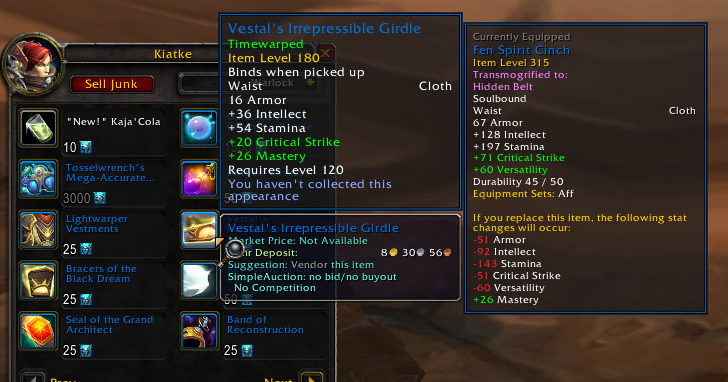
The item on the left is a normal drop.  The item on the right is a Warforged version, which should be an upgrade but is in fact worse that a Normal BfA dungeon drop.


jnyv6wc6meo11

The items for sale on the Timewalking Vendor have not had their ilvl updated, but do need a 120 player.

These are item specific – not related to how the stat squish has impacted the overall balance.  End Times can’t seem to be completed right now, for example, as Sylvanas will 1 shot most tanks.

All of this was corrected in a hotfix on the 25th.

Timewalking is something that comes up every few months.  It opens old dungeons from a previous expansion, and applies scaling so that max level players can go back into them.  Completing these dungeons awards drops as well as tokens.  Those tokens can be exchanged for items that were previously on-part with heroic dungeons, or cosmetic gear, or heirlooms, or mounts.

It’s a neat side activity. This is the way most dungeons work in FF14, so it’s not like the tech is new or hard to do.  Blizz has done this a few times in the past.  An entirely different topic as to why this system is always available…

Bug Hunting

IT has bugs.  That’s life.  Some are obvious, some are not.  Some are easy to fix, some are not.  Fixing them is one conversation that I don’t think I need to get into.  This is about finding them.

The 3 examples put above would have been obvious from a single dungeon run, through every Timewalking dungeon.  Guaranteed, 100% reproduction.  That these were pushed into production means that either a) it was not tested or b) it was tested and the project manager accepted the test results.

If this happened in my team, this would merit disciplinary action.  After 3 times, they would either be dismissed or re-assigned to other work.

Reality

It’s a game.  It’s made to be relaxing for some, challenging for others, fair for all.  It’s just symptomatic of BfA in general.  Which is sad – and not what we should expect from Blizzard.  I should be focusing on the fun items, not these brain fart items that keep popping up.  I’m missing the polish.

And I can only fathom how Blizzard employees are feeling about this.  These items deflate overall confidence… and it takes a long time to build that back up.  It also causes finger pointing, and niche work.  No good ever comes from that.  Again, in most industry the lead of these teams gets replaced so that it at least appears something is being done to rectify the situation.