Linear Progression

I’m rather fond of GW2’s linear level progression. Each level is more or less as long to complete as the other. Makes for a smooth ride and set expectations. Compared to Rift’s absolute massive timesink from 51-60, it feels great!

The downside is the concept of power progression. You unlock pretty much everything by level 5, then wait until 80 for a few tweaks. It’s better than Wow where you go 10 levels and then have to learn a new playstyle but the forward goal building is intangible.

I’m curious as to how TESO and Wildstar address this core component. Either the stretch the content to fit the timeframe (how many orcs can you kill before your eyes bleed) or they make all content relevant at all levels (ala GW2)

It’s interesting how much that design decisions impacts my playstyle.

Fun is Measured in Time

There are a few posts going around lately that argue the financial around F2P and the concept of bypassing challenge – or rather quickening your way to reward.

The core concept here is the old addage that time equals money. The modification I would bring is the “fun” variable to time. If I did something I found a lot of fun I would pay extra for it.

If the value is intrinsic, that is the journey is the prize, then either money or time is a justifiable payment.  If the value is extrinsic, that is the prize at the end of said journey and that journey wasn’t fun, I’d be more likely to spend money.

The reason for this in my mind is that I make a lot (if not all) of my money working. I know exactly what an hour of my time is worth. It’s easy for me to figure out if doing something boring is worth 5$ for a month or not. The answer is quite often a no.  For example, the Sparkle Pony back in the day caused some uproar.  This was in the days where you didn’t share mounts and it was a hassle to get new ones.  Not in terms of gold so much as time.  Buying it gave a ground and flying mount for every character, on every server.  In effect, it allowed you to bypass a boring part of the game for a fee.  Hence the millions sold.  Whether you want to argue poor design in the first place to make that bypass worthwhile, is a different matter.

Where it gets complex is in the mix between intrinsic and extrinsic reward structures. You can only kill bosses for so long before they no longer have intrinsic value. If you’re also not socially driven – say a guild or friends – then there’s even less value after a few runs.  Using WoW again, you could run LFR for 2 weeks, see every boss, likely upgrade half your items and be done with it.

It really is a systematic problem with themeparks as a whole.  If you’re only concentrating on the end of the road, rather than the journey, then there’s no way that can keep you coming back.  If you enjoy the ride, then you can have fun so long as that lasts.  If you play the same content for hundreds of hours, it takes amazing design to keep that relatively fresh.

Where F2P shines is in setting up a smooth, repeatable game with items that provide intrinsic worth. The most common example is with consumable customization options – like dyes.  Another example is services for alts.  It’s a very complex balancing act to maintain and few developers do it well.  Too many people are copying successful games without properly understanding why they are successful.

It’s really simple.  Get a fresh player, have them play until they think an hour is up.  If they are below that when they finish, you have a problem.  If they are above it, then you have a damn good game.

Addendum

Time is short and work is crazy busy making for nights that end quickly.  A few more detailed posts are being worked on but in the meantime I wanted to add a bit to the previous posts.

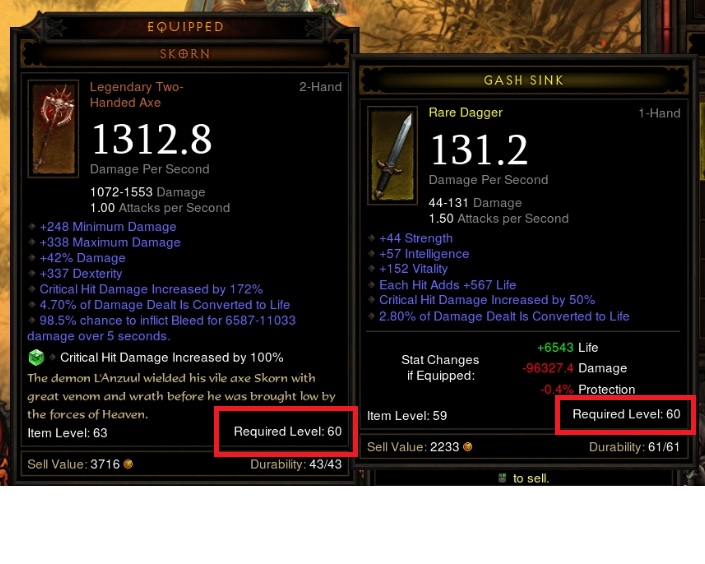
First though, I wanted to dwell a bit on D3 itemization.  That horse isn’t dead yet!

Diablo ItemizationThe above shows a fairly good roll against a fairly bad roll.  Look at the estimated DPS loss (character runs at 102K DPS) from a weapon.  That’s a 96% difference in damage from one item.  Take that horse!


Second item is the defense of subscription.  Gaffney posted some stuff defending WildStar’s decision while Jack Emmert will talk about the opposite in a few weeks.  These are both people with significant experience in the field.  Both have seen F2P on their games (Gaffney was with Turbine and NCSoft) and have seen subscriptions as well.

Perhaps we’re at a point in the hype cycle that subscriptions can become niche again and that the MMO tourist avoids it due to the massive F2P options out there but WildStar doesn’t seem to be aiming for niche.  TESO certainly isn’t.

In regards to the PLEX variant WildStar is aiming for, that only works in a closed and extremely well developed economic system.  It works in EvE because everything is player created, everything required sweat equity and everything is relevant, even at max level.  Taking a cue from any themepark, even the recent GW2, economies from start to max level-1 are completely irrelevant 1 month after launch.  I “beat” WoW’s auction house, making a few million along the way – PLEX would have failed hard in that market. This isn’t apples and oranges.  This is apples and nuclear missiles.


In Defense of Subscriptions

I like Gamasutra, there are some solid articles about the business side of the industry. Ramin and Isaac are on my reading list not so much because I agree with them but because they expose a side that we rarely see.

Ramin is more of an internal systems designer with strength in economic systems – auction house, crafting and so on. I am guessing he’s working on one of the two Big MMOS coming around the bend.  Isaac is a service guy, looking more to the economic systems outside the game – support models, client interactions and whatnot.  Both of their fields intertwine but I consider the above their specialties.

Isaac’s latest post attempts to support the subscription model along 3 main issues. First, subscriptions push people to get value for money by rushing content. Second, development of said content needs to follow and be of quality. Third, companies cannot price discriminate as everyone has the same fee.

While conceptually I think he has some strong arguments I think there are some flaws and realities that are unaccounted. Let’s say his baseline is accurate for playerbase – 30 to 40, kids, working, no huge time available. Yes they sink less time but they are hyper-aware of dollar per smile economics. Subscriptions drop when similar services are available for less cost, that’s why F2P works.  The math is simple enough.  I have X dollars to spend per month, where can I get value for that money?

Two, content delivery must meet player expectations in terms of volume and quality. Iceberg Blizzard has paid massively for their schedule. SWTOR’s 4th pillar destroyed their ability to quickly iterate and expand (voice acting).  This bleeds a bit into the first topic.  2 months after launch, the content that was there was consumed at a rate far exceeding expectations and what was left lacked value for money.

Three, price discrimination is a red herring. All games have internal metrics to see what is consumed and for how long. WoW saw that their moneysink – raids – were only hitting 1% of the userbase in Cataclysm. That brought us LFR, and now Flex Raids. DDO only offers what sells, same with NeverWinter. Companies know exactly how to nickle and dime. There is no other reason for lockboxes.

Are subscriptions bad? No, they provide a baseline income that investors can see and development can project. They are however, an easily accounted for expense for players to compare to other games. The argument simply becomes “can I spend 15$ or less in another game for the same or more fun?”. The answer, today, is a yes and that bodes extremely poorly for Wildstar and TESO.  They must “out content” all other MMOs (not really seeing this as possible), provide an iterative schedule faster than what is offered by competition (everyone is better than WoW, few are better than Rift) and somehow target their material/pricing to bring in the most dollars/effort possible – without existing metrics.  One heck of a tough road.

Holy Bangarade

10 weeks on parental leave and back to work now for 2. It’s annoying when you delegate work and nothing at all got done. Now I have 10 weeks of work to do in a few days. Quality!

Suffice it to say I need a mental breather some nights. Lack of time means minimal investment though, so I’ve been giving F2P games a hit.  No RIFT, GW2, WoW, or any game that I can’t simply drop within 2 minutes.

The Mighty Quest For Epic Loot

This one is in open beta and a lot like Dungeon Master and Diablo in that you can set a castle full of traps and run other people’s castles. It has upgrades with timer (where the F2P stuff comes in) which is fine I guess. The gameplay is horribly balanced though where the tanky class can run through anything without batting an eye, even 6-7 levels above them. The other classes have no chance. But it’s beta and the concept is solid. Maybe in a later patch.  The file size is rather small.

Infinite Crisis

I got into the beta, which is beta.  You’re comparing LoL to a game with an admittedly limited character roster.  You might have 4 flavors of Batman but it’s still Batman.  There are technical bugs, some serious balancing issues but overall the game is pretty solid.  Community management is going to be the real kicker here.  Current playerbase is nice enough, since it’s test.  But once you get the crud coming in, there needs to be a way to filter that out.  The learning curve is extremely high but that’s expected in beta.  Oh, and it needs way more maps.

Dragon’s Crown

I don’t play a lot of console games, only when I’m on the bike.  This one is pretty solid, with a link back to the arcade D&D games.  Is it worth 60$ though?  No.  Maybe once it hits 30$.

Marvel Heroes

A new patch (1.2) fixed the defensive skills, added a ton of itemization and huge balance changes. This is what the game should have launched with. It even has 3 difficulties making the trek from 25 to 60 different than running the same zone for 20 hours. The itemization and skills are the polar opposite of Diablo3, which is good.

Diablo3

Just a few days in, tried a new Monk build. Cost me about 25 million in gear to make it work due to the way itemization works in game. And this isn’t even for hard stuff, just regular Inferno. What’s the point of upgrading gear if you need to swap nearly all of it to change builds? Maybe 1-2 pieces but not 10.

And of course the AH is going away in 6 months – likely the launch date for the expansion. It annoys me that Loot 2.0, which is what the consoles got, has been getting great reviews but the gamer base has to wait so damn long for it. Anyways, the AH simply focused on Jay Wilson’s poor direction for multiple systems. A loot system that dropped inferior gear even at high difficulty, itemization that drove stats to absurd levels to even compete, the requirement for “perfect” rolls for the item to have any possible value and a difficulty setting that made no sense. All of those systems by the way, have been or will be removed.  The game today is wildly different than launch and the console version is yet another massive leap forward.

Listen, the AH was a good concept to avoid gold farming and scamming. If I knew I could get upgrades while playing (I have never once with my monk past 60), then the AH would just be a slight nudge. When I can see that a single item on the AH can raise my damage by 10% and costs 20 minutes of gold farming time, there is a massive problem in the loot system.  Shutting down the AH is one thing, shutting down the RMAH is another, as that thing certainly brought in a sizeable amount of income.  It takes some pretty large brass to through that away – baby and bathwater.

Summer Is Here

Summer is here and that means sun and fun.  I’m lucky enough to have the summer off, of sorts.  Actually, it’s parental leave with 2 young kids.  Depending on the day, it can be seen as better or worse than vacation.  Topics today are my break, XBOX and GOG.

Me

Last week was at the cottage and for my birthday, my eldest daughter and I went fishing.  Lucky me, I caught a 40 inch pike.  As big as my 3 year old.

I’ve mentioned in the past that a true MMO has fishing and until then they are just pretending. I caught this bugger turning a corner, about 200 feet from the dock.  Took 10 minutes to haul in and the net I had was a tad too small.  Took pictures and sent it back on its way.  Won’t ever forget that day.

XBOX

Back in town now and back to the news.  Don Mattrick has left XBOX and moved to Zynga. Love or hate the guy, he built the XBOX to what it is today.  Hard-ass to the end, it seems the only ones with success in the big industry are like that.  Enough that when news hit that he had moved, Zynga shares suddenly became a “BUY”.  I don’t see how anyone will be able to properly replace him now.  That has a lot to say about the 180 Microsoft has had to pull lately, and now two top execs are gone because of “always on”.

GOG

Good Ol’ Games is having their summer sale.  This is the start of the end for me as I love their selection.  STEAM has more recent titles but jeebers if you can’t find excellent quality on GOG.  No DRM and for $60, you can get 20 absolutely amazing games that will give you thousands of hours of play.  Steam is going to break me in a few weeks, I know…

F2P – Baseline Forward

There’s enough hullabaloo (I don’t get to use that word often) about F2P in the blogs today.  I don’t necessarily get the fervor so much but I suppose with RIFT swapping and Neverwinter “officially” launching, we’ve got new competition.  Here’s a thought for the day.

The theory is that in an open market, the market itself self-regulates.  This has a dependence on there actually being an open market, so no collusion (banks and gas) and no monopolies (Windows, Internet Explorer).  Movies are an almost an open market in that the price of tickets from theater to theater is relatively the same.  Cars are similar, since you can do an apples to apples comparison of features and price match between dealers.  Games are close too, since the upper cap for any game is going to be $60 and anything below that seems to be seen as “budget” title.

The new variants to this are the mobile space, DLC and F2P games.  Mobile space has 3 price points – free, 99c and $4.99.  Anything outside of that is an outlier.  DLC is seen as $5 as a price point for any given package, regardless of quality.  This makes season passes effective in that you pay 20$ for the promise of 5 packages (or more).   These prices are set because of market saturation and competition.  Why spend $7 here when I can get the same item for $5 there.  Subscriptions above $15 have never worked.

F2P games are approaching a baseline price model for various features.  For a long time only the East had a model and everyone on this side of the pond basically stuck their thumb in the air and guessed at a price.  Allods is the poster child for how pricing structures can destroy a product.  Up until a few years ago, we basically had Zynga & friends telling us the price for F2P.  DDO swapped with a decent package, then LOTRO, STO, AoC, EQ 1&2 and now a few more.  The market is still somewhat fresh and expectations for pricing points are still somewhat in flux.  That being said, I think we’re hitting the point of what’s acceptable.

A mount at $10 is acceptable.  Costumes and customization at $5.  DLC expansions at $10-$20.  The market is going to decide what is acceptable if you give enough similar choice.  RIFT, Neverwinter, LOTRO, EQ and SWTOR all offer extremely similar services.  Any new gamer looking at the field is going to try to find value for their dollar and right now, RIFT and Neverwinter are setting a heck of an example.  EQ recently (a few months back) increased what was available to the masses.

At the end of the day, each developer needs to make money to pay for servers and staff.  It does not get any simpler than that.  In order to make money, they have to sell something.  Consumers are now in a better position to compare products and value, and invest where they see fit.  This is going to drive the market moving forward.  Voting with your wallet works and is the only true way to make sure something changes.

XBONE – Sad Face

Here’s a link to an anonymous Microsoft employee (allegedly) explaining what they gave up when they rolled back their DRM strategy.  I’ll go over a few parts I find worth discussing.

We didn’t do a good enough job explaining all the benefits that came with this new model.  We spent too much of our time fighting against the negative impressions that many people in the media formed.

Extremely accurate.  There was not an ounce of positive spin for anything MS was pushing.   Quite the opposite.

Many will argue the development system is broken, and I disagree.  The development system is near broken, it’s used gaming that is broken…

“Many” being actual developers themselves.  If selling over 1 million copies at full price is a loss (Amalaur), it is not used games sales that’s the problem.  Used games are a symptom of the problem, pricing and value.

First is family sharing …  The premise is simple and elegant, when you buy your games for Xbox One, you can set any of them to be part of your shared library.  Anyone who you deem to be family had access to these games regardless of where they are in the world.  … When your family member accesses any of your games, they’re placed into a special demo mode. This demo mode in most cases would be the full game with a 15-45 minute timer and in some cases an hour.  This allowed the person to play the game, get familiar with it then make a purchase if they wanted to.

First, not anywhere in the world, only a place with online access to XBOX Live and an account active.  Second, I do this today by handing a copy to my brother and he has an unlimited demo.  Third, many games today have demos or videos to show how the game is played.  Do people really buy games blindly?

I stand by the belief that Playstation 4 is Xbox 360 part 2, while Xbox One is trying to revolutionize entertainment consumption.  For people who don’t want these amazing additions, like Don said we have a console for that and it’s called Xbox 360.

And this is really the crux of the matter and where I think there is the largest disconnect between the audience and the provider.  The XBOX (and the Playstation) are gaming platforms.  Gaming platforms have existed “as a thing” for nearly 40 years and have had only minor changes over that time.  The core process is the same though there have been additional services layered on top.  I have a game, I have a controller, I have a TV, I have a couch.  I can bring the console on road trips.  I can play my friends games when he comes over.  I can play with headphones on when my S/O is in the other room.

The XBONE broke all of that and didn’t sell an upside.  Here’s what could have helped.

The family program would have been great if they had access to your games without a timer.  DRM would have been acceptable if prices were lower.  DRM would have been excellent if there was a digital used game marketplace.  DRM would have been OK if you only needed to check in at first install.  DRM would have been OK if you only lost multi-player functions while offline.  DRM would have been acceptable if you provides 2-3 use case examples.  DRM would have been fine without region restrictions.  Kinect would have been acceptable if you could turn the thing off completely.

None of those features existed.  Whatever benefits the console may have had, each one of these items combined to make it a deal breaker for the general gaming population.  A revolution happens when there is a need for it.  When things are desperately bad.  You don’t impose a revolution.  If you try to, then you get exactly what Microsoft has been getting for a year (including Windows 8) massive and un-ending backlash and perhaps a revolution you didn’t want.

XBox One Eighty

So news here, here and here.

Before I get into what this means, let’s refresh our memories a bit here.

Can’t get online?  Too bad, buy a 360.

We can’t just flip a switch to turn off DRM.

This is the same company that said we had to live with the fact that there was a new paradigm and no amount of complaining by the public would make it change course…

And here we are.  Today’s announcement that the XBONE has removed nearly every single DRM function from their system.  There is but a fraction of a degree between what they’ve done and a true 180.  To summarize:

  • No need to be always online
  • You DO need to be online to register the game initially
  • No check-ins every 24 hours
  • Discs work similar to the 360, in that they need to be in the console to play
  • Downloaded games work offline or off
  • You can rent, trade, exchange games as you do today
  • Works in all regions (AUS games in US)

What are you exchanging for this?  The ability to play games wholely from the cloud, meaning you didn’t need a disc in the console.

So after taking what by most accounts is the most massive pounding in gaming history, completing denying reality, telling gamers to basically smeg-off, flipping the bird to the used game industry (GameFly & Gamestop), losing a VP for trying to push always online and still selling games for the same price as the PS4 they decided to turn tail.

Can you imagine being inside the Microsoft offices the past few weeks? It must have been like a madhouse of scrambling from a PR side, trying to spin the “future” of gaming.  Even Major Nelson had a hell of a time trying to pitch it.

Still, this is good for Microsoft.  With ~4 months to go, they’ve removed a massive barrier to sales.  Sure, you still have a camera that’s always one.  Sure you still need to have internet access to initially launch a game.  Sure, it’s still $100 more than the PS4.

At least the playing field is a bit more equal.

The Crash of 2015

Pure speculation post incoming.

By the end of this calendar year, all the new consoles will be on the market.  The 2013 holidays will see the “hardcore” gamers buy either a PS4 or XBone. True market penetration won’t really occur until the fall of 2014.  It’s cyclical, happens with most any product.  I would hedge my bet on a particular brand but that doesn’t really matter much for this topic.

What does matter is the cost structure of said consoles and games.  Microsoft has stated that their first-party games will be $60.  Sony has said the same.  I’m disappointed in the former since one of the main draws is the reduction in pirating/used game sales, therefore companies should be making a lot more money.  You’d think the prices would be lower.  It’s  a bit more expensive than today’s games and the dev costs should be lower since the architecture between PC, PS4 and XBone are near identical.  Game prices are part 1 of the problem.

Free to Play (buy to play, freemium, cash stops) is a still relatively new financial model that no one really has a good grasp on.  A company can get 1-2 years tops out of a cash stop before devolving into lockboxes.  There comes a point where there is simply nothing left to buy and the company still needs money to operate.  There are more games that fail this particular step than succeed (waiting on Marvel Heroes to discuss this point).  Part 2 of the problem.

DLC is bleeding between the line between core play, additional content and value.  Gone are the days of horse armor but here are the days of Protheans.  While Skyrim DLC can prove to add value to the entire game, the prevelance of in-media-res DLC (like Deus Ex) is disturbing.  Entire chunks of the game are missing.  Part 3 of the problem.

Micro/macro-transactions have yet to find a floor or ceiling.  LOTRO horses, EvE monocles, sparkle-ponies are in a class of their own.  Paying for crafting material in Dead Space 3, or simply having a cash stop button on every screen, regardless of the underlying payment model, is garish.  Paying for XBox Live and still getting ads is ridiculous.  Part 4 of the problem.

Disconnect with the core audience.  Back in the day, the core audience was 18 year olds sitting in a basement.  They still exist but the core spenders are older, those with more disposable income yet conversely less time.  An older person has a better understanding of value for service yet there is a growing divide between AAA developers and consumers.  Ni No Kuni, Tomb Raider, BioShock and The Last of Us are supreme examples of quality and sold extremely well.  Gears of War and God of War are cash grabs that are bleeding companies.  Part 5 of the problem.

Independent developers are the future.  It’s not a question anymore, it’s simple reality.  They cost structures are lower, they aren’t jaded, they target their games to a specific market and have lowered expectations.  The gate to entry is small (especially on PS) but the market itself is becoming saturated.  This makes it hard for a new indie game to reach the spotlight, outside of word of mouth.  Part 6.

A crash occurs when a bubble bursts.  A bubble occurs when reality is artificially inflated up to expectations, in order to turn a profit.  Gaming today seems to be heading farther and farther away from reality and more into slide decks for quarterly reports.  Looking from the outside, it seems more like a head scratching exercise of “did they really think that would work?”  The market is heavily saturated with the same product on every corner, with less features and more cost per iteration.  There are only so many SWTORs that can launch and fail before bankrupting a company (see THQ).  You can’t spend $100 million to develop a game that sells 100K copies or only provides income for 3 months.

The gaming paradigm that exists today is doomed for failure as it is simply not sustainable.  There’s no one single problem to fix, it’s a plethora of systematic failures driven by a core concept – getting more money out of gamer’s pockets.  We’re nearing the edge and it’s a hell of a fall on the other side.