Do What I Think, Not What I Say

I was in a meeting today and someone said “they are only doing what we told them to do, not what we wanted them to do” and I thought that was a great summary of computers and games as a whole.  I remember in my early programming days getting frustrated with some section of code that just wouldn’t work.  I’d pour through the lines, trying to find the problem.  It was never a problem with the code but a problem with the coder.  The system only ever did what I explicitly told it to do, not what I wanted it to do.  For every keystroke the user put in, I had to put in error handling to prevent a whole bunch of other things from happening too.  QA and bug control is a pain.

Today’s games are more and more complex, with hundreds of options for a player at any given time.  Gone are the EQ days of rigid code and sever limitations on playstyle.  If you were creative, you were called an exploiter.  Today, you can do pretty much anything you want in a game (exemplified by GTA) but with that freedom comes unexpected results.  Burning Crusade in WoW is a good example.  Everyone who raided needed to be a leatherworker for drums.  Guilds stacked shamans for bloodlust/heroism.   Content was tuned for this crowd since anything lower was something around a 15% power gap.  Lich King had to completely redesign the buff system to accommodate and “homogenized” the classes to avoid stacking.  Now it’s about individual player skill less so than actual class mechanics.  In that I mean that a great rogue is going to outshine a poor shaman, where in BC this was rarely the case.

This is more of a problem in themeparks, where the rides have expected outcomes.  In sandboxes, where emergent gameplay is encouraged, balance is less of an issue since the variables are so many.  I mean, you can’t rightfully balance group encounters in EvE so that both sides have an even chance.  You can however be explicit in how the given tools will function in a given circumstance.

In my gaming history I was often called an exploiter because I liked to try different things.  My favorite game was “The Incredible Machine”, which pushed for out of the box thinking.  In EQ, my necro soloed effectively in all sorts of places due to poor pathing.  In UO, I had a tree in my house.  In WoW I corpse-jumped through locked doors and climbed to the airport in Ironforge well before Cataclysm.  BioShock Infinite had quite a few places where I’d set up death traps for large groups and not take a scratch.   The entire concept of “what if I do it this way?” is the reason I still play games today.  I do feel bad for QA though.

Old is the New

Most things in life happen in cycles. These cycles can be long (ice ages) or short (food cravings). Game patterns have their own ebb and flow. People aren’t clamoring for Pac-Man, though it still sells for nostalgic reasons, but there are some elements that function better with simplicity – for a time.

I like public quests. I really like RIFT’s take on them, what with the instant grouping, chat channels and length. I like GW2s versions for the variety but take issue with the lack of social. Wow has the Timeless isles now which is just a bunch of random bosses every other minute. Cut the BS, gimme the loot. EQ didn’t bother with much of that. Every quest was a group quest and it took a zone to make it work.

I float between the models, depending on mood. There are advantages to each and time is a rather serious factor. EQ takes forever to get going but is much more rewarding. GW2 has oodles of choice but everything is a 1 night stand. Wow, well I don’t rightly know right now. They’ve never done something so organic and it really feels out of place.

It’s good that so many MMOS are around giving the playerbase some choice and developers some baseline. People don’t go back to play BF2 but people go back to play UO. The systems might not have been perfect but new games since then haven’t really moved the bar up – just sideways.

Rate Of Return

There’s a simple concept that exists in that a person only does something if they have an acceptable rate of return. That is, whatever you’re putting in is proportional to what you get out.

In the real world, this is obvious. You won’t put money into an account without a return of some sort. Sometimes the reward is deferred – where it comes later on. School is like that in where the paper is most often worth more than the class.

Gaming is different since it’s abstracted from the real world. Our values take on different meanings because a) we are anonymous and b) that anonymity allows us to do things differently with minimal consequences.

Games also have a reward structure built over a time element. You need a consistent feeling of reward (progress) to keep moving forward. At some point though, that timer gets either too long or the rewards too poor to keep investing time. At that point people quit.
Some stay, granted, but typically chase another goal – say pet collection or social bonds and proxy rewards. The idea of “making people happy, makes me happy” fits well in this model. But, as most players have found, this player is a rare commodity.

I won’t say this wraps up the analysis of fun/time/challenge/reward but over the last few posts I think I’ve covered a lot of the fundamentals. People will invest time (or money) to do something to get a reward. That something must have value and the reward has to be proportional to the effort or it has no value.

I’m writing this like it was obvious and for most, it is. How to code obvious things is where the challenge lies

Determination vs Deterrence

Back in the UO and EQ days, you needed to be determined to succeed. Death was extremely painful. You could lose hours of progress or even your entire house! Death was seen as a deterrent for many types of gameplay other than the one prescribed by the developers.

Flash forward to early Wow and the worst part of death was a 20 minute corpse run through STV. Nowdays, any game that puts you more than 20secs away from your corpse is considered hardcore.

GW2 is my current flavor and it treats death lightly. It really isn’t a deterrent in terms of penalty or time. What it does do is kill you all the time for little valid reason.

See, I like to get better. In the majority of games, I tend to float above average. I get meta gaming and theorycrafting. Heck, I write guides for games. GW2 is different.

You can die all the time due to level scaling. You can die to poor spawns, you can die to guys behind rocks, you can die because of aggro radii being inconsistent, you can die because of sparkles that don’t correspond to an attack but do to damage.

My elementalist cannot get better. He has the best gear, all his skills, all the passive traits that I think are of value and enough knowledge of the class to understand skill synergy. But I die a lot. I’d say 1 in 10 fights puts me in rally mode and half of those I die. Most of the time it’s me being victim of poor spawning in an empty zone. And it gets worse the higher in level I get.

It gives the impression than I’m getting weaker as I grow, which is not a fun feeling to have.

Travel Wish List

My friend Luc has a post up about his top 5 travel spots.  Well friend might be too strong a word, depending on the hockey teams playing.  I’ve been kicking around a similar idea for a while now and his post is triggering this one.

Pre-amble.  I am not big on travelling.  In fact, I have a rather large distaste for it.  I like the destination part but the trip itself, garbage.  I think it’s just a bad taste with US travel, really.  Any other country, customs practically gives you a high-five for showing up.  That’s another topic though…

Believe it or not, I am a rather large history fanatic.  History as in anything that occurred before the West was colonized.  I really love stories and the best ones are legends from other cultures. The legend of Gilgamesh is fascinating and is nearly 4000 years old.  Japanese feudalism, China’s dynasties, Egypt’s emperors, Greece and Rome’s democracy, South America’s empires, the European dark ages up until the monarchy sets in the 1700s.  Each one has a very large impact on today’s society, even though most don’t realize it.

Funny anecdote, my wife was reading a Disney book to my eldest and they pointed to a character they didn’t recognize.  I said “that’s Merlin”.  Both said, “who’s that?”.  The recognized Pinnochio, Belle, Cinderella and all the other ones but not Merlin.  I still have trouble understanding how a grown-up today would not know that name.

Ok, to the main point now.  Top 5 places I would like to visit!

  1. Ireland + Great Britain.  A large part of my heritage comes from here.  This place to me seems like the last place on earth with real magic.
  2. France.  Specifically the Louvre.  I think I could spend a month in there.
  3. China. Half the inventions the world uses daily come from here.  It’s the oldest continual civilization to boot.
  4. Japan. The other half of inventions.  Feudal japan is fascinating.  Religion is particularly interesting here.
  5. Home (Canada).  I’ve seen some amazing parts but there’s so much more to see.  Maritimes are on the short list.

In my anal ways, I’ve already made “brain plans” as to how and what I’d do to make this list real.  Many years ago. If I was a DINK, this would be simple.  So I’m stuck on the idea of bringing kids for a historic tour without them having the context, waiting for them to gain the context (in 15 years) or going without them.  I much prefer the second option but time is always a challenge.

How bout other people?

More or Less Time

There’s a concept in gaming called time to kill, or TTK.  This number starts off at a baseline and usually gets smaller the stronger you get.  Makes sense, you swing harder, shoot faster and all that.  Designers increase the challenge by either increasing the number of enemies, changing tactics or simply buffing the enemy hit point pool to no longer be linear.

D&D is the perfect model for this.  Baldur’s Gate kinda pushed this to the limit where you could die to 3 wolves if you were too low a level but get 1-2 levels above them and they didn’t even matter anymore.  4th edition moved away from simply throwing the kitchen sink at you in terms of numbers and instead added challenge with stronger enemies.  Still, a level 20 character is practically a god and that makes it a real challenge for a DM to put an enemy that makes it hard for characters to progress since you need to make your own god.

MMOs have a disconnect here between the leveling game, the grouping game and the end game (or raiding).  As you level, it can be argued that your power increases and TTK drops drastically.  TTK in WoW is 2 or 3 attacks after level 50.  Expansion packs have to reset that TTK though, since there has to be some challenge for players or why bother.  While at the tail end of Cataclysm you could kill 10 enemies in 10 seconds, Mists turned that into 20 seconds.  Group content is similar where when it’s fresh, you are likely to die.  When you are powerful, I’ve seen tanks simply walk up to the bosses and ignore everything else in the zone.

Now we get to what is considered acceptable TTK.  I think WoW is a bit low for my tastes, at least in the single player game.  There’s no strategy, just 2-3 buttons.  The Secret World is way too high (cue meme) at 30 seconds or so.  Fights become annoyances where there’s just a meat wall with no impact on strategy.  I like the SWTOR model, GW2 to some degree, where you get to use 5 or so skills and get a rhythm going, or at least an understanding of class mechanics.

There’s some comfort in knowing that I have control over TTK and that if that number fluctuates, I can improve my play to address it.  If random buttons have the same impact as smart button presses, then I just zone out.

Linear Progression

I’m rather fond of GW2’s linear level progression. Each level is more or less as long to complete as the other. Makes for a smooth ride and set expectations. Compared to Rift’s absolute massive timesink from 51-60, it feels great!

The downside is the concept of power progression. You unlock pretty much everything by level 5, then wait until 80 for a few tweaks. It’s better than Wow where you go 10 levels and then have to learn a new playstyle but the forward goal building is intangible.

I’m curious as to how TESO and Wildstar address this core component. Either the stretch the content to fit the timeframe (how many orcs can you kill before your eyes bleed) or they make all content relevant at all levels (ala GW2)

It’s interesting how much that design decisions impacts my playstyle.

Fun is Measured in Time

There are a few posts going around lately that argue the financial around F2P and the concept of bypassing challenge – or rather quickening your way to reward.

The core concept here is the old addage that time equals money. The modification I would bring is the “fun” variable to time. If I did something I found a lot of fun I would pay extra for it.

If the value is intrinsic, that is the journey is the prize, then either money or time is a justifiable payment.  If the value is extrinsic, that is the prize at the end of said journey and that journey wasn’t fun, I’d be more likely to spend money.

The reason for this in my mind is that I make a lot (if not all) of my money working. I know exactly what an hour of my time is worth. It’s easy for me to figure out if doing something boring is worth 5$ for a month or not. The answer is quite often a no.  For example, the Sparkle Pony back in the day caused some uproar.  This was in the days where you didn’t share mounts and it was a hassle to get new ones.  Not in terms of gold so much as time.  Buying it gave a ground and flying mount for every character, on every server.  In effect, it allowed you to bypass a boring part of the game for a fee.  Hence the millions sold.  Whether you want to argue poor design in the first place to make that bypass worthwhile, is a different matter.

Where it gets complex is in the mix between intrinsic and extrinsic reward structures. You can only kill bosses for so long before they no longer have intrinsic value. If you’re also not socially driven – say a guild or friends – then there’s even less value after a few runs.  Using WoW again, you could run LFR for 2 weeks, see every boss, likely upgrade half your items and be done with it.

It really is a systematic problem with themeparks as a whole.  If you’re only concentrating on the end of the road, rather than the journey, then there’s no way that can keep you coming back.  If you enjoy the ride, then you can have fun so long as that lasts.  If you play the same content for hundreds of hours, it takes amazing design to keep that relatively fresh.

Where F2P shines is in setting up a smooth, repeatable game with items that provide intrinsic worth. The most common example is with consumable customization options – like dyes.  Another example is services for alts.  It’s a very complex balancing act to maintain and few developers do it well.  Too many people are copying successful games without properly understanding why they are successful.

It’s really simple.  Get a fresh player, have them play until they think an hour is up.  If they are below that when they finish, you have a problem.  If they are above it, then you have a damn good game.

Liebster Award

Liebster Award


Nuuryon nominated me for this and it’s really a chain letter that gets you seeing other blogs.  The rules are here.  I need to do more research to actually refer to 11 more blogs though and time is rather pressing at the moment.  I will re-post that list in the next few weeks.

In the meantime, I do think the 1st half of the effort, getting to know things about me, might provide some additional context when you see my brain farts (aka postings) in the future!  To that end….

1) What was the first video game you remember playing?

Pong.  At my grandmother’s.  I was amazed. This was mid-80s.  That kicked off this whole fascination with gaming and computers.  It’s the reason I have the job that I do I guess.

2) What is your favorite video game character (originating from a video game)?

Tough one.  Link is probably the one though.  I’ve never gone wrong with a game with Link in it.

3) If you were stranded for the rest of your life on a desert island with Jar Jar Binks and one other item, what would that other item be?

A knife. For the coconuts.

4) Who would you cast for April O’ Neil in the upcoming Ninja Turtles movie instead of Meagan Fox?

That list is pretty long.  I don’t know if people actually read the comic books or what the source material is for that movie but the real April O’Neil isn’t a damsel in distress.  More of an in-your-face character with brains.  Jennifer Lawrence, Emma Stone — Katee Sackhoff!

5) If you won the lottery but had to spend it all in one place, how would you spend the money?

Interestingly enough, I’ve actually planned out what I’d do with that money.  I’d invest it in a fishing lodge on a lake in northen Ontario.

6) Who is your favorite villain (any medium), and why?

Khan.  He wasn’t really a villain, just trying to survive.  I much prefer the intellectual villain to the murderous rampage.  Sometimes by the end, you realize the villain was actually the hero (such as in Omega Man/I am Legend).

7) Have you ever participated in a project you felt you did not get enough credit or recognition for, and if so what? 

I think everyone goes through this.  In my line of work, due to the fact that I’m under 50 (34 actually), it’s extremely difficult to get credit for half the things I do.  So while I might not get public credit, my name has gone around enough circles to assure me a fairly long career in my field.  It’s actually entertaining to hear people talk about my projects without realizing I ran the majority of it.  It’s even funnier to see them take credit and then quiz them on it. (I swear I had an interviewee do this).

8) What is your favorite book you had to read for school, or were otherwise obligated to read?

The Chrysalids. I’ve always liked reading but once I took a bite into this book, I was sunk into the golden age of sci-fi.  I think read into the Foundation series, Ringworld, Neuromancer and a bunch of space sci-fi.  Childhood’s End and Ender’s Game are the two best books I’ve ever read.  The concepts in both simply changed the game for every book that followed.  I still get chills about it.

9) Which of Ramona Flowers’ 7 ex’es would you be?

Gideon Graves.  Sadly, I’m a lot like him in the real world.  Professional defect, though that’s not really a good excuse.

10) If you could trade places with any historical, non-contemporary figure, who would it be?

Leonardo DaVinci.  The renaissance period is simply fascinating.  We’re still implementing some of his ideas today.

11) What is the most obscure game/movie you have ever seen/played?

Hard to think of a game here since I’ve played so many.  I’d gather most people reading this blog have as well.  Most obscure games and movies are so because they stink.  Casshern is a Japanese movie about a re-incarnated man in a ninja suit fighting massive robots and zombie-like enemies.  Amazing visuals.


As mentioned above, I’ll think up my questions and links in the next 2 weeks.

Addendum

Time is short and work is crazy busy making for nights that end quickly.  A few more detailed posts are being worked on but in the meantime I wanted to add a bit to the previous posts.

First though, I wanted to dwell a bit on D3 itemization.  That horse isn’t dead yet!

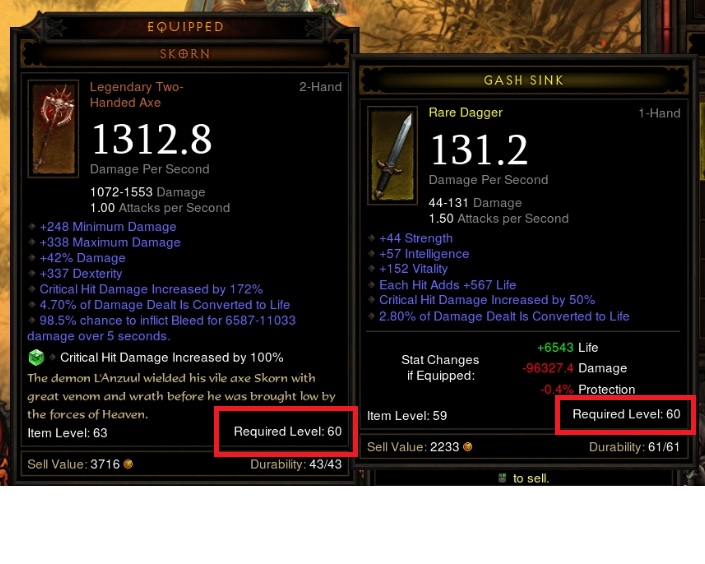
Diablo ItemizationThe above shows a fairly good roll against a fairly bad roll.  Look at the estimated DPS loss (character runs at 102K DPS) from a weapon.  That’s a 96% difference in damage from one item.  Take that horse!


Second item is the defense of subscription.  Gaffney posted some stuff defending WildStar’s decision while Jack Emmert will talk about the opposite in a few weeks.  These are both people with significant experience in the field.  Both have seen F2P on their games (Gaffney was with Turbine and NCSoft) and have seen subscriptions as well.

Perhaps we’re at a point in the hype cycle that subscriptions can become niche again and that the MMO tourist avoids it due to the massive F2P options out there but WildStar doesn’t seem to be aiming for niche.  TESO certainly isn’t.

In regards to the PLEX variant WildStar is aiming for, that only works in a closed and extremely well developed economic system.  It works in EvE because everything is player created, everything required sweat equity and everything is relevant, even at max level.  Taking a cue from any themepark, even the recent GW2, economies from start to max level-1 are completely irrelevant 1 month after launch.  I “beat” WoW’s auction house, making a few million along the way – PLEX would have failed hard in that market. This isn’t apples and oranges.  This is apples and nuclear missiles.