Gaming Trends

It feels like ages ago, but it was only a year or so where I posited that the largest shift this generation for gaming would be cross-play. That was related to Dauntless, and it’s ability to link any version together. Frankly, there are nothing but benefits to having MORE people play in an online game. We’ve seen some bits of it moving forward – Fortnite, and PUBG do it now, Apex Legends is in beta. Genshin Impact is another big splash. I still think this is like the largest change to all gaming.

With these OS/hardware refreshes underway, fancifully called new consoles, there’s a common ground in that the foundational platforms are the same. No significant architecture changes, just “new” assets. It’s allowing for backwards compatibility for nearly anything currrent-gen, without real issue. It also means that the efforts to make crossplay work in the past are still valid. There’s more in common across platforms than not.

Some thoughts on current trends and where we’ll end up.

Exclusives

Last gen really only saw Sony do this with their 1st party games. Many GOTY candidates were in this basket, and XBOX users were left in the dark. Last of Us, God of War, Horizon, Ghost of Tsushima to name a few. XBOX was meh. Forza, Gears, and Sea of Thieves. This does explain Microsoft’s insane buying spree of late, Bethesda of note.

I’m sure we’ll continue to see exclusives, but only in relation to timed exclusives for say 6-12 months from the Microsoft team. Sony is a question mark, the drive a serious amount of console sales from their software. The trial run with Horizon’s on PC is the likely future, with again a timed exclusive model.

Software as a Service

So this is a buzzword that can be used for so much, but this is more like the PS and XBOX monthly gaming passes. This allows the platforms to have a consistent cash flow in exchange for keeping a useful digital library. This provides a ton of value to gamers who float from game to game, and tons of value to platforms for those who stick with a game for a long duration. It dramatically changes the cash flow for developers, where they are putting in millions of dollars and not getting that $70 one time buy.

Consoles are going to invest in partnerships with developers to get access to their services (EA and Ubisoft in particular) to increase the attractiveness of the service. Again, due to the shared architecture with PS, XBOX, and PC, the library of games just keeps on growing.

Updates and Networking

XBOX is in a decent spot. PS4 is so much better than PS3, but holy moly the amount of system updates preventing you from playing is annoying. Sony has said that this is further improved in the PS5, so time will tell. A big change here is more related to hardware, with SSD drives being so much faster than disk drives, which should dramatically speed up the install times. Game load times will be SUPER fast (Monster Hunter on PS4 takes 90s to load a zone that takes 5s on PC).

Now for games themselves, this is actually going to get much, much worse. We’re going back to the early CD days where you had multiple install disks because the storage media couldn’t handle everything. The XBOX S only has ~350gb and doesn’t have a disk drive. That’s about 6 standard games, but for the very big ones you may end up with only 1 or 2. As much as we have modular storage upgrades, my gut is telling me that industry is going to go the game streaming route instead.

Production Values

Graphically there isn’t much here that hasn’t already been seen on PC. 4K + ray tracing, everywhere. We won’t see 8K (nor can people really afford those TVs). That said, a console today is cheaper than a PC video card.

Voice acting is everywhere today, even in indie games. Musical scores are astoundingly solid and memorable. The mid-days are long dead. I don’t see much progress in this department, other than just a new baseline.

The weird spot here for me is going to be character creations. With all the AI tools we have around us, I’m surprised we don’t have a more mature “replicate this picture” in games.

Game Mechanics

This console run we saw “open world everything” and “rpg every system”, with Ubisoft certainly taking this to the extreme. With better processing power, I’d expect more procedurally generated content that increases replayability. I’d also expect there to be better support for player-generated content. To me it seems strange that things like Minecraft and Dragon Builders, and I guess No Man’s Sky, are not being explored in more depth. Hell, Roblox is a cash cow.

Rogue likes are everywhere, and mobile is covered in the concept of incrementals. We haven’t seen a big budget version of this yet, unless you’re counting FPS games here. We’re due.

Integration into the mobile space is severely lacking. I don’t mean ports to mobile, I mean having a companion program to “games as a service”. There’s an insane amount of money left on the table here, if only in the ability for the companion app to be in the players pocket during all waking hours. It obviously would need to be optional, but since all the consoles support Bluetooth and cloud connections, this shouldn’t be hard to sync up.

I would be ultra surprised if we don’t end up seeing Early Access games on consoles this generation. If there’s a way for a developer to make money on a broken game, damn sure they will do so. There’s a GOOD argument to be made around Fallout76 and Anthem being examples of this behaviour. Maybe EA gets a subscription service instead.

Maybe this is the generation where we see a return to Myst-like games of exploration, using FMV and VR. The PS VR toolset worked well, and Oculus 2’s requirement for permanent big-brother Facebook links is putting a ceiling on adoption. Using a standard framework, this is a great opportunity.

Mobility is weird one. Consoles are not exactly tied down like a desktop, but they aren’t exactly mobile either. Streaming would allow you to play the console from anywhere in your house, or from another location if the network supports it.

PCs

The days where consoles drive gaming progress are long behind us. Their best bet is home entertainment units, and at a stretch, a potential VR interface. PCs will continue to dominate the bleeding edge, and the indie scene is where we will see new game mechanics iterated upon.

I do think PC has some serious hurdles to get over, primarily on the absolute insanity of custom PC builds to play potato-quality games. Or, at a more extreme level, having to modify the core settings of a game (or find a mod) to allow a game to use all the parts in the PC. Driver support alone is bonkers. The future of PCs is in the hardware space. Larger/faster storage options. Smaller components with non-PhD cooling solutions. A continual price reduction on pre-built gaming rigs.

Mobile

Here is where I think the largest change will take place, specifically in the streaming area. Right now, Apple and Google “own” the app delivery method and they take a 30% cut. Game streaming services mean the game never really exists on the device, and all the compute is done remotely. Assuming the network speed is sufficient, you should be able to play pretty much anything through a streaming service.

Ok, an example. Fortnite right now can’t be played on iOS for fun reasons. Imagine Fortnite being deployed as a gaming stream rather than an actual app. This would likely break the Great Firewall of China and a whole slew of other interesting hurdles. Bluetooth controller, USB-C to HDMI, a TV, a streaming service and you have gaming on the go.

Future

Gaming today feels like magic. The audio/visual fidelity is right at the edge of the uncanny valley (RTX is crazy good). They bring more and more people together. The provide long term goals and a sense of continual progression and community. There are options for everyone. To me, the future is going to focus on gaming where you want with who you want. It’s going to be awesome.
Blizz Being Blizz

Blizz decided now was the time to ban multi boxing through multi-input software.

Let’s get this part clear – WoW is celebrating it’s 16th anniversary. Multi-boxing is as old as MMOs (I used to do it with UO). This isn’t a new technology, there’s no new technical risk, and nearly all devs have turned a blind eye to this because a multi boxer is a paying customer – and likely a dedicated one with a “permanent” subscription. People don’t multibox casually.

So let’s take a look at the pros/cons in this space.

ProCon
– More money for the devs
– Allows players to have multiple characters
– Allows people to play solo without depending on LFG
– Saves insane amount of leveling time for “grind” activities
– Primary tool by farming bots
– Can be viewed as required for 1% gamers
– Can dramatically unbalance PvP

There are certainly other arguments for/against multi-boxing. I did it in UO in order to build multiple accounts in order to sell them, at very low risk. It also allowed me to farm materials as needed. I’ve never really found a benefit in leveling faster, or avoiding people, but I can see why that’s of huge benefit (EQ certainly).

So the question is why now? What happened today that is making multi-boxing somehow a challenge for Blizz? Specifically, why in the world would they be turning away money from players?

Are there more bots all of a sudden? Gold is pretty meaningless in WoW… people sell achievement runs. Maybe in PvP, where you find something like 20 druids with similar names coming down on you. Again, that’s not new.

I’m guessing here, but the only “new” thing is Shadowlands – and specifically the covenants. I’ve pointed above that multi-boxing is already somewhat niche, and this continues that thought process. And more specifically, how the 1% in WoW impacts the general health of the rest of the game.

Blizz has doubled down these past years in the raiding scene. Nearly every activity released has a raiding focus – the legendary cloak is a great example of this. So top tier raiders tend to set trends in game, which creates barriers for horizontal choices down the player base. In BfA, you were either running X corruption or you were not a raider. Raiders would look for every advantage possible to be able to adapt and overcome design choices. (BC gave us leatherworking raids after all.) Changing talents mid-raid is still a thing.

Covenants are powerful choices for players, and currently balanced in such a fashion that they have a noticeable impact on gameplay. There are optimal choices, and then there are situational choices. The reality of it is that classes are going to be put into situations where their covenant choice is not optimal, and that is the main pain point for the player pushback.

Multi-boxing addresses this. Not in the leveling aspect, but in the grind aspect. This became more popular in Legion, where the AP grind (Maw runs) were facerolls with alts.

I’m certainly biased here. Covenants are effectively powerful talents with very long cool downs. BfA raiders had multiple sets of gear in order to tackle specific encounters, ensuring they had access to ability sets. It’s surprising to me that Blizz didn’t learn anything from that. Well that’s not fair – there is very little that Blizz is doing with WoW combat design that surprises me anymore.

Now for the majority of players today, this is entirely a positive thing. While there were plenty of cases where multi boxing was a pro for a player with minimal cons, the wide majority of cases focused on “abusive” play. Removing this as an option for raiders is even better, allowing for some semblance of balance. That said, multiboxers with nefarious intents will simply find another way to do it.

In a TLDR; for this post, it seems to me that Blizz is banning multi-boxing tools in order to remove the ability for raiders to game the covenant system. In the general sense, this is good for everyone except Blizz who will be out a fair chunk of cash. I’d love to see evidence otherwise.

Divinity 2

I’ve had this one in my library for quite some time, yet I’ve just not been in the right mindset to take on a VLCRPG (very large and complex role playing game). It’s a game that focuses on numbers, die rolls, and limits. Compare that to the more action oriented Skyrim/Fallout games, where the numbers are much less meaningful.

tldr; Baldur’s Gate 2 sits in my top 5 all time games, and it would be sad for me to share the amount of hours I sunk into that bugger. Early Access for Baldur’s Gate 3 got me thinking about going back to the genre. My own sanity prevents me from playing any EA games, even more so one that is known to be buggy, incomplete, and that I would have to replay again anyhow. I value my time more than that exchange returns.

So Divinity 2 it is, and Larian’s vision on how D&D-like mechanics can be applied in the modern age.

Creation

Normally you’re a no-faced bugger and you get to tweak some numbers that eventually end up making your life interesting. A dumb warrior is not going to talk themselves out of anything. Here we have a somewhat straightforward character builder, where the stats are familiar, the skills are just on the edge of focused (so many spell types), and talents that make you go hmm. That’s neat below the covers stuff.

The actual look of the character is pretty awesome, with a decent variety of races and customizations. Topping it off are pre-set characters you can select from, that will allow for a more directed story experience. I tend to pick mage classes in RPGs, they can do amazing things. Divinity 2 takes a different approach to combat though, so my attempts at a caster didn’t go so well. I opted for a dyed in the wool Rogue – Sebelle. She eats people to learn their memories, neat beans!

Tutorial

On the surface the game looks like other isometric RPGs, and for the most part it follow the formula. The tutorial starts you off on a ship, that ends up on a beach. We’re in Chekhov’s gun territory in terms of tropes here. It’s the combat aspect that I think really sets things apart.

It’s paused action, meaning everyone has initiative. Like a game of chess. Each character gets a set of action points to either move or perform an ability, taking up a specific set of AP. While this makes for a more realistic combat scenario in terms of “energy”, it does strongly favour ranged classes who have a limited need to move. Neat bit, the Rogue gets a cool teleport mechanic that allows for a backstab, 1AP but 3 turn cool down.

The tutorial also explains the environmental aspects of combat, where pretty much anything can blow up. Oil catches fire and explodes, causing burning. Water can be frozen or electrocuted. Water can also put out fire, or create steam that people can walk through. There’s poison, bleeds and a pile of other effects that can feel like they come out of nowhere. Since the environment is a hazard unto itself, moving around carefully is important. This again has a disadvantage to melee characters – often you’ll have a pile of fire between you and a target.

Practice

I think this is the magical part of Divinity, where the foundations above create these extremely divergent experiences. Example is a fight I had against Griff and his crew, for not giving up name. There’s Griff in front of me, an archer right next, a melee 2 moves away, an archer above me also 2 moves away, and 2 mages of a similar distance. Starting the fight blind (around Griff) I get picked off in 2 rounds from all the ranged attackers – I just can’t get to them in time. Quick save habits pull me out and I move my folks around before triggering the fight.

Attempt 1 has my main damage dealer put to sleep before her turn, things go bad from there. Attempt 2 has my healer put to sleep before her turn and everyone somehow ends up on fire. Attempt 3 goes super smooth until I’m left with a mage and Griff. Then mage freezes my team (too close together and wet) and Griff just goes off on everyone.

Attempt #4 is where I decide to game it a bit more, frankly because melee characters at low levels are wet noodles. My tank manages to get Griff’s attention, and the other 2 members split up on taking out the mages. Fane (earth/fire mage) does 90% of the lifting here with a dual ranged attack (wands) that causes poison and burning. Not a spell, just a simple ranged attack.

It took 5 tries to get something that resembled a real fight, where target priority mattered, my ranged attackers were smart enough to spread to good positions before attacking, and my healer wasn’t focused down in 2 turns. I am unsure if this is the natural issues that come with low level character in RPGs – this was certainly the case in BG2 – or if this is how things work out in the longer term.

Thoughts

I’ve been playing RPGs for a very long time, and the older D&D model is etched in my brain. Melee excel for the lower levels, and mages have exponential growth later on (e.g. solo dragons).

From the tutorial, it would appear that this model is no longer valid. This is primarily due to the AP mechanic on movement, that penalizes melee characters until they have movement skills. Casters are also limited since their abilities are also limited by the AP mechanic, as well as cool downs, preventing chain casts of something like fireball.

D&D focused on single turn events. You took down one enemy (or more) per turn, and moved through a list of priority targets. Divinity 2 is different in that the landscape itself changes from turn to turn. Entirely possible that the next target is just not reachable because of a fire pit that wasn’t there last turn. It’s a much more dynamic system, more tactical than strategic. It’s certainly interesting!

Forward

I’ll keep up with the game and have a few posts on progress. The presentation values are amazing, everyone is voice acted, and the interconnections between NPCs and events is impressive. Feels like I’m seeing the tip of the tip of the iceberg. Fun times ahead I’m sure.

Blood of Zeus

I’m a tad convinced that Netflix has gamers on the board, otherwise it’s a hell of a coincidence that this anime series launched so darn close to the 1.0 launch of Hades.

I took ancient history in university, which had a solid chunk of time spent on Greek history. I’ve had a rather interesting passion for that topic for as long as I can remember. (Roman to some degree, but they were Greek gods transposed for the most part). I do get that there have been hundreds of takes on the Greek pantheon over the years, across all forms of media. They generally get along, in particular around the “main” actors, and their characteristics. Zeus is the leader, mega strong, smart, and sleeps around. Hera is his wife, always pissed at Zeus for his infidelity (this is the catholic lens applied.). Hermes is fast and a messenger, Ares is tough and focus on fighting, Poseidon is either quiet of full of rage (like the sea), and Hades is a mystery to everyone, keeping to himself. Almost exclusively, the gods fight among themselves and humans are just pawns.

Blood of Zeus maintains the broad strokes, but changes the whole Titans/Giants backstory to something significantly different. It attempts to keep arm’s length to the gods in daily lives, but the reality is that nearly all of the storyline is based on the outcomes of a set of poor decisions by Zeus. I won’t say it contradicts the general society’s understanding, but it’s much more fantastical than what we’ve seen in the past (no gorgons here).

That said, with 8 episodes lasting 30m each, the pace is fairly quick. The setup takes a tad longer than I would have liked, but every hero journey starts with reluctance I suppose. The villain of the series is more interesting than the main character, for reasons that would spoil most of the viewing. The bident alone sticks out like a sore thumbs, so there’s clearly a setup for future viewing.

The series does do service to more than just people walking around. There are the Greek staples throughout, such as Cerberus, centaurs, satyrs, manticores and whatnot. There are very BIG things. The 3 fates are there. The characters all have their own drivers, and for some reason, not a single god lies. That was weird to me, cause Greek gods lie all the time. All the characters make decisions that align with their beliefs – I can’t really stress how refreshing it is to watch something that is not plot driven. It does suck that MANY gods are there for a fraction of time and don’t really do anything (Poseidon has 2 scenes.)

The art style is well done, I certainly enjoyed it more than say Dragon Prince. It isn’t as fluid as a film, but then that’s not the point. The character designs are solid, colour choice is well though out, and there are more than a few winks to the viewer.

Of the large slew of Netflix-only anime I’ve seen, this is only the 2nd of which I’ve been able to watch an entire season’s worth. Oh, there are plenty of choices. Dragon Prince got 2 seasons out of me from pure hope of the writing team being able to slightly repeat the magic of Avatar (they did not). If it had not been set in Greek mythology, the story would still have worked, though I doubt my interest would have been as high.

At 30m per episode, this is a digestible anime with a plot that moves. That alone should be enough to warrant a watch.

PC Building Simulator

This weekend, my daughter and I (with the wife and other daughter watching on a cast) played us some PC Building Simulator. I’ve played a lot of simulators and as a common theme, they all do an admirable job at exploring how monotonous any task can be. There are spikes of “WoW”, very long periods of tedium, and then plenty of “ah shit” moments. What I’m getting at is that the game is a true reflection of building PCs.

(Side note first. I went back and specced out a CDN build of a RTX-capable desktop. The core parts came in around $1300. The video card starts at $800.)

There’s a simple tutorial that explains how PCs are built and which components are used. It’s impressive how simple PCs are today compared to 10 years ago. PSU, mobo, CPU, cooling, RAM, storage, and a case. That’s it. In the real world, the only extra component would likely be a network card if you’re not going on-board (few do). I clearly remember managing sound cards, printer cards, modems, limits on hard drivers, jumper placements, mouse cards, and a series of nightmares that followed with drivers. Thankfully, none of those are here.

But the simplicity of the pieces belies the true complexity of managing PC builds. To say anyone can build one is a lie for the simple fact that PC parts themselves are a labyrinth of half truths, interfaces, parity, and wattage. First there’s the simple stuff, like AMD and Intel chipsets, which dictate the rest of the build. You need the right chipset, which means half the available motherboards won’t work. The mobo’s RAM speeds determine both the quantity and the speed of your RAM. Mobo also decides what type of video card is available (SLI or Crossfire support). Hard drives don’t appear to matter here, since all I’ve seen so far is SATA connections. Cases matter, since they can only support a given set of mobo standards (S-ATX/ATX), and they limit the size of certain components (video card may be too big). Entirely possible to buy some stuff that simply will not fit together.

Then there’s the arcane math of PSU, making sure that the listed wattage draw is supported, and if you happen to add any over-clocking (OC), you’re going to need even more power. Cooling is certainly impacted by OC, which pretty much forces you to get into water cooling.

And then the magical PC Part Rank lists. Multiple times a year the makers will send something new to market that is either a major or minor tweak. Instead of “clear” lines of a 590 being better than a 570, you’ll end up with 10+ versions of the 590 that meet niche requirements and bloat your options. Prices often dictate performance, but sometimes not as was shown last month, you’ll get a 3070 which is on par with a 2080 (for cheaper), but less good than a 3080. And I haven’t even talked about the game yet!

The Game

In truth, the game covers all of this and rather well. You have a shop with a great search function, a Part Ranking list that’s damn solid, 3DMark testing, RGB settings for many parts, a build order requiring paste before cooling, and clients with very strange habits.

More often than not you’ll get a box that’s filthy and full of viruses, on top of a fundamental issue. Could be they just want an upgrade, or know a part needs to be replaced. Those easier items are eventually replaced by “I don’t know what’s wrong” and you need to figure it out by reverse building the PC and checking each part. That alone brought back nightmares from IT support in my younger years. The worst offenders are those who want a NEW build, saying they want it to meet some benchmark, and then give you a budget that gets you a sandwich at the deli. And you’ll often have 5-6 requests all going at the same time.

And this is where the game both shines and suffers through it’s accurate reflection of the real world. You are spinning plates and have a wall of parts, a list of PCs to address, budgets for each, compatibility issues galore, and you can’t label pieces destined for builds. You have a pile of work, and a pile of parts, and no real link between them. God forbid you end up 100pts under a benchmark (the test takes 2 real world minutes) and you’re over budget. Now what?

Now you OC the crap out of it and pray to the gods in the sky that you don’t burn it out. You pray that you have enough power to the box, and that the cooling won’t turn it into a marshmallow roaster.

And as you progress, more and more parts come down the pipe. What was top of the line a month ago is relegated to mid-tier today. Making you doubt if it’s ever really worth it to spend triple on a PC that will be relegated to “ok” in less than a year. Of all the things PC Building Simulator does well, it’s the accurate reflection that ultra amazing is a carrot that cannot be held.

This is an amazing simulator.

Desktop vs Laptop

This past weekend, my daughter explained to me that for the past year she’s been wanting to learn how to build a PC. I think I shed a tear.

I’ve had quite a few posts on this subject over the years. I’ve built hundreds of PCs over the years, it was a super pass-time/income option in my late teens & early twenties. I built my last box in 2009 and since that time, I’ve gone the gaming laptop route. The main driver for this was mobility, as the price point was most certainly higher, and the performance was a tad lower. And mobile in the sense I could plug it in somewhere else, cause a gaming laptop ain’t gonna work when it’s not plugged in.

My recent purchase (MSI Raider) before Anthem came out was an eye opener as to how laptops have come a very long way. Performance-wise, they are frankly on par with pretty much any gaming desktop. There will always be the top tier gaming rig, that’s over-clocked, and needs more cooling than a power plant. Even the price points are frankly damn close.

Don’t get me wrong, I still think that the desktop has a place, but the mobility factor is what everyone under 30 needs to get their life working. There’s always going to be a niche for power rigs, yet more and more compute is going into the cloud… hell gaming is moving to the cloud.

I’m seeing it sort of like the following now.

DesktopLaptop
Pro– highly customized parts
– the highest computer power
– easy to upgrade parts
– can last 10 years with upgrades (ATX is how old?)
– mobile
– computer power meets nearly all needs
– easy to upgrade RAM/storage
Con– no mobility
– requires peripherals to work
– costs ~10% more than a desktop (without peripherals)
– can’t upgrade CPU or GPU
– lasts ~5 years and hard to repair

At the end of the day it really boils down to price vs mobility. I could easily plug in my laptop to my desktop station and use all the same things. Mobility is a personal choice – more of a generational one it seems. Price, that’s somewhat clear.

Pricing Exercise

So let’s look at this for a minute. Maybe not a blistering rig, but one that’s more than capable of running pretty much anything at 60fps. There are plenty of options; custom builds, ROG, MSI, Alienware, Razer and others. For this we’ll look at 3 options, an MSI build, a custom laptop, and a custom desktop.

Baseline specs we’re looking for

  • 10th gen Intel chip (the whole i7/i9 stuff gets complicated quick)
  • RTX enabled video card @ 8GB
  • 32g of RAM
  • 1GB NVMe main drive

In terms of MSI options, this is narrows to the Titan (big rig), Raider (standard), and Stealth (thin) rigs. Only the Titan has i9 options, the others are running i7. They all run RTX2080 video cards, which is still the best card you can get in a laptop, and the Titan offers 3840 resolution. The Titan also has 64gb of RAM, and it runs 2x NVMe drives. All those upgrades come with a 10lbs weight.

Prices are in CDN, with the following

  • Raider – GE75 goes for $2,600 with a RTX2070 or $4,000 for an RTX2080
  • Titan – GT75 goes for $2,400 with a RTX2070 or $6,400 (!!!) for an RTX2080
  • Stealth – GS75 goes for $3,200 (??) with an RTX2070 or $3,900 for an RTX2080

There’s an insane amount of fluctuation in these things, especially with the 2080. Buying my Raider took me 2 weeks to figure out this mess.

Custom build next, same specs as above. I’ll use Reflex Notebooks, not a lot of custom builders in Canada. Sager is pretty much the de facto form. The RTX2070 variant is $2,700 and the RTX2080 variant is $3,500. Clearly there is a HIGH premium for the 2080.

If I’m looking at a PC build with these items, I’ll use NewEgg’s tool. Low end (i7/2070) is about $2,300 and high end (i9/2080) is $3,200. This is with a $200 case and $200mobo, assuming looks matter a bit. This does not include a keyboard or monitor, which at average rates would set you back another $300 (but could use for a very long time, even with the laptop).

If you’ve built a PC, then you know these prices can move up and down based on time of day. And that a PC build has near infinite combinations. Motherboards alone have so many price points with barely a difference for most folks. And don’t get me started on RAM… there are a dozen variants of DDR4 8GB 2400, yet they should be functionally identical. The act of building a PC is easy, the art of getting the parts is frankly magic. See, I skipped cooling!

It’s pretty clear that laptops are in the similar price range as desktops. In the $2,500 range, you can get either. If you want bleeding edge , or love tinkering/OC then desktop is still the best option (e.g. 4K 120fps ultra wide), but otherwise welcome to 2020.

Anthem NEXT Update

Clearly we’re at the point where base Anthem is dead, and everything is focused on NEXT. We’re a few months shy of 2 years from launch from the base game, with nothing new for over a year. I guess all the chips are in this new pile.

A blog post due in August is finally up. I’ve read it a few times now, and truthfully everything in there is a solid decision point. In terms of “decisions that should have been made years ago”, the only thing that really matters is that abilities are unlocks and not drops.

For those not recalling Anthem’s skill system, javelins at max level have no abilities. You need to equip items to get access to abilities, and those abilities are limited by your class. The drops have stats, and for nearly every item in the game, there are god rolls and then garbage. Inscriptions made it even worse, since they allowed for tweaks of base abilities, had god rolls that made things broken, and were next to impossible to find.

So that change is more than welcome, there’s no point in having NEXT if that’s not the foundation to build from.

The rest of the post talks about drops that add modifiers to abilities, a skill tree, and specializations. Which if you look at every other looter/shooter, is baseline structure. It’s hard for me to emphasize how fundamental that this be the case and how mind blowing/infuriating it was when Anthem launched.

At this point, I can’t say that there’s anything bad in here. The devil is clearly in the details and balance. At no point did I ever have a problem with the moment to moment parts of Anthem, they were kick butt. Everything wrong with Anthem was the mechanics that prevented players from experiencing the game. It really felt like no one played the game outside of the battles. It was like a 4 course meal of AAA lobster, nachos, curry, and tiramisu. Each piece is great, but they just don’t go together.

In that respect, if you look at Anthem NEXT as a parallel to FF14’s relaunch, things are rosy. That EA/BioWare are willing to invest in this is amazing, clearly seeing some value in the IP/assets already in place. We’re ~6 months since the new direction was launched, and this is pretty much where I expected things to be. EA’s fiscal year end on March 31, ain’t no way we’re going to see anything launched by then. So I guess we’re looking at March 2022 as the end date for all this work.

Aside from Dragon Age, I don’t know what the devs would be working ont. I sure wish them luck in this.

Final Hades Post

Probably.

I completed the full epilogue the other day, which I won’t spoil for those who have yet to reach it. Understand that it takes a significant amount of “relationship” investment to achieve. It was somewhere around run 78 I think. I have 1 only Aphrodite left to max out now.

I still have some minor prophecies to go, related to getting all the duo boons, getting all hammer upgrades for gloves, bow, and railgun, as well as completing the lyre quest. That last one appears to take ~100+ uses of the lyre and a good half dozen extra runs. I think that one quest is my only complaint of the game so far!

Given the Duo Boons quest, it’s made for some interesting focused runs. Things I normally would not have tried for. The biggest hurdle in this is Demeter, as she is the least likely to show up as a primary god on a run. Primary gods are those that show up 5+ times in a run. Combined with the fact that her tier 1 boons are the weakest, you’re really at the mercy of RNG to have a decent run.

I wouldn’t say I’m in the optimization mode, since you know, RNG is RNG. Yet, I’m aware of every weapon’s strengths and weaknesses, as well as each god’s. Zeus for example, is great on fast attacks, but horrible otherwise. Artemis is best on slower weapon as the crit impacts can deal crazy damage levels. Dash-strikes reduce combo damage, but are twice as fast. Hermes speed boons can be crazy. Chaos boons need to take into consideration when you’re going to reach the boss.

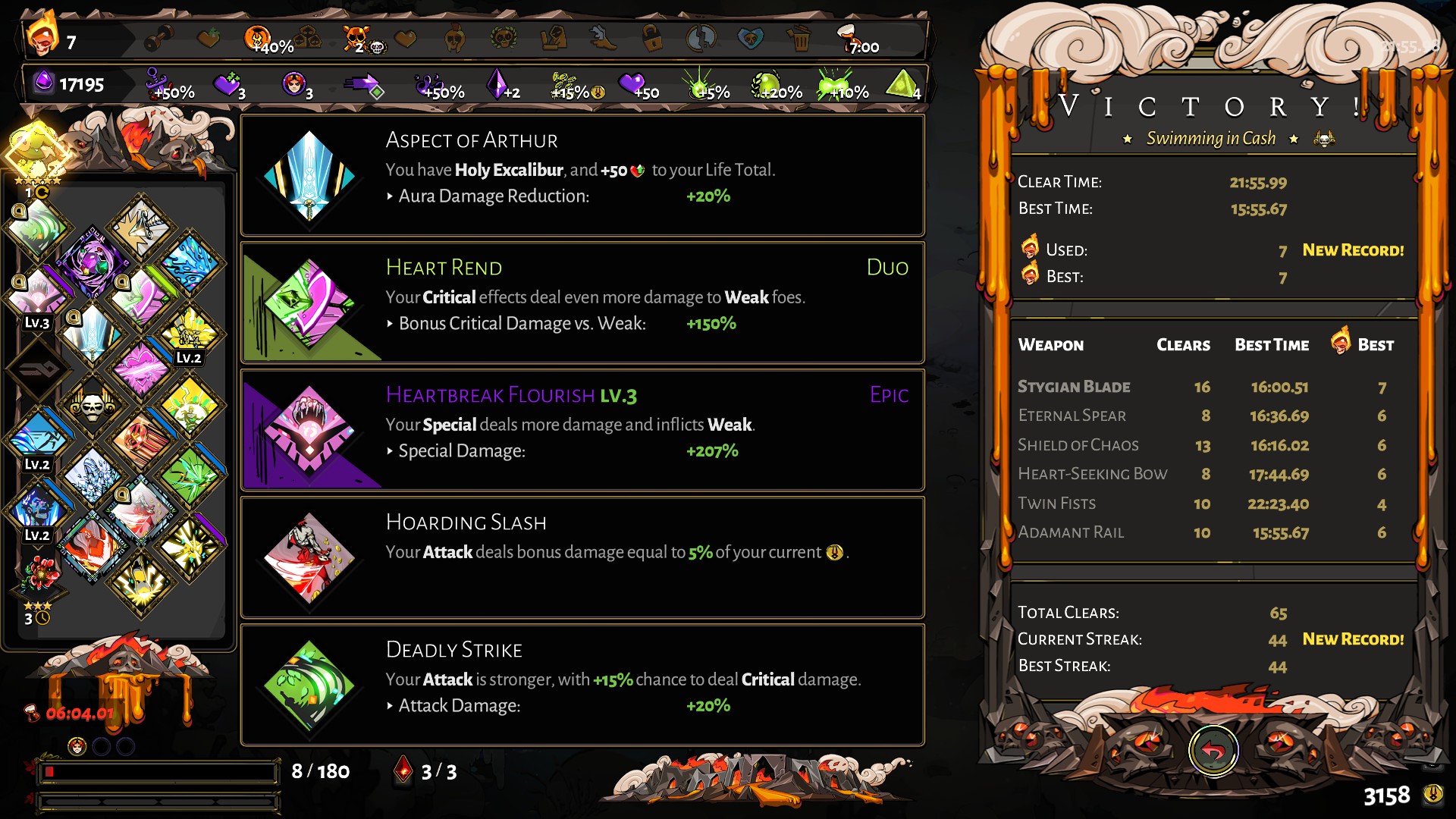
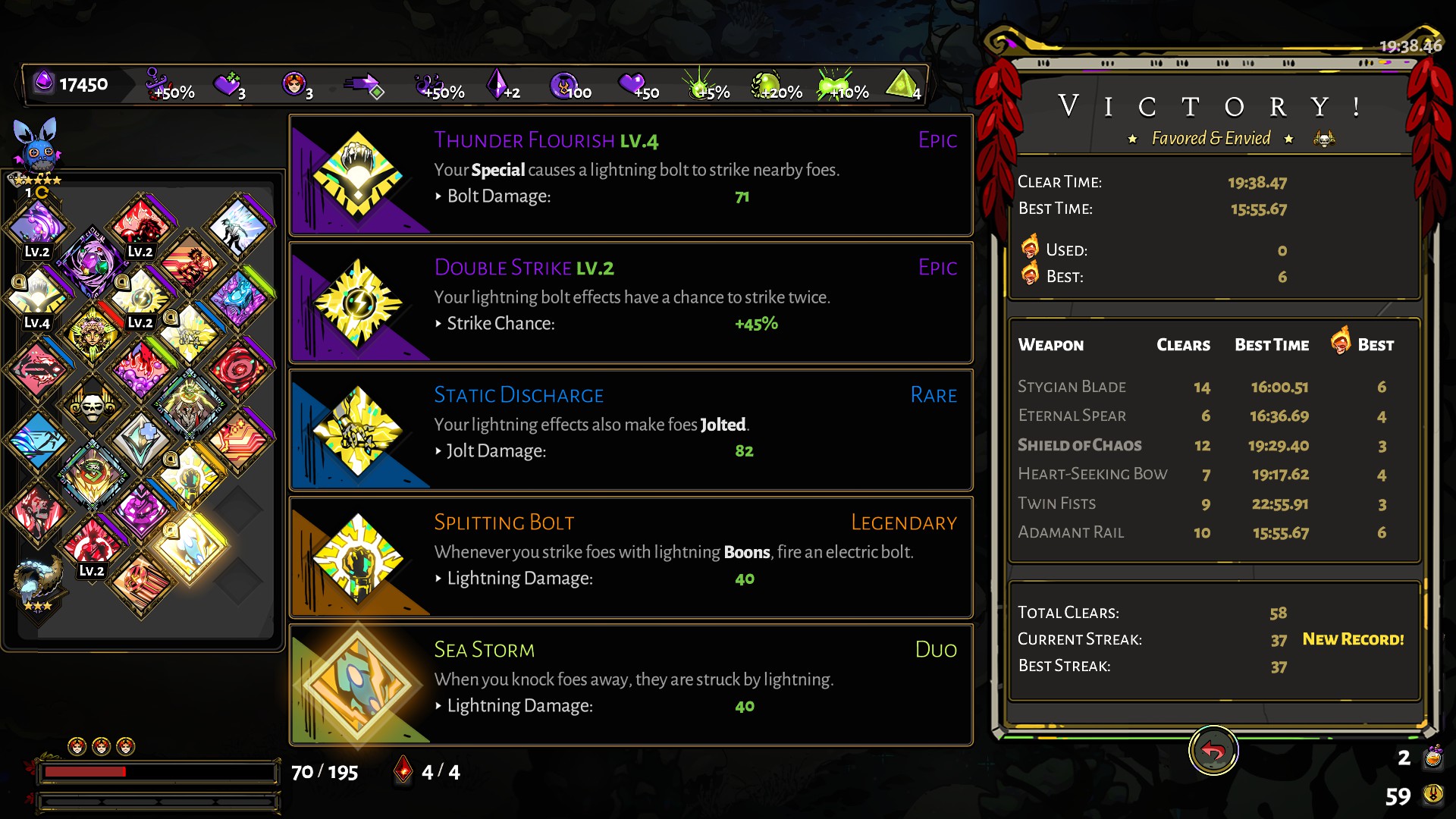
Some screenshots below of end of game screens that I thought were worth mention.

This run focused on the Zeus/Poseidon with the Zeus Shield. That shield aspect hits multiple times, and if you aim it right, it can hover over a boss. The actual shield damage is minimal (30) but it triggers a 71dmg bolt that has a 43% chance to hit twice. Each of those triggers a 40dmg bolt which can also hit twice. All the while I’m dashing to trigger Sea Storm for yet another 40dmg bolt (again hitting twice). It’s impressive to see.

This run was an Arthur Sword run, which is high damage but really slow swings. The base combo damage 60/80/200. It was focused entirely on getting the Hoarding Slash hammer upgrade, which raises attack damage by 5% of your total gold. Poseidon, Hermes, and Chaos all give gold boons. The Golden Touch mirror upgrade (+15% gold at end of zone) is also great. With 3158 gold, that comes to +158 damage on attack. It has a 15% crit chance, and with Weak, crit deals 350% damage. You’ll notice that I didn’t boon my Cast, that’s due to a mirror upgrade that increases damage to targets with a crystal by 50% – only Artemis and Poseidon have casts that inject a crystal. The weird math behind this means a 3rd strike can hit for ~2,300. Even a non-crit 3 hit combo hits for 1,500.

Easy Heat

Heat levels give you more Diamonds, Ambrosia, and Titan Blood. Diamonds are for cosmetics (some quests), Ambrosia to max friendship, and Titan Blood to upgrade weapon aspects. You only get rewards for 1 Heat increase per weapon – repeating the same heat level only gives Darkness. In the picture above, that means I’ve successfully beaten Hades 41 times with increasing Heat levels. The rewards end at 20 heat (aside from a Skelly cosmetic/achievement at 24). You can get all these materials through the Broker in the Lounge, or buying them at the Styx/Charon shop.

The absolute easiest Heat levels come from Tight Deadline, which reduces the amount of time you have to clear a zone. No difficulty increase, and ample time to clear everything with either 9m or 7m selected (36m/28m full clears). As a perk, this pact prevents the annoying “survive 45 seconds” rooms. Extreme Measures is also helpful here, at least for the first two ranks. The Furies add some extra AE attacks, but that’s it. And Lernie has a smaller zone, which actually helps clearing the extra heads (and AE damage). Extreme Measures for Theseus/Asterius is a pain in the butt, at least in terms of clear time.

Now for the hard ones. Underworld Customs (remove a boon at end of zone), Routine Inspection (lose 3/6/9/12 mirror upgrades, from bottom up) is insanely painful, and finally Approval Process (remove 1/2 boon choices) is extremely restrictive. There’s a quest to clear the game with each active, but I don’t suggest trying with all 3 active at the same time.

I won’t suggest any combos past 5 heat. If you can clear that, then the rest is fairly obvious.

While I’m still having a ton of fun playing, I think I’ve saturated the blog enough on Hades for a while. Happy gaming!

Godfall

Of all the console launch games coming in a couple weeks, this is the one that intrigues me the most. At least, at the conceptual level. It gives a vibe between Warframe’s flexibility, and a 3rd person hack and slash like Monster Hunter. It’s a weird mix.

Destiny launched in 2014, which ostensibly put the looter/shooter into the limelight. Destiny 2 and The Division(s) iterated on that. Warframe had launched a year earlier but took a couple years to find it’s footing. The game today is much different than back then. That to say that in general, the model has evolved over time. Where it hasn’t is with Anthem (the 2.0 blog update is 2 months late), and from all I’ve read, Avengers.

The good news with Godfall is that the lead designer has a fair chunk of experience in this field. Devs have worked on Diablo2 and Destiny 2. IGN has an interesting article on their mindset for loot management, which articulates how much importance they are putting on that item. Since “tinkering” is the long term carrot for most of these games, I’m somewhat optimistic that they can get this to work.

There are some eyebrow items in here, such as how leveling one class levels all the others – you swap plates to change classes. That’s a very odd choice as it reduces replayability, and certainly has some mechanical reasons. I think the grid mechanic is neat, where proximity of slots impacts their effects. Two identical classes, with identical gems to slot could have different (marginal?) effects based on the order of the slots.

Interesting that 2 weeks out, no one knows anything concrete.

I’ve been a fan of Warframe’s customization for a long time now, enjoying it much more than hunting light levels or whatever arbitrary term the game uses. I’ve written dozens of posts as to how Anthem screwed the pooch on this aspect. I’ve avoided Avengers, primarily due to the way the power grind is built (I won‘t get into the Mega Hives, or that it’s better to play with AI).

I should point out that this game is built by a rather small team, so there’s no “traditional” end game here. There’s some sort of rogue-like tower activity you can do with others, but that seems to be it for now. The focus appears to be on the campaign, which can have on-line co-op. Which seems a-ok to me, much better to bite off what you can chew. If multi-million dollar companies can’t even get the basics right, then why would a small crew try to do the same?

Colour me interested. Maybe they actually figure out the loot part and can teach the big studios something. Guess we’ll find out in a couple weeks.

Winter Is Coming

This morning there was some white stuff on the ground, first time. Considering we were wearing shorts on Friday, it’s a hell of a swap of mindsets. I rather enjoy winter, though that’s primarily due to the hockey season. Without it, I’m curious as to how my brain will manage through.

Wife is interested in taking up cross-country skiing. It’s one of those weird things where I have zero interest in skiing, in any form. I think that the cross-country version is too close to running, which I also do not enjoy. My joints have enough invested in hockey already, I don’t need even more abuse. I’m sure it’s a mental block. That and the near grand I’d need to drop to be equipped for it properly.

Winter also brings a form of SAD, where sunlight plays a massive part of my energy levels. The good news there is that I work next to a very large window, so I get a ton of it during the day. The downside is that I don’t get it directly by being outside. When the work day starts it’s usually dark, and it certainly is by the time it ends. Recalls when I was younger in an office with no windows… felt like I was working in a mine. I did invest in a neat piece of technology, an alarm clock that simulates sunrise. It’s done wonders for my morning routine.

Pumpkins are carved, outdoor patio stuff is put away, cottage is closed. All that’s left is putting up the holiday lights in a couple weeks and the outdoor rink. Winter coats aren’t out yet, but I’m sure they will be by next weekend. Including winter tires. Adulting sucks sometimes.

Games, well it’s obviously all Hades. I’ve done about 75 runs now, on a streak of 33 wins too. There was one in there that was a heck of a close call, while I was trying out some interesting difficulty modifiers. Got the last boss with 2 HP to spare. Note to others, Hades with speed and damage modifiers is like bullet hell.

I will say that going for fast runs is certainly fun. I’m running ~15 minutes on the good ones, and have some favorite aspects to get through. Lenny on Extreme Measures, and enemies with increased move speed makes it all go a lot faster. I do like that every run has a preferred weapon, with a 20% boost to darkness/gems. It’s a neat motivation to keep trying different playstyles instead of fishing for the perfect boons on a specific weapon. I should have the final epilogue complete in 5 or so runs, which would “complete” the true game.