Pluto

Manga is a bit like Steam. There are piles of it to choose from and most of it is meh. There are however the odd flowers in the pile that stand out. Pluto is certainly a flower. There’s a story behind the manga, which I won’t get into aside to say that it’s a re-telling of one of Astro Boy’s series. Well I guess I could add that retelling this is sort of like Frank Herbert allowing someone else to re-imagine Dune with all the same characters. Very hard to wrap your mind around how 1) the rights were allowed and 2) the sheer guts to even attempt this. But it worked!

Netflix somehow (of course they did) got the rights to an anime adaptation of Pluto. It is a ridiculously faithful adaptation, which helps as the manga itself had some amazing framing. It’s also one of the very rare anima where the English voice dubs are very well done! The fidelity here is impressive. And with 8 episodes at nearly an hour each, there’s a ton of breathing room for the slew of characters, yet short enough to not feel like there’s DBZ-level padding.

It is hard to categorize Pluto as it’s part murder mystery, sci-fi, thriller, action, and ethical treatise. The main line is the mysterious murders of the 7 most advanced robot AI as well as a group of humans that investigated advanced AI, which precipitated a giant war. We then get into a cycle of hatred, what happens after robots have the same rights as humans, what happens if you can’t forget, what actually makes a human, emotional cycles, and is it possible to have true redemption. Wall-E asked “what if robots had feelings”, and Pluto is a thesis on that exact question and more.

I realize I am in the right state of mind for this type of existential discussion. Love and hate, and anger and tolerance are all flowing through me like a raging river, beating at my walls of logic. I’m about to close a chapter in my life that has been holding a bookmark for over 10 years. A relationship that at a time I thought would frame my life, but instead I’ve used that to take a different path. I had moved on and not looked back for a while, and it’s time to reflect on the journey’s start.

The best art, regardless of medium, is the one that acts as a mirror. It takes a view on the human condition, pulls it apart, and then puts it back together so that it just hits different. Pluto is an impressive take on the human process of anger, guilt, redemption, peace, and legacy. It hit me square in the jaw.

Return to Moria – First Impressions

Lord of the Rings + Base Building + Survival? Count me in.

In reality, none of those things actually turn out to be what you may expect.

Lore

Lord of the Rings is just oozing lore at every corner, and Moria certainly is ripe for the picking. Since this game takes place at the end of the 3rd age (Rings is gone, Gimli still lives), you won’t ever cross paths with the Fellowship, but Moria is a tomb and should be full of history. Sure there are orcs in every corner, but you’re borderline Indiana Jones in terms of potential here.

In practical terms, there isn’t much here that comes from the official lore. You have target quests to complete along the path, which guide your exploration to a degree. It’s mostly window dressing, with some minor exceptions (Elven Quarter and the final bit). I will say that the art style is where things make a bolder statement. This feels like Peter Jackson’s vision.

Base Building

For some reason, the entire game is built on a cardinal grid. North-east does not exist. The net effect is that the base building portions are locked into this grid, and if you happen to a generated corner, you may be stuck with things locked into 45 degree angles. You don’t have the ability to fast travel, build roofs, or ramps until QUITE a ways into the game.

If you’re going into this wanting to build a new Kazad-dum, this is not the game. If you’re going into this for the pragmatic base building – in particular where fast travel stations are located, then yeah, this will work out just fine. Due to the general lack of continual harvest, you will never backtrack to a prior base once you have a new fast-travel point/base. Always you are heading east.

Survival

This is the most confusing part to me. Survival games are not new, there’s an entire genre of amazing ones out there. You need food/sleep/shelter to survive, tools to acquire material to progress, equipment to attack/defend, and exploring the world.

The food/sleep/shelter portion sort of works here. You won’t have the ability to create portable food until you’re well into the Deeps (what appears to be the half point). Light sources are weird, where even with a torch you’re considered in the dark, which drains stamina. Food variety is generally meaningless, as the stat boosts are identical, and “feeling full” is whatever item you can cook. That farming is present with food seems strange… perhaps I am missing something or this is simply a QoL thing.

Tool progress is a mixed bag. You need to keep moving forward to find new things to do. Take on some tougher foes to barely collect some material to make a better sword, so the next time is easier. The tiers of progress are ultra confusing mind you, as you’ll enter the proper Mines of Moria and not be able to collect half the stuff around you, and no indication what to upgrade in order to do so. I do like the exploration aspect, that discovery is predicated on trying to mine something, or repairing random statues for recipes. But if I’m given the option of a gold vein, I should be a few minutes away from unlocking the ability to mine it. Note to all: collect as much coal, stone, granite and adamant as you can.

Equipment has tiers, which you unlock well after you actually need them, which again is a nice risk/reward function. The downside is that Moria has way to many frigging enemies with absolutely stupid AI. You’re fighting constantly through swarms of enemies, stuck repairing gear after nearly every attack, and the combat is simply mind-numbingly boring. I triggered a horde attack of orcs in Moria, which lasted nearly 15 minutes. Orcs drop zero loot of use, except to repair your gear. I’m sure there will be a mod (or an update) that controls enemy spawn rates, or increases the damage you do so that this is a bump rather than a wall of dumb. The bosses (and trolls) are interesting for multiple reasons, but I’ve had my share of orcs. Learn to love the dodge-roll.

Exploration

This is the broken expectation part. The game is fundamentally a dungeon tile explorer. You are in pre-generated “rooms” that have a dirt path connecting to another pre-generated “room”. You can explore any of the rooms, but progress is entirely and absolutely gated behind the dirt paths. The walls of these rooms are also unbreakable, same with the floors. I was absolutely not ready for this. In hindsight I can’t see how this game could have functions with pure freedom given the lore limitations. Not like you should be able to dig down as deep as you want and find a Balrog in minute 15.

The net effect is that plays much more like a dungeon run, with survival elements. Explore the tiles to find the entrance to the next zone. Explore that zone for the “McGuffin” that allows access to the next, at so on.

Subvert Expectations

This is not Valheim. This is not Ark or Rust. You are in Moria not to rebuild it but to traverse it. It took way too long for me to come to that realization, but once I did my enjoyment of the game drastically changed. Each room become a puzzle to solve. Every zone one to conquer and leave behind. I needed to buff up before the next spelunking.

This is a very slow burn game, and if you’re going into this expecting a free-craft survival game (as it’s promoted), you’re going to be in for a bad time. If you look at this instead as a dungeon crawler with survival elements, then yeah, this game is actually pretty solid.

Multiverse & Monkeysphere

Or perhaps just Dunbar’s Number. The general concept here is the limit of people through which you can have a stable relationship. Obviously, for each person this will be different but in general terms this floats around 150 people. Past that point, you lack the time/resource/memory to have meaningful relationships. Personal anecdote here, but my kids are the first to be annoyed at the number of people my wife and I know, and with whom we stop to chat. It’s well above 150, but in terms of meaningful relationships, the number is closer.

I bring up this topic because Loki Season 2 + the entire multi-verse structure of MCU brings a flaw to this model. A mutliverse in itself is not super hard to grasp, the concept has been around for some time. Meaningful mutliverses is a harder things to grasp. Like picking which flavor of toothpaste to buy should have a larger impact than say, having kids. Did they all start at the same time? Do new ones start all the time? Do they ever merge? Those are more philosophical in nature, and up until Loki, there were only minor additions to the MCU multiverse.

Loki blew this up and made the pitch that new branches of the multiverse are growing all the time, and a TVA organization is responsible for pruning them to maintain a core reality. Season 1 ended with the explosion of that pruning, and branches growing everywhere – but the stakes made no real sense. This is because we are on the main timeline and the cuts never impacted us.

Season 2 makes this worse because the main driver of weight is that there are people in these other multiverses, and that by pruning these, it’s effectively ending the lives of entire universes. Thanos had weight to remove half the people in 1 universe. The TVA effectively destroyed entire universes multiple times per day. How is Thanos viewed as a villain and not the TVA?

The answer boils down to the ability to relate to a multiverse, in that there are other “yous” out there. And that if you met them, that you’d feel they are as important as you are, even if they’ve only been around for a day or less. No human on the planet can relate to that level of empathy, and therefore the stakes in Season 2 are all but meaningless. Even less so when you don’t see these people in other universes, only a line on a screen.

There’s a reason the comics have gone to great lengths to avoid the multiverse problem, with multiple resets of the universe to simplify the larger world and reset the true stakes. You can’t worry about 62 versions of Spider-Man. You can enjoy it for a small period, sure, but have it be meaningful? No.

Loki is only 2 episodes in, so time will tell where this finally lands. But it would be fair to say that the natural conclusion in all of this is a consolidated universe. When is the question.

Ahsoka

Context #1. I like Dave Filoni. He’s a testament to every single geek on what’s possible if you really care about something and want to share that love. He’s pretty much the only reason Star Wars has existed past the prequel stage. There are few people on the planet that know more about Star Wars, and that is both a boon and a bane.

Context #2. When Disney bought Star Wars from George Lucas, they reset the entire lore into “Legends” and “Canon”. Now if you weren’t paying attention in the 90s, there was an explosion of expanded universe content, some great, most not. Disney wisely said screw that, drew a line, and then started to selective pick from Legends to bring into canon. Of all the developments in Legends, Grand Admiral Thrawn was by far the standout. Filoni brought that character back in recent years in the animated Rebels series.

These 2 pieces of context are important, because Ahsoka (the padawan of Anakin Skywalker during the Clone Wars animate series) is a litmus test of your patience of deep cuts. Enjoyment of Andor had much less to do with the Star Wars setting as it did with simply amazing writing/acting. Even The Mandalorian’s first season was like this. Ahsoka is not a great series, the pacing is off, the setting confusing, and most importantly assumes that the viewer fully understands the foundational lore.

Every established character (Ahsoka, Hera, Huyang, Sabine, Ezra & Thrawn… Morgan to a small degree) come with a ton of baggage and miles of history. Character history that is called out at multiple times in every episode, making some interactions confusing. Like heading to a group party and everyone has inside jokes that you simply do not get. The new character of Baylon Skoll (Ray Stevenson, who sadly passed away before the series was released) is the true joy of this entire series, introducing a “grey” Jedi that has just not been seen before.

Now, if you do know the lore, and you have followed Dave Filoni’s efforts to grow said lore, then Ahsoka is a more than decent show! Thrawn in particular is a type of villain that simply has not existed in live-action Star Wars and is a breath of fresh air. The challenge of a cerebral villain is that it doesn’t necessarily translate well to live media. Few people find chess matches entertaining after all… or perhaps more accurately Thrawn is playing 3D chess while everyone else is playing checkers. The deep lore cuts here are also fairly crazy. The final cut of Baylon on Peridea on the statue of the Father, next to the Son, and a Daughter statue will mean nothing to folks who have not seen the Clone Wars episodes from 2011.

I will close with a final thought. Disney (and more specifically Dave Filoni) have been going to great efforts to bury/retcon/move past/justify the Skywalker sequels (Ep 7, 8, 9). A new expanded universe is being constructed, which is adding a very large amount of complexity and nuance. The lack of linearity in the story telling is bringing to light the exact same issues that the Marvel Cinematic Universe is experiencing. If you can’t understand a storyline without having invested dozens of hours of previous content, that is not a sustainable model. Filoni is building a beautiful, integrated, and consistent world. But he’s not the target audience.

Assassin’s Creed: Mirage

I am so extremely hopeful that Ubisoft takes some lessons from what Mirage has delivered, which is about 20 hours of quality content, and a relatively successful call back to its roots.

Context first. I’ve played nearly every AC over the years, including the Origins/Odyssey/Valhalla phase. AC2 and Black Flag still rank highest for me, though for different reasons. AC2 due to the depth of the story, the characters, and the setting. Black Flag due to risks it took by adding the water elements. The O/O/V phase is remarkable for other reasons, mostly the full RPG/stats behemoth, the general lack of any assassins, as well as the sheer size of the games, clocking in at over 50 hours each. The phase also exemplified the Ubisoft mini-map icon curse, where there are hundreds of absolutely meaningless collectibles where it was simply easier to barge in with weapons than put any thought.

Mirage instead applies focus.

  • There are no levels.
  • You have a much refined skill tree, with impactful effects
  • Combat is challenging due to the parry/lock mechanic, which reinforces the need for stealth
  • There are puzzles that require some thought and attention
  • There are only 5 types of collectibles
    • Dervis’ junk. Provides material for upgrades that you can get through regular gameplay.
    • Shards. 10 total, unlocks some gear that I found no use for.
    • Books. 7 total. Unlocks a cosmetic. Can’t complete this until the penultimate quest.
    • Enigmas. Puzzle indicators that lead to cosmetic talismans. Some are very obtuse.
    • Chests. Unlocks gear/schematics that allow upgrades. More on this.
  • The main storyline has multiple branches that are about a half dozen steps each, and all come back together near the end.
  • You can assassinate anyone except the final staged battled. It is ridiculously rewarding to stealth your way to a head of the order and fly in from above.
  • The story is contained, the city is small, and the opportunity to explore is limited.
  • There are optional side quests that add story as well as a bonus reward if certain conditions are met. e.g. don’t get detected.

The gear upgrade part needs some expansion. Where O/O/V was primarily focused on numbers, Mirage is focused on effects. You’re extremely unlikely to use any armor or sword aside from the starting ones, as they provide incredible effects – less detection on assassinations and increased damage on parries. It makes this function seem important, but in reality it’s as optional as everything else.

The Ubisoft question often goes back to “why collect things” and the answer was often “because it’s there”. Getting that icon off the map was often more a reward than the actual item, and the developers can apply so much creativity when there are 400 icons. Mirage cuts those icons down to a very small amount, and in almost all cases (junk/shards aside), applies a meaningful challenge to them, like having to collect a key a few blocks down in order to unlock a door. It’s far from perfect, but it’s a marked improvement on the pace of the game.

Where Mirage stumbles is in the main storyline. Basim is not an interesting character. The Order is the same as in the past games. And because this is a prequel of sorts, the ending is already known. Baghdad as a city is more interesting (and the historical codex entries too). Mirage also has the traditional “jank” of parkour where you want it to do something, but it does something else.

Finally, and I think this is the true merit of note, is that this entire game was built by a smaller Ubisoft team with existing assets, and a decent level of quality as a result. Ubisoft does NOT need to throw the kitchen sink and pad every aspect of the game, which is frankly money/time wasted.

AC Mirage as a result is a refined experience, a throwback to the more classical AC games, and frankly respects YOUR time as a gamer as a result.

I Hit a Moose

Was heading up north for a fishing trip with the father in law, and in the middle of no civilization for 30mins either way, we encountered a pair of moose and hit one of them.

A cow, no antlers

Canada is mostly wide country with wildlife, few of them a danger. Moose are the most dangerous animal in terms of volume in Canada, primarily due to vehicle accidents. They are 6ft+ tall and a near ton of weight. It’s like a mass standing on stilts. With a car, you’re going to cut the legs out and the mass will fall on the cab. For larger vehicles, it’s like hitting a wall. If you hit a moose, in nearly all cases, you’re in for a very, very bad time. So generally, no one wants to see a moose while they are travelling.

In our case, we were miraculously fortunate that we only hit the 2nd moose, which destroyed the truck mirror, dented the boat, and caused some additional damage to the trailer. I’ve yet to fully appreciate that fact, though I can say that any close-call certainly triggers an automatic re-evaluation of all aspects of life.

Introspection is a rather natural part of my psyche, and it’s a bit like spinning a bunch of plates. When major events occur, I re-evaluate each of those plates in terms of keeping it spinning or just letting it drop. I’m in that space now. I’ve got my list of important plates set out, now I’m triaging the rest. It’s a complicated measurement with tons of factors that ends up with a simple thumbs up or down. I am also quite conscious that my current career path is limiting my ability to absorb “the dumb”. I’m super game to help people grow and experience challenges and new experiences. I am not at all in to spiraling in self-pity of repeated bad behaviors where people know better, they just don’t do better. My daily quota for that is finite, and drawing energy from other pools means spending twice the energy, not fun for anyone.

So yeah, I hit a moose, could have been infinitely worse, making me focus on internal priorities, and we’re going to see what the next few months look like with a renewed mindset + focus.

Blasphemous 2 – More and Less

I played the first Blasphemous a good dozen times from start to end, and each of the DLCs included. It’s a souls-like metroidvania, though more the former than the latter. The game focused a lot on hard combat and obscure lore, while the exploration portion came up a distant third. It was all but impossible to hit the “true” ending without some sort of guide, or blind luck, as you needed to take a specific step at the midpoint to unlock it.

Blasphemous 2 takes every barb thrown it’s way and pivots to something different.

First the setting. You’re in Cvstodia, a land that’s run by a religion that worships The Miracle, an event/host/god that both demands worship and randomly punishes its adherents. It’s a world of gruesome and constant suffering, where everything is attributed to the will of The Miracle. If the worst nightmares of the Spanish Inquisition + Old Testament + Void of 40k all merged into one. It’s an absolutely fascinating setting. More please!

Combat now has 3 weapons that focus on damage, speed, and balance. They each come with a unique method of exploring (the core of the Metroidvania aspect), and their own skill tree. The ball & chain is slow and powerful, the largest range, with some unlocks that triple the damage output. It cannot block, but you can cancel out of attacks. The sword & dagger hits quickly, but you need to be in their armpits to get there. It can potentially deal crazy damage, and block attacks. Multiple enemies make it very hard to use, and the range is an issue with bosses. The balanced sword offers a nice middle ground of decent damage and the ability to block. However, its “special mode” prevents blocking (which makes me think this will be patched) , and provides only marginal damage improvements. It’s a tremendous defensive weapon.

Enemy variety is better than the first game, though the latter portion of this game has quite a few reskins. You’ll be attacked from multiple angles, with delays, making some battles incredibly hectic. At multiple points you’ll be locked in a room, forced to attack waves of enemies. This is arguably the most fun part of the game, depending on what tool you have in the belt. At no point did I ever feel that victory was out of my grasp.

Bosses are a mixed bag. The highs are in the art department and move variety, though most of them are much too “human like” and lack the vertical or size of a true boss fight. Many of them can feel cheesy (the dual fight in particular), until you get very accustomed to the dodge / i-frame mechanic. The difficulty is un-even, with some acting as walls, others I took out on first try with barely a scratch. The penultimate boss packs a hell of a punch.

Movement is smoother all across the board, with multiple traversal options unlocked throughout. The first game felt a bit like molasses, but here there’s a good flow around the fights, and most of the time with multiple enemies to deal with. This part is important, as the map is much less linear than expected, and has a metric ton of backtracking when you unlock more abilities. You’ll unlock shortcuts after difficult stretches, and eventually unlock the ability to fast travel. Map markers become your best friends. Exploration feels much less random here that the first.

Customization is simplified, and this is a good thing. You still have a rosary with beads you can swap for passive bonuses (e.g. more resistance, more money, etc..). Spell variety is “less” though unlocked earlier, meaning you’ll actually use them here on a consistent basis. Fervour Statues are a new piece, with slightly more powerful bonuses than beads, but come with a pairing feature for resonance. Pairing a statue that increases damage for the ball + chain, and one that does fire damage, gives you major fire attacks as a result. I will state plainly that it’s dumb that you need to experiment to find them and there is no record to tell you which you’ve found. I expect this to be addressed in a QoL patch.

Quests bear mention. There’s still no quest tracker and the hints can still be obtuse. Finding the “floor of screams and purple petals” isn’t much to go on. However, most quests are straightforward enough and the lore of an item gives you an idea of who needs what. You will be traversing the map multiple times to complete them, and the tail end quests give some tremendously useful rewards. The quests are more straightforward in general, but that’s a bar to trip over, not high praise.

Which gets me to the lore portion. The text/voice work is much better than the first game, and has much more clarity. Reading the lore of every item adds flavor rather than clear direction, with few exceptions. It’s still full of catholic imagery, and a “god” that punishes as often as it aids. The grotesque nature of everything permeates the world and makes it interesting. The first game expanded tremendously on the lore with each DLC, I’d expect as much here.

Blasphemous 2 pivots from almost pure combat to a more dense metroidvania, and I think it comes together quite well as a result. Nearly all the friction from the first game is addressed, which is frankly astounding for a sequel these days. The first game was quite rough around the edges, and the (free!) DLC helped flesh it all out. Blasphemous 2 doesn’t have those edges to start, and it’s ridiculously easy to get engrossed in the fluidity of it all. Well worth it.

Production Bus

A bus is a service that transports lots of things efficiently. For most, we think of public transport in a city. Engineers see this in designs. You can also consider a sea port where ships deliver products as a bus (though more like a logistics hub). Production games “succeed” on the concept of buses, as no logistical chain can scale without a bus.

The basics of a production chain are production –> distribution –> production. If you want iron bars, you need iron ore. If you’re going directly to the supplier, you are limited by their own production rate. If you need 500 ore per minute, and each miner creates 100 ore per minute, you need 5x distribution lanes. Everytime you increase production rates, then you need to create the entire distribution chain again. That doesn’t work at scale. What you’ll find instead are distribution centers that change it to production –> distribution –> storage –> distribution –> production, effectively turning the multiple branches into a sort of hourglass figure.

A production bus focuses on simplifying the distribution –> production portion, so that the same materials can be used in multiple production steps without adding more distribution. DSP has 9 items that can be crafted from stone, iron bars, iron cogs, circuit boards, and magnetic coils. I could run 45 (9×5) connections to build these items, or I could simply run 5 lanes and collect the material for 9 production stations. Clearly the latter is the better option. Add 3 more base items and you can produce another 15 or so items, making a slightly more complex bus of 8 items. This main bus allows you to produce almost every basic item (except motors) and get to the mid-game rather easily. My first playthrough I did not use a bus. It was pure spaghetti, with belts and machines running everywhere.

It bears note that production ratios matter at the initial stages of the game. 2 miners per node cluster, 6 smelters per line, and then the various bits and bobs (cogs, circuit boards, magnetic coils) to get the basic production bus going. Ratios do not matter at all past the mid-game, as you have ample storage options and tools to measure consumption.

Early to mid-game has a drone system that allows you to move items between locations without belts. This allows for quick injections of materials for unique production chains, like titanium alloy. Planetary logistics allow you to quickly ship across the planet in larger volumes, effectively allowing for “harvesting hubs”.

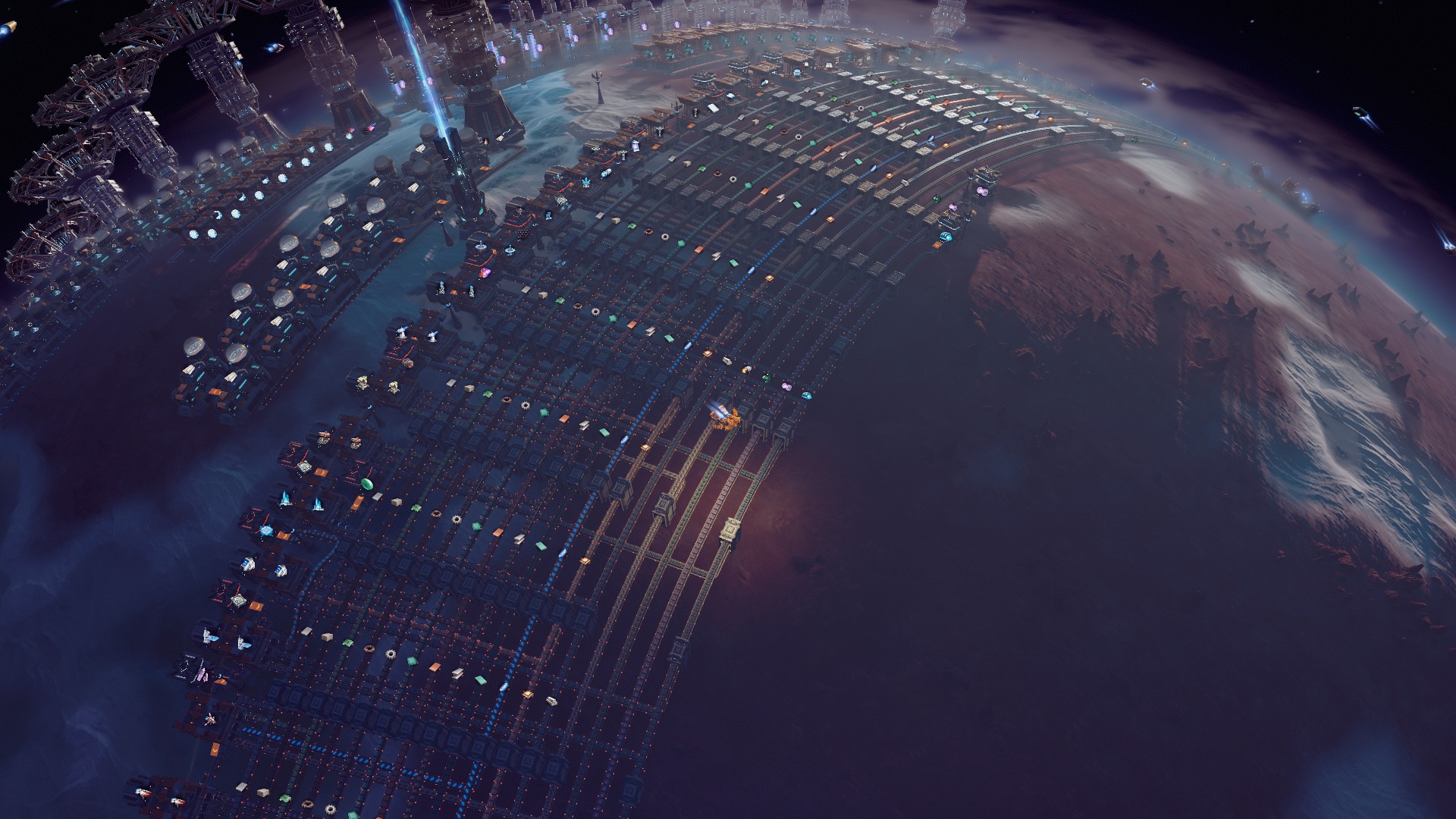
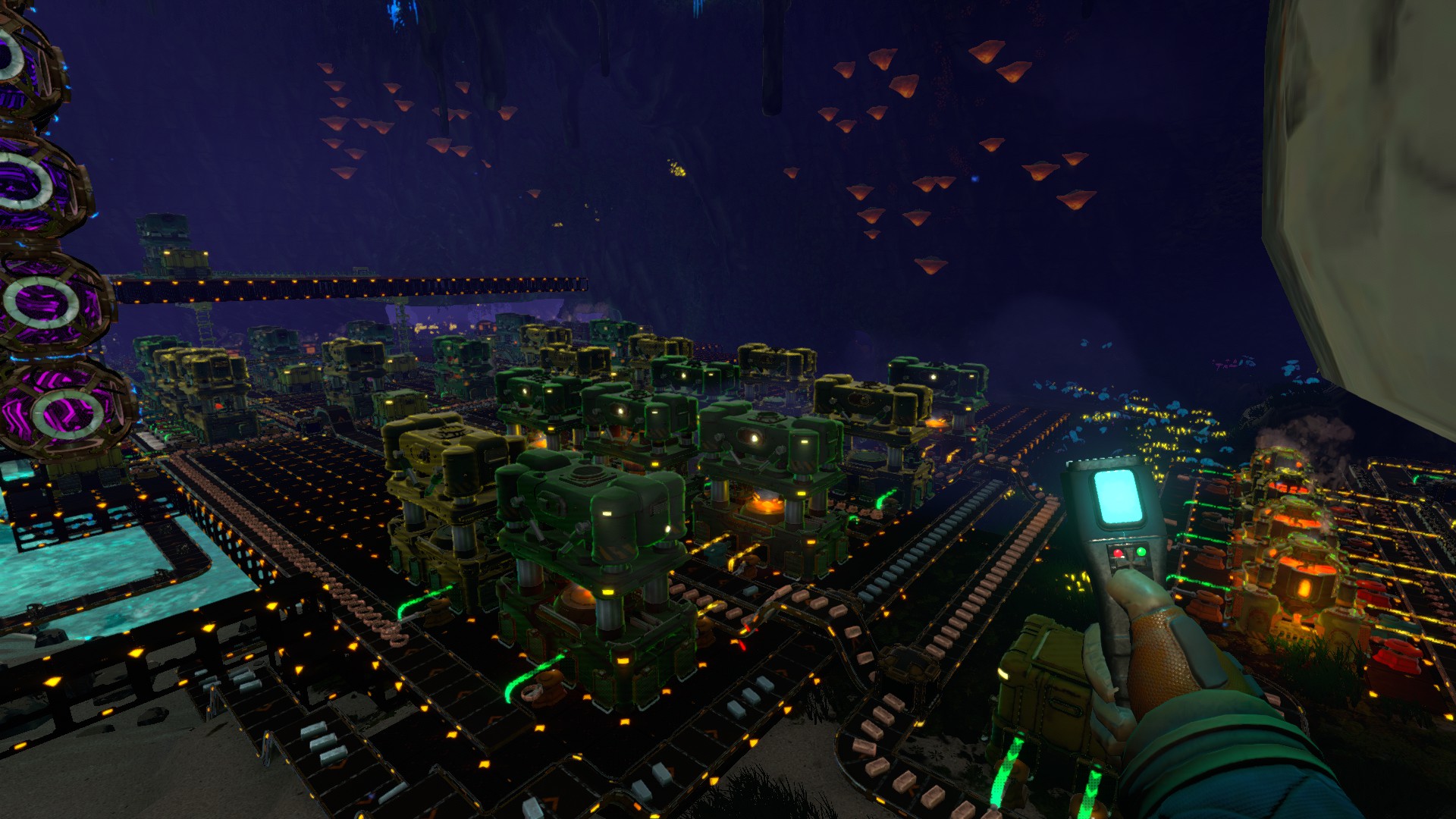
The mid-game moves from planetary construction, to solar system construction in that you need to distribute things between planets. The only way to do so is with planetary logistic centers, which are massive towers that take a ton of power to operate (and cargo ships). You’ll still need the production hub for basic materials, but scale starts to be a problem. When you need 3000 iron bars per minute, well, you’re going to need a production hub dedicated to that sole purpose. One planetary logistics takes in ore, sends it out to 50 smelters, who send the bars back to the tower. You can add more smelters and scale up as need be. You’ll eventually have a single planet crafting everything from dozens of towers, and hundreds of drones shipping things between them. It will look like a beehive, which is simply fascinating to just watch.

Towers EVERYWHERE

The late-game focuses on the actual Dyson Sphere, which requires a massive amount of material/power to produce. This creates multiple production chain roadblocks and scaling issues, and you end up with power issues. A single carrier rocket takes ~700 raw material to create, and you need thousands of them. Isolating bottlenecks, and then expanding production to get back onto the bus is the name of the game.

An end-game production bus planet, with dual layer Dyson Sphere behind. Over 100 towers, and 3000 smelters & assemblers. Not shown, the 8 feeder solar systems.

The end-game focuses on interstellar production, where entire planets are dedicated to single production chains. Entirely reasonable to have a planet with a few hundred smelters just making iron bars, which in turn will require a planet as a distribution hub collecting from the galaxy. The goal is to produce as much white science blocks as possible, which is required to unlock the infinite upgrades. Hitting even 100 white science per minute is a solid achievement, and aiming for 1000 is at another level.

It is entirely possible to get to the end game (4000 white science created) without leaving your starting planet, and running massive spaghetti monster belts. That was certainly my first playthrough. If you’re aiming for a “complete” Dyson Sphere, you can also stay on the starting planet, but you’ll end up terraforming a ton of it to get there. In both cases, a production bus is the only way you’ll get to that point. Putting it on a different planet, same system, has more to do with a blank canvas than anything else. If you want to run end-game, well, you’re in for a galactic level bus, with at least a dozen planets required to get the complete scale in order. I’ve only dipped my toe into that…wildly crazy space to be in.

My recent playthrough is just a tad over 60 hours, and that’s shy under 400 white science per hour. To get to 1000, I’d need to move towards dedicated planetary hubs (the current production planet is simply full), and that would need about double my current harvesting power, and a much different energy relay system. The good news is that blueprints allow MASSIVE time savings. If I did it the original way, that’s close to 10 hours of work to lay it out. With blueprints, which can be planet-sized, it would be closer to 2. Recall that setting up a nuclear power plant in Satisfactory was 20+ hours of effort and it still wasn’t working.

At some point I’ll get to true end game, but there’s Baldur’s Gate 3 calling me, as well as Blasphemous 2.

Dyson Sphere Program Redux

After spending nearly 20 hours finangling with a nuclear power plant setup and then missing a critical step that would require hours of re-work, I’ve put Satisfactory on the backburner. It boils down to three simple facts:

  1. The inability to-prefabricate buildings combined with stupidly small stack sizes means continuous back and forth for material when trying to build anything larger than a shoebox.
  2. The transport logistics for belts are the only thing that makes a lick of sense, given the above mentioned stack size issues.
  3. The z axis is core to the experience, and built to be a hurdle to surmount.

Dyson Sphere Program (DPS) addresses both of these points, and more

  1. You can pre-fabricate everything. Belts, smelters, drones, space stations, rockets, everything. And those items stack, so I can have 50 smelters, 200 inserters, and 600 belts to connect it all take up 4 (!) inventory slots.
  2. Transport logistics have multiple options. Belts are drag-and-drop and go for as long as you have inventory. Small-range drones show up early and cover what you can see. Planetary drones are mid-game. Interplanetary drones are end-game. All drones require infrastructure at start and end points, nothing in between.
  3. The z axis (vertical) is an option, and not a requirement. You use the z axis to get around roadblocks on the x/y plane, and then return to said plane.

I would chalk this up to quality of life bits, but this is actually the foundational part of any logistical puzzle. The speed of building something has little to do with your factory machines, but more to do with the ability to get material in and out of said factory. I am super cool with the concept of ‘mathing the crap out of something’, and that requires experimentation and the ability to modify things as you learn.

The z axis point in particular is important. Super Mario was 2D, most people played that. Super Mario 64 added a z axis, and exponentially added complexity to the game. Subnautica has a Z axis, but the entire game is predicated on simple movement. No Man’s Sky also has a Z axis, but there are no significant logistical hurdles… it’s primarily base building/architecture which is ‘snap based’, which makes it mostly decorative. Voxel games (think Minecraft) do a lot of work on the Z axis, but the pieces are snap & not finicky. The simplicity of the logistics (only minecarts) is amazing. Factorio, the grandfather and gold-standard, has a virtual z axis by applying tunnel and bridges.

I’ll share a picture from DSP.

While there is belt ‘magic’, I didn’t really do anything special here aside from click the start location and the end location. The larger concept here is that there is a “bus” of production, which itself is a really interesting concept I’ll get to in another post. The long and short of it is that DSP has a broad material chain (more options), rather than a deep material chain (more crafting steps). The net effect is a different type of toolbelt.

I’ll only briefly touch on the research tree, where you have a tree of growth, clearly defined from your first 30 seconds in the game. Alternate recipes are automatically unlocked, and should be exploited when you can find the extra material – they are always more efficient. You unlock crafting options, and you unlock character perks that improve performance (e.g. mine more efficiently, move faster, stack more things). The latter upgrades often have “infinite” upgrade options for those that want to expand their production chains across multiple star systems.

More Thoughts…

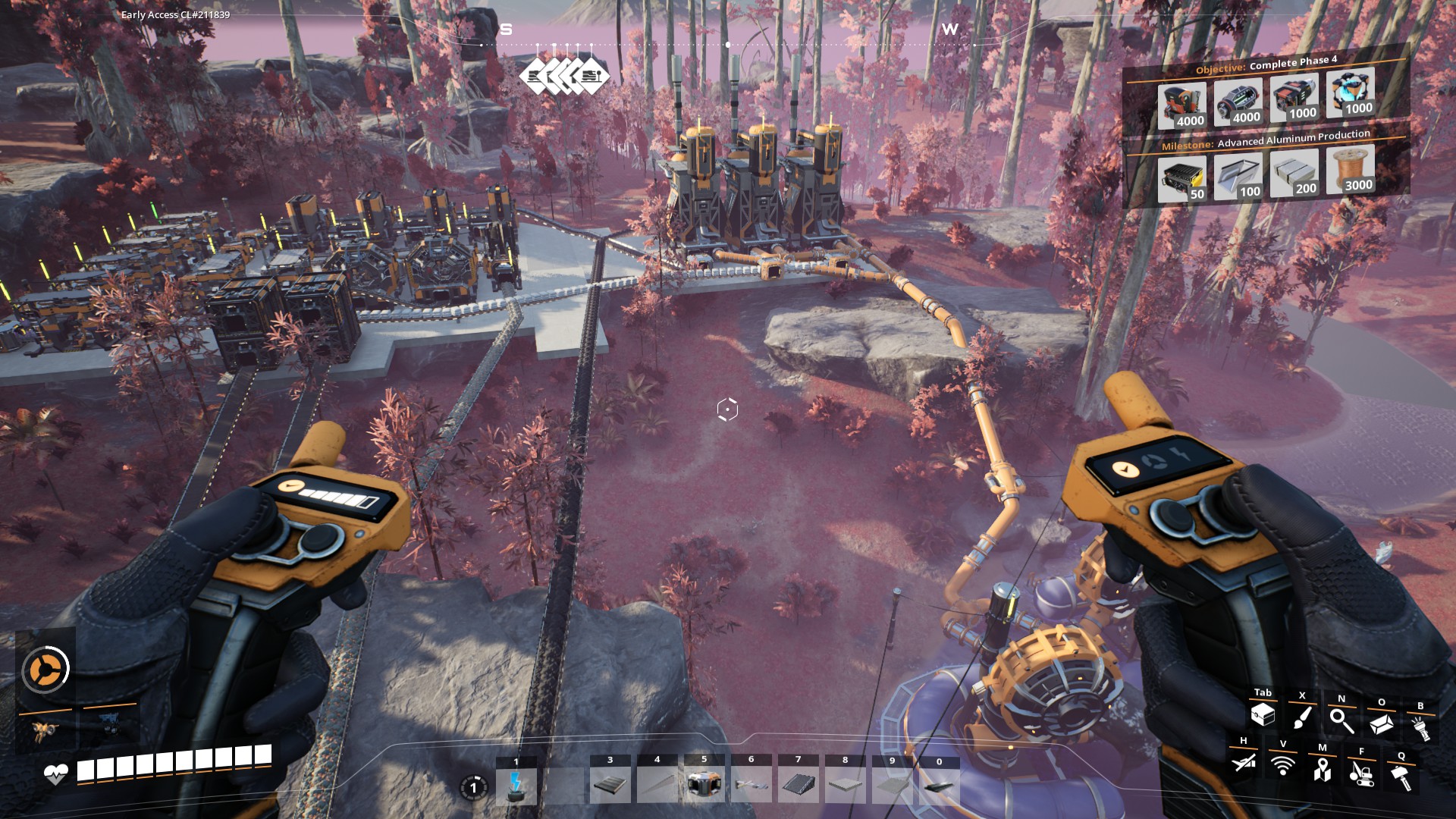
I’ve tweaked a few more bits in Satisfactory of late and used the Smart! mod to try and help in some parts. I’ve further moved forward and unlocked every milestone in tiers 7 & 8, which effectively means all the core bits are unlocked. I’ll get to that point in a bit.

At last point, I had automated everything but sulfur and uranium, that case remains. I did add Nitrogen gas to the mix, and ran a very long pipe to my main hub as a result. This was required to get some extra milestone bits done through Blenders (hard material + liquid/gas). I’ve reached a point where time and scale are the main issues. A Manufacturer may only create 1 item per minute and that takes a damn long time to build enough to do much of anything. I’ve resorted to just letting the game run for a couple hours while I do something meaningful IRL. That builds stock levels, which allows for more construction.

Which itself is a problem because every end state item requires hundreds of items prior and dozens of sub-steps. Even the “simple stuff” is hard. More rubber? Need an oil extractor, a half dozen refineries, water, and transport. A late game item is crazy, just look at Cooling Sytems.

The recipes above are base items. Across the world are Hard Drives, which are used on a 10minute timer to unlock alternate recipes, that use different materials to create an item. For example, you can smelt 1 iron ore to make 1 iron ingot. Or, you can use 7 iron ore, 4 water to make 13 ingots – which is 2x as efficient for ore, but 9x more expensive in terms of power. Almost every recipe has 1 or more alternate options, and your choices on usage will depend on the materials you have at hand. “Best” alternates are therefore relative, though I would say that anything that simplifies Aluminum production, removes screws, or copper is going to be a good idea, if only due to the simplicity offered.

These Hard Drives are placed in containers which are 90% of the time in some sort of deadly place – poison, toxic, or on a sheer cliff. Plus they require some material and/or power to open. There are a dozen or so “simple” ones, while the rest require late-game materials and major power requirements. The next effect is that these recipes are unlocked very late AND you are placing power poles everywhere, in case you need 300MW of power to open a container. I get the idea here, rewarding exploration. The randomness of the alternate recipe just plain sucks. There are 85 alternate recipes, and many of them you won’t care about. For the math folks out there, that’s ~15hrs of RNG research timegating. Or, savescum at the start of the 10 minute counter and reset if you don’t get what you want. YMMV.

In the fun space of this, is that I needed to build a new mini-factory to output 20 Reinforced Iron Plates. I had an optimization issue in the middle of my production line and needed to supplement. To get there, I needed 240 iron ore and 15 machines. It was a good test of the Smart! mod, which aided with the foundation + the layout of the machines with a couple keystrokes. Took me about 10 minutes to figure out all the ins/outs of the mod, but the larger construction effort was cut in half. “Simple” belt management was a breeze. Stacked belts (dual+ inputs) don’t work, think I’ll need blueprints for that.

Plan A

The next milestone is building nuclear plants to generate sufficient power. I am currently consuming about 60% of my power, so if I want to build a new factory that scales, I need much more power. That breaks into steps:

  1. Collect and transport the uranium. It is incredibly toxic, and I need to ship a fair amount (~200/min) to a brand new plant.
  2. I need to build said plant. That’s over 60 buildings, which is substantial.
  3. Collect and transport the base material needed. Limestone, Iron Ore, Coal, Copper Ore, Sulfur, Water, Caterium Ore. At least there’s no aluminum required!
  4. Process the waste into Plutonium Fuel Rods so I don’t have a nuclear wasteland. That’s a dozen more buildings.

That will build 5 nuclear plants at a sustainable level of production. Yet, also build it in a way that allows for future growth. 5 plants = 12,500MW of power. The final space elevator requires 4000 Nuclear Pasta. Generating ~10 of that per minute (so ~7hrs to fill) is about 80,000MW of power needed. So yeah. Scaling.

Plan B

To start Plan A, I need material. TONS of material. Fine enough, that will take time to generate. While that is happening, I want to do 3 more things:

  1. Collect as many hard drives as possible
  2. Collect Slugs / Power Shards for overclocking
  3. Lay out power cables across the map.

Thankfully, all 3 of those are done in the same pass. There are 97 crash sites to explore, and I really only need 85. More than half have power requirements, so the power lines will be needed (and for the hover pack). Slugs are often near the crash sites, so that’s point 2 in the loop as well.

I’ve actually completed this step, which also means that for practical purposes the map is FULL of power lines. Hover Pack + Power Lines = easy vertical. All-told, this was about 4 hours of work to get through, with an external map to guide, and 3 runs for extra materials. Radar Towers tell you how many crash sites, but don’t tell you where. Now to continually research all these hard drives…

Plan C

Blueprints. I need many of them. They are small, but I can work with that. I cannot delete them, which is less fun (will work in Update 8 I hear). But to save the layout headaches I need:

  • Refinery options (there are 4)
  • Assembler
  • Foundry
  • Blender (3 input variants, 3 output variants – 9 total)
  • Smelter
  • Constructor
  • Factory floor (to run belts below)
  • Raised belt poles w/ power

These will be mostly lego blocks, and I’ll have to find a way to connect them together long term. I’ve got most created, but I need to actually test them to validate I can connect them.

The outlier is the Machinery, which has 4 belt inputs and I can only fit 1 per blueprint. I may just avoid blueprints here, but then again, I may create a below-ground belt fed one, and and an above ground version. Hmm.