Satisfactory – Revisit

So first things first, I’m on a hell of a bender for games with logistics. There’s a ridiculous dopamine hit when you solve a complex mathematical puzzle and I can use some of that due to IRL works stuff. Solving a 5 step chain of production to “perfect” balance is a crazy feeling.

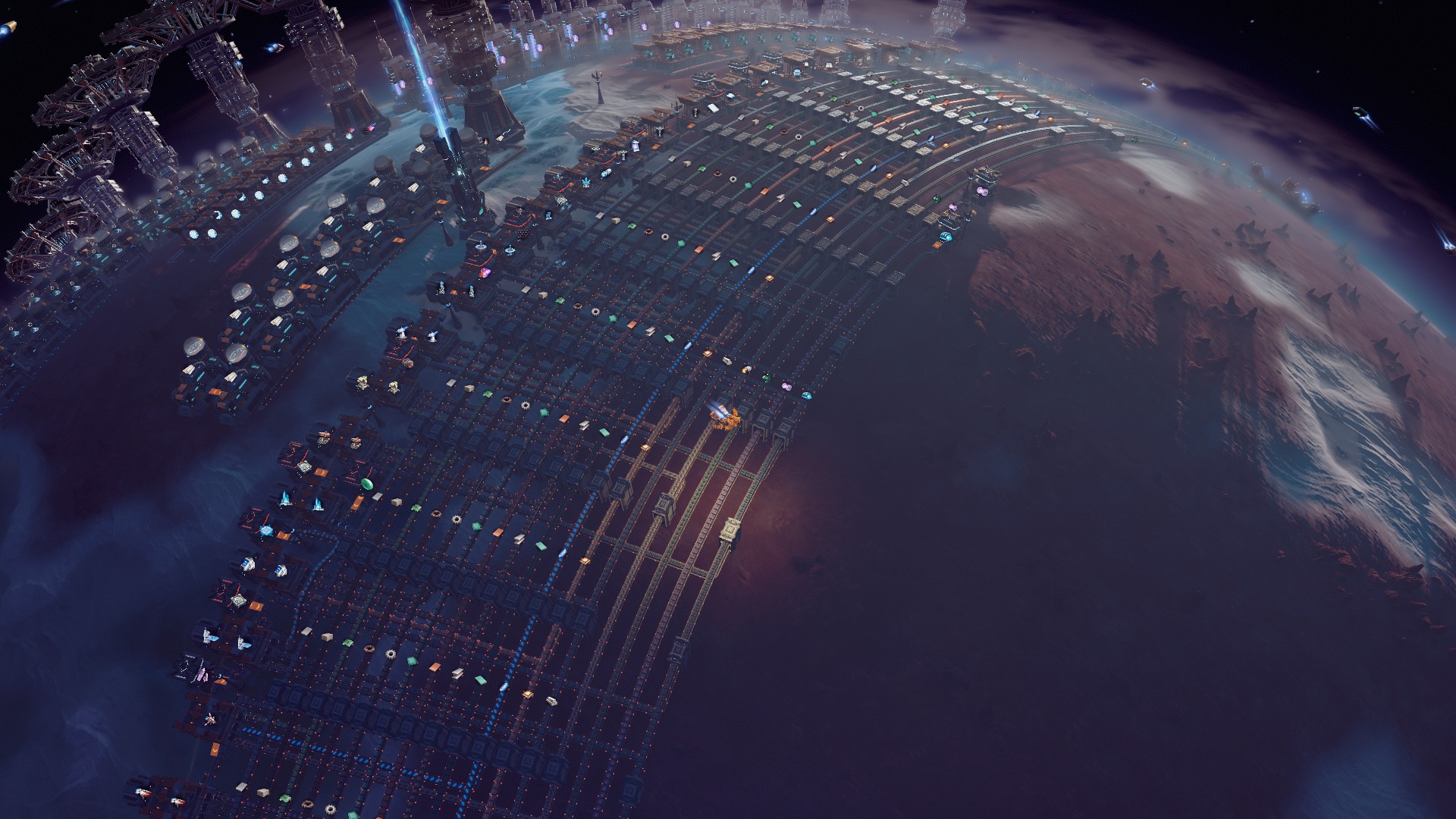
I gave Satisfactory a shot about a year ago. It’s what you’d get if you put Factorio into first person. Or conceptually it is. What Factorio does extremely well is scale the logistical challenge. The first logistics chain is complicated and rewarding, and the next one needs that first plus another. It compounds the logistics and by the end you’re running hundreds of machines to make thousands (if not millions) of things. Dyson Sphere Program is as close as you’re going to get to Factorio in that regard, with a 3D 3rd person view.

Satisfactory takes that logistical challenge but does not handle scale well. And this is for multiple reasons, which can be seen as a boon or bane.

  • The world is custom built, with every node places by developer. This means that you can’t do everything in one spot and will be forced to move. Which creates the next challenge.
  • The world is designed to be explored and vertical. Logistics work best horizontally, and the tools to explore vertically are limited to ramps. A hover pack is unlocked very late, and has limitations in terms of high you can actually go. A ramp made of 40+ sections is quite normal.
  • Transportation is very limited. Belts require no power and are lightning quick, but can quickly develop a “spaghetti” look to the world. Vehicles really don’t work well without roads, and also require fuel, a giant pain in the butt to coordinate (you won’t bother until you unlock oil). Trains are the ultimate transportation but are finicky to build and network. Plus, their vertical climbs are only 2:1, so that 40+ ramp becomes 80+ if you want a train on it.
  • The blueprint function is limited to a 4x4x4 cube. With very few exceptions, that won’t work for any production chain.
  • Merging and splitting is life. The tools to lay that out here only work 1 at a time. If I have 16 smelters trying to collect from a belt, I’d like to split to each one. Well, that’s at least 16 clicks, but more like 25 because the splitter function “bugs out” frequently.
  • The field of view is limited in 1st person, meaning you can’t really build large. Maybe 4 buildings at a time.
  • The largest change is that you cannot pre-fab buildings. If you want 16 assemblers, you need to carry the materials on you. In other games you can automate everything. DSP I had machines building hundreds of smelters for me (I needed thousands). In practical terms, this means that building a new factory requires a crap ton of planning and great inventory management. It’s math-ier.

The image above is a factory that uses 480 iron ore per minute to create 20 modular frames. There are 16 smelters, 25 constructors, and 16 assemblers required. It took about 2 hours to build and a few trips to fill my inventory of material.

In this image, I’m in my train station (2 cars long) and in the distance you can see the path I needed to create to get the train all the way up that mountain. Heck, you can just see the train too, if you squint a bit. Laying 2 stations, the path, and the track, took about an hour. A 1 way trip is 30 seconds by train, almost 5 minutes on foot. Trains rock.

Finally, this image is a “basic” aluminum factory of 240 bauxite, 120 coal, 240 water, 120 quartz, and 20 copper – that results in 60 sheets and 120 casings. There are 2 water extractors, 3 refiners, 1 smelter, 8 constructors, 4 foundries, and 2 assemblers. This factory is at the other end of the train path, and took close to 3 hours to build. The coal is close by. The quartz is halfway up the train path. The copper is at the other end of the train and I have to use belts to get it up there… close to 1500 pieces in length. This is an incredibly painful build. And next, is finding a way to get the quartz BACK to the starting point too.

The “good news” in all this is that I effectively only have 2 more types of material to collect – sulphur and uranium. The less good news is that those materials are rare, to the point where there are only 4 uranium nodes total on the map (I have ~20% of the map discovered now).

Scale

I am picking on the game here because the main issue with all logistics games is the transition from micro to macro. Satisfactory does a superb, insane, amazingly great job at the micro. You are quite literally dwarfed by these awesome machines. It’s a right maze to navigate and the scale of it all, and there’s a clear sense of joy when you click pieces together and the things whir into action.

Where the game struggles to transition, as most do, is the macro level where you need to juggle more things. You’re given transportation tools that allow some macro transportation, but to get that to work, or anything else, you’re stuck with the tools from the start. It’s like building a deck and then transitioning to building an apartment complex with the same toolbelt… sure, you can get it done, but damn it’s going to take a while.

This is a tooling thing. Let me craft 15 smelters with a drag of the mouse instead of 15 clicks. Let me configure them ALL the same with 2 clicks, not 30. Let me manage the Z axis with much better tools, like a scroll wheel or other key. Give me a global production screen!!!

These are quibbles about balance and optimization that are part of early access. I figure another 18 months or so of stuff before it launches… unless they want to add an entirely new set of tiers after nuclear. Worth a play if you’re into excel sheets that move.

Timberborn

This one is also on sale, and as a Canadian, I am obligated by law to play any game with beavers.

Take your standard city logistics planning game and throw in cyclical catastrophes and you have a decent pitch. I’ve followed this game for a while now as the genre has always been of interest. What’s here, in Early Access I should point, it a tough nut to crack.

First, the curve ball is simply that everything depends on water flow, and said water flow (which is an impressive mechanic I must say) goes through periods of drought. You are given tools to conserve and restrict water flows to maintain the life-juices. The tools are basic, and you will likely lose arable land upon each drought until you are well into the game. That effectively means that you know what you need to do, but for most of the game lack to the material to do so, which is quite frustrating. Aside from the first few minutes, the majority of the game will be spent played on max speed mode, as you’re always waiting for things to complete.

Your population of beavers is predicated on housing. They will breed and give birth, and beavers will die of old age. Compared to logistic games with limited populations, you will simply see them as metrics rather than investments. Population control will primarily come through thirst/starvation, which is a rather cold touch.

Production chains are only 2-3 deep (e.g farm, then cook, or log-board-resin) which helps with organizing work areas. There’s very little flat space, and everything needs a path to work, so it’s a bit of Tetris to get it all going. Power is generated either through water current, shame wheels, or wind, and everything outside of farming seems to need it. Logistically, two buildings that need power and that touch each other automatically transfer power, which makes for very interesting daisy chains of production.

Trees are of course the core resource of the game. Cutting and processing them is the foundation for everything, and you are given ample tools to manage this. Renewable oak forests a-plenty. Everything in the game is renewable, making it a quite ecologically driven game.

Progress is gated through a form of research, which operates in 2 phases. First is a very small increment that scales linearly until you unlock an Observatory which exponentially increases research points. The net effect is feeling starved until you reach a point where there’s simply too much. And interestingly, unlocking an item has very little bearing on being able to use it, as the material costs are massive for some later items. For example, the Mechanical Water Pump costs 5,000 research points (which is absurd as basic items cost 150) but even when you do have it, the material costs are so advanced it work take hours to produce, AND it takes 700w to power it, which is likely 100% more than you have at any given point.

In the interesting innovation space, your beavers get performance bonuses based on a plethora of quality of life features. Variety of food, lodging, and amenities have a compound increase in many aspects of the game. As the game is predicated on being efficient, this is a great incentive to diversify. This is directly weighted against your population numbers too. Plus, the mechanical beaver faction in unlocked when you reach a specific point threshold with the basic faction. That secondary faction has many micro-management options, plus trains.

On that point, logistics are a the true-end game component, and you will quickly learn that vertical stacking of storage is needed to save headaches and that anything you can do to save in “sprawl” will pay large dividends. The game does give tools to create self-sufficient divisions of the map, so you can have an industrial district, a farming one and so on. I found myself pausing the game and trying to build something innovative with platforms, stacks, stairs and so on.

Where this game is still trying to find a footing is specifically in the transportation department. You will continually fight sprawl because of the time lost moving things from one place to the other, which can only be done with beavers. Anytime someone is moving something is time when they are frankly not being productive. If there was a way to improve the amount of items a beaver can carry (notwithstanding trains in the second faction), then we’d be talking!

Realizing that this is a rather critical review of the game, I should point that this is a genre that is predicated on balance of specifics and the ant-farm mentality that ensues. There’s as much joy in setting up as there is in watching it actually work. Timberborn does a LOT really well, more than most games in this genre. It struggles, as many games do, with managing scaling of productivity. It’s certainly worth the price of admission, and your mileage will vary as to how long you stick with it.

The Wandering Isle

Turtles all the way down!

Ok. Not even close. But The Wandering Village(Early Access and on sale) is clearly inspired by the concepts of the world being on the back of a giant turtle, an item explored in fantasy settings for quite a while.

In this game, you travel on the back of Onbu, a large creature whose back is flat enough to live upon. The size is standard, but there’s randomness to all the components left on the back. Trees and rocks grow, berry bushes, there’s grass and dirt, and finally 1-time structures that allow harvesting material but cost “trust” from Onbu. Aside from that limited space, this is straightforward city simulator where you need people to do things, to build things, to find more people and so on. Progress therefore is limited to a) the number of people you have and b) the list of things you can build, which gets me to…

Onbu is always moving, and you have some influence on the direction at given intersections. Each path takes you through a different biome, which affects the heat/humidity/poison of the air, requiring you to pivot to different manufacturing modes. Don’t enter a desert if you can’t grow cactus to create water, for example. Onbu gets hungry, tired, and sick… and your job is to manage that aspect through either the directing him to safe places, or feeding/curing him. Also, in each biome, you can see objects of interest that provide you basic resources, special resources (iron/sand), more people, or possibly research points. You need all of this, meaning you are always incentivized to take challenges.

End-point town

The game adds complexity through layers of difficulty. More people increases their types of needs to keep them happy. More biomes means more types of food and water generation. Poison means lot of doctors and eradicators to prevent massive outbreaks. Aside from basic items, most research requires research points, which are extremely limited. Generally, the pace of increased difficulty is well balanced. Is is possible to make a choice that kills you?

Sadly the answer is yes, and it’s entirely predicated on research. There are items you NEED and items you WANT. You simply cannot survive a water biome is you don’t have the ability to collect and clean sea water, which itself required the ability to make glass from sand, which comes from a desert biome. The Glassblower is deep in the research tree and it really isn’t clear why you need it until it’s clear you do. No water = no crops, so you try fishing to make food… well it so happens that also requires research points. And that’s not discussing the items that are double gated – such as a wheat windmill and bakery, where you can entirely unlock one and be a couple hours from unlocking the next, making it useless. This can be addressed through a re-balancing of research to be biome specific and tiered. Instead of paying 3 +5 +5 points to unlock 3 different things, you pay 13 total to unlock access to all of them (still requiring time to research them).

The only other gripe I have is towards population needs for housing + decorations. There are 3 types of housing, with different population benefits (#): tents (2), huts(6), and cottages(4). The resource requirements for cottages are VERY high and non-renewable, making them a poor decision in every respect. It is cheaper, and provides more benefits in all respects, to build 2 huts than to build 1 cottage. Which ok, is easily fixed by swapping the population benefits. The decorations part though, it takes 15 research points to unlock the “good” ones. These points are extra rare and worth much more for survival. The net effect is that you will never place decorations, guess it’s a system to be developed further down the road.

Total time for a given playthrough is about 8 hours, which I think is quite reasonable, and I never found that I was “waiting” for something to happen, which is a very tough balance to achieve. Replayability is primarily through additional difficulty modifiers, or I guess trying for an optimized run where you are able to better plan from the start (e.g. people never need to walk home, but walk all the time for food). The ideas here are impressive, and it’s pretty clear that there are only 2 major patches left to go, which should mean “official launch” in late fall 2023. If you don’t get it now, it certainly will be worth it then.

Planet Crafter – Part 2

I thought a bit more after my last post on the game, and came to the conclusion that further exploration was needed.

The largest driving factor here is that the dev team is 2 people, and what is here is frankly absurd given the resources at hand. I generally love small dev teams as the games are a direct representation of their passion, and Planet Crafter certainly hits that mark.

While I certainly highlighted it, I want to strongly state that the ‘issues’ with the game in it’s current state relate to balanced progress. The easy comparisons are games that have been polished to a high degree, putting the bar somewhat out of reach. And that risks are taken here means that some things will work, and others not.

Planet Crafter has effectively 3 phases, and the game dramatically shifts between them.

Survival

This phase is the smack dab start of the game, where you have no sources of food, water, or air, except for what you find. Every system is new, inventory is a massive pain in the butt, and you frankly are lacking all the tools necessary to move forward. This mode is the one that’s most familiar to players given the genre explosion. You have a very small base (for air), explore for seeds (for food), and need to collect the most basic of material to progress towards new tools.

This phase ends when you have the ability to generate water, which is near the 3 hour mark.

Exploration

This phase is the rough one. You now have the ability to stay alive, but progression is now limited through scale of operations. You absolutely need to explore the map to find iridium and uranium in order to build rockets (massive production increases) and to build power generation for machines. The balance in this part is really challenging, primarily because the things you need are so spread out. An ore extractor will get you some materials – but not uranium (or osmium).

The balance issue here is that you know what you need to do, but lack the material to do so. It’s also the phase where you learn that building a simple & door is the only way to effectively explore the map. I had a dozen+ little camp spots throughout the map. Progress slows down dramatically, and the RNG of blueprint/microchips shows its head.

The phase isn’t broken, it’s just jagged and has what feels like too many steps. This phase takes about 8 hours to get through.

Optimization

This phase is more weird than anything else. You’ve found a way to generate every resource reliably, you’ve been to every area in the map, and you’ve crafted at least one of everything. Given that progress is a math formula based on multiple aspects, you’ll focus on one and then another and then another. Progress is very slow, where you are the hiccup in the supply chain.

Now, in most logistic games, you end up with a hub of sorts that does all the things. That is true here, but getting there is another story. There’s an auto-crafter that automatically collects things from range to build another thing. What you end up with is a very large room with storage that stays within range of the crafter. You then hit a wall where you can’t craft something because the box is empty, then go out to collect said thing to fill said box.

Automation of that collection comes much later in this phase with Drones. The setup is very manual, and slower than you might think, but it does work.

From this point forward, the issue is a combination of time and scale. Time in that you are waiting to unlock more things, and scale in that you want at least 5 of every machine possible, including rockets. But I don’t need 5 beehives you may ask. You may not need the honey, but you need the insect generation.

Future

Functionally, the game stops providing “new things to do” at the breathable atmosphere stage – which takes ~20 hours or so to reach. You’ve explored every bit, crafted every item, and the world is green. The systems that remain past that point deal with complex organics, fish now, frogs soon.

Back to the original post on this, the game has a ton of rough edges, but the concepts here are pure passion. The majority of the quibbles deal with balancing in the exploration phase, and just plainly a lack of data to help make decisions. Once you get to the optimization phase and understand all the systems and have access to all the tools, the game turns into something much different. On the whole, it’s frankly amazing what’s here.

Planet Crafter

Came up on my list and I’m giving is a shot, Planet Crafter is a hybrid game in the survival/exploration/crafting genre. The “definitive game” of this genre is Subnautica, a rather impressive mish-mash of ambience and story, with crafting elements. Planet Crafter emulates this to a degree, but with the polish expected of an Early Access game.

Now, I generally avoid Early Access games unless it fits a certain set of criteria, typically focused on a small development team trying to iron out an idea. I really like Subnautica, and I like crafting games, so this hits the right marks. That said, if I am paying for Early Access, I will review it to a degree.

The concept here is that you are stranded on a deserted planet to serve out a prison sentence. You have some very basic tasks to complete in order to get a “foothold”, and the larger goal then turns to terraforming the planet. Now, planet in the general sense, as you’re really only given a single map to explore, which undergoes various points of transform over time. That map is quite large, even when you’ve got a ton of movement abilities available. It takes a long time to reach a point where you won’t starve/asphyxiate/dehydrate to death while crossing it.

There’s a very basic shelter that allows you to restore oxygen (which insanely always requires a door to be constructed), so that’s one part easy enough. Creating extra water requires a decent amount of progress, and frankly knowledge that it’s possible. Starvation requires growing food, which is simple enough. So with those pieces in hand, you can explore the world, collect minerals, build stuff to unlock more stuff to build and so on.

Progress is gated through a terraforming index, which is calculated through other milestones (heat, pressure, biomass, etc..), as well as random blueprints. The net effect is that it’s entirely possible to unlock the ability to craft items long before you have the material to do so. Further, these milestones are weighted so that progress is not linear, but more logarithmic. The game progresses quickly to begin, then there are wide swaths of frankly waiting for a number to go up. The balance of this progress is not necessarily broken, as much as it needs optimization.

This is not Satisfactory

The act of crafting requires things. Material does NOT stack, and there’s so much out there that you will end up with 2 dozen chests of things just to stay sane. This creates a back & forth process of collecting things, bringing them back to storage, and collecting more things. Movement and inventory improvements quickly become essential to your sanity. The lack of “world diversity” here also means that it feels, and is, time padding.

And creating things is what you will spend 90% of your time doing, in particular one mid-tier element that is used everywhere (super alloy). You’ll end up creating 5 or so of every item at any given tier (e.g. there are 5 tiers of heaters) in order to make those numbers move. There lacks some balance with regards to materials needed to construct, and energy requirements for said things to run. This becomes glaringly obvious as you enter the nuclear age and there simply isn’t any obvious renewable source of uranium. Again, balancing.

The thing I have not talked about is story, which frankly there simply isn’t much to discuss. There’s no discovery carrot, and exploration is driven by the need to find a specific material rather than the desire to see more. The risk of exploration remains relatively the same from start to finish, which diminishes any real reward as you’re always walking around with what feels like a sword over your head.

One piece I think that is important to mention is friction. These are design choices that impact systems and interfaces that are counter-intuitive. The flow between interfaces and menus is an example. The ability to easily understand information. The expectation here is that you start with a lot of friction and that you gradually reduce that over time. In that being proficient with the systems is based on player skill as much as the actual systems. The largest point of friction here is the system complexity/dependency and lack of tools to address. You need a scale of material to move forward, but inventory sizes are so small, and the near complete lack of logistics (drones come at end game, essentially after game completion) mean that you are stuck in minutiae rather than progress. Super Alloy Rods are important, and you need 9 ingredients to make it, and needs 49 base materials. Collecting that material takes about 20 minutes, no matter what point of the game you are in. Now, I realize that Planet Crafter is not a logistics simulator, but friction points such as these are not fun.

In the current state of the game, there are some rather interesting ideas, ideas that are not found in their totality in other games. However, split across multiple games, those ideas are significantly more refined elsewhere. It’s a bit like how a buffet is cool to try things, but if you want good Italian food, you go to an Italian restaurant. Increased content is certainly a big piece of this puzzle, but at the same time, there’s a balance/refinement pass required as well, in particular for the mid-game. It’s an interesting sandbox to play.

Steam Deck Streaming

I’ve been a proponent of a gaming laptop for some time now. Sure it helped that the pandemic “broke” the video card market, and the niche custom PC build market has pivoted back to the mid-90s chaos of compatibility. Plus, I don’t have the time/patience to build a liquid cooled rig. You can get an amazing laptop rig, delivered to your door within a week, for nearly the same price as a custom rig – heck, during the pandemic it was the same cost as a video card. The screen of a gaming laptop can be a bit harder to figure out… but it’s not really different than a custom rig.

What does this have to do with anything? The Steam Deck uses it’s native streaming mode to play games that are installed on your PC over the Switch on any home network. I’ve used this on various streaming devices, and it works “ok”. The best experience so far was from a “normal” laptop to my gaming laptop, with expected video degradation. The Steam Deck’s streaming option makes all of that go away.

I can certainly install a game like Fallen Order or Control on the Deck, and they play quite well. A drain on the battery of course, so the sessions are a bit harder to manage if I’m not docked on 45w. But streaming… that is another thing. The gaming laptop has no performance or power issues, and it plays almost identical to the native Deck mode. I’ve yet to give it a shot at Deck + Stream + Dock mind you, which would certainly put it through some crazy paces. It would effectively fully replace a console at that point (which is a separate topic about the future of XBOX).

The natural downside to all this is that “gaming on the go” isn’t really an option if you’re streaming. However, you can run it in dual mode, with a local install and the option to stream is always present. I tried this with No Man’s Sky and it worked flawlessly.

I realize this is part of a series of glowing recommendations for the Deck, and yeah, that’s right on target. The lack of integrated mouse + keyboard controls makes some games more complicated than others (e.g. you can’t really play any RTS or ARPG without a dock), but the rest of the features make it feel like a massive step forward in gaming.

Ant-Man: Quantumania

Right. This was weird. But the wrong kind.

Reminder, this was the actual promo trailer for the first Ant-Man.

Ant-Man is one of the most unique Marvel superheroes because a) he doesn’t actually have any powers, b) he’s average at best, and c) is generally naïve about the world in general. An everyman superhero in a world of folks flying around. It feels like he wins through sheer luck.

The first two movies were more heist films than actual superhero films. Sure, there’s a sci-fi part to the larger elements, but they were still grounded in the “real world” with human problems. I will say one of the good things about this film is that you don’t need to watch 85 Marvel movies/tv series to understand what’s going on. Nice.

Ant-Man 3 is not this. Ant-Man 3 spends all of 10 minutes in the real world and then goes 100% green screen in a trippy reality jump that never grounds the people. Ant-Man 3 is not a caper (except for a 10 minute CGI-a-thon that struggles to land). Ant-Man 3 is not a comedy, it’s borderline a war/guerilla movie. Ant-Man 3 lacks villain logic (Loki did this much better). And Ant-Man 3 has made-for-TV CGI.

On this last point, which certainly made the rounds. Rarely have I ever met any artist that was happy with a mediocre result. The artists here had to do almost all the lifting. I can’t fathom the pressure of timelines to get this done. Hats off to what was able to be put out.

Ant-Man 3 ends up being a shining example of the excess of the superhero genre, the tonally deaf response to more spectacle. CGI is not the means AND the ends. Ant-Man 3 is a mediocre because it goes against the first 2 movies and the set up that Paul Rudd put in place. He’s not a superhero, doesn’t want to be. Not sure how that message was lost along the way.

Diablo 4 and the 2023 ARPG

There have been hundreds of action role playing games, probably thousands, since the first Diablo launched in 1997. I remember heading to a PC cafe to indulge and marveling at, well, everything!

Since then, the genre has taken some interesting twists and turns – and to a degree some forks in the road. Some have bridged back, some pruned, and some flourished. What we’re left with is effectively 3 main streams.

  • Diablo 3 – RoS. The “fast food” of ARPGs. The original launch is best forgotten, and what we have now is a rather well-integrated, drop-in/out, meta-of-the-season approach.
  • Path of Exile. The “hardcore” of ARPGs. This game requires a community approach due to the trading / RNG mechanism and is F2P done right. Only WarFrame has more systems maintained over time.
  • Grim Dawn (Titan Quest). This is the middle ground where you have complexity, integration, modding, and the general foundational systems of ARPGs present. Frankly, I’d consider this the “trunk” of the ARPG tree.

I have not talked about Lost Ark here because it’s a much different game that has more in line with a branch that is frankly being pruned – the mobile ARPG. These are games with extremely simple interfaces, minimal choice, and an RNG upgrade path that is supplemented by a cash stop. There are certainly whales willing to play these games, and feel free to navigate them ethical waters. I’ll get back to this…

The key bits that set ARPGs apart:

  • There is moment-to-moment activity
  • There are levels, and character customization over time
  • There are multiple item slots, variety in said slots, quality that impacts power, and synergy between said items
  • Most of the game focuses on RNG, both in zone layout, monster spawning, and most certainly in item drops
  • There is the option for increased difficulty, which also increases RNG factors
  • There is a “long tail” progress system with logarithmic gains (e.g. you quickly gain power, and later on power comes more gradually). This makes the game relevant for years.

Diablo 4 is out, and it does cover the first 5 bullets in this list. There are going to be multiple balance patches for the next 6 months as people find new and interesting ways to exploit the foundations of the game – that’s expected.

The larger questions remain around the “long tail” portion of the game, which were frankly non-existent in Diablo 3 for nearly 2 years. Well, I’ll caveat that in that the end game was farming the auction house. RoS brought it to rift farming. PoE has map farms. Grim Dawn also has a sort of map farm. It will take some time before Diablo 4 figures out that dance.

The very interesting (to me) part of Diablo 4 is less about the gameplay and more about the mobile ARPG aspect – namely the cash stop and monthly passes.

  • The game has a box price of $70
  • There’s a seasonal pass, with paid and free tiers. Paid unlocks more cosmetics, provides gold/xp boosts, but no “concrete” power.
  • There’s a cosmetics shop with the natural shennanigans of using another currency for items so that you always never have enough to have a zero balance.
    • The items in the shop are hovering near $20-$25. I can quite literally buy game of the year candidates for that price. These are macrotransactions.

This is an interesting experiment for Blizzard. Clearly Diablo costs money to run and maintain, and there’s always an opportunity to milk out some folks of extra cash. Ubisoft has been doing this for years, and EA has no real shame in this space.

However, the Diablo crowd is different – or perhaps more accurately the ARPG crowd is different. The game has the value, less the window dressing. If the moment to moment stuff doesn’t work, or there is no long tail, ARPG players just won’t stick around… there are simply better options out there today. It will be quite interesting to watch how this develops over time.

Knowledge is Preferable to Ignorance

I spent a day at the lake this weekend, staring out on the water and simply pondering.

As I am inundated on a daily basis by willful ignorance, I turn to look at my 2 children and ponder. What role do I have in leaving a legacy, or guiding them on their personal journey of self-discovery? What tools am I giving them to make their way through the multitude of opinions and power-grabs? What confidence can exist in a world governed by popularity rather than humanity?

I could, and do at times, fret over society’s joint ignorance and futile grasping at truth-sellers. To avoid the truth laid bare and accept a lie that comforts rather than confronts. To think that one person somehow has more value than another, simply by the conditions of their birth. That the stratification of education and knowledge is some duty born by self-elected gatekeepers.

It is evident that society resists change and that said change can take a very long time. We have ample evidence of such. Our growing ability to share is offset by our inherent need to protect. There is so much out there, that it can seem like staring into an abyss, and with that, who can truly judge someone simply turning around for the safety of the familiar.

Humanity has a beautiful flaw, in that it pushes back against the inherent chaotic nature of the universe. This is an upstream battle that will last well after we turn to dust. We kick and scream for a place at the table, where we are but a crumb on an intergalactic scale.

I get by on a word shared by many, and that is one of faith. Not faith in that the answers will be laid bare if I simply submit to the will of another, but faith in the grander humanity. I marvel at the magical randomness of cosmic order. That every day we unlock another fractional facet of this eternal mystery. I have faith not in that there are answers, but that we will search for them.

That is the path upon which I guide my children, the legacy of continual search for knowledge, and the character to face the abyss and not look away.

Overwatch 2

Adding to the fun Blizzard news of late, Overwatch 2’s main selling point of having a PvE mode has been more or less scrapped. This particular link has an interview with the devs on the topic, which I think provides a more complete take on the situation.

Context here seems the more important bit. Yes, a developer should cut content that doesn’t meet their quality standards, and we’ve seen Blizzard do this over the years. There are dozens of examples of “promised” content that hit the floor (WoW housing and Titan system are notable, Ghost even more so). Now, the argument can be made here that selling a car with the promise of it having locking doors, then never delivering on said doors, is an interesting approach. Blizzards has never launched something with a promise of future delivery, they have instead outright cancelled the work before asking for money.

Overwatch 2’s primary existence as a sequel was predicated on 3 main items. Moving from 6v6 to 5v5, implementing a battlepass, and PvE. Overwatch 1 stopped all content delivery for 3 years so that they could figure of the PvE component. It would be a stretch to convince me that this particular model required an expansion and a content drought (which enabled Fortnite and Apex to take a massive chunk of this space) when you can look right at WoW’s massive mechanical changes over the years. I can understand that the knee-jerk reaction here is not positive. Though realistically, if you were waiting for PvE in Overwatch2, you really aren’t playing today, right?

The next bit of context is Blizzard’s staffing exodus. More than ample reading on that topic where executive decisions and culture have caused people to leave the org. And as any manager will tell you when you lose a key member, you likely lose 3. Dead wood / negative people are typically isolated when they leave. Strong skill sets and positive people will automatically pull people towards them. These are like papercuts, annoying but you can usually get through. However, there’s a point where you simply cannot find qualified resources to fill in those gaps… which is 99% incentive based. The “glory days” of Blizzard are well in the rearview mirror, so the pride of having that on your resume isn’t as strong as it once was. Is it an environment that a senior developer would want to enter? Can you fast track existing junior employees (who then get poached)? So yeah, there’s the fundamental question if Blizzard actually has the capacity, let alone the competence to deliver their lofty goals.

Tangent, as I tend to do, I recently had a town hall event where there were diverging styles presented, one of management and one of leadership. There is a very large gap between both, and not every manager is an actual leader, just like every leader is not necessarily a manager. In the larger business news context, the wide majority of CxO positions are held by managers. Makes sense, only the bottom line ever seems to matter. Leaders take risk and take accountability – ain’t too much of that on the scene today. A manager that takes a pay increase while cutting 10,000 jobs, well, it would be quite hard to articulate that as being leadership qualities.

I do have hope that Blizzard can find some effective leadership in the proverbial pile of rubble that is there today. As much for the nostalgia in me as it is for the development team that is certainly trying their hardest to get things done. I have no doubt that everyone actually coding goes in with the best of intentions and want to deliver amazing quality products. I do hope that they can achieve that goal, without gamer pitchforks being launched.