Prince of Persia – Lost Crown

I have a soft spot for metroidvanias. It’s a genre that seems to scratch many itches at once, and the floor to entry is rather low in terms of development. They can be taken in bite size chunks, can have varying levels of difficulty, typically have some interesting storyline, and the branching paths make for some interesting options. Hollow Knight, Ori, and Blasphemous still sit way atop for me, though there are many others close by, like Bloodstained. Heck, Dead Cells has a good foothold in the genre too!

The recent Price of Persia game is a full on reboot of the series and most closely emulates the Hollow Knight attempt at the genre, to varying degrees. About 15 hours or so to get through for the basics, 20 if you want to reach closer to 100% (which I do not recommend).

The map is absolutely sprawling, with most branches relating to trap traversal, followed by backdoors to skip it in the future. You have a core melee attack, a limited range option, and then “magic” of sorts. You have amulets that provide passive skill buffs, which you are limited to equip. Movement traversal skills (like double jump) come after key boss fights. There are side quests, health boosts, upgrades from materials and so on. Those are the pieces of a metroidvania, it would not be one without.

Should I talk about the ability to take pictures of the map? This is neat but not groundbreaking… every metroidvania has had the ability to mark the map with specific icons. Guess I’m just not getting it.

The heart of a metroidvania is more than the pieces, but how they connect. And the true heart of a metroidvania is in the fluidity, the balance between combat and movement. Hollow Knight is a gold standard for a reason, it nails this absolutely perfectly. Blasphemous 1 went a bit too much into combat, an issue admirably resolved in the sequel. PoP struggles in this area due to design choices. By the time you’ve acquired every movement power, the fluidity is there as you can quickly zip across the map and avoid tough enemies or plow through simple ones. But that’s truly the last hour or so of gameplay, with 20 prior being a relative slog of imprecise controls.

I mentioned that most of the game relates to trap traversal, which is not a bad thing in itself. Platforming can be fun, if the tools are there to help. Sadly, I have been spoiled with games like Celeste. PoP doesn’t have fixed camera angles, it zooms in and out depending on the map, which messes with visual cues. Second, it has imperfect pixel placement, so that a jump done once will work, but done the same way a second time will not (this is exacerbated in the late quest “Impossible Climb”). I completed all the challenges, and the wide majority on the first go, but it’s clear that there are issues here. And hats off to the developers on this… they added an accessibility feature that allows you to skip all “normal” trap traversals. This is a massive sanity check near the tail end of the game.

I’ll also pick on the magic system for a bit, because it’s interesting in concept and flawed in execution. You have a magic source – athra – that fills up a bar up to 3 levels. You have about a dozen skills to choose from that empty 1 to 3 bars and either deal damage (11 of them) or heal you (costs 2 bars). You can only slot 2 of them at any time. For most players, one of those will always be the healing option as healing alternatives are quite low in the game and damage comes from everywhere. So you effectively have 1 skill to chose from and generally want to keep close to 2 bars ready for a heal. Athra gains are slow, you may fill up 3 bars total in a boss fight. Which in practical terms, means you’re only going to use a simple melee attack (as it’s the only consistent damage source) and never a tier 3 option, which effectively wastes an entire game system. Sure, you can supplement magic moves through amulets, but those are best reserved for melee augments.

A quick note on the parry mechanic which is becoming more and more popular. It’s here, there’s a visual queue for what can be parried or not, and is a great option for bosses. Miss the timing and you take extra damage. It works great in 1v1 battles, and horrendously in group settings, which is fine by me.

Bosses and mini-bosses are a highlight. The fights are well structured, reward memorization, and with a single exception, avoid super cheese. I’d have liked more of them to break up the exploration portions, especially the middle part of the game (turn on Guided mode, trust me). Everyone has multiple stages, and the final fight feels like it will never end. Quite well done.

There’s one movement skill that’s interesting, a sort of timewarp where you leave an impression and can zoom back to it on command. It’s never used in standard combat, a few odd times in optional trap levels, a lot in the optional puzzle rooms. It can be great for some boss fights, if you put is somewhere “safe” and want to avoid an AE attack. Cool idea.

The “extras” are odd here. There’s a few quests, nothing too ornery (the bird one was bugged and could not complete). There are some “hidden” puzzles for you to figure out, which was fun. Also some optional trap traversal areas. Combined, they reward you with partial hearts (yay!), amulets & slots (cool!), ore to upgrade weapons (yes!), gems to buy stuff and coins to upgrade amulets (YMMV). So you’re going to want to do most of these, with the exception of the extra coins. See, you can upgrade every amulet twice, the first time for gems, the second for gems + 1 coin. There are 37 amulets, you’re going to upgrade maybe 6 of them.

Notice how I haven’t talked about the story or lore? Yeah, well, there’s not much there. There are 50 odd lore objects that provide near zero added context. Persian mythology is ripe for options here, lost opportunity.

While PoP is a good metroidvania, it doesn’t dethrone any of the pantheon. I am not a fan of the AAA pricing on this game, not when there are dozens and dozens of frankly better metroidvanias you can get for less than half the price. The great news is that the demo should still be available – give that a shot as it’s a pretty good approximation of the mid-point of the game.

Dark Fog – Part 3 – Spaaaaaace!

The most impressive part of any factory production game is the rhythm. You are just barely getting anything going, and then boom, a near perfect production chain just works and you can watch it run its magic. It’s like if each factory had it’s own voice, and you could see them sing. Ok, maybe that’s just me?

Following that analogy, each piece of the factory has it’s own specific sound, and when you can get enough of those voices working together, it’s extremely impressive to watch. To point, entering the late game means warpers, which require green science (Gravity Matrix). Each one of these requires over 120 pieces of something collected, which are processed at just under 20 different stations. Which if we’re talking main production lines, is going to be about half of a given factory. So half of everything you own is going to have a part in building this 1 thing. And by the time you reach end game, you’ll be producing a few hundred of these per minute. 

All that to say you’re going to be running rather impressive production chains across multiple planets, and the need to harvest from many locations.

Ground Stuff

The last post talked about ground bases, which in truth are rather simple to manage. 8 Missile Turrets with pretty much anything in them will destroy any base that has a Signal Tower close by. The only issue is that the Dark Fog will continually create NEW bases, which are all but impossible to defend against given the power/material requirements to fully protect a planet. This needs a rather significant balance pass.

Space Stuff

A disclaimer that the devs have stated that the space portion is not complete, and space stations should be coming.

The first post mentioned that you should not attack space relays (the thing in the sky connected to ground bases) because that turns the space fleet against you. This remains true for the duration of the game, as even if you had 50 turrets on the planet, they’d take a whooping from any space attack… that means battlebases to keep them all repaired, which is more wasted energy.

And currently, there are no star system based options for attacking space fleets, aside from you piloting up there with some smaller ships. Which has the following issues:

  • The size of the fleet (# of ships) is very limited until the late game due to research requirements. Even at late game, with ALL upgrades, you are going to blow through 500+ ships to take out any hive above level 5.
  • The ships themselves require a significant amount of resources to craft, which are not available in bulk until well into the late game.
  • The power/durability/attack speed of the ships is dependent on a rather substantial amount of research.
  • Your own power levels continually decrease while your ships attack, meaning you need late game upgrades to power levels/charging/deuterium rods

Even at end game research levels (e.g. all “colored” research complete), you will go through a double stack of space ships to take out even a level 1 space base. Which you will be required to do as the Dark Fog is continually sending “seeds” into star systems to generate space bases, which you cannot defend against.

Sulfuric Acid + Unipolar Magnets

These two items are only available in late game star systems, which prior to Dark Fog wasn’t much of an issue. The Sulfuric Acid is available in infinite supply (and essential to alleviate some oil production chain issues), and will generate a bottle neck in the late game. Unipolar Magnets are a very limited supply, and only used in end game.

By the time you unlock the ability to find these items, those systems will have Dark Fog present, with multiple ground bases and a space base. To actually clear all this out, you need a Missile Turret blueprint (6 or more turrets, a storage container, a signal tower, and belts to feed it all) and some really basic power generation. Take out one base, install a thermal plant for a new power source, and move the turrets next to it, and a space station to ship extra missiles. This should allow you to install mining equipment, put a signal tower to defend it, a battlestation base to repair any damage, and harvest all you need. A sort of back door harvest I guess. 

Overall Thoughts

I think this is a great first pass at scalable enemy AI. They are logical, the threat levels are manageable, and the attack patterns are defensible. I never felt like I was fighting an exponential curve that required diverting too much material. But I’ve also played this game for 200+ hours and know how to optimize. I also didn’t generate a space attack until I was ready. No joke, a space base attacking your planet before late game will pretty much mean a full restart, it is that strong. 

The ground portion generally works, though the material provided from combat is clearly just placeholder for now. It makes no sense to “farm” ground bases for material at this point. But it generally works. I don’t quite understand why you’d run laser towers, or cannons though, as missile turrets are infinitely better in absolutely all cases. New power distribution options will be required to support planetary shields as well, as this is the first time you truly need to use the entire planet’s surface (space stations?) And there are simply too many things to build on the ground to have true value (laser turrets are a great example)

The space to ground portion is not yet balanced. Protecting a planet from new bases requires too much power and at the absolute most optimal 10 towers (connected with 100+ poles), which makes no sense before end game. Having the ability to have orbiting space stations may do the trick. It really changes the end-game portion to wars of attrition, which I don’t find terribly interesting.

Net result is that the initial star system is cleared of Dark Fog, and 2 others (to get all the rare material). Those last 2 were multiple attack runs with nearly 600 ships destroyed. And now, every 30 minutes or so, a new attack happens in those systems because it’s not possible to protect a system, only a planet. So, play session complete until the space portion is in.

Steam Deck + EGS

One of the most interesting features of the Epic Games Store (EGS) is the weekly free game. During the holidays, it was a game a day – I hope you picked up Marvel’s Guardians of the Galaxy! EGS has a slew of different games than Steam, which has it’s own pros and cons. Ubisoft has first pick with EGS, and Alan Wake 2 is only found there. If you have a PC, no real big deal here running 2 different storefronts.

And yet, EGS does have some rather glaring issues. I won’t get into the overall maturity of the storefront, it’s clear that Steam has years and years of experience here. I don’t mean trading cards here, I mean just basic configuration options. I use a Dual Sense controller on PC, that simply will not work with EGS, so I “sideload” EGS through Steam and it works better.

Now, I’ve been signing praises of the Steam Deck for nearly a year. Any pick up and go game plays wonderfully on the Deck, Metroidvanias absolutely shine. Some games, where you truly want an immersive experience are better on the PC (Alan Wake 2 is a great example), but you’d truly be surprised as how awesome the experience truly is. Given Steam’s bajillion title library, this generally works.

Where stuff gets LESS fun is when you’re integrating into something that isn’t on Steam. EGS is the main culprit here, as other launchers generally don’t do well with handheld gaming (GOG, ActiBlizz and so on). You need to figure out how to get EGS into the Deck, then ensure the games themselves can be played with a different overlay. There are dozens of ways to get there, and they all boil down to sideloading launchers. Some are insanely complicated, others a bit easier to get through. You can try this integrated tool that integrates it all fairly well: https://github.com/moraroy/NonSteamLaunchers-On-Steam-Deck/releases

  • Steam Desktop mode (hold the power button for 5 seconds)
  • Download a browser (I used Firefox), click the above link, download the first asset
  • Look in downloaded items, execute the file
  • Select the launcher you want to use, watch it download. 
  • Load the launcher while still in desktop mode to finalize some configs, such as logon
  • Once it’s working, go back to handheld mode

And that’s pretty much it. You just load the launcher from the Steam interface and everything works. Well, sort of. Anything that has a dual launcher (like Ubisoft Connect, loaded through EGS, loaded through Steam) is going to be more painful to navigate through, but it will still work. And loading it through this convoluted way should ensure that cloud-based saves also work.

This is one of the few parts that the Nintendo Switch ecosystem does a great job at managing. Everything just plain works. But, if you want access to pretty much any PC game in the last 20 years, and play on the go, the Steam Deck is without hesitation, the best way to get there.

DSP : Dark Fog – Part 2

Smallish update here. I’m learning the AI behavior a bit more here, in particular around aggressiveness. In particular around the planetary bases.

  • Get Missile Towers. That’s steps 1, 2 & 3.
  • Destroying a base and NOT filling in the “hole” means you’ll see a new base in about 60 seconds.
  • It takes a little less than 10 minutes for a base to construct fighters
  • The attack wave progression has a linear linkage to power generation. You make more power, they become tremendously more aggressive. At mid-game, this could mean an attack wave every 30 seconds.
  • The enemy will continuously try to create bases on the planets in a system. 3 seems to be the main goal to run at any given time.
  • Letting the enemy dig bases and filling with a geothermal plant = ~310% efficiency, and a relatively small footprint. It’s a decent boost in the early game.
  • Enemy waves drop random items, at volumes that are relatively meaningless aside from inventory hassle. And they can drop any base items (there’s like 20 of them), that you’d need to build a sorting chain to manage. I am hopeful this is a placeholder for something else.
  • The space hive doesn’t get angry or attack you, even with interplanetary towers. The next step is to see what happens when I deploy warpers.
  • Defending planets from random base construction is an interesting feat. I don’t think the game does a good job explaining how to get there, at least in a practical sense. If you’re on planet #2 and planet #3 all of a sudden has an imminent attack, you are not going to get there in time. And my planet #3 is a production hub, meaning half of it has stuff on it, making it quite important to stay “up”.
  • Oh, planetary shields are worth a mention. While they are listed as a mid-game item, the material/power to make/run them is actually late game. And you need 80(!!!) to fully protect a planet. I am clearly missing a key piece of info here.

In terms of quality of life here, the added materials/products that were released with this add a substantial amount of complexity to builds. Not that I’m advocating for a single simple bus to build every end-state item, but at the same time it shouldn’t require massive spaghetti farms. The saving grace for this challenge are Logistic Distributors+ Logistic Bots.

These little doodads sit on top of storage containers and ship items between them. They don’t move huge amounts of items, but for a production bus they do wonders. It allows you to construct base materials in one area, and ship a few around the map to another container. So if you need to inject a single item within a bus, it works great! If you want to produce material around a planet, then you can centrally store it too. It doesn’t really work if you are producing multiple items (say 6 assemblers making the same thing) as the volume is too low. And the initial versions have a limited range, which can be upgraded to a decent place by mid-game. By the time you get to planet-level production, it’s simply required, and you need the upgrades to increase their range.

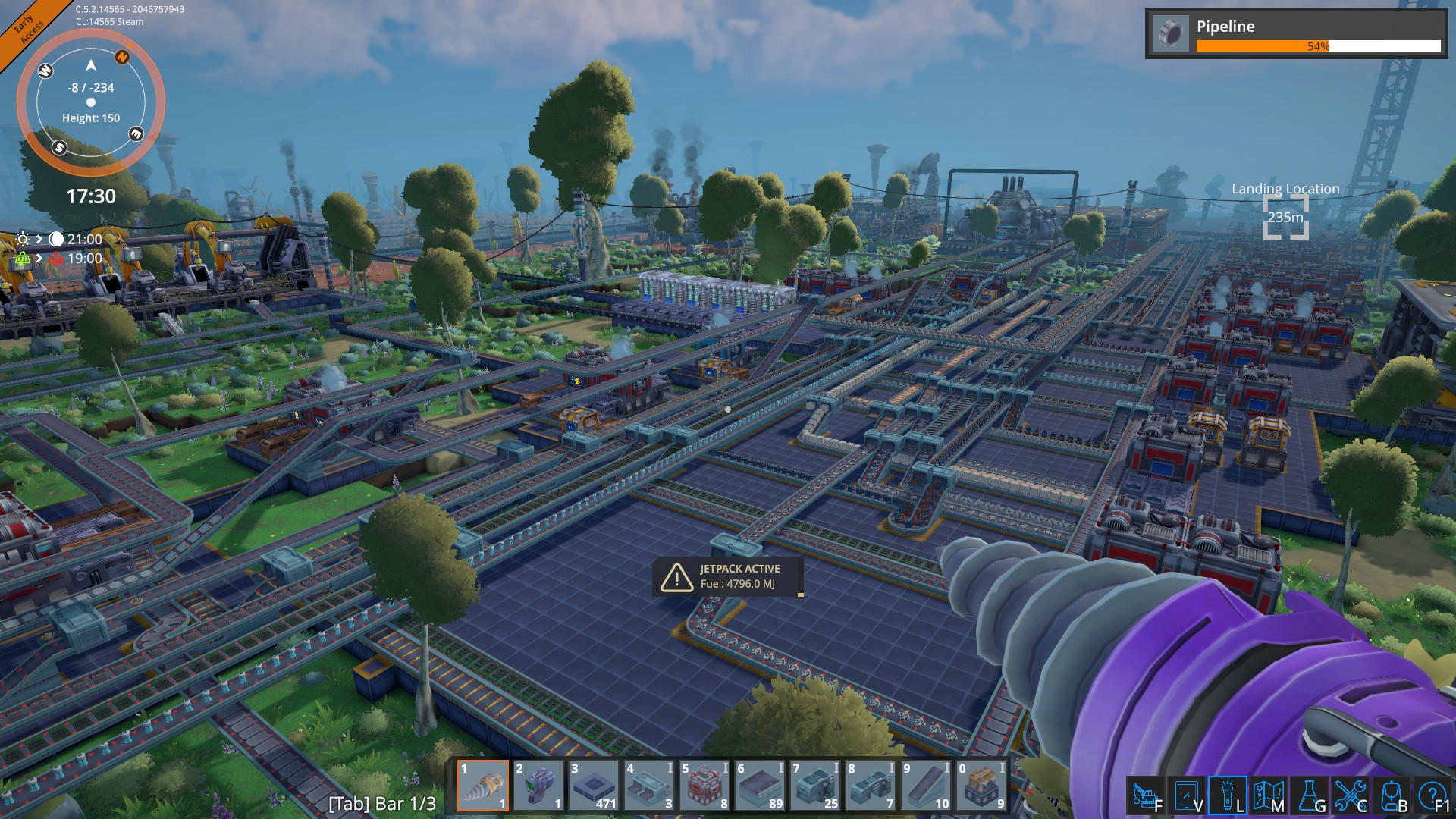
This covers about 1/3 of my planet, produces all low volume items.

I’m nearing the warp phase of the game now, which I consider late game. Getting rare resources has a huge impact on simplifying production chains – especially the oil ones. Oh, how the oil ones are painful.

Dyson Sphere Project – Dark Fog

Again, if you don’t own Dyson Sphere Project, you really should be picking it up. Or, don’t, and then you won’t have a bar set so high to disappoint with other games! I’ve completed it a half dozen times now, its really that good.

For the last year or so, the devs have been trying to add PvE content into a procedurally generated 3D game, in a similar vein to Factorio. (There have been a pile of QoL patches along the way, the game is way more intuitive now.) This has been labelled Dark Fog, and came out in early December. I’ve waited a few weeks because a) Steam Sale!!! and b) bug fixes always come after major content. Smart move, let me tell you.

The concept of Dark Fog is actually quite simple in theory, but amazingly complex in practice. In your starting area, the enemy has a starting base on your planet and one in space, with a few more planet-based bases in the system. You don’t have the ability to view other systems, but they are also infected to a degree. Now, the kicker here is that the enemy itself adapts to your progression, and increases its threat based on a set of variables – for the start, it’s power generation. It progressively increases its attacks until you can build enough strength to wipe it out. Which, as a progressively challenging enemy, becomes progressively more difficult to achieve.

In order to defend against these enemies and conversely counterattack, you are giving new items to research (approx 20% more “things”). If you are familiar with that concept, anytime to add a “thing” to a production chain, you are effectively adding a multiplicative factor of complexity. I’m not terribly far into that path now, just started the 3rd research tier, but I’d easily say it’s added what amounts to a sub-game to my regular path, or for those older-school folks, this is a large expansion of content rather than simply DLC. 

In practical terms, this means that not only is the main bus longer, but you’ll need to protect the bus from attack, effectively building defensive walls around it. That’s simple! (says you), until you realize that building the wall needs material to construct, material to continually arm, and importantly, precious power to keep active. The secret sauce here is the Signal Tower, which acts as a planet-wide extender for your relatively short-range missile towers. You’ll need at least 5 missile launchers + enough signal towers to destroy an enemy base, and then you’ll need a geothermal plant (which is mid-tier tech), in order to prevent future incursions. It’s a relatively complicated dance to learn at the start.

Swapping to other planets, you’ll have 3 or more bases to destroy, using a similar setup. Build a missile factory (iron, copper, coal), build a dozen or so missile towers, and extend your Signal Tower network until you take out the base. The higher rank those bases, the more missiles you will need, but more an issue of scale.

And that’s just the planetary portion. The space/hive portion is even more complicated as these bases you’re destroying are feeding an ever growing space fleet. Which effectively puts you against the clock to a) build up enough defensive power to survive, b) build enough offensive power to destroy it and c) not tick them off by accident (don’t attack relays!!) And even the smallest of space ships is the equivalent of 5 planet bases, so you don’t really want any fleet attacks.

My current run is about the mid-way mark, where I’ve cleared out 2 of the 3 planet’s bases, and I’m about to install a interplanetary logistics hub (to get silicon & titanium to my home planet). The steps that follows generally go:

  • Clear out planet #3.
  • Build a power generation hub with solar panels + batteries (in this case, that’s planet #2)
  • Build gas planet harvesters (40)
  • Build a Deuterium harvest cycle (planet #2)
  • Start terraforming planet #3 to build a planet-wide construction hub.
  • Transfer production from planet #1 to planet #3
  • Get purple cubes
  • Scale up production hub
  • Explore other systems for raw / rare materials
  • Build Dyson Sphere frame
  • Get green cubes
  • Fill in Dyson Sphere frame
  • Collect solar power
  • Final planet scaling
  • Get white cubes
  • Win!

Somewhere in that, I’ll need to figure out the math for a planetary defensive shield + attack base. I’ll reserve some thoughts for when I hit the later portions of the game, in regards to speed, complexity and difficulty.

Starfield

Or more accurately, Fallout in space.

I bought this at a rather large discount, more curious as to the hubbub than actually expecting disaster. In the simplest of terms, Starfield is one of the better Bethesda games in a very long time, but still less than what was pitched.

I’ll hit the bad stuff first, as it’s a somewhat short list. 

  • Yes, there are way too many loading screens, especially those relating to your ship. Learn to use the fast travel option.
  • Yes, there are game breaking bugs. I crashed to desktop numerous times, had to reload saves, had everything turn hostile for no reason, quests didn’t work, the Bethesda regular stuff. But, there was less of it than I expected. (The bug where you can’t unlock more powers is gamebreaking and has no fix aside from a console command.) 
  • Yes, the game has an absolutely stupid and archaic view on inventory management. Infuriatingly dumb. 
  • Yes, the game is complicated rather than complex. Ship building and Outposts (only practical reason is for a bounty terminal) are way too complicated for their own good. Ship stealth is a standout of complicated with no purpose.
  • This is a bespoke universe, it is not infinite, it is not random, and 99% of it is empty. This is NOT No Man’s Sky. That means a lot of repetition (Temple puzzles in particular are a lost opportunity.)

And really, that’s about it. There are many more good things here.

  • The story line is quite good. 
  • The faction quests are generally well thought out (Ryujin excepted).
  • There are some very well thought out side quests (I like the concept of Starseed)
  • Combat controls are much, much improved. Much. 
  • Ship combat works well enough, and with the proper skills, feels generally powerful.
  • Levels matter.
  • Some space powers are quite cool to use.
  • Companion AI is pretty decent. The voice work is really well done!
  • The game looks quite good. I found myself at quite a few times just stopping to enjoy the planets or towns.
  • Terrormorphs are a really cool idea (Red Dwarf flashbacks) that could have been more present.
  • The sense of exploration is there for a good dozen hours or so. Quests randomly pop up based on conversations you hear.
  • There was clearly a lot of passion put into world building. Things make sense and aren’t randomly placed. Lore is generally meaningful.

Overall, I’d say there’s about 20-30 hours total of content here, if you’re looking to complete the core content + factions, which I would recommend. The Crimson Fleet one in particular was a ton of fun.

I found zero joy in ship building (this sounds crazy, but Kingdom Hearts 2 has a much better system). The concept is cool, in that you can explore what you’ve built – but the practical part is that you never will because of the mass of loading screens.

Outposts are a mixed bag. I think the idea itself is somewhat sound, but the implementation of too many material types and sub-steps (nearly 90) makes this more complicated than need be. Finding the material is enough of a challenge, getting it from one planet to another is a bonkers logistical, where it’s a 1:1 cargo link. So let’s say you have a main base, and a half dozen mining outposts (which is still low ball). You need a cargo link on each of those outpost (fine), then you need another cargo link for each on the main hub (so 6 in this case). What? I was sure I was doing it wrong trying to connect just 3 together, and simply gave up. No Man’s Sky does it infinitely better.

Is there as much staying power here as in say, Skyrim? I honestly, cannot see that. Is it innovative? It’s Fallout 4 in space (so no) and the piece it tries to innovate (ships & outposts) are done better elsewhere. Is it good? Yes, but not to the point where I’d recommend buying it at full price. Then again, it’s a rare feat for me to recommend any AAA game at full price. Not worth the hype, but also not meriting the hate.

Steam Winter Sale

It’s been a while! Life has been going at a crazy pace and my traditional outlet of blogging has taken a backseat to, well, survival I guess. This holiday break is doing wonders to my sanity!

First, I want to restate for the dozenth time, the Steam Deck friggin’ rules. More than half of my existing Steam library is verified, and another quarter are playable. Things that aren’t typically are mouse/keyboard heavy, too old, has a weird launcher (looking at you Ubisoft), or just not optimized. Playing something like Cyberpunk Liberty City on this thing is a right joy. I am continually impressed and still feel like I’m holding the future of gaming in my hands – more so now that Microsoft bought out Acti-Blizz and Sony plans to port more to the PC. The downside is the harder-to-get-running other game stores, like Epic or GoG. It works, just not easy to get done.

Now to the topic at hand, the Steam Winter Sale. Or as it seems to have evolved, the everything-is-on-sale sale. My entire wishlist seems to be there, and savings seem to average around the 30%. In some cases, this is a great deal, in others (SquareEnix is bad for this), the base price is just dumb so the savings put it down to “I may consider buying it”. There are just so many games out there, it’s going to take a lot to convince me to play a $90 game on sale for $60.

So what have I picked up?

  • Sea of Stars & Octopath Traveller 2 are set up on my deck. I’ll get to them in a bit
  • Guardians of the Galaxy. A seriously impressive 3rd person action game with the humor of the comics, great controls, wicked fights, and a kick ass soundtrack. I almost feel bad not having played this earlier!
  • Robocop. This is timetravelling back to the late 80s in all the grimy glory. It has a solid storyline, the “heft” of being Robocop, the exact tone from the first two films, and frankly less jarring given that we are living in this world today. There are issues with character growth (max vitality is pretty much a requirement) and the gun customization (auto-reload is beyond OP), but they wash away in the larger scheme.
  • Talos Principle 2. A beyond solid puzzle game, with a seriously strong philosophical debate within. With about 150 puzzles inside, I could solve almost all with some time to think. Two of them required mechanics I didn’t grasp until I saw the solution. The storyline would make for a great sci-fi flick.
  • Graveyard Keeper. Sort of Stardew Valley with more quests and less time/energy to do things. You can make zombies to automate things, and the DLC are all but required to truly enjoy the game. There’s a (very) late game buff that auto-generates energy that completely changes the pace of the game… I’d go so far as to get a mod to put that in earlier.
  • Techtonica. This is an RPG with production chain elements, a sort of merger between Factorio’s grid-based design and Satisfactory’s exploration mechanics. It’s in early access, I saw Nilaus’ videos about it, gave it a shot. I like that the tech tree growth is based on quests and logical progression. I like the setting (tight spaces) and controls. I like the idea of production chains, but they are simply too complex at the start, with poor building option to find much joy. It goes too wide, too fast, and requires too much effort to “port” factories across the map. To me this is simply balancing, a natural step of any game in early access.

I’ve still got more to get through, and a few more sales that are catching my eye. Cocoon and V Rising are on the list, but at a price where I don’t mind paying full price to support great games. It’s been a hell of a 2023 for gaming, fingers crossed the pace continues next year.

Deliver Us Mars

Say what you will about Epic, but the weekly free games are a real treasure trove of curiosities. I tend to pick up at least one offering a month, and in almost every case, they are a 4-8 hour stroll through an idea that is right on the edge of execution. There are moments of pure brilliance and a risk taken, but it’s missing something key to really make it stand out. Deliver Us Mars is perhaps the best example of this.

This is a hard sci-fi adventure game, which certainly checks boxes for me. There’s no combat, no decisions, no real way to “fail” the exploration part. It’s on the edge of an interactive novel where a concept is explored, one exploring the failures of humanity and the implications of hope. The broad sci-fi stuff, in truth.

Importantly, the game has a prior game (Deliver us the Moon) which sets up a fair chunk of context for the characters at play, though not necessarily required. Essentially, the Earth is encountering human-brought disaster, they are using the moon to generate power, and the colony on the moon (smart-folks) essentially gives up on humanity’s faults and decides to pick up shop and rebuild on Mars. In Deliver us Mars, you play a character trying to reach Mars, as her father was part of that group. Throughout, you learn that the evils of humanity exist at all levels, and how people with the best of intentions can fall to their own hubris and fears.

I won’t spoil the game, as it’s a fun page turner to get through, with some interesting pieces to discover. It’s not a terribly original story, but it’s still a good one. Getting though it..

The game part is where this gets less challenging. The puzzle portions are simple enough where they grow in complexity until the end, with the same set of tools. The platforming portion is less fun, as you’re stuck with two ice picks to climb walls, with very loose controls. With one small exception, these pieces are extremely minor and more of an annoyance. The real kicker is the graphics. The scenery is quite good, the environment, and the concepts art. The issue is the ragdoll physics and in particular the hair of the characters. It’s pure uncanny valley, which distracts a lot from the rather well-written and well-acted performances.

Overall, the journey here was satisfying and I am well aware I never would have even bothered if this wasn’t available on the Epic store in the first place. It’s an unfortunate space where games like this would not get the attention they are due as they are grasping at a really great idea and on the edge of really pulling off the execution. I have no idea how the Epic store curates these items, but I’m quite thankful that it is finding those rough cuts for the world to experience.

Alan Wake 2

That this game even exists is a miracle. For a Finnish company to release such a strange and surreal experience, based on an already rather niche IP is wild. Honestly, it’s inspiring to see the sheer amount of creativity still out there and gives hope that gaming can exist outside of the FPS space.

I can’t really do justice to what this game is. Survival horror I guess is where it starts, build it flirts with alternative realities and sensory changes that really challenge your gaming instincts. I guess it’s more like an interactive novel in a way, or “true art” in another.

The story follows the first Alan Wake, intersects a bit with Quantum Break and Control, and ends with a satisfactory question. You play alternatively as Saga Anderson and Alan Wake, each in their own realms of reality. The mechanics of Saga’s journey are more familiar to the genre, with exploration, small puzzles, and combat (more on that). The unique twist is her Mind Place, where to slot elements of the plot on a board to uncover the larger story. That is more like a detective novel trying to piece together random elements to tell a larger story. Alan’s mechanics are more fuzzy, with some very minor combat pieces and shadow folk who may or may not be aggressive, for some extra horror/jump moments. His unique element is the ability to re-structure a space given plot elements. Maybe it’s the start of a cult ritual, or the end of it. It is fascinating to see how plot elements can interact with a given space and dramatically change your experience – calm one minute, and pure chaos the next.

It’s hard to properly explain how this simply all just works. At no point did I ever feel like I was ill-equipped, or that there was some game-y way through a challenge. Nursery Rhymes in particular were a nice highlight. It is by far the most coherent surreal experience I have ever played.

The sole exception is combat, and this is more of a balancing thing. Alan’s mechanics are lose and understandable – he’s a writer. Saga’s portions are rarely fun, in particular due to ranged attacks, limited ammo, and respawns. There are parts of the map I simply ignored because I didn’t want to waste ammo, which is less fun. There is one particular event that highlights this to a significant degree, where your NPC friends are obliged to keep throwing you ammo, ala “Booker I found ammo” from Bioshock Infinite.

The plot construct is such that you can alternate between both characters at your choosing, and both threads need to complete in order to reach the final conclusion. Each particular thread has multiple chapters, which are wonderfully constructed. You’ve likely heard of one of them on the interwebs, it is much more fun to play than watch, and is a blast to watch!

Alan Wake 2 may be one of the best games I have ever played, certainly one of the most unique. I have no idea how Remedy was able to pull this off, as it feels like every risk they took here paid off, and the playing-it-safe portions are the weakest part as a result. You absolutely should play this game. Just do it with headphones.

Return to Moria – Part 2

I get a kick out of making mistakes. I find them to be the best way to learn. The consequences of mistakes tend to be the largest driver for change.

In the video game world, the only true consequence is time. In Everquest, you died, lost XP, and needed to get it back – time. In a permadeath/hardcore mode, you lose a character and have to rebuild – time. In Valheim, you get taken out by a deathsquito – holy moley the time.

In Return to Moria, when you die, the cost is generally a mild amount of time to return to the place of death from your bed. The cost to create a new bed is relatively small, sort of like a mini-save point. For some encounters, this is absolutely required. For the more complex areas, the game tends to provide a fast-travel point. Now, have I died in really bad spots that caused horrible corpse runs? Heck yeah! The Deep runs in particular (holes in the ground that require 4x rope ladders to get down to, and have a permanent DoT) are perfect examples of risk/reward, because they provide access to some rare materials. I’ve died more than a few times by pushing my luck to harvest a couple more Black Diamonds.

The dungeon tile exploration aspect also highlights this, very similar to a D&D campaign. You know there’s a door, will you open it if you are low on HP and lacking spells? Same thing here, do you want to open the new room when you’re tired, hungry, and your armor is gone? For the first half of the game, you are generally at a disadvantage to address those issues. Eventually you will acquire the material to build temporary (and useful) camps that address all that (medium hearth, table, bedroll, repair station, and mushroom/sun onions to cook). This temporary camp model is required, as the later parts of the game can go for very long stretches of combat/exploration. Orc camps or hordes will absolutely wreck your shield/health.

Which highlights a larger challenge with fast travel, where the game considers you having walked the distance. Meaning any buffs you may have acquired before travelling are mostly worn off by the destination (buffs that are stupidly short duration). This generally means that the home base model is more about a place to store stuff rather than prepare for the next run. It takes a long time to get a bag big enough for that to be practical.

I will flag that the game difficulty does increase over time, more so in the space of significant vertical travelling, more enemy density, and more environmental hazards. Vertical movement starts off rather simple, maybe a single floor up. Later though, you’re going to be going through 4 floors at a time in a single dungeon tile. Enemies move from patrols of 3 orcs to a dozen + wargs. And the environment is just chock full of poison/despair which eats away at your health if you don’t go above it. This costs time. Add into that the move from fairly linear exploration to multiple paths, there’s a crazy amount of time spent just trying to figure out where to go and getting there alive.

There’s a rather long list of QoL gripes I have with the game, and already patches are coming along to address them. You get stairs very early now!! Slag and Scales drop more frequently and less are needed!! It reduces the grind and RNG aspects. QoL things are often hard to balance out, so hats off here.

Now having opened the Dimrill Gate and effectively completed the main quest, there are some exploration and completionist portions that remain. Which I can say without hesitation is a much different game altogether. Having access to Tier 6 armor & weapon (after the final quest), plus continued access to Miruvor (a quite strong HoT) reduces the overall risk tremendously. And if you’re so inclined, you can lay down a special lamp to clear piles of purple mist. Sure, you may still encounter a large troll or fell beast, but you’re more than prepared for it after that final run. Of note, once you do have a particular item, you can restart a new world (or join another) and very quickly unlock a shortcut to the near-end of the game.

Hindsight is a heck of a thing however, and it is next to impossible to avoid comparison to Valheim, which is an all-around better game. Return to Moria is built upon, and suffers for, the need for claustrophobia and lack of freedom. Freedom is the reason survival games exist. I am not against the concept of dungeon tiles as an exploration mechanism, but the inability to make mistakes and explore too deeply is wildly confusing. “The dwarves were greedy and dug too deep” is not possible here. Every player will start in the West Halls, head to the Elven Quarter, the Crystal Depths, Lower Deeps, and so on, in that order. The concept of procedural generated worlds off seeds is almost pointless.

The start of a final abode, at the eastern gate. There’s really nothing to fill the space with.

I will say that this disappointment is offset by potential. The game a week later is much better. Improved maps, improved food/buffs, clearer direction about digging in deep cracks, better building tools, and better combat are all things that would put this much in much higher regards.

The game does an admirable job of making you dig through a mountain, and once you’re done, you can look back and better appreciate that journey. And certainly the journey is better in a group. Return to Moria may not be a GotY candidate, but it certainly fits in the top shelf of of LotR games.