At a Glacier’s Pace

Let’s chat a bit around the fire shall we?  There’s an old saying that goes “Do not raise your children the way [your] parents raised you, they were born for a different time.”  I think that applies extremely well to gaming and even more so to MMOs.  A gaming generation lasts about 5-7 years.  The last console wave was on the tail end of this.  The general point of this is that the strategy applied at the start of an MMO needs to change over time.

In IT design there are two portions of a service that are often classified as above and below the waterline, like an iceberg.  Only a very small portion is ever seen by the user (above water) while an inordinate amount of time is put on the back end items (below water).  So whenever you see a patch/expansion, figure the amount of time it takes for you to consume it and multiply that by at least 100 to get an idea of the amount of effort it took to generate it.  So, if you get 60 hours of gametime, likely it took 6000 hours (which is a ~month for 30 people) to create it.

Suffice it to say that IT developers strive to find economies in the below water systems in order to maximize the amount of content delivered in the least amount of time.  Agile development!   The older the system, the harder this is to do.  Microsoft famously stated that the average Windows coder during the XP days, only ever put in 1 line of code per day due to historic content.  IE had the same problem up until version 9, which explains why it still fails the Acid3 test.  In order to move forward, sometimes you have to rebuild the foundation.

Today’s world is run through agile development, meaning that changes needs to be applied quickly and for lower cost.  This is done through service oriented architecture.  Think of it as Lego blocks.  If I wanted to build a boat without Legos, it would take a heck of a long time – wood, nails, etc…  If I built it with the blocks, then I could get a boat built in 10 minutes.  StoryBricks (for EQ Next) uses this model.  So does the Foundy in Neverwinter.  GW2 is able to release new “living content” at a quick pace because of their toolsets.  SWTOR seems to have an update every other month.  TESO and WildStar are both promising something similar, with a quick dev cycle to justify the subscription cost.  EvE does a decent enough job too.

The outlier for years has been WoW.  Their patch cycles aren’t the worst, a few months between but their expansion windows are simply ridiculous.  There was a time when “soon” meant quality.  It does for Starcraft.  It did for Diablo3 once Jay left (that game is barely recognizable now).  It has not often meant it for WoW.  The MoP expansion, outside of new art, introduced one new mechanic – pet battles – and that took 11 months.   Flex Raids, arguably the 2nd best thing to come out of MoP, took much less time. WoD looks like we’re going to see at least 14 months with no new content.

Now, there are a couple of possible reasons for this.  One, Blizzard is exceptionally greedy and wants to milk the user base for all their money.  I doubt this when MoP launched, it was the lowest rate of sales in their history.  The next quarterly review is expected to show another drastic drop, likely hitting the 5-6 million user level.  Second, Blizzard only runs 1 development team that changes in size based on the content being developed.  This seems highly probable as it ensures quality development and a lower bug count but not having multiple source codes running around.  Old code needs to be stable and the toolsets must be ancient.  The WoW ship is massive and even a little tweak can have massive repercussions.  There is tons of evidence that raiding is at an all-time low, somewhere near 15,000 guilds total raided in SoO outside of LFR.  Servers are being connected (merged without some of the hiccups) continuously, with only a dozen or so that are not slated.  When people are leaving en-masse for “greener pastures”, it puts the fire under the designers to keep what you have and get people back.  Pressure, in design, often leads to very bad ideas or impractical ones (such as the Path of Titans which sounded amazing).

I am not saying Blizzard is closing WoW or that it’s failing.  Just that the statistical anomaly that existed for ~5 years seems to be returning to normal.  Players have realized that there are plenty of viable options on the market.  It’s just surprising that with all the change that has happened on the market, that Blizzard hasn’t made a more concerted effort to change their design practices.


Gaming Updates

I’ve only been on 2 games recently, FFX-HD and WildStar.

Final Fantasy X – HD

When this game came out in 2000, I was all over it.  I still own it on the PS2 (and X-2) but I wanted to see what Squeenix did to improve it.  The answer – quite a bit.

The sound is amazing.  A lot of it was re-recorded and the music is great.  The original had a more “midi” flavor to it, but today’s version is practically orchestral.  The voice acting is the same and on-par with a high school play in terms of quality.  I get it.  FFX was one of the first RPGs with full voice acting, and it shows.  FFXII was a drastic jump in quality on that front.  Graphics are quite impressive.  Some of the character models have been redone, or rather re-worked.  Real shadows now too.  All the textures are in HD and the detail is darn good.  It even seems like the draw distance has improved.

Combat is to me, the pinnacle of the FF series – a near perfect merger of strategies and tactics.  After having played the auto-pilot XII and the “press A” XIII, this is quite refreshing.  Make the right choice and you can avoid disaster, make the wrong one and restart the fight.  You’re always given enough time to make the choice too, which is great.  Boss fights are a ton of fun too, especially Seymor on Gagazet and Yunalesca at Zanarkand.

The game also added the international content – expert sphere grid and dark aeon fights.  The former is a more customizeable feature compared to before and the latter a massive butt whooping.  I’m at the phase where I need to enter Sin and I’m collecting for the Monster Arena.

People complained at the time that X was linear and to some degree it’s still true.  XII took a wholly different approach and XII decided to go super linear.  X provide enough lateral movement and options throughout and a very open end game to boot.  I’m guessing rose-colored glasses here but it’s enjoyable.  Reliving nostalgia for the win!

WildStar

I finally got into the beta the week before and got a few characters to level 5, just to see the starting zones and character dynamics and paths.  I liked what I saw and got the pre-order from GreenManGaming with a 20% off deal that got me the deluxe edition for the cost of basic.  I went back into the extra beta this weekend, deciding that I wanted to see housing (at level 14).

I have been planning on playing an Esper, so I used my Dominion Chua on the solider path, to try and get through the levels.  I am ~80% complete the first zone and level 15.  I didn’t read any quest text or lore (and there is TONS of lore) because I don’t want to spoil myself.  I am extremely impressed in the quality of the story and characters though, without going into more detail.

So, leveling content first.  You have zones with small town hubs.  There are maybe 4 quests in a given hub and the remainder are triggered out in the field through the satellite phone. By and large, generic quests of kill X, where X goes up by a % based on the difficulty of the kill.  Fights are against 1-4 enemies at a time and I died a few times because I didn’t pay attention to telegraphs.  I like dying.  You also get to unlock path missions at various points.  Soldiers include kill-type events, either defend a point, test a weapon, assassinate a target and so on.  I will not be playing a Soldier on live – likely a Scientist.  There are plenty of Settlers around putting up buff stations for other people.

There are group quests (I found 4 in the zone) and you need a group for it.  There are challenges that ask you to collect X, kill Y or destroy Z within a certain timeframe.  You get a bronze, silver or gold medal based on your performance and the reward is a lottery of sorts on prizes.  Each prize has separate odds of winning and the one you hedge your bets on gets a 400% increase.  I opted for housing stuff whenever possible.  These challenges re repeatable after a certain time too, which I think is great!  The zone is organic, without obvious breadcrumbs.  I am pleased.

Crafting opens at level 10 and is decently complex.  Gear is actually usable and leveling up is not just setting up a macro.  I opted for a tailor and made some decent gear that replaced all I had.  Costumes are open from level 1 too, so even though my stats went up, I could keep a consistent look across the levels.  The crafting trees are complex and decently balanced.  Color me impressed.  Oh, I tried cooking too, which is a weird beast of a mini-game.  The link goes into some detail on it but you’re essentially playing darts.  It’s a neat system, not sure how it will work at the tail end.

Housing is what I really wanted to see and what you get at 14 is the tip of the iceberg. It’s more than a house, what with the plot system.  I made a simple garden first, then decorated my house with a bed, carpet, ferns and other knick-knacks.  The tools are both simple and complex, depending on what you want from them.  I spent a solid hour in that house, trying on the different textures and features in preview mode.  I think this is where I will be spending the majority of my time/money.  It is really impressive.

Now, I get that people see Wildstar as WoW on LSD.  It is a hyper version and if you don’t like the style, stay away from the game.  It does however improved on a lot of systems WoW has.  Character customization is fluid (you can “respec” at any time), there is a mentoring system, the world is more dynamic, travel is meaningful, crafting is more complex and involved, combat has an “open tagging” affair, there is minimal phasing, combat is tactical and responsive.  There are surprisingly few bugs but some systems need some polish (the auction house in particular).  Color me impressed.  Hopefully the next beta weekend I can get to 20 and run a couple dungeons.

Granted this is the view from level 15.  The view at end game may be drastically different.  Even so, the ride to the end sure looks like a lot of fun.

Alas Yorrick – QfG1 Part 3

After talking with Erasmus and being provided a few more clues, I’m off to see the wicked witch of the valley – Baba Yaga.  Well, more specifically an ogress, but she’s ugly nonetheless.

When I first get to her gate, I have to make a deal with the skull at the door.  Apparently he’s jealous that the other skulls have eyes.  Off I head around trying to find this eye.  Finally meeting up, and trading with, a frost giant, I’m one glowing gem richer.  Skull’s happy, I’m happy and now I get to go into the hut.

After 20 years, I still remember the rhyme to get that hut down.

Hut of Brown - that sounds bad

Hut of Brown – that sounds bad

Once inside I get to meet this wicked witch – who immediately turns me into a frog.  What fun.  The old hag (what an affectionate term) sends me on a quest to collect a mandrake root at midnight, in the middle of a graveyard.  Oddly enough, this was a simple task compared to the other ones so far.

After leaving her hut I keep wandering around and find a Dryad, who thankfully instructs me on how to concoct a dispel potion.  A few mini quests later (green fur from meeps, a magic acorn, flying water from a waterfall and dancing fairies) I get the healer to make me a nice potion.  Getting ready for the end!  Now I just need to figure out where this brigand leader is.

And for that I visit the local thieves.  A quick snoop later, I get the password to the secret tunnel and the key from a corpse.  Of interest in this portion, if I don’t take a particular path across the map, I die.  Which I do repeatedly.  Games like QfG practically forced you to save continuously to avoid constant death.

Thank You!

Thank You!

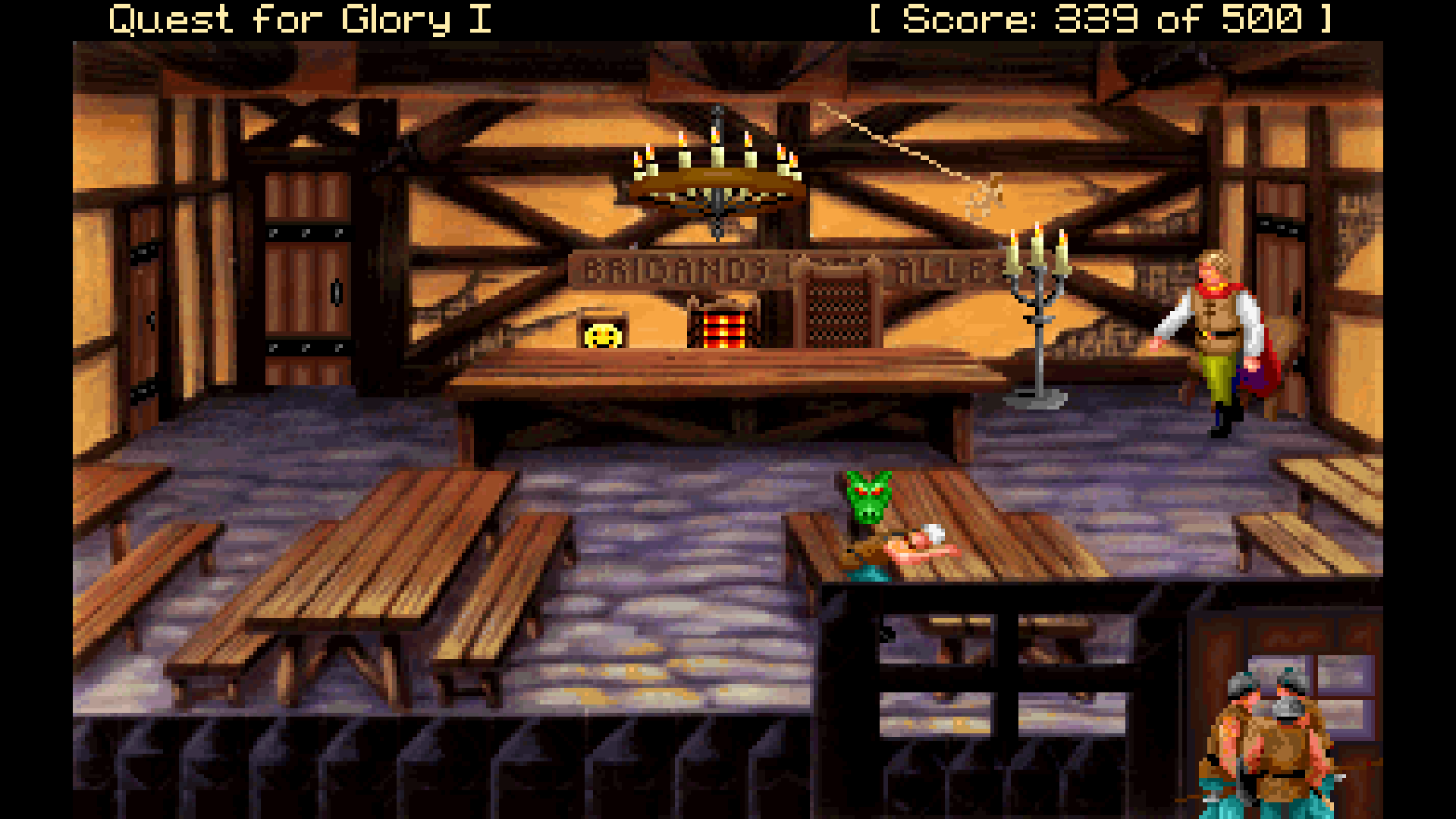
On to the final chapter.  Meeting up with the secret cave, I give the password which shoos away the local troll.  A bit further in, I get to meet Toro, the local minotaur guard.  For some reason, my sneaking ability fails again and again (even though it’s at max) and I have to fight this poor bugger.  A few daggers and fireballs later, he goes down and I go in over the wall.

Seconds before my sneak attack fails miserably

Seconds before my sneak attack fails miserably

The next portion is a trap filled death zone which takes a few tries to get through.  Nothing to serious but the arrows hit me in the knee a few times.  I then enter the eating hall.  Or as I like to call it, the room of eternal failure.  There are 5 distinct actions that have to be taken here and all within a specific timeframe.  Each one too soon, or too late, causes death.  I do end up clearing it but it takes me a solid 15 minutes for what amounts to 30 seconds of actual gameplay.

I see dead people

I see dead people

The next zone has me meeting the warlock, or Yorrick to his pals.  This was the jester that followed the baroness to make sure she was ok.  Given that he couldn’t break Baba Yaga’s curse, he just stuck around to protect her.  He devised this massive trap zone to isolate her from the rest of the brigands.  Getting through the funhouse is as challenging as it is colorful.  Finally through that, I meet the brigand leader, throw the dispel potion and poof, baroness!

What, no kiss

What, no kiss

She informs me that her magic mirror can reflect spells (why she didn’t use this before is a good question) so I pick that up and we both skedaddle.  Mirror in hand, I decide to pay the ogress one final visit.  A zap and a half later, Baba is now a baby frog and I’m a free man.  The game takes over now and I’m sent to the Baron’s castle for a victory feast, with all the cast and crew (along with Corey and Lori Anne Cole).  I save my game afterwards to get eventually started on Quest for Glory 2 – Trial by Fire.

Everything is Awesome

Everything is Awesome

Summary

I played the EGA version of this game about 50 times when I was younger and tend to replay the VGA one every year since.  It has not lost it’s charm.  The art style still holds up, as it never really went for realism in the first place.  The text is still as good/corny as it was before.  The puzzles are still well thought out and have multiple paths for success.  One of the best parts of the game, and the series, is that you can start in QfG1 and continue to play the same character all the way through QfG5.  And it did this 15 years before Mass Effect.

Man I love this game.

More Glory – QfG1 Part 2

After exploring the town, my Thief is ready to head out into the wild.  Heading up North I meet up with the healer.  After finding her ring in a nearby nest, she was nice enough to let me know about all the things I can do around here.  Note to keep, I can make some money collecting deadly Cheetaur claws.  Woo.

Off out I go again, looking to the Baron’s keep.  First up is a fighting trainer.  Given my skill in combat (quite literally the fact that I have any points in Parry) he opts to train me in combat.  I give it a shot and get handed defeat in short order.  Apparently neophytes can’t beat masters, no matter what the movies tell us.

qfg4

After the fight, I ask a few more questions to the guards about the Baron’s curse. Seems there might be some activity nearby related.  Sure enough, a nearby cave, guarded by a massive ogre, has a kobold keeping the Baron’s son hostage, under a spell.  A few fireballs (I did mention I took up magic right?) and down the baddie goes.  Looting a key, I free the Baronet and head back to the castle for a nice party.  Not the nicest guy in the world but the gold reward is well needed!  Plus, 1 of 2 kids found.

At this point I decide to do some exploring and attempt to level up some stats as combat with that Ogre and Kobold was pretty tough.  QfG, a series as a whole, has maps that are mostly used as filler I guess.  About 50% of all the areas on the map are empty and therefore have a chance at generating an enemy.  Sometimes it’s just fun to run around these places to find enemies to fight, in order to increase your RPG stats.  You certainly get to meet some interesting folk!

Giant Cheetah Attack

Giant Cheetah Attack

Big Teeth

Big Teeth

So now, not only do I have Cheetaur claws for the healer, but quite a few stat boosts to help too.  I didn’t max anything out but I did pass the 50% mark on the majority of things.  Before taking on the next half of the Quest, I decide to explore a bit more.  I remember Zara talking about Erasmus being nearby, and being a powerful wizard maybe he can provide me with more wiz-bangs.

Erasmus, and his talking pet rat Fenrir, as the heart and soul of the puns in-game.  I don’t think they ever said a single serious word.  It’s funny in that the puns stink as much today as they did back then.  Yay for rose-colored glasses!

Due to my proclivities with magic spells, Erasmus challenges my to a wizards duel.  No, there’s no magic wands and hokey latin.  Instead we fight by proxy with little flames.  The trick is to move stones and bridges and get my little blue guy from the top left to the bottom right.  It takes a few tries, and quite a few mana potions, but I finally get the win!

qfg9

After the battle, I get a bit more information from the wizard about the baroness.  Clearly she’s under an enchantment that I need to dispel.  Seems like I have a target for the next step of the quest.


Housing For Everyone!

To little fanfare (at least from my feeds) SWTOR announced player housing.  Maybe they gave out more information while I was at sea but this is what I found today.

It looks somewhat similar to RIFT’s housing idea, what of instances of housing to choose from.  Where that game had a lot of choice in terms of domicile, this one seems to be limited to either your capital city or Nar Shadaa. So, yay?

As per everything in SWTOR, a new experience bar is also available for housing.  It increased based on the amount of decorating you do.  This is a strange mechanism, to be honest, as housing is between achiever and socializer in my books.  This “prestige” gets you more something but do they want people to decorate just to raise that bar or simply as an afterthought to decorating?  I’ve always been of the mind that people build what they want for the pleasure of building, not some mini-game.

Not a whole lot more to go on.  Namely travel (hopefully a single hop), size, customization options, cost (though $1.5M seems to be listed somewhere) and a few more things.

Other good news is that fleet ships are in, which is essentially guild housing.  That is pretty sweet, if again, they can get the transport issue resolved.  I have quite a few fond memories of guild housing in UO, what with the local amenities and shared common space.

Keeping track, we have housing in EQ2, LOTRO, RIFT, FF14 (though too expensive for most) Wildstar and now SWTOR.  WoW has an extremely simplistic version.  TESO doesn’t yet appear to have anything, though it’s been a core of the single player series.  The concept of ownership certainly does make people come back.  Hopefully this thought process, where player initiated actions provide noticeable changes to the world, can take hold in more games.

So I Want To Be a Hero – Quest For Glory

No word of a lie, I can clearly remember getting Hero’s Quest for Christmas when I was younger.  I unwrapped the gift and saw the picture below and could not wait a second more to get back home and play the game.

It all started here

I had played a few shareware games, Commander Keen and whatnot, by that point but this was the start of my fascination with games.  Now the game series had to change titles because of a boardgame with the same name (which was also awesome) and turned into Quest For Glory, spanning 5 games.  I remember even buying the little books as guides, with the red plastic window to read the clues.  I played all the games, extensively (even 4, which was notoriously buggy) and was saddened when 5 was announced as the last in the series.  Which, in my opinion, spelled the death of Sierra games.

Tears aside, Syp’s recent foray into nostalgic games had me thinking I could do something similar with QfG.  Let’s see how that goes!

Building a Hero

First off, QfG is a mix of adventure and RPG, with most of the focus on the former.  You class, either Fighter, Thief or Magic User, impacts the types of tools you have at hand in any given puzzle.  Most of the puzzles have many solutions, depending on your level in your skills.  For example, a Thief with Flame Dart can attack at a distance rather than sneak around.

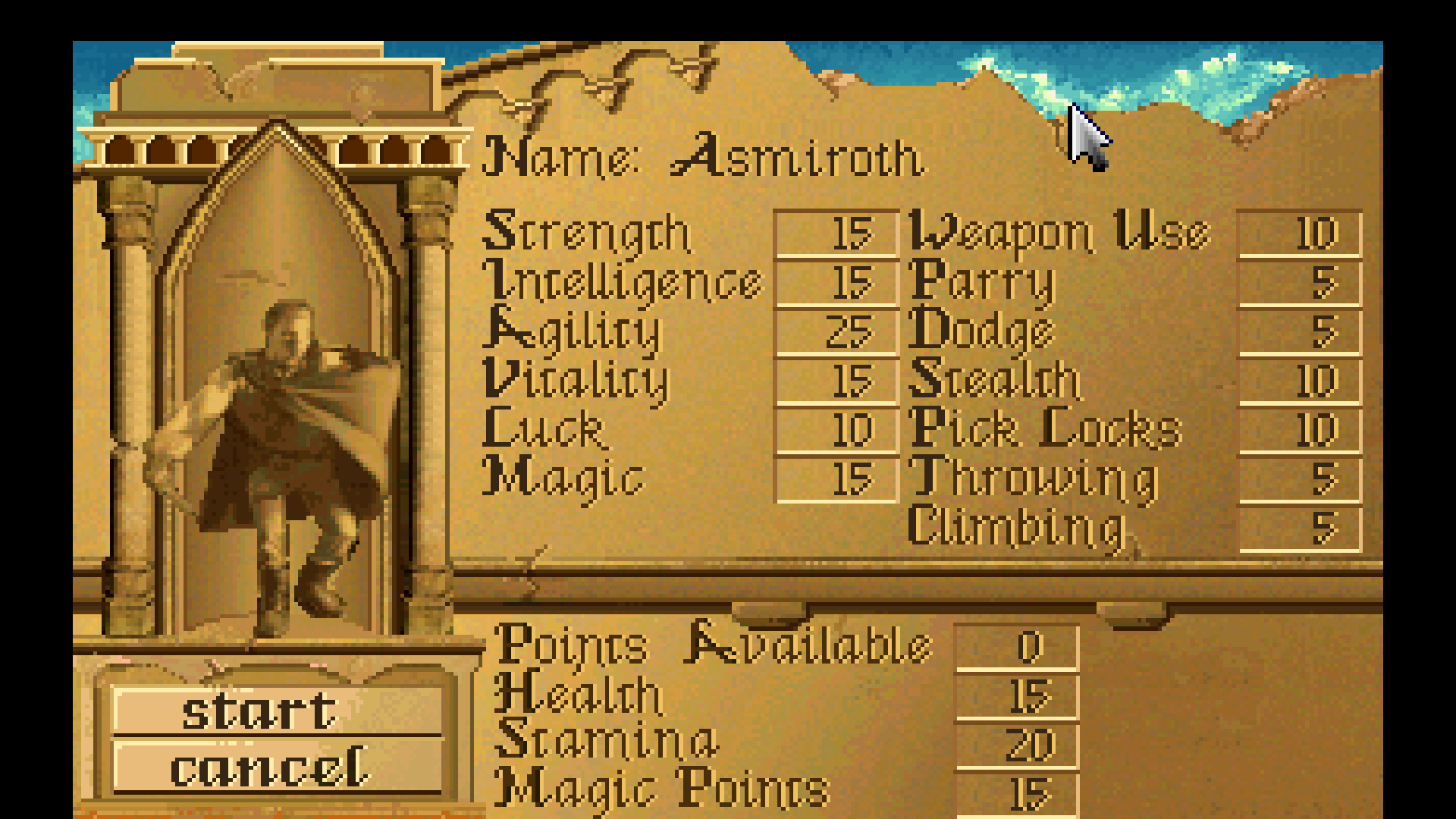
For my tastes, I have always been drawn to the Thief.  They have a subset of missions in every game that just seems more fun.  I opted to make a Thief with a set of points in every skill, allowing me to try anything out.

9000!

9000!

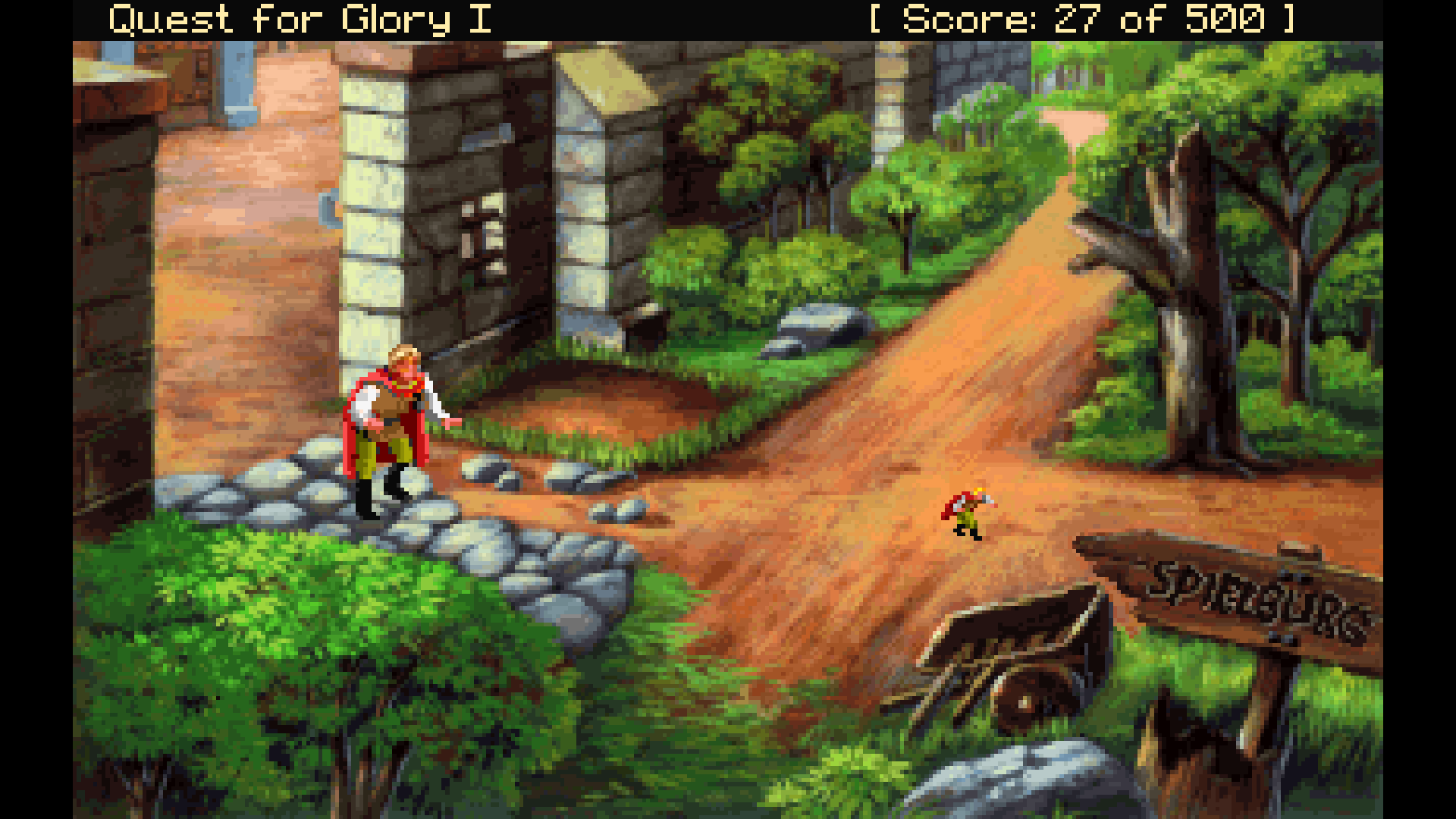
And off I went.  Sent into Speilburg (this game is notorious for puns), I meet with the sheriff at the gates to learn about some brigand problems, along with a curse from a local ogress.  Get rid of the brigands, rid the land of the curse and become a hero – sound simple!

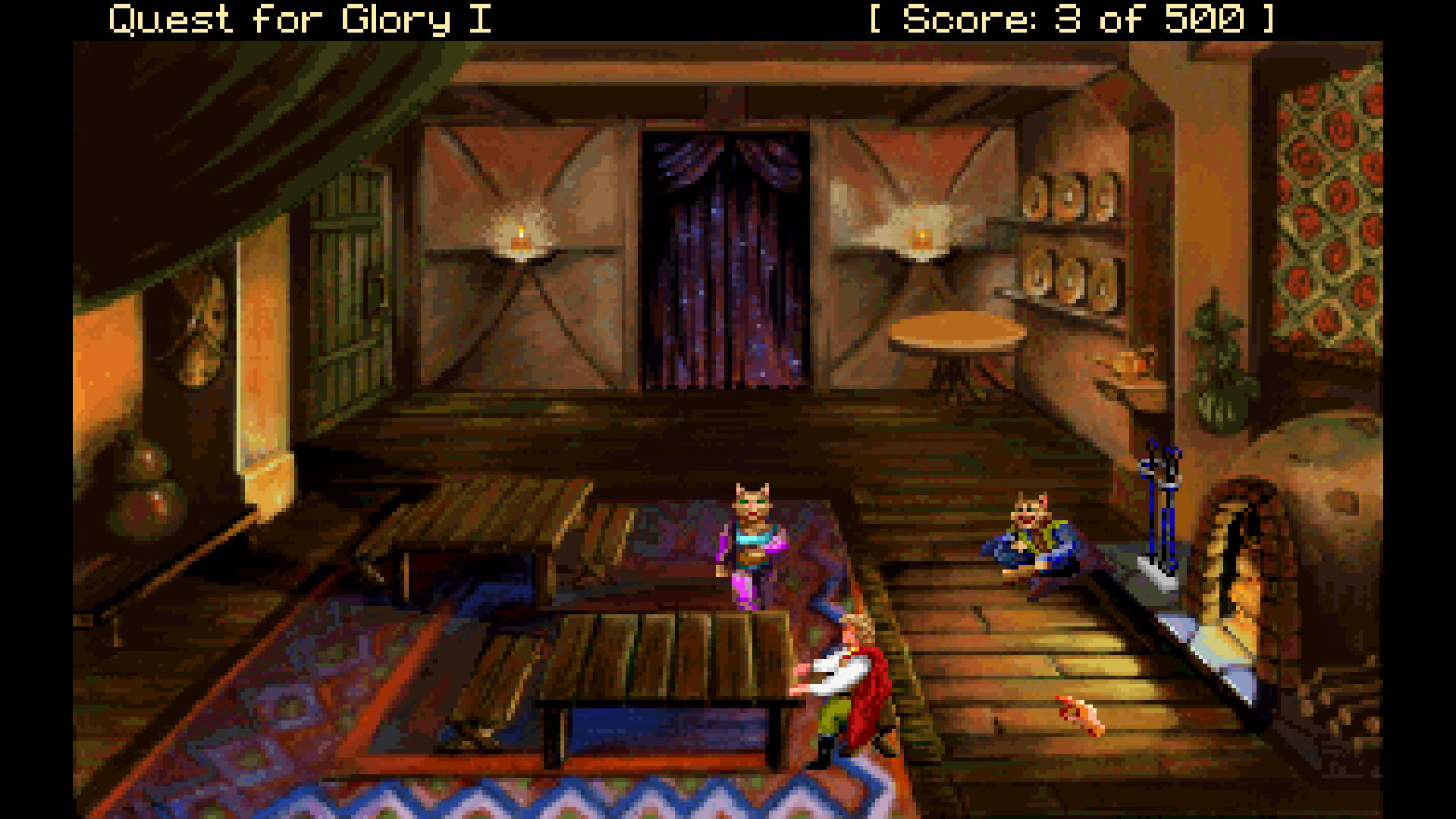
I head next door to the inn and meet some cat folk.  Always cat folk in fantasy games, don’t really know why dogs aren’t around more…anyways.  Nice people, got robbed by the brigands and now they have to lay low, charge me a pretty penny for a sloppy meal and then ask me to find their stuff.  I don’t know, maybe give me a free meal and I’ll think about it?

qfg2

I explore a bit more of the town afterwards.  Hit the Guild Hall to learn about being an adventurer.  Buy some magic spells from Zara, buy some apples from the cute centaur and sit down for a mug of beer and some stories at the pub.  Looks like this peaceful town has a thieving problem, which is right up my alley!

At night, I find a shiny coin in that same alley which leads me to the thieve’s guild.  Buy  myself a license, train up a bit on lockpicking and hit the town.  Only 2 houses to lift from and very little within them, maybe a few gold total.  There are many ways to die however, of which I find quite a few novel ones.  That cat is especially friendly.

Time’s up in the town, let’s head out into the wild!

qfg3

Until the next chapter.


Slow Start to the Year

Syp has a post that reflects my current thoughts, that the year is off to a slow start.  I think this is mostly due to the new console generation, and the push-back on development of cross-platform games.

From a PC-only perspective, we have the indie stream (kickstarter and Steam) where development timelines are “always beta” it seems.  Sure, we get the odd Banished coming along but the real push of games seems to be months away.

The first real launch appears to be TESO, in a month, and from beta reports I’ve read – Reddit included – there are some rather significant bugs that still need to be ironed out.  They’ve mentioned no open beta, so the odds of having these bugs killed before launch seems small.  I guess there’ll be a day 1 patch.  Fingers crossed.

TSW Tokyo was delayed.  GW2 living story doesn’t seem to be having much impact.  Diablo3 did put out patch 2.0 (the loot-bonanza) which seems to be going well.  How the RoS expansion comes to fruition is a separate manner.  I honestly do not expect major sales on that front but it’s interesting to read about.  Neverwinter’s Icewind expansion is a few months away.

Wildstar still doesn’t have a launch date, though apparently this “phase” of beta had completed invites.  There are certainly bugs in the game, it’s a beta after all, but there are apparently some core mechanics that need to be tweaked.  The hype is in a lull right now and given that elder game is currently being tested, we’re likely 3 months away.

WoW is the last one on the list.  WoD heresay indicates that friends and family beta is just getting started.  The watercooler discussion still shows that there are large design gaps to be filled.  I would be surprised if WoD launches before November at this pace.  This would make the current patch 14 months old, which is so astoundingly stupid I am at a loss of words.  It does give TESO and Wildstar a ton of breathing room.

Other games on my list include Wasteland 2, Project Eternity, Xenonauts and a couple other outliers.  Hopefully when March finished, we’ll be on a good wave of launches to fill out the year.

Race to the Bottom

An interesting article on TTH-Respawn about the Death of Mobile Gaming got me thinking.  Always a dangerous thing, I know.  In the continuing race to the bottom, markets get saturated, value gets inflated, the bubble bursts and then there’s a crash, followed by a renaissance.  It’s a cycle, seen a few times but usually takes a LONG time to come about.  Today’s hyper consuming market is changing that.

To point, mobile games are still relatively young.  A true Android capable platform is only 2-3 years old, iOS about 5.  The original mobile games were exploratory in terms of controls and limited screen real estate.  There was innovation, it was new and with so little competition, it was “easy” to find the gems in the pile.  And today we have (had) Flappy Bird and the literally hundreds of clones.  Now, I don’t have issue with Flappy Bird itself – it was a simple game with no aspirations. I have issue with the market around Flappy Bird.  Issues with Temple Run.  Issues with Clash of Clans.  There is so much garbage in the mobile space today that it’s next to impossible to make money and quality.  Games that were offered for free on PC through Flash now dominate the Paid App Store.  99c for a game doesn’t speak much to value.

This delves into the MMO space too, where the largest glut was a few years ago, the days of Allods Online.  Everyone took WoW, took out the stuff that made it good and sold it for cheaper.  The actual dev cycle for an MMO is measured in years, so it must have been quite the ride to see all these games fail, and fail spectacularly, while you haven’t even released yet.  I won’t go too far into the F2P debate but clearly, the line at which people associate value with product is at a completely different place today than it was even 3 years ago. Quality aside, TESO and Wildstar’s single largest hurdle is public perception of value.

Consoles… I don’t even know where to begin.  Hats off to Call of Duty, FIFA and the NFL for making so much money on the exact same recycled product year after year I guess.  The market for games is so astoundingly atrocious that I can’t name a single XBONE exclusive title that isn’t a rehash.  PS games at least had Naughty Dog.  It’s just so bad that I can’t even bother to pay attention anymore.

That leaves us with the last refuge of the damned – PCs and indies.  Every couple weeks, another game seems to pop up.  Jewel and Murf have been posting/tweeting about Banished lately.  A game that likely never would have heard of if not for the blogging circle.  And it’s not a game that’s free, or one that is so cheaply priced you don’t even think about it.  In fact, the average Steam game tends to be between $10-$15.  The perceived value for that dollar is so drastically different on PCs than other media that it makes you wonder if it’s a completely different target audience.  There’s Free and then there’s Free.

The seemingly unending cycle to pump out crap to be consumed (pushed by large and small groups) is not sustainable.  There’s no money left in mobile outside of IAP – and even there, whales dominates (something like 1.5% of the population pays > 50%).  F2P MMOs aren’t a whole lot different, depending on their model.  Expectations are at a point where the large majority is expecting everything for no cost.  How does that make sense?

In the quest for the last penny, or for all the pennies, it’s remarkable how many developers have lost sight of the true value of games.   Here’s hoping that bottom is found soon.

Old School Challenge

When I was a kid, games were tough.  There was little grey area.  Digital meant black or white – you missed the pixel or you didn’t.  The concept of “ledge grabbing” was unknown and you could die for a ton of reasons, many of which made you want to destroy your controller.  Battletoads, I’m looking at you!

SNES back on topic.  There were quite a few “twitch” games, where precise movement was required to complete a task.  Super Mario World and the star road is a prime example.  Few people saw this section of the game but having to fly for 2 minutes with a cape and avoid all sorts of stuff flying at you was a massive drain on your fingers.  Recently, I was playing Donkey Kong Country and after the first zone I was standing at 25 lives.  I was thinking “I’m set for the rest of the game!”  Then I entered the second world and in particular, the mine carts.

Now, if you’ve never played DKC, then I get why this doesn’t mean much to you.  For those of you who did, this is likely a part of your memories you pushed in a dark corner.  These mine cart zones are an exercise in “press jump”, which you would think is a simple affair.  Back to the digital comment from above, where either you have it or you don’t.  There are a ton of obstacles you need to avoid and the hitboxes for these things are larger than the actual objects.  Jumps are measured in pixels, not inches.  In one particular level, I blew through 20 lives.

I compare this to today’s games, like Assassin’s Creed 4 of recent memory.  It’s platform based (mostly) but there’s so much room for error.  I think I died 5 times total (outside of naval warfare) for the entire game.  You mess up?  That’s ok, go hide.  There’s just so much padding on skill today that you need a real outlier, a Rogue-like or Demon Souls to remind you of challenge.  Plug back 15 years though and the cream of the crop is likely considered too difficult for today’s players.

I’m certain that has a large impact on MMOs as well, given that players who have been at it a while are used to a certain level of challenge and have a certain skill set.  New players don’t have that, there really aren’t any games that teach them about challenge, other than pulling that slot machine arm another time.  It certainly makes for a culture gap between the “older” and “newer” players.

Reliving Youth, One Game At A Time

I loved my SNES.  I really liked the origina NES but the games on that were mostly crud filler.  Atari had more choice…  The SNES was a real eye opener as to what gaming could produce from Super Mario World all the way to Super Mario RPG.  I played hundreds of SNES games.  I remember a local corner store had a subscription service where I paid a monthly fee and could rent as much as  I wanted.  Boy did I get my money’s worth.
image

Don’t get me wrong.  I wasn’t on the couch all the time.  I was an outdoors kids by and large, living on the outdoor rink for the entire winter months.  But when the lights went down, when we had to be a bit quieter at home, the SNES was where it was at.  I can still clearly remember going out to buy FF6 at the store, with a sticker price of $99.99.  It took a lot of work to scratch the money together to make that purchase.   And it was worth every penny.

Memories

I went back to that model on the original XBOX.  A friend had a full set of roms and a good emulator.  I modded my console and put in a ton of hours on that.  Even the odd ball games.  Mind you, I think I put way too much time into Earthworm Jim and not enough into Secret of Mana.

I was thinking recently about my two little girls.  The eldest has been playing with our tablet for some time now and all around the educational games.  My tablet (t701) comes with an integrated keyboard, so she gets to practice writing as well.  Good stuff.  But if I want to be able to share my passion for gaming, I need to find adequate games for her.  Consoles today are not the place.  Outside of Skylanders, what kids games are left anymore?  Bubsy is gone, Kirby, Mario and all that are super complex today.  My kids love the Wii and that’s all fine and dandy but there’s more out there.

So I found an emulator on Android, SNES 9X, which for the lovely price of FREE, plays all my old roms.  I still have an old box somewhere with the SNES cartridge connection but ROMS on a tablet are a great experience.  The downside was control schemes.  Games from the 90s were not designed with touch screens in mind.  Enter my logitech gamepad.  I use that with Steam + Big Screen already (which is awesome) and I wondered how it would work here.  Given the integrated keyboard and powered USB slot, it was a plug and play experience.  So now I have a 10 inch portable screen and a controller to play a few hundred games.  And my kids can experience old school gaming with new world convenience.  Win win!