Reading Resolutions

I read a lot of blogs and one of my favorite streams is the Joystiq line.  The main site provides all sorts of gaming and it’s relatively neutral in terms of opinion.  I do like to read their reviews though, as they take a rather different, almost meta, approach to the process.  Quite a bit different than IGN’s game reviews, where you can practically see the dollars changing hands.

The World of Warcraft stream used to be the go-to place for information.  It’s been a few years now but I would say mmo-champion is the place for breaking news.  WoW Insider is clearly lacking in content drivers and more importantly, authors.  Other than the class columns (which I think only the  Rogue and Warrior ever have regular updates) the site is mainly a platform for Olivia (PvP) Grace and Mike (WoW-fanatic) Rossi.  It’s really too bad, as the past authors brought some needed diversity to what now reads as continual gripes about the game.  If I was Blizzard, I’d be worried that the #3 search result for WoW lacked quality and content.  Too bad, I rather enjoyed the Warlock vs Mage battles that happened on that site.

The next stream that I enjoy is Massively.  This to me seems the future of gaming, where everything is persistent multiplayer – either characters or setting.  The best part is the widely divergent views of gaming.  I think it would be hard to find more opposite gamers than Shawn, Justin and Eliot.  When you have a clearly jaded gamer, a superfan and a realist in a room, it makes for very interesting commentary.  Even Jef’s Soapbox  columns clearly are made to generate conversation.  The recent hands-on testing with Marvel Heroes with Justin and Eliot went exactly the way I thought it would.

The concept of Confirmation Bias is prevalent in many blogs.  I’m quite certain the Syncaine doesn’t read much else than Aventurine and EvE material. I read the left and the right to try and find some semblance of balance.  It’s a lot harder than it seems as there tend to be more critical bloggers (myself included) than positive ones.

Perhaps this has more to do with the genre as a whole.  Where WoW has become more familiar and therefore less news-worthy and the MMO-genre as a whole is in a rather large transition.  People have trouble with change and when you realize that your corner of the world is getting less and less relevant, it’s certainly something to talk about.  While it may not seem like it, this year was a great year for gaming in my mind.  Grimrock, XCOM, Torchlight 2, Borderlands 2, Rift and now The Secret World are all consistently putting smiles on my face.  I wish I could express that more.  It might be a bit early for it, but I’ll be trying really hard in the New Year to temper the criticism with more positive posts as well.
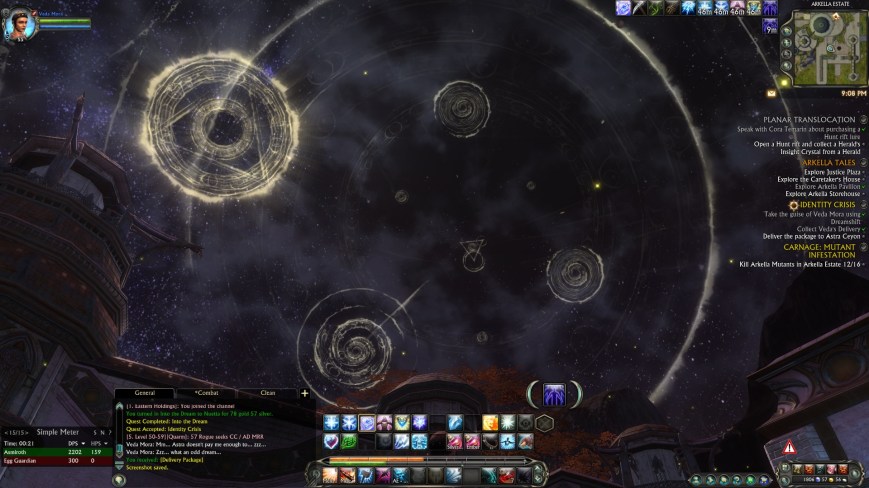
The Secret World

The subscription model did not harm SW:TOR, SW:TOR seriously, if not fatally, wounded the subscription model.

-NosyGamer

I, along with what seems a few thousand people, waited until The Secret World dropped its sub fee to give it a shot.  Even better news, the game is buy to play rather than free to play, so there’s no massive hindrances left and right.

I picked up the game on Friday, put in about a dozen hours and am pleasantly surprised with the quality of the game.  I know I would not have subscribed for more than a month but for a pick up and play game, pieces at a time, it’s got a fair amount to show.  I really dig the setting, maybe a bit less the enemy models and do think that skill-based games (not twitch based) are more fun than the typical themepark-level-based games.

You know how SWTOR spent millions on voice acting for all quests?  TSW spent it for the main quests and not for the side quests.  And the writing is actually decent enough so that I’m not wishing for a spacebar to skip everything.  Context is key, I actually care about the story and I’m looking forward to each unveil.

Give it a shot.  You’ll have a hard time finding more content for 15-30$ (depending on where you pick it up).  You’ll also realize that this business model (as GW2 before it and DDO to some degree) might be the wave of the future.  Funcom won’t make a cent unless it’s something you WANT to buy.

This is What Rage Looks Like

Gamasutra has an article on the failings of SWTOR and specifically on the conversion to Free to Play.

I’ve covered this topic enough to really not need to add much to the material.  I agree with Simon’s argument but not so much with the tone.  The entire argument reads as a “/ragequit” forum posting where the salient points are covered with hyperbole.

Read 3 pages of this and just remember this.  SWTOR has made no improvements to the core game, simply added gates to the features.  So many gates that it really pushes people to subscribe (but not purchase more once subscribed).  Considering that the whole argument for moving to F2P was that subscriptions were a bad financial model, it begs the question.

Still, it’s worth a chuckle.

A New Model

As everyone seems to be reporting, The Secret World is going Buy to Play (pretty much the same business model as Guild Wars 2) and Trion has let some people go.  The former is somewhat expected, though most thought Free to Play was the way to go.  The latter is a bit more complicated due to Rise of Nations and doesn’t speak directly to Rift’s future but could be a sign.

So what’s left in the subscription realm?  EvE and WoW as the two benchmarks for sandbox and themeparks.  They can afford to charge due to their size and business models.  Rift is a sort-of-straggler here in that the product is arguably better than WoW yet needs more mass to really justify the subscription.

Any game that comes out from now on in either realm needs to be as good or better than EvE/WoW in order to justify any subscription price.  As much as I think Wildstar looks cool, there is zero way it can compete in a sub-model with WoW.  The Elder Scrolls Online is doomed for failure on that model.    The problem with that model is that you can’t easily take it apart and change to another after launch (SWTOR is a prime example), it needs to be core to the design phase.

As Tobold alludes, the traditional single player games are converging to the model of buy the base game, pay for DLC.  We’re well past the days of Horse Armor but DLC is here to stay and a very valid way to extend the life of a game.  The argument of “on-disk dlc” is going to be a fun one, or rather the difference between true DLC and game unlocks (a-la Street Fighter).  I would think though, that the market itself will decide on the correct path as there appears to be nothing worse than an angry gamer.  BioWare has learned this the hard way – see Dragon Age 2, Mass Effect 3 and TOR – where I’m certain the cost to fight the bad press has been in the hundreds of millions.

So single player games are coming to be more like MMOs in both financial and play models while MMOs are dropping the idea of a subscription for a more a-la carte model in order to pick apart pieces of the pie.  The danger here is that the concept of an MMO community is gone.  The odds of a game keeping any given player’s attention for more than 3 months (as is the case with single player games) is low.  If you were going to play something for longer, you probably already are.

Makes you wonder where the in-roads are for any new game.

Free Isn’t Without Cost

I mentioned previously that I was horribad at Planetside 2.  My death to kill ratio was atrocious and I put it up to lack of skill/understanding.  Truth be told, I’ve never played a game that offered zero hand holding and simply dropped you in the middle of a death match.  I am certain that someone has botted a new account creation scheme just to farm new arrivals.  And that brings me to this post’s topic, F2P and bots.

When SWTOR went F2P and decided to have zero entry to the door, they basically said to the botters “come on in”. Without restrictions, they could potentially farm entire zones, flood the market and all sorts of economic destruction without any real repercussions.  BioWare was smart enough to realize this and essentially paralyzed the non-payers with a huge wall.  Though, if they buy but a single item, they still get a lot of access – enough to cause serious damage.

Diablo 3 is rife with botters and this is due to the low cost of entry.  You can get D3 for 20$ or less.  Gold has an absolute floor of 1.25$ per million, meaning you need to sell 25 million gold to break even on the RMAH.  I can assure you that this is no challenge as most bots can make > 1 million per hour with little effort.  So let’s say you’re a botter and you want to make money.  Buy 50 accounts.  Farm for 2 weeks (14 days), 12 hours a day.  You’ve made 7000$.  I could go on about this particular point, but suffice to say that the RMAH is the cause of massive inflation in D3 and an overall failure from a gaming perspective.  From a business perspective, Blizz makes a cut on every gold sold… so you know.

Planetside 2 has zero barriers to entry and zero barriers to play.  Every purchase is a convenience purchase (to level faster) and there’s no actual trade in-game, so the economy can’t break.  What does happen however is that players can cheat the system with hacking tools: aimbots, speed boosters, etc…  SOE can ban the players but the players can just as easily come back for the same experience.  Blocking IPs doesn’t work, proxies fix that.  Blocking hacking techniques doesn’t work either, they just build better tools.  SOE has a massive problem here, where the concept of “equal footing” is a key marker for the value of the game.  If a player doesn’t feel they have a fair chance at winning, why play?  With no barrier to access, anyone can hack their way to the top.  Even if they get banned, they can do it again with no cost but time.

F2P with no barrier is a risk.  An open-world persistent PvP game with next to no penalty for cheating is a disaster waiting to happen.

Let’s Pretend

We’re a week away, so let’s recap!

Let’s say you’re a really big developer with  solid fan base.  Let’s say you partner with a massive publisher.  Let’s say you have been using the largest IP in the world and have had tremendous success with it.  Let’s say you get tapped to make an MMO with that.  What do you do to try and find success?  Repeat it of course!

Repeat what worked in the single player game and throw in more players.  Repeat what the largest MMO has as well.  Don’t innovate, don’t provide any “out of box” thinking, just use what you know works.  Oh, and throw more money at it than some countries have GDP.  Hype it to heck and back.  Get massive pre-orders 6 months before launch.  Sell nearly 3 million copies.

Don’t forget to ignore beta feedback or all feedback for that matter than you don’t agree with.   Oh, don’t let players copy players to the test server either, and wipe after every patch so no one can test in live either.  Watch as that untested material, of which you had no experience developing previously nor had valuable feedback, turn away the playerbase in droves.  Watch after less than 6 months you have to consolidate over 90% of your assets due to player loss.  Blame the payment model.

Try a new payment model!  But wait, don’t forget you don’t have experience in that either and you need to generate cash to stay afloat, somewhere near the 500K subscription mark no less (which in F2P terms means having 5 million players at a generous 10:1 ratio).  Now, gouge players and penalize them so much that actually buying the content isn’t attractive at all and that a subscription is the only way to play the game you designed.  So, force the players to use the payment model you know doesn’t work.

Now, sit back and watch.  Wonder how the largest IP in the world, the largest publisher in the world, one of the largest developers in the world with the largest budget the genre has ever seen was able to fail in such a spectacular fashion.

I am so utterly baffled by this past year that I can’t even be disappointed.

Balance for the Sake of Balance

Wildstar is on my map for future MMO.  It seems more focused on the action/adventure portion than the “mash 1-2-3” of current games.  I also like the art style, and if you’re going to spend dozens of hours staring at a screen, might as well like what you see too.

There’s only a bit of stuff on the site so far but one of the more interesting links is on balance.  Sure, you get the typical crud about trying to and actually achieving balance but some of the more interesting comments are:

Gazimoff: Glass cannons that are all glass and no cannon. If I’m playing a spellcaster, give me a Yamoto Cannon, not a Pea Shooter.
sirchatters: When the developers give up unique classes and just make everything fair/even. I prefer a few paths be bad than all the same.
qn2Quid: I get annoyed when special abilities are removed to create class balance, classes should be different and feel unique
jleithart: When I don’t understand why things are nerfed. patch notes should give an explanation for the reason I’m nerfed.
jkkennedytv: many players confuse 1v1 for game balance. Biggest frustration is for devs having to filter misinformation.
Gazimoff: Also: Buff Spellslingers.

This is why prefer Rift’s class balance efforts to WoW’s.  Rift knows that some builds are simply horribad and some are great.  It doesn’t focus on the details of the builds but more on the feeling of the builds.  WoW has all specs having to be withing 5% of each other, which is simply impossible to do when trying to balance raids, dungeons, single player, duels, arena and battlegrounds.  A mage should be a glass cannon.  Most games today make them a ranged tank.  Games either need to accept that balance isn’t possible at a high level or build their systems to ignore the need for balance (lower difficulty).

Wildstar is doing a few things right.

  1. The focus is on PvE first and PvP will fall in later.  Focus.
  2. Balance on fun skill vs number skills. This is a major problem I have with ToR.
  3. Due to the telegraphing mechanics of the game, CC really ins’t a factor.  AE attacks put markers on the ground, dodge them.  Active combat!
  4. Skills work on everyone.  In most games, (TOR especially) a bunch of skills don’t work on bosses for balance reasons.  They will work with diminishing returns but they will work from the start.

Planetside is Not For Me

All this talk about Planetside 2 made me want to give it a shot.  As most have reported, the second to log into the game, you’re going to die.  You’re not going to understand any single mechanic (like the inability to get more ammo without another player), what the hell any of the icons mean, why enemies look the same as regular players, and how it is you’re exactly dying.  Emptying an entire clip into someone’s head and them not dying while you die in a single shot is annoying.  Snipers that can’t hit the broad side of a barn, annoying.  1 grenade for all your lives, unless you buy another, annoying.

There are so many core mechanics that baffle a non-hardcore FPS player, it’s surprising.  I’m sure I ended up with a 100: 1 death to kill ratio.

None of this says it’s bad, so much as clearly the game is designed for a particular niche and makes no compromises.  I gave it a shot, some people are going to love it, and those some people aren’t me.

When A Climax Is Not

It took about 16 hours to finish Dishonored on a “low chaos” setting. If I recall, I only ever had to kill 1 enemy for a sub-quest and a bunch of spitting plants. Every single boss, including the last, has a non-lethal solution. Let’s get to that.

It’s no mass secret that Dishonored is about being betrayed. How often that happens is perhaps a secret but a poorly kept one after 10 minutes of play. You know the outline just not the details. And the details are good.

The final mission, or set really, test your ability to get around without being seen. Where the first missions had you jumping from roofs to avoid people, the last few have you running in the open with massive robots and teleporting ninjas all around. The second last zone is quite taxing.

The final zone has 4 enemies to avoid before the boss. Took a few tries but I got through.

When you reach the boss, you aren’t yet acknowledged so the door is open if you will. I shot sleeping darts, moved on up and opened a door to end the game.

I can tell you that after having subdued the first boss at the start of the game, pulled him across what seemed like 5 miles of corridor and branded his face, this last fight was perplexing.

But then I looked at it from a lore/story perspective, and lacking the want to spoil it, the ending made perfect sense.