Frostpunk

I picked up this game a while ago based on Syncaine’s recommendation / praise.  I played about 2 hours, couldn’t make heads or tails of the systems, and moved to something else.  I knew that it was a mash of crisis simulator / city builder, and what better time to play that than now!?

Premise is simple – its the 1800’s, the world is frozen over, and you’re leading a small group on rebuilding a single city.  Steampunk + extreme cold = wordplay.  The actual gameplay is a spreadsheet manager, where your pivot table keeps messing up.  But it looks pretty.

Where normal city builders have you starting small, and the only real chance at failure is a lack of funds, Frostpunk has you in a continual downward spiral of not having enough resources.   While doing A, B suffers and vice versa.  You end up doing a bit of A, moving to B before it gets critical, then back to A before that gets critical.  When you think you have a handle on it, the game throws in something to mix it up.  Either it gets so cold no one can work, a bunch of injured people show up, the population demands resources, or a long list of other items.

Resources are managed through an underlying source of heat.  The generator in the middle of the map provides heat for those nearby, and humans can’t work if it’s too cold.  There are many ways to improve this – either more heaters, hubs, insulation, overdrives.  They all consume coal, which you need to harvest.  Building / research material is a combination of wood and steel, also things to harvest.  Food you need to hunt (and a TON of it), then cook it.  You need people to do all of this, and you rarely have enough of them.

One add-on here is automatons. These robots can replace humans gathers, work 24/7, and don’t need heat.  Making them requires a core, which is a very rare resource.  If you get enough of them, and the right buildings, you can basically huddle down the humans permanently.

These things are painful, yes, but they are not game breaking.  If 90% of your population died, that wouldn’t be game over.  Instead there are two larger metrics – Hope and Discontent.  The former is how people feel about their chances of success, and there are a ton of variable to make it move.  Discontent is how upset people are with the current state – too cold, not enough food, bad laws, criminals and the like.  If Hope reaches 0 or Discontent reaches max, you lose.

Every in-game 18 hours, you can pass a new law.  Either these are Adaptation laws (thin the food, make children work, bury the dead) which have very long term consequences, or they are Faith / Order laws which primarily govern Hope / Discontent.  This part gets neat, and quickly.  You may think you are a good leader, and would try to help everyone.  But when you don’t have enoguh food for half the population and a group of 30 show up at your door… do you have everyone starve to death?  Do you make people work a 24 hour shift so that there’s heat for everyone through the night?  Do you triage the sick, so that only those with a strong chance survive and the rest pass?

Or maybe discontent is so high that you need to pass laws on protestors, and publicly execute someone.  Maybe you become a prophet for the city and simply avoid discontent altogether, as anyone who doesn’t follow you is exiled.  Are there bad choices when it comes to survival?

So that’s the real goal of the game – letting you try your hand at managing a non-stop crisis.
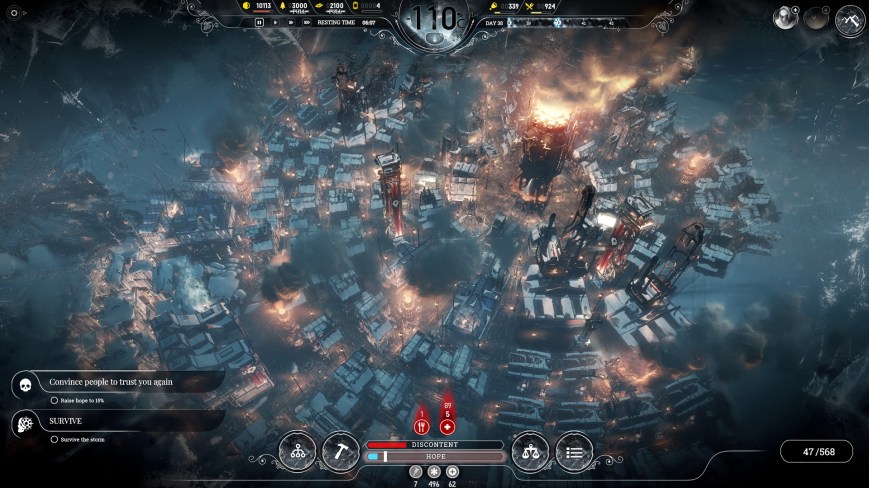
ss_28db92509d505c855b07d480d749119fc147c84c.1920x1080

The gameplay itself is generally solid.  The graphics represent the activities going on, people picking up wood, or heading out to hunt.  You get heat and religion overlays.  You get to see where people are working.  You’re presented with generally enough data to show what’s going on at any given point.  What you don’t see are the things that are about to happen.  If you’re in the day, maybe that part of the city is warm enough, but at night it will freeze the bones of someone.  Maybe half the people in a building are sick, dropping productivity.  And when people get sick, that has a cascade effect on others… production slows, other people get sick, and then woosh.

The game does a decent job at explaining what a Law will do, in the immediate sense, but doesn’t really go into the long term effects.  Child daycare may seem a great idea, but then you realize they eat all your food, live in the least insulated buildings, and don’t produce anything – ever.  Like a near permanent hole in the dam.

The game also doesn’t do a very good job explaining what the buildings do, or how it impacts the long term city viability.  Hunting huts never require heat, but you’d never know until you turned heat off for them.  Cooking huts require TONS of heat.  Mines can be rotated before building to make them much more accessible.  Roads… holy crap it took me forever to realize how to build them.  What’s the difference between a Coal Mine and a Coal Thumper?  Is a Wall Drill better than a Sawmill?  How does exploration work?

It is hard to articulate how important these items matter.  If you’re going into this cold (heh), you can’t make educated decisions.  You will fail, multiple times.  The initial 3 days have cascading effects for the rest of the game.  Passing laws before you need them has by far the largest of all consequences.  Ignoring research + related buildings focuses your resources on much better things.  Building “permanent” hot zones for residents, and working “hot zones” for gathers has a major impact on coal management.

From a gameplay perspective, it is incredibly frustrating not to have that balance ahead of time, or the information at hand.  From a simulation perspective, it makes total sense.  People managing a crisis rarely have all the facts at hand.  You can only prepare so much for a crisis, and once it hits, you realize how everything is so interconnected.   You’re going to have protestors who are thinking about themselves rather than the city.  You’re going to see really hard decisions made, based on the goals of the person making those decisions.

My first successful playthrough (I failed a half dozen times before) had over 600 citizens, 1 death, laws focused on hope (extended shifts, child shelters, amputation, soup), and a faith-based hope system, without New Faith (where hope is replaced with devotion).  I won’t lie, the mechanics and planning required to get to this point where substantial.  At the end of the scenario (~12 hours), you get a video of your city building over time.  When it was over, I felt relief and some measure of pride.  I did it, the way I wanted to.

Coping with Chaos

Blapril is around, and I was totally in the dark, for reason explained later.  What was initially seen as a long weekend has moved into purgatory.  First world problems abound here, where mental stress is taking a toll.  (I say this, because there are people arguing to get haircuts… which is just, wow.)  The good news of living in Canada is that there is a heck of a lot of financial support for those who are struggling – far from perfect, but it’s there.

Dealing with this is a personal thing and depends a whole lot on your social context.  I come from a lower-middle class background, where money was tight.  I’ve had to make interesting decisions on food vs having a roof.  From that, I don’t put a lot of value in material things (acquiring them), and tend to maintain the heck out of them and try to repair rather than replace.  I brown-bag my lunch, make my own coffee, that sort of stuff.  The majority of my expenses relate to social settings – like having a beer after a hockey game.  My household budget is a tight spreadsheet.  Organized without being anal about it.

My day-job is a non-stop sequence of meetings, often conflicting.  I wake up in the morning, review my calendar, mentally prep for each, then just cascade through them.  It’s highly structured, and I have more work than time.  If you’ve read the 7 habits of highly effective people, that would describe my ability to get through a day.  I’ve further taught myself to speed read, and all this online gaming and blogging has a neat benefit of a crazy high words-per-minute typing ability. Within those work hours, I’m a highly regimented and effective person.

Outside of work, there’s the eternal list of to-dos.  For the winter, it’s hockey (2 kids + me) about 10 times a week – which is close to 25 hours if you include travel/prep.  There’s other kids activities, social events, prepping food, chores, projects, and piles upon piles of things.  When you’re in it, it seems normal.  Looking back, the reality is that there was perhaps 2 nights a week where things were open – and we worked to fill them.  Having an entire day off, that was like a vacation!

Today, work is pretty much the same, except my commute time is measured in seconds instead of minutes.  I need to switch from work to home mode, multiple times.  Up until this last weekend, it was close to 7 days a week of work.  Trying to help kids with their own work is crazy, and my wife is doing an amazing job at that (on top of her work as a teacher).  Time outside of work is harder to juggle, since I’ve now got no extra activities, and limited options for the social stuff.  I’ve had to include a new workout regime to compensate for the lack of sports (that’s working out rather well, if I havent’ had a 12 hour work day).  We take more time to prep meals, often eating much later.  Time just seems to be flying.  Most nights past 9, I’m on some game trying to ramp the brain down from the day’s events.

My mental stress is not due to finances.  There are no health issues.  Food is still relatively easy to access.  It’s not due to boredom.  It’s not cause my wife cuts my hair (which is pretty sweet, and my mustache is kick butt). It’s due to having an even busier schedule than before, and a lack of previous social outlets.  It’s managing other people’s stress in the house, and helping them cope.  The super mega great news on that front is that I love my wife and kids, and being locked up with them is cool.  Getting to spend more time with them is a damn perk.

There are days that are tougher than others.  Where work just drains me completely.  I let the wife and kids know (they aren’t mind readers, at least I hope not), and they 100% respect that and let me recharge.  I get back into it.  I’m conscious that my situation is likely the best of nearly all possible variables.  I’d sure as heck like to get out of this house and have a pint on a patio, but all things considered, I’m in a really good spot.


Tales from the Loop

You may have seen Simon Stålenhag‘s art in the past.  It’s post-modern, where technology is disused and strewn about, but technology we don’t yet have access to.  I think it looks really neat.  The artist has a foundational world he builds from, where a company called the Loop has driven most of this.

Amazon picked on the idea and built a series from it.

mv5bnmexmjg1nzgtzmfmms00ztezlwjjodktmmi0ztjmyje4zwrjxkeyxkfqcgdeqxvymdm2ndm2mq4040._v1_

What follows next will include some spoilers, and as with most sci-fi, it’s a good idea to avoid it.  tldr; it’s closer to golden age sci-fi, with a slow burn, self-reflection, and not a whole lot of answers.

*spoilers ahoy*

The first episode wastes little time in taking advantage of the sci-fi setting.  Mysterious object + little girl = cool adventure.  If you’re following along, then you see the twist before it happens, but it still resonates.  The framing of this episode keeps in that “weird things are normal” for the rest of the series, and gives a Loretta the anchor position.

Second episode tracks an old trope of body switching and goes to the logical conclusion.  Which is distressing, quite frankly.  More like Black Mirror than what people are used to.  It leaves some giant unanswered questions.

The third one takes a familiar short story trope and teens into it.  But not teens in the stereotypical sense, more so in the sense of lack of experience.  Everyone can identify with this story, as we all go through our own growth, and how it seems completely isolated from the rest of the world.

Fourth explores our ability to cope with death at different states of our life.  I rewatched this episode, because it felt like too much to absorb in one sitting.  The premise of a bound lifespan and knowing this, is a freaky concept.

Fifth loses steam compared to the others, as it relates to episode two and the lengths a grieving father/husband will go to protect his family.  This is a hard concept to pull off, since many people can’t empathize quickly enough with the situation, and the actions taken rely more on sci-fi knowledge than human instinct.  Since the setup is weak, the follow-through doesn’t hit.

Yeah, I didn’t like this one either.  The idea is really cool, what if you travel to a parallel dimension and meet yourself.  Would you get along at all?  Where did the dimensions split to make another you?  Could you fit in?  All great questions, but the writing and acting here isn’t very good.

Every series needs a flashback episode to contextualize a given character, and this is the one that does it for one-armed George.  The story tried to hit a few too many beats at the start, making for a muddy middle.  The final act opens up a whole different set of questions for the world.

The final episode tries to close up as many of the questions as possible.  Where every other episode is more of an anthology, it’s not possible to watch this one without having watched all the other ones.  As a parent, this one hit me like a damn truck.  The series went full circle, going back to its tenet that time is a curse.  I reminded me a lot of the intro for Up, where in a seemingly simple montage, an entire life story is told, and you get to feel every bit of it.  The thing that really hits, is that no one questions why or tries to correct it, they just accept the fate and try to make the best of it.

Which is a general character theme throughout.  When people try to fix a problem, they generally make it worse.  Those that accept that life has given them a bad hand and move forward all seem to get better.  It’s not a world of regrets, it’s a world of growth.  Even if that growth is not what people wanted or planned.


Tales from the Loop is a solid series.  It’s not for everyone because it doesn’t fit the mold of sci-fi in 2020, with Michael Bay blowing everything up.  It’s a story about people, dealing with people, and making the best of a bad hand.  Optimistic in the tragedy.  I could use more of that.

FF12 – Post Game

I guess it’s a Final Fantasy tradition that there are post game activities to complete.  Well, not in the sense that you complete them after the last boss, but more in that the last boss is considered easy mode to the post game stuff.

The Hunting system (it’s much more than a mini-game), adds challenges at every level from the first real battle on well past the final boss.  At nearly every occasion, if you can take down a hunt when its offered to you, that means the “regular story” combat is going to be very easy.

FF12’s final boss is targeted for the mid 50s.  You can do it earlier with a bit more planning (and items), or you can do it later and destroy the bugger in a few hits.  Levels make a very big difference in FF12, damage scales tremendously well.  In truth, I think this is FF’s easiest final boss.  You’re just dealing with damage, which is easy enough to mitigate.  Status effects… those are the things of nightmares.

FF12 adds status effects to increase difficulty.  The optional bosses all make liberal use of these to make life painful.  In order of most painful to least:

  • KO/Death
  • Inverse (swap HP with MP)
  • Disease (can’t heal)
  • Reverse (damage heals, and heals damage)
  • Reflect (enemies cast on you to heal themselves)
  • Stop (can’t move)
  • Confuse (hit others, likely killing them)
  • Sleep (wake up on damage, but healers dont normally get damaged)
  •  Silence (can’t heal)
  • Drain (removes all MP)
  •  Sap/Poison/Stone/Doom/Blind

FF staple the Marlboro has a habit of casting many of these in a single attack – as a regular enemy.  Thankfully they have low HP and with a (buffed) Remedy you can clear most of it in a single turn.  Bosses… that’s different.  Let’s start with Zodiark, the “final” esper.

Zodiark

Just getting to him in the Henne Mines means you’re in the mid 60s, as it’s the highest level zone in the game.  Zodiark uses Darkja, which deals a ton of dark damage (can 1 shot) and has a good chance to instant KO.  Losing all 3 team members in a shot should be expected.  If the entire team has dark absorbing gear, then he casts Darkja twice as often.  He also comes buffed with Reflect/Haste/Shell/Protect, which if you dispel he casts a damage immunity spell.  He avoids evasion (ignoring shields).  He casts AE (Scathe) at multiple targets for very high damage.  Gravija to drop team HP to 25%.

He’s a high group damage boss, with the ability to randomly KO the entire team.

Shadowseer

The penultimate hunt requires you to clear the bottom of Pharos.  Clearing that out is an exercise in frustration, as there are multiple enemies that can cast different status effects.  And it’s more than probable that even at max level, you’re going to have a squad wiped out if they can be inflicted by Stop/Disease/Silence.  That’s a good prep for the actual boss.

The actual boss takes all of that and dials it up to 11.  He summons previous 4 previous marks, all leveled up for the fight.  He himself goes immune to everything for 2 minutes.  And he’ll keep wailing on you (combos up to 11!) during the fight.

He has high damage group attacks, he dispels, he slows you, he prevents you from moving, he inflicts disease, he removes all your mana, and he casts invert.  The math on those last 2 are the worst.  He’ll remove all the mana from your entire squad, then invert 1 character’s HP/MP.  So you end up with 2 people with no mana, and one with no hit points – and primed to die due to a fart in the wind.  Doesn’t matter what level you are – you are going to die.

Hell Wyrm

A hidden boss that you need to clear for getting the Yiazmat hunt.  He’s the first boss you fight with multiple HP bars, since he has nearly 9m HP.  Shadowseer by comparison has 300k.

He’s more of a battle of attrition due to pure damage output and liberal use of Stop. Near the end, he uses Invert and the -ga spell series to do a really good job of wiping out your HP.  If your “tank” dies, there are pretty good odds that everyone else is going to die in 1-2 melee hits.

Yiazmat / Omega Mark XII

In the original release, due to damage cap (9,999) it took about 4 hours to kill Yiazmat due to his insane HP pool, and his random KO attack.  Omega Mark XII is just pure damage – killing a maxed out level 99 character in 2 hits.

The former requires significant planning in the damage dealing departments (TZA has no damage cap thankfully, so it’s only about 2 hours now), ideally  high combo character with a darkblade (his weakness), haste, and beserk.

The latter requires a sacrificial lamb + healer + someone who can chain cast Wither – a hard to find ability that reduces enemy attack power.  You need to get those attacks to under 1,000 damage total to have a chance to get through it.

Trial Mode

FF12 comes with a trial mode, where you’re in a gauntlet of battles against tougher foes, saving every 10 levels.  Stages 51-60 are in line with the regular game difficulty.  61-80 are tough hunts.  81-90 is the difficulty of Hell Wyrm.  91-100 includes (with no pauses between):

  • Magic Pot
  • Shadowseer
  • lvl99 Red Chochobo
  • Gilgamesh
  • Ultima
  • Abysteel
  • Zodiark
  • Yiazmat
  • Omega Mark XII
  • 5 level 99 judges (this is pretty much the equivalent of the Moroes fight of Karazan in WoW/TBC, where you need to take out a crazy group of enemies with deadly AI)

That was long

I didn’t expect this to be such a long post. It does go to show that FF12 put in some big efforts to have content outside the main story line to challenge players.  Without the Gambit system, each of these battles would have been insanely tedious start/stop to get the right actions going.  The game does a really kick butt job of throwing the kitchen sink at you AND giving you the tools to deal with it.  This game scratched a heck of an itch.


FF12 – Closing In

FF6 pushed a lot of exposition in their cutscenes.  With no voice overs, you were reading text and listening to MIDI tracks.  Still, if you’ve played that game, guaranteed you remember the Opera scene.  I’m of the strong opinion that SquareEnix (SE) has been chasing that specific moment since then.  The plates falling in Midgar in FF7.  The Black Mages falling from the sky in FF9.  The water scene with Tidus & Yuna in FF10.  They are not moments of story expedition – because there’s no text or words.

I’m nearing the end of FF12 and realizing that the nature of the game doesn’t really allow for this, outside of the overall bookmarks (intro and outro).  There are plenty of in-game engine scenes, trying to follow Ashe’s quest to follow a ghost prince (man, that sounds so FF when written out).  There are cinematic cutscenes, which generally provide an area context shot (like a really big skyship), since those models didn’t exist in the game engine. But to say there’s a defining moment, I can’t really say I’ve found one.

That’s not say there aren’t impressive moments in the game, cause there certainly are.  The skyship that blows up is neat.  The scenes before the last dungeon are wild.  The vignettes for the first time you entre each zone are solid.  Even the tougher hunts have some cool backstory (Gilgamesh is great).  I guess I’ve come to realize that FF12’s defining mark is that there are smaller peaks and troughs.

FFX was a 5 minute custscene, then 30 minutes of RNG battles, then a boss, then repeat.  It was like watching a movie, then grinding for a boss fight.  FF12 changed that because enemies were on-screen.  It wasn’t an exercise in frustration getting from A to B.  And by putting in the AI portion (gambits), it made the “regular” battles that occur seem like minor speed bumps.

And the bosses in FFX were gimmicky, which made sense given it was turn based combat.  If you had infinite time to think, then yeah, make good choices.  The Yunalesca battle is a damn good example. With a more active battle system, you have much less time to think, and the fights become more about being prepared at the start, then reacting accordingly in the fight.  Did SE get this right?  Hell no.  The initial release had a very early “exploit” that worked for 90% of the game.  Put on a specific belt, throw a specific item, and nearly every boss got neutered with every status ailment possible.  It also made skills available really early in the game, making you effectively gods by the 1/2 way mark. The TZA release made that belt unavailable for most of the game, that item require skill investment to use, and split up all skills across classes and the game.  Very well balanced, and the combat requires a whole lot more thinking.

The last bit here is the horizontal gameplay.  Most FF games keep their sidequests for the end, with the exception of a mini-game that’s introduced at the start (e.g. blitzball, tetra master).  The mini-game here is a set of hunts for difficult targets.  These targets require specific scenarios to even get them to spawn, then a good build & gear, and finally some quick thinking to get through the fight.  You usually end up with some decent gear by the end, a new subzone to explore, or a new summon.  It is an amazing system, providing a great challenge/reward system throughout, and reason to go back and explore zones.  The Bazaar is a weird system where you sell specific items to get access to other gear.  Hell, even figuring out how to find something like Gemsteel is a major pain. This one I really don’t like since you need a wiki to really use it properly, because you can’t tell what items give what rewards.  FF13 used a similar system, but it was more transparent about it. (More props to FF13 for the stagger system.)

I’m at the last dungeon now and this game is playing better than my memory recalls. The game manages to be continually engaging, both from a system and story perspective.  Rare that time is kind to a game that’s nearly 15 years old.

Jurassic Park Was Prescient

The first Jurassic Park had a really cool hook.  It was a new idea, what with opening a park with giant monsters that would love nothing more than to eat things a 1/10th their size.  What could go wrong?  Turns out, people.  Chaos ensues, the dream dies.

Then the sequel jolts that idea back.  And the plot point for each successive entry is “it won’t happen again THIS TIME“, which of course it does.  Watching those films, you’d have to wonder why anyone would even remotely think it was viable to run a park like this.  What would drive people to invest money on what is near certainly going to be a death machine?

Turns out I was wrong.  The prospect of money is more important than being alive.  Turns out people need haircuts more than they need their aunt to live.

Man am I happy to be Canadian.  Too cold for dinosaurs.

Living With Less

Canada isn’t perfect, but it’s certainly showing some nice colors during this mess.  For a long while we even had cooperation between the opposing political parties, pushing to get things through.  Then, as politicians are naturally invested in taking credit and shifting blame, one in particular started taking a combative approach.  It’s interesting since that party at the national level was getting good cred for making politics work, so this is a weird turn.  Even in Ontario, our premier seems to have learned that lesson.  Despised to an insane level, COVID appears to have broken his shell and make him actually appear human.

The problems for each are similar, and they’ve all had to take really hard decisions these past weeks.  There’s no perfect answer, and a lot of people are negatively impacted.  There are a couple good programs at the federal level – CERB gives $500 a week to individuals, and CEBA gives businesses loans and covers salary payments.

(The US in comparison is giving $1200 total to individuals, and their business bail-out… well if people actually understood it, that’s what they’d be protesting.)

I don’t want to sugar coat all the bad stuff up here.  The nursing homes are really badly hit.  The oil industry has pretty much been hit it’s death blow.  Many businesses based on physical presence (tourism for many) are never going to be able to make up lost time.  A lot of people who invested for their retirement…they’ve seen a lot of it go away.

But in all there is some silver lining.  Through hardships, people reconsider their priorities.  A lot of folks are in their house 24/7 with people they barely saw prior.  The “need” to work crazy hours is being critiqued.  Discovering the joys of home cooking rather than eating out every day.  Talking to your wife and kids and realizing how cool they are.  Being able to survive, even thrive, without all the daily incidentals we were growing used to.

COVID isn’t gone, it’s that social distancing is dramatically reducing the number of people catching it.  Getting back to “normal” is something that will take a very long time so as not to cause additional flare ups.  Mass gatherings of people are going to be highly scrutinized – sporting events, cruise ships, buffets, things of that sort.  The question really becomes – are people going to miss those things enough to want to go through the hassle of attending them?  Some for sure, yet dollars to donuts that this crisis is going to have much larger social implications.

And hopefully everyone comes out of this with a new found respect for health care workers and our teachers.  There are plenty of other folks that help make society run, but these two rarely get any recognition.

Fundamental Physics

Right, so this one has nothing to do with gaming or social stuff.  It’s pure science. Two step background.

Stephen Wolfram is hopefully a familiar name since he’s the brains behind Wolfram Alpha.  Google gets you clicks.  Alpha gets you answers.  He also developed a natural programming language (Wolfram Language) which is not what most programmers are accustomed.  He’s also a trained physicist, with a focus on theory.

Next, physics has two main branches – relativistic and quantum.  The first works well for things we can see with our eyes, the latter with things we can’t see.  We know they are related, but we’re not able to say how.  There’s been work for many years on a unified theory.  It’s been the holy grail if you will, and so far tremendously out of reach.

He recently put up a very long post on progress on reconciling physics using his own toolsets.  I am amazed at both the material and the simplified explanations provided.  Theoretical physics is a different language that only a few people understand.  The explanation provided in his writings is simple enough that someone with a high school education should be able to follow most of it.

The real kicker here is the approach.  He’s starting with a near blank page and applying a single rule to modify a starting point.  Then he repeats that single rule multiple times and checks the results.  He’s found dimensions, gravity, black holes, quantum bits through the patterns.  He hasn’t found the right rule for our 3D space, even after 1000 rules.  He also realizes that simulating our model would need run through 10^500 times.  Some of that can be compressed, some cannot.  That means that there’s still tons of work left to do, but the signs here are just mind blowing.

Does this have a practical impact on day to day life?  Right now, no.  Even if we found the answer today, it wouldn’t impact us for 20 years.  Yet that development would change the foundation of other research, and most likely change the direction of science as we know it.  Quantum Computing was a pipe dream 10 years ago.  It’s here now in the trial stages and still has a while to go, but if it works at scale… holy shit.  A unified theory could finally help us breach the media-based propulsion challenges (e.g. you need fuel and can only go so fast).  It could change communications to be instantaneous across the globe.

Still no definitive answers, but this is the closest I’ve ever seen for a unified theory.  Wowza

FF12 – Building a Tank

FF12’s license system brought a whole lot of flexibility to character creation while leveling.  The downside was that at max level, everyone had access to everything (similar to FFX), making it a mush of character development.  Zodiac Age instead limits every character to 2 jobs, creating meaningful choices.  A White Mage / Knight is great at close damage and healing, while a White Mage / Archer can pluck away from a distance.  There aren’t any bad jobs, just less optimal ones.  A high combo character is better suited to the Bushi class (ninja) since it comes with high combo weapons.

For 80% of the game, you can run pretty much any group combo you want as long as someone has access to Cure/Cura/Curaga.  10% is bosses, and with few exceptions, all are better served with a tank to take physical hits.  The last 10% are the hunts & espers, which after rank V absolutely require a tank.

FF12 has one of my favorite versions of a tank, the evasive tank (something I think Rift did best in the MMO world, though the WoW Monk is pretty close).  The concept is not so much in padding them with extra hit points as much as it’s about increasing their ability to simply avoid damage altogether.  A few hits will get through, but sparesely enoguh so that you can heal through them.

The Shikari job works best for this since it has access to the Main Gauche, a relatively low damage weapon with +34 to Evade.  There isn’t any other weapon remotely close to this.  The best shield you can buy only has +30.  There’s a +75 evasion shield through hunts later, as well as a +90 (though that comes with poison, sap, and slow).  So a clean evasive tank would max out around 83% physical evasion.

And yeah, there’s magic evasion too!  Considering that some of the largest attacks in the game are magical, this is super useful.  It maxes around 65%.  But you can only get the tank for that, and most magical attacks are group-wide.

So the tank is stat-ready.  Next is getting them spell ready.

FF12 has Lure, which is essentially a taunt spell that sticks to a character.  It also has Bubble, which doubles a characters hit points.  The duration of Lure isn’t all that long, and during the re-cast time the enemy can certainly swap targets.  So it’s not foolproof.

The evasive tank only starts being viable once you’ve unlocked all characters.  Then it shines like crazy for the rest of the game, and turns supernova against the toughest hunts.  Gilgamesh in particular.

The general idea is – get the tank ready and a 2nd character that has access to Curaga, Decoy and Bubble (see jobs from above).  The 3rd character is a high combo character with maxed damage.  You then purposefully put them into Beserk mode (they can only attack, but with higher damage) and just let the chainsaw effect go through.  This is pretty much the model every group-based RPG works under, but it’s the only FF where the tools are presented to players in such a clear fashion.

The best part of all this is that it’s entirely optional.  You can kill the last boss without ever having a tank.  It’s less optimal, but certainly feasible – my first run proved that! If you want to play the hard-mode stuff at later levels, then you need it.  That’s some good design balance.

Echo Chambers

Right, so off the edge a bit here.  The insanity of the news cycle is really getting to me.


Men in Black has one particular quote that has struck me for a long time.

A person is smart, people are dumb.

We’ve all been teenagers, and peer pressure certainly was a driver for some dumb stuff.  I figured this would stop applying once people get educated and mature. Not so much.

This behavior isn’t always bad.  Think of a comedy club.  It’s a whole lot easier to laugh if other people are laughing.  Or a concert, where you will sing along if other people are as well.   Heck, any professional sport event fits this (football in Europe is notorious for this).

The anti-vax movement is a solid example of dumb.  This really sucks because the people in the movement already have their vaccines – they are putting their kids at risk.  The large bursts of whooping cough in these groups is both preventable and infuriating.  The sort of good news out of this is that during the COVID pandemic, you don’t find too many of them making headlines.  The ones you do end up being religious nuts who end up dying.

There’s the never ending ‘pills and herbs’ groups that are sold to cure everything.  Canada has some interesting laws to prevent this model from working as compared to other countries, but it’s still impressive to see folks hawking snake oil cures.  Clearly people are desperate and looking for any option.  Hot Dog Water is the natural conclusion to this madness.

I had a born again friend try to convince me that the world was 5,000 years old and presented me ‘scientific material’ to prove his point.  Event horizons were used to explain light from stars that were far away.  At the time I was studying computer engineering in university, and first year physics was enough to debunk nearly every argument.  But I had that information, he didn’t.

The 5G conspiracy is the new one, where people are burning towers cause they think it’s the cause of COVID.   Just… wow.

The Need

There’s no way to avoid these groups from forming.  Some of them start off as jokes (Birds aren’t real) and develop a cult following.  Some start off as small ideas and then blow up to crazy levels as people make more and more outlandish justifications.  Obfuscation is a main tool to keep people hooked, where the reasoning behind the actions are so complex that people just give up and accept the answer.

Yet all these people involved have a fundamental need to know.  Maybe they have a basic question and a rat hole develops that they can’t get out of.  Maybe they have a fundamental need to belong and stay with the group that shares one fundamental thing in common and just ‘learn to accept’ the other stuff.  Maybe a life event occurs and the group that provides the most support is also the most fringe.  That need will never go away.

The Echo

Ignore social media for a minute and let’s say you’ve found like minded people.  To get more information about the movement, you need access to the mouthpiece’s information.  That occurs through local events (rallies) or through distributed media.  It’s a slow burn, with ferverous spikes when people meet.  Since those events are relatively spread out, the people are interacting with other people in other times.  Cults saw this as bad, and the worst prevent socializing with people outside the group (Scientology much?)  If you can talk to other people, you’re exposed to other ideas, and that generally means you ask more questions.  Questions are good for the person – bad for the nut movement.

Add in social media now.  It’s a 24×7 surround sound box of nutjob videos, podcasts, and streams.  Social media algorithms make recommendations that just drag you farther down the rabbit hole.  If you find a ‘5G causes COVID’ video, it’s not because you were looking for it – it’s because an IT system recommended it to you.  And if you view it, the other recommended videos will be in a similar vein.

There are plenty of reports and studies on the far-right movements that took wind in the last 5 years.  Nearly all of them fueled by smart people taking advantage of social media.  Think about it for a second.  Of the people you meet every day, the amount you consider ‘special’ should be relatively small.  But there’s enough of them out there to make people some money.  Using tools like Facebook or Twitter to focus your message on these people is much more effective that say, auto-dialers or mail outs.  And once you have their attention, it costs pennies to drive out new material to keep them coming back.

The telltale sign of this behavior is the hypocrisy of the group.  Rather than operate on a set of ethics and rules, they work on social order.  It’s an Us vs Them mentality.  The Us part can do whatever we want, and often the ‘leader’ is allowed extraordinary leeway. Megachurches around the world ask for tithes so their leaders can buy jets.   But the people outside the church are all greedy.  My leader is a king, but their leader is a dictator.  Uh huh.

The Cure

There is only ever one cure, and it’s sunshine.  People get educated.  People use researched facts.  People stand up to scrutiny.  People need to meet other people and share their ideas.

My born-again friend from earlier realized that he had lost his entire circle of friends.  The ‘church’ he was with restricted him from doing almost everything he enjoyed doing.  When his kids started asking questions as to why their family was different than others, that’s when it started to click.  He made a choice to step away from that cliff.  He still practices, just with a more open minded group.

Instead of focusing on the group, we need to focus on the people.  It’s not possible to destroy an idea with facts, the people in that group are immune to facts.  But you can focus on the person, and their needs and values.  There’s enough converted white nationalists to prove that model works.

A person needs to feel valued and that they belong.  A person is smart.