Why I’m Looking Forward to Wildstar

There’s about 3 weeks to go before the head start of Wildstar and I am certainly looking forward to that date.  I wasn’t lucky enough to get into the fall beta but I did get into the Winter one which was “feature complete” and obviously the pre-order weekends too.  I played all the classes in the tutorial, which really means squat.  I did get an Esper to the mid teens, to get an idea of mechanics but I skipped over ALL THE FLUFF.  Which was really hard, since I really like fluff.  I think I may be one of 3 people in ESO that read the books I found. This post is to describe the parts I’m really looking forward to, as well as a couple things that I’m not so souped up about.

Art style

To me, gaming is an escape from reality.  I like comics, anime, hyper-realistic art, sci-fi… stuff I can’t find in the real every day world.  Photorealism doesn’t work for me – maybe a little too uncanny valley?  ESO’s world is amazing but I really think the characters are awful.  I rather enjoy Wildstar’s depiction of everything.  There’s size variation between objects, movement is fluid, attacks are unique, targets are distinct and varied.  I can tell when I’ve changed zones or even areas.  When I’m seeing the same wolf art at level 2 as I’m seeing at level 40, it irks me.  You know how in Avatar, all the wildlife looks like it belongs?  Everything has 6 legs, body types are similar but different enough… that’s consistent design.  I think Wildstar really gets this right.

Combat

Let’s not kid ourselves, combat is the majority of content in all MMORPGs.  The days of stand and fire are gone for me.  Zerg runs to the Plane of Fear or just throwing more bodies at Sulfuron… we’ve move on.  I’ve expounded on the fact that I really, really enjoy Neverwinter’s active combat system.  You need to be moving often, near around half the time. Movement is easy too and obvious.  There’s skill balance and synergy.  The Limited Action Set (LAS) works for me too, so I don’t need to map 100 buttons and move my mouse all over the screen to find that one skill I use once a month.  I like the theory crafting for selecting skills and not having 5 that do the exact same thing (looking at you ESO).  Combat flows, each class is distinct and can fill their role without gimping themselves.  It works for me.

Horizontal Progress

Shiphand missions (solo dungeons), dungeons, housing, warplots, crafting, meta-gaming, raiding, paths, adventures (dungeons with random events), battlegrounds.  I wanted to take the time to write them all down as each is distinct and likely will attract a different audience.  I personally enjoy all of them, minus those that require 19-39 friends and take 4 hours to complete.  I am disappointed that paths are more of a side quest than a true alternative to leveling but at least it’s more stuff to do.

Crafting won’t reach the bar that FF14 has set but I do like that it’s not an afterthought and is rather complex and involved.  Also that gear “levels” are only 2 levels apart and are relevant.  In most MMOs, you get crafting level ranges, where by level 20 you can make gear that fits a level 12, 16 and 20 player.  Typically the gear is next to useless compared to world/quest drops and leveling is so fast that it takes you 30 minutes to skill up to craft for the next tier, negating the craft completely until max level.  The system works as an evolution from the basic crafting macro, which is great.

Housing, from my limited experience (a couple hours) of tinkering is a massive money sink of fun.  I really enjoyed managing my house in Rift and this aligns pretty closely to that.  That housing drops are all over and there’s a crafting profession just for this, awesome.  It makes me feel a part of the world.

Customization is also pretty nice.  You get costume slots from the get-go and it’s a lot of fun to make some sets.  Dyes are in-game too.  The current implementation (as of last weekend) has you go back to the capital to manage it, which I am hoping due to massive negative feedback gets reversed.  Seems weird to offer so much flexibility but only a single interface to manage it in.

Lore

I am a sucker for lore and I want to be a part of the world and understand what’s going on.  Wildstar’s twitter approach to quests is novel in that everyone should have enough information to complete activities but the true lore hours have a bunch of other interfaces for more data.  Datacrons, lore books, the exploration/scientist paths.  There is a lot of love/attention being put into a consistent story.  The 2 factions are really separate in ideals too, which I find is a tad more consistent than other games.  That said, I do miss the voice acting in more recent games.  Still, I have more faith that Wildstar can continue to deliver content at par quality in a ~2 month timeframe compared to the more iceberg pace of other games on the market.

The thing I’m worried about

End game stuff mostly.  There seems to be a rather large focus on raiding and warplots.  The latter one I don’t have such an issue with but raids are core focus at max level is a recipe for disaster.  I’m sorry but the days of 40 man raids died 5 years ago.  Your “average” player isn’t going to be able to put in more than 2 hours per night on average.  WoW has clearly shown that people who raid are in a drastic minority.  FF14 isn’t much different as the top quality content is 4 person dungeons.  I will gladly run some dungeons (only 4 so far at max) and adventures (there are 6) at max level.  I’d also love to run some shiphand missions (no clue how many).

Fingers crossed

3 weeks to go.  Beta has been fun, things look promising.  I’m not putting the game on a pedestal but I am hopeful for its long-term success.  Many of the core concepts of the game appeal to me and I’m hoping they appeal to enough people to make the game a long-term prospect.
This Weekend’s Gaming

While I didn’t get much in, I did get enough to quench the thirst.  Seems a cold is going around town and we were not immune to the effects.  That and a long weekend, plus finally nice weather after what seems 6 months of winter, we were outside a lot and around the city.  Fresh air!

Wildstar

This was weekend #3 of the pre-order open(?) beta for Wildstar.  It had been 2 weeks since the last and that one was pre-empted by ESO for the most part, so I’m a little rusty.  The good news is that they put in a kitchen sink patch which means beta is going well as nearly everything is tuning.  Sure they added a few more body types (which is actually kind of neat) but the biggest change for me was the UI.  It is a whole lot smoother now.  It looks a ton like some of the WoW mods I used for my UI.  Clear icons on the bottom, wide open screen on top.  I think it looks great.

Anyhoot, back into the game I played my Esper again.  Saturday was lag day, so no gaming then.  There are surprisingly very few bugs in this game.  I’ve played from 1-18 and haven’t found a single one related to content.  I’ve seen plenty of UI bugs with this patch.  Consistent ones too, but the the actual game has been super smooth.  I’ll get back to this in a minute.

I mentioned the patch applied some balance changes.  My esper does a bit less damage but now the skills are actual choices.  Previous to this, there were 2 or 3 skills that simply outshone every other one and now they are all pretty even, if situational.  I’ll use a pet tank for boss work.  I’ll use an AE attack for when I need to move and damage since my regular builder needs me to be standing still.  I like what I see.  Hopefully the next beta weekend I can hit 20 and run some dungeons.  Group content so far is open-ended.  Who knows what will happen when the live gates open though.  Side note, the server I picked randomly is apparently the French server.  Good thing I can speak it.

Elder Scrolls Online

I put in some time here too, though a bit less than Wildstar.  I hit level 27, found another dozen bugs and realized that Greenshade (the AD’s 3 zone) has a rather large memory leak issue.  Zoning into it from any dungeon has a 25% of permanently hanging or crashing my game.  It’s weird too, since it’s so consistently a problem in this zone but not any other.

As per previous posts, I am getting seriously annoyed at the inventory issues.  There are way too many glyphs that serve absolutely zero purpose.  Research of armor pieces is needed for 2 things.  First, the opportunity to slot a benefit to the item (like more armor or immunity to resists) but of the 10 or so “types” of benefits, only 3 are worth anything.  Who needs more “exploration experience”?  Second, you need to research X amount of benefits on a single piece of gear to craft set gear.  So, let’s say you need 4 types of benefits on a girdle before you can craft a “night watch” girdle.  Since sets require 3-5 pieces to gain the set bonus, you’re looking at ~12-20 different research combos needed.   Each research takes 6 hours to start and doubles from there (12-24-48, etc..)  You can do 1 at a time to start, but after level 8 (I think it was) I could do 2 at a time.  Suffice it to say, I have very little researched.  My bags are full of crap that I’m starting to wonder if it has any use at all.

Second, repair costs.  Death is ok.  In fact I like dying in games, it shows there’s a skill level required.  The rate of death in ESO is pretty solid.  The repair costs are high though.  It costs me about 1000g to get a full repair.  Quests give me ~200g per and I’m sitting on 22,000g right now.  That’s a fairly steep penalty.  I am going to be ultra curious as to what the money sink will be in this game once there are no quests left to run and the repair costs are 5000 per shot.  This is something I find good by the way.

I’ve followed J3w3l‘s advice and better slotted my skills upon quest turn in to get a larger boost to experience.  I’m down to my last skill line to pump, which is pretty neat.  I still only deal half the damage of any other non-tank and seem to take 25% less damage in return.  Not the biggest fan, let me tell you.  On the flip side, all these skill lines allow me to make some smart choices about attack patterns.  It’s getting better.  I do wish they let you  know the morph options in-game before you actually level the skill.  Ah well, wikis have all the data anyway.

Still fun, if a bit less everytime I have to use the dame /reloadui command.

Gaming Updates

I’ve only been on 2 games recently, FFX-HD and WildStar.

Final Fantasy X – HD

When this game came out in 2000, I was all over it.  I still own it on the PS2 (and X-2) but I wanted to see what Squeenix did to improve it.  The answer – quite a bit.

The sound is amazing.  A lot of it was re-recorded and the music is great.  The original had a more “midi” flavor to it, but today’s version is practically orchestral.  The voice acting is the same and on-par with a high school play in terms of quality.  I get it.  FFX was one of the first RPGs with full voice acting, and it shows.  FFXII was a drastic jump in quality on that front.  Graphics are quite impressive.  Some of the character models have been redone, or rather re-worked.  Real shadows now too.  All the textures are in HD and the detail is darn good.  It even seems like the draw distance has improved.

Combat is to me, the pinnacle of the FF series – a near perfect merger of strategies and tactics.  After having played the auto-pilot XII and the “press A” XIII, this is quite refreshing.  Make the right choice and you can avoid disaster, make the wrong one and restart the fight.  You’re always given enough time to make the choice too, which is great.  Boss fights are a ton of fun too, especially Seymor on Gagazet and Yunalesca at Zanarkand.

The game also added the international content – expert sphere grid and dark aeon fights.  The former is a more customizeable feature compared to before and the latter a massive butt whooping.  I’m at the phase where I need to enter Sin and I’m collecting for the Monster Arena.

People complained at the time that X was linear and to some degree it’s still true.  XII took a wholly different approach and XII decided to go super linear.  X provide enough lateral movement and options throughout and a very open end game to boot.  I’m guessing rose-colored glasses here but it’s enjoyable.  Reliving nostalgia for the win!

WildStar

I finally got into the beta the week before and got a few characters to level 5, just to see the starting zones and character dynamics and paths.  I liked what I saw and got the pre-order from GreenManGaming with a 20% off deal that got me the deluxe edition for the cost of basic.  I went back into the extra beta this weekend, deciding that I wanted to see housing (at level 14).

I have been planning on playing an Esper, so I used my Dominion Chua on the solider path, to try and get through the levels.  I am ~80% complete the first zone and level 15.  I didn’t read any quest text or lore (and there is TONS of lore) because I don’t want to spoil myself.  I am extremely impressed in the quality of the story and characters though, without going into more detail.

So, leveling content first.  You have zones with small town hubs.  There are maybe 4 quests in a given hub and the remainder are triggered out in the field through the satellite phone. By and large, generic quests of kill X, where X goes up by a % based on the difficulty of the kill.  Fights are against 1-4 enemies at a time and I died a few times because I didn’t pay attention to telegraphs.  I like dying.  You also get to unlock path missions at various points.  Soldiers include kill-type events, either defend a point, test a weapon, assassinate a target and so on.  I will not be playing a Soldier on live – likely a Scientist.  There are plenty of Settlers around putting up buff stations for other people.

There are group quests (I found 4 in the zone) and you need a group for it.  There are challenges that ask you to collect X, kill Y or destroy Z within a certain timeframe.  You get a bronze, silver or gold medal based on your performance and the reward is a lottery of sorts on prizes.  Each prize has separate odds of winning and the one you hedge your bets on gets a 400% increase.  I opted for housing stuff whenever possible.  These challenges re repeatable after a certain time too, which I think is great!  The zone is organic, without obvious breadcrumbs.  I am pleased.

Crafting opens at level 10 and is decently complex.  Gear is actually usable and leveling up is not just setting up a macro.  I opted for a tailor and made some decent gear that replaced all I had.  Costumes are open from level 1 too, so even though my stats went up, I could keep a consistent look across the levels.  The crafting trees are complex and decently balanced.  Color me impressed.  Oh, I tried cooking too, which is a weird beast of a mini-game.  The link goes into some detail on it but you’re essentially playing darts.  It’s a neat system, not sure how it will work at the tail end.

Housing is what I really wanted to see and what you get at 14 is the tip of the iceberg. It’s more than a house, what with the plot system.  I made a simple garden first, then decorated my house with a bed, carpet, ferns and other knick-knacks.  The tools are both simple and complex, depending on what you want from them.  I spent a solid hour in that house, trying on the different textures and features in preview mode.  I think this is where I will be spending the majority of my time/money.  It is really impressive.

Now, I get that people see Wildstar as WoW on LSD.  It is a hyper version and if you don’t like the style, stay away from the game.  It does however improved on a lot of systems WoW has.  Character customization is fluid (you can “respec” at any time), there is a mentoring system, the world is more dynamic, travel is meaningful, crafting is more complex and involved, combat has an “open tagging” affair, there is minimal phasing, combat is tactical and responsive.  There are surprisingly few bugs but some systems need some polish (the auction house in particular).  Color me impressed.  Hopefully the next beta weekend I can get to 20 and run a couple dungeons.

Granted this is the view from level 15.  The view at end game may be drastically different.  Even so, the ride to the end sure looks like a lot of fun.

Raids Are a Nightmare

Sensational title for the win!

WildStar, if you didn’t already know, is pushing for a fairly difficult raid environment.  Compared to other games that have a variable player count per raid (or only 1 size), WS is taking a slightly different step.  There will be 20 man raids and 40 man raids, completely separate from each other.  I know that the resources required to develop either size raid are equal but it seems to be a waste somewhat, and that’s what I’ll be discussing.

I played Vanilla WoW.  I did Molten Core and Blackwing Lair.  AQ & Naxx were off my list because of the first two.  I won’t argue balance on these raids, they were relatively new takes on EQ’s zerg-fest, and had their share of bugs and issues.  What was challenging was the logistics.

Today’s raiders have it easy.  You need enchants, potions, buffs and whatnot.  They are easy enough to find and the challenge is getting the gold to buy them.  Let’s say a raid session sets you back 500g, at top tier.  In Vanilla this was a bit harder.  Tubers were BOP, gear needed resistance on it, enchants were rare (diamonds anyone?), repair bots and money was scarce.  It honestly took me longer to get ready for a raid than it did to be in one.  It just was not fun to slog through prep work to raid.

Then you get into the whole herding chickens aspect.  I was a role leader, DPS.  That’s 30+ people you need to corral together on a  set target list.  The difference between top DPS and bottom was massive.  Losing a single top DPS player could break a raid.  How does 1 person make or break a raid?  We had penalties for not showing up on time, in a day when summons were rare and travel was hard.  Sign-up sheets and a bench.

It is logistically impossible to consistently raid with the same people every time.  People have things to do and you can lose 2-3 per raid – most times in the middle of a raid.  Having a bench means people are on a waiting list to have fun.  What?  Math and people do not mix.  If I need a bench for a 10 person raid, then I need 1-2 people, max.  If I need a bench for a 40 person raid, I’m looking at 5+.  That’s 5 people, heartbeats, that are on a waiting list.  Maybe they just go to another place where there is no list and then you have to backfill that slot.  Managing people like this isn’t fun for the raid leader, guild leader or the people being managed.

Now we get into fairness, specifically around loot.  Enter the DKP systems.  Enter the master looter role.  Enter tribunals.  You have 40 people.  You have 5 pieces of gear (at best).  You have 35 people who are not getting anything for the effort.  You have a ton of gear wasted if they are class specific (shaman/pally gear….) and no one to collect.  As fair as you want it to be, people will be upset for many reasons, most stupid and selfish.  But you don’t have a choice, you need those people to actually raid.

Finally we get into simple usage metrics.  Raids are vastly underused compared to the effort developers put into them.  Until WoW put in LFR, the top tier raiders, 40 man raid target audience, accounted for less than 1% of the entire population.  LFR currently sits around 60% of all players having consumed raid content and 10% at top tier.  If the most accessible raiding system can’t get higher than 10%, and this is with recycled content (LFR, 10 man, flex, 25 man, heroics), how can other games expect more?

Perhaps this 40 man raid idea is an experiment.  Maybe there are a ton of tools surrounding this structure to help move it along.  Strong class balance, LFG tools, partial lockouts, tokens, flexible sizing to cap among others come to mind.  I am waiting with fingers crossed that there’s more coming on this topic.

Content Balance

J3w3l has a post up, albeit high-brow sarcastic, about the detractors to TESO and Wildstar.

I have a bunch of thoughts on both games.  The gist of it is the value of the items within the current market.  There are only 2 AAA games that require a subscription – WoW for themeparks and EvE for PvP (though this one has alternate payments).  They own their respective fields, with a significant  market share.  Any game that releases has to justify their price point against these two games if they want a subscription.  Then they have to justify the time spent against all the other games on the market, F2P and others.  That’s simple market reality and there isn’t much to debate about.

What there is debate about is the content types and their balance.

TESO has some features to discuss.  First is the class balance and skills.  Given the open framework, there are probably hundreds of possible skill combinations possible, many of which are not viable.  Beta has shown  few of those (blade furry).  Experience from balancing talent trees, not even skills, has shown that.  You want skills to be balanced against each other, so that it becomes hard to gimp yourself.

Next you have crafting/items to balance.  TESO doesn’t hand out items liberally and has a decently complex crafting system.  You can make top end gear, if you have the right parts.  Most themeparks cannot manage this and early indications say TESO has a good hold on this.  Top level activities are veteran dungeons, exploration, open world anchors and PvP. There are no raids.  It makes for an odd end game to be honest, where the long term activities seem to focus near solely on PvP.  GW2 launched with this model and them promptly added more PvE content (to much furor) through gated fractals.  Perhaps if TESO has an analog to the Living Story, every few week have a content patch.  I honestly compare this game as a combination of GW2 content and TSW skills.  That’s a pretty solid mix.

Wildstar  is more or less WoW on steroids.  Skills are pretty static but talent builds (AMPs) provide some variety.  There isn’t as much class variety as TESO but there are more classes.  Crafting is missing details.  I hear that there are 2 crafting systems, one to pump out items, another for customizing said items.  Top level crafting is supplemented from raiding, so while you can craft top level items, it’s a bit of chicken and egg here.  A bit like Vanilla WoW raiding I guess.

What is the same as themeparks is the focus on dungeons, battlegrounds and raids, difficult ones to boot.  You could call this more of the same and I would agree.  What adds a bit of flavor is the rest of the elder game.  Housing, ship missions, war plots and adventure provide some horizontal options.  This provides three goals.  PvP, PvE gear and customization.  Balance on the first two is always hard and I really have not found a game that could address this properly.  You always end up with a PvP stat (e.g. Resolve) that puts a massive sick in the ground that says “PvP only”.  While there is a lot “of the same” from what we’ve seen before, it does appear to be iterative.  It’s almost a kitchen sink approach and time has shown that is really hard to do.  The devs are all experienced MMO folk though…

So while it would be nice to compare both games, they really don’t have a lot in common outside of high level stuff – levels, crafting and group content (PvP and PvE).  They really do seem to be aimed at different market.  That’s great for the genre.  More options is a good thing.  Fingers crossed that both can find success.

Cohesive Design

Going to deviate a bit here, or rather return to a favorite topic – design.

I read the following article on Gamasutra from Stephan Frost on how to manage development of an MMORPG.  It got the brain juices flowing.  First, background.

I work in IT as a lead systems integrator/architect.  My job is to take extremely complex systems and make sure all the pieces fit together, while meeting business, security and functional requirements.  That pretty much means, on budget, on spec and on time.  My current project has about 500,000 clients and a team of about 100 working on it.  Ok, background complete.

If you played the recent Deus Ex you (and the world) noticed that the boss fights in that game made no sense when compared to the rest of the world.  The former was all run&gun and the latter was extremely open ended.  That’s a lack of systems integration, where people use the same tools, have the same goals but get there in different fashions.  It creates a jarring feel when players go through it.

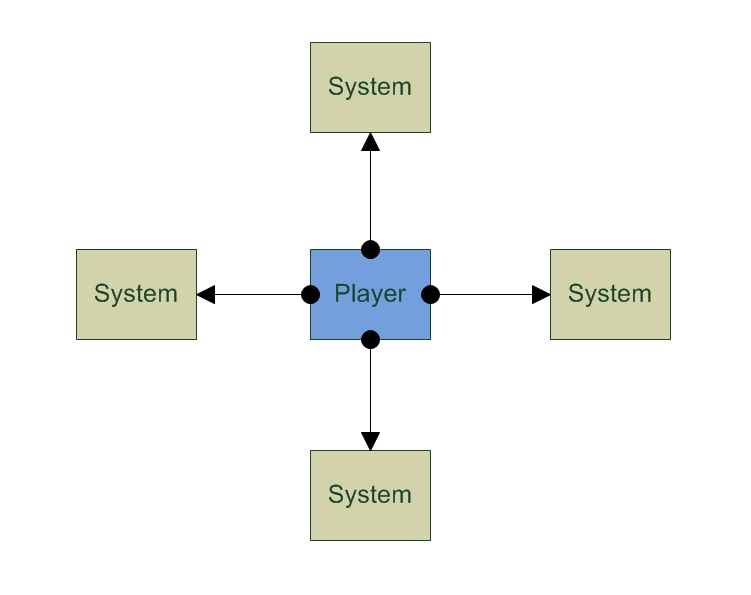
Independent Design

Independent Design

In the MMO space, there’s the leveling game and the max level game and, for the most part, these systems are also not integrated.  WoW has next to no links between the various systems – pet battles don’t mess with scenarios don’t mess with raids, etc…  It means there’s no conflicts between systems but it also makes it feel as separate games.  GW2 has an interesting approach where all content is auto-leveled.  RIFT links a few systems together, mostly around you know, rifts…

For a team of 100+ people to work together and ensure a cohesive experience for the consumer, they need solid direction.  In IT, certainly architecture, we have Concepts of Operation (ConOps) and architecture designs at the reference, technical and detailed level.  The ConOps gives a high level picture of how the client is going to consume the service and sets expectations.  You’d see raids, housing, crafting, exploration in a ConOps, including how they interlink.  A reference architecture is a ‘behind closed doors’ guide for similar systems.  Say a art style guide, so that all the assets are similar.  A technical architecture is one level deeper, explaining the various components in that system.  A raid guide would say something like, it has 24 people, this type of class diversity, this number of bosses, the expected completion time, and how it interlinks with other systems (tokens, crafting, etc…).  The detailed architecture is explicit in design.  It would be for a single raid, explain the flow of the zone, the boss abilities, themes and so on.

Think about the WotLK expansion and the raids that came from it.  Ulduar and Trial of the Crusader were extreme opposites in terms of detailed design.  Before someone started coding those zones, there had to be a plan for people to connect to and milestones to reach. Raids don’t just magically appear from some code.

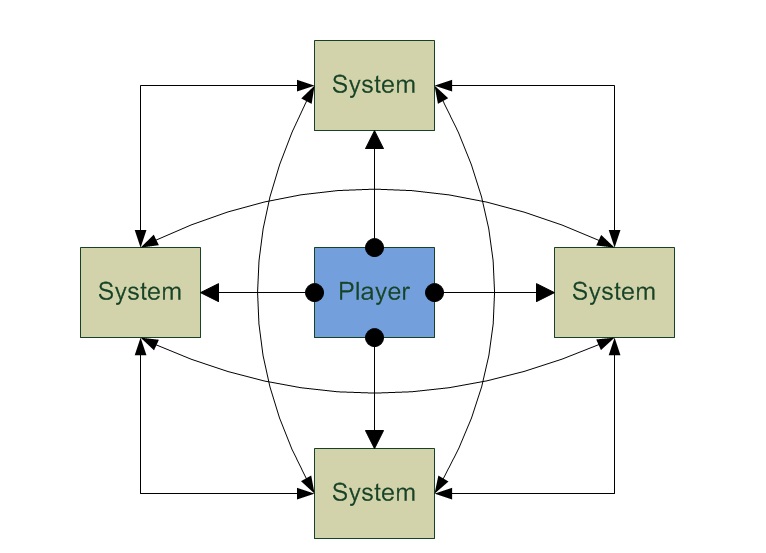
Now think about how an entire game maps out, with 20+ teams working on their various systems.  Classes, crafting, zone design, quest design, lore design, raids, housing, travel, art design.  Either they work in silos for 2 years and meet later on, in a massive clash of conflict or you plan it out right so that each one accounts for the other and there’s an open path of communication.  Jim in the housing group says to the other leads, “Hey, I think it would be great if we could see housing items acquired in other systems.  It would give prestige to players and provide an extra carrot in the other systems”.  “What a great idea! Let’s see how we can work it in.”

Integrated Design

Integrated Design

From a player perspective, it means that each system has an impact on the other and that you can make progress across the entire game, regardless of what system you prefer.  You like to craft?  Well, it’s used in housing, raiding and questing.  You like exploring?  It impacts the world by putting in trade routes and creating new spawns.  It means that when you move from one system to another, you don’t have to learn a completely new game.

I really appreciate Stephan’s post on the matter.  It provides clarity on the complexity of system design.  Hopefully more developers can provide similar insight into their work styles.


Control Schemes

I’ve been playing video games since Pong and at each iteration, there seems to be a more and more complex control scheme to get things done.  We’ve gone from turning a single know to having 100+ keys to press, sometimes 4-5 at a time.

Back in the day, sometimes the control scheme itself was the game.  Good luck getting Arkanoid/Breakout to work with a crappy mouse.  X-Wing/TIE Fighter with a joystick?  No chance.  Ever try to play street fighter on a controller without 6 attack buttons?  Once you have the controls down, then the game had a completely different light.  Sure, they were challenging as games, but just understanding how to play them was enough of a battle.

I remember the original adventure games, mostly from Sierra.  They were all text entry based, no need for a mouse at all.  Then a few standouts, LucasArts most notably, prompted the adventure game to go into the mouse business.  The game was still an adventure but try to argue that finding the right sequence of words to get things done wasn’t half the battle in the first place.  “Set sights on gun” got me killed in Police Quest for a few weeks.

The Wii / Kinect / Move phase…what a fun 5 years that was.

When we start looking at the MMORPG genre, the original games where pretty limiting.  Mouse was for movement and text was for doing things.  UO was a ton of fun typing in (or more specifically macroing) spells.  Everquest’s skill based system changed the paradigm a bit.  Now you had skill buttons to click with the mouse but the actual timing was pretty simple.  Well, maybe not bards.  WoW was next, at least as a big dog in the playground.

Now comes the age of the keyboard turner.  WASD was the default movement on games for nearly 15 years by this point.  WoW supported it, and built nearly all their mechanics around it.  By then providing challenging content that required ever increasing reflexes, keyboard movement became the next hurdle.  If you didn’t understand circle strafing (which most no one outside of FPS did), then you needed to learn a new skill.  Naxx and the Heigan Safety Dance is a perfect example of an encounter designed around control scheme and nothing else.

WoW’s skill bloat certainly didn’t help anything.  A poor default UI (the UI today is built nearly entirely on community mods) led to complex classes needing automated systems.  HealBot is a super example of a single UI element that combines multiple entries.  With a simple click you can do 4-5 things at once.  Great!  Shitty design that you actually need this mod to play the game though!

SWTOR followed in the skill bloat problem and then tried to make money off the problem with hotbars.  That was the proverbial straw that broke the camel’s back as nearly every other game that’s come out since then has a limited skill bar.  Sure, you still have 20-30 abilities to choose from but you can only ever use a small subset (~10) in any given fight.  This makes it a lot easier on the player to figure out what to do and easier to balance as well.  It makes for a smaller, more intuitive UI.

The next big change was active combat.  This stemmed from a WoW addon that put markers on your screen to avoid certain spots to not take damage.  As the game grew, more and more of these “red circles” showed up to the point where today’s games run near exclusive on that model.  NeverWinter’s combat is all about this.  There’s more active dodging than anything else.  Small amount of skills, plenty of movement, makes for a highly skilled game.

Now we start looking at the next two games coming down the road.  TESO uses a telegraph model, similar to WoW.  It also has a very limited active skill set.  Combat is relatively slow, which allows for some strategy.  Admittedly, this is extrapolated from PR footage but combat so far seems to be more around the “sort of do this” style that thoughtful, targeted motions.  Soft targeting is a large part of this.  Think of shooting a fireball in Skyrim.  The farther away you are, the less likely you are to hit a moving target.  A fireball in WoW hits 100% of the time if you have a target.  Players will have a challenge adapting to this more analog system of “sort of hit” compared to the digital one where “it hit or it didn’t”.

Wildstar uses a hardlock system, telegraph combat and a limited (though seemingly less limited than TESO) combat model.  If you’ve seen any videos it looks like WoW on crack.  There is constant movement, constant attacks and differing types of attacks within the same skill.  Press and hold for more damage, AE attacks (with 5 corresponding colors), multizone attacks (hit 1,2 or 3 times).  Think about that a second.  You need to be constantly moving, which means Mouse + WASD.  You need to be pressing buttons, aiming AE attacks and holding buttons down.  This is mouse + holding keys.

I want you to take a minute the next time you’re at a computer and hold your mouse in one hand, W+S pressed down in the other, then press and hold the 6 key while making circles with the mouse pointer.  We’re really at this point?  What kind of physical skill level is now required to play games?

I’m running out of hands.

Can I Have The Car With That Kitchen Sink?

Wildstar.  Lovely, lovely Widstar.  First – read this.  I’ll wait.


Let’s go over the list so far.

  • Great art – check
  • Levels – check
  • Integrated zones – check
  • Dynamic content – check
  • Active combat (avoid the fire!) – check
  • Talent system – check
  • Customization – check
  • PvP – check
  • Dungeons – check
  • Housing – check
  • Mentoring – check
  • Dungeon housing – check?
  • Focus on tactics, not zerging – check
  • End-state content – check

I know of no game that launched with all this working.  I know of only a few that had half this list working.  You’re lucky if you get 2 of them right these days.

There are 3 possible outcomes that I can see.  First, the most probable.  The game launches, has everything in it, works about 50% of the time.  Two, the game launches, everything is broken and it’s a massive failure.  Three, they somehow manage to pull of the most amazingly smooth launch in history and become a shining beacon of tomorrow.  I’m hoping for #3, but I’m betting on #1.

Well, there is a fourth one.  Carbine is going to pull off the most massive troll prank in the history of gaming.

Social Core

There’s an old saying that goes something like this.  If I have an apple and you have an apple and I give you my apple, you have two and I have none.  If I have an idea and you have an idea and I give you my idea, we both have two.  For a long time this basically was a separation between the tangible and not but in today’s world, I have a bank full of intangible swords and there is an infinite supply (or near enough) of digital books.  In that train of thought, what you really are exchanging are concepts or frameworks.

This translates well into games so that two people who play the exact same game, the exact same way come out with different results.  You might come out of Tomb Raider antsy from the fighting or wondering about the next step.  What you are given is not necessarily what you actually receive, or interpret to receive.

If we move back a few years in the MMO space, when the time and social requirements were much more stringent the game didn’t provide you content as much as the people consuming the content provided it.  In my UO days, you could spend hours just sitting in the guild castle, talking with friends, working on some skills, maybe bring in a dragon to fight.  In contrast, today’s game is a wham-bam thank you ma’am affair of instant everything.

We’ve been down this road before but gaming is a reflection of the times and as the average “core gamer” age (~30) increases, it is extremely evident that they have less and less time to play.  Today’s younger gamers have thousands of venues to compete for their attention – Twitter, Facebook, all the Internet, Netflix, smartphones, tablets.  When I was younger, I had to leave the house to see friends. As a quick aside, Keen mentioned recently that he’s finishing up grad school this week (congrats!).  That would make him 22-24ish.  His experience in UO would have made him around 6-8 years of age.  It’s safe to say that UO had a different impact at that age than when I was playing (16-18) – especially from a social perspective.

For example, my largest gripe with SWTOR wasn’t that the game had bad ideas, just that they were poorly implemented from a social/time perspective   You were rarely able to find the social aspect while leveling (due to having a companion, very heavy instancing, low difficulty and no tools) and it stuck out like a sore thumb at max level when you 100% needed a social framework.  The time aspect was inversely proportionate to the fun factor.  You spent more time waiting around (again, with no social) for the fun to start – or even to get to the fun.  Sadly, the necessary game updates came 6+ months after launch and 90% of the playerbase had left by that point (they went from 211 servers to 23 in 6 months, now 20).  I firmly believe that the single most important reason Rift is not yet F2P is because of the social/time aspect being a core concept of game design.

Now TESO and Wildstar are both coming in with some new concepts to a genre that was originally founded on the social aspect.  I’ve heard aspects from Wildstar as to how the social portion is going to be important, in a non-combat way, but next to nothing from TESO.  I have my fingers crossed that both can maintain that core concept, with a little tweaking, in order to make either successful in the long term.  I mean, I don’t log in to kill the big bad guy for the 30th time, I log in to talk to my friends for the 300th time.