What Does A Subscription Get Me

After yesterday’s post, this really got me thinking.  If I don’t think ESO is worth $15 because I don’t consider it an MMO, what am I willing to fork over and for what features? I think this is more of an internal discussion for each and every one of us but this is my blog, so you get to read the ramblings.

I want an MMO

This part seems obvious but lately it seems like this is a challenge for developers to grasp.  I want a massively (more than 8 people) multiplayer (that I can interact with and have dependencies) online (ok, this is obvious) game.  Diablo 3 is not massive.  Neverwinter is.  ESO is not multiplayer because the more people you play with, the worse the experience. Few games actually do this well, with sandboxes where the real benefits are found.  I want other people to matter.  I want other people to enrich my experience outside of a chatbox.  Crafting dependencies.  Guilds that matter.  Group challenges.  Customization.  Roleplaying.  Mentoring.  Tribunals.

I don’t want my experience to suck 8 levels of hell because another person is next to me.  I don’t want phasing that prevents me from just picking up and playing.  I don’t want a system where level differences mean we cannot play/see each other.  I want content to scale so that enemies don’t die in 0.2 seconds.  I don’t want camping of spawns.  I want a white-hat service for the scum of the earth.

I don’t get why this is such a massive problem.

I want an RPG

Ok, this is pretty simple.  I want a visual excel spreadsheet.  I want the numbers to make sense, complex systems between them and a feeling of overall balance.  Nearly every game gets this right.  The ones that don’t stumble from the gate and have massive retcon patches after month 1.  STO is a good example of bad RPG.  SWG and the NGE change is another example.

RPGs are always about progress.  The best games have you progress organically, where by doing something you simply get better at it.  The level grind is an extraction from the old D&D days, where the levels were mostly just a cap on a dungeon run to make the next one different and more complex.  It could take months to gain a level.  But the progress in the dungeon was a separate matter.  Challenges to overcome, dice rolls to make, choices in some item drops.  Small things added into big things.  I do miss that.

I want an active dev team

Most games have this but many are just on cruise control.  SWTOR lost my subscription quickly because of this.  RIFT kept it because they were amazing in their activity.  Neverwinter has made a fair chunk of change too.  WoW gets me for 2 months a year because of asinine dev cycles.

I get more content from Marvel Heroes or Neverwinter in a month than I get from Blizzard in a year.  This also related to bug fixes and balance patches.  I understand that a team of 50-100 people won’t catch everything when the game has 500,000 players.  That’s normal.  What I don’t get is massive bugs that affect everyone.  Balance issues that completely prevent people from playing.  And that those first got through QA and second, that they are not near immediately hotfixed or at least communicated to the player base.

I want to pay for it too

All of this isn’t free. It takes a lot of hours to make quality and I respect that.  I am not a whale by any means but my $15-20 a month MMO-budget can be spent anywhere I see fit.  I have spent the most on UO, followed by WoW, EQ and RIFT – all sub games.  I’ve spent more in Marvel Heroes and Neverwinter than in all the other subscription games I’ve ever played.  The timelime reflects that well enough.

If you provide decent quality content and provide it at a decent rate (say every 2-3 months or so) as well as provide the social framework that improves my experience, then you have my money.  If not, then you make a blog post.
 

MMO Data Analysis

This post stems from Syl’s recent rant on games giving (or trying to give) players what they want.  I feel a lot of empathy for the position.  There’s a lot to be said of EQ and the stubbornness of the design but you really have to give Verant credit at the time, what with sticking to their “vision”.  On a side note, it appears that vision isn’t enough to get Pantheon going.

I’m a data analyst by training and a project integrator by career.  That means I take a bunch of numbers and stats from a given system, analyse and interpret them, then assist in the design of a new system and then finally help the end users with transition to the new stuff.  I live in a world of numbers, patterns and statistics.

Systems, just like games, are for the most part a black box design.  You know what goes in and what comes out but the inner workings are a mystery.  From the outside, you can’t see the system interdependencies.  All you see is that if you put in X, then Y comes out.  Theorycrafters (of which I did a bit of in WoW and a lot of in SWTOR) try a ton of mathematics to reverse engineer a blackbox.  This is well under 0.01% of the game population though.  Other people may use the spreadsheet generated by the theorycrafter but next to no one mucks with the code.

As a general rule, MMO players are horrible designers.  By and large, they are sheep who follow the sparkly path.  They like the black box and that when they press a button they get some fancy graphics.  If you give a player a choice between a high risk, high reward activity and a low risk, low reward in nearly all cases they take the easy road and just repeat is ad-nausea.  It isn’t that the design for the high risk is bad, it’s that human nature is risk-averse.  We don’t go around kissing spiders after all.

A MMO designer has a ton of metrics generated from the game from all sorts of venues.  Heat maps, activity counters, percentage of completion, distance traveled and many more.  Each individual piece says something but given that MMOs are such massively complex beasts, you’re missing the context of the data.  WoW’s Firelands tier of Cataclysm raiding had less than 1% completion rate on heroic, under 10% on normal.  That would be a red flag and you’d look at raiding numbers.  Is it because the raids are too hard?  Not enough people?  Gating is too complex?  Not enough gear?  The raid isn’t rewarding enough?  Other competing activities are more engaging?  Each one of those questions has numbers but it take a pretty bright person to find the links between them.

So as a player, what can you really do about this?  Posting on official forums is often times useless as the din of the dumb is much too loud.  A decent developer instead keeps track of fan site message boards, which usually attract people with a vested interest in the game in that you can better communicate with context.  You can start a blog on the game and start some further discussion (I still rank exceptionally high for Neverwinter).  You can “vote with your wallet” but moving your expenses from a game you don’t like to a game you do.  99% of the time when you quit a game today, there’s an exit interview where you can explain the position.  I know from personal experience that those questionnaires are highly valued as it’s much easier to get an old player back than a new player in.

There’s an old adage that goes if you try to please everyone, you end up pleasing no one.  Games that lose their focus on their core end up in this bucket.  It’s rare to find a game that is drastically flawed from the start.  If you’re playing the long game then you need to start small and get bigger – please a few and convert some later.  If you’re playing a short game, then you want a flash in the pan. Of course, there’s always the split between planning and reality…

Travel is Part of the Challenge

FF-X reminded me of an older approach to challenge related to travel.  In XII and XIV, you can see every enemy on the field and avoid them.  All versions previous to that, it was a random event while travelling.  This is somewhat jarring in X, especially related to rare monster hunting.  One particular bugger only shows up every 20 fights it seems and I need 10 of it.  Random battles are certainly frustrating and being able to pick and choose your enemies is more fun approach.  Especially when it comes to ambush attacks that instantly kill your party…damn Marlboros.

I’m also playing a bit of Quest for Glory (in the 2nd one now) and combat in the wild is deadly.  I can take on one type of enemy so far, what being a weakly wizard, so I want to avoid travel in most cases.  Skipping the content here would remove the feeling of “argh, run away, run away” I get while crossing zones.

UO had visual enemies on screen that I could (should) avoid.  Destard, the dungeon of dragons, was a death pit of running around avoiding everything that moved.  Even the rune/recall system was fraught with death, especially if you bound the rune to a really bad spot.  High level recall books often had a few runs smack dab in the middle of a lich/demon cave.  That’s ignoring the entire PvP aspect of travel.  NPCs broke chase, enemy players did not.

EQ took a slightly different approach, notoriously with the massive trains (hello Butcherblock!).  Enemies had massive aggro ranges and followed you the entire zone.  SoW was the only way people survived some of these places.  I chose a necromancer specifically for the dead man floating buff, which allows me to travel the skies above the death traps.  Travel options were severely limited and death from a wrong turn (including potential corpse loss) was a bit too much for me.  If enemies broke chase after a while, I think this would have been a fine compromise.

WoW originally had a densely populated world, where travel on the roads was often deadly.  Sure, they didn’t follow you forever but if they caught up with you, bye bye.  It was very easy to chain a bunch of enemies together without trying and world PvP (STV and the Mill) created massive death zones.  BC kept this approach for leveling and then it introduced player flight…

Player flight removed any and all risk from travel in the game, similar to what I did in EQ with my necromancer.  Since you couldn’t fight enemies in the air, there was rarely any serendipitous socializing.  The world became empty with people dropping in, dropping out and avoiding interacting with the world at all.  WotLK took a similar approach and made 2 zones that were near impossible to travel without flight.  Cataclysm gave flight to everyone, everywhere and there are entire zones I never experienced.  Combined with the massive dependency on phasing, I barely grouped with anyone at all, if I could ever actually see anyone.  MoP was the final kick at the can for this model.

Timeless Isle is the best success Blizzard has had with non-raid content since launch.  Emergent gameplay cannot happen with everyone in the air, so no one flies on the island.  They have stated a few times now that the TI model is going to be used for WoD and they still haven’t committed to any flying at all during the expansion.

I think this is a great thing.

At a Glacier’s Pace

Let’s chat a bit around the fire shall we?  There’s an old saying that goes “Do not raise your children the way [your] parents raised you, they were born for a different time.”  I think that applies extremely well to gaming and even more so to MMOs.  A gaming generation lasts about 5-7 years.  The last console wave was on the tail end of this.  The general point of this is that the strategy applied at the start of an MMO needs to change over time.

In IT design there are two portions of a service that are often classified as above and below the waterline, like an iceberg.  Only a very small portion is ever seen by the user (above water) while an inordinate amount of time is put on the back end items (below water).  So whenever you see a patch/expansion, figure the amount of time it takes for you to consume it and multiply that by at least 100 to get an idea of the amount of effort it took to generate it.  So, if you get 60 hours of gametime, likely it took 6000 hours (which is a ~month for 30 people) to create it.

Suffice it to say that IT developers strive to find economies in the below water systems in order to maximize the amount of content delivered in the least amount of time.  Agile development!   The older the system, the harder this is to do.  Microsoft famously stated that the average Windows coder during the XP days, only ever put in 1 line of code per day due to historic content.  IE had the same problem up until version 9, which explains why it still fails the Acid3 test.  In order to move forward, sometimes you have to rebuild the foundation.

Today’s world is run through agile development, meaning that changes needs to be applied quickly and for lower cost.  This is done through service oriented architecture.  Think of it as Lego blocks.  If I wanted to build a boat without Legos, it would take a heck of a long time – wood, nails, etc…  If I built it with the blocks, then I could get a boat built in 10 minutes.  StoryBricks (for EQ Next) uses this model.  So does the Foundy in Neverwinter.  GW2 is able to release new “living content” at a quick pace because of their toolsets.  SWTOR seems to have an update every other month.  TESO and WildStar are both promising something similar, with a quick dev cycle to justify the subscription cost.  EvE does a decent enough job too.

The outlier for years has been WoW.  Their patch cycles aren’t the worst, a few months between but their expansion windows are simply ridiculous.  There was a time when “soon” meant quality.  It does for Starcraft.  It did for Diablo3 once Jay left (that game is barely recognizable now).  It has not often meant it for WoW.  The MoP expansion, outside of new art, introduced one new mechanic – pet battles – and that took 11 months.   Flex Raids, arguably the 2nd best thing to come out of MoP, took much less time. WoD looks like we’re going to see at least 14 months with no new content.

Now, there are a couple of possible reasons for this.  One, Blizzard is exceptionally greedy and wants to milk the user base for all their money.  I doubt this when MoP launched, it was the lowest rate of sales in their history.  The next quarterly review is expected to show another drastic drop, likely hitting the 5-6 million user level.  Second, Blizzard only runs 1 development team that changes in size based on the content being developed.  This seems highly probable as it ensures quality development and a lower bug count but not having multiple source codes running around.  Old code needs to be stable and the toolsets must be ancient.  The WoW ship is massive and even a little tweak can have massive repercussions.  There is tons of evidence that raiding is at an all-time low, somewhere near 15,000 guilds total raided in SoO outside of LFR.  Servers are being connected (merged without some of the hiccups) continuously, with only a dozen or so that are not slated.  When people are leaving en-masse for “greener pastures”, it puts the fire under the designers to keep what you have and get people back.  Pressure, in design, often leads to very bad ideas or impractical ones (such as the Path of Titans which sounded amazing).

I am not saying Blizzard is closing WoW or that it’s failing.  Just that the statistical anomaly that existed for ~5 years seems to be returning to normal.  Players have realized that there are plenty of viable options on the market.  It’s just surprising that with all the change that has happened on the market, that Blizzard hasn’t made a more concerted effort to change their design practices.


Housing For Everyone!

To little fanfare (at least from my feeds) SWTOR announced player housing.  Maybe they gave out more information while I was at sea but this is what I found today.

It looks somewhat similar to RIFT’s housing idea, what of instances of housing to choose from.  Where that game had a lot of choice in terms of domicile, this one seems to be limited to either your capital city or Nar Shadaa. So, yay?

As per everything in SWTOR, a new experience bar is also available for housing.  It increased based on the amount of decorating you do.  This is a strange mechanism, to be honest, as housing is between achiever and socializer in my books.  This “prestige” gets you more something but do they want people to decorate just to raise that bar or simply as an afterthought to decorating?  I’ve always been of the mind that people build what they want for the pleasure of building, not some mini-game.

Not a whole lot more to go on.  Namely travel (hopefully a single hop), size, customization options, cost (though $1.5M seems to be listed somewhere) and a few more things.

Other good news is that fleet ships are in, which is essentially guild housing.  That is pretty sweet, if again, they can get the transport issue resolved.  I have quite a few fond memories of guild housing in UO, what with the local amenities and shared common space.

Keeping track, we have housing in EQ2, LOTRO, RIFT, FF14 (though too expensive for most) Wildstar and now SWTOR.  WoW has an extremely simplistic version.  TESO doesn’t yet appear to have anything, though it’s been a core of the single player series.  The concept of ownership certainly does make people come back.  Hopefully this thought process, where player initiated actions provide noticeable changes to the world, can take hold in more games.

Race to the Bottom

An interesting article on TTH-Respawn about the Death of Mobile Gaming got me thinking.  Always a dangerous thing, I know.  In the continuing race to the bottom, markets get saturated, value gets inflated, the bubble bursts and then there’s a crash, followed by a renaissance.  It’s a cycle, seen a few times but usually takes a LONG time to come about.  Today’s hyper consuming market is changing that.

To point, mobile games are still relatively young.  A true Android capable platform is only 2-3 years old, iOS about 5.  The original mobile games were exploratory in terms of controls and limited screen real estate.  There was innovation, it was new and with so little competition, it was “easy” to find the gems in the pile.  And today we have (had) Flappy Bird and the literally hundreds of clones.  Now, I don’t have issue with Flappy Bird itself – it was a simple game with no aspirations. I have issue with the market around Flappy Bird.  Issues with Temple Run.  Issues with Clash of Clans.  There is so much garbage in the mobile space today that it’s next to impossible to make money and quality.  Games that were offered for free on PC through Flash now dominate the Paid App Store.  99c for a game doesn’t speak much to value.

This delves into the MMO space too, where the largest glut was a few years ago, the days of Allods Online.  Everyone took WoW, took out the stuff that made it good and sold it for cheaper.  The actual dev cycle for an MMO is measured in years, so it must have been quite the ride to see all these games fail, and fail spectacularly, while you haven’t even released yet.  I won’t go too far into the F2P debate but clearly, the line at which people associate value with product is at a completely different place today than it was even 3 years ago. Quality aside, TESO and Wildstar’s single largest hurdle is public perception of value.

Consoles… I don’t even know where to begin.  Hats off to Call of Duty, FIFA and the NFL for making so much money on the exact same recycled product year after year I guess.  The market for games is so astoundingly atrocious that I can’t name a single XBONE exclusive title that isn’t a rehash.  PS games at least had Naughty Dog.  It’s just so bad that I can’t even bother to pay attention anymore.

That leaves us with the last refuge of the damned – PCs and indies.  Every couple weeks, another game seems to pop up.  Jewel and Murf have been posting/tweeting about Banished lately.  A game that likely never would have heard of if not for the blogging circle.  And it’s not a game that’s free, or one that is so cheaply priced you don’t even think about it.  In fact, the average Steam game tends to be between $10-$15.  The perceived value for that dollar is so drastically different on PCs than other media that it makes you wonder if it’s a completely different target audience.  There’s Free and then there’s Free.

The seemingly unending cycle to pump out crap to be consumed (pushed by large and small groups) is not sustainable.  There’s no money left in mobile outside of IAP – and even there, whales dominates (something like 1.5% of the population pays > 50%).  F2P MMOs aren’t a whole lot different, depending on their model.  Expectations are at a point where the large majority is expecting everything for no cost.  How does that make sense?

In the quest for the last penny, or for all the pennies, it’s remarkable how many developers have lost sight of the true value of games.   Here’s hoping that bottom is found soon.

Old School Challenge

When I was a kid, games were tough.  There was little grey area.  Digital meant black or white – you missed the pixel or you didn’t.  The concept of “ledge grabbing” was unknown and you could die for a ton of reasons, many of which made you want to destroy your controller.  Battletoads, I’m looking at you!

SNES back on topic.  There were quite a few “twitch” games, where precise movement was required to complete a task.  Super Mario World and the star road is a prime example.  Few people saw this section of the game but having to fly for 2 minutes with a cape and avoid all sorts of stuff flying at you was a massive drain on your fingers.  Recently, I was playing Donkey Kong Country and after the first zone I was standing at 25 lives.  I was thinking “I’m set for the rest of the game!”  Then I entered the second world and in particular, the mine carts.

Now, if you’ve never played DKC, then I get why this doesn’t mean much to you.  For those of you who did, this is likely a part of your memories you pushed in a dark corner.  These mine cart zones are an exercise in “press jump”, which you would think is a simple affair.  Back to the digital comment from above, where either you have it or you don’t.  There are a ton of obstacles you need to avoid and the hitboxes for these things are larger than the actual objects.  Jumps are measured in pixels, not inches.  In one particular level, I blew through 20 lives.

I compare this to today’s games, like Assassin’s Creed 4 of recent memory.  It’s platform based (mostly) but there’s so much room for error.  I think I died 5 times total (outside of naval warfare) for the entire game.  You mess up?  That’s ok, go hide.  There’s just so much padding on skill today that you need a real outlier, a Rogue-like or Demon Souls to remind you of challenge.  Plug back 15 years though and the cream of the crop is likely considered too difficult for today’s players.

I’m certain that has a large impact on MMOs as well, given that players who have been at it a while are used to a certain level of challenge and have a certain skill set.  New players don’t have that, there really aren’t any games that teach them about challenge, other than pulling that slot machine arm another time.  It certainly makes for a culture gap between the “older” and “newer” players.

Sounds Like a Dare

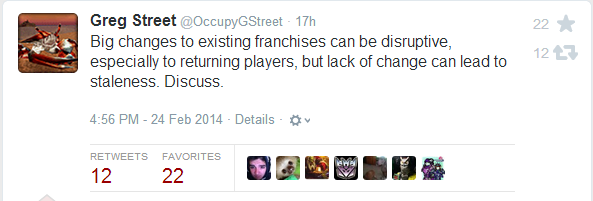
Greg Street had the following tweet recently.

gstreetdare

That really does sound like a dare more than a discussion, as it’s the core of many rants.  Still, dare accepted.

I am going to assume that he relates to WoW and his tenure but it also applies to other franchises.  Sure, CoD has made a bajillion dollars on an simple formula.  GTA and Assassin’s Creed are in the same boat.  Tomb Raider has seen multiple iterations, mostly crud for recent years until the last reboot.  Final Fantasy, ever the iterative franchise, has found glory and shame for nearly 30 years.  It’s hard to debate that the original FF14 was a positive step, or that any of the FF13 games were solid.  Diablo 3 and Starcraft 2 took two wildly different approaches – which would you call successful?  But we’re talking about separate games within a franchise stream, not the same game.  A separate game should take risks, there’s a transition break between them for players.  Mass Effect may transfer saves between games but the experience between the 3 is not the same.

When Greg talks about franchises, I see it more more along the lines of a single product.  Expansion packs and DLC for games are where this discussion truly has merit.  These games are living entities, whose beating hearts are the players within.  Certainly, after a while people grow old within the confines of the game and some new life needs to be injected.  Blizzard has traditionally focused on iterative design and that design usually takes 18 months to 2 years to be applied.  Icecrown Citadel was current content for over a year after all.  Let’s avoid the talk about SWG + NGE ok?

I think that changes over time, tweaks and system adjustments make sense.  Jarring changes, like adding/removing entire sub-systems changes the scope of the game.  It took 9 years but WoW finally figured that Pokemon was popular and Pet Battles were the result.  If I recall from previous stats, Pet Battles are currently consumed by more people than raids – so a change in direction much.  Let’s try and summarize the big changes.

Raid size changes – This was a big one from Vanilla to BC.  It destroyed many guilds and changed the way raids were implemented in every game since.  Iteratively, there have been many more changes, with the largest benefit coming from Flex Raiding.  My thoughts are that all games should support this last model.

Stat changes – Remember when you needed resists on all gear just to step into a raid?  Or magic power and healing power being different? How about armor penetration?  Stat bloat due to item levels?  All are gone in WoD. On their own, they were somewhat small changes as they coinciding with expansions which naturally replaced all your gear.  Systematically, it changed the entire way battles and planning worked and rejigged balancing.  These changes were needed, primarily due to poor planning on Blizzard’s part (ArPen in particular).  Talents have undergone a few revisions, but the near removal of the system today means leveling has little merit.  Pretty much a precursor to the “buy a 90”.

Itemization – A few things here. Item drops turning into tokens.  Valor/Honor points for gear.  Role specific drops.  Transmogrification.  All except for the last one had a rather large ripple effect on gaming.  Most were implemented to avoid the issues with raid gear allocation and the headaches of DKP systems.  Too often, an entire raid’s gear drops would be disenchanted and a group could make little progress.  How often did I scream about Shaman gear dropping on an Alliance raid…

Social Tools – These are iterative but massive in scope.  Guild levels is a small one and one that is poorly implemented.  Extremely poorly implemented as it makes no sense to be a in a guild that isn’t level 25, especially if you have an alt.  LFG came in patch 3.3 and absolutely destroyed any sense of society WoW had at the time.  The era of go-go-go was born and I am still a firm believer that WoW’s implementation is flawed at the core.  LFR was implemented because no one raided.  It was under 10% at the time, less than 1% for heroic Firelands.  It was a logical step to take, but again had a massive impact on existing raiding groups and wasn’t fully integrated.  Flex Raiding is still being tweaked but is where the natural evolution of this problem should have lead 3 years ago.


Now, did these things need to change?  Yes, clearly.  There were some significant design issues at the core of the game and the demographic for WoW has changed over the years.  Where the initial focus was a combination of EQ and Warcraft 3 players (young males) today’s MMO landscape is more around a 30-35 year old individual (male and female).  Time to play has gone down while available income has gone up.

Did the actual changes implemented address the design issues?  For the most part, no.  In fact, by and large, they introduced even more significant issues.  The BC to WotLK phase saw this the most.  Cataclysm took a drastic turn and simply disconnected all the systems instead, to avoid chasing down balance issues.  The big items listed above are still “broken” in their implementation.  LFR is a good idea but WoW’s version has been a cancer on the community.  The consistent focus on the individual instead of the group has been a core driver for too long and really has had a disastrous effect on the industry as a whole.

So while Greg’s tweet sounds simple, the crux of the argument is not that changes are / are not required.  It’s that the changes implemented must be quality changes that improve the game yet maintain a core vision and cohesiveness.


Learning Through Trial

I’ve been thinking more about the skill gap issues that most MMOs have today.  Skill gap in that the game from 1-max rarely requires any effort and then people are put into group situations that they simply are not prepared for.  Cataclysm is a prime example of this problem.  It would be interesting to see statistics of how often stuns and interrupts are actually used during the leveling curve…

A couple games recently have taken a somewhat different approach to this problem.

FF14 has trials and forced grouping all the way through the levels.  From the very start you learn about situational awareness, prime targeting, interrupts, line of sight and avoiding the red.  If you don’t learn, if just one person doesn’t catch on, then you simply cannot progress.  This is great.  Your leveling experience is complemented with the system intricacies.  Outside of tank defensive cooldown usage, it really primes you for all group combat.

The Secret World takes a more direct approach with the Guardian.  Given the structure of the game, you can fill any role, so it gives you the choice of defeating him as a DPS, Healer or Tank.  All of them are tough battles in that you need to have a very solid understanding of the role, skill synergies and how to manage interrupts.  I know some solid gamers who were stuck on this guy for a while, he’s no cakewalk.  TSW already has a pretty punishing skill level and this just brings it up to 11.  Still, it makes sure people are prepared.

WoW has trials.  There’s rumor that they are going to expand on that system for WoD, likely using the Silver medal rank as the baseline.  Having done those, I can say that Silver isn’t all that hard to achieve if you’ve ever done group content and were awake.  For those that have not, those that have just leveled and done pet battles, then this could be a tad challenging.  It’s also quite a shock, since nothing up until this point actually requires skill.

I’m getting of the opinion that all games should have this type of system.  While I prefer FF14’s, since it’s from the start, both TSW and WoW have decent interpretations.  It certainly will help with bridging the skill gap at the start of end game activities.  That naturally will help with the animosity of “noobs” and “l33t” players.  Raising players knowledge of the game systems is always a good thing.

Raids Are a Nightmare

Sensational title for the win!

WildStar, if you didn’t already know, is pushing for a fairly difficult raid environment.  Compared to other games that have a variable player count per raid (or only 1 size), WS is taking a slightly different step.  There will be 20 man raids and 40 man raids, completely separate from each other.  I know that the resources required to develop either size raid are equal but it seems to be a waste somewhat, and that’s what I’ll be discussing.

I played Vanilla WoW.  I did Molten Core and Blackwing Lair.  AQ & Naxx were off my list because of the first two.  I won’t argue balance on these raids, they were relatively new takes on EQ’s zerg-fest, and had their share of bugs and issues.  What was challenging was the logistics.

Today’s raiders have it easy.  You need enchants, potions, buffs and whatnot.  They are easy enough to find and the challenge is getting the gold to buy them.  Let’s say a raid session sets you back 500g, at top tier.  In Vanilla this was a bit harder.  Tubers were BOP, gear needed resistance on it, enchants were rare (diamonds anyone?), repair bots and money was scarce.  It honestly took me longer to get ready for a raid than it did to be in one.  It just was not fun to slog through prep work to raid.

Then you get into the whole herding chickens aspect.  I was a role leader, DPS.  That’s 30+ people you need to corral together on a  set target list.  The difference between top DPS and bottom was massive.  Losing a single top DPS player could break a raid.  How does 1 person make or break a raid?  We had penalties for not showing up on time, in a day when summons were rare and travel was hard.  Sign-up sheets and a bench.

It is logistically impossible to consistently raid with the same people every time.  People have things to do and you can lose 2-3 per raid – most times in the middle of a raid.  Having a bench means people are on a waiting list to have fun.  What?  Math and people do not mix.  If I need a bench for a 10 person raid, then I need 1-2 people, max.  If I need a bench for a 40 person raid, I’m looking at 5+.  That’s 5 people, heartbeats, that are on a waiting list.  Maybe they just go to another place where there is no list and then you have to backfill that slot.  Managing people like this isn’t fun for the raid leader, guild leader or the people being managed.

Now we get into fairness, specifically around loot.  Enter the DKP systems.  Enter the master looter role.  Enter tribunals.  You have 40 people.  You have 5 pieces of gear (at best).  You have 35 people who are not getting anything for the effort.  You have a ton of gear wasted if they are class specific (shaman/pally gear….) and no one to collect.  As fair as you want it to be, people will be upset for many reasons, most stupid and selfish.  But you don’t have a choice, you need those people to actually raid.

Finally we get into simple usage metrics.  Raids are vastly underused compared to the effort developers put into them.  Until WoW put in LFR, the top tier raiders, 40 man raid target audience, accounted for less than 1% of the entire population.  LFR currently sits around 60% of all players having consumed raid content and 10% at top tier.  If the most accessible raiding system can’t get higher than 10%, and this is with recycled content (LFR, 10 man, flex, 25 man, heroics), how can other games expect more?

Perhaps this 40 man raid idea is an experiment.  Maybe there are a ton of tools surrounding this structure to help move it along.  Strong class balance, LFG tools, partial lockouts, tokens, flexible sizing to cap among others come to mind.  I am waiting with fingers crossed that there’s more coming on this topic.