Skill vs Time – A Visual Aid

After reading Isey’s post on How to Lose an MMO Gamer in 10 Ways, and after pondering a bit more my previous post on Wildstar, I decided to draw out what I think is one of the larger hurdles for games to succeed – at least on a “massive” scale.  And that’s player skill.

Good game design is a series of meaningful choices.  I don’t think there’s any debate on that.  Where I think the kink in that comes from is in the ability for a person to have a an actual choice and appreciate the results (i.e. the ability to apply a skill and learn a new one).  I’ll go back in time a bit to vanilla Naxx and Heigan the Unclean.  This is the famous “avoid the fire spouts and you can solo me” boss – a dance really.  This was a massive twist in the traditional RPG space, where you just stood there pressing buttons.  Now you actually had to pay attention to the play space and move.  You couldn’t just absorb the damage.  I do know that many guilds at the time used it as a triage for recruits (combined with Thaddius) and it formed a massive skill wall for it’s day.   You either performed it perfectly, or you died.  That model, tried with a slight twist in BC, got the Ol’ Yeller treatment.  For good reason too, it wasn’t a meaningful choice and other than memorization and “no keyboard turners” there was little skill exploited.  WoW since then (with a blip in Cataclysm that they want to forget) has been more and more accessible at the lower end, with harder content for those who want the option.

To me, player progress is important.  Not only improvement itself but the opportunity for improvement and the evidence of improvement.  Huge spikes in difficulty is bad.  Difficult just to be difficult is bad.  No difficulty is bad.  A gradual increase in difficulty, where your progress is both evident and rewarded is the optimal solution.

On to the visual aid I promised!
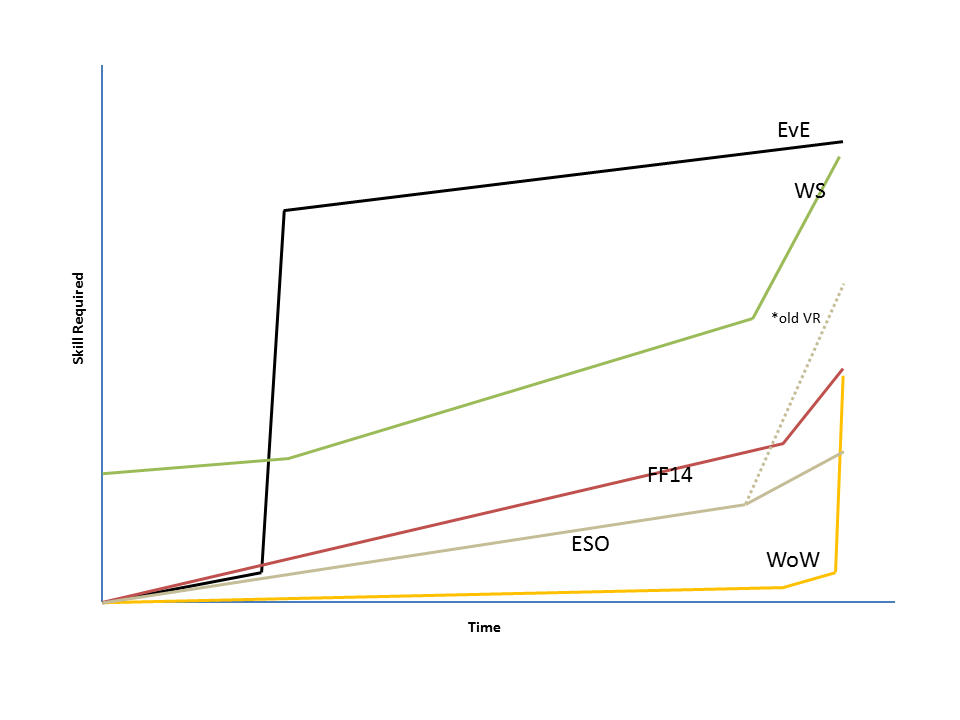
skillvstime

What I did here was map the player skill required to complete tasks, assuming a time investment.  The skill portion is relative between games, where EvE is certainly the most challenging.  The remaining themeparks are ranked in difficulty, based on my play.  Over each in particular now.

EvE

Everyone has seen the EvE difficulty curve.  The game is rather simple to start, assuming you stay in high-sec and follow the themepark crumbs.  Try to move off that path, either through null-sec or mastering a trade and boom, welcome to excel online.  If you make the transition, you’re gold.  If you don’t, then you’re dead.  EvE has been able to succeed with a supremely polished game after the transition.

Wildstar

No game starts off harder than Wildstar.  Then you start dungeons and the difficulty starts to climb.  Reach max level and the attunement begins, with a massive climb in difficulty. There’s no help to transition between the stages, the difficult is very binary (you die in 1 shot or you take no damage) and the climb at the end is like no other themepark.

FF14

A game with a very gradual increase in difficulty due to skill unlocks being limited and the presence of force grouping at an early stage to progress on the solo train.  You learn to tank, heal, pull, DPS, stun, craft… everything.  And the change at max level is more along the lines of perfecting skills you’ve already acquired.  It’s a very good experience.

ESO

This one is a little odd, in that challenge as you level has no training and very little feedback but the skill level required is pretty low.  Given that there are actual “bad choices” the game design allows you to have a couple and still succeed.  If you make good decisions, then it’s like cutting Jell-O.  That said, at launch the game had a veteran system at level 50 that was significantly harder than the first portion of the game and accounted for 60% of the content.  Bad choices meant you were going to do.  Good choices gave you a 25% chance to die.  That system was drastically changed after 3 months to a more similar difficulty curve.

WoW

I could have drawn 1 line per expansion here but the power curve line is pretty close to this.  Today’s experience from 1 to 89.9 is a joke.  I leveled a Monk to 90 in a week and only died from falling damage.  Dungeons & LFR can be AFKed by 20% of the group and you’re still going to win.  Normal raids have some challenge but the real difficulty is in the heroic raids.  And not heroic raids because of the mechanics but because of the stats the players have on the content.  Remember that power curve line?  The difference in power between expansion launch and 2 months is nearly 25%.  People were clearing MoP raids in Cataclysm raid gear.

Others

I could have added other games, like LoTRO, STO, DCUO, Rift, Neverwinter and DDO where I’ve done the high level stuff.  They are all pretty similar to WoW, with the final spike happening earlier.  I can’t think of one that plateaus before max level – though TSW might be a candidate as it doesn’t really have a max level, just limited action sets.

Summary

I think the comparison between all the games is important for discussion.  Certainly each has their own variables but of you were to look at where players quit the game, I’d bet dollars to donuts it’s where you see a shift in the curve (assuming they get past a trial phase).  Difficulty is good.  Shifts in difficulty must be moderate.  The benefit of that difficulty increase must be evident.  All of the games listed have made changes since launch to their curves (yes, even EvE) except for Wildstar – but it’s also the youngest.  Here’s hoping they get the hint.

#Wildstar – 3 Months In

I want to talk about the negativity around Wildstar – which I guess is sort of a Streisand effect…

First off, Massively isn’t a gaming news site.  It’s an editorial/opinion/re-posting web service.  It’s one of the more prominent sites but to claim that it holds any journalistic merit, well you couldn’t be much further.  What it does, it does well – in that it generates buzz/comments.  So when you read an article stating that Wildstar isn’t doing well, take it with a grain of salt.  It should hold as much weight as when BoK posts something similar.

So let’s start with the facts.

Some Wildstar servers are ghost towns.  As with any MMO, once you can’t find anyone to play with, you stop playing, so this is really just like watching water leave a drain.  To combat this, Carbine will be implementing Megaservers (like every other MMO in the past 4 years – including WoW).

The game has a much harder difficulty curve than any other themepark.  The wall is early and it is high and it gets bigger over time.  I won’t say the game is complex, outside of coordinating interrupts, but it is very unforgiving of mistakes.  This by nature reduces your potential client base.  There are no planned changes for this outside of a “learner” dungeon in the next patch.  More tools to teach without changing the core system.

Itemization/Runes/Power distribution is not aligned.  Right now, the melee classes get a larger benefit from stats than ranged players, which is causing them to have ~50% more damage output.  They just scale like crazy.  Rune slots are also an issue, where “optimal” runes are 2-3x better than a normal rune.  What this means today is that there is little choice at max level, and making anything but the correct choice is a massive penalty. Both of these issues are going to be addressed by Carbine – the first part by normalizing power and stat gains and the latter by spreading out runes across more slots.

The next part is my observation.

The end game is forked into two parts – the solo side of dailies (that each take 30+ days to cap), customization (armor and housing) and farming/crafting and the group side of adventures/dungeons/raids.  Elder Gems are the max level currency and right now, it only has a use for the latter group.  Solo folk need more content and the next patch has some more dailies.  However the game needs more types – shiphand missions are an easy target – and a better use for Elder Gems.  Carbine has stated they are working on this but there are no timelines.

The group folk have a completely different problem, in two parts.  First is the attunement wall.  Unless you already have a raiding guild who wants to pull you through content, you’re not going to get through it – in particular because of the world raid bosses.  It took WoW multiple content patches to create this attunement wall (BWL and BT come to mind) and caused enough problems that the entire model was scrapped.  That Wildstar implemented this wall at launch…very odd choice.  Carbine is making changes to reduce the requirements of attunement but without Megaservers or an existing raid group, people are still out of luck.  The second part is the reward structure around group play, in that it’s “gold or bust”.  Given the above mentioned difficulty, and the fact that adventures/dungeons provide a significant boost in rewards if you achieve a gold medal, any failure is met with a group disband.  This causes an “elite” culture and provides absolutely zero learning curve for players.  Carbine has made some changes to the rewards structure in that now even a bronze gives something but there is still too large a gap between bronze and gold. (To compare, Gold runs in Wildstar are akin to Gold Challenge runs in WoW).

The good news is that I’m still playing and having fun.  It isn’t a daily thing mind you, but every couple days I log on and run a few things.  The group thing is an issue for my playstyle.

Is Wildstar in a rough spot?  Certainly.  At the very least, it will continue to hemorrhage players until they can implement Megaservers. There should be no larger priority.  Aside from that, there are plenty of balance changes on the way to address some of the concerns above – and soon too.  As for the group play at max level, that is going to require more time and more thought.  Had Megaservers been there at the start, perhaps the attunement issue would be smaller as there would be a larger player base to get through it.  My opinion (since beta) is that focusing solely on 20/40 person raids is a mistake.  Time will tell if Carbine feels the same way.

Your Voice Matters

I have a personal rule in my line of work, if no one says anything, then it’s approved.  I tried forcing people to approve things and nothing moved, so now everything has a disclaimer.

You have x days to provide comments, otherwise you’re indicating approval for the content.

It took 2 or 3 passes before people realized I wasn’t messing around and now feedback is quite quick.  It’s also something I use when talking to friends and politics comes up.  “Did you vote?  No?  Then shut up.”

The link to gaming, and actually more like social studies, is as follows.  A lack of action is an approval of another action.  In much simpler terms, if you’re not calling an asshat out, then you’re ok with their actions.  If you’re not /reporting someone for clear harassment, then you’re supporting them.

Now, people can make all sorts of excuses around that and that’s all they are, excuses.  If you aren’t standing up for something, then you’re standing up for nothing.  Things don’t change by just sitting there and looking at them.  They need action, they need people.

Greifer – someone who through their actions, costs you more than they pay into the system

I could care LESS about what people think about the UO Trammel split.  It was the solution, at the time, that was meant to stop greifing.  There was such a furor on the forums and in-game, people were simply just abandoning completely that Origin needed to make a drastic change.  You can blame the “carebears” if you want but the cause was always the greifers.  The solution… we can talk about that another time.

I won’t be linking to any hashtags or websites about the garbage going on today.  It’s really not that complicated.  There are a bunch of people who would rather stroke themselves and put everyone else down rather than share the ball.  I get that.  We used to call them schoolyard bullies.  They all ended up pumping gas for a living.

The gaming industry is undergoing a revolution.  The old days of pumping out shareware crap at Radio Shack are long gone.  The old guard of online games has long since retired or morphed into today’s MMO/online presence.  Today’s gaming must be inclusive.  It’s beyond financially irresponsible to ignore 50% of your market – it’s ignorant.  Gaming is a business, it needs to make money.  Focusing solely on greifers as your target audience is stupid.  XBOX One even has a cesspool of players with low score to avoid this problem.  If you want to be an asshole, that’s fine.  Go circle jerk with the rest and leave us alone.

There is a massive storm of ideas and mandates going on today.  It will not get better in the short term.  This is what happens when you want a revolution, people will get hurt, business will suffer and after what seems like an eternity, the industry will come out stronger.

But the only way this thing will change is if you use your voice, because every single one matters.

#Wildstar – Veterans

While I recently tagged 50 with my Engineer I was left with a conundrum.  What do I want to do now?  I mean, I have a healer and a tank, both of which are DPS as well.  I’ve done the paths that interest me (scientist and settler).  What’s next?

I opted to get my Engineer up to the first “hurdle” for attunement, getting enough reputation.  Well, the first step is getting 150 elder gems, that took a week+.  Then was killing Pyralos in Wilderrun.  I did this guy with my Esper, who had about 20K hit points.  That took about 3 hours of trouble and I was swearing something fierce.  My engineer had the hit points to be knocked down from the tower and survive with 300hp.  He could also stand in the fire without dying.  3 tries and he was down.  I can’t imagine how that would feel for a player with their first 50 – with such a large disparity between the classes.  Anyways, after that I hit the reputation wall – currently at 26K of 32K.  At that point it’s either daily grinds OR veteran content.

My Esper is at the “all adventures on veteran” stage and a class I tend to enjoy playing more, so I hopped back on.  I collected a Goldensun Essence (which is neato) first, then decided to run around a bit.  I collected a few bags (the 16 and 15 slot ones from challenges) as I seem to be perennially out of space.  The I looked at my housing plot, thought “It’s going to take days to make this look less like a trailer park” and moved on.  I do need to take a stab at it mind you, just not today.

First was re-gearing from the AH.  Esper had more cash and for 1.5p I was able to replace 4 pieces of gear and up my Moxie by nearly 200.  (note to others, look at level 49 gear).  I put in a few runes but it’s about 1p per right now, something for later gear I suppose.  Though from what I’ve read, this crafted gear I have is optimal well into the raiding sphere.

At this point I thought about getting into the veteran content outside of the guild, which meant the LFG tool.  I have a natural aversion to LFG tools for the first few months of a game.  Let’s just say that the people who are using it are in it for the end result rather than the actual content, locusts by and large.  Once you hit the end of month 3, the people left in the game are vastly different than before and quite enjoyable.

So I said, let’s do veteran ship hand missions – the button was there while leveling after all.  To my disappointment, the button doesn’t work.  Same with housing plot adventures.  I’d gladly do both on veteran.  Mind you, the housing ones do scale and the shiphands scale you down.  There’s a challenge, I just don’t want the gear.  I want the housing stuff!

I then decided to bite the bullet and opened the LFG tool.  I selected DPS and removed myself from the healer queue.  It’s always a good idea to do hard mode content as a DPS, where you can make mistakes and learn new patterns, and then graduate to healing.  Less than 2 minutes and I was into War in the Wilds.

This is the MOBA adventure and I’ve done it quite a few times on normal.  Capture flags, destroy enemies, check.  Very easy, very short.  Veteran started well enough as we captured 5 flags without incident.  Then things took a turn.

I don’t know if this is the core strategy or not but the tank decided to take on all 5 enemy heroes at once, in the middle of the enemy AI path for the moodies.  So there’s those 5 plus 5 more moodies and there’s red telegraphs everywhere.  I was doing my job, decently enough I might add, then the healer just ran out of focus.  We’re talking a solid 5 minutes of non-stop battling, which shouldn’t be a normal thing for a healer.  I died, the tank died, then it was a wipe.

You know what happened next? Full disband.  I’m used to gkicks in other games but just a full drop seems excessive. I know to get silver you need to have more kills than deaths, and we were WELL above that marker.  I just don’t get that mentality of failure and quitting.  I guess I need to run some more stuff with the guildies.

WoW – 10 Years Leading the Pack

Bhagpuss found a neat idea from Atl:ernative Chat, that came up with a neat way to recognize WoW’s personal impact.  Reading through his post, I found a fair bit in common and a fair bit of nostalgia as well.  So here goes.

1. Why did you start playing WoW?

I was a pretty big W3 player, was deep into EQ/UO and found the MMO concept pretty decent.  I somehow got into the very early beta and fell aback at the sheer quality compared to what was available.  Interestingly, I found a website about the game (WoW.net I think it was) and wrote some guides for the beta.  Someone found them, offered me a job writing more guides and that sort of cemented me into the game.

It also helped that I had a dozen or sort friends that I converted to play with me.

2. What was your first character?

Dwarf rogue.  I was active with him until MoP too.  I loved Rogues, always have.  They were pretty darn solid DPS class, and at the start weren’t all that glass canon.  I think the best part was stealthing dungeons with a couple other rogues, clearing it out.  BC was prime-time for Rogues.

3. What factors determined your faction choice?

Barrens decided it for me.  I think for quite a few years the starting area for the Horde was horrible.  Westfall and Dun Murogh were amazing in comparison.  I liked the Horde concept and the characters, but the actual gameplay was not fun.

4. What was your most memorable moment?

Good question, hard to think of one off hand.  Clearing MC in vanilla was up top, chess event in Kara too.  My healing shaman ruling AV for a few months is also top of pile.  Hmm, the most memorable are likely the two massive guild implosions I experienced.  One where logistics of MC destroyed us.  A guild of 60 people, we had a bench for raiding and still couldn’t get everyone to show on time.  The other one was related to DKP drama.  Oh the days of loot ninjas!

5. What is your favorite aspect of the game, and is it still the case?

Originally, it was the ease of access along with system integration.  Everything seemed to interconnect with everything else.  Plus the game had a low skill level for entry but a relatively high skill cap.  The first one is gone, completely obliterated through iterative design focused on the second.  I think the game is much, much to simple today and has trained too many people to just faceroll and expected purples.

6. Do you have an area of the game you always return to?

The auction house.  I’ve never found the art in-game to be particularly attractive, just average.  I like the concepts of the zones just not a big fan of the implementation.  I will say that every expansion has been drastically better than the last.  Cata certainly showed that clearly by re-jigging the starter world and making Draenor look like poop.

7. How long have you /played and has it been continuous?

I started at launch, played consistently until a few months into BC.  Since then, I play 2 months starting the expansion then 1 month after the last expansion patch.  That’s a fair amount of time and I’ve enjoyed most of it.

8. Do you read quest text or not?

I do on the first play through.  Blizzard has very good writers and some pretty memorable characters.  It’s really impressive what they are able to communicate without voice.  While over the years there have been MANY conflicts within the lore, overall the quality of the text and stories has been solid.  I think this is the most consistent part of the game.

9. Are there any regrets about the time in game?

I think I played too much at the start but over the years the play time has been sensible.  I rather enjoyed the single player aspect and the “live world” aspect.  I do regret most of my time “farming” gear though and ignoring the social aspects.

10. What effect has WoW had on your outside life?

A lot.  Much more than I would have thought.  I met people through WoW, made a ton of money (off the guides), applied learning to the game, developed a better understanding of system complexities, improved leadership skills.  WoW taking the forefront of my gaming plate for so long gave me an outlet, as an introvert, to try new things without long term consequences.  I’m a firm believer that gaming can provide some significant real world benefits.

DPS Meters and the Problem with E-Peen

If the game is an MMO, I’ve likely played it at some time.  If it had high-end PvE, then I did that too.  If it allowed modifications, I used them, liberally.  Wildstar is no different.

While stock UI and tools are fine and dandy for leveling, in today’s more aggressive top tier content, additional UI modifications are near required.  If you were to compare WoW at launch to today’s version, you’d find dozens of UI mods from the public that were incorporated.  The stuff that isn’t in base package today deals mostly with two ultra competitive things – the market and raiding.  By and large, this applies to other MMOs as well, where the top tier players end up with mods because they care about being the best, while those who don’t have mods care about having fun.   Most MMOs were pretty good at allowing the right amount of mods.  SWTOR, not so much.  ESO, they were put in to fix design issues.  Wildstar is just a set of mods to start off with!

I’ve been adding and removing mods for some time now.  Discussions always come about where mods are a form of cheating and I can’t disagree with that statement.  But I also think that mods allow you to move above the routine and focus on the big picture.  I often refer to the mission on Farside with the “simon says” minigame.  You need to remember a 16 color pattern and replay it.  Once I completed this mission, I told myself I had beaten it forever and installed a mod to auto-complete from that point forward.  I did the same with the “tap/hold/dance F” to complete missions as well, after having done all the possible permutations.  I’ve got market mods to help with inputs, price points, value calculations and a few others.  I have a UI mod to make raiding easier (grid-like) as the default mod is crud.  I have a mod that draws lines to resources because the default map view is awkward.  What I didn’t have, up until yesterday, was a DPS meter.

I hate DPS meters as a meter of power.  One of their sole purposes is to make people feel bad.  “Oh look, I did 50% more than you, you’re cut”.  Until we had gearscore (which is akin to linking car types with driving ability), DPS was the go-to stat for PvE.  If you didn’t do X DPS, then you were garbage.  I know as a Rogue I was often times at top of chart but I took some DPS loss to help increase overall raid damage.  A buff/debuffer with decent DPS is a common role I take in MMOs.  Espers in Wildstar are in that bucket today.  But then you get someone else staring at their numbers and actively trying to beat everyone else rather than trying to get the group through content.  Or a “leader” complaining that your DPS is too low without understanding why.  There’s certainly more value in raising everyone’s damage by 4% than raising your own by 10%.  Yet that is a concept few people seem to get in an age of “me me me” and “go go go”.

I think Wildstar is forcing a change though, in particular due to how interrupts and moments of opportunity (MoO) work.  It is often times more effective to interrupt an ability to reduce the need to move, than it is to use a high DPS ability and risk missing or getting hit. It is even more effective to stun an enemy as they take a near 50% increase in damage taken MoO state.  Getting a MoO often means improving a stun ability while reducing the damage of another skill.  It’s counter-intuitive to the WoW-masses but anyone who steps into group content without at least 1 stun on their bar, shouldn’t be doing group content.

But I put in a DPS meter for one main reason – combat logs.  I am an avid analyst and numbers are my crack.  Seeing the detailed breakdown of my skills, timing and cross-buffs allows me to tweak a few things here and there.  Set ability priorities.  Time buffs/debuffs for the right mix of other skills.  I’ve built damage calculators/models in the past, and meters + dummies are a huge part of that.  So last night I started to put theory to practice and on the minimal boss fights we did have, I realized my patterns needed work.  An immovable dummy vs. running around like a headless chicken are quite different affairs.  A few tweaks here and there, improving some skills, realizing that others on paper look good but are impractical in practice is forward movement.

I think with the advent of shared raid logs taking up a larger portion of the discussion that DPS meters become a bit less relevant.  They make great subjective tools, or indicators, but as an objective measure of player aptitudes, they are sorely lacking.

#Wildstar – Class Design Interview

Oddly enough, TenTonHammer is one of my go-to places for Wildstar news.  Massively’s staff cuts have cut that bugger off my reading list.  Recently, TTH had the chance to interview the lead class designer, as well as the Medic and Esper leads.  There are three main things I get from this interview.

  1. Carbine is being rather forthright and honest about their design intentions.
  2. There are fundamental issues with balance that need to be sorted before they look at skills
  3. TTH’s interview skills are “unique”

For 1, this is somewhat novel to me. I know Blizzard is seen as open about their design intents but that took 4 years to start. And the tenure/legacy of GC is always a debated topic. Compared to other MMOs mind you, ESO, TSW, FF14, SWTOR and RIFT, this is a drastically different approach. Now the flipside to honesty is that people are going to dissect every word. A 2 month lock on class design before launch may seem crazy to some but from my experience, that’s a rather short lock on release windows outside of bug fixes. Plus, if you look at the patch notes WS puts out, Carbine is putting a ridiculous amount of effort in fixing their game.

For 2, this is disconcerting while at the same time NORMAL. When you build operational models, you use normalized data. So assume everyone is at the same power level, and what do you get – that’s the baseline of testing. Sure, you can test some outliers but core builds are based around design principles you need to adhere. And as with all massively multiplayer games, people will find optimizations that the developers did not consider. Absolute scaling is tough to predict.

If you play WS, you’ll notice that the tank players have lower Assault Power compared to the healing players, assuming the same item level. It’s rather drastic actually, where a level 30 tank weapon as 200 AP and a level 30 healing weapon has 350 AP. Now, for a level 30 tank and healer to have parity, it means that damage has to scale differently between the classes.   Let’s say they each need 1000 power. A tank would scale at 5 power / AP and a healer would scale a 2.85 power /AP. Good so far?

Well once you reach max level and start optimizing, those options are class agnostic. While your equipment may be optimized for tanks (lower stats, better scaling) runes and imbuements are not. A 50 AP rune can be used by anyone. So what you have is players stacking AP runes (and imbuements) in parallel with healing classes, but they scale at a much better rate, giving them a very aggressive power curve.

There are a few fixes for this but it’s really a core design flaw that needs to be addressed. Either you change base scaling of the class, or you apply the scale to all stat inputs. And that’s aside from skill/AMP balancing.

Skill/AMP balancing is an interesting topic since Carbine can clearly analyze existing patterns. Some classes have decent diversity, others less so – Espers in particular, with only 2 skills per role that matter. Nice to see they’re trying to fix that.

Finally for 3, TTH’s rather aggressive and subjective interview style comes off as being childish. Or perhaps extremely passionate about the topic rather than objective. There were no softballs in the interview – again, a significant difference when compared to Massively. It’s fresh but at the same time dangerous.

Overall, I’m happy with the interview. The lead designer is clearly a lead (correcting a class designer in an interview is rare) and the class designers have a solid plan to resolve issues they freely admit exist. And if we follow the current patch timeline, most of the changes should be in September/October, which is a very acceptable timeframe for a big rebalance. WoW didn’t touch Rogues at all until BC, if you recall. It’s encouraging to see that type of attitude.

ESO – Veteran Levels

It’s a simple fact that all games that want to have retention need re-useable content.  Sandboxes have a distinct advantage here as the content is generally created by the players and not the developers.  EvE, UO, ATitD are examples of user-generated worlds.  Themeparks have contained experiences that, by and large, are the same for all players.  The “ride” is balanced against other rides and provides a more uniform experience.  UO, until the shard split, was  near death-trap for any new players venturing outside, with a completely different experience depending on time spent in-game.  Themeparks are the same formula from 1-max level, with a few variations at the top (raiding, achievements, PvP, collecting, etc…)

While I have posted a bit about Wildstar and its approach for end-game activities (there are many), ESO has taken a slightly different approach.  First though, some quick context.

ESO has 3 main “phases” compared to the typical 2 in other themeparks.  There’s the 1-50 phase, following a central quest structure through a half-dozen zones for your faction.  As you level, you have full access to PvP and level appropriate dungeons, across all factions.  Once you hit 50, then you reach the veteran levels, of which there are currently 10.  That’s phase 2.  This phase encompasses a central quest structure for the other 2 factions, split between the levels, with a bit more challenge.  Phase 2 is therefore twice as long to get through as Phase 1.  You still have PvP access and you now have access to veteran-ranked dungeons, which are rather unforgiving in terms of tactics compared to their regular variants.  Phase 3 is what happens at veteran rank 10, and this is where the new Craglorn content comes in to play.  Group-based open world objectives, is the main gist of it. That said, there are dozens of quality of life changes in the pipes (fixing many grouping issues).

J3w3l goes into it from her personal experience.  Phase 1 is simple, phase 2 is significantly more complex and unforgiving and then phase 3 has no relation to either previous phase.  Due to the odd grouping mechanics, where it’s rather difficult to find someone to play with during Phase 1-2 (phasing, quest progress, etc…) you’re in a solo-only world for about 400+ hours.  I am curious how Phase 3, with a heavy if not singular focus on group content will work with the player base.

On top of that, given that 99% of the content is consumed by phases 1 and 2 (all quests across all factions) and that you have enough skill points to fill out 80% of all skills (which works out to more than 100% of the useful ones) there’s no replayability, outside of the 3 class-specific skill lines.  There’s a difference between a Dragonknight and a Mage but not enough to fill out 400+ hours.

Finally, as current metrics seem to indicate that the wide majority of players are in the mid-30s at the end of the first month, or somewhere around 60 hours in, and that the new content requires 400+ hours to even access – you need to wonder about the design direction.  I give a lot of flak to Wildstar for their 20-40 person raid commitment as end-game content (it’s just stupid to do in 2014) but ESO deserves a fair amount of head scratching too.  If you want to retain people, there’s only so many turns on the Magical Tea Cups that people can stomach before heading to the door.

Continual Content – Gated Dailies

Themeparks have to give you a reason to run the ride again and again.  There’s a carrot somewhere that makes that switch in your brain go, “ok, one more time”.  Way back in the day, this was more or less organic – run a dungeon.  Eventually it turns into formal quests as we know them today – dailies.  For a very long time, this was mostly about money.  Free cash!  Just jump up and down!  Then this became a reputation grind to get items.  Just 18 more dragon eggs before you get a new shoe.  Then we reached a really weird stage where dailies were the precursor to more dailies. Hello Golden Lotus!

Dailies were also typically capped in terms of how many you can complete in a day.  Not only are the individual quests on a timer but you could only do X amount per day.  The reason for this was three-fold.  First, this was a massive money tap that could be exploited easily.  Millions of gold entered an economy per day unchecked.  Second, they often rewards reputation scores for better gear – which was vertical progression.  If you could do them all, then you would be progressing very fast.  Third was the natural gating requirement of time.  The game should last Y amount of time.  People would (and did) burnout.

Using WoW as a solid example, dailies went through many iterations and nearly all based around expansions.  From BC to MoP, there have been different flavors.  The main driver, or success if you will, for dailies is an alternative progression path.  Certainly, given the choice people will naturally take the path of least resistance.  Dailies however give you a chance to “quickly” make progress through alternate means.  The tabard/daily quest reputation grind made sense.  It fit both playstyles.  The “only-dailies all the time” approach of MoP put in an artificial gate that could not be bypassed.  Don’t get me wrong, I like the cloud serpent faction as the quests were related to the outcome.  Pat Nagle progressed through fishing-related activities.  Golden Lotus had (before 5.4) no purpose other than to gate access to 2 other (and more rewarding) reputation grinds.

SWTOR takes a slightly different approach in that “zones” have daily quests that share rewards.  Tokens/progress is made.  This supplements the raiding/dungeon game with modifications.  There’s a fair amount of horizontal progress as well (customization).  It works for me.

Neverwinter is an odd mix.  Daily quests reward Astral Diamonds based on activities – been there since day 1.  It works in that the rewards are the same, regardless of the content consumed.  Most of that content is social so, more people doing things together = good for the community.  The last 2 expansions added “gated dailies” where the rewards are not item based but content based.  You complete a few and get access to new dungeons.  A few (a lot) more and you get passive stat buffs that are not gear related – you keep it forever even if you get new items.  You complete more and get a better chance at loot.I like that this is daily and gated but that brings me to the final daily hiccup.

If you miss a day, you miss a day of progress.  Missing a raid means you have, usually, another shot in the week (assuming the timer is a week).  Miss a dungeon, then run 2 the next day.  Dailies are the only content with a short expiry.  I personally think it would be great if you could “store up” daily quests for a period of 3-4 days, or perhaps have the rewards reflect that “store”.  Have it run at a reduced ratio too, say 25% per day missed.  I know a game wants a hook to have you login often but unless that game is offering off-line progress (and an interface), then after a while you just lose interest.

If I knew that after a long weekend I could come back and make some additional progress, even reduced (which would be double daily rate based on the numbers above) I think that would motivate me to login and spend more time.  Especially if it related to gaining access to new content (and not items).

The Future of MMO Combat is Here

While I hung up my ESO sword, I do have a few comparisons to make with other games.  The Internet and I have an outstanding issue with the combat in ESO (it’s better than Skyrim but combat in Skyrim was never the point) and the mix between a limited action set, “don’t stand in the red”, and free-flowing combat.

Combat is, for better or worse, more than half of the time you spend in game.  Figuring out the model that works for you is key.

Limited action set

I won’t say that League of Legends created it but it certainly put it to the forefront.  LAS provides a strategic (what skills can I slot) and tactical (what skills can I use) view to combat.  There’s a fair amount of situational choice and LoL exemplifies that, to a degree.  LAS in MMOs is best seen in Neverwinter and soon Wildstar (which also combines resource management).  There’s skill variety, different variables (similar to the morphs) on a given skill and the flexibility to change pretty quickly outside of combat.  I think it’s fair to say that LAS is going to be the way forward for MMOs and games in general from this point forward.  It has a low skill barrier as you don’t have to map 18 keys so it’s easy to learn, hard to master.  Good stuff all around in my opinion and sort of makes WoW look like a dinosaur in comparison.  Mind you WoD is cutting what seems half the skills due to bloat.

Don’t stand in the fire

It seems any 3d game with terrain today has an indicator system rather than a numeric damage system.  We’re no longer trading punches (which in Molten Core was 90% of the battles) and debuffs.  There are damage spikes but also telegraphs or visual indicators to avoid it.  Smart play avoids damage, bot play dies.  The margin for error on this is where games differentiate themselves.  Some have a lot of room (SWTOR) and some have next to none (Wildstar, WoW).  Most straddle the line and allow different levels of skills.  This brings in a bit more of the action-aspect of gaming from consoles and makes every fight thematically different as the bad stuff is different as well as the dance to avoid it.

Free flowing combat

This is a bit harder to define but it deals with combat on the move.  Older games were more of the “stand and shoot” variety.  The traditional glass cannon mage is a good example.  Cast-times where you cannot move are a more old-school system, mind you they combine the risk/reward system for decision making.  At a low/medium skill level though, it’s far from evident how you decide to keep casting with 0.25 seconds left or just stop and move.  More recent games force you to be mobile for the majority of an event, with Neverwinter and Wildstar really pushing this concept.

The hiccup with moving combat is keeping track of your target.  With the screen moving everywhere, you want to be able to continue attacking even if you aren’t directly looking at the enemy.  This is a skill thing as circle strafing (a FPS concept) is very difficult for most players to grasp.  For tab-target games, like WoW or FF14, this is built-in.  For free-from games like Neverwinter or ESO, then you lose targeting when you move the screen.  Wildstar uses a hybrid approach. The basic concept is “can I deal damage while moving”.  Depending on the auto-target configuration, ranged and melee attackers have different situations too.

Current Options

Of all current games, I consider Neverwinter the current best case scenario for active combat in an MMO outside of a MOBA.  It’s got skill variety, plenty of stuff you should avoid and stuff to stand in, and a very response active combat system. You need to dodge, dip, duck dive and dodge a lot.  It’s frantic but manageable.  Given that it’s a free to play game, it gives the chance for everyone to give it a shot to see if the model (and not so much the rest of the game) fits.  I won’t compare other games to this system as it’s really personal preference.  It does bode well moving forward that the combat from this point forward is going to be more engaging and require more than a macro of pressing 1, 2, 3 for 10 minutes at a time.