Rise Updates

Monster Hunter’s measure of progress is typically related to the weapon upgrade tree. There are 8 tiers of each weapon, and more weapon options than there are monsters. As you complete more quests, and kill more monsters, the tree ‘fog’ lifts and you can see what crafting material requirements are needed to make something. When you’ve unlocked the entire tree, then you’re in end-game.

I’m currently at rank 7, having taken down Magnamalo from the village, which rolls the first set of credits, giving access to 6 star quests. The village part is important, as MH:R actually has two modes. The Village quests are story related and unlock village items. Things like better food. The Hub is the regular mode and required to progress in order to improve your hunter rank and access tougher monsters (e.g. High Rank). I’ve yet to complete a single Hub quest…

I know I said 2 modes, but there are actually a few more. Arena quests are closed circuit fights against specific monsters, with specific gear loadouts. Better rewards if you clear faster. Training quests are just basic intro bits to the mechanics. There are plenty of requests/side quests to collect/kill things to have village upgrades (get Submarines!!). And finally, there are Rampage quests, which are a sort of tower defense mode. I’ll get into that in another post, it gets complex.

Easy Access

I tend to think of the Switch as an easy access console. I think that’s more because their first party games are more family oriented as compared to Sony/MS (God of War, Last of Us, Gears of War). Rise is not a first party game, and I would really struggle to call it accessible. MH: World was revolutionary in terms of making the series have global appeal, and Rise takes that foundation and then doubles down on the vertical aspect of combat. The World barrier of Anjanath shows up much earlier here. The map feels more claustrophobic than World, and that can cause some camera issues if you’re near a wall.

Put simply, you need to learn real quick about monster tells and how to tactically attack. A button mash approach is going to get you killed faster here than World. Now for the good news! Magnamalo is twice as easy as Nergigante was – there’s no insta-kill dive bomb attack here.

Wirebugs

This is the part that really ups the complexity. Wirebugs allow you to swing across the map, recover quickly from knock back and come with 2 specific attacks per weapon. A Charge Blade has a quick dash and a counter, both useful but not crazy essential. Longsword also has a counter, but the Helmsplitter is the real big show here. Knowing when and how to use them makes a huge difference! Heck, some monsters have area attacks that can be completely negated by taking a Wirebug to the sky and just hanging there. Which leads to the next interesting bit…

Monster Riding

With enough Wirebug damage, a monster enters a rideable state. Or, if two monsters fight each other, this will also trigger. Attack once and jump on board.

If you’re in a monster duel, then you can use light/heavy attacks on the other monster, which deals some decent damage and has a high chance at drops. If you’re just 1v1, then you can force them into the wall a few times for some damage and a quick stun. The cooldown for riding is about 10 minutes or so, and really makes a huge difference in terms of drops rather than damage. So you’re highly incentivized to use the Wirebug as much as possible.

Buddies

This is so much more complex than World… yet appears simple. You start off with a Palico (cat) and Palamute (dog) which accompany you on fights. In the basic sense, Palicos are very similar to World in terms of providing support. Palamutes are more combat focused, and simply amazing in terms of traversing the map. You can hire any two, so if you want two Palamutes, go nuts. Where is gets more complex is in how these buddies actually work.

Both have passive skills that are randomly selected and can be slotted. Things like Health Up or Knockout King. They only impact the buddy, so optimization here is more about ensuring they survive than much else.

Palamute attack skills are based on gear selection – similar to Palicos in World. Things like threat generation, or passive healing, or defense. This means that unless you’re super min-maxing, the starter Palamute is more than enough to get you through the entire game.

Palicos are different. They come with active skills that are a combination of role and RNG. The level 1 and 20 skills are locked to their role – healer, gathering, warrior and so on. Learners will want Healer, farmers will want Gatherer, and group play is likely to want Assist for some extra buffs. The random skills at 5, 10, and 15 can make a difference. Any level 5 Palico can access a healing bubbles skill, for example. So there’s some optimization to be had here.

How? Well, you can scout buddies based on a subset of items – looks and role. If I want a brown tabby Gatherer, I can narrow down my options from a pool, which resets after every battle. From that list, you can work through the RNG to find your optimal Palico.

You’ll use the Palicos and Palamutes in a mercenary mission mode (like in World) and submarines (similar to the garden from World). You can also train your buddies in a dojo, so that you don’t have to bring an underleveled one with you in battle.

Moving on Up

It took me this long to figure out how the basics work, and to unlock the foundational items. It feels like I’m just dipping my toe here and I have a LOT of time already in-game. I haven’t even looked at the multi-player component yet given the ability to pause is super useful!

I’m still trying to find the right Palico build, and will work on the Hub quest lines next. I’m really happy that I put so much time to learn the game in World, because that’s a major step of progress that Rise takes for granted. I really didn’t think we could have more systems in a MH game, but Rise somehow manages to deliver on this, and does so very well. And I can only assume as more and more content (monsters) are added, that this will eclipse World in terms of amazing gameplay and content. Absolutely worth the purchase.
Monster Hunter: Rise Quick View

So the Switch came in on time, awesome. Kinda bummed that we need to keep buying external storage for every gizmo out there though! 32gb of internal storage is bonkers for a device meant to be mobile. I found a decent deal on a 512gb card though, so that’s done. Initial setup was fairly easy, at least the physical parts. Nintendo online, or account management, still feels like it hasn’t left the early ’00s. The e-shop is just a horrible experience – Nintendo is leaving millions of dollars on the floor here by not investing in better UX. It’s truly baffling that a cell phone from 2015 does a better job.

The Switch itself though, that’s clearly gone through some ergo work. It feels really well balanced, it has a durable feel, it’s responsive, the screen is clear and bright. Really well done.

MH:R

I know I can take screenshots, just getting them off the damn thing is going to be a fun run.

Rise is a strange game. I did play a small amount of prior MH games before World, I’m aware as to how meticulous and grindy they felt. There was a LOT of busy work and complex systems. World streamlined it all into an absolutely beautiful package and remains Capcom’s highest selling game of all time. If you played World to any degree, you would not call it simple. There are dozens of integrated systems, a very thorough combat mechanic, and a world that feels like an actual world.

Rise has the unenviable task of following up on near perfection. And somehow, with half the processing power, manages to get a lot right. I’m only a few hours in, so really just scratching the surface of what’s actually here, so take a cup of salt with this.

I have only the barest of experience with the Switch, so comparisons to other games is a challenge. I can say that it’s ultra smooth, the load times are great (should be!), there’s minimal clipping, and the creature designs still stand out. It just looks good. I realize it’s not yet taxing, there’s no big bodies of water, and I’ve seen only minor fire/ice effects. Perhaps later on I’ll see things that cause some slowdown. (Compared to World, even with multiple massive monsters on screen, I never really saw dips.)

Combat is still really tight and responsive. Most weapons work the same way as they did in World, with the same muscle memory helping. Each weapon has a couple new optional twists. Well, the Hunting Horn is an exception – it feels like it was rebuilt. It is much more forgiving, and allows for offensive single player content. World HH mains were mostly support roles. The game defaults to the long sword, which I guess will keep it as the #1 weapon again. Yet..

Rise focuses on the vertical aspect of the game, and each weapon now has the ability to attack with relative ease from the sky. It is hard to describe what adding a new dimension to combat really has as impact. World felt like a chess match, with relatively large spaces and a face to face combat model. Rise… this thing is all over the place. Monsters feel more aggressive, and in turn, you need to have a much better understanding of controls to find success. And learning the Switch controls at the same time as learning a new game, well it doesn’t always work. I’m learning though!

The home base portion is both smaller than world, and has more to do. Just feels like a better use of space. Canteen is still there, quests, smith, palico (and palamute dogs) to help out, missions for pets, argosy, and the list just goes on. The customization of characters is more fullsome here, both in terms of YOU and the variety of gear loadouts.

The zones themselves are rather well designed, though I’ve yet to discover a 2nd camp. Movement is easy enough with the Wirebugs (more in a future post), and there’s a LOT of vertical space to travel. The whole ‘find bugs for mission-specific buffs’ is a little iffy right now, truth be told. I really does put you in the space of optimizing a run to a monster, rather than just making it go as fast as possible with a canteen and food buffs.

I will say I had gladly forgotten about the 50m timers on missions. Dauntless had converted me to the 5-15m duration, and I’m not exactly looking forward to spending an hour in a fight again. At least the Switch has a super mega awesome pause feature.

So far, I’m rather enjoying myself. Monster Hunter has a certain polish and quality that just doesn’t exist in other AAA games. That trend certainly appears to continue here.

Now to try out a few more weapons!

WoW Update

I’m about 5 days in of the sub having lapsed. I’m sitting on a half dozen tokens, and last count had over 1.5m in gold on hand, so that’s really not a barrier to play. No, my challenge in WoW is that I’ve done all I need to do for now. This isn’t a slight towards Blizzard, there’s certainly more here than in BfA, and much less frustration. It’s just that the stuff to do is mind boggling boring.

Torghast

I’ve done enough to get a legendary and never want to step back in here. I’ve written a bit on this topic, and it’s an impressive take on rogue-likes, but with all the fun of a root canal. The corridor runs are for a special kind of player that wants to invest an hour+ and lose to bad rolls.

I will say it’s a weird shift from the island expeditions of BfA. I thought that system was great at the end, what with so many cosmetics available for short bursts of play. The state at launch was garbage, and the LFG portion made it much worse.

Add gear drops, gems, materials, cosmetics, ANYTHING to make it worth more than soul ash.

The worst part about Torghast, without question, is that you need to grind the Maw in order to get improvements.

The Maw

Timeless Isle, Throne of Thunder, Tanaris, Broken Shore, Argus, Mechagon, Nazjatar. All of these were solid takes on the concept of organic play. They all brought something different to the game (unlocking flight for one), and had multiple levels of rewards throughout.

The Maw does none of this. You go in, look for the blue !, do those, try not to get killed (while gearing) and then leave. The scaling doesn’t really work past a certain point, the group phasing makes it very hard to complete anything formally, and you’re ultra dependent on other players being around because the mob density is crazy.

The rewards here are only related to Torghast, so you only really need to do this with one character. That’s good, because it’s so painful.

I’d double the time on the eye of the jailer for starters, so that people can spend more time in here per day, and reduce the time to grind. I’d add a pile of stuff to Venari as a vendor, in particular themed armor cosmetics, or some sort of pet. Heck, even if it gave a temporary buff to anima gain, that would be HUGE!

Anima Gains

Anaemic. Getting 1000 a week and total costs being in the 300,000 area is just dumb. Not being able to use those cosmetics (or pets) if you swap covenants is even dumber. Which is really quite sad, because the actual content behind the anima covenants is fairly good. Kyrian in particular is impressive.

Covenants

From start to end, I think the covenants work really well. The storylines are solid, their integration to levelling is well done, the characters are interesting, the art styles are appropriate, the inherent rewards are comparable. There’s always going to be the square peg / round hole Blizzard level writing, but on the whole, it’s really well done.

Dungeons & M+

They feel better than BfA, but less so than the launch Legion dungeons. It’s still a shame that there’s so little reason to run dungeons for their immediate rewards – what with super low RNG.

M+ is evolving into an interesting beast. I did a couple, didn’t really like the artificial pressure, and I’ve watched from the sidelines since. In the current state, it’s suffering from the same issues Wildstar had at launch – it brings out the absolute worst in people. Valor points are a decent addition (funny that the community has been right about this for 10+ years).

The Grand Vault… that’s a weird meta incentive tool. I like the concept, but hmm. Bad luck protection is always a tough balance.

Raids

There’s one. I’ve done it on LFR. It’s interesting. I won’t comment on it further, as others have done a much better job than I could. My days of raiding are long behind me now.

Professions

I really thought BfA killed them, but that doesn’t seem to be the case. Used only for crafting the base part of legendaries, and pretty much a money sink. They are practically pointless now… easier to just buy stuff from a vendor for a fixed price and use token drops for rare enchants. This would get rid of most of the bots.

I am disappointed that there is zero on archaeology, though not surprised. Fishing won’t ever match the Legion fun!

Zone Design

Ignoring flight points, I do think the zone design is rather impressive, again more in line with Legion’s approach than BfA. Most of the zones have a purpose rather than just being there. They have their identity and deliver.

Flight points though… holy moley. Just travel in general is extremely painful. The hub/spoke model is archaic, the flight points are either super far apart or within spitting distance, which makes little sense. There really should be a portal on a LONG cooldown to get back to your covenant.

Balance

No real secret, 9.0 launched early. Could have used another 2 months in the oven to get some balance items through. I get the pandemic time tax, I do. I live with it, but I’ve pushed back on dates to make sure the stuff I’m delivering works. Similar to Cyberpunk and Anthem, I do put the blame squarely on Blizzard management – and most of it on Brack himself. That’s what he gets paid to do after all. 9.05 is what should have been there at release.

9.1 is unlikely to come around until August, maybe September. For sanity’s sake, I do hope that’s the case and that the devs get the time to release something that works.

Overall

It’s hard to provide judgment on any MMO expansion versus another. Each is a creation of their time period, and really only relevant to the one that preceded it. I am nowhere near the same player I was when I played Vanilla, nor should the game be.

In that context, SL is a notable improvement on BfA at launch in nearly every aspect. I’d love to say that was a compliment, but it would have been amazing to see Blizz strike lower. I will say that the covenants are as close as we’re going to get to Legion class halls as possible, and those are really the shining part here. The borrowed power mechanic is reasonably well executed, and the lack of multiple layers of RNG is welcome in that all progress is forward.

I can only imagine what this would have looked like without a pandemic around our necks. Both in more time for the devs to work on it, and less time for players to act like locusts.

Loop Hero : Second Thoughts

I’ve cleared the 3rd boss now, and have the top of the tree left to do. Technically, this is 3/4 of the content, but I am going to assume that it’s much less in terms of time. Some extra bits I’ve considered since.

  • RNG is king. Full stop. God-level items can make or break a run.
  • The RNG aspect is clearly weighted, in that not all cards are equal. Vampire Mansions are more common than Blood Groves – at least 4:1, for example
  • Deck building is crazy important, and you generally want to have as few possible choices in any run. This increases the odds of getting ‘good’ cards
  • Sadly, as you kill more bosses, you unlock more traits. Traits that are generally worse than what you have, which dilutes the pool of options. It’s really weird to be penalized for killing a boss.
  • Some cards are borderline worthless, unless you’re hunting specific achievements OR farming (e.g. storm temple)
  • There are some significant ‘under the covers’ mechanics that are not at all explained in the game proper. On the one hand, it’s fun to find interesting mechanics, on the other hand some of these are massive power increments and could use with a hint or two. Like collecting items after death, what are the skull icons?
  • Hunting for a specific stat usually comes with a specific look of the item. It’s neat for lower level items – less so as you start getting the super rare ones
  • Each class favors a very specific build, without a whole lot of wiggle room. The most flexible that I’ve found is the necromancer, as they only have 4 stats to manage. I cleared the 3rd boss with level 2 rings.
  • Each class also favors a specific type of enemy.
  • It’s entirely worth restarting a run to get an optimal layout and early slimes. Straight to start, 2 U-bends with one near the campfire are my go-to.
  • Map tiles can only spawn 4 creatures on the map, but can spawn 5 in battle (+ ranged). Battlefields will not spawn chests if there are 4 creatures on their map tile.
  • Bandits are ok when starting, but can destroy a late run with a destroyed item that is equipped. I’ve now built the habit of never deploying a 2n Village card unless I have an Oblivion card in hand to get rid of the Bandit Camp.
  • Goblin Camps + quest + vampire = you’re going to die. You need to count the number of rock/mountain tiles laid out and stop at 9 until you get an Oblivion card.
  • Farming is fine, but the RNG on specific cards + layouts is annoying. Doing 8 loops and not getting that 1 material is frutrating.
  • The best tiles for 4+ enemies seem to be Overgrown Fields, at least to me. Even Ransacked Villages are good. 4x spiders works.
  • The boss designs are really quite neat. I particular like the Priestess’ mechanics.
  • A boss fight deals nearly 3x the damage of an entire loop. In practical terms, this means finding a way to drastically reduce incoming damage AND a way to rapidly restore it. Regen per second is an absolutely worthless stat for bosses.
  • Attack speed is king, and doesn’t appear to have a cap.
  • Rogues are great for farming, but I can’t seem to make them take any boss down.
  • The game speed default should be 2x, and the ‘fast’ one should be 5x. It’s not like you can actually do anything while battles are taking place.
  • I am annoyed that I cannot save an expedition mid-run. 8-10 loop runs are ‘normal’, and that’s an hour or so without the ability to save. You can pause just fine though.
  • To its credit, the game absolutely nails the ‘one more loop’ mechanic.

It’s an impressive package, all told. Hades still take the crown for best rogue-lite, but Loop Hero is pretty darn close in terms of accessibility. I’ll see if I find the time for boss #4. My gut tells me that I’ll need to boost some other base parts before I am in a good enough space to take it on. Or have some crazy good RNG luck.

Monster Hunter: Rise

Hell of a spring gaming season! There’s a pile of stuff I’m quite interested in that’s coming out shortly. And really, the last few months have been just as amazing. Really hard to find any issues in terms of entertainment.

MArch 26 was the launch day for Monster Hunter: Rise on the Switch. I put in more than 100hrs into Monster Hunter: World, on both PS4 and PC. That is a game with barely a flaw, and the Iceborne expansion was just superb. The reviews so far all indicate the same level of quality. And they refer to the same issue when World launched – the cliffhanger ending and lack of future progress. Capcom has a history of this, and the DLC for content has always been free. I get why they do it, making sure the core is functional and pace out the end game. No different than any MMO on the market delaying the launch of raids, or adding content over time.

I don’t have a Switch, I game almost exclusively on PC. I bought a PS4 really late in the cycle and only because Horizon Zero Dawn was out. That worked out for me, as I did get to play God of War, Monster Hunter: World, Spider-Man, Read Dead Redemption 2, and Ghost of Tsushima. And it makes a decent media center in the rec room. Kids still use the Wii more though! I don’t play more of it primarily due to the costs for online gaming. I get that for free, and the whole Steam/EGS model just plain works better.

Switch… well, that’s a tougher sell. The ‘best’ Switch games are PC games, with the exception of Zelda, Mario, and Animal Crossing. It’s not a good media center. It barely scrapes by at 1080p. It’s gone through one iteration already, and is likely to have a 4K variant this year. The mobility is cool, but I have a tablet with a BT controller that does a better job in almost every regard. The Nintendo Online part also isn’t an easy sell. $25 for a year isn’t the problem – it’s that it doesn’t seem to work consistently. Clearly for cost reasons the Switch is a compromise on multiple fronts.

And all this time I really hadn’t been pushed to even consider it as a viable option. Monster Hunter though… that’s a game I’d LOVE to have as a mobile option. And I’ve saved more than enough in parking fees working remotely to afford it.

Seems Nintendo is aware of this fact and has a Monster Hunter edition Switch, which costs less than the base console + game combined. So let’s see what arrives in the mail in a day…

Loop Hero Thoughts

How Valheim and Loop Hero came out at the same time, and are both early contenders for GOTY is quite interesting. Lucky gamers!

I generally enjoy rogue-lites, or games with an incremental gameplay loop. I really like the strategic aspects, where you are provided some level of control in the starting conditions, then the tactical implications of the RNG in the moment-to-moment parts. Even more pleasant when there are complex systems that build off each other, and you are given the opportunity to learn from mistakes without complete failure.

I have a dozen posts on Hades that cover this in more detail.

Loop Hero is a more passive game, where you impact the world rather than the player. It’s a balancing act of building a challenging world, where the player takes frankly as long as possible to complete a loop, while still surviving. Taking longer means that you get more loot and experience (which gives some passive traits). The loot is used on the strategic layer (home base) to build improvements for the next run.

There’s nothing fancy in that description – almost every idle game on mobile uses this same model. Actively run, collect things, go home, upgrade, and do another run. There aren’t a whole lot of these on PC though. Darkest Dungeon may be the closest comparison, yet that’s much more active than Loop Hero.

I’m not far in the game. I’ve beaten the first boss a few times now, and unlocked the supply depot. In the ‘building tree’ it’s just under the half way mark, and I’m told there are 4 bosses. Far enough to understand the basic mechanics, and not far enough to have all the tools available to me.

I will say that pretty much everything up until the point you take down the first boss feels like molasses. It may be that the costs of the initial buildings are simply too high for my tastes. They have a large impact on gameplay (healing potions!), yet there’s a lack of information to help with explaining what’s a useful choice. Once I unlocked the Supply Depot though… that’s when I really started paying attention.

I got through the intro part of Kingdom Hearts 2, so I do have some level of patience for ultra long tutorials. But I can also recognize them. It’s not a killer, obviously, but it will prevent a larger demographic from getting to the good stuff.

The game is enjoyable, and a good way to spend some time. I would enjoy this a WHOLE lot more if I could save mid-run – right now I’m stuck pausing for hours. Think that’s coming in a future patch …

Learner’s Building Permit

My kids really love making stuff in Minecraft – I can lose them for an hour or more with ease. They have only fading interest in survival mode, creative really lets them focus on possibilities. They started with the infinite Legos thinking, and have move into more thematic living environments – animals, people, redstone and so on. It scratches that itch of pure build, and there are very few limits to what you can make. Infinite blocks, simple building rules, the sky is the limit.

Most other games that have tried to find a spot that focused on restrictions. Nearly all of them focus on the world trying to kill you – either through hunger, cold, or some animal trying to take you down. The very best of them (like The Long Dark) spin this further by focusing on some underlying story, rather than just a playground. Yet they fundamentally apply the concept of scarcity to move you forward. You always need more and that means you need to continually move out.

Valheim works for me because it doesn’t have scarcity. You can’t die of hunger, cold, or sleep. If you’re low on crafting resources, take down a wall and use that. It has rather simple constructs that can be used in interesting ways to achieve some really amazing things. And these constructs tend to build upon each other, so the content you see in the very first few minutes are still relevant all the way at the end.

Building Basics

While I often gripe about the workbench needing shelter, this sole item is really the fundamental part of building anything in Valheim. Shelter is not just a wall, or a roof, it’s a combination of those things. The broken down huts strewn across the Meadows give you an idea as to what a build could look like, and it only takes a few extra wood to get those stable.

Early you learn about the benefits of fire – it dries you quickly, gives a rested bonus, can be used to cook food, goes out if it’s raining, and if you don’t vent the smoke it can kill you. You learn that doors keep bad guys out, that storage containers are essential, that flooring dramatically helps in any construction. You learn that falling from a roof is just like in real life: it hurts a lot. Same with a falling tree.

Your first real home is the real treat. You need enough room for a bed, some stuff for comfort, chests, and crafting stations. You’re going to have a real roof, and likely learn about overall stability constraints. And given your toolsets (regular wood), the restrictions actually force you to learn what’s possible.

When you do get to portals, remember that being wet and entering the Mountains is a bad idea. Your frost resistant gear doesn’t work while wet. Keep at least 1 portal sheltered.

Ground Stability

When you’re in build mode, you’ll see that items come in various colours. Blue means that it’s touching the ground and fully stable. From there, you will get green to red tones, depending on how far you are from the ground, that indicates if the item is stable. Wood is the least stable of all items, and also the largest amount of craftable items. You can stack them to about 6 pieces away from the ground before it crumbles. So a double wall + 3 roof pieces is the limit. Often more than enough for a basic abode. If you’re just stacking as high as possible, it’s 16m.

As you move into the Black Forest, you gain access to Core Wood. Since the benefits are per piece and Core Wood is longer than regular wood, you get more benefit. A full vertical stack of poles goes 24m (6 pieces).

Stone doesn’t have pieces higher than 2m, so it is just as tough to use as wood – max stack of 16m. It’s why you often see stone as the base of a building, not the walls.

Now it gets interesting. Wood iron poles are 2m high, but can stack up to 50m (25 times!) before it fails. They are insanely strong, and allow for some quite ridiculous builds. The obvious downside here is that they take 1 iron per 2m length. But 1 iron is easy! A 2 story building is going to be 4 posts high, and you’re probably going to need 4 of those. A larger settlement may need 50 or more iron if you need any large open spaces or verticality.

A roof that’s 26 degrees is technically shorter than a 45 degree roof. This can save you a lot of headaches if you need to cross long spans with minimal pieces.

A quick note – you can dramatically raise the ground if you click on the very edge of any piece of land. So if you want to build a dock on solid ground, just walk in a straight line, while only clicking once to raise the ground. I’m not sure where the limits are for this but I’ve gone out 3 boat lengths with this method.

I haven’t even talked about trees yet, which always count as the ground. Plant a couple pines, wait 4 or 5 in-game days, and you have a house on stilts.

Durability and Decay

Wood structure have no true durability. A solid swipe from your weapon, or a sneeze from a troll and the thing comes down. It’s cheap to build and lasts just as long. Stone has massive HP, and a 1 stack wall will protect you against everything but deathsquitos. Trolls, Lox, and Golems can eventually break through – I’d have to test Fuling Beserkers. A 2 stack wall just means deathsquitos can’t get to you. That’s a good trade.

Another note is that wood decays if it is exposed to the sky OR is touching water. It will turn greyish and fall to 50% max HP. The only way to prevent this is with a roof – and roofs are only the straw-looking kind. You’ll know when it’s working if the game gives you the ‘sheltered’ buff. You can build an entire stone castle and not actually be sheltered. This is the largest reason that docks fail, they do not have a roof. Oddly, the rain effects of the swamp do not seem to incur decay, but only a madman builds in the swamps.

Smoke

Any fire object generates smoke. Too much of it, and it deals damage. You’ll need to think about ventilation, and it could be as simple as raising a roofing tile. If you leave the fire exposed, then the rain will put it out. For smaller buildings, this isn’t too hard to figure out, you have a lot space to extend, maybe with a chimney. In a larger building, say 3 floors, ventilation is a heck of a challenge. Stone in particular is a pain to manage to that it both looks nice and stacks properly – a hearth-sized hole in the roof won’t burn.

Collecting Materials

If you’re building with wood, then you’re going to need trucks of it. Core wood too, most likely. Get a portal, a workbench, the Elder power and find a meadows or black forest to plow through. When you are filled up, make wood piles near the portal. You want a LOT of stacks. With all the Beech seeds you end up with, I do suggest you plant a new forest in an open meadow. You want them about 4m apart from each other.

Mountains are great for stone. If you dig under a giant rock, eventually it will fall to pieces. If you planned a bit while mining silver, you probably have a lot of stone piles around anyhow.

Now a neat bit. While you can’t jump while over-capacity, you can use a portal. Load up ALL the stuff in your inventory (manually click) and you’ll be closed to 900kg. Go through the portal and lay down the stacks again. Wood isn’t too bad to build with – but any walls made of stone are going to eat through your stock like crazy.

Thinking it Through

Like most large projects, you need to plan. It doesn’t have to be complicated, and because the pieces themselves are relatively small an uniform, almost any shape will work. I’ve made some UGLY attempts, but no matter how much I try, I’ve never mucked it up so bad I couldn’t put a roof on it. Knowing how space is utilized is quite important.

A workbench requires 3x the space to have all the upgrades about (and close to a wall). A forge needs 4x the space (and a wall). You probably want a kiln, smelter, and blaster all close to each other – along with a chest for coal storage. Windmills need wind. Spinning wheels need a roof. Your comfort bonus extends in a 5x5x5 area – so a 2nd floor if it’s 2 walls high. You’ll probably want a wall of stacked chests too! And close enough to the crafting stations.

And importantly, you’re going to want to build a safe space to construct. Most enemies cant get through moats that are ‘YOU’ deep. Dig a square/circle around your building area and you’re good. Deathsquitos will cross in the plains though, so a wall 2 high is usually enough – wood is fine if you have a moat.

Oh, and you’re going to need a bed and sheltered workbench to get through the days/repairs of any construction. Either have a portal to that, or build it in a small spot out of the way.

Putting it Together

My technique is to put a floor and door down first, then add flooring for the rest of the building, with my big pieces laid down as I go. I’ll have a crafting section, a place to eat, a place to store, a pace to cook/ferment, and then a place to sleep. Outdoor crafting is obviously outside, as well as my portals. I only make it ground level to start, then imagine the verticality of a 2 wall high floor (3x chests fit easy).

Alternatively, you could just lay down floor and make stuff fit. Most roofs can cover 10 floor units of width without too much trouble, so a 10×10 floor is a great starter.

The last option is to build rooms that branch out. A 6×8 main hall can fit most key items, including a hearth. Then have some side rooms to cover the rest of your needs.

My Build

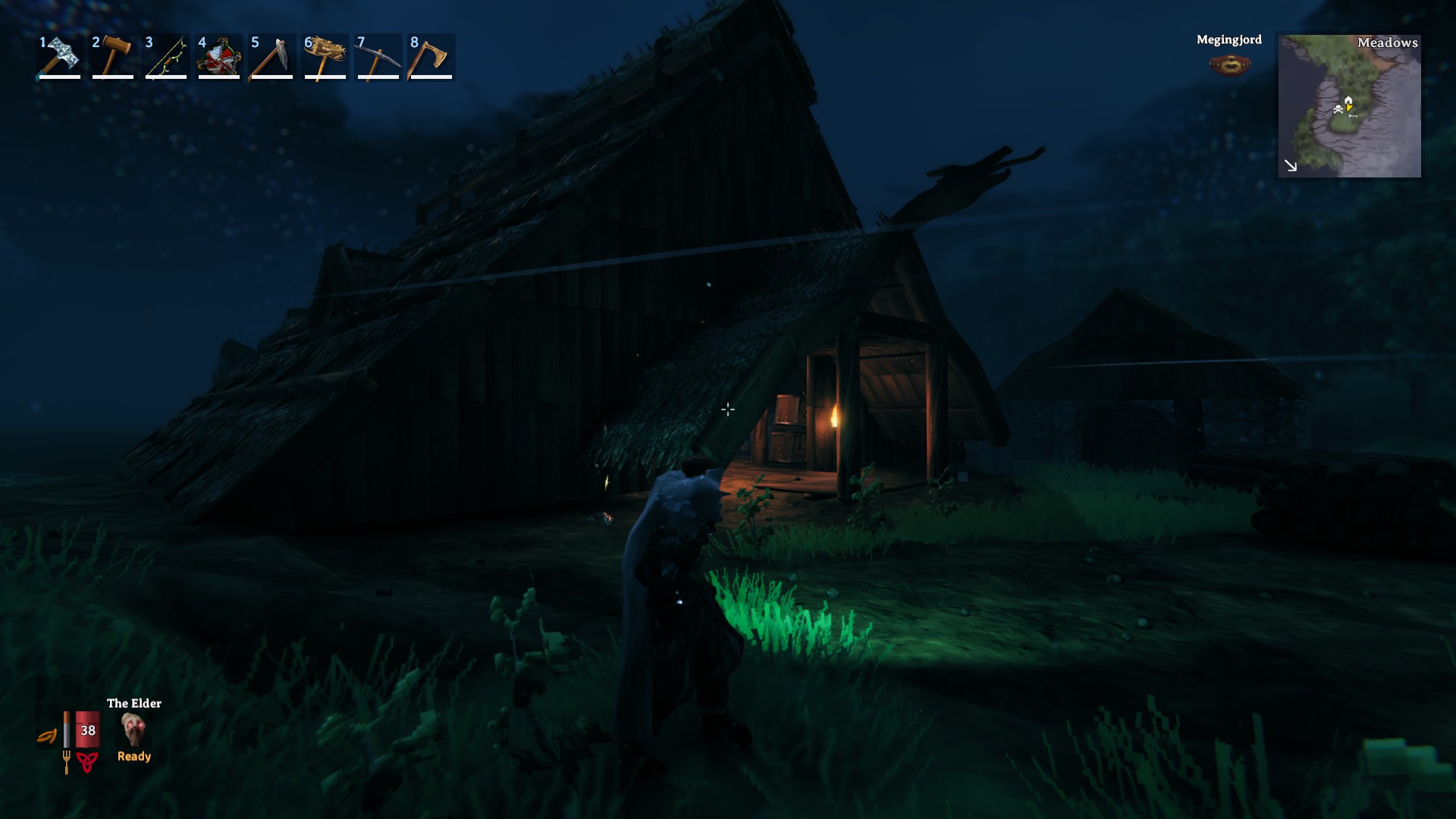
I opted for a seaside castle in the plains. I started with the walls, then dug a water filled moat (until I was forced to swim) all around. I laid down stone flooring, then a 4 corner tower structure 3×2 floors high. The hardest part was putting up a roof, since it was so far from the ground. Iron posts got that done. The dock was fun to make, in particular making a roof high enough for a longship mast to fit through. The end result is a practical abode that took about a week in-game to construct (and multiple deaths from fall damage). It’ll take me twice as long to tweak the design to have sufficient lighting, division, and practical use.

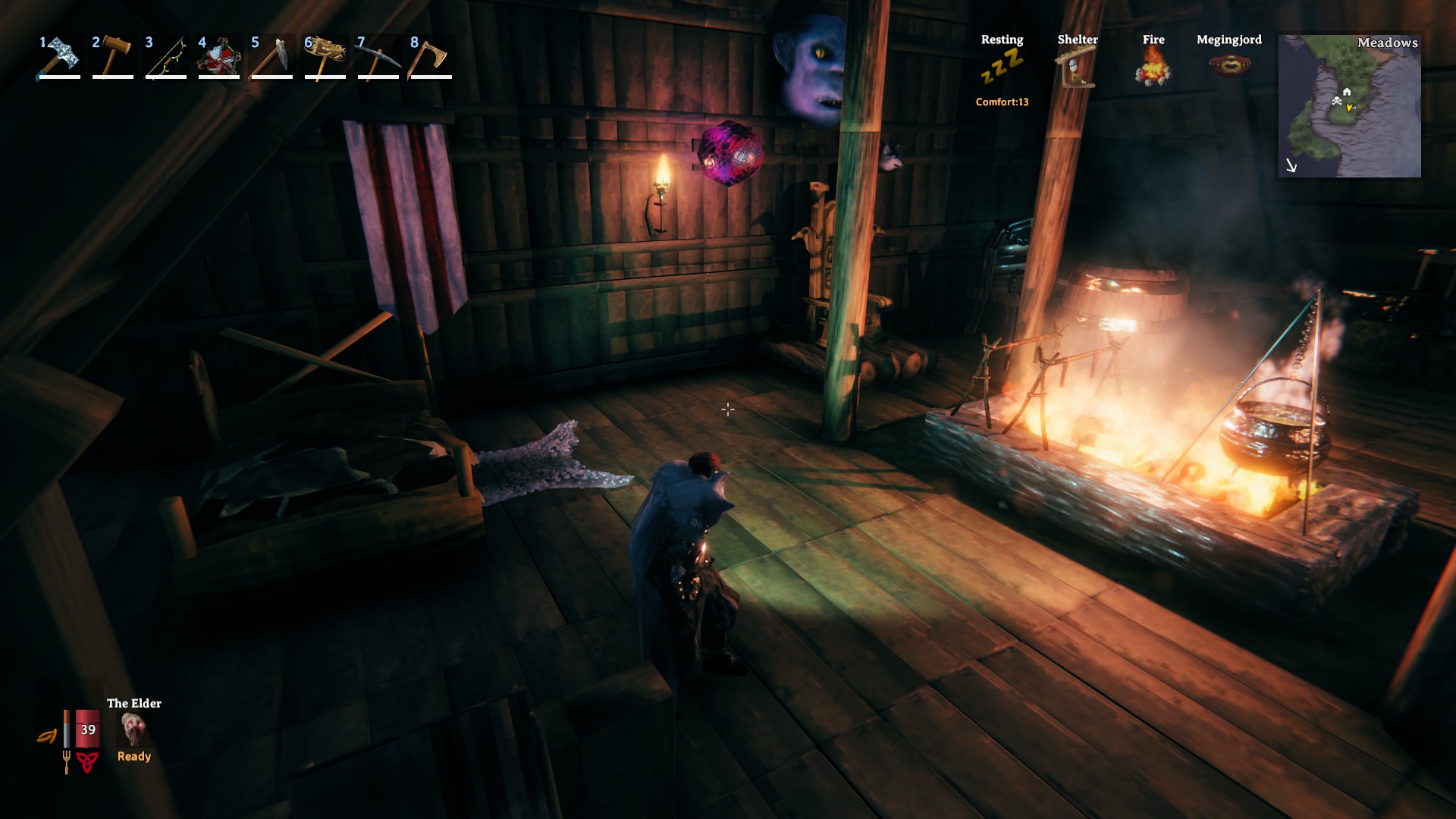
When I’m a tad happier with the overall design, I’ll update the pictures. The wall-o-chests needs a tad of prettying up, and the main dining hall needs a higher roof to allow for braziers. It is impressive how dark this place can be, so there’s finally a need for the 400 resin I have stockpiled!

This was an incredibly fulfilling process. Well beyond what I expected.

Yagluth Is No More

After the fall of Moder, I figured I was entering the unfinished part of the game. You know, the long tail where stuff is sort of just there and you make do. Well… Yes and No.

The Plains are a death trap, simply put. You cannot survive there if you’re not always rocking 100+hp. Deathsquitoes come from nowhere, fulings can crit for 90+, and lox are really bulldozers. Everything out there is out to kill you. And to continue Valheim’s penchant for punishing nights, you’re going to get fuling patrols at night, which are hella hard to see.

The twist here is that of all the stuff that drops in the plains, you need an artisan table to use. And you can only craft that at base. So it’s entirely possible to farm all the mats as soon as you start the game (which is insane, but you could), and yet without that table you’d just be filling chests. The part I think isn’t working is the amount of Iron you need to craft the armor. Somewhere around 110 for all of it, and after you’ve come down from the mountains you aren’t looking to go back to the swamps. I wonder if they will use the Black Metal drops instead in the future.

Anyhow, I decided to build myself a nice abobe – more on that in a future post – and really try to figure out how the plains work.

Plains Basics

Each biome has a place you need to raid to get stuff, and the plains are similar. You raid villages, and these are full of, well, fulings. They come in a bunch of flavors, with the ranged spear throwers the worst of the bunch as they hit at weird angles. Shaman are annoying as they shield everyone. Beserkers are smaller trolls, but hit harder. These villages come in different sizes and makeups, though most have 12 or so fulings to clear. You’ll get flax, barley, and black metal here. Used to make armor, food, and weapons respectively.

The challenge with villages is that a) they are uncommon, b) they are insanely dense in enemies, and c) these enemies hit fast. Melee is not going to be an option as you’ll get swarmed. Bow it is, and you will come to appreciate a high (>40) bow skill.

You will spend most of your time in a ship, scanning the coast for villages, taking shore, putting up a portal, eating a buffet, and then going to work clearing out a village. All that’s missing here is mead and it really is the stereotypical viking raid!

And one extra bit worth mention, the fuling shamans shoot fireballs and sometimes you get hit by a torch – so get used to being on fire. At least there are potions here – but you should be able to avoid nearly all of it anyhow.

Finding Yagluth

I am going to just put this out here, but this part stinks. It stunk for Moder and it stinks here. You need to find a tiny runestone in massive biomes that you are scanning from shore. You’re looking out for stone structures similar to Stonehenge to have a chance to find one. I found quite a few stone structures in my travels. It turned out to be a single arch that had a stone right next to it… nearly impossible to see if I hadn’t died to a damn mosquito next to it.

Fine. Yagluth was due north from my base.

Summoning Yagluth

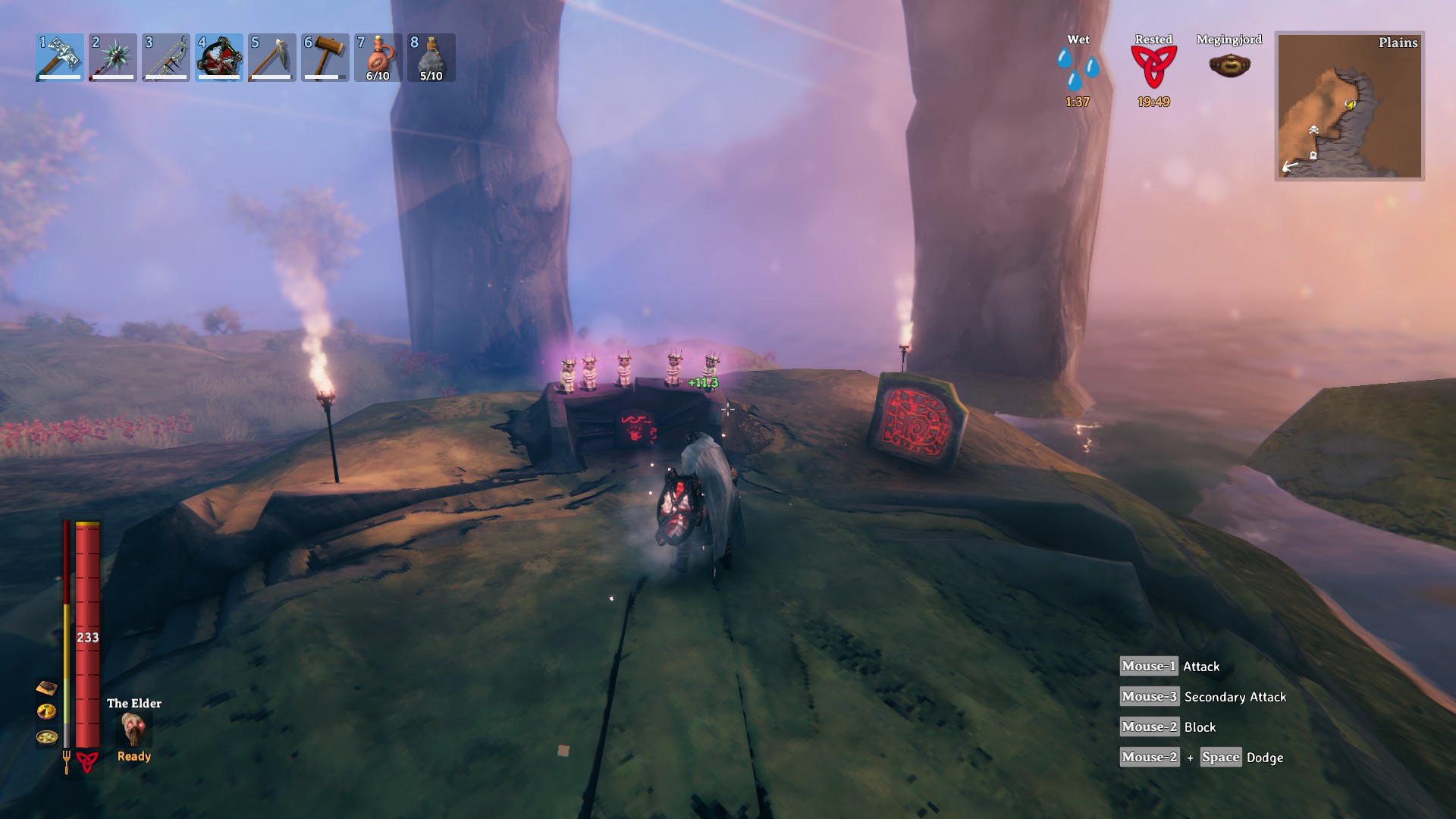
This part wasn’t clear to me as even with killing the villages I couldn’t see what it was I should be using. For the other bosses it was super obvious – either it dropped like candy or flashed (Moder’s eggs). Here, not so much. It took a while but I did eventually figure out it was Fuling Totems. I thought they were shaman trophies at first, since that’s when I got my first one. But I eventually noticed in another camp that they put the totem on a stick and it emitted an eerie light. One I found Yagluth’s area, it said I needed 5 of these things.

Of course even after 10 villages I only had 3. Instead of taking out the village for the fun of it, I started being super selective and only bothered attacking if it had a clearly visible totem. 5 in hand, I headed back to the altar.

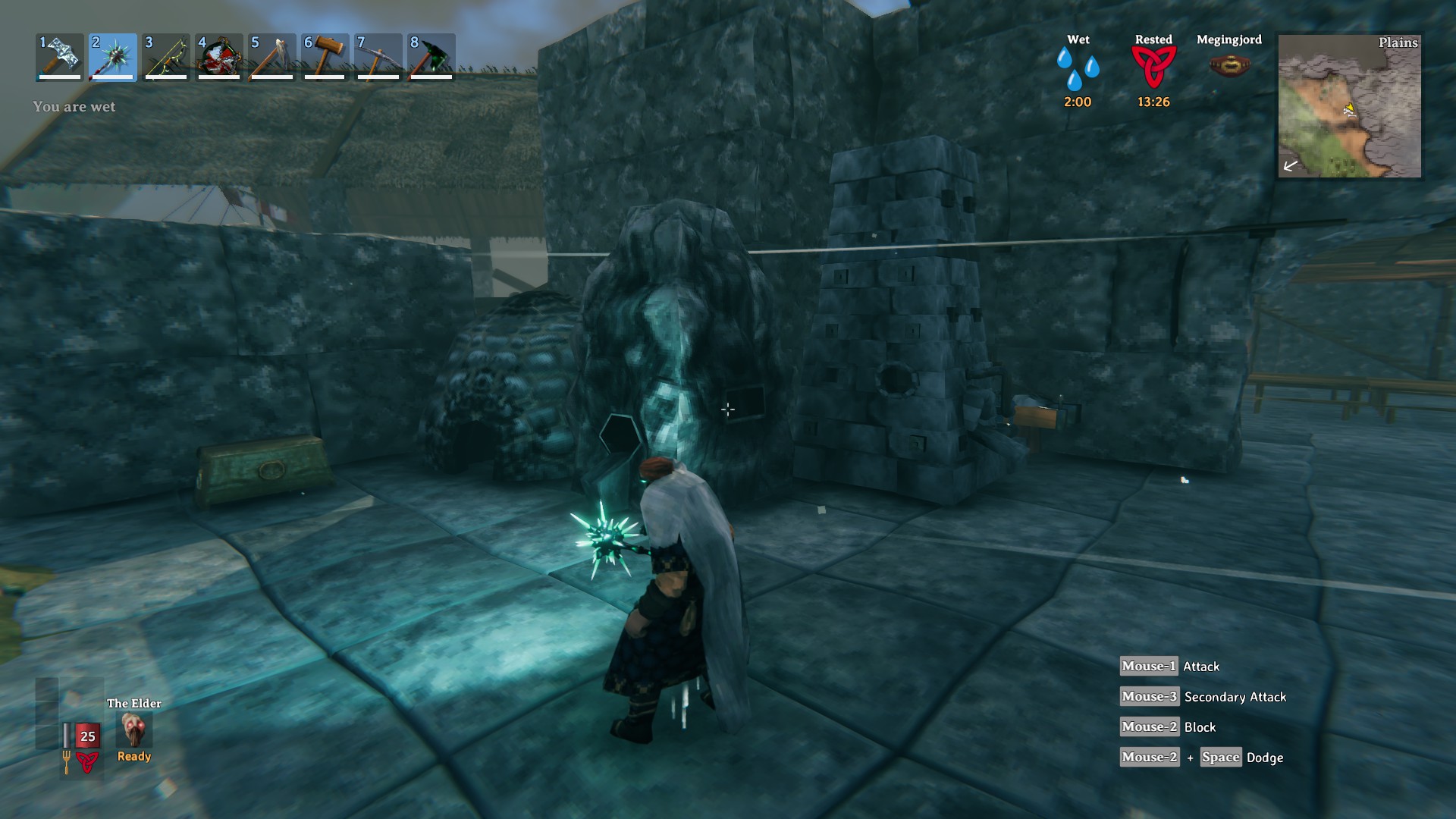
That seems like a lot of hit points. Notice I’m also wet.

You can’t see it here, but where that big tree is on the left there? Yeah, that’s a huge fuling village. More on that in a bit.

I showed up to the altar with max Frostner, Porcupine, Draugr Bow, Black Metal Shield, fire resist potions, medium healing potions, and having just gulped Lox Pie, Blood Pudding, and Turning Stew.

The Battle

Yagluth is a damn cool looking boss – feels like it’s straight out of a JRPG. A half corpse skeleton that shoots fire. He has 3 moves and no real cooldowns.

Lifting his right (your left) hand, he smashes down for a blast of fire damage and then some blue fire on the ground. You can avoid the blast, but you’ll need to be in the fire to damage him.

Lifting his left (your right) hand, he summons meteors that deal substantial fire damage. You need to run in a straight line as they home in on your location.

If you are too far away, he will shoot a fire beam at you that tracks your location. Easy enough to dodge, and it eats through stone.

If you’re just you vs him, then it’s not too painful. Use Frostner (since it deals extra damage to undead), avoid the meteors and fire beam. Face tank the rest, if you have decent food. But ya know what? Life don’t work that way in the plains!

About 15% of the way into the fight, an ENTIRE fuling village joined in the fun. Shamans and all! I needed to run circles around Yagluth while I used his AE fire attacks to whittle down the fulings. That worked until I hit a stone that was cracked and stumbled. Long enough for 3 fulings to spear me to death together.

Corpe runs to bosses are stressful enough. Corpse runs to a boss and a dozen fulings is just another level. I took a nap, fed myself, put on my old mountain armor and took a shield to town. Sleeping had caused half the fulings to leave, but caused 3 deathsquitos to show. Ugh. Corpse run then back to the portal – chucking the black metal on the way so I could actually use the portal.

Reset all my gear, psyched myself up and went back to town.

When I hit this phase, I knew I could beat him. Even with no more healing pots! Bows deal NO damage.

I took nearly 30 minutes from start to end, death run included, to take him down. It is really hard to explain the sense of joy that comes from taking down a boss that was hard to find, hard to summon, and hard to kill. And a boss that you can’t cheese (Bonemass archery towers, or Moder’s really bad pathing). If you aren’t going in with the best food, best armor, a good weapon, and some fire resist, you’re just not going to beat this thing.

And with another boss down, there’s only 1 thing left to do!

All altars complete

Steam says I have 91 hours in here. It doesn’t feel even close to that, as I never felt a minute was wasted. The devs are working on the home crafting for the next big patch. That makes a lot of sense. I love my castle, but some more tools to improve it would go a long way. Including some terraforming processing improvements. My FPS can drop sometimes, and the autosave takes nearly 4 seconds. Which it did while fighting Yagluth no less!

While all the bosses are down, I’ve got a few more bits I want to flesh out around my home base.

And all this for $20!

Should’ve Hired Movers

You can build anywhere in Valheim. Flat floors, over the water, in caves, up in the trees. Some folks are insanely creative. Now whether it’s practical or not is a different matter. I wouldn’t build in the swamps if you paid me, and the mountains require some crazy engineering feats to make it all work. Looks amazing all the same.

For practical reasons you’re going to build either in the meadows or the plains. The meadows has the simplest enemies, nearly every food grows there, and it’s often quite flat. The plains are great too (2 key things only work here), yet you have to deal with some rather deadly natural enemies, and sloping terrain. But just building in a biome isn’t helpful. You want to be near the ocean for your ship, and hopefully close to a few biomes for some more farming. Swamps in particular – however much iron you think you need, triple it.

With that in mind, my original homestead had served it’s purpose. I was forced to take long trips to mine, and wasn’t really well situated in terms of shoreline. In my travels to find the vendor, I happened upon a nice piece of coast, with a nearby stream, and right next to all the biomes. Time to get prepped to move!

Limits!

Portals are great. More than great, they are true lifesavers. But they don’t let you bring metals, meaning you need a ship to make the trip. Good news first – the longship has 18 slots and metal stacks to 30 each. That’s 540 pieces I can move! The bad news was that I had 40 stacks to transport – and had no interest of making 2 trips.

I’d have to dig again, but I found a blog that had the neat idea to put a cart on a ship. Heck, they had put 2. Since carts have 18 slots, that was more than enough to bring all my metal in a single trip.

Build It First

Here’s a lesson I learned quickly. Don’t move stuff before you have a place to put it. I sailed all the way over, figured I could build something quick, and then get going. Nope! The spot I selected had a Draugr camp, and was a stone’s through from a Fuling tower, a herd of Lox, and obviously Deathsquitoes. And as poor habits have me, I tend to sail without food on the ship. Sure enough, I land at night and get my butt handed to me. At least it was after I put down my portal!

I took my time to clear it all out and then took my time laying out a spot to make camp. My prior “practical” abode was a simple box to hold all my stuff. This time, I really wanted to take advantage of the space to try some stuff out. I knew I wanted more comfort (to increase rested time), more than enough space for crafting kiosk + upgrades, and enough room for some fortified chests (18 slots!), a decent sized farm, and a portal room. I needed to think stuff through!

Taking it Slow

I started with my hoe to level out the terrain, then laid out some 2×2 flooring to get a decent base. I wanted something more akin to a natural house, or an A-frame. Building in Valheim requires thinking, since items need to be connected to the ground by other items. You see this through the colors of items connected together – green is good, red is bad. It took way more time than I want to admit to get even a basic roof going. Had to remember to put in a running chimney up top for the fire inside.

Work in progress

With the walls up, I was able to transport all my junk stuff in batches through the portal. I had so much resin it felt like Jurassic Park. A bunch of fortified chests and I was good enough to put a bed and call it a day. More like 4 in-game days.

Oh, and while I was building, I had 4, yes 4, troll attacks. 2 of those attacks I lost everything.

Adding As I Go

The beauty here is that it’s easy to add to existing buildings or correct mistakes. The main reason I dislike survival games is that you can’t make mistakes – put something in the wrong spot and you lose the materials. Valheim is awesome since it let’s you experiment for no real cost. It’s great in that you just keep progressing forward.

With that in mind, I wanted to change my entryway, and redecorate inside.

Side windows and new entryway
Stacked chests, but needs work
20 minutes of rested! That’s a dragon egg on the wall
Crafting stations + archery range (stone pillars)
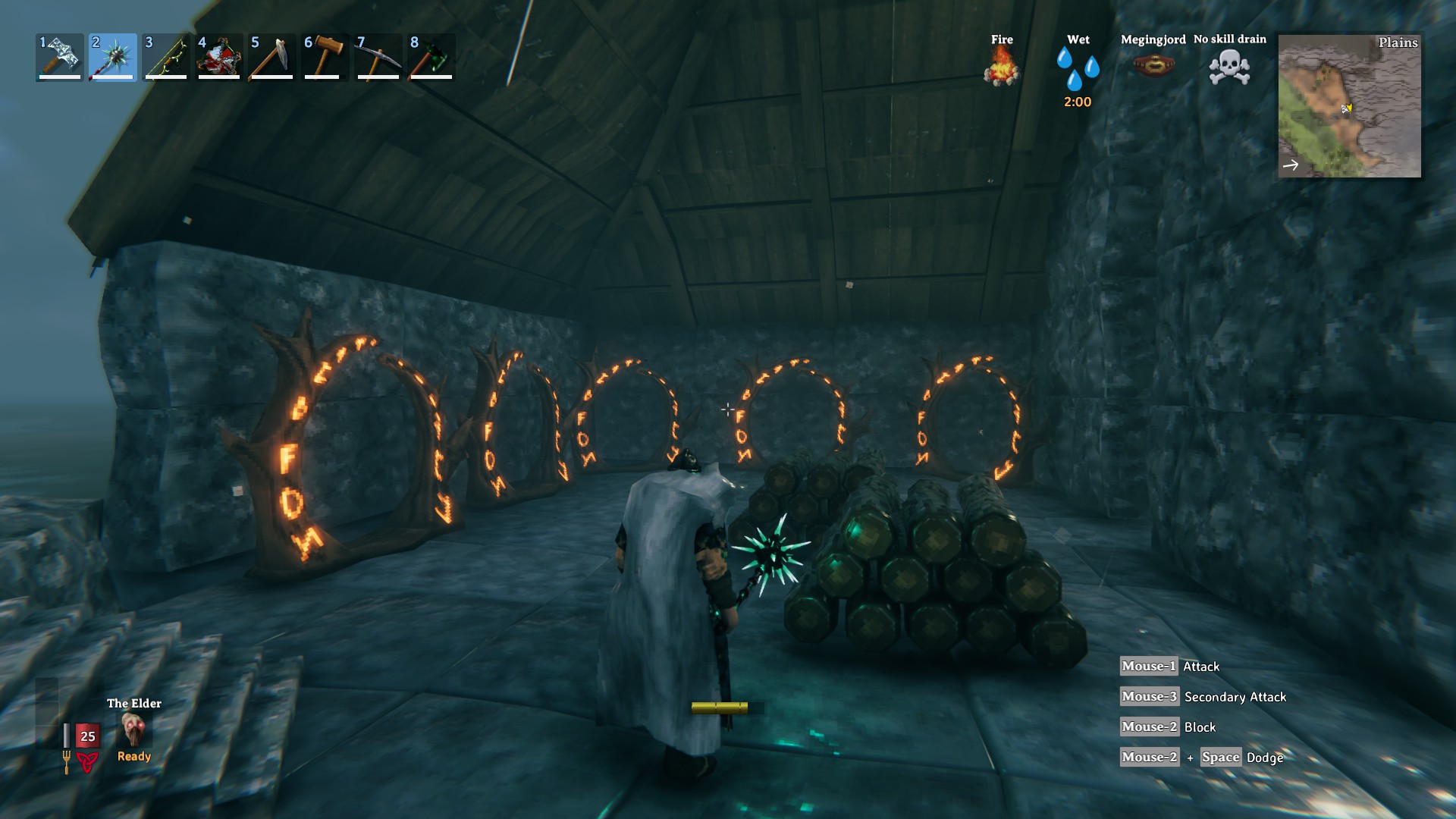
5 portals in this shed
The farm. Turnips!
The Great Wall protecting me from the plains folk

Next Steps

I’ve cleared a few plains camps now and have some things that only work in the plains. And I’m seriously short on iron and chains (ugh, these thing are a pain to find – Wraiths at night are best). So while I have a decent abode here, I’ve come to realize that I’m going to have to move again. It won’t be far mind you, not much more than 5 full power shots from my bow. Enough to be on the plains, yet still close to the Meadow/Black Forest biomes.

I’ll use the lessons learned from this build to really make a solid final base, and this time, with moat. Trolls won’t cross that!

Being Prepared

Elder and Bonemass taught me that preparation goes a very long way in a boss fight. Not only in making sure I am ready, but that the world itself is ready. Boss fights in Valheim are really attrition rather than tactics. Do you have the stamina/hp to survive a drawn out fight, and one that likely will other enemies join in.

Prep work focused on a few areas:

  • Making sure all my gear is prepared and that the items I will use are relatively well upgraded.
    • Base frost armor is 20, and every increment add 2. Aside from Golems, the damage in the mountains is manageable, rank 1 for me.
    • The Draugr Fang bow deals pierce/poison damage. The damage increase is 3/5, which isn’t a whole lot. But the durability increases are massive (100/150/200/250). Rank 3 for me.
    • The Silver Shield has strong block power (75/80/85) which is incredibly powerful. Rank 2 at least.
  • Making sure I have consumables!
    • 6 medium healing potions. These things have long cooldowns, so you want it to be BIG when you do use it.
    • 3x meat based foods. I don’t have Lox yet, so it’s sausages, cooked meat, and cooked neck for me.
    • 200 poison arrows. Same cost as obsidian arrows + 2 ooze (from slimes) per craft. Poison seems small, but it’s always active. It’ll probably be 20% of your total damage on a long fight.
    • Probably a good idea to use Bonemass’ power for any boss fight. It allows for you to make mistakes at the start.
  • Making sure the world is ready
    • My portal cabin is close, without being too close. This makes sure I can run away if needed, but far enough that the boss wont accidentally crush it
    • I clear the general area around the boss summon so the ground is relatively flat (pickaxe + hoe) This includes trees.
    • Do not, ever, fight while Wet or without the Rested bonus. The stamina regen penalty will kill you.
    • Get a good night’s rest so you have a full day of sunlight. Night creatures as super deadly.

The Fight

3 eggs (200kg each!!) and then an extra click to summon Moder. It’s clear from the altar that she’s a drake, and sure enough she spawns in the air. By this point, you’ve probably killed a few dozen drakes and Moder is just a steroid version. She gets extremely close to you and shoots large ice bombs that will leave residue on the ground. Getting hit by one is close to 60 damage, so you want to avoid it as much as possible.

She generally shoots 2 times in the air, then comes down for some melee bits. This part seems buggy to me, as she both moves extremely slowly, and isn’t aggressive if you keep your distance. Golems chase you more. Anyhow, she has 2 other attacks here – one is a very (very) long-reach melee attack, and the second is a straight cold beam she shoots from her jaws. The swipe hits really hard, and the beam has a sort of ticking damage depending on how long you’re standing there.

From this, it should be pretty clear that you should not be in melee range with Moder.

My rested bonus at the start of this fight was 12 minute…it is a long fight

With trusty bow in hand, I shot arrow after arrow into this dragon’s hide. While Moder is certainly LARGE, arrows have physics applied to them, so you really need to plan the shots in order to not waste stamina shooting into the air. I fully expected some Drake to show (they always show elsewhere), or some wolves… heck, there were no nearby golems either. Nothing though, so it was just me vs the dragon, and in any 1 vs 1 setting in Valheim, that is a massive advantage to you.

12 minutes later, Moder dropped. In mid-flight, from a poison tick no less.

After having taken down Bonemass, I have to say that Moder was a mile easier. The pathfinding portion certainly helps, but without a near permanent DoT and tons of adds, this is only slightly harder than the Elder. Now that I have some Dragon Tears I can make an Artisan Table. First though…

It is hard to describe the feeling of accomplishment (EA could learn something!) when looking at these altars. Looking at Elkthyr, it’s a great reminder of how far I’ve come in this world.

Next up – creating a new settlement.