RIP – Overwatch

An opinion article, fine, but also one that really does a good job highlighting the compounding Blizzard woes of poor pipeline management.

There are multiple factors here, and all of them are compounding on each other. Nearly all of them deal with Blizzard’s management approach.

Content drought

The pace of content for any GaaS is predicated on keeping people engaged. OW has been borderline maintenance mode, in line with the WoW content pipeline approach. Is game development hard? HELL YEAH. Did it get harder with COVID, triple hell yeah. At we 18 months into the COVID model? Yup, and any management team that wasn’t able to adapt (not reach 100% of prior, simply adapt) really shouldn’t be a management team. So while yes, there are delays, no it shouldn’t be an all-stop.

Competition

Valorant is one, no doubt. But Apex, Fortnite and a pile of others still manage to release content on some cadence and take some eyeballs. Gamers are locusts and lemmings. Cool that you had something 3 months ago, but there’s a bright and shiny over here.

Fair to point that Blizzard made a point of keeping track with WoW to launch updates to compete with FF14, Wildstar and other MMOs. The shoe is clearly on the other foot now.

Sequel

Any “live” game keeps eyeballs as long as they know there’s a roadmap. Announcing a sequel, means that you’re pulling people from the current one to the next one. Halo 2 players moved to Halo 3. But those game launch cycles are 1 to 2 years. Overwatch 2 was announced at BlizzCon 2019. It will not launch until 2022, at the earliest.

The serious downside to sequels is that you need an A and B team. Each alternates between dev and support. It was made really clear that this did not exist for OW2, and that they needed resources shared between both. Why not add more people? First, the skills are hard to find, and second, that costs money.

Leadership

There’s no denying that Jeff Kaplan is the reason that Overwatch even exists. The game director leaving mid-stream is never a good sign. And we can’t shy away that this whole lawsuit is going to cause some leadership ripples (for now, this seems to be hitting Diablo 4).

Sponsors

It seems you only need to wait a day to learn about another sponsor dropping OWL. This is a financial consideration after all… HotS was shut down due to funding. OWL cannot survive without sponsors, and if OWL doesn’t exist, then there’s not much coming in terms of funding for future content.

End Result

This is a year and a half of content drought, nothing in the pipeline, leadership woes, serious competition, and diminishing funds. This doesn’t mean that OW2 is dead in the water, but it does provide some serious indications that OW1 is on it’s last legs as an e-sports item. It’ll move into the HotS bucket of maintenance mode.

I really didn’t think that OW would have reached this space this quickly. A fascinating set of circumstances.

ActiBlizz – A Picture Says a Thousand Words

A bingo card

More “departures” at Blizzard, and this particular photo is acting as a sort of hit list of easy targets for Activision to take action upon.

I have done some dumb things in my life, of that there’s no question. We all have. I’ve paid my fair share of consequences, enough to understand that while in a leadership position, there are some fundamental values and ethics that we need to share. And for a very long time, money allowed people to get away with almost anything. If you survived the middle trenches, it really didn’t matter what you did from that point forward.

There’s a fundamental concept in physics, that for every action there is a commensurate reaction. This applies to sociology as well, just that the timeframes are different. Sometimes that triggering event seems minor compared to other things, but it’s just a lack of awareness of the pressure on that given topic. Dam failures are not often caused by massive floods, it’s gradually eating away and lack of maintenance.

SUPER TANGENT TIME! I do want to point that the last US President is viewed as the final trigger for sexual harassment deluge. MeToo started in the mid-2000’s but truly picked up in 2017. The trickle turned into a torrent of allegations everywhere, and you can’t shake a stick without hearing/reading about it. The normalcy that he presented in sexual assault/harassment really pushed this thing over the edge. And where this current leads, I have no clue.

So more Blizzard leadership exits, and I’m somewhat sure that this will continue for the months to come. It’s a good message to leaders that there are consequences for actions, but it’s also years late. And for those who actually want to buy Blizzard products, the leadership exists here mean that dev cycles will slow to a crawl, which certainly isn’t helping things. It’s all bad news, with a sliver of justice for those who were abused in the past.

Let’s see how far this toilet will flush.

UX

In my younger days as a programmer, I spent a total of 0 hrs thinking about how people used my products. I coded, and people were simply using it wrong. I then coded a program for tanning salons, something to help them book, scan cards, charge people, run the beds, and then tabulate the finances. Like an all-in-one app for a cash-only business (I learned a LOT about ethics here!) Where I spent 2 months coding (the interface to the beds was painful), I spent 6 months doing the user interface work – back in the day we called it UI. Let me tell you that the ladies working there were trying their best, but 4in press-on-nails do not work with keyboards, or small icons. From that point forward, I had a much different appreciate for ease of use.

A few years ago, the concepts of UI got rebranded to the totality of the User eXperience (UX), which covered more than just the buttons, but how the user feels when they are using it. Amazon is a great example, where the UX has been refined over the years to reduce the number of clicks required to complete a transaction. In quite a few cases, 1 click can place and confirm an order (you shouldn’t use this btw). Apple, under Mr. Jobs, had the UX as a core principle of design. I’ll readily admit that the mid 2010 Apple devices were super intuitive and much better than Android. The stuff just worked.

Games are very similar. Mobile games break with bad UI – the successful ones are predicated on simple interfaces that allow complex execution. Incremental games are successful based on the impression of progress where there is little – AdVenture Capitalist succeeds where many do not.

Controller based games simply need to be responsive. Input lag, slowness, poor button placement, TTK ratios all need to be refined through iteration. The user needs to feel like they have some sense of control of the outcomes. Hades and Dead Cells feel amazing because they are ultra responsive – and also rather simple. Keyboard/mouse games aren’t a whole lot different – LoL works because the interface allows it, and that each click matters.

There are quite a few reports on how Mario Bros on NES was designed with UX in mind. The pace of the obstacles, the music, the gradual increases in difficulty are all reflective of a thoughtful design. The NES is a fascinating exploration of good and bad UX (Battletoads is near impossible because of a crappy UX).

Bad UX on the other hand, dramatically impedes the perception of quality. WoW’s default UI is horrendous, and you’re practically mandated to use mods in order to make any sense of the game – at least with regards to the rails Blizzard wants you to run upon. FF14 is marginally better, due to simplified systems, but you’re still looking at 3-4 hotbars of buttons. Civilization as a series has refined this a lot over time, and looking at any other thematically similar game really makes you question why developers think they can do better (I do think Civ 5 is better than Civ 6 due to this).

Complex simulation games live and die on the ability to relay complex concepts in digestible and layered interfaces. Frostpunk is a set of disasters that need to be addressed before they cascade to total failure. When things are about to fail, you are warned. When they do fail, you get a big notice. SimCity doesn’t readily tell you that something needs tweaking, and you’re often stuck digging through a bunch of variables to see why things are not progressing. Factory games aren’t much different! The supply chains can fail at multiple points and it’s not often clear at a glance as to why. The ability to bring up a production report (Factorio and DSP have this) can give an indication because your consumption is equal to production (or above).

In summary, the general thought on UX is that its reflective of polish. Most QA testing focuses on bug catching, but there’s the risk of the people used to the interface becoming accustomed to it. It’s also quite hard to accurate measure, as it’s often a subjective view. The sort of good news is that most gamers have an appreciation for it, and that more and more ‘reviewers’ are taking it into account, A great UX simply enhances the total experience, and it really sticks out when it’s not present.

DSP – Restart

Who restarts a 100hr playthrough, honestly? I do!

I won’t sugar coat it, Satisfactory was seriously making me question my sanity. ImKibbitz has a ton of videos on that game (and does a great job at it too), and his more recent one on the transition of late-game nuclear waste (the penultimate stage) is fascinating to me. You know how you watch a Minecraft video and it shows these massive cities? Satisfactory is like that. It’s a 24 minute video that honestly covers like 20 hours of effort. It’s glorious when it’s all running at the end. (There’s another video of a “full game world” with some artistic touches that has over 1000hrs of playtime. Craziness.

So I was thinking, is Dyson Sphere Project really that different? What is it about that game that makes it more enjoyable? A new playthrough with a different set of lenses, one that understands the mechanics and has a general plan, would certainly focus on the details and quality of life bits. At least, that was the thinking.

Starter World

The randomizer at the start of the game has some bits of interesting, like how spread out the star systems are. If they are too close, then the rare materials spawn less often. So a wide space is best. The number of planets per type doesn’t mean much – you’ll only ever have 1 black hole. With that set up, I landed and began immediately to survey the land.

Every starting planet has the same sort of temperate layout. You’ll have water, trees, rocks, iron, copper, coal, stone and oil. The “difficulty” here is in the land allocation. You’re often put in a space that’s somewhat tight in terms of land/water ratio, and the first few nodes accessible are low volume. Starter area after all. That makes it important to scout ahead and find where the larger ore piles are located and the larger land masses. You’re going to need it.

The Bus

The concept here is that you want to build a highway of basic material, and then run it through a production area. The first “bus” area will focus on stone, iron, and copper. You’ll break it into 4 phases, basic material, assembled material, buildings, and storage.

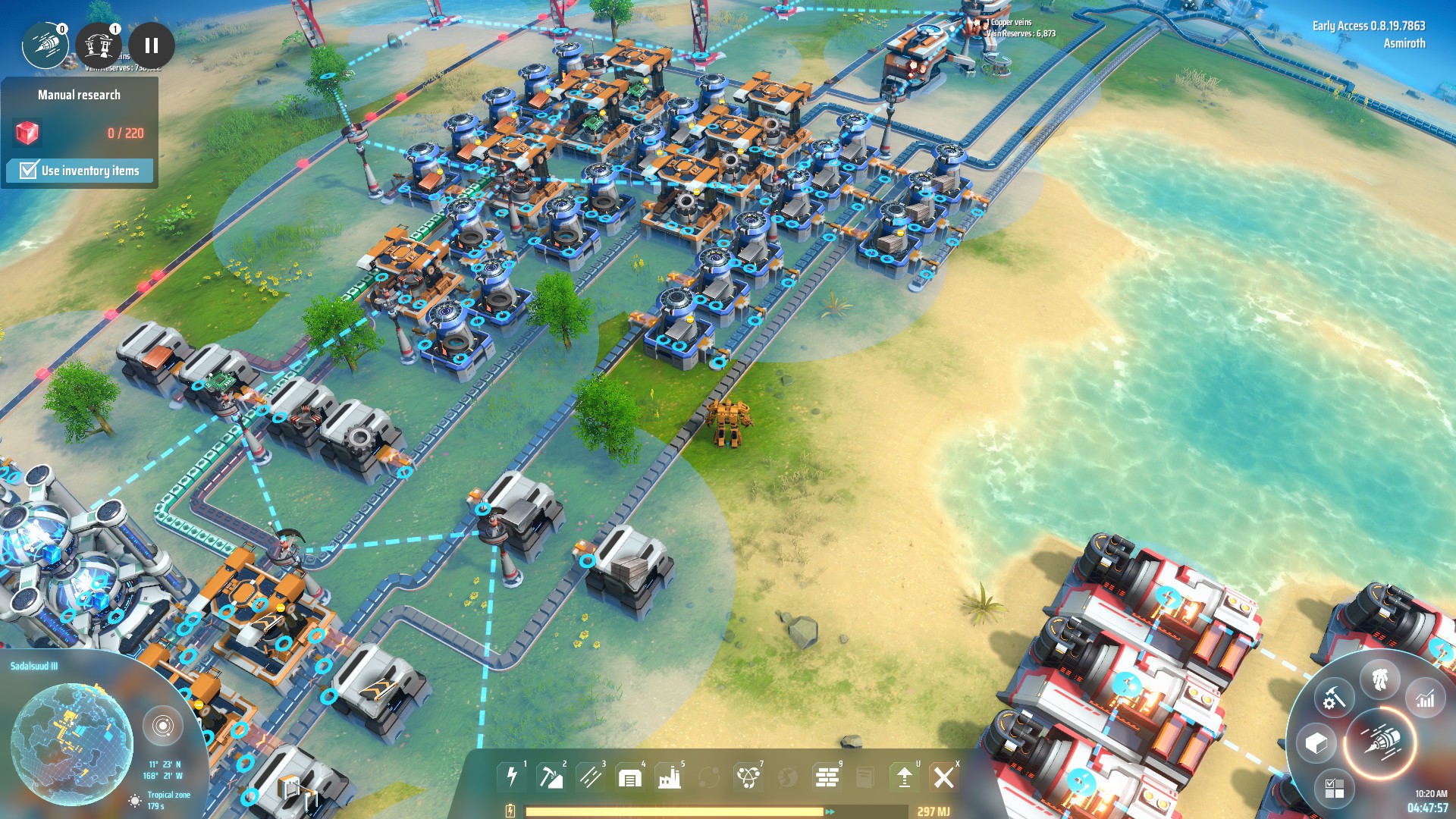
Basic material is the initial smelting process. Stone to Bricks, Iron to Ingots and Magnets, Copper to Ingots. The assembled material will move into the simple items, Gears, Magnetic Coils and Circuit Boards. This phase then leads out with 5 lines to the buildings section (bricks, iron ingots, gears, coils, and circuit boards). You can make nearly every important building with these 5 items (Tesla, Wind Turbine, Belts, Sorters, Splitters, Storage, Smelters, Assemblers, Miners, Thermal Stations). Building all these things is important, but you’ll want to store them too. Setting the maximums is important, you’re unlikely to need more than 50 miners and a box can hold 1500. Best to restrict production so that the resources can be used for things “down the line”.

Since this bus takes space, you’re going to need some rather open room to build it all. I’ve personally split it into 2 groups – one for the first 2 phases, then another for the last 2. Breaking up a phase is not a good idea, you’ll end up with spaghetti lines. The best part of a bus is that if you empty an ore node, it’s really easy to run a new supply line to the start and not have to rebuild the entire thing. And since you’ll have 5 main outputs (and access to copper ingots), you can then work to have a more complex 5th tier of the bus to make things go.

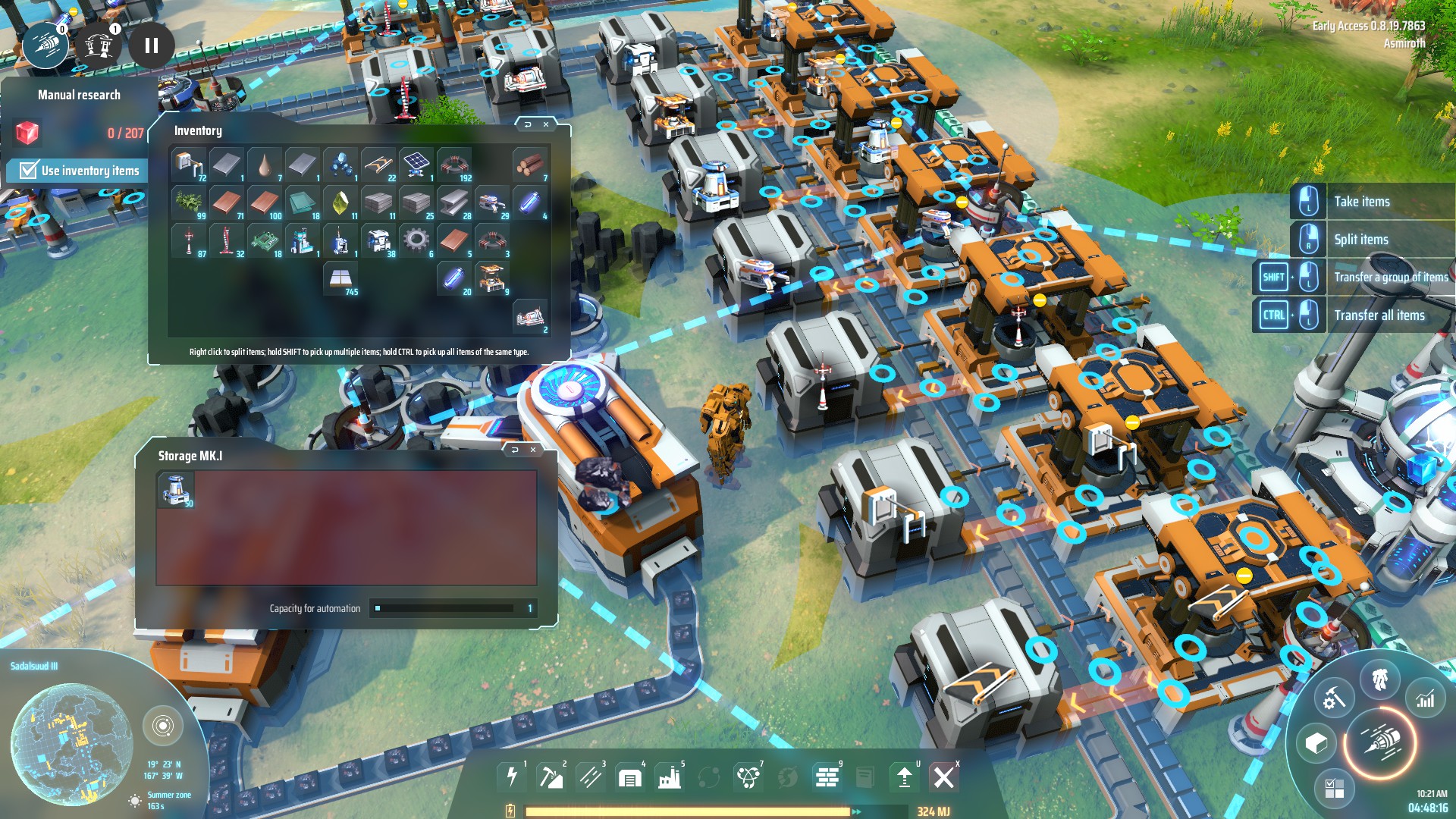
The basic construction phase of the bus

The concepts of buses are important, as you’re going to need to do it again for oil, and then again for silicon. You’ll have basic inputs, a transform phase, and then a storage phase. And then use that storage to kick off another transform & storage phase. The storage part is super important, as it allows you to make changes within the bus and not have impacts on the rate of production downstream. As supply chains get more complex, breaking an early part can have devastating effects down stream. It also allows you to create one-off items when automation isn’t practical (e.g. early logistic stations).

The assembler phase with storage

Research Planning

The research tree in DSP is big, and it’s entirely possible to research a tech and not be able to build the items because it’s missing a dependency. It’s also not at all clear to a new player what’s actually important!

That’s only half the choices!

Having done a full playthrough, I have a much greater appreciation for what’s important for progress. You’ll reach pain points that prevent automation, so my general thinking is:

  • Basic power (tesla + wind turbines)
  • Mining (to get ore)
  • Smelting (to make ingots)
  • Logistics (belts and sorters)
  • Assemblers (to complete the bus)
  • Blue Matrix (research cubes)
  • Graphite (refined coal)
  • Thermal Plants

That’s pretty much all you need to get the main starter bus up and running. The upgrade tree (generic upgrades) are also good, where you really want to unlock Drive Engine 2 in order to visit another planet. The other planet will have silicon & titanium, essential for future growth.

Build Phases

The early game is all about Blue Matrix production. You need oil to get to the Red Matrix phase, which is a new bus that is more dependent on glass production (stone) and a completely different bus (water, sulphur, coal, oil). The Yellow Matrix phase is a right mess, because it needs Titanium and Silicon, which are only found on another planet. You need a fair chunk of it too, like 6 trips with full inventory worth, to get access to the real goal – Interplanetary Logistic Stations.

When you get access to those (~ the 8hr mark), the game completely changes in scope. For another post.

ActiBlizz – Part 3

The internet is a funny place. There’s next to nothing that is fully isolated, most things are dependent on other things. That thing you treasure, odds are it’s dependent on a pile of other products to function. You hate Steam? Well how else are you going to buy that cool PC game? Want to boycott a car company? There are 300 different companies providing parts to it. Imagine for a second if YouTube shut down tomorrow, or Facebook? How many “influencers” would be out of a “job”?

ActiBlizz is no different. There are thousands of people that have tertiary relationships to the company and make a “living” from it. MMO-Champion and WoWhead would stop to exist without WoW. BlizzardWatch if the company went away.

Preach, Bellular, Evi+Tali, Asmongold all made a decent buck on the WoW wagon. Two of them have decided to move on, and certainly are going to bring a crowd with them. Where does Dark Legacy Comics go?

Overwatch League brings in a fair chunk of cash to the coffers. T-Mobile has pulled their ads and others are looking to do the same. Kellogg’s is out. That increases the risk that OWL as an e-sport is at risk of not being able to move forward – just like HotS went through. When HotS did close, there were a lot of people that needed to find new income streams – most outside of the ActiBlizz umbrella. It’s a hell of a choice to change your livelyhood, compared to a player changing what icon they are going to click.

This blends into the discussion of boycotting, where the impacts are oddly messed up into the idea of “winning”. Like if all the “good” people quit WoW, then the “bad” people have won. In what world does your monthly sub and in-game chat have an impact on the paycheck of a CEO? Does anyone think that the WoW direction is a positive one based on player feedback? The MAU certainly say otherwise. Do people think there’s any positive to come out of the LoL community? Nah, we just end up with tertiary actors mad at other tertiary actors.

If you’re paying any attention, ActiBlizz only makes decisions based on money. Their shares went up on the Q2 reports. As long as they are making money, and not risking losing money, they have no reason to make meaningful change. You paying them and expecting them to change is insanity. Why would they? They’ve got what they need from you.

You ever try to negotiate a bill or service with your internet provider? Ever have any success without threatening to cancel your subscription? They don’t care about you as a person, at all. They just want to ensure that you pay your bills on time. Big companies are the same.

If you want something to change, stop rewarding the negative behaviour and instead, reward the good behaviour.

DSP – Starter Experience

I dislike saying something isn’t working when there’s no comparative. If you haven’t played Factorio, then it’s important to state that this is the gold standard for the factory genre (admittedly niche).

The snowball effect of complexity

Dyson Sphere Project (DSP) is a lot like Factorio in almost all respects. The change to 3D brings a verticality to building and then some geometry since you’re building on large spheres. And the whole large scale logistical bit (trains) are replaced with shuttles since you’re moving between planets (side effect of not having the need for train tracks). This last bit is a major simplification from Factorio.

The starter experiences are extremely similar. You:

  • Manually mine 1 resource
  • Create a mining factory & power it
  • Create a smelting factory & power it
  • Connect the mining to the factory through a belt
  • Mine a second resource and repeat
  • Use the dual smelters to assemble something more complex

Once you’ve assembled one thing, the rest of the game is the same concept. Mine/harvest/extract some resource, refine it, and merge it with something else. The complexity comes from multiple layers of crafting items, at different rates of production, and getting them all to the right locations. The earlier you are organized into ‘hubs’ the easier life becomes.

ABC

Corny, fine, but Always Be Crafting. These games are about falling forward, so when you have solved one logistical challenge, a new one shows up. You think that you’ll never need more Iron Plates but then you realize that you need to produce 50x the same amount.

The actual Dyson Sphere requires somewhere close to 120,000 solar sails. Each sail takes 25 raw materials, across 6 different types. There are 12 crating stages involved, which has its own logistical challenges. So 3 million in pure raw materials, plus close to 2 million more in the logistical buildings to automate it all.

And you start the game mining 1 item per second.

Satisfactory

I feel the need to compare here as the concepts are the same (more like Factorio as it’s not a sphere and also has trains). The execution is more finicky because it’s next to impossible to select multiple things, draw things out, or do simple group alignment. Videos really do justice to explaining this, so for comparison’s sake here is the same streamer explaining the starter experience in both Satisfactory and DSP (he also has some Factorio stuff). Both videos are similar in length, but the ease of interface is the key bit. (I am avoiding the random MAM research results that would require rebuilding a factory line… that’s its own rant.)

Satisfactory start

DSP start

Satisfactory – Post Coal

Steam says I have 24 hrs in, and I’m trying to fill up the items for the next phase of the Space Elevator to unlock ranks 5-6 research. If that means nothing to you, Satisfactory has 4 main “phases”, blocked into sets of 2 ranks of research. 0 is the intro, 1-2 are the starter, 3-4 are the basic (coal + steel), 5-6 are mid (oil), and 7-8 are the end (nuclear). So I guess I’m at the end of the basic phase.

Sandbox

Satisfactory is bound by two main factors – belts of mined items and power. It doesn’t matter what you want to build, the power limits are going to prevent you from automating much to start. Even coal power is quickly consumed with the need for massive (I think) power plants to get things running, then large powerlines to get it where you need.

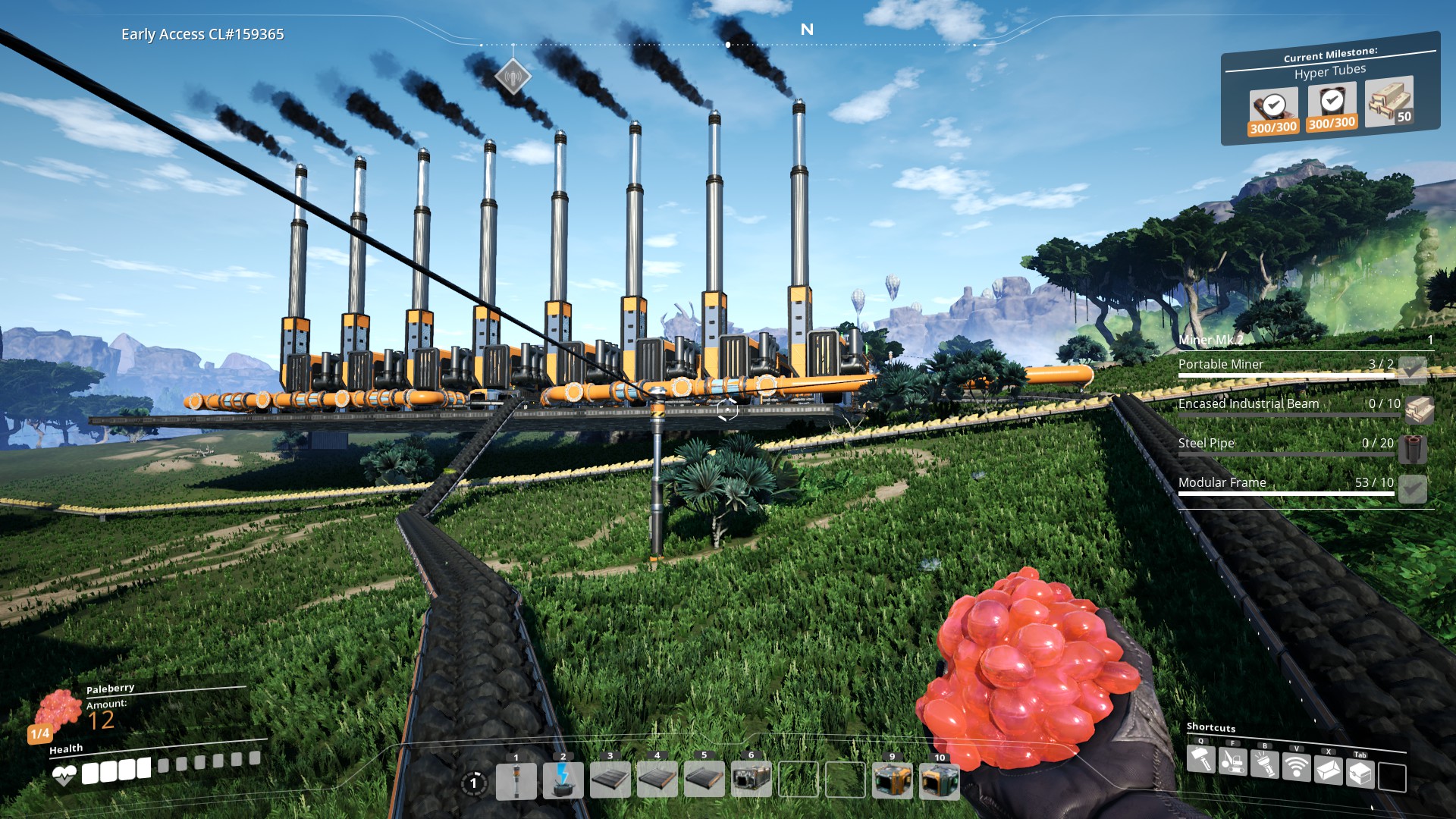
The coal miner way in the distance
My 600MW set of factories.

It took me a while to figure out this layout and the math required to make the water pressure make sense. Let alone the sheer volume of Mk2 Belts needed to get the coal there in the first place. Mines have different production rates, and you need to make sure the belt can deliver it to the intended target.

Mk1 Belts are really easy to get going. Mk2 require Reinforced Iron Plates, which comes from screws and prior plates. At a rate of 7.5/minute. My coal run above has nearly 300 pieces of belt. That’s 40 minutes of waiting, assuming I don’t need the pieces for other bits (I do). Mk3 are based on Steel Ingots, which are used for even more things. It’s insanely tedious that basic logistics are so painful to manage. Heck, my Sulfur mine is a good 600 belt pieces away (30 belt pieces per 100meters).

Map Size

No sense in shying away from it, the map is frickin’ massive. I’ve seen maybe 5% of it in 24 hours. DSP is massive – it’s solar systems after all – but it also comes with some serious improvements to player movement early on. And getting stuff from one location to the other is not about walking for 5-10 minutes.

I will state that having a world THIS big and no map is beyond dumb. (I know I can unlock it, with Quartz 1.5km away.)

I do read about vehicles being an option, even jetpacks. That would be awesome! There’s even the option for trucks and trains at some point! Wouldn’t that be great! For now – I get jump pads to move vertically. Honestly, it’s just better to build ramps everywhere, even if they are kilometers long.

Conveyor Belts

This is the general way to get things from one place to another. The expectation here is that belts work under cardinal rules, meaning 4 directions possible and that you need to worry about belts overlapping not about them being able to connect to the end point. Satisfactory has guide lines to help with belts, but that only applies to items with a single entry/exit point. If you have 2 things going in, then it’s a right nightmare to line it all up.

It’s also quite weird to be able to overlap belts without issue (not the splitters/mergers). I can certainly make it all work, but I’d need a fair chunk more space… and the inability to easily move vertically at this point makes that a painful experience.

This shouldn’t even be possible.

Blueprints

Building a factory gets even more finicky as the game progresses, as you need to start splitting and merging more lines. The game doesn’t automatically line stuff up, which makes for a lot of trial an error to make the whole thing make sense. Blueprints would dramatically help in setting up basic lines – or at the least a better “grid lock” system. It’d be really cool if the foundations you laid down did a better job of “locking things”.

This is about 2 hours of effort to build.

MAM

I thought progress was only in the main base, but it actually is a lot in MAM. Not only do you unlock key items here (like explosives for rocks) but you can also research “alternate” recipes. The screw I mentioned above takes 1 iron rod (1 smelted iron ore, crafted into 1 rod) at a rate of 40/minute. A steel screw takes 1 steel beam (1 iron + 1 coal ore) and gives you 260/minute. Ridiculous efficiency… and hidden behind RNG. I only know this recipe exists because of the wiki and figuring out what Hard Drives were. There are more hard drives than there are recipes, so that’s cool. But it’s probably 40 hours to collect them all.

Factory Goals

I wrote earlier that a good factory game focuses on the numbers and making the logistics balance. It is not about resource scarcity, it’s about optimizing the resources you have. It’s not about waiting for things to happen, it’s about testing things out for hours.

Satisfactory is about exploring first, then about not having enough materials/inventory on hand to get the things you find back home. Then fighting with the interface to make supply chains. I am convinced there is a balance point somewhere, where the logistics finally take shape and I can build a real factory. Like cripes, just let me build a ladder – I have a vertical belt but no real way to use it. Right now, I can’t fathom waiting hours to build new belts to get all my stuff to a new location (since I’d have to build new power plant). I’ll be parking this until it’s spent a bit more time in the hopper – it has rough edges in a space where there’s no room for it.

ActiBlizz – Part 2

Let’s start with a disclaimer in that the all the allegations of abuse at Activision Blizzard are abhorrent. At no point am I defending any of those actions, and I’m not too far away from the idea that it’s simply too corrupt to continue. It’s a farce to believe that capitalism exists – it’s an oligarchy driven by a sole purpose, more power through more money. Power corrupts, plain and simple.

In my prior post I was somewhat curious as to what the fallout would be of the DFEH lawsuit. Considering what came before it, the odds of any significant impacts were rather low. A few shuffles, but generally not much else.

We’re at 2 weeks now, and J Allen Brack is gone (no surprise, he was named in the suit) as well as a formal release of the head of HR (who was out of that position in January, indicating knowledge this was all coming). That’s expected. The replacements with Kotick-assigned members is also expected, given that has been the trend for nearly 10 years now.

There are other bits in this too, all standard things that are part of the corporate dance. There’s an internal bad cop, the staff express dismay and write a letter, the good cop steps in with some sort of plan to address it (but not). Shareholders complain that the value of the stock is tarnished. There’s a lot of hand waving is what I’m getting at.

Kotick is a smart bugger, you have to give him that. Employees wanted a big response… they got one from one of the largest law firms on the globe. A firm that will report to Kotick, and zero reason to anything other than the bare minimum.

Tangent for a second. Amazon treats most of their employees as garbage and disposable (enabled by our massive consumer tendencies). They account for turnover rates near 150% per year. Amazon employs so many people and turnover is so high that they have a corporate risk that there are not enough people to replace those leaving and that they will have burned out that pool. In other words, they are at a point where it’s possible there are not enough people who want to work for Amazon in order to keep the thing moving. This is a new concept, where most companies figure that cheap labour is practically infinite (and to Amazon’s credit, they somehow found the value of that term.)

Kotick has only one concern here… making shareholders happy. Doesn’t matter who is stepped on to get there, there’s always another job applicant waiting to fill in the ranks. The stocks dropped by about 10% when the news broke on July 26 (the volume commensurate to shorts) and then bounced to halfway to continue the year-trend of a downward slope. The anticipation of the Q2 report had another dip (5%) which has pretty much bounced back after they reported that they met their financial targets (well, Activision did. Blizzard is still hemorrhaging players and their pipeline is even dryer than before.) And if you think he’s not going to do everything in his power to crush any possibility of a union, then you’re not paying attention.

Is it a good thing that Activision is trying to build a corporate culture on top of a “bro” culture? Honestly, yes. Corporate cultures evaluate risk to make decisions. Blizzard assumed (from the allegations) that a reminder was enough to stop the bad behaviour. If anything this raises the floor of bad behaviour to the industry average, rather than the bottom. Industry is still very bad, so it’s more about the lesser of two evils. There’s no “return path” for Blizzard here.

All back to the topic of actual meaningful change. I don’t see that actually happening in this case, not unless there is a massive financial incentive to do so. I’d love for that to not be the case, but we’re talking about companies that rake in billions of net revenue dollars per quarter (close to $10b a year). It’s like if you had $10 dollars and I said you need to pay me 10c a year and do what you want to your employees.

If ever there was a time for me to be completely wrong, I wish it was here.

Zelda: Link’s Awakening

There’s just something about first party games – doesn’t matter the console. I firmly recall playing ZLA on my Gameboy back in the day and enjoying the hell out of it. It was also a 5 year wait until we got OoT, so time a plenty to get every ounce of joy out of it. Color me intrigued when they announced a remake for the Switch in 2019. I still didn’t own the console (and wasn’t planning to for a remake) but with that in hand, I’ve been giving it a shake.

First though, a slight time travel back to the days of the Gameboy. Two main things are important here – the fact that it ran on 8lbs of batteries and lacked an easy-to-use save feature and that it had 2 action buttons. That concept is crazy to anyone under the age of 30 (as are punch cards to me). So imaging playing one of the best games of all time with 2 buttons, no easy way to save, and a ticking clock that you could not predict. Batteries run out at the end of a long dungeon? Too bad. (the fact that it was all in grayscale is another matter)

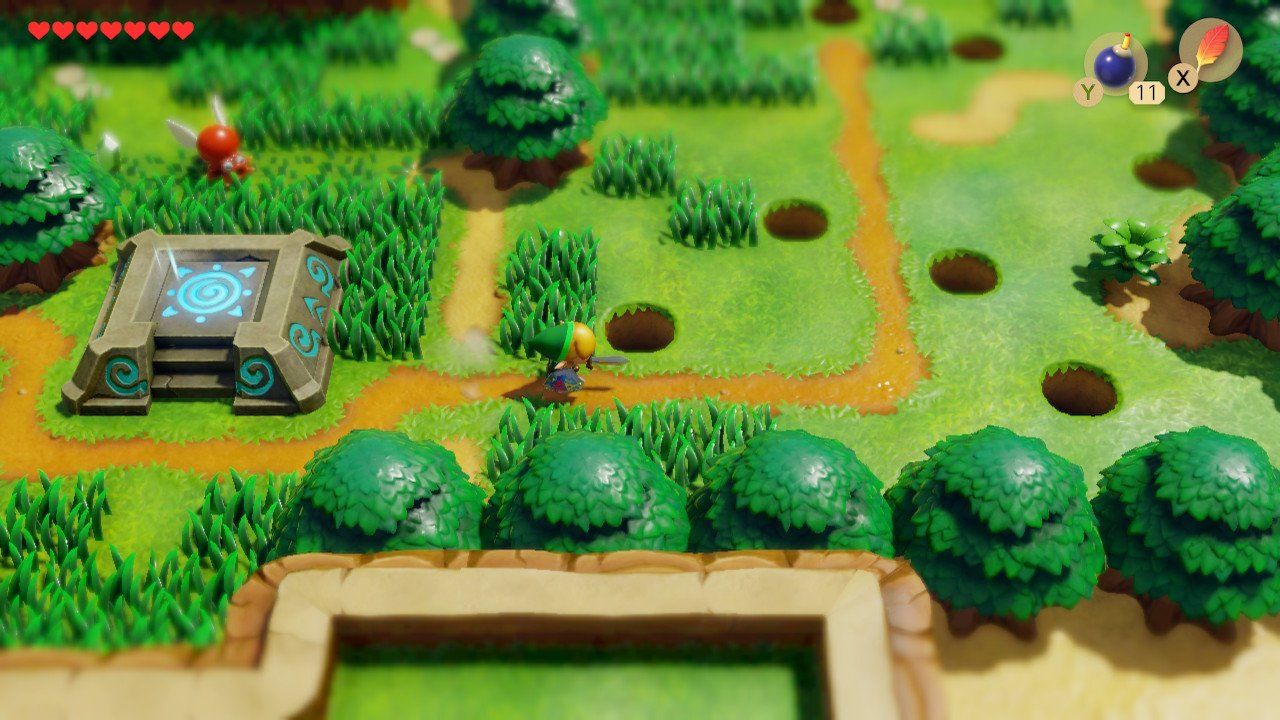
The first big thing about ZLA now is that the game looks spectacular. It has a blurred focus effect, so that it feels like you’re playing in a diorama world, where the focus is all on you. I can’t spoil a near 30(!!) year old game, but it does also give that dream effect. The controls are reminiscent of the GB version, with only 2 items being useable at any given time. This’ll sound crazy, but having DASH, SHIELD, ATTACK, and LIFT not bound to those 2 buttons is awesome – I can’t believe I had to write that. There’s a certain pace of movement in a Zelda game that is present here, a sort of dance to the underlying beat. It feels right.

It feels like you’re playing with toys

The game isn’t terribly hard by any stretch. It is however somewhat obtuse in what you should be doing. There’s a literal help line in the game that gives hints as to what the next steps should be. I still recall getting stuck at the monkey bridge section, no idea how to progress. It was a really weird thing to have a trading mini-game be a gatekeeping exercise for progress – and back in the day I was taking notes of who wanted what.

There are plenty of other mini-games here too – most are clear precursors to what came out in OoT, like the actual ocarina. It’s probably here that my love of fishing took root too. Dampé’s shack is a strange addition, where as you clear dungeons you get “tiles” of those dungeons you can use to solve other puzzles. The concept is ok, where you need to slot in the right tiles to complete a puzzle, but the actual running of said dungeons feels somewhat tedious. There’s no way I could achieve the focus/flow in a 5 minute effort compared to a game designer spending weeks on it.

It’s a complete joy to play this game on the Switch.

Satisfactory Initial Thoughts

I’ve completed the large majority of Dyson Sphere project tasks. I’ve got all the cubes to finish the last quest, about 3/4 of the tech upgrades complete (like more construction drones), and the actual Dyson Sphere is more about waiting for solar sails (took about 17,000 rockets to make the structure, so maybe 300,000 sails to fill in all the holes?) to do their job. The roadmap includes adding some combat/NPCs, and I have to assume some sort of technology bridge to make the waiting portion of the game more progressive. The blueprint addition is a massive boon, so perhaps I can go back and optimize even more in a few weeks. But for now, time to try something a little different.

I did look at Satisfactory when it was announced nearly a year ago. The concept seemed really interesting, but it was always missing some pretty big pieces to make any sense of it all. I won’t shy away, a game needs to have an early and mid-game to even be worth looking at, and the bar that Factorio has set is ultra dang high. Satisfactory was conceptually a good idea (multiplayer, FPS factory game) but the actual game had a lot of rough edges. Patch 3 came out this winter 2020 and brought pipes (for liquid transport), and patch 4 was in March with aerial movement/transport (essential in any 3D game) and then some late game content balance/changes. In terms of functional content before the 1.0 release, there’s some balancing and a signalling system for trains – so pretty much what’s there now is what’ll be there til the end. Might as well take a good stab now, right? These are thoughts up until the Coal unlock phase.

Starting Information

DSP doesn’t give much insight to a starting planet, and frankly, Satisfactory doesn’t do anything on that front either. There’s no RNG in Satisfactory though so the starting location is simply where you land on the big overland map… nothing preventing you from physically moving elsewhere.

I will say that it’s quite jarring to have to build buildings that dwarf your character. A smelter is 4 times bigger than you, and the ability to place things bigger than you in first person mode is not a pleasant one. Worse when you’re trying to connect things, as you’re never quite sure if they line up or not. I do miss the concept of a locked grid here… though that’s quickly (1hr or so) fixed when you unlock foundations.

The flow from base material to more complex stuff is pretty simple to grasp. Not a terribly large fan of only being able to manually construct in a single location (you could build another crafting location, but then that takes material rather than the actual building – so you’re likely to run out of mats). Reminds me a lot of the concept of a crafting table in Valheim, but extra not-portable. The ratio to craft stuff is well structured.

Power management is not pleasant. There’s never enough power to run what you need, and then you have maximum outputs per generator that need to be respected or you blow a literal fuse. It’s unpleasant minutiae that really should take a cue from other games. Focus on production, not the logistics of power – especially when you need to worry about a spaghetti layout for a factory. I will say that the need for biomass (leaves and wood) forces exploration, which is a super pleasant experience. The hostile NPCs can go jump off a cliff (knockback here is crazy), but the idea of finding new locations and stuff is really cool. The interface for power usage/consumption is really good. Not sure how relevant that becomes at the larger scale, but since stuff either works or doesn’t, it’s super good to know how much is missing.

I am looking forward to using the Z axis in the 3D world. Early game puts vertical as a hurdle that is almost impossible to surmount. Mutli-story factories are a thing I am looking forward to using.

I dislike the UI to build stuff. Clicking a menu, then scrolling, then clicking is way too long. You can add things to the hotbar, which is frankly mandatory and I don’t quite understand why it’s not default.

Progress Information

Where I think DSP really hits this well is that it tells you well ahead of time what’s possible. The research tree is open from the start, which in 2021 is like having the wiki page just built into the game. Satisfactory obscures nearly everything, which makes creating goals painful. I desperately wanted to know how to automate power generation… I had to randomly pick progression paths to figure out that was even possible. Not sure why you wouldn’t want to let people know that Coal production is eventually possible.

Which gets me to the larger point of progression targets. Satisfactory has tiers and sub-tiers. Tiers are relegated to upgrading the Space Elevator (which looks frikkin’ cool as beans), and the sub-tiers are related to upgrading the hub. You need material to upgrade the former, things that you may not be able to do until you upgrade the latter – but no real explanation of their relationships. It’s cool that there are no bad choices.

Speed & Scale

I wish I could do a better job explaining this, but it feels like trying to move an iceberg. Production rates are extremely slow and the buildings you are using are massive. You end up with a massive (relatively) factory that is just producing 6 things, and at a rate of 10 per minute. The construction part is a challenge because lining things up is not automatic, you can (and will) mess it up because things slide while placing them.

A pet peeve is that creating new factories requires that you have the resources on hand. It’s not like it’s 2 clicks to stock up again, or that you can “pre-fab” the items. If you are short on Rotors, well you need to walk to the Rotors storage, pick out a pile, and then run for a few minutes to the location you want to build. It’s infuriating busywork.

Factory games are great when the progression of automation is the goal. It should snowball into the logistics of competing demands. Your time is spent on thinking of new ways to automate the recent construction bits. It’s not RNG – your focus should be on managing outputs and demands so that the math works. Satisfactory does not focus on any of this right now. Placement is finicky, production rates are atrocious (limited severely by power constraints), and progress feels stymied. Perhaps I should reframe this to say that standard progress in a factory game is about making more complex things.

So far, So Good

I need to reset some expectations here and move back from the 100hrs invested in DSP (and I don’t know how many in Factorio). This game takes a much different approach to the early game as compared to those. Exploration is way more important here than automation, which is a weird twist. As I move to progress into more complex tiers (and frankly, I am drooling at the idea of coal power), I’m certain it will shift into more familiar territory.

It’s not a bad game, it’s just not what I came in expecting (a 3D factorio).