Was heading up north for a fishing trip with the father in law, and in the middle of no civilization for 30mins either way, we encountered a pair of moose and hit one of them.
A cow, no antlers
Canada is mostly wide country with wildlife, few of them a danger. Moose are the most dangerous animal in terms of volume in Canada, primarily due to vehicle accidents. They are 6ft+ tall and a near ton of weight. It’s like a mass standing on stilts. With a car, you’re going to cut the legs out and the mass will fall on the cab. For larger vehicles, it’s like hitting a wall. If you hit a moose, in nearly all cases, you’re in for a very, very bad time. So generally, no one wants to see a moose while they are travelling.
In our case, we were miraculously fortunate that we only hit the 2nd moose, which destroyed the truck mirror, dented the boat, and caused some additional damage to the trailer. I’ve yet to fully appreciate that fact, though I can say that any close-call certainly triggers an automatic re-evaluation of all aspects of life.
Introspection is a rather natural part of my psyche, and it’s a bit like spinning a bunch of plates. When major events occur, I re-evaluate each of those plates in terms of keeping it spinning or just letting it drop. I’m in that space now. I’ve got my list of important plates set out, now I’m triaging the rest. It’s a complicated measurement with tons of factors that ends up with a simple thumbs up or down. I am also quite conscious that my current career path is limiting my ability to absorb “the dumb”. I’m super game to help people grow and experience challenges and new experiences. I am not at all in to spiraling in self-pity of repeated bad behaviors where people know better, they just don’t do better. My daily quota for that is finite, and drawing energy from other pools means spending twice the energy, not fun for anyone.
So yeah, I hit a moose, could have been infinitely worse, making me focus on internal priorities, and we’re going to see what the next few months look like with a renewed mindset + focus.
I played the first Blasphemous a good dozen times from start to end, and each of the DLCs included. It’s a souls-like metroidvania, though more the former than the latter. The game focused a lot on hard combat and obscure lore, while the exploration portion came up a distant third. It was all but impossible to hit the “true” ending without some sort of guide, or blind luck, as you needed to take a specific step at the midpoint to unlock it.
Blasphemous 2 takes every barb thrown it’s way and pivots to something different.
First the setting. You’re in Cvstodia, a land that’s run by a religion that worships The Miracle, an event/host/god that both demands worship and randomly punishes its adherents. It’s a world of gruesome and constant suffering, where everything is attributed to the will of The Miracle. If the worst nightmares of the Spanish Inquisition + Old Testament + Void of 40k all merged into one. It’s an absolutely fascinating setting. More please!
Combat now has 3 weapons that focus on damage, speed, and balance. They each come with a unique method of exploring (the core of the Metroidvania aspect), and their own skill tree. The ball & chain is slow and powerful, the largest range, with some unlocks that triple the damage output. It cannot block, but you can cancel out of attacks. The sword & dagger hits quickly, but you need to be in their armpits to get there. It can potentially deal crazy damage, and block attacks. Multiple enemies make it very hard to use, and the range is an issue with bosses. The balanced sword offers a nice middle ground of decent damage and the ability to block. However, its “special mode” prevents blocking (which makes me think this will be patched) , and provides only marginal damage improvements. It’s a tremendous defensive weapon.
Enemy variety is better than the first game, though the latter portion of this game has quite a few reskins. You’ll be attacked from multiple angles, with delays, making some battles incredibly hectic. At multiple points you’ll be locked in a room, forced to attack waves of enemies. This is arguably the most fun part of the game, depending on what tool you have in the belt. At no point did I ever feel that victory was out of my grasp.
Bosses are a mixed bag. The highs are in the art department and move variety, though most of them are much too “human like” and lack the vertical or size of a true boss fight. Many of them can feel cheesy (the dual fight in particular), until you get very accustomed to the dodge / i-frame mechanic. The difficulty is un-even, with some acting as walls, others I took out on first try with barely a scratch. The penultimate boss packs a hell of a punch.
Movement is smoother all across the board, with multiple traversal options unlocked throughout. The first game felt a bit like molasses, but here there’s a good flow around the fights, and most of the time with multiple enemies to deal with. This part is important, as the map is much less linear than expected, and has a metric ton of backtracking when you unlock more abilities. You’ll unlock shortcuts after difficult stretches, and eventually unlock the ability to fast travel. Map markers become your best friends. Exploration feels much less random here that the first.
Customization is simplified, and this is a good thing. You still have a rosary with beads you can swap for passive bonuses (e.g. more resistance, more money, etc..). Spell variety is “less” though unlocked earlier, meaning you’ll actually use them here on a consistent basis. Fervour Statues are a new piece, with slightly more powerful bonuses than beads, but come with a pairing feature for resonance. Pairing a statue that increases damage for the ball + chain, and one that does fire damage, gives you major fire attacks as a result. I will state plainly that it’s dumb that you need to experiment to find them and there is no record to tell you which you’ve found. I expect this to be addressed in a QoL patch.
Quests bear mention. There’s still no quest tracker and the hints can still be obtuse. Finding the “floor of screams and purple petals” isn’t much to go on. However, most quests are straightforward enough and the lore of an item gives you an idea of who needs what. You will be traversing the mapmultiple times to complete them, and the tail end quests give some tremendously useful rewards. The quests are more straightforward in general, but that’s a bar to trip over, not high praise.
Which gets me to the lore portion. The text/voice work is much better than the first game, and has much more clarity. Reading the lore of every item adds flavor rather than clear direction, with few exceptions. It’s still full of catholic imagery, and a “god” that punishes as often as it aids. The grotesque nature of everything permeates the world and makes it interesting. The first game expanded tremendously on the lore with each DLC, I’d expect as much here.
Blasphemous 2 pivots from almost pure combat to a more dense metroidvania, and I think it comes together quite well as a result. Nearly all the friction from the first game is addressed, which is frankly astounding for a sequel these days. The first game was quite rough around the edges, and the (free!) DLC helped flesh it all out. Blasphemous 2 doesn’t have those edges to start, and it’s ridiculously easy to get engrossed in the fluidity of it all. Well worth it.
A bus is a service that transports lots of things efficiently. For most, we think of public transport in a city. Engineers see this in designs. You can also consider a sea port where ships deliver products as a bus (though more like a logistics hub). Production games “succeed” on the concept of buses, as no logistical chain can scale without a bus.
The basics of a production chain are production –> distribution –> production. If you want iron bars, you need iron ore. If you’re going directly to the supplier, you are limited by their own production rate. If you need 500 ore per minute, and each miner creates 100 ore per minute, you need 5x distribution lanes. Everytime you increase production rates, then you need to create the entire distribution chain again. That doesn’t work at scale. What you’ll find instead are distribution centers that change it to production –> distribution –> storage –> distribution –> production, effectively turning the multiple branches into a sort of hourglass figure.
A production bus focuses on simplifying the distribution –> production portion, so that the same materials can be used in multiple production steps without adding more distribution. DSP has 9 items that can be crafted from stone, iron bars, iron cogs, circuit boards, and magnetic coils. I could run 45 (9×5) connections to build these items, or I could simply run 5 lanes and collect the material for 9 production stations. Clearly the latter is the better option. Add 3 more base items and you can produce another 15 or so items, making a slightly more complex bus of 8 items. This main bus allows you to produce almost every basic item (except motors) and get to the mid-game rather easily. My first playthrough I did not use a bus. It was pure spaghetti, with belts and machines running everywhere.
It bears note that production ratios matter at the initial stages of the game. 2 miners per node cluster, 6 smelters per line, and then the various bits and bobs (cogs, circuit boards, magnetic coils) to get the basic production bus going. Ratios do not matter at all past the mid-game, as you have ample storage options and tools to measure consumption.
Early to mid-game has a drone system that allows you to move items between locations without belts. This allows for quick injections of materials for unique production chains, like titanium alloy. Planetary logistics allow you to quickly ship across the planet in larger volumes, effectively allowing for “harvesting hubs”.
The mid-game moves from planetary construction, to solar system construction in that you need to distribute things between planets. The only way to do so is with planetary logistic centers, which are massive towers that take a ton of power to operate (and cargo ships). You’ll still need the production hub for basic materials, but scale starts to be a problem. When you need 3000 iron bars per minute, well, you’re going to need a production hub dedicated to that sole purpose. One planetary logistics takes in ore, sends it out to 50 smelters, who send the bars back to the tower. You can add more smelters and scale up as need be. You’ll eventually have a single planet crafting everything from dozens of towers, and hundreds of drones shipping things between them. It will look like a beehive, which is simply fascinating to just watch.
Towers EVERYWHERE
The late-game focuses on the actual Dyson Sphere, which requires a massive amount of material/power to produce. This creates multiple production chain roadblocks and scaling issues, and you end up with power issues. A single carrier rocket takes ~700 raw material to create, and you need thousands of them. Isolating bottlenecks, and then expanding production to get back onto the bus is the name of the game.
An end-game production bus planet, with dual layer Dyson Sphere behind. Over 100 towers, and 3000 smelters & assemblers. Not shown, the 8 feeder solar systems.
The end-game focuses on interstellar production, where entire planets are dedicated to single production chains. Entirely reasonable to have a planet with a few hundred smelters just making iron bars, which in turn will require a planet as a distribution hub collecting from the galaxy. The goal is to produce as much white science blocks as possible, which is required to unlock the infinite upgrades. Hitting even 100 white science per minute is a solid achievement, and aiming for 1000 is at another level.
It is entirely possible to get to the end game (4000 white science created) without leaving your starting planet, and running massive spaghetti monster belts. That was certainly my first playthrough. If you’re aiming for a “complete” Dyson Sphere, you can also stay on the starting planet, but you’ll end up terraforming a ton of it to get there. In both cases, a production bus is the only way you’ll get to that point. Putting it on a different planet, same system, has more to do with a blank canvas than anything else. If you want to run end-game, well, you’re in for a galactic level bus, with at least a dozen planets required to get the complete scale in order. I’ve only dipped my toe into that…wildly crazy space to be in.
My recent playthrough is just a tad over 60 hours, and that’s shy under 400 white science per hour. To get to 1000, I’d need to move towards dedicated planetary hubs (the current production planet is simply full), and that would need about double my current harvesting power, and a much different energy relay system. The good news is that blueprints allow MASSIVE time savings. If I did it the original way, that’s close to 10 hours of work to lay it out. With blueprints, which can be planet-sized, it would be closer to 2. Recall that setting up a nuclear power plant in Satisfactory was 20+ hours of effort and it still wasn’t working.
At some point I’ll get to true end game, but there’s Baldur’s Gate 3 calling me, as well as Blasphemous 2.
Frostpunk may be my all-time favorite city builder. It provides you with a limited set of tools, a near constant set of cascade failures, really tough choices to make, and the tiniest spark of hope throughout. That balance between the edge of control and the edge of failure is what makes the game superb. And it’s success certainly pushed for imitators.
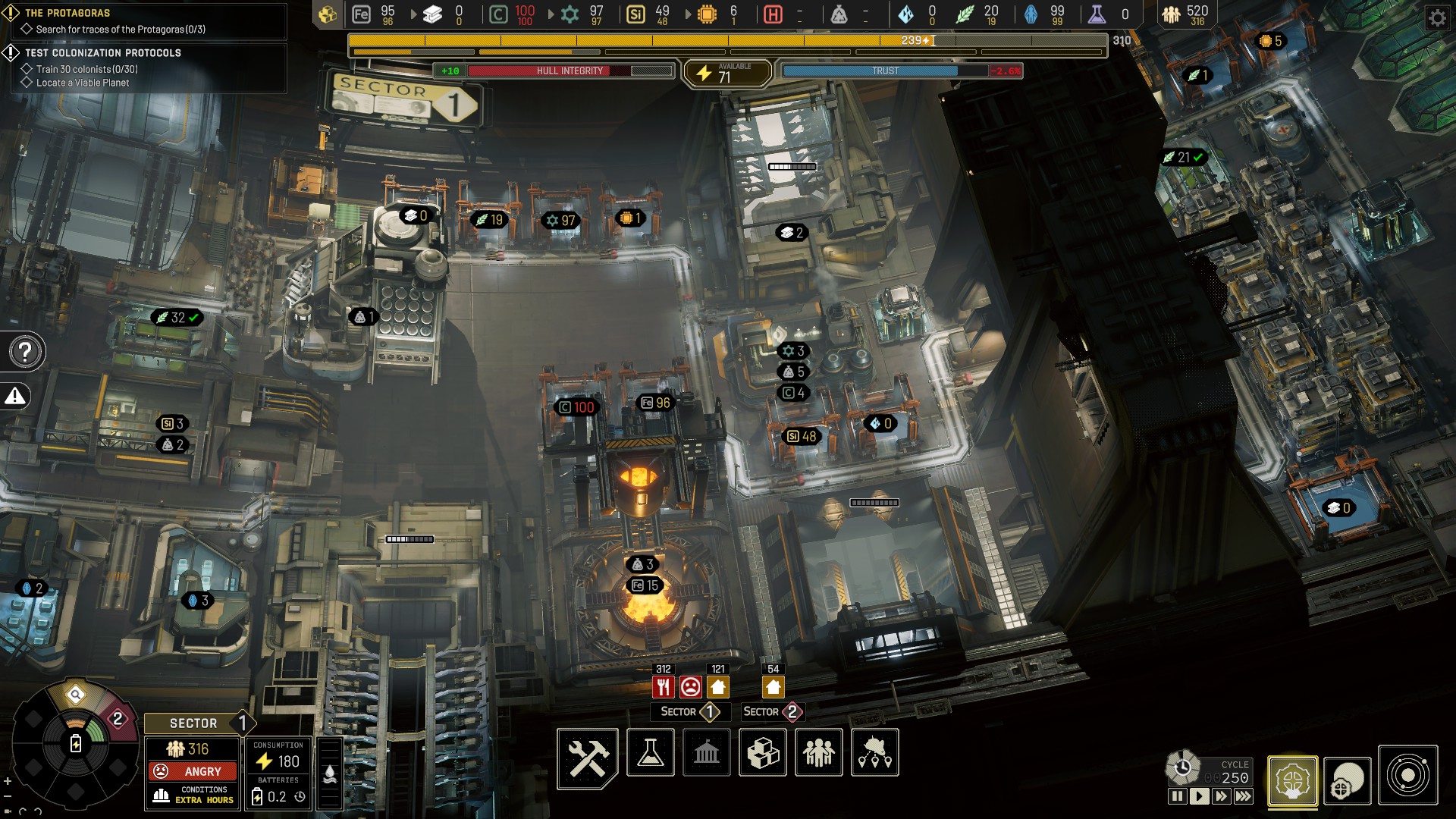
IXION is such a game. The story is simple enough, the future of humanity is focused on an ark of sorts, that is on a space journey. The challenges are also cascading, with balance a constant battle. The tools are your disposal take a while to uncover, and some decisions can massively hamper your progress… to the point where save scumming is a running thought.
The start of phase 3
Space to construct is limited, and each building has a specific set of location needs. Build enough of a type of building and the sector (of 6) becomes specialized, providing a bonus. As with most games of this genre, small percentages have large impacts, so you are likely going to want to specialize.
Resources are scarce. You can find more people in frozen capsules – which feels really weird when you population quadruples somehow. These people need food, shelter, work… and if they don’t, then you start to lose trust, which causes a mutiny and game over.
The ship you are in is in continual decay, and each mission makes the damage greater and harder to repair. This means a constant drain on resources, and intelligent use of time as there are periods where you have to stop repairs to improve power generation, or move the ship. Oh, and each sector you unlock also adds to decay.
Research is both hidden in layers, and difficult to progress. Each “zone” has a limited amount of research points to collect, effectively giving you a soft-wall of progress and forcing you to move, and therefore increase difficulty.
Combined, as is the genre, you can be going along smoothly, only to encounter a massive cascade of failures because one small piece stopped working. Like collecting iron… which repairs the ship and helps construction, which generates housing, which causes trust and decay to increase, and that’s the end of that run.
I do enjoy the logistical challenge of keeping resources balanced between sectors, and overseeing the various needs of the population. That said, I also think there are some balance passes required in how they interact and how they are set at default. Logically, the system should default to complete balance between the storage in each sector… but it doesn’t. Food created in one sector won’t move to another unless you set up that swap… which caught me off guard and caused a rather negative event.
I also enjoy the compounding complexity of various decision points, where you can have a general idea of how something will help you in the future. Some of those decisions are very obtuse… like research for items you won’t be able to use for a very long time. Given the scarcity of some resources, it makes it so that there’s an order of priority that simply is not evident on your first playthrough, and little grace for those types of mistakes. I will point that each chapter requires a very long process to complete, which not only feels like padding, but is likely to generate additional challenges. Like how collecting 500 cryo pods creates discontent as its faster to collect than thaw… Discontent that increases accidents and deaths, making it spiral.
I’ll also point that the pace of the game is rather odd, with random acts of sabotage that you can do absolutely nothing to prevent, and that can hobble you substantially if you’re in a balancing act. They act as time padding, preventing progress for the sake of making the game longer. The rate of accidents increases substantially as happiness decreases, which happens when there are accidents.
I will point out that some decisions you will make can have dramatic consequences down the road, to the point where you won’t realize it until it’s too late. Some mission options have catastrophic consequences, so that you’re better to save scum that hobble through. Some sector construction layouts (in particular around things requiring external walls) can be disastrous… to the point where it’s better to revert to a save an hour+ ago than to rebuild. In a “normal” city builder, you are not continually facing failure, just delays. In here, to a stronger degree than I was expecting, a single bad decision can be enough for a game over.
These are quality gripes, and I can only see them because I’ve been fortunate enough to play Frostpunk. If you’re coming from something like Surviving Mars, then you may not notice these smaller bits. The pace and impact of decisions, in particular hitting massive milestones that alter the gameplay, are key to these types of games. If it’s just continual fire fighting, then that loses appeal quickly as you run into the next fire before the last is put out. IXION straddles that line, and doesn’t always have that work out. For a game that’s been out a month or so, this is super normal and balance passes are part of the deal. I’d still recommend the game in its current state, but can only imagine how amazing this game will be with a few small tweaks. All the pieces are here.
There are 9 episodes this season, with the last 2 coming in July. The first three are very similar, figured I’d bunch them.
The biggest change this season is time. Everyone is noticeably older, the kids are in their early 20s now. It’s not exactly jarring, I mean we’ve all seen 20 year olds playing teenagers, but the sense of mystery and “newness” doesn’t come off like it once did.
Which I suppose reflects the change of tone in the season. There’s very little comedy left, it’s mostly drama. The sci-fi portion has been replaced by horror. Even the villain is fully revealed in the first episode, with a death in the first 2 episodes meant to set a foreboding tone. This isn’t Barb’s pool attack here… it’s all on screen. I guess one way to look at this is that we’ve moved away from The Goonies and into Nightmare on Elm Street.
The first 3 episode act as a sort of call back to season 1. There are bullies, there are scientists, there’s the lab, and a big scary bad thing hunting people. It acts as a prologue of sorts, and given that this is season 4, it seems very out of place compared to all the craziness that came before. To make a gaming analogy, like how when you beat God of War 1 and then start God of War 2 and lose all your powers and have to walk in the mud again. The good news here is that all the episodes launched at once, so you can binge through it. Had this been a weekly launch of episodes, it would be infuriating. You can skip the first 2 episodes completely and not lose a beat.
The really great news is that episode 4 is a true highlight.
Side notes:
I can always use more Kate Bush
Steve (Joe Keery) and Robin (Maya Hawke) still manage to steal every scene
It was always odd that no one batted an eye on monsters in a city. Mental health seems to be the core theme this season.
There are too many characters in the main cast with no purpose other than to be present. Will is even more useless. Mike makes faces and is powerless. Lucas is there to show how bad the local teens are, does nothing else. Dustin is the comedic element.
I had picked this up on PC on a sale a while ago, put in a few hours and something or other came up to distract me. The recent play through Blasphemous reminded me of that fact, and I decided to pick it up on Switch.
First, let me just say that the Switch itself is a near perfect platform for this genre of game. It’s quite ridiculous how the form factor lends itself to pick up and play, controller-based inputs. If the Steam Deck ever launched (or copied) and delivers anything close to this experience… there wouldn’t be much reason to use a Switch again. My Steam library (or PC library in general) has way more on it that is reasonable. I’m not seeing this as the whole Wii/Kinect/Move junk we saw before, this can actually work! And with Nintendo having netcode designed by a monkey intern, there’s another reason to move on. Price is likely the sticking point…
Back on track. Hollow Knight. A metroidvania game developed by a small studio, sound familiar?
The cell-shaded art is a standout, with extremely smooth and fluid movement throughout the adventure. It’s oddly important how much art cohesion is important in a game, more so that you can identify the protagonist, enemies, an environment with minimal eye effort. These games often rely on reactive movement in the exploration portions, or tells and memorization when it comes to bosses. The less work your brain needs to do on identifying queues, the better your reaction time.
The story is explored as you go through the game, with a purposeful lack of context in the initial set up. With multiple endings available, it’s entirely possible to miss the larger picture at hand. This is all standard for the genre (and something entirely lacking in Metroid Dread). Given the scope of this game (over 30hrs on the playthrough), there’s an interesting amount of lore here to discover.
The mechanics follow the genre as well, with nearly all gates blocked behind movement abilities that must be unlocked. Dash, wall jumps, double jump, and a move that simply launches you sideways. Movement skills/platforming elements are generally restricted to finding extra health or magic points, with the exception of the final optional dungeon. That’s a good thing, because it’s the only weak part of the game, with hit boxes and controls feeling a bit “loose”. I’ve been spoiled with Celeste I suppose.
You can access to a set of charms/spells throughout, which change the way you can approach combat. Maybe you want better spells, more healing, more health, or minions to help with damage. You’re limited in the total amount you can equip, which effectively gives you purpose-builds. I had one for exploration that increased the amount of money I made, while my final boss build was focused entirely on maximizing hit points. One particular spell upgrade boosts your dash so that you are immune for it’s duration… which still seems odd that it isn’t a default setting. You can’t clear the ultimate boss without it.
Exploration is interesting. Rather than having your map auto-update as you move along, it instead will only update if you have a base map (purchased) and then sit at a save point. You’re effectively a cartographer, which gives an interesting sense of adventure. It bears note that the map here is absolutely massive, with zero load times (again, Dread doesn’t do this). The path to the area boss is marked on the purchased map, but each zone has a ton of hidden content/shortcuts/connections to other maps to discover. You’re going to do a lot of backtracking across with new movement skills to move forward. It’s an interesting approach that isn’t for everyone.
Combat is the meat here, and combat is quite challenging. No question, the game is hard. You’ll die often enough while exploring, with the majority of the walls coming from bosses. Only 1 has any true form of randomness, the rest are all about memorizing patterns and taking advantage. I’d die 5-10 times per boss, figuring out the dance steps. The Grimm Troupe final boss was without question the hardest, much harder than the optional last boss (who is also incredibly hard). There’s a coliseum event, where you fight 16 waves of enemies, and it acts as a great training ground on how optimal combat can work. Video below is an optimal strategy for an optional boss.
The thing about this genre is that it needs to hit all the topics above, and find a way to integrate them. Clear art, great movement, twisted exploration, character development, multiple endings, and tight combat. That’s not a small order, but somehow it’s the small developers that are able to deliver. I keep picking on Metroid Dread, but it’s an outlier on a genre that has surpassed it.
Hollow Knight and Bloodstained are the high watermarks in the genre. Absolutely should be in a gamer’s library.
I’m feeling quite under the weather and my whole family is in isolation for a while. It sucks.
Given that I am therefore not working, and in the moments of some lucidity outside of cough syrup, I figured I’d see if I could log into FF14. “Peak hours” were giving me queues near 3,000 or more. Can’t be that bad near lunch time, right?
Well, the queue was 998.
Let’s play a game. You get to guess how long that took to clear through?
Just a tad over an hour. Of which, thankfully, I have wireless headphones that let me do something actually useful during that period. Or semi-useful given my state of mind.
Interesting tangent. In the mid 00’s I used to work in a science organization. One of my tasks was scouring eBay for 386 components because the foundry we had was only able to run on a specific set of hardware. Hard-coded and proprietary elements made scaling or support a challenge…and it was cheaper to get parts on eBay than to rebuild a black-box system. Was.
Early Thoughts
It’s FF14, just more of it? Can I say how pleasant it is not having to relearn my entire class kit when an expansion comes out? It’s like going to a restaurant that has undergone renos and they have a brand new menu. Why should I just not go to another restaurant? This is more like the local pub having a few new beers on tap.
It’s more of the good stuff. Like how XCOM2’s War of the Chosen kept all the good bits and added more. I won’t spoil anything, because clearly if I could only experience the game while so ill I need to isolate, there are many more people who have not even dipped a toe.
There are a few QoL items to highlight. First, city Aetheryte give you a map for easier (and logical) transport. Belts and HQ items being gone are super nice on inventory. The Aether Compass has moved to collections, which was a bit jarring. Daily hunts are way easier to complete. And on the instanced quest duties, you get a profile of the character speaking rather than just their name… that’s oddly useful to remember who-is-who in a game with what feels like 4 dozen side characters.
Next Up…
Well, I have 21 days of “free” playtime, which I guess makes up for 19+ days of quite astounding queues. I’d have to guess that this will extend until the queue times peak to something considered “reasonable”.
There’s the pandemic factor, no question, but having a virtual con is still something of use. Warframe and EvE can still manage this, with arguably much smaller bases, so that’s a fun factor to consider. And yet…
The purpose of a convention is to get a bunch of people who are fans of something together, and use that herd to pump up the view of the future around the theme. As much as they can be seen as massive interactive ads (SDCC for example), there is still the base that people go to these things to get good news and good vibes.
BlizzCon has had issues on this for some time, because the relationship between the fans and the developers has been very one sided. A cool idea gets pitched, people get pumped, and the eventual product is cut down to bare bones and doesn’t work. I can still remember WoD’s garrison pitch – you could move it between zones and it was interactive with other players, very customizable. What the heck actually got delivered? Farmville. That Blizzcon was nearly 10 years ago. And all goodwill for this was lost with the Diablo Immortal presentation – an announcement that should have been an email and not a stage delivery. tldr; if you don’t have good news to share, that you have a reasonable chance of delivering, keep quiet.
This assumes that people actually want what you’re selling. There is a lot of “you think you want it, but you don’t” mindset from the dev team, where player feedback was ignored and instead favored the extremely simple themepark design of “this way and only this way”. It’s certainly a difficult balance to manage a very large playerbase, one that is clearly distributed across multiple veins. The folks that enjoy pet battles are unlikely to enjoy raiding, for example. And yet, when the people who do enjoy pet battles provide feedback, and that is ignored, or raid feedback is ignored, well… you end up here. Where the player base has lost a lot of trust in the dev team.
Kaylriene’s post on this facet had me head nodding a lot. One the one hand, there’s the simple fact that Blizzard takes ages to deliver relatively tiny bit size morsels, which often lack the necessary polish that you’d expect with more time. On the other hand, Blizz puts in clear time gates to stretch out the content for as long as possible, which means people experience the flaws for a longer period. From a dev perspective, these things should offset each other – from a player perspective that’s a different story, because the market has changed.
10 years ago we were starting to scratch the concept of always online games. Games in the sense of more than an MMO. The larger proliferation of smartphones really pushed this model to the mainstream, and then consoles quickly followed. Nowdays, you can’t take 2 steps without finding something that is permanently online and has a massive player base. Every game today on a best-seller list is multiplayer (if it is SP, then it’s there a month and fades). Dev companies are fighting for eyeballs and clicks with the minimal amount of investment possible (*cough* FIFA *cough). So let’s look at Blizz pipeline.
Overwatch – hasn’t had an update in over a year and won’t have one until Overwatch 2 comes out
Overwatch 2 – ummm
Heroes of the Storm – this is on maintenance mode
Hearthstone – 3 releases a year or so, with a big release this Spring
WoW – 9.1.5 is all recycled content and no dates for 9.2 (is that the last patch?)
WoW Classic – perhaps a Frozen Throne announcement, but the general vibe from TBC is that the model is somewhat broken where 2007 content is meeting 2021 playstyles (and bots)
WoW Classic 2.0 – seems something closer to progression servers from EQ is coming.
Diablo 4 – we’re 2 years away
Diablo 3 – nothing
Diablo Immortal – it’s still in beta and is not targeting the Blizzcon audience
Diablo 2 / Warcraft 3 / Starcraft 2 – all in the rearview mirror
There’s not much to talk about!
Oh, and the fact that Blizzard is still being sued and a chunk of their leadership has moved out certainly changes the tone of any conversation.
It’s a really fascinating case study of multiple smaller issues causing a cascade of larger ones, resulting in a problem space that has no single solution. Seems oddly analogous to Theseus Ship – the Blizzard we grew up with is certainly not the same one we have today.
I’ve written numerous posts on the fact that fishing is a pre-req for me to consider any game an MMO. I’ve seen all flavors of this skill in what feels like 30 years. From WoW’s ultra simplistic point and click, RIFT’s artifact hunt, to UO’s really fascinating view on treasure hunting.
FF14 takes the more complex road for fishing. Leveling fishing isn’t hard. You could just take a trip on the Fishing Boat (every 2 real time hours) for 20 odd minutes and fly through the levels. It’s extremely efficient and barely costs anything – plus, gear level makes no difference here at ALL, from level 1 to 80. If you want to optimize that fishing for the highest returns, then I suggest Zeke’s spreadsheet. You get rainbow fish, dolphins, gulls, secret fish and of course, mounts to claim here. So there’s a very good reason to keep doing this at 80.
Alternatively, you could fish in Foundation from 10-60. There’s some benefit as you can sell the material, but it’s hard to argue with a ocean trip that gives you 8-10 levels in 15 minutes.
If you were to take the more traditional path, things can get pretty complicated. IRL, fishing requires water, line, and bait. Well, FF14 takes that approach as well which makes it harder to figure out.
Water isn’t obvious. Some things look like they are fishable and they are not, others suddenly are. Eventually you will fish in sand, clouds, and lava.
Line (or overall gear) impacts the ability to real in a fish (gathering) and the quality of a fish (perception). Nearly every quest required a HQ version of a fish. This is meaningless for ocean fishing.
Bait is something else. There are dozens of types of bait and each fish has a favorite. Some fish just won’t bite without. Bait is used on each cast, so you can go through a fair chunk. To combat this sprawl of bait, you can instead use lures. They work on more fish, but bits take longer (~50%) and you’ll catch everything instead of the specific ones. If you are hunting a specific fish, then you want to use bait – makes a world of difference in ocean fishing.
Fishing is heavily based on RNG. Botany/Mining is clear what you’re going to get. You could have the best gear, best bait, and the right location and still not find the fish you want.
In Stormblood, you’ll unlock the ability to spear fish. Thankfully, you will only be required to use that skill for 1 single quest. That quest feels more complex than it should be. Gathering in that expansion was mostly underwater… not much fun.
The actual fishing skills you get as you level are a bit different than the other gathering jobs. You can mooch (re-use a caught fish as bait), try to double hook fish to get more than one, have patience (which ups HQ but you must press the correct hookset button to catch), or a few other “manage the RNG” skills. So while you don’t have any control once the line is in the water, the rest of the fishing is plenty complex if you want it to be.
So why fish then?
Well, the most notable part is that fishing is a ridiculously profitable profession, more so than Botany and Mining on my server. Ocean fish will not sell, but everything else does. Most HQ fish for quests are in the 1k-10k price range. Normal fish for cooking are 200g-1000g each. That’s not bad for standing in one spot.
Second, you can frame most fish for decoration. There are others that you can plop in an aquarium as well.
Third, the ocean fishing gameplay is my kind of fun. 24 folks throwing lines over the boat, all trying to trigger the rainbow effect and get to that 10k point threshold for the final mount.
Fourth, and most importantly, it’s fishing. Is that not enough?
My only complaint in all this is that the game gives you a few dozen tools to fish and the general idea of what they do, yet the fishing log is really bad at giving you the actually useful data to keep catching fish. Knowing that a specific fish likes a specific bait and a specific time of day would be super useful information to have in-game. Sadly, you need a web page open to make sense of the chaos.
Fishing in FF14 is probably the most enjoyable implementation of the skill I’ve ever played in an MMO.
I’ve got a healer (WHM) to 80, and there’s a reason they call it green DPS. The goal of the game, at a high level of skill, is to spend as little energy as possible on healing, everything should instead be focused on DPS. It’s a strange balance… and had I not played a Monk in WoW with Fistweaving, I’m sure it would have been much more jarring.
Tanking is a different boat though. It’s often seen as the hardest role in an MMO, the default leader since you’re the vanguard for any given run. M+ tanks in WoW certainly suffer from that… and DPS love to complain about not skipping certain trash packs, or things taking too long, or a dozen other things. They never step up to tanking though!
FF14 tanks are all pretty much the same. Getting aggro (enmity) is extremely easy here, and near impossible to lose. There’s the odd tank swap in a raid, but in so much of the content, it’s just not a consideration.
That leaves the idea of giving and receiving damage.
Tanks as DPS
Each tank has an optimal DPS rotation, and that often depends a lot on the target. There are breakpoints for AE attacks, and then staggering buffs to optimize damage over long cycles. Blah, blah, blah… what you need to know is that some skills trigger other skills and you should continue to press buttons until there are no more blinking icons – then start it over again. And in all honesty, you could just press the same button all the time (AE attack for trash, single target for bosses) and most would not see the difference.
Tanks as Sponges
This is different, where tanks share a common set of cooldowns that reduce incoming damage. All damage mitigation is multiplicative, so you want to avoid stacking any particular cooldowns. When pulling groups of enemies, you want to use the better cooldowns at the start, when there are more things attacking you. The idea of “wall to wall” pulls, meaning pulling all the trash up to the next hard door requires not only great understanding of cooldowns, but a healer that can pump out a decent rate, and more importantly, DPS that can clear out parts of that pack before your cooldowns expire. I like to take on the first group in a dungeon, and then time how long it takes for the enemies to die and see if the healer does DPS or not. Quick kills and green DPS = good to try a large pull.
For single target enemies (bosses mostly), they usually have 1 big attack called a “tankbuster”. Understanding which attacks are tankbusters and not is important more for progression, less for leveling. For a LOT of fights, you should be able to soak the damage on the first pass, if you’re at full HP. Eventually you’ll use your big cooldown, then 2nd cooldown, and the first one would be back for the next big attack.
Tanks have stuns and interrupts. I wouldn’t stress too much about those. Put them on the bar, learn when to use them. Your healers will thank you for it, but it also won’t break a run.
Each tank also has a “oh crap” button. Gunbreakers should not use this skill.
Tanks as Herders
This is really where tanks shine. An ok tank will run into a pile enemies and then be surrounded. A good tank will run through the enemies and group them together for AE attacks, having them face away from a group. A great tank will do all that and then “shuffle” the AE attacks, meaning that they will move out of the AE attacks, and then return to their original spot, reducing the amount of movement enemies take.
This is very obvious for trash pulls, especially wall-to-wall ones. It matters a lot for bosses too.. especially those that have rear attacks. There are a few DPS classes that really want an enemy to stay in one spot.
Tanks as Peelers
To get an enemy to attack you, you need to hit it. Enemies that spawn while you’re already in battle need to be attacked and sometimes it can be really hard to target them. In most cases they will show up on the target list on the left side of the screen, which you can manually select and then attack at range. In the odd cases where there are spawns and they don’t show up, you need only walk a tad an perform an AE attack. You will be peeling enemies off your teammates.
What if We Wipe?
The joy of FF14 is that there are very few timers and you can take your time to get through most content. There’s no big push to go faster… at least until you reach the max level content and have some comfort on the role. If you die, then there’s usually a really good reason for it (90% of the time it’s the DPS).
Tanking itself seems to be a stressful position and you do have some additional responsibilities, but it’s also the easiest roles in the FF14 party structure because of all the various things you’ll be doing. If the enemy is hitting you and not your group, and you’re not dying, then you’re doing fine.



 Leo's Life