(The) Gnorp Apologue & To The Core

I would like to think that we all have a switch in our brain that likes to see things improve. Incremental games are like a scratching tool made specifically for that itch, where the focus is almost purely on numbers getting bigger with tactical decisions. The word ‘prestige’ is more widely spread now.. mainline games call it New Game+, but with incrementals its the mechanic of restarting, but having to do this a dozen or more times to reach the end.

(The) Gnorp Apologue is a very simplistic game where you control gnorps trying to break a rock. As you progress, you get more options to create more wealth. Get enough wealth, get a talent point, which unlocks more options. The joy of this game is that the source of wealth changes as the game progresses, so that an early obvious choice becomes rather useless later on. Your strategy changes multiple times, and there are multiple options to get all the way through. Personally, I went fire arrows, guns, rockets, and then grenades (for weak points). There’s a wonderful feedback mechanic where the screen just gets filled with more stuff. Yeah, I like more stuff! Game is about $10, enough to reach the end of it all by hours 8 or so. There’s replay options with time-trials, or different builds. It also plays decent on the Steam Deck.

Yup, it’s eye candy.

To The Core has you piloting a ship meant to mine various planets and destroy their cores. Each core you destroy causes a planet prestige where it gives 3x the resource but has 8x the health. This is NOT an idle game, with a rather substantial amount of tactical decisions required. I will say that the first hour is a right slog, where progress is very limited. You’re given minor tools, little information, and progress is very incremental without feedback on progress. Once you move to the 2nd stage (of 5), you get a better appreciation for targeted activities to reach specific goals. e.g. I want more health, I need more coal, I will farm the coal. As you progress on this path, more options present themselves – like having rockets, or poison, or electrical orbs. You eventually reach a point where you don’t even use your ship, just let the doodads do all the mining for you. The largest difference here compared to (The) Gnorp Apologue, is that the progress tree is hidden until you hit certain milestones. This honestly sucks, because some of those milestones are useless, but gate amazing things. Had I known that farms were a thing, darn tooting I would have beelined for it! The game has a decent concept, but the execution is a bit wonky. Also, it does not play well on the Steam Deck due to mouse/keyboard commands and needing active play.

Video does this one more justice.

You may be sensing a general theme in gaming of late, where smaller dev teams are focusing on ideas rather than graphic fidelity. I’ve got a post on that coming up, but in the widest space possible I think it fairly obvious that people would much rather play a great game with bad graphics than a bad game with great graphics.

Anyhoot, incrementals that have an end, great mechanics, and a solid loop, and have figured out how to scale are worth my $$$. Many more out there to try!

Turbo Kid

If you saw the cult film, then this may ring a bell. Now there’s a metroidvania (ish) game that’s out and about, and indie in the name of the game. I am a fan of the genre, I liked the movie, and I have an itch to support small dev groups, so I picked this one up.

The game is about 10hrs or so to complete, with a decent chunk of content done. I’m sure you could blast through it in half that, or spend another 5 or so hours trying to hit 100%. Following the genre, you start off weak, get various upgrades, which unlock different areas. But this is more like Mega Man, in terms of you have 4 options, pick the one you want, and the items therein may be better designed for another boss. I opted for Sewer, Skatepark, Junkyard and then Wastes. Each areas gives you a skill and a weapon – the Sewers has by far the best skill, and the Wastes a ridiculously OP weapon.

You can get a bad ending, or head to the final dungeon and what is arguably a super boss. That one was a mix of frustrating due to some weird RNG.

First, this is not Hollow Knight or Blashphemous. I am friggin’ spoiled for having played those games and put the bar so high I can barely see it. Turbo Kid is a smaller game in almost all respects, and does a decent job of hitting its targets.

The difficulty of the game starts very high, then peters off as you get more health, then spikes again at the final levels. Most of this is related to finicky controls that are not precise enough for involved platforming. You can kill every boss without taking a hit (once you figure out their patterns) due to dodge rolls, but the environmental hazards are the real pain in the butt. Enemy spawners can fill your screen and the knockback effect of contact can throw you into blades and your doom. The video above shows the use of a bike, and while true, this has the depth of control of Excitebike – especially when you are attempting the various trials.

There are minor quests, a battle arena (ugh), vendors, slotable passive upgrades, and a decent amount of stuff to find. In most games of this genre, I like going back to explore more fully the world, but here every zone looks pretty much the same, and navigating the world requires near constant use of the map as a result. I really like the ideas this game is trying to reach, but the execution is a tough one. Maybe with a few patches, these quibbles will be addressed.

It’s an interesting take on the genre, its a rather small dev team (30 people) and I still think it was a good purchase. Plus, works great on the Steam Deck!

Horizon: Forbidden West

First, always bet against this IP. I have no plans game releases for Sony, but good golly, they seem to release right next to other major IPs. Which stinks, because this is a real crown jewel in open world games for a dozen reasons. It’s now out on PC, which is the full package, and is both optimized and looks absolutely spectacular.

(Optimization Note: PC ports have had some absolutely notorious optimization issues. H:FW is a glorious exception on the main game – as it was designed for PS4. The Burning Shores expansion was built for PS5 and has a unique asset caching process, which can cause massive slowdowns if it doesn’t load properly. Aside from that, holy cow does this game look & play amazing.)

The original game was a very interesting take during the “put bows in everything” phase of game design. The general storyline blended social issues and hard sci-fi, with very impressive combat mechanics. The game looked amazing, and had a rather groundbreaking way to manage field of view and memory allocation. Issues were mostly around character art, and the Ubisoft-put-icons-everywhere-on-the-map minutiae. The sequel came out in 2022 on the PS5, so I won’t rehash too much on that front. I still don’t own a PS5 because I know that Sony will release the 1st party games eventually on PC, so the value-add there is quite low.

Forbidden West improves on nearly every single aspect of the prior game. The story is more coherent, with a relatable protagonist (Aloy may be my favorite female game character), with more world flavor and better design. The enemies have more variety and added tactical options. The skill tree adds more options for customization based on your preferred playstyle. Customization/crafting is both streamlined and easier to track. Accessibility options are amazing. Questing has more variations. You get a glider! It also leans much less on the old-world story as a crutch, as that story was complete in the prior game. It’s all about the now and what’s next.

The combat mechanics here are really quite fun. Each enemy can be addressed in multiple paths – speed, rewards, or brute force. Speed is achieved through exploiting physical and elemental weaknesses. If you do this properly, 1 or 2 arrows may be enough to take down almost any enemy. This is all but required when you have multiple opponents. Equipment becomes key here, as you need as many elemental attack options as possible. Hunting for rewards is a risk/reward activity where you are aiming to maximize item drops for crafting purposes. This only works with Tear damage, primarily from arrows, though you can optionally use gauntlets which are deal more of this damage but you can’t really target. Finally, brute force is simply attacking blindly, including melee damage. It is the “oh shit” mode of combat, which is harder than both the other paths. I do feel there are too many combat options on the plate, especially short-range options. You’re not going to go toe-to-toe with a robot T-Rex or a flying robot bat. Lack of defensive options means that any non-ranged attack is at a MASSIVE disadvantage… and 99% of combat will simply revert to hunting bows.

While the first game suffered from having too many things to do, Forbidden West provides a bit more flexibility here. Things are more targeted rather than simply a bunch of map icons to parse through. If you zoom all the way out, the ? icons are things worth exploring and all the other icons are more or less “fluff”. You don’t need to collect 40 doohickeys, which is great! Case in point, there are less cauldrons this time, less rebel bases, less proving grounds. I will say that there is a long-tail option here, namely the Arena that you open up near the tail end of the game. If you want to have more combat difficulty, this is the place to play.

The storyline is better (?) in that is closes every question mark from the prior game, adds a ton of world building, and does a good job of setting up the next installment. The plot flow is just fundamentally better. The villains are lackluster, effectively being gods with no moral compass – quite similar to the issues Marvel has. For the most part, they are simple plot devices that can quickly be moved past.

I would like to take the time to truly appreciate the overall complexity/balance/design of a game such as this. It’s astounding that a world this big can be entirely seamless and populated. That every NPC has a voice actor. That the breadth of content has tools to help parse and direct your play. That you can pretty much apply the combat approach that fits your feel. That there are SO MANY ACCESSBILITY options!! At no point have I felt the game was unfair, or questioned the decisions made in the development. It all has purpose and all feels like part of an integrated system (so meta!)

If anything, Forbidden West reminds me of what I truly expect from a AAA game, and how much of a gap exists between games developed with clarity of vision and obvious leadership, and those that do not have such. An absolute gem.

Techtonica pt.2

Wanting to add more here, some thoughts on how production games manage progression.

Many of these games operate on a construct of volume, scale, and then complexity. You harvest a set of basic material, automate construction of basic elements, use those elements to create more complex things, which allows you to scale the initial harvesting.

As you get further in the creation chains, you would normally unlock alternative chains of production that either provide shortcuts by skipping steps or, using different materials, gives different paths to create items. These alternative paths require new approaches to crafting chains. The challenge then becomes about balancing complex crafting chains to create enough volume to create final items. Items that require hundreds if not thousands of the basic harvested items no less.

The math required to balance all this is substantial, some complex algebra in fact. Changing a ratio at tier 2 can have huge ripple effects 5 steps later. Techtonica has had a few stages (other EA games too) where the math effectively created an exploit for infinite material. It is not easy, and small dev teams need a lot of testers to validate.

Where Techtonica differs from other games is two fold. First, basic resources are practically infinite, more akin to Sastisfactory, but can yield different material at different stages. Second, a significant portion of the game resides with plant material, which is 100% dependent on a finite amount of seeds. You never lose seeds, but this caps your production rates. This doesn’t seem like an issue at first, but at some point you’ll realize that Mining Charges are the key to everything, and production of that specific item requires tons of seeds.

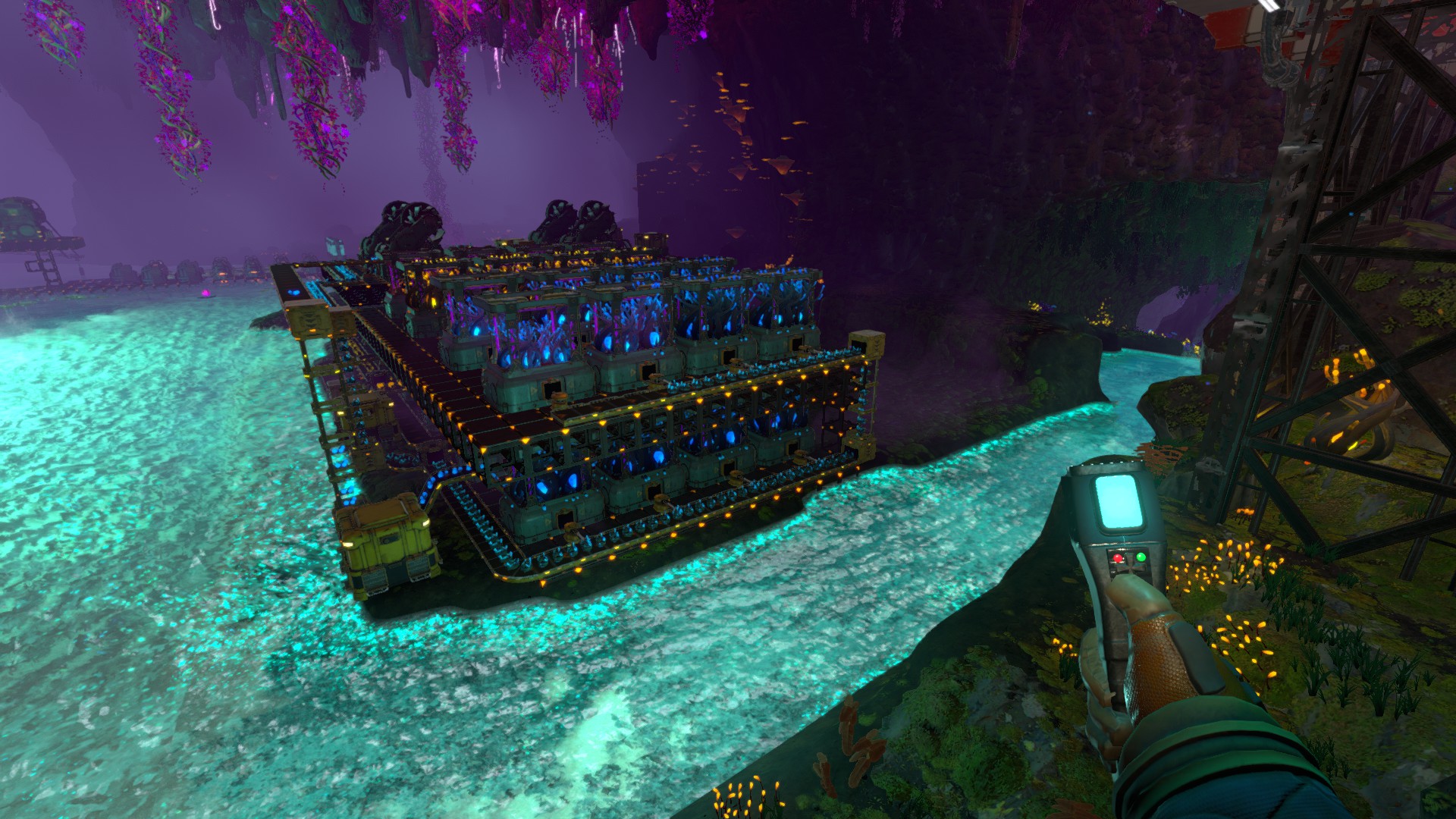
A basic plant farm.

Which brings me to exploration. Techtonica had multiple cave systems that are only accessed through digging. Sometimes 10 minutes of digging. I think this time padding is good, it allows a factory to produce while you explore. Finding all these locations though… that’s the tough bit. Not the best map, then again I still think it’s better than Satisfactory. Some parts of the research tree require exploration to hidden areas, which the functional impacts only really matter end game. Not too sure how I feel about that just now. I know I really don’t like Satisfactory’s RNG take on this.

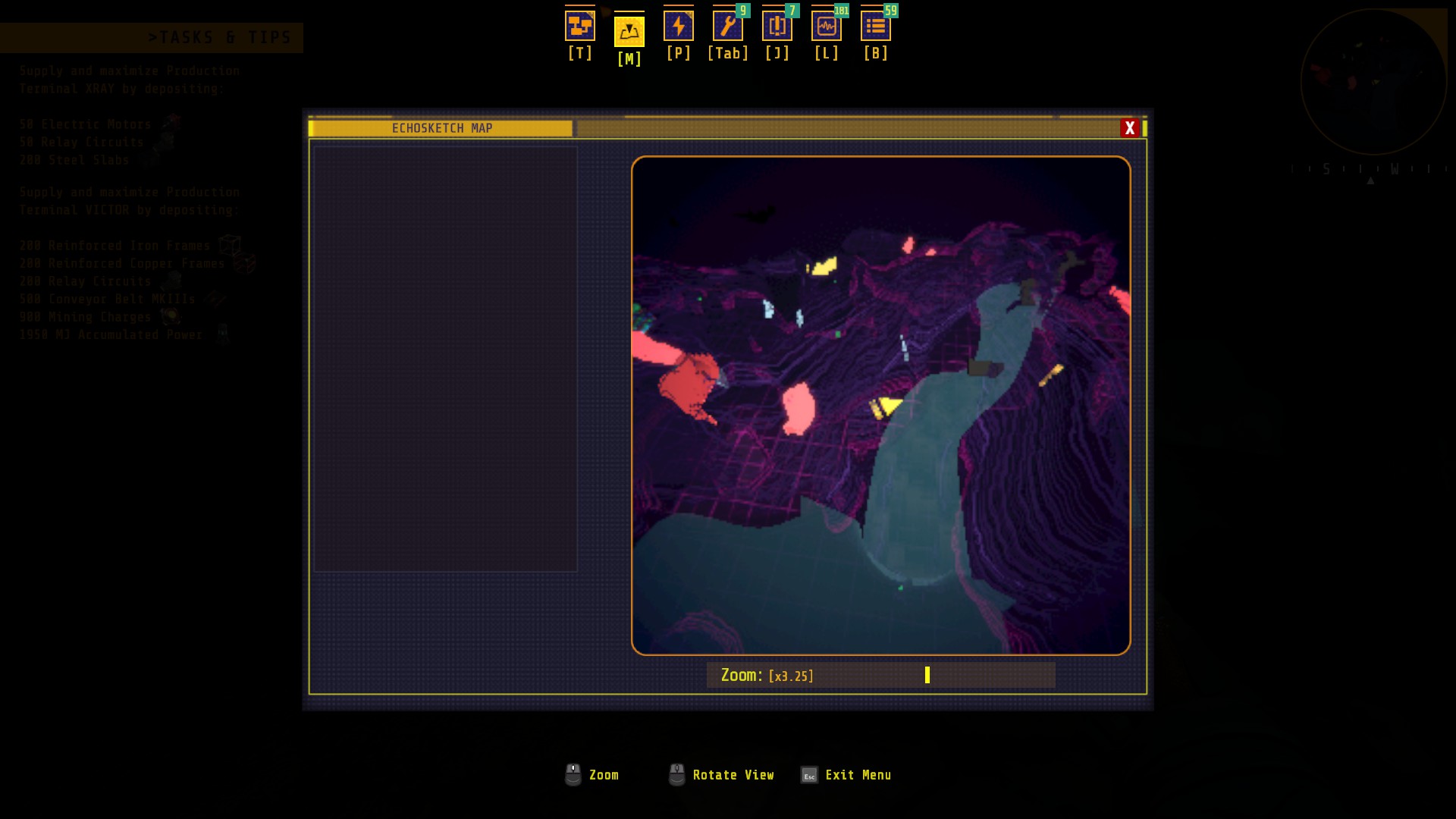
This 3D map shows open areas. Green dots are chests buried in the walls.

I’ve got one more post relating to the mechanics of crafting and rate limits. Techtonica is still finding its footing here.

AAAA Prices for B-level Games

Cue derision for Ubisoft CEO Yves Guillemot justifying Skull & Bones price point as being worthy of a AAAA game. For a game that is mechanically less than the game that spawned the idea 10+ years ago (Assassin’s Creed 4). I mean, fine, there are bound to be games out there that are such high quality and value that the top-tier price tag makes it arguably (and I will argue this) worth it, but that demographic is clearly suffering from some mental delusion applying such justification to Skull & Bones.

Preamble complete.

It is no mystery that the cost of everything is up, game development included. That trend was clear well before the pandemic, and isn’t helped when waiting 2-3 weeks after a release gets you a game for 20-50% off (35% off in the case of Skull & Bones!) The proliferation of Unity and other game engines, as well as hundreds of tutorials has democratized game development – anyone and their grandmother can give it a shot. Steam launched 14,451 games last year. What the actual hell?! Actually finding a good game in that pile is all but impossible, meaning lots of budgets on marketing (Dave the Diver!) or simply hoping that word of mouth is enough (Valheim!) Games should not cost $200m to make, they should not take 10 years to reach market.

Different that any other form of media, games in nearly all cases have improved content due to patches. What you’re paying for is effectively the privilege to test the content, and to a degree avoid FOMO. Even when looking at Game of the Year candidates – waiting a few days pays off. Alan Wake 2 is an absolute banger and still it had some rough spots that needed a few patches to iron out. But for every Alan Wake, you’re going to have to parse through piles of Suicide Squad.

In today’s hyper-connected world, it takes very little for the target audience to get a good sniff of a game prior to launch. A high price tag and zero reviews before launch, or extremely limited media attention are massive red flags. No news, in this case, is often bad news.

Next up is Capcom taking a mighty risk pricing Dragon Dogma 2 at top tier. Previews have been quite glowing, the character creator was launched early, and there is some relative positive track record here. That said, you’d be crazy to pre-order this game or any other. You’re not missing out on anything by not buying it early, and it most certainly will require some patches to be truly playable. Plus, you’ll save some dough along the way.

Markets only change when the consumers demand it. Time to start making small choices that will have major impacts.

Pacific Drive

I do like games with finality to them, what with a credit screen or some sort of last big hurrah. A line in the sand that someone else put that says “it’s ok, move on”. I’ve noticed of late that I’ve been drawn more to games with a seemingly infinite tail, but an unstructured one. I played Return to Moria much longer than I needed to, Enshrouded certainly fits that bill. Valheim I’ll get back to when the next continent launches. Survival games in general have this longer tail, as there’s a need for an optimized cycle that seems to scratch my itch. Probably why rogue-lites work well with me, it’s about incremental progress and juggling multiple variables.

Pacific Drive is a survival rogue-lite that is really quite a bit different than anything out there. Perhaps that’s unfair, Pacific Drive is a mix of multiple known ingredients in a different meal, and a damn fine meal too!

It’s a story driven survival game, with pieces of horror. High level, you get sucked into a contaminated area that is always trying to find new ways to kill you. You get to drive a station wagon around this zone, collecting materials, and then returning to base to upgrade both the base and the station wagon. There’s a pile of story in here, both as to why the zone exists and who brought it to be.

The rogue-lite portion is more about you dying on these voyages, and losing whatever you accumulated on that run. The larger challenge here is that each run is friggin’ long. The first few runs are fine, you have a single zone with some things to avoid and a bunch of stuff to collect. The risk factor is rather low, and the pace of collection follows. You then get multiple hops along the path, needing to select “safer” routes. There are actual stable zones, meaning there’s nothing trying to kill you – so optimal to collect stuff. Normal zones escalate in difficulty, and you have generally around 15 minutes before it goes all out to kill you. And then there are deadly zones, which are to be avoided at nearly all costs.

Red = you gonna die man.

The challenges of any roguelite relate to the risk/reward formula. Progress is gated behind materials (some of which are only found in later zones) and energy (which has 3 tiers, and again per zone). I hit a point where progress was gated behind a set of mid-point resources and I got absolutely wrecked through zone obstacles. I lost an hour of progress, shut the game, and left it alone for a few days.

When I returned, I went into the options and disabled item loss on death, which dramatically changed the approach to a run. Material collection was the sole priority, and as long as I collected enough materials to “rebuild” the car, everything else was a bonus. Rebuild in this case was the bare minimum, as survival wasn’t even a thought anymore. Risk dropped to next to nothing and it felt more like a farming game. This was not better.

The only answer I can provide to this model is a mod that allows you to instantly teleport to a previous discovered zone. You’re only in the “easy” zones to get to the hard ones, and this would save the 5 minute drive per, and avoid what feels like extremely bad RNG damage. It’s a weird spot. It can also be that I simply value time in a different metric than the target audience.

I like Pacific Drive, or at least I think I do. The concepts are cool, the storyline is quite interesting (all NPCs are through the radio), and you have meaningful progress to track. The art is really well done, the ambiance is constant, and you always feel the need to push just a little further. My personal challenge here is that there are tons of other games in my backlog that fit my time constraints.

Enshrouded – Quick Thoughts

I have yet to be completely burnt out in punching trees.

More seriously, I think Valheim was a near perfect swing at the concepts of pure exploration meeting PvE challenges. The procedural world meant that it could only be self-directed – it is incredibly hard to implement a quest/complex narrative if the world is random. This is one of the reasons I enjoy Minecraft – you are given some simple tools and an infinite world to explore. You make of it what you want. Valheim’s large issues stemmed from the rather massive difficulty spikes and limited base building tools. Once it hits release, I’m sure to give it another go.

Enshrouded is in the same vein of game – build a base, collect things, build things, collect more things and die a lot along the way. The key difference is that the world is fixed and built with purpose. The tower in your world is in the same place as mine. This reduced randomness is a double-edged sword.

High level quick thoughts:

  • Base building is simple and effective. Very impressive. Tip: build as high as you can.
  • The game looks great, renders well, and performs impressively. The map is large. The map tool itself auto-marks multiple spots of interest, but the ability for you to make markers is very limited. Let me add a label.
  • Monster variety is nice.
  • There are multiple types of dungeons, they are really well done.
  • Grappling is so-so, more to cheese out enemies. You’ll trigger it by accident more often than not.
  • Gliding is really cool and with a very vertical map, essential for travel.
    • There are 5 very large towers that cover the map. Gliding from the top of one clears a ton of the map.
  • When you die (a lot), you leave a marker with items from your bag. Items in your hotbar stay with you. Inconvenience rather than penalty. I’ve died more here than in Valheim. Way more.
  • There’s a level structure to the world, from 1 to 30. I’m at the midpoint of that now, and quite simply, levels matter a LOT. 
  • Your levels give skill points (or through special dungeons). By level 15 you’ll have ample points for the core things you want (double jump is life, water aura gives life).
  • Get the 5 NPCs ASAP, they open new crafting options and quests to move forward. Bags, gliders, grappling hooks are all based on NPC quests.
  • Quests provide direction, and the NPC quests are mandatory for progress. There are numerous bugs if you skip ahead. Quests are based on the world, not the player. Major implications for multiplayer.
  • Crafting is dependent on multiple components and steps. Finding some of the components could use more clarity – Amber and Shroud Sacks are the first “roadblock”.
  • Combat is unbalanced, especially for melee. 
    • Armor doesn’t work. Enemy AI is insanely aggressive, attacks with multiples (insects particularly attack 6+ at a time), and can stun you. Bosses deal absolutely massive damage, especially in melee range, and counter if you are at range… so you need to be mid-range. 
    • Shields/parry are mandatory. 
    • Weapon damage is very low, even if you put a lot of effort into skills. Wands are currently the only viable option as a result.
    • Magic has casting time and ammo, which could work if it did way more damage. There are infinite ammo options that do less damage and cost more mana, that are absolutely better options.
    • Weapon durability is very low. By the mid-point you’ll need to repair more often than empty your bags.
    • Weapons are 98% acquired through random numbers in chests found in the world. They respawn on logon. You will want to “farm” at level weapons every 5 levels.
  • Base building is limited to flame size (which is specific to a single base) and flame power (which is shared). Size impacts how much space you can build with, which is rather meaningless until the mid-point. Power has massive implications and is a critical priority
    • It impacts how long you can stay in the shroud
    • It impacts the difficulty of the shroud you can enter (red shroud kills you until this is upgraded, preventing map progress)
    • It lets you create more bases, which allow world teleportation. Bases act as respawn points too. It goes 2, 4, 6, 7, 8, 8. 
    • It gives character attributes, which are very secondary.

In most respects, Enshrouded has taken an iterative approach to the survival PvE genre. There are many great ideas here, and the world feels alive. Balancing combat is a numbers thing, which is “easily” fixed as compared to building entirely new systems. There is a lot of potential here, and with some tweaks can really provide more of the “do what you want” feeling that these games thrive upon. Worth a peek for sure.

I Hit a Moose

Was heading up north for a fishing trip with the father in law, and in the middle of no civilization for 30mins either way, we encountered a pair of moose and hit one of them.

A cow, no antlers

Canada is mostly wide country with wildlife, few of them a danger. Moose are the most dangerous animal in terms of volume in Canada, primarily due to vehicle accidents. They are 6ft+ tall and a near ton of weight. It’s like a mass standing on stilts. With a car, you’re going to cut the legs out and the mass will fall on the cab. For larger vehicles, it’s like hitting a wall. If you hit a moose, in nearly all cases, you’re in for a very, very bad time. So generally, no one wants to see a moose while they are travelling.

In our case, we were miraculously fortunate that we only hit the 2nd moose, which destroyed the truck mirror, dented the boat, and caused some additional damage to the trailer. I’ve yet to fully appreciate that fact, though I can say that any close-call certainly triggers an automatic re-evaluation of all aspects of life.

Introspection is a rather natural part of my psyche, and it’s a bit like spinning a bunch of plates. When major events occur, I re-evaluate each of those plates in terms of keeping it spinning or just letting it drop. I’m in that space now. I’ve got my list of important plates set out, now I’m triaging the rest. It’s a complicated measurement with tons of factors that ends up with a simple thumbs up or down. I am also quite conscious that my current career path is limiting my ability to absorb “the dumb”. I’m super game to help people grow and experience challenges and new experiences. I am not at all in to spiraling in self-pity of repeated bad behaviors where people know better, they just don’t do better. My daily quota for that is finite, and drawing energy from other pools means spending twice the energy, not fun for anyone.

So yeah, I hit a moose, could have been infinitely worse, making me focus on internal priorities, and we’re going to see what the next few months look like with a renewed mindset + focus.

Blasphemous 2 – More and Less

I played the first Blasphemous a good dozen times from start to end, and each of the DLCs included. It’s a souls-like metroidvania, though more the former than the latter. The game focused a lot on hard combat and obscure lore, while the exploration portion came up a distant third. It was all but impossible to hit the “true” ending without some sort of guide, or blind luck, as you needed to take a specific step at the midpoint to unlock it.

Blasphemous 2 takes every barb thrown it’s way and pivots to something different.

First the setting. You’re in Cvstodia, a land that’s run by a religion that worships The Miracle, an event/host/god that both demands worship and randomly punishes its adherents. It’s a world of gruesome and constant suffering, where everything is attributed to the will of The Miracle. If the worst nightmares of the Spanish Inquisition + Old Testament + Void of 40k all merged into one. It’s an absolutely fascinating setting. More please!

Combat now has 3 weapons that focus on damage, speed, and balance. They each come with a unique method of exploring (the core of the Metroidvania aspect), and their own skill tree. The ball & chain is slow and powerful, the largest range, with some unlocks that triple the damage output. It cannot block, but you can cancel out of attacks. The sword & dagger hits quickly, but you need to be in their armpits to get there. It can potentially deal crazy damage, and block attacks. Multiple enemies make it very hard to use, and the range is an issue with bosses. The balanced sword offers a nice middle ground of decent damage and the ability to block. However, its “special mode” prevents blocking (which makes me think this will be patched) , and provides only marginal damage improvements. It’s a tremendous defensive weapon.

Enemy variety is better than the first game, though the latter portion of this game has quite a few reskins. You’ll be attacked from multiple angles, with delays, making some battles incredibly hectic. At multiple points you’ll be locked in a room, forced to attack waves of enemies. This is arguably the most fun part of the game, depending on what tool you have in the belt. At no point did I ever feel that victory was out of my grasp.

Bosses are a mixed bag. The highs are in the art department and move variety, though most of them are much too “human like” and lack the vertical or size of a true boss fight. Many of them can feel cheesy (the dual fight in particular), until you get very accustomed to the dodge / i-frame mechanic. The difficulty is un-even, with some acting as walls, others I took out on first try with barely a scratch. The penultimate boss packs a hell of a punch.

Movement is smoother all across the board, with multiple traversal options unlocked throughout. The first game felt a bit like molasses, but here there’s a good flow around the fights, and most of the time with multiple enemies to deal with. This part is important, as the map is much less linear than expected, and has a metric ton of backtracking when you unlock more abilities. You’ll unlock shortcuts after difficult stretches, and eventually unlock the ability to fast travel. Map markers become your best friends. Exploration feels much less random here that the first.

Customization is simplified, and this is a good thing. You still have a rosary with beads you can swap for passive bonuses (e.g. more resistance, more money, etc..). Spell variety is “less” though unlocked earlier, meaning you’ll actually use them here on a consistent basis. Fervour Statues are a new piece, with slightly more powerful bonuses than beads, but come with a pairing feature for resonance. Pairing a statue that increases damage for the ball + chain, and one that does fire damage, gives you major fire attacks as a result. I will state plainly that it’s dumb that you need to experiment to find them and there is no record to tell you which you’ve found. I expect this to be addressed in a QoL patch.

Quests bear mention. There’s still no quest tracker and the hints can still be obtuse. Finding the “floor of screams and purple petals” isn’t much to go on. However, most quests are straightforward enough and the lore of an item gives you an idea of who needs what. You will be traversing the map multiple times to complete them, and the tail end quests give some tremendously useful rewards. The quests are more straightforward in general, but that’s a bar to trip over, not high praise.

Which gets me to the lore portion. The text/voice work is much better than the first game, and has much more clarity. Reading the lore of every item adds flavor rather than clear direction, with few exceptions. It’s still full of catholic imagery, and a “god” that punishes as often as it aids. The grotesque nature of everything permeates the world and makes it interesting. The first game expanded tremendously on the lore with each DLC, I’d expect as much here.

Blasphemous 2 pivots from almost pure combat to a more dense metroidvania, and I think it comes together quite well as a result. Nearly all the friction from the first game is addressed, which is frankly astounding for a sequel these days. The first game was quite rough around the edges, and the (free!) DLC helped flesh it all out. Blasphemous 2 doesn’t have those edges to start, and it’s ridiculously easy to get engrossed in the fluidity of it all. Well worth it.

Production Bus

A bus is a service that transports lots of things efficiently. For most, we think of public transport in a city. Engineers see this in designs. You can also consider a sea port where ships deliver products as a bus (though more like a logistics hub). Production games “succeed” on the concept of buses, as no logistical chain can scale without a bus.

The basics of a production chain are production –> distribution –> production. If you want iron bars, you need iron ore. If you’re going directly to the supplier, you are limited by their own production rate. If you need 500 ore per minute, and each miner creates 100 ore per minute, you need 5x distribution lanes. Everytime you increase production rates, then you need to create the entire distribution chain again. That doesn’t work at scale. What you’ll find instead are distribution centers that change it to production –> distribution –> storage –> distribution –> production, effectively turning the multiple branches into a sort of hourglass figure.

A production bus focuses on simplifying the distribution –> production portion, so that the same materials can be used in multiple production steps without adding more distribution. DSP has 9 items that can be crafted from stone, iron bars, iron cogs, circuit boards, and magnetic coils. I could run 45 (9×5) connections to build these items, or I could simply run 5 lanes and collect the material for 9 production stations. Clearly the latter is the better option. Add 3 more base items and you can produce another 15 or so items, making a slightly more complex bus of 8 items. This main bus allows you to produce almost every basic item (except motors) and get to the mid-game rather easily. My first playthrough I did not use a bus. It was pure spaghetti, with belts and machines running everywhere.

It bears note that production ratios matter at the initial stages of the game. 2 miners per node cluster, 6 smelters per line, and then the various bits and bobs (cogs, circuit boards, magnetic coils) to get the basic production bus going. Ratios do not matter at all past the mid-game, as you have ample storage options and tools to measure consumption.

Early to mid-game has a drone system that allows you to move items between locations without belts. This allows for quick injections of materials for unique production chains, like titanium alloy. Planetary logistics allow you to quickly ship across the planet in larger volumes, effectively allowing for “harvesting hubs”.

The mid-game moves from planetary construction, to solar system construction in that you need to distribute things between planets. The only way to do so is with planetary logistic centers, which are massive towers that take a ton of power to operate (and cargo ships). You’ll still need the production hub for basic materials, but scale starts to be a problem. When you need 3000 iron bars per minute, well, you’re going to need a production hub dedicated to that sole purpose. One planetary logistics takes in ore, sends it out to 50 smelters, who send the bars back to the tower. You can add more smelters and scale up as need be. You’ll eventually have a single planet crafting everything from dozens of towers, and hundreds of drones shipping things between them. It will look like a beehive, which is simply fascinating to just watch.

Towers EVERYWHERE

The late-game focuses on the actual Dyson Sphere, which requires a massive amount of material/power to produce. This creates multiple production chain roadblocks and scaling issues, and you end up with power issues. A single carrier rocket takes ~700 raw material to create, and you need thousands of them. Isolating bottlenecks, and then expanding production to get back onto the bus is the name of the game.

An end-game production bus planet, with dual layer Dyson Sphere behind. Over 100 towers, and 3000 smelters & assemblers. Not shown, the 8 feeder solar systems.

The end-game focuses on interstellar production, where entire planets are dedicated to single production chains. Entirely reasonable to have a planet with a few hundred smelters just making iron bars, which in turn will require a planet as a distribution hub collecting from the galaxy. The goal is to produce as much white science blocks as possible, which is required to unlock the infinite upgrades. Hitting even 100 white science per minute is a solid achievement, and aiming for 1000 is at another level.

It is entirely possible to get to the end game (4000 white science created) without leaving your starting planet, and running massive spaghetti monster belts. That was certainly my first playthrough. If you’re aiming for a “complete” Dyson Sphere, you can also stay on the starting planet, but you’ll end up terraforming a ton of it to get there. In both cases, a production bus is the only way you’ll get to that point. Putting it on a different planet, same system, has more to do with a blank canvas than anything else. If you want to run end-game, well, you’re in for a galactic level bus, with at least a dozen planets required to get the complete scale in order. I’ve only dipped my toe into that…wildly crazy space to be in.

My recent playthrough is just a tad over 60 hours, and that’s shy under 400 white science per hour. To get to 1000, I’d need to move towards dedicated planetary hubs (the current production planet is simply full), and that would need about double my current harvesting power, and a much different energy relay system. The good news is that blueprints allow MASSIVE time savings. If I did it the original way, that’s close to 10 hours of work to lay it out. With blueprints, which can be planet-sized, it would be closer to 2. Recall that setting up a nuclear power plant in Satisfactory was 20+ hours of effort and it still wasn’t working.

At some point I’ll get to true end game, but there’s Baldur’s Gate 3 calling me, as well as Blasphemous 2.