TSM Examples

So you wanna learn to flip. Let’s take a look at the data set available in TSM to make better decisions.
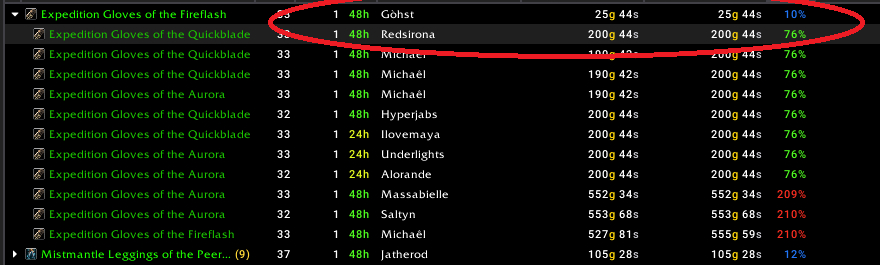
What I’m looking for here is the 10% in blue in the top right. That’s the posted cost vs. the relative cost of a given item, and where flipping can work. Now in this case there are many items for sale, and at quite a few different price points. What makes this a good idea to flip is that there is only 1 item at 25g, the next one is 190g. So buy this one, post it for 189g and you make the difference. This is the simplest example, and there are quite a few.

Let’s look at the fundamental data next.
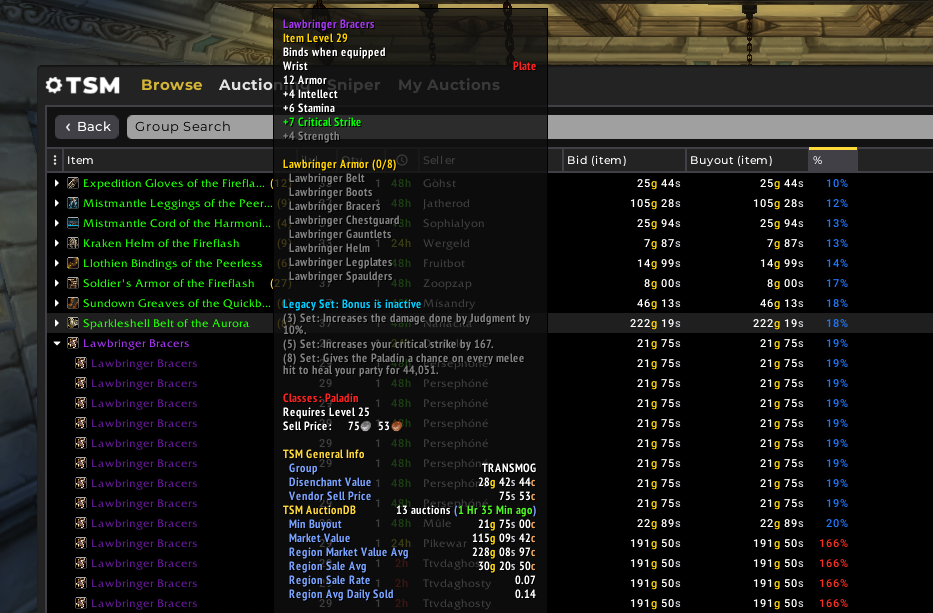
This is a more typical view of any AH posting. Lots of an item, and someone is trying to dump stock. 21g is all from the same player, and then prices jump up to 191g. Theoretically you could buy the 10 items and flip them all for 190g. But…

Look at the data highlight. The TSMAuctionDB data is the important one.

  • Min Buyout is the cheapest item on the AH
  • Market Value is the value across AH, on YOUR server. On high volume items, this is the number to look at.
  • Region Market Value Avg is specific to your region, and the average posted value. Region meaning, US, EU and so on.
  • Region Sale Avg is the recorded sale average in your region. The is what people are buying for and not terribly useful unless you’re talking about things with low volume. For BoE this can have some use as they are often low volume.
  • Region Sale Rate and Avg Daily Sold are metrics to see how much volume is in the market. Low numbers means that it can take a while to sell.

So in this case, while people are asking for 191g, the reality is that on my server the avg sale price is 115g and very few are sold on any given day. It would not be a good idea to flip here. To simplify, you want something that is low relative buyout compared to it’s true value, and where either you are the ONLY poster, or the difference between your buy and your post is meaningful (e.g. 150g or more).

Bots a Lots

So let’s see what the AH looks like now that a few bot bans have come across. This is just a dip until the next bot software comes about…
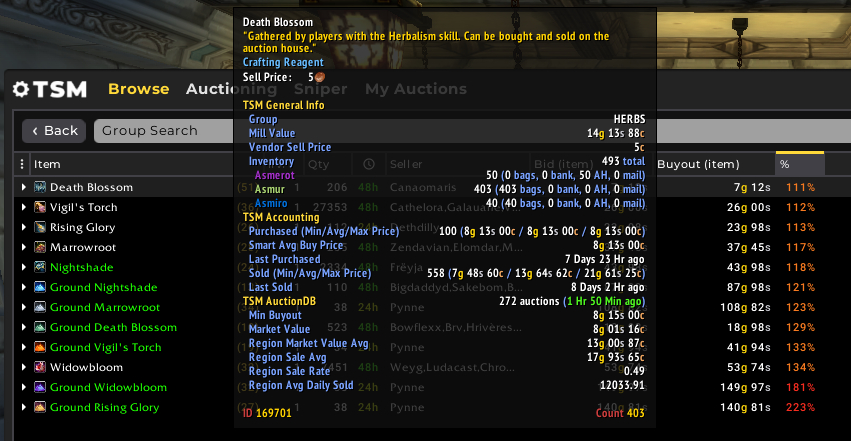
The reason the % are all above 100% is because there was a massive glut of herbs a few days ago. Bots were just flooding the market, and Death Blossom in particular was really hit. 2 weeks ago it was 20g, now it’s 7g. As the market normalizes, it will be interesting to see where this all goes.

I’ve personally set this metric to only buy at 80% of market value (which is higher than the overall market value). If herbs cost too much, then there’s no profit on alchemy. With some herbs still going for 30g, I can blow through 10k in gold without really trying.

Crafter View

This one can be a right pain, as the items that post the largest profits are often the ones requiring the most grind. I don’t mean effort to get mats, or expensive to make. I mean GRIND, as in behind a faction or some sort of super random drop.
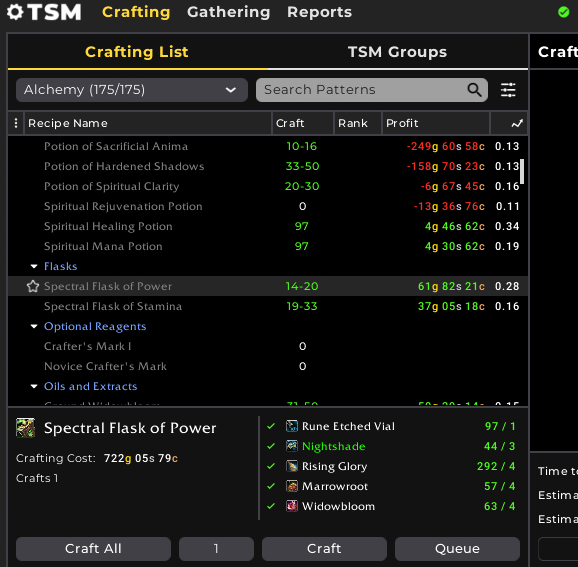
The basic crafting window is like this. If it’s green, you make money assuming you buy stuff at market rates. You can see that the flask would cost me 722 to make, and would give me 61g in profit. That’s about 8%. I can make more per craft on other items.

Here’s a high value Transmute.
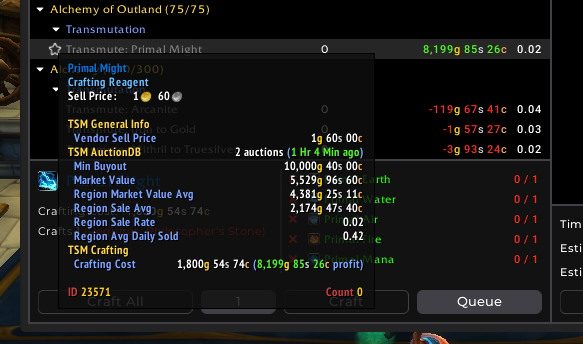
I could make this, and maybe turn a profit. As much as I’d like to make 10k, the odds are better than I’d make 5, and it would cost me 2 per day to make. There are quite a few transmutes out, and very few of them actually turn a profit. Even more so if you can’t get the mats at a good deal. In this example, Primal Fire is supposed to be 500g, but on my AH it’s 1800g.

The larger point I’m trying to make is that the base UI is not one that’s made to make money. Even TSM is only a tool, and unless you know how to use it, you’re odds better at losing money than making it. I’ve got a fair chunk of optimizing I can make to speed up the scanning and posting. I enjoy the optimizing much more than the actual profit making.
Paying for a Sub

I’ve written a lot on in-game finances, mostly in WoW. I played that game for a while too, enough that I haven’t paid for a sub since MoP launched. The rebuilding of the WoW Auction House had a rather dramatic impact on the overall economy, especially in the context of stack management and undercutting. What’s interesting about WoW in particular, is that gold is relatively immaterial for most gameplay. Only when you focus on a specific slice of the population, does gold really mean something.

In traditional demographics you have a bell curve, with smaller populations at the low and high ends, with a big bunch in the middle. Of course, that depends on the scales you’re using, but in the larger sense it’s a desirable outcome – if only in that controls applied to the demographic can hit the most people at once. If your population is equally distributed, it’s actually harder to make change. If you have multiple peaks, then it’s nearly impossible to implement change without massive disruption.

The concepts of faucets and sinks in an economy are somewhat easy to understand. Money shows up, money then leaves. In games, the faucets are entirely controlled by the developers and then exploited by the players. WoTLK’s daily quests decimated the market with the massive faucets, to a point where Blizz has never really recovered. WoD’s garrisons were WoTLK 2.0 in that regard, as it was even more money coming in and players having no real obligation to interact with the world (also see the start of mission tables).

Shadowlands’ faucets are similar. WQ regularly award 250-300g. Mission tables are the same (though longer investment). Each calling/emissary quest puts ~2,000g in your pocket. Then there’s the actual drops you get as you go through these motions. Let’s just low ball it at 2k per day. Depending on your server and player engagement the amount entering fluctuates. Let’s say 1,000 people do the daily – that’s 2m gold per day entering the system.

Sinks have not scaled in the same sense. You are still limited to flight paths, repairs and the AH % cut. I made a Kul Tiran Druid for level up fun (heirloom armour). In the leveling process I was able to buy access to every flight skill and 30 slot bags with thousands left over when I was done. The net result is that the “floor” of gold available to people is miles higher now than ever before.

And yet, the cost of a WoW token has been relatively stable for years. If more money is entering, and less leaving, should this token not increase? That begs the questions as to whom is buying and who is selling. Which I can get into in another post.

I won’t bother talking much about the Druid bot infestation. Seeing any Druid with ilvl68 gear picking an herb is an automatic report for me. They are a sink to the economy, as the sales through the AH have a % cut. While they may annoy players, at the system level they do more to normalize than anything Blizz has ever done.

Shadowlands Tools

I mentioned the basic daily faucet of emissaries. Even doing it every day you’re only going to see 50k or so by the end, still well short of 120k. Selling harvest mats can be a major increase of income. Necrolords who have completed their campaign have a distinct advantage of accessing an area that is KOS for anyone else for herbs. With such poor travel options in WoW today, it’s easy to pick up herbs between destinations – and selling them for 2-5k a day isn’t all that hard to do.

I prefer to wait until I have 3 callings at the same time, as often they will overlap. Gives 5-6k in easy gold, then a few piles of herbs to sell. This process was enough to make about 200k in the first month.

Using the AH normally is ok, you can see what stuff is selling and make your choices to sell. If you want to really simplify your life, just installing TSM and leaving it at its default setting is going to be easy money. It should scan everything in your bag, look at what’s on the AH, and then post for a bit less than the cheapest one there. You want simple, and this is super simple.

Optimizing

TSM is a tool. It can be used for many things, but in order for that to work best, you need to customize the tool. High volume items (like herbs) are much different than low volume items (like transmog). 50g profit is a LOT when compared to a 100 crafting cost, but is peanuts when it costs 1,000 to make it. Same as with % gains… you need higher margins for lower values to make sense of things.

Let’s say I find an item that’s selling for 10% of value. I can buy it and repost hoping to get 100%. Doing this for an item posted at 20g means 180g profit. Doing this for an item posted at 2,000g means an 18,000g profit. TSM has the ability to be configured to take this into account.

You can also narrow down searches to categories or even items, so that you speed up the scanning process. I have a transmog category with 3,000 items. That takes 20 minutes to scan through and I certainly need to drop that down. But… I’ve also made 50k in the first day with that larger scan.

Maybe I want to craft items instead. TSM has a per-craft profit calculator, so that I’m buying herbs are lower than average value in bulk, then selling only when the profit it at its highest. I want to make 100g per flask, not 50g, so the system will only post when I am at that threshold.

And similar to the GME debacle, it take analysis to make smart decisions. If the average value of an item is 1000g, and the scan shows that the current post is 10%, I need to make sure this is a reasonable item to flip. Are there other items that area less than the average value? If so, can I buy them all and then flip? Is the projected profit worth the time (I draw the limit at 500g per flip). How much and I willing to extend myself on a single purchase? Maybe I could flip that BoE epic and make 20k. But it would cost me 100k to take that chance. Could I use that 100k on say 50 smaller transactions to make the same amount?

And importantly, how much time do I really want to put into this? All I want is to pay for a month’s sub. There’s no AH dinosaur to go for. There’s nothing that I need. Do I aim for 500k to cover 4 months, and then just play? Do I only bother with 1 month at a time? I could spend an hour or two a day just flipping, or I could spend 10 minutes, or even none.

Future post will go into some of the thought process behind picking a flip, with examples.

Supply, Demand, and Perspective

It’s really fascinating how financial models apply to online social interactions – in particular anonymous ones. If you don’t have a known person, then it’s no different treating a box or AI. The empathy gap is serious, and there’s a VERY large thread related to the pros/cons to internet anonymity. That is not this post.

This post is about the concepts of supply and demand in relation to WoW’s Mythic + content – M+. In order to access M+, you need to complete basic Mythic difficulty dungeons. Your performance gives you a key to access higher levels of M+. Those events are then timed. There are three end conditions

  • Beat the timer and get +1key to a different dungeon, and 2 pieces of gear.
  • Beat the dungeon but not the timer and you lose a key level to a different dungeon, and get 1 pieces of gear.
  • Leave the dungeon without completing and the key goes down a level, but stays the same dungeon (allowing people to manually downgrade the key level)

This makes it so that the risk of success / failure is entirely borne by the owner of the key. The penalty for not making time is not horrendous. It’s not that you need to redo the dungeon, its just that you get a slight downgrade on the key. In this context, the supply of keys is limited, as it gates access to content, and by proxy, the supply of key owners is also limited. Further, due to the difficulty / reward structure of M+, there’s an even further limit to the number of high level keys. I think it’s something like 3% of all runs are currently M15.

Since it takes 5 people to run a dungeon, there’s 5x more people without keys than with keys. This means that the supply of all possible players is larger than the amount of keys. Not that they don’t have keys (they likely do) just that only the key used to start the dungeon gets upgraded, and you’ll have plenty of people with +2 keys trying to run +10 dungeons.

Financial math says that systems with low supply and high demand put the power of decisions with the owners of supply (read keys). If there are only 3% of M+ runs that are at 15, that means that of the 100% of players in M+, 97% of them will not get in. It’s not to say they won’t try, it’s to say that they won’t get in.

Falling back to the reward item above, the owner of the key loses a LOT if they don’t make the time on the clock. They are incredibly incentivized to select the best options to improve their odds of winning. If they have the choice between someone who is overpowered for the content and pretty much everyone else… they are going to pick the former. If they have two equal power candidates, then they are going to look at the meta specs (e.g. tanks are going to be DH, not Warrior).

Which, a small tangent, I agree that the meta is not representative of the masses. However, the meta of M+ has a psychological downstream impact.

Let’s compare that to you having a barrel of blueberries in front of you, and the task of baking a single pie. You’re going to select the best looking berries and ignore the ones with twigs, or bumps, or too tiny. The anonymity of WoW makes it so that people are effectively the same – they are just numbers. The odds that you group with someone twice from a LFG / LFR structure are astronomically small.

Now, if you’re the blueberry this stinks! It certainly feels like those job postings that are entry level and asking for 10 years of experience. How is that reasonable? Well, it’s reasonable because there are people with 10 years experience willing to take entry level positions. Your perception is one that the system is unfair, and there’s no way for you to get that experience if you’re not given the shot.

Options?

Run your own key groups. You may ethically think that you won’t be so prescriptive, and it’s certainly possible that’s the case to start. But power corrupts, and you’ll find out why the system works the way it does pretty quickly. This would increase supply of keys, and reduce demand of other players.

Only run with a guild. This is a great option for those with guilds who are large enough to support the structure and various combinations/levels. You can also run this with friends too. This exponentially changes the supply/demand metric, to the point where it may not even apply.

Blizz makes systematic changes that reduce the penalty for not making time. We are in expansion 3 of M+ with zero changes to the way this works. The meta of weekly rewards has been tweaked (the Vault now), but nothing on the individual mechanics, structure, or incentives. So… not likely to actually change.

Blizz makes it so that more people have high level keys. While this sounds cool in theory, it would also mean that more people need to step up to leadership positions. The supply of keys would skyrocket, but the supply of people wanting to lead groups… that’s a big ?

Blizz somehow implements a scoring system. This would effectively be an automated screening tool for making M+ groups, using in-game measurements. You couldn’t apply for things you’re not qualified for, and people would have less applicants to stream. Raider.IO is just another version of GearScore from yore. Modders will fill the void.

It’s absolutely fascinating to see this situation unfold, and the various perspectives applied. With Blizz all but mandating that M+ is the core activity in WoW (there are M+ invitationals after all), it’s no surprise to see so many people enter and push the system forward. Victim of their own success really, with a highly complex and competitive environment somehow trying to be accessible to the masses. Imagine if LoL didn’t have ladder ranks? Or rocket league didn’t have a casual mode? Quite curious where Blizz goes from here… if M+ is the content of choice and piles of people are not able to access it… do we get another LFR?

Core, Satellites, and Sprinkles

Let’s pingback to Kaylriene on his post on SL thoughts after 2 months. This really is a larger game design challenge, and one that as consumers we can feel but often have trouble articulating. Why is it that some games just work despite clear flaws, while others fail even if they are relatively even?

I posit this is more related to psychology and analogous to Maslow’s tower of needs.

In game terms we can instead view this as the core systems, which are then supported or perhaps dependent on satellite systems. Take the first Mass Effect, the core systems were RPG focused on story and character development. The inventory was horrible, and everyone is best to forget the vehicle portions – yet they were not a requirement to enjoy the game. Invert that to something like Anthem, where the core systems were inventory (it’s a loot game after all) and combat. The latter was seen in a positive light, but the former was disastrous.

Or you know, look at Marvel Avengers. The core activities are meaningless and people have just noped their way out.

Look at every GOTY candidate. They all have near perfect core experiences, with some having some challenges on the satellite systems. God of War is near perfect from start to end, every aspect. Horizon’s combat, development, and storylines are great… yet it’s pulled down by the ubisoft-world-map-icon-palooza system. Some even start throwing sprinkles on top of it all, because their foundations are so solid. Hades is a spectacular achievement in system design, and yet they threw in extra cosmetics, an integrated soundtrack, relationship development, and a super complex dependency chart that dictates what dialogue is presented. We get to a point where we’re comparing an indie company as being objectively better than multi-billion dollar developers (such as Last of Us pt 2).

WoW View

But to WoW for a minute here. I do think that SL’s core systems (dungeons, covenants, raids, borrowed power) are all relatively well balanced. Maybe not perfect, but balanced within relatively acceptable levels. The things you need to do generally work. Where SL stumbles is in the things you can optionally do. I could post a bunch of things, you could read Kaylriene’s post, you could visit Reddit or the official forums… suffice to say the list is quite long. The major balance issues are in satellite systems. In the general sense, the rewards for activities in SL is much lower than in recent memory… which is sort of anathema to the concept of carrot and stick.

If we time travel a tad, it’s been a long time since the core systems ‘worked’.

  • BfA – few of the core systems worked. Whether the Azerite Gear or the Corrupted items, or AP grind. The satellite stuff was ok, but had some serious challenges.
  • Legion – the core was generally good, but the AP grind was painful, as well as the heavy RNG on legendaries
  • WoD – the garrison is well, maybe let’s not talk about it. This is where flight was disabled too I may add.
  • MoP – The core systems here worked, by and large. The initial rep grind was tough, and the “forging” system came into play.
  • Cataclysm – the only core was a new talents system, the rest was all satellite. That is a major genesis of the LFR system as no one was engaged in the content.
  • WoLK – the core here was solid, and implemented a pile of new systems. The challenge was on the reforging mechanic and talents, which were removed/revamped in Cata.
  • TBC – The core was amazing here, yet hindered by the attunement system that made it very hard to “catch up” to relevant content
  • Vanilla – I just refer to this as the true sequel to EQ. The core was just a refinement of that game, and changed the MMO landscape as a result.

Each person has a different driver to play a game. Some people need the core to be solid and ignore the satellites, others can ignore the core and just focus on the outside stuff (I’m sure some people enjoy pet battles more than dungeons). It’s not a common thing where a game can do both well. In the MMO space, designers tend to focus on core as the driver for the multiplayer aspect, which in turn drives retention. It is FAR from easy, it requires vision and passion. It certainly requires consuming your product.

Here’s hoping that somewhere in this mess, we as consumers can find a better way to recognize and reward quality. And where it doesn’t exist, find a way to help the developers (who are by and large extra passionate) to find their way forward.

Kyrian Trial of Ascension

With the rather ho-hum review so far, I did want to hit on something I think is working rather well. While each covenant has their own unique activity, I’ve only invested real time into the Kyrian one. The Trial of Ascension is a sort of brawlers guild variant, where you play as one of three characters against boss events. It’s entirely solo content.

I’m a bad news / good news person. So the bad stuff first.

  • You need to farm materials (5 types) to unlock new enemies (10 of them), create items (5 of them) and then various single use items. They drop in all 4 zones, with a 20% rate on specific mobs. Alternatively, you can buy a box with 20 of each in them from 5 Medallions of Service (MoS)
  • It costs 1 MoS per boss attempt. MoS are not a guaranteed drop or reward. You can craft 1 MoS for 8x of each farmable material, which is super painful.
  • If you go into a boss blind, you will not succeed on the first attempt (reasonable!) Some bosses have 1 hit kills. But it costs you a MoS.
  • It costs 45,000 anima to unlock all the bosses and difficulties. It costs a further 45,000 anima to unlock all the rewards (I hear some prince in Nigeria is interested in this model). Imagine you got a drop from a raid boss and it cost you 1000 anima to use it?

Long story short, it’s a grind to access this activity, a grind to participate, and another grind to claim your rewards.

Now for the good stuff!

  • Each of the 10 bosses has unique mechanics that change depending on difficulty. The quests to unlock them can be interesting in their own right. There’s very limited RNG, nearly everything is pattern based.
  • You have 3 characters to choose from, each with their strengths and weaknesses.
  • You have the option to equip gear (permanent) or charms (1 time use) to add benefits to a run. Things like improved speed, a shield, healing, more damage and whatnot.
  • The increased difficulty requires smart playing to get through. Face tanking isn’t an option. Depending on your normal class, this will require some interesting mechanical changes.
  • All stats are normalized, meaning your regular character’s gear has no impact.
  • Most fights take less than 5 minutes.
  • The challenge is learning the appropriate tactics and then executing them as close to perfect as possible.

Blizzard has built a very interesting activity that’s a merger of the Withering and Mage Tower events from Legion. It’s an active battle simulator that treats all players the same, and has a cost of entry. That is a reasonable design goal (maybe less in an MMO, since it’s solo only) that as a distinct activity, it really quite fun.

Yet, Blizz being Blizz, they’ve put in a ridiculous grind to participate in the fun. The mats require a massive grind. The MoS require you to do Callings for the best drop chance. The anima costs are completely insane given the current drop rates from content. It also requires renown unlocks to access 2 of the 3 characters since you need to have bindings to them. These are simple fixes… increase the drop rates on the grind to 100%, drop multiple MoS per calling (5 per day), cut the anima investment costs by 50% and remove all anima costs for the rewards. It will still take a month to get through all the content. Focus on the actual content as the time investment, rather than granting access to the activity.

As it is now, this feels like some of the best content in SL is something everyone is going to avoid. I’d be curious as to how the activities feel in other Covenants.

Mandatory Buffet

The only benefit to consumers for a buffet is the sheer variety of options for a fixed cost. The quality is rarely that of a focused restaurant. The benefit to the restaurant is that they have a much larger client base and a rather consistent income stream because of it. The expense management aspect is similar to other restaurants (people make different choices), yet there can be massive spikes with no corresponding income spike. You should be able to identify trends and accommodate, but the launch is going to be rough – or if you get a sports team show up. Consumers generally sour on buffets if there is not enough food, or if the quality dips beyond a certain level (e.g. it’s cold).

Why is this relevant? Most games offer a buffet type approach. Assassin’s Creed is a perfect example of this, you have dozens of possible activities. MMOs also have this, in that you can craft, hunt, dungeon, raid, or other. The difference is in the structure of the buffet in that things are an option or not.

MMO players have differing goals. Some like the social part, some the achievements, some discovery, some the competition. Most games have a gate that prevents access to a given function, either player level or player power. Some are soft gates (you can try something while underpowered but it will be very hard) or they are hard gates (you simply cannot access the feature).

In WoW, there are both. The hard gates are usually related to levels (90% of the game is locked at max level), or to a quest. The quests are notable in WoW, as most items are time gated. Even if you have all the pre-requisites done, you still have to wait for that gate to be accessible (covenant storylines, twisting corridors). The soft gates are power related, or ilevel. You need a certain level to do dungeons, another for raiding, and so on. If you want to access the full buffet, then you need to increase your power level or renown level.

To increase renown, you need to do your covenant quests. These require you to do a set of activities (you don’t get to choose which):

  • collect souls from the maw (weekly)
  • collect 1000 anima (weekly) – anima comes from WQ + dungeons
  • complete some combination world quests (daily)
  • complete a specific dungeon (uncommon daily)
  • complete a PvP event

If you want to increase your power level, you need to:

  • complete the odd WQ that has a reward
  • complete the covenant story (through renown + dungeons) and boost your item level
  • complete relevant dungeons and get a drop
  • complete raids and get a drop
  • complete PvP and raise your rank
  • open the weekly vault, which stems from completing mythic+ dungeons, raids, and/or PvP
  • complete the weekly open world boss and get a drop
  • complete 2+ Torghast runs to get ash for legendary upgrades

Assuming you’re a fresh 60, that’s a big buffet! Nearly all of it is right at your door when you start too. You’re going to try as many pieces as you can, then develop a taste for one or two. Then you realize you’ll need…

  • to do WQ for the weekly anima quest
  • to run the Maw once a week for the souls quest
  • to do WQ for renown increases
  • to run Torghast multiple times (at least twice) to get soul ash for your legendary
  • to PvP for renown and vault rewards
  • to raid for vault rewards
  • to run M+ dungeons for vault rewards

“Need” may be a harsh word, you don’t need to do any of it. You can ignore all the systems if you want, and just do the content you enjoy. The game will hamper that enjoyment if you don’t engage in more systems, but that’s entirely up to you. That loot is so incredibly sparse, if ever you do see something drop, you’re going to jump on it and forcibly try any avenue to get that artificial number to increase.

The cynic in me see this design approach as on par with mobile games and their focus on engagement. Or, as we’ve all seen reported, Monthly Average Users (MAU). The game is purposefully designed to tunnel you into ALL activities, whether you enjoy it or not. If you don’t enjoy content and (feel the) need to do it, then that is not a positive feedback loop. If that content is not working properly (e.g. Beastwarrens bugs, placeholders in Torghast, anima rewards that don’t scale, broken mission tables, broken WQ gimmicks, etc…) and you need to do it, then ugh.

In the individual mechanism space, on the whole, Shadowlands improves on BfA. You never have a reversion of power. The borrowed power mechanic doesn’t scale to absolutely stupid levels. You’re never looking at triple RNG (-forging). But as I’ve mentioned before, I can’t see how the game could have gotten worse than BfA. It reminds me of an Eddie Murphy joke.

Shadowlands feels like this.

Covenants

Or, as I like to call them, Class Halls 2.0.

There’s been a lot of talk about Covenants, as they are the main feature of Shadowlands – driving the majority of the story, providing a reward structure, and a “borrowed power” mechanic. Picking one is easy. Changing one means you’re losing ~2 weeks of time gated content.

I’ve got Kyrian and Venthyr storylines running. They are interesting and varied, taking place across multiple zones. I won’t go into a pile of details, due to spoilers. I would be surprised if anyone picked a Covenant due to the story (maybe for aesthetics though, which is another topic). They are time gated, and catch up mechanics are present. They do not, as of yet, appear to intersect.

The reward structure is very similar in both. You get a travel hub to speed up zone travel, which is great, cause zone travel is horrendous. Side note – crappy travel means I harvest a ton of herbs/ore without really trying. Somewhere around 200k in profit in 3 weeks. You get access to a very odd mission table structure that is completely unbalanced. Venthyr/Kyrian are running at half the power of the other two factions, and the UI is so bad that it’s frankly not worth trying unless you use something like Venture Plan. Another item is a sort of temporary event generator that you’ll likely do once and never again – primarily due to the horrendous travel time and lack of rewards. Finally, each faction gets their own unique side activity. Venthyr throw parties, Kyrian have a very interesting battle arena, gated through grinding components. It’s a cool concept, meant to emphasize world exploration. Maybe at some point I’ll do more of it.

A small pit stop on identifying people in a covenant. It seems a lost opportunity that people within a covenant would not want to work together, or identify other people in their covenant. Tabards at the minimum. Player power, not so much, cause that would sway guild/player choice. Yet there are certainly some opportunities here… like more Stygia if you group in the Maw. Even the Horde / Alliance differentiator is completely absent here.

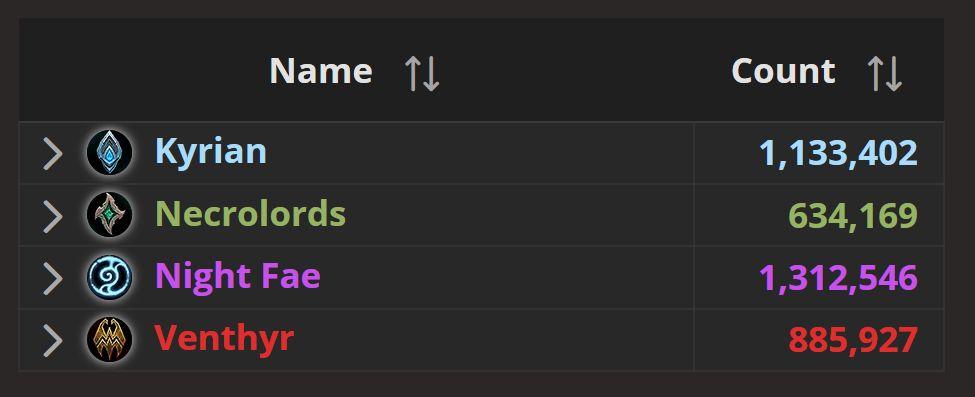
The borrowed power though, that’s where things go a bit sideways. There are lateral choices for some classes, and outright bad choices for others. DH can swap between Kyrian and Venthyr, but Necrolords are an insanely bad choice. Icy-Veins has a pretty good summary of how people have selected their covenants. The “pretty” factions lead, which further pushes the Elf/Blood Elf value. Necrolords are 16% of the total, which given both their ability and unique activity… yeah.

What’s interesting to me is the breakdown on a class basis. For multi-spec classes, this can get a bit muddy as people have a preference. That Druids pick Night Fae first, in all specs, and like 9:1… that’s a problem. Same with Paladins and Monks for Kyrian. The “pure DPS” classes you’d expect somewhat flat choices, though it’s more like no one wants to be a Necrolord Mage.

Is it hard to balance skills across all the class/spec variations? Heck ya. Is it OK to have preferences, sure. Less OK is when one option is superior to all others. This falls back into the argument of paragon/renegade, where is everyone makes the same choice, there really isn’t a choice to be made. It’s also a challenge from a design perspective, as you can’t really change the powers too much, as people will then math it out and show that a new bad choice is present and want compensation to change. It’s a very interesting spot they’ve painted themselves into.

In a general sense, I think Convenants work. They provide thematic tools to expand on the player experience. Covenant abilities could have used more time in the oven, but the issue at hand is related to reducing the penalty from swapping between choices (which will get worse as more renown ranks are unlocked). Combat Tables should just be removed from the game at this point, right up there with Archeology.

Overall it sort of works. This is a bit like falling upwards from BfA though. They are better than garrisons in that they are not instanced, and don’t pump out insane raid level rewards. But they are worse in story telling as compared to class halls. When “it’s ok” is seen an improvement, expectations are out of whack.

Blizz Being Blizz

Blizz decided now was the time to ban multi boxing through multi-input software.

Let’s get this part clear – WoW is celebrating it’s 16th anniversary. Multi-boxing is as old as MMOs (I used to do it with UO). This isn’t a new technology, there’s no new technical risk, and nearly all devs have turned a blind eye to this because a multi boxer is a paying customer – and likely a dedicated one with a “permanent” subscription. People don’t multibox casually.

So let’s take a look at the pros/cons in this space.

ProCon
– More money for the devs
– Allows players to have multiple characters
– Allows people to play solo without depending on LFG
– Saves insane amount of leveling time for “grind” activities
– Primary tool by farming bots
– Can be viewed as required for 1% gamers
– Can dramatically unbalance PvP

There are certainly other arguments for/against multi-boxing. I did it in UO in order to build multiple accounts in order to sell them, at very low risk. It also allowed me to farm materials as needed. I’ve never really found a benefit in leveling faster, or avoiding people, but I can see why that’s of huge benefit (EQ certainly).

So the question is why now? What happened today that is making multi-boxing somehow a challenge for Blizz? Specifically, why in the world would they be turning away money from players?

Are there more bots all of a sudden? Gold is pretty meaningless in WoW… people sell achievement runs. Maybe in PvP, where you find something like 20 druids with similar names coming down on you. Again, that’s not new.

I’m guessing here, but the only “new” thing is Shadowlands – and specifically the covenants. I’ve pointed above that multi-boxing is already somewhat niche, and this continues that thought process. And more specifically, how the 1% in WoW impacts the general health of the rest of the game.

Blizz has doubled down these past years in the raiding scene. Nearly every activity released has a raiding focus – the legendary cloak is a great example of this. So top tier raiders tend to set trends in game, which creates barriers for horizontal choices down the player base. In BfA, you were either running X corruption or you were not a raider. Raiders would look for every advantage possible to be able to adapt and overcome design choices. (BC gave us leatherworking raids after all.) Changing talents mid-raid is still a thing.

Covenants are powerful choices for players, and currently balanced in such a fashion that they have a noticeable impact on gameplay. There are optimal choices, and then there are situational choices. The reality of it is that classes are going to be put into situations where their covenant choice is not optimal, and that is the main pain point for the player pushback.

Multi-boxing addresses this. Not in the leveling aspect, but in the grind aspect. This became more popular in Legion, where the AP grind (Maw runs) were facerolls with alts.

I’m certainly biased here. Covenants are effectively powerful talents with very long cool downs. BfA raiders had multiple sets of gear in order to tackle specific encounters, ensuring they had access to ability sets. It’s surprising to me that Blizz didn’t learn anything from that. Well that’s not fair – there is very little that Blizz is doing with WoW combat design that surprises me anymore.

Now for the majority of players today, this is entirely a positive thing. While there were plenty of cases where multi boxing was a pro for a player with minimal cons, the wide majority of cases focused on “abusive” play. Removing this as an option for raiders is even better, allowing for some semblance of balance. That said, multiboxers with nefarious intents will simply find another way to do it.

In a TLDR; for this post, it seems to me that Blizz is banning multi-boxing tools in order to remove the ability for raiders to game the covenant system. In the general sense, this is good for everyone except Blizz who will be out a fair chunk of cash. I’d love to see evidence otherwise.

Shadowlands – Meh

Legion worked primarily because it was a fresh breath of air on the WoD structure.  It had a big focus on the world and story, added new life to dungeons (with keys), and had a pile of horizontal stuff along the way.  The main gaps were around the abundance of RNG on game-changing items (good vs. bad legendaries).  There were challenges when it came to alts, and even larger challenges when it came to different specs.

BfA rubbed the wrong way because rather than build on that model, it opted to add multiple levels of RNG to pretty much every system.  Instead of targeting vertical progression, a wide swath of activities actually had a negative progress curve. The balance from launch improved the RNG, dramatically.  Multiple activities provide progress towards goals, which is mechanically solid.  What remains is Blizz’s frankly bonkers approach to balancing those options.  Multi-spec characters really took a beating here, since skills were locked into gear.  Felt like time travel.

Which brings me to Shadowlands.

There are multiple systems here that appear solid at the conceptual level.  It appears to be the merger of factions and talents, which seems a somewhat logical point in 2020.  It appears to provide rewards outside the gear, also good.  It has a visible progress line, compared to a roll of the die for the next upgrade, great.

Where the gap is for me, and from various blogs I appear to not be alone, is in the Blizz approach to balancing these choices.  Sure, there’s the meta, and there will always be a meta.  It’s 2020 for crying out loud.  No, what I’m getting at is that the illusion of choice due to poor balancing.  If your job is healing, then there are no choices but those that increase healing.  If you need movement for 1 fight out of 10, but it takes you a week to get access to that skill… well then you don’t take that skill.

I keep using the word balance, but we only ever think of one side of that scale – the one we are evaluating.  The measure on the opposite end is even more important.  If I am balancing a skill, we all have to agree on what’s the counterweight, the baseline.  Blizz has a habit of making that weight equal to 100% optimal use in mythic difficulty.  They will eventually reduce that, but it takes time.  The amount of time that takes, and the level, directly impacts the importance of the meta.

Further, the internal testing/beta process is clearly broken.  The massive nerfs applied to corruption effects once live show that clearly. Everyone was given a choice between a tactical nuke, and a rake.  I get that nothing is perfect, I more than get that.  That’s my everyday life, ugh.  You need to iterate, that’s normal.  But BfA didn’t have a single system that launched in an “acceptable” state, everything felt rushed.  I will be the first to admit that nearly every system improved over time, but that level of improvement is typicall in the beta process… not live.

My newsfeed has a ton of Shadowlands stuff.   Beta is live.  Core systems (like conduits) are already going back to the drawing board.  The speed of that change means that Blizz didn’t really think it was going to fly anyhow.  The selling features of this expansion are really twofold.  That this covenant system works (and is therefore balanced) and that the Maw has some sort of attraction to do on a regular basis.  As of now, in beta, where the excitement should be high, it’s instead very muted.  It’s very reminiscent of the BfA beta vibe.

Maybe we do end up with the A/B cycle of good/bad expansions.  I hope so more for Blizzard’s sake than my own.  There are a lot of eyes on this expansion, and if the cash cow that is WoW no longer produces, we are all aware that Mr. Kotick is more than willing to take action to solve it.  Way too many people lose in that event.

Heirlooms in BfA

For a very long time, the entire point of heirlooms was to bypass the wonky leveling mechanics in WoW.  Mainly the fact that items scaled in power, smoothing (?) the power curve.  The % increase to xp gain has been a perk on top of that, and of larger and larger benefit as the leveling experience has gotten longer.  From level 100+, there’s really nothing in game that provides any character growth, it’s just a time tax.  Every expansion just adds 4 hours or so to the leveling period.

Shadowlands aims to reduce that time tax – with something near the 20hr mark to get from 1-60.  That’s in the realm of most single player games, so not too bad.  Heatmaps are going to be interesting… I don’t see why anyone, anywhere, would want to level in any zone that was NOT Legion / BfA.  Anything pre-MoP feels horrendous – and unless you’re really strapped for attention, you’re best playing the LFD roulette.

But 20 hours, that’s doable I guess.  Certainly less than the current pace of leveling, even with heirlooms.  So I guess that’s why Blizz is not planning to have an %XP boost anymore.  The item scaling appears to still be there, but I’d be wildly surprised if anyone thinks that’s enough of a motivator in a single expansion cycle (where I assume item levels make sense).

Taken from another lens, I see heirlooms as a band-aid for the larger problem – time to level.  That problem generated other problems, primarily the value of a level.  The level crunch should get rid of the value problem, where you spend 20 hours and get nothing for it.  The time to level reduction is pretty much required, given Blizz’ persistence to only put relevant content at max level.  I mean, aside from the art, what’s different from a player at level 30 and 119?  The rotation is 95% the same, there’s no real grouping aside from guilds, crafting is entirely meaningless.  The Class Trial option gives you nearly every permutation of gameplay for a class – and it doesnt take 20 hours to complete.

But that’s a larger rant.

Right now, Blizz is cutting leveling time, reducing a significant problem’s impact.  Removing %XP from heirlooms, in this expansion, removes the practical need to buy them.  Curious if they will do the same to the Refer a Friend bonus…