Iceborne Storyline Complete

I guess spoilers in some sense within.  But frankly to reach the end of Iceborne you’ve put in nearly 60 hours.

So the “last” elder dragon is down, and that’s a hell of a fight.  One move in particular I don’t think it’s possible to survive, and you need a Farcaster to avoid it (return to base).  It’s very similar to the Xeno fight, in that it’s a very LARGE dragon, and it seems like you’re tickling it more than anything else.  I won’t go and say that it’s necessarily difficult, but I can say that it punishes mistakes.  Painfully so.

There are a few more monsters to discover in the Guiding Lands.  I have a chunk of optional quests to clear out, including some arena battles.  Then there’s the whole process of levelling the Guiding Lands themselves.  That will be it’s own topic at some point.  The general idea is that it’s a large map with 6 zones.  The zones level up as you do battle/collect materials.  Higher levels = tougher monsters and better materials.  But raising one zone will reduce the level of another, so that you can realistically only max out 2 zones at a time.

While those are activities I can undertake, there’s still the underlying purpose of gear acquisition.  Iceborne put in a TON of new gear compared to base game, and really seems to have gone all out on set bonuses as well.  There’s plenty of new levels to charms (element attacks go to 5!), and the general augment/enhance options for gear is deeper than prior.

Quick math bit.  Deep Schnegel II has 480 base ice attack.  With augments it can be boosted to 550.  Then add level 7 Frost attack for an extra 100 + 10%.  Then the 4 set Namielle which adds 90 more ice damage.  The end result is something like 880 ice damage.  In more practical terms, it’s double the damage… and not at all clear to players in game.  Now, this only applies to Ice damage (since it’s based on the weapon), so you need a different gear set for Ice resistant/immune enemies.

The big thing here is that there’s a LOT of RNG to get to the end.  We’re talking about some decorations that have a <1% chance of dropping – on battles that take 15 minutes to complete.  Then the material to actually augment your gear is also RNG based (and guiding lands level based too).

MHW, in that sense, is very much like the long tail of an MMO.  You complete the main story in a week or two, then have months of re-runs of the same content.  Except in MHW, the monsters themselves have random spawns/battles, your weapons change your class at any point, and you’re always getting something.  No run ever seems a waste – whereas I could run 10 dungeons a night and get zero for it in WoW.  In that sense, MHW has a similar long tail, but a much wider one.

Overall Thoughts

I had some early thoughts, and this I guess would be the mid-point.

  • The story is more nonsensical than the base game.  Nergigante is somehow the ultimate badass.  (side note, Ruiner Nergigante is infinitely more fun than AT Negigante)
  • There’s a larger reliance on item pouch management.  Great that there’s a new slot for the garden, just wish personal inventory was a few slots larger.
  • There are 30 “new” monsters.  16 of them are reskins – generally just “tougher” with more damage or a new element.
  • The added movesets make combat more enjoyable than simply using the same combo over and over again.  Lateral moves and flinch shots are a joy.  Offset with the addition of snow/sand to restrict movement.
  • Clutch attacks are extremely powerful, but there’s a lack of training on how it all works.  A successful knockdown (to the wall) causes an enrage.  Attacking the head requires specific timing.  Combined with creature mounts, it’s a great way to “get off the floor”.
  • There are still some bugs that need to be worked out.  Using the radial menu to equip Mantles doesn’t always work.  Enemy health indicators don’t always trigger.  The new MASSIVE monsters can block camera angles.
  • Some new monster’s effectiveness is entirely based on their movement speed and your ability to react.  Tigrex/Barioth/Deviljho are good examples.  It’s cool the first few times fighting them, but eventually you just want the ADHD stuff to end.
  • The looks of the armor is top notch.   The player housing is also really cool, but sadly you need a loading screen to get to it.  The weapons though… there was a general lack of effort there.  Lots of reskins, or things that just don’t match the theme.
  • Fishing is still in the game.  All small creatures have a quest to capture a gold trophy (very large version) for some room cosmetics.
  • PC version has mod support!

Let the hunting continue.

Breadth & Depth

I’m further along into Iceborne, with a lot of sidetracking along the way

  • I’m only missing 2 canteen ingredients now.  Having more food choice is a major benefit
  • I’m still with Charge Blades, but I’ve moved from Blast to Poison.  That required a half dozen other hunts to get the pieces for a Rank 10 weapon.
  • I’ve upgraded a bunch of mantles and boosters.  This increases the effectiveness of items (like being able to take 50% more damage, or heal duration).
  • Velkhana is down.  I should have invested in more Ice resistance to simplify this fight, but hey, it’s down.

Going through this, I’ve come to a realization that this expansion requires a different level of thinking than the base game (or Dauntless for that matter).  It instead requires you to plan ahead of time, research the enemy, learn their tactics, then exploit them.  Sure, that sounds simple but it’s not in practice.  Some examples.

One of the first enemies you find in the base game is Great Jagras.  You can pretty much button mash and take him down.  Anjanath is a few bits later, and he shoots a ton of fire.  You need to learn to dodge roll.  Diablos comes along, and now you need to learn to guard and counter.  Nergigante shows up a bit later, and now you need to learn to evade dive (or you will be 1-shot).  Teostra/Lunastra teach you the benefits of resistance.  Along the way you learn that food buffs are super important, you need to use palico gear for damage/support, and that decorations can make a huge difference in end-game gear.

End-game is the base game was about perfecting skill builds, with both gear an decorations.  Hunting the perfect decorations was a very long process.  Some are so rare, I never found them in 100 hours of play.

Iceborne assumes you’ve mastered all of that before hand.  It doesn’t hold back, and throws a massive amount of preventable damage your way – but only preventable if you’ve been paying attention.  It assumes you know how to use the radial wheel, that you understand that resistances are a big deal, that instant use items (max potions, herbal medicine) are essential, that you always need slinger ammo, that you need to keep a farcaster at all times, and a dozen other bits.

When I started Iceborne, I had forgotten a fair chunk of that.  My first fight against Banbaro (the big moose) was a trainwreck.  I remember barely winning that fight, and then taking some time to re-assess what was going on.  MHW doesn’t ever provide any feedback as to what’s working or not – it just leaves you to it.  The player needs to discover what works, what doesn’t, and how it all intermingles.  I found I could just shoot a rock at the Banbaro when it has something to charge with, and it would just drop it.  That the head took way more damage than the legs.  That I could Clutch mount it after specific moves, but not after others.  The best times where I could pop a potion to heal, or lay down a healing booster.  All these bits together allowed me to take down a tempered version with barely a scratch.

There’s just a sheer breadth of things to take into consideration in this game.

In Dauntless, you consider the weapon type, the damage type/resistances, the passive skills, and then the enemy attack patterns.  There are some consumables, but they really don’t have a huge impact unless you’re speed running.  They are a pain to craft, and battles are so quick you feel like you’re farming more than playing.

In MHW you have the above, as well as:

  • Terrain
  • Grimalkynes
  • Palico gear
  • Canteen
  • Consumables
  • Environment  (reduce stamina or health)
  • Other monsters (turf wars)
  • Mounting

I could (and likely will) write something about the seemingly insane depth of weapon combat, but for simplicity I’ll talk about Terrain, since it seems rather simple.  Each map has multiple places to have a fight.  Maybe movement is restricted (water/mud/snow).  Maybe the area causes damage (spikes/fire/poison).  There are small creatures around that are likely to join the fight against you.  There are minor traps (poison/sleep/paralysis) that you can lure the monster.  There are large traps that cause major damage to the monster.  There are walls to jump off and attack, ledges to roll off and hit the monster on the head.  Heck, there are places where the floor just gives way.  Some monsters are just miles easier to fight on one map vs. another.

Each category of things has a high level of variety and inherent complexity.  When it all comes together, it looks like a cakewalk.  Reminds me a bit of people speedrunning something like Celeste on 1 life, when I went through a few hundred to complete the game.  Each hunt you undertake, even if you fail it, provides valuable information for the next one.  It’s a rare game that provides that level of challenge and reward – and dramatically improves the “stickyness” factor.


Skill Ceilings

Checkers is much easier than chess.  There are only 4 basic rules in the game.  A child can play, and even the best checkers players can get there without much effort.  Chess has different rules depending on the piece, but still only has about 10 total rules to the game.  It takes 2-3 games for most kids to learn the fundamentals.  The best chess players require thousands of hours of practice, and a very high level of intelligence to execute.  The current world champion can recall games from 15 years ago (which he did not play), on a move-by-move basis from a simple picture.  It’s insane.

Games with long-tails (forever-games I guess), in particular those popular in the e-sports fields, have approachable entry points and very high skill ceilings.  MOBA’s, shooters, battle royales… they are all have relatively basic rule sets but add complexity and options as players develop.  It’s quite impressive, and the skill level is often translatable so that even people with limited understanding of the game can appreciate what is occurring.

MMOs today have a much higher skill ceiling than 15 years ago, when zerging was an acceptable tactic.  Dungeon bosses today are more complex than raid bosses from 10 years ago.  The difference here is that MMOs have a skill floor that is continually raised with both fixes and increased player statistics.  Imagine playing chess and after every 10 turns you got a new piece to play on your board.

Monster Hunter World has a high skill ceiling, though it does a really bad job of showing it.  Often times players feel like luck plays a larger role than skill.  Due to the structure of the game (30+ minute solo battles), it’s hard to experiment with new tactics.  The training area is good to explore damage options, fine.  The real challenge is connecting attacks, while avoiding getting hit, which is really hard to practice effectively.  Some monsters can kill you in 1 or 2 hits, with no real feedback to see why.  It would be neat to have a death camera to figure that part out…

When it comes to specific weapons, they all have relatively simple button presses to get things started.  Then some combos.  Then some movements that can chain into combos. Then damage types.  Then wounding.  Then slinger attacks.  Then….it just goes on.  Where it may have taken me dozens of attempts to take on a basic Nergigante because the game didn’t explain diving made you invulnerable, I can also find videos of people taking him down in less than a minute.  I know part of the challenge is moving like this person, but I am also aware that their stats are such that they can reliably stun/attack and keep their patterns working.

I really like the Charge Blade.  It’s a high risk/reward weapon.  When it works, it’s glorious.  When it doesn’t, you get chain stunned and die in frustration.  When you finally learn about Guard Points, the weapon completely changes into an offensive powerhouse.  Instead of slowly moving around, you can deflect almost any attack and chain into massive damage.  Battles against ultra fast attackers become a game of daring them to attack you, instead of waiting until they stop moving.  Heck, here’s a video of players killing a monster with blocking alone.

There are plenty of little nuances like this that have a dramatic impact on the game, and it’s more noticeable once you get a decent way into Dauntless as to how integral it is to the enjoyment of the game.  I’m not saying Dauntless has a low ceiling (time trials prove otherwise) but it’s noticeably lower than MHW.  In fact, I’d argue that the skill floor is the biggest difference between the two games, where Dauntless is much lower.  You can reach the end-point of Dauntless with button mashing due to the LFG mechanism.

I really like games where I’m continually making mistakes and learning from them.  Games where I’ve perfected, or come as close as I care to, tend to be put back on the shelf.  Still amazing games (God of War notably), but time to move on.  When there’s always something new to learn, or perfect… then there’s your forever game.

Monster Hunter: Iceborne

I have the base game on PS4 and PC, though quite a few more hours on the PC version.  Figured I’d wait for the PC expansion, which hit last week.  A few random thoughts on this while I make my way through the main quest.

  • This is an expansion and not DLC, in the sense that you need to complete the main quest before even stepping foot in this world.  That’s a solid 40 hours before this has value.
  • The new snow map is solid.  The various nooks all have tons of interactive bits.  The stamina draining cold effect is easily offset if you’re paying attention.  The waist high snow really slows things down, but can be offset as well.
  • New monsters have interesting mechanics that build on previous ones.  Very strong emphasis on status effects now (sleep, poison, paralysis, fire, cold, bleed).  If you gear up properly, then you can immunize yourself and make the fight a billion times easier.
  • As a general rule, most monsters have one (or more) moves that require a smart counter.  You can’t just go HAM and hope to win.  This makes combat painful until you learn the tells, then oh-so-rewarding.
  • General enemy speed appears to have increased a tad.  Or at least the new ones.  Barioth feels like a snow tiger on drugs.
  • Every weapon got a tweak, and the majority of tweaks focus on added mobility.  The Charge Blade (my favorite) got some crazy tweaks for Axe mode that make it both familiar and refreshing to try out.
  • The Clutch Claw allows you to climb the target while in combat, for some limited effects.  If you can climb their head, point them in the right way, and have a full Slinger, you can knock them into a wall for great damage and a stun.  Hitting any part causes it to be wounded, increasing overall damage.
  • Fights are still quite long.  My average first-encounter fight is somewhere near 25 minutes, with no ability to pause.
  • The difference in defense levels between HR (base game) and MR (Iceborne) is very high.  I was in the 70s before, and basic MR gear is 114.  I’m now using 140.  It means that the skills on the gear matters not…so you’re focused almost entirely on decorations.
  • Decorations seem to drop after every mission.  These are random, and can be slotted into gear for various effects.  This expansion wouldn’t work at all without them.
  • There are numerous QoL changes applied throughout.  The new town hub is a dramatic improvement in terms of layout/interface.  There are more cooking options.  Changing gear is easier.  Palico hunt interface is in town.  Your new quarters can be super customised.
  • Palico gadgets are improved.  Vigorwasp (healing) in particular has a major boost with 1 free revive per mission.
  • Mantles / equipment all have a 1 rank upgrade which increases their duration (from 60 to 120) with the same cooldown.  Matters less for some pieces, but a big boost for the Boosters and Bandit Mantle.
  • Upgrading Charms is pretty much required now.  A fully upgraded Charm can grant full immunity, freeing up all the gear decorations.
  • Monster health scaling is better for 2 players.  Same for 3/4 players as in MHW.


  • I still have a gripe when it comes to item drops/farming and the inability to search for them.  You need the wiki open.
  • With a focus on status ailments, some fights feel impossible without immunity and then practically trivial once you have it.
  • Fishing does not appear to have been touched.  Boo.
  • Lots of customisation options (looks) it still feels limited since many things are thematic.  I mean, there are a dozen metal-based armor sets.
  • Grouping in this game is still obtuse.  You can only find people through the SOS mechanic, and there’s limited chat ability when not in a group.  It could be so, so much better.


There’s an essential question of Dauntless vs. MHW that remains.  MHW is the more complete game, in every sense BUT the group/social mechanics.  Dauntless is a real pick-up and play game, with battles only lasting 10 minutes at most.  There’s a very long grind near the end due to the system mechanics forcing a broad approach (you need to master everything).  MHW instead has a laser focus, with optional things to help out.  Sure, some fights may be easier with a Bow vs Dual Blades, but that’s a personal choice.  You can certainly complete the game with a single weapon type.

More thoughts on this after I complete the main quest in Iceborne.  So far though, it’s more MHW, which is an amazing thing.

What Remains of Edith Finch

In the ever expanding catalog of games I’ve had the chance to play, few ever come across as art without feeling artsy.   It takes a special kind of blend to present game mechanics wrapped up in such a fashion that it plays more like a movie.  Shadow of the Colossus has been at the top of that list for a long time.  What Remains of Edith Finch is pretty darn close to that level.

Presented as an anthology of short gaming segments relating to the Finch family, and the possible curse that has caused all family members to pass away, you play the teen Edith looking for the root cause to all the story.  The actual Finch house is something to behold, as it’s not presented as a set piece but feels like it’s an actual house.  All the various bits and bobs look like they belong to someone, and were placed for a specific reason.

edithfinch-1280-1493245671809

As you progress through each short story, you get to understand that individual person and a very stylized telling of their passing.  There are some simple enough game mechanics to be had, but the point here is more about the interpretation of the story and how the game mechanics reflect the state of mind of the person in question.

Personally, when I finished most segments, I needed to take a breather in order to collect my thoughts.  I needed to digest the person, the message, the medium, and how it all fit into the larger picture.  I’d scour their room for some additional personal tidbits.  I’d imagine how the rest of the family felt at the loss, and how it motivated them in their stories.  The point here isn’t so much how they died (everyone dies eventually) but how their lives were beforehand, and the trickle effect unto others.

The game is only a couple hours to go through, and you will only get out of it what you want to.  My wife took a stride through the game after I did, and you could see the wheels turning when it was all over.  Highly recommended.

Control

When a game reaches multiple top 10 lists, my eyes tend to shift over.  When said game blends X-files, Lost, Fringe, Twilight Zone, Metroid, and Zombies… I’m doubly in.

Built in a New Weird setting, you play as Jesse who’s trying to find her brother within a secret government organization.  As you finally get through the front doors, you realize everything is going sideways, with a small war underway.

Cue the various exploration bits, and additional powers.  You have a weapon that can transform to other styles (full auto, sniper, shotgun, grenade launcher, handgun).  Powers are relatively simple.  Dodge and shield for defense.  Seize to convert low-health enemies.  Levitation to explore a pile of areas and make combat go full 3D.  And Launch – which is the bread and butter skill that picks up almost anything to throw it at targets.    The variety of items that can be thrown, and the distance… it makes for some extremely satisfying combat.

Enemies generally look the same, humanoids.  They are quite a bit different though.  Some are basic grunts, others launch grenades, some fly, some explode on death, some stealth and then shoot you at close range.  Then you have various elite enemies, and some exceptional boss fights.

Which does bring me to likely the largest hurdle for many gamers… this thing is hard.  Not to the level of Dark Souls… but enough that I died a solid 50 times before the end.  Sometimes it’s just bad luck and you end up between two grenades.  Sometimes you miss an important jump.  Most of them were the boss fights, in particular the last one and the few optional fights.  Levitation, dodging, launching, shooting.  It feels like pure chaos, but then you look back and go “holy shit”.

In fact, there’s one sequence near the tail end where Jesse says “that was awesome” and I cannot recall any game sequence that actually felt that awesome to get through.

There’s some RPG-ish elements here.  You get skill points to increase various powers/health/energy.  You get mod to modify yourself (better throws, less energy per use, more health, etc..) and your weapons (accuracy, rate of fire, ammo return, etc..)  There’s a huge amount of RNG here, and a massive difference between rank 1 and 5 items.  If you like min-maxing, there are some options here.

All of that stuff works, and generally works well.  But you’ve seen that before.  The extra bits here are the lore/setting.  There are dozens of lore items to pick up and read, listen to, or watch.  Some of it is absurd, like a rubber duck that teleports on it’s own, or a traffic light that teleports users when it’s red.  Some is freaky, like mold that takes like candy and transforms people.  There are various hidden puzzles too, like one where you cheat on a roulette table.  Piles of side quests that add extra flavor and bring you to the weirdest of places.  An extra dimension phone line.  The amount of effort and quality world building here is stunning.  You want to explore every nook and cranny.

And I want more Ahti.

Long story short, yeah, Control is one of the best games I’ve played this year.  That was awesome.

Warframe Update

Goals.  I need to set more of them.

Progress in Warframe is an odd measure, since it’s like saying you’re done with the soup section of a buffet and moving to seafood.  Ain’t no measuring stick for that!  But Warframe has a conceptual value called Mastery Rank, and it’s based on the rank of various pieces of loot.  Get a sword to rank 30, get some MR.  Same with companions, pets, main weapons, side weapons, and archwings.  Right now, I’m at MR7.  The max is MR28, though MR16 is where the final content is unlocked (Riven).

That makes one set of goals of getting more stuff.  There are 42 main line Warframes.  27 of them have Prime variants (better stats, much harder to obtain).  I’ve gotten all the ones that drop from planets up to Neptune.  I’ve got the main blueprints for Chroma and Octavia as well.  That also means I have a fair chunk of main weapons, secondaries, and melee choices.  I’ve leveled a fair chunk of them, though it bears note that leveling them is not the simplest of things.

From 1-30 takes just under an hour.  You can level multiple items at the same time, though most weapons level faster if you use them.  Helene on Saturn is a defense mission against Grineer, and is the go-to place for people to level everything.  Easy groups, generally small room, plenty of drops.  It can get repetitive though, so I try to interlay some other missions to break the monotony.

Upgrading items is done with mods, which work like points-based bonuses you can slot into gear.  You can upgrade mods, which increases their point value, but each piece of gear has a max amount, so it turns into this interesting (?!) puzzle at times.  Many mods are useful, though the best are quite hard to come by.  A full leveling run (from 1-30) can get me ~250 or so mods, though 99.9% of them are sold.

If I was to set myself some goals for the next month or so, they would be as follows:

  • Get to MR10
  • Complete all nodes up to Neptune
  • Complete Octavia & Chroma
  • Acquire Titania & Grendel
  • Complete Pluto missions (which should unlock lots of quests)
  • Get into a Dojo (guild)

Some of those are more achievable than others.  Octavia in particular requires a random drop from a 20 minute mission, which are level 25-35.  Guess that will depend on luck for groups.  Even completing all nodes can be a major pain.  Archwing missions aren’t all that muchr fun, and I have a large dislike for Mobile Defense missions.

Still, if I can complete at least MR10 and up to Pluto, I guess I can consider the basic stuff all complete.  Then I can start worrying about factions and whatnot.


SWTOR – Shadow Musings

I’ve loved stealth classes for a long time.  They work in excellent form for quick combat, but generally get weaker as the combat duration lengthens.  In WoW, Monks have pretty much replaced Rogues in that respect.  But it’s hard to ignore their benefit of group stealth for time-based challenges.

In my Republic playthrough, my current character is a Jedi Shadow.  By level 25, aside from a stealth button, there really isn’t much there that screams “I’m a shadow ninja and you can’t see me.”  I’d have to triple check when my toolkit from stealth actually has a purpose other than bypassing groups of enemies.

I’ve just finished the Nar Shadaa / Taris grouping, then the tiny ship event that follows.  I’m chasing a Sith that is infecting Jedi with some sort of mental plague, turning them to the darkside.  My secret weapon, which I learned at level 5, is to take their illness for my own – sucking the poison as it were.  I finally found the Sith, and now to chase him…

This is an odd storyline.  Why in the world would the Jedi Council assign one of the largest threats to its existence to an initiate?  When  you’re already short staffed and someone is poaching your team, I think that merits more than the rookie’s attention.

The story beats are all similar too.  Each planet you find a Jedi turned dark, complete some quests to finally meet them, then use the shield ability to cure them.  Feels like I’m a doctor running around giving vaccines.  Aside from the very final part (in the ship), there’s no tangible progress.  If I recall, that is a point for quite a few of the Act 1 class stories, yet in this case it seems really apparent.

I generally liked my companions on the Empire side.  Sure, some annoying ones but it worked.  Qyzen is the whole honorable warrior shtick.  It completely conflicts with the light side Jedi options though.  Tharan Cedrax is meh.  His own companion, Holiday, is where it’s at.  There’s something about the exploration of AI in the Star Wars universe that’s always been interesting.  The whole Iokath/SCORPIO line is where it’s at for me.

I still maintain that the leveling experience is jarring compared to later content.  Planets are large swaths of nothing, with the hub/spoke model that has side quests that are not at all near where your main quest points you.  I’m sure I spend 75% of my time on my mount getting from A to B.  If not for investment in Legacy Quick Travel, the trip from B back to A would be all the more annoying.  It’s more of a gripe though, since I’m able to clear an entire planet’s quest (class & planet) in about 90 minutes.

I’ve thought about doing multiple classes at the same time, enough to allow rested XP to get me to 50.  Good news there is that since every planet scales to my level, that’s not needed.  So off to Tatooine I go.


Phoenix Point Quick Impressions

XCOM of attrition.

I rather enjoy the tactical/strategy squad genre.  I played the heck out of the original XCOM (even wrote my own mouse driver for it).  I’ve played every iteration since.  JAG was decent enough.  Syndicate is a top 20 all time game.  There are a half dozen in that vein every year that seem to pop up.  Sattelite Reign was a recent one.  Hard West.  Phoenix Point is a bit different, in that it’s designed by the same guy that made the first XCOM.  And hooo boy does that show throughout.  Couple thoughts after a few missions.

  • Squads?  Check
  • Alien bay guys?  Check
  • Research & manufacturing?  Check
  • Geoscape? Check
  • Factions?  Check
  • Action points in tactical mode? Check
  • Classes?  Check

The foundational parts are all there, it’s a relatively familiar system.  What Phoenix Point (PP) does differently is apply the concept of time management to equation.  One effective strategy in XCOM is to take a more defensive approach to combat, primarily due to the rather low hit points, and extremely long periods of recovery after damage.  Losing a top-end Sniper for a couple weeks due to really bad luck rolls was super painful.

PP instead puts the clock front and center for a lot of actions.  You need to collect material to build things, and you get more material if you finish a mission quickly.  You are presented with multiple attack choices at the same time, but never really enough soldiers to complete them all on time.   There will be times when you simply run out of ammo.

PP also adds a fair chunk of hit points to every enemy, so that it takes 3-4 attacks to take out even the lowly grunts.  Rather than throw a half dozen enemies at you, there are less of them, but they last longer.  The net effect is that each map is the same time duration, but there’s always something going on, and usually more than 1 active target.

Free Aiming

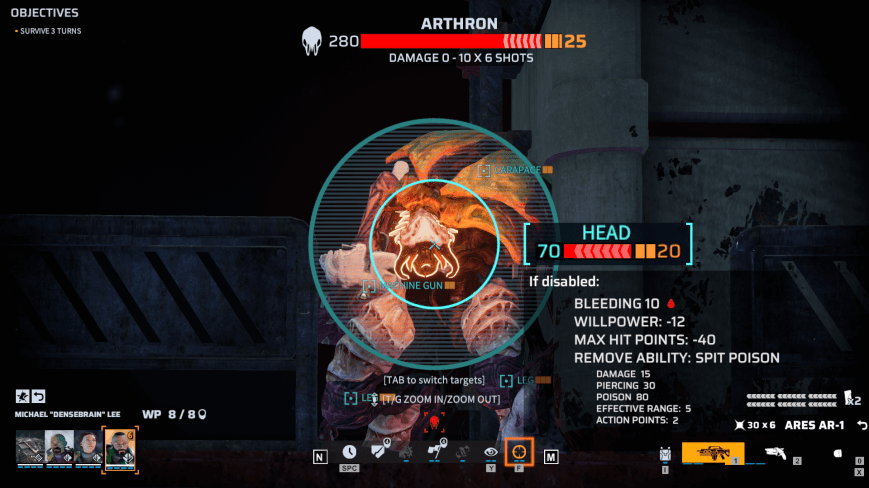
Everyone has missed a point blank shot in XCOM.  It’s absolutely infuriating when it happens, and often at a key point in battle.  Hip shots still exist in PP, but it also adds a Free Aim mode, which is a much more realistic combat mechanic.

phoenix20point6028129

Dead to sights

In most cases, you can bring up your sights and find 2 concentric circles to assist with aiming.  There’s a 100% chance of it hitting the outer circle and 50% chance of the inner one.  As you get closer or farther from the target (or swap guns) the circles change in size.    Picking a part of the enemy has differing effects.  Maybe it disables an attack, maybe it restricts movement.  For some shielded enemies, maybe you can get by the shield and hit an exposed part.  Or perhaps you just want to take out the wall of the building to get a better shot next time… that works too.

This customized shooting makes a tremendous difference in combat.  XCOM sometimes felt like Excel with graphics, just a pretty pain on top of a number crunching machine.  PP says enough with that, and puts a lot of control in the player’s hand.  Yet with that control comes a suprising amount of challenge.  If you aren’t attacking the right enemies, what seems like a sure win can easily turn into a loss.

It will take some time to come to terms with PP.  There’s a lot to unpack here, and it’s going to take some time to get through it all.  From what I’ve seen so far, it should be a fun ride.

Exploration vs Achievement

At work, we’ve gone through psych profiles (NOVA, Insight, Myers-Briggs), and for a long time I’ve been super dominant in one aspect.  I am not a cheerleader, I am a trailblazer.  I see broken things, I want to fix them and find more broken things.  We have an annual review of these profiles, and that allows any new staff to better understand the drivers of teammates.  Which then makes for much more pleasant conversations where both people are aiming for common ground.

There are analogies to gaming.  Bartle posits a 4 quadrant player profile, including Social, Killer, Explorer, Acheiver.  Everyone has a bit of each profile within themselves, though there are certainly dominant aspects.  In that space, I am strong in the Achievement section, with some exploration bits included.  I have next to no drive for the Killer persona, and the Social one is fairly weak as well.  In both of those cases, people will play shitty games because either they are dominating other people, or the other people are the reason to log on.  Generally speaking, an FPS is much more about the Killer model, and an old-school MMO (UO, EQ, WoW Classic)  is more about the social aspect.

I tend to strike more in the Exploration & Achievement sections.  Not in the absolute sense of finding every nook and cranny, and the obscure/grindable achievements though.  Both of those have very long tails.  I have little interest in ever getting a 100% complete, or a Platinum only to have a badge show up.  Now, if content is gated behind the activity, then sure, it’s a tad more interesting.  Things like FFX’s Monster Arena is a good example, and WoW’s pet menagerie is a bad example.

When I “finished” Jedi: Fallen Order, the rest of the game was about unlocking new cosmetics.  Meh.  No real interest.  Outer Worlds I had done nearly all the quests and explored all the zones, but only in the context of playing a specific character build.  To get “more” content, I’d need to restart with a different build.  I’m giving myself time to forget my first playthrough to make it more enjoyable the next time.

SWTOR is in an interesting spot.  There’s piles of content I missed (the near entirey of the Republic 1-50 storylines), so there’s a fair chunk there to face through.  I don’t have much interest in the end-game.  There was a time that I used to.  I raided a lot in early WoW.  I was runing dungeons a-plenty until WoD.  WoD’s implementation made me reconsider my gaming choices, and that meant looking at my gaming catalogue.  Instead of spending a few hours dungeoneering for extra gear, I would rather play something like Shadow of Mordor, or Slay the Spire.  I get why people would commit to a single game, and the social bonds therein.  But I’m good with having to go through 5-6 other GotY candidates instead.

Reviewing what I have left on deck game-wise, that leaves:

  • SWTOR Republic class quests to 50.  Maybe, just maybe, get one of them out to Onslaught.
  • Warframe. Not much more do to here until I get a Platinum coupon, allowing for a much larger inventory.  There’s a post here about online pricing…the coupon is the actual price.  Everything else feels like a penalty.
  • Phoenix Point.  The XCOM successor of sorts from Julian Gollop who created the series.  I don’t expect it to be at the same level as XCOM2 at launch, but then again XCOM2 took it to another level with War of the Chosen (DLC) and the Long War (mod).