Hades Build Tips

Continuing on the the Hades topic, an overview of how builds generally work. Given the randomness inherent in any given run, this will assume that the player understands all the enemy mechanics, from Tartarus to Hades himself.

Weapons

Each weapon has 2 types of attack, regular (attack), and special, with the latter being twice as strong as the former (e.g. 25 and 50 dmg). Cast is always 50 damage. % increases to these are therefore quite small in the larger scale. Raising attack to 50 would require 100% dmg, which is not going to happen on most runs. Instead, you need to think of these as enablers for other types of attacks or boons.

The Bow’s Chiron aspect is a good example, where you use attack to target a foe, and all special attacks send missiles to that target. This is different than the usual “spread” attack for bow specials, and allows for HUGE damage stacking.

Cast is a weird one, since most boons that affect cast change it’s behaviour – either a fog, a beam, or a pulse. The beam is low damage but consistent, while the fog (100+) and pulse are high damage and well worth a % increase. A decently buffed fog cast can deal 500 damage and chain stun an enemy.

You can get up to 2 hammer upgrades per run, and these can have a dramatic impact on your success. Make choices that align with your build…and as a general rule, you want to avoid anything relating to armor penetration – that only matters in the final 3-4 rooms of Elysium.

Mirror

It’s a good idea to focus your first runs to unlock all the mirror upgrades, even before unlocking more weapons (at least the 20 key options). Death Defiance is key, giving you multiple tries to complete a run. The rest are either safety nets or increases in options and up to personal choice. My personal choice is to swap the last 4 to their alternate options (+5% per god boon, 20% chance of gold laurel rooms, 10% legendary/duo boons, 4 reroll chances on boons).

Gold (Obol)

9 out of 10 runs will reach Styx with less than 500 gold. Visiting Chiron’s shop doesn’t mean you need to buy something, though often it’s still a good idea. Keep in mind that Styx’s shop offers diamonds (1000g) and titan blood (1200g) if you happen to have that much on hand. Getting a Hermes boon for +10g per room can give you ~300g if you get it early on. Well of Charon items are extremely situational, and generally best reserved for the final rooms of Elysium. Styx burns through these effects since it’s 4-5 encounters per path.

Curses

Each god has one, and they are not made equal. Weak causes enemies to deal less damage, which has only marginal use – meh. Rupture causes enemies to take damage while moving, but is super low to be unnoticeable. Hangover deals damage over time and stacks up to 5, this is really only effective with high attack speed builds. Marked causes a target to be more susceptible to critical hits, after taking a critical hit. Crits are insane damage but you need this to be very high for it to be useful (> 50%). Jolted causes enemies to take damage when they attack and is very high, it can become pretty insane. Exposed makes enemies take even more damage from backstabs, which really only impacts a couple weapons and a couple fights. Doom causes enemies to take a big hit after a second, it can reach very high levels but will not stack. Chill causes enemy movement to slow down, meh.

Except for Jolted, they are all situational. However, they all unlock interesting tier 2 boons or duos. Weak is usually useless, but it can cause enemies to take 25% more damage, or Doom to tick, or plain charm enemies as examples.

Boons vs Poms

First a note that every run has a preferred god. You’ll know who it is before Tartarus is over and see them show up more than any other.

When you meet a god, you get to pick from 3 boons. The rarity is locked, and you need special items to increase them. Rarity increases the base effect of a boon, which is good but rarely a deal-breaker. This can help if you’re fishing for a specific boon, as the pool of available ones gets lower as you go on. Some boons are only available if you select prior ones (e.g. you can’t get Static Discharge if you don’t have lightning effects already.) You can upgrade each basic boon by using a Pom of Power, which has a decreasing effect the more you use. The first Pom is worth more than Poms 4,5,6, and 7 together. So not much use to go past level 4.

Legendary boons are the same, requiring the 2nd tier of boons to be chosen (so at best, the 3rd time you meet that god). Duo boons require specific boons from both gods and have a random chance to show. Chaos boons require you to play with a penalty for a few encounters and get boon afterwards – the cast boon in particular is amazing. None of these three types can be upgraded.

Making a Build

It’s a good idea to prioritize 2 types of attacks per build, say Cast and Special. This also depends on the weapon you’re using, and the hammer upgrades you have. Say you have the sword hammer upgrade that causes attacks to heal you – probably a good idea to invest in attack options that run.

A bow build

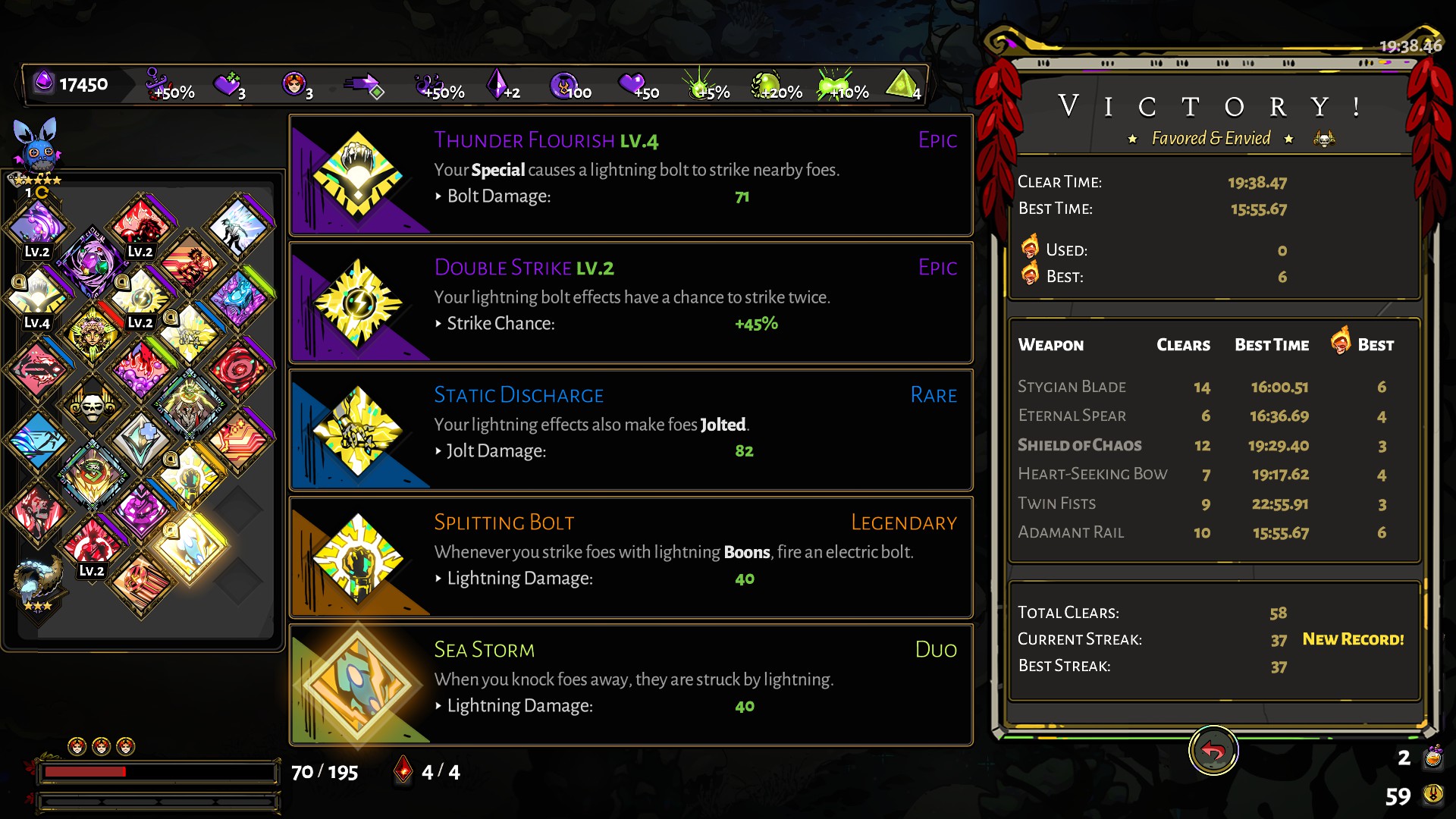
The above shot is a recent bow build I used to great effect. Using the Chiron aspect, it causes the special attacks to all hit the enemy – normally you can get 3 special volleys (I’m currently at 5 missiles per volley). While I have quite a few boons, the important ones are shown and mostly from Ares

  • Relentless Volley (hammer) means my special hits 4 more times per volley, which means 9 total. It’s a 40% damage increase. This damage isn’t very much mind you, since base special damage on a bow is pretty low.
  • Curse of Pain causes my special to inflict Doom for 161 damage. Doom doesn’t stack normally, so this would just be 161 damage after 1 second (so 3 volleys a second apart). 161 x 3 = 483
  • Impending Doom increases Doom damage by 115% – so 346. But is also causes Doom to tick later, meaning I only get it after the first volley and the last. 346 x 2 = 692
  • Dire Misfortune causes Doom to stack and deal more damage per stack. Combined with Impending Doom’s delay, I can now stack 3 times. 2.15*((346)+ (26×16)) = ~1,700 damage.

I got that last one near the end of Elysium and up until that point the run was “ok”. That single boon put it on another level.

The point here is that when you’re making a build, it’s never going to be there the next run, and it likely won’t work as well with another weapon. Like above, damage would have been abysmal with a sword, since the special is so slow. It’s important to understand what each god’s strengths are, and use that as the core forward.

Exceptions

There are 2 exceptions to the boon rule. First is that you want Poseidon’s dash for as many runs as possible. The knockback effect is insanely effective for every single build and makes nearly every other boon look like garbage.

Second is that you ideally want a Call (summon) that makes you invulnerable. That’s Athena, Ares, or Poseidon. These make a massive difference, especially in the final Styx rooms and boss fights. It’s not critical, but it does make life a whole lot easier.

And yes, it’s entirely possible to clear the game without these boons. Frankly, it’s possible to clear the game without any boons, and just hammer upgrades. Just takes longer.

Hades General Tips

The marvel of Hades is the progression through the world, the player, and the character. I remember my first run, and Meg took me down without much trouble. Now she doesn’t touch me.

Some spoilers ahead.

World

Of the 4 zones, each builds upon the last, including the bosses. Tartarus is very simple, you learn to dodge to avoid some attacks, learn that you can backstab and corner lock enemies. You can easily button mash through here – boss somewhat included. Asphodel has no real walls, and it focuses almost entirely on area awareness. There are bombs, fire pits, smoke, and waves that cross the screen. You move defensively. Elysium adds target focus to the mix, and dodging through enemies. Most of the enemies have an “eyeball” phase, where they can regenerate, so you need to focus and burn down. Styx is all about speed. The rooms are tiny, there’s poison everywhere, and AE damage from every corner. You need to clear quickly, and use the environment to protect yourself from attacks. It’s a progressive world building methods, adding to each previous challenge. When you get to Styx the first time, you’ll have mastered Tartarus and Asphodel.

Player

This is about learning the key game mechanics. It is very rare that you can face tank anything, 90% of every build focuses on dashing in/out. So you end up learning how to dash-strike, and how to position yourself best with every weapon against every enemy. Knock an enemy into a trap for massive damage, or taunt one to attack so you can backstab them. You learn that certain boon combinations make basic enemies a breeze but are less effective against bosses. You learn which rooms should be taken when given options (Hammers are always taken).

You learn that every weapon has strengths and weaknesses, and that the limitations of Cast can be offset to tremendous effect. The most important lesson learned is that you are deadly all the time. Learn to dash in while attacking, quickly strike, then dash out while attacking. It’s like you’re a ginsu knife.

Character

This is going to take more posts, but at the very least upgrading the Mirror buffs will make every future attempt miles easier. Maxed Death Defiance gives you 4 chances to complete a run, and should be prioritized. Getting all the keys to unlock weapons and Mirror buffs is a top priority, as well as giving 1 nectar to anyone who has affinity (hearts in the codex). The gifts they give you in return are game changers – I prefer using Skelly while still learning the basics.

The meat of it is in boons. Every god has some amazing boons, but not all boons are great. There are so many variables, it would take ages to go over all the permutations. High level, you have active boons which impacts your active skills, and passive boons that impact the rest of gameplay. You generally want to focus on a giving theme, and that can often change depending on the weapon.

  • Attack – % increases here are bad, since base attack is so poor. Curses are also bad, since they often don’t stack. Zeus’ boon insanely powerful.
  • Special – A good spot for curses, and the damage can be pretty high.
  • Dash – Poseidon rules all here. Knockback while dashing creates room, deals damage, and can trigger other amazing boons.
  • Cast – Cast already deals high damage, and almost every boon is a solid choice. The beam and pulse boons can becomes OP if you stack more boons onto them (like more Casts).
  • Call – The summon ability is often used for immunity (Poseidon, Aphrodite, or Ares). If you want to use it for damage, then you need to use Call actively as the “max bar” version is less effective that using 5 charges.

Curses (doom, rupture, marked, weak, chill, jolted) will not stack, but hangover will. Doom can deal crazy damage, but takes a second to activate. Jolted is simply bonkers in power, but you need other Zeus powers to make it really shine.

% increases to attack are often the ones you want to avoid, and instead focus on flat + damage. The is because attack starts at 10 damage, and 40% to that is 4. Every single boon that applies flat damage is more. Dash alone is in the 70s. % increases to others can be useful, like say increasing Cast damage.

In a future post I’ll talk about specific builds that I enjoy. You’ll find that Zeus & Poseidon are there often, it’s impressive how powerful they are when combined.

Let’s Talk Hades

There are a handful of game companies where I buy all their products, they are simply that consistent. Supergiant Games is one and Hades is no exception to the trend.

Incrementals/Roguelikes are all the rage. That does make sense, since developers make smaller packages and re-use it for dozens of hours of content. Assassin’s Creed recycles a ton of content, but it still adds small tweaks to the layout. Clearing that last fort on the map isn’t much different from the first one, it just happens to be on a hill rather than a bay.

A pure roguelike doesn’t allow for increments between plays, it expects the player to learn how to get better over time. Pure incrementals allow for the player to choose when to reset, and then provides some boost to the next attempt. You can find hundreds of these in mobile apps.

The merger between both is a challenge in terms of balance. You want there to be a cap to the increment in player power, but not so much that the game over screen never is a possibility after a few attempts. Conversely, you want the increments to be valuable so that people can “beat” the game. Tricky math, and as a general rule, players are much smarter than developers in that regard. Slay the Spire and Dead Cells are two recent examples of games that hit that just right.

Hades has more in common with Dead Cells, but focuses less on exploration and more on intense combat. The best Dead Cell runs simply blow through looking for specific drops. Hades forces you to clear everything in a room before giving you options as to the rewards in the next room. It’s hectic action with a period of respite afterwards.

Mechanically, the game has multiple levers to increment both the power of the player as well as the difficulty. It took me 17 tries to beat the final boss, and that first win had much less to do with the power increments than it did with my knowledge of the game.

The real beauty in Hades is the setting. Every character you talk to exposes more of the story, but only 1 conversation at a time, and often only after you die. And they are solidly written and drawn. Each one has their own motivations, slowing lifting the fog of the game as you progress. The friendly competitions with Thanatos, or great cooking of Eurydice are high points in the mess of tons of enemies. Even the bosses have dialogue that they expand upon after previous victories/defeats.

It’s easy to lose a couple hours to runs, a whole bunch of “one more turn” of old. Dying never feels like punishment, cause you’re always getting something from a run. And you never really feel cheated along the way, because you have more control over the room rewards than the high randomness of something like Slay the Spire. And once you beat the final boss, a whole new aspect of difficulty opens up, with a level of granularity that isn’t common in games.

And with any game of this nature, speedrunners are going at it. See video below, which took about as long for the whole game as it did for me to clear the last boss on my first attempt.

That’s fast.

An amazing game. Well worth the pick up. I’ll have a future post on some strategies I’ve found over many failures.

The Gacha Connumdrum

Free to Play is a lie. It really means “pay what you want”. It’s a more effective business model because 1 whale can compensate for hundreds of freeloaders, and in 99% of cases, the games are predicated on sheep for the wolves.

As a guy, there’s this interesting thing about being buff or having a suped up car. When you’re younger, you think these things will impress potential mates. As you grow older, you realize that the only other people who care are other males. The intended audience is in fact not the true audience.

F2P games are not made for me, they are made for whales. The largest incentive for whales is showing off how much of a whale they are, yet they need an audience for it. For PvE games, you would think this is cosmetics (it can be sometimes), but it fact it’s ladders. A smart developer will include the ability to view a character from the ladder… then you see cosmetics take a whole other meaning. PvP games are somewhat similar, but now we’re really talking sheep vs. wolves. I am not dismissing the talent that top level players have, but they need targets to practice. And those targets needs targets, and so on.

In both cases, there’s a feedback loop where the bottom of the pole sees the top and has some incentive to say “hey, they did this with X, I should buy X too!”. The monetization model is simple on the surface, but can get extremely complex as more and more systems are developed. The kicker here is that eastern developers have figured this out a while ago, and they have practically perfected it. Puzzles and Dragons is probably one of the most popular ones, and it’s 8 years old.

Which leads me to Genshin Impact. The bait of the game is amazing, I only hear positives. There’s a lot of good content until AR30. The money aspect up until then is mostly around wishes – loot boxes for characters and gear. It appears optional since progress is so quick. The switch that occurs past that point is that the fun things people were doing are now time gated (bypassed by money or waiting a day for resin to recharge). There are hundreds if not thousands of other games that use this exact same business model of energy / loot boxes (who hasn’t seen Raid ads on mobile?). Genshin Impact is different in that it looks amazing, is multi-platform and does an ok job on multiplayer. It’s lipstick on a pig. Nothing wrong if you like pork, but there’s no sane argument that it’s not pork.

All of this and I didn’t even get into the moral aspects of supporting a Chinese company. I’ll leave that to smarter folk.

I will end on saying I’m happy folks are enjoying it for the time being. Dollars to donuts it crashes before end of calendar in the west. As much because it’s a gacha game, compounded by our infinitely small attention spans.

God of War – Return Again

I came in late to the PS4 era. There wasn’t much there at the start, plus I have a PC that covers a seemingly infinite amount of games. I did come in for Horizon: Zero Dawn. And God of War. And Read Dead Redemption 2. And Spider-Man. And Monster Hunter World. Some good games in there, but at the aggregate, less worthwhile to spend $400 in order to have access to half a dozen games. Hell of a cover charge. It does make for a decent media server for my basement projector though.

I have a top notch gaming laptop – there’s very little that consoles can provide that I can’t get elsewhere. Having Horizons show on PC is an eyebrow raiser – I’d expect more of that down the road. Maybe as my kids get older they’ll find more things to do with consoles, but for now Minecraft and Stardew Valley keep them going. Until then, I still can replay the games on PS4.

Spider-Man was a quick jaunt. NG+ means you start off at full power and a mini-map of things has little value. The main storyline is at best 8 hours, and on a second play through, struggles to hit the same beats as the first time through. The Peter/Doc Ock relationship is still solid, but by plowing though the quests, you don’t get the time to digest the results of the previous one.

God of War is different in quite a few respects. The game includes a sidekick (your son) and uses the story as a backdrop for the challenge of a relationship between father and child. Even the side quests have story dialogue attached, and none of it feels procedurally generated. They aren’t just icons on the map, they have a purpose. It also helps that all of these side activities provide additional rewards, even in NG+. The best items in the game are only seen in NG+, to the point where even the basic currency (hacksilver) still has a TON of value.

Rewards aside, the story line continues to really be the standout. All the roles are well written and acted. The arcs are character driven rather than simple plot devices – you can look back after a time and see the dominos that led to a given conflict. It examines the concepts of duty and sacrifice, the ramifications of trying to protect someone without their understanding of why. And it looks amazing. Jormungandr is still a sight to behold.

So I’m giving it another go. It’s entire package is like a warm bowl of homemade soup, it just feels like it hits all the right spots. I could use some of that today.

FF7 & PTSD

This is going to be a weird one.

The Final Fantast series has quite a few tropes that keep it going. There’s nearly always a crystal, someone named Cid, and chocobos. They all showed up at some point in the series, and they’ve stuck around. Thematically, they also tend to focus on redemption, righting some wrong. FF4 really hit that one strongly (Cecil the dark knight / paladin) and it took FF6 to really start digging into the grey of morality. The storyline got much more complex.

FF7 was the first in a lot of respects, certainly in terms of visual representation. The swap to 3D brought an in-game perspective change, and with that, a more focused view on the drivers of the individual characters. Cloud is brooding because of guild. Barret is trying to find the balance between revenge and justice. RedXIII trying to find solace as the last of his kind. The story certainly took some long steps through, and while you start off thinking it’s an eco-heavy plot, after about 5 hours you realize that was just the appetizer. The literal world itself is at stake, and you plunge into its heart to save it. You win, but just. Game over.

Except this is where Squenix saw an opportunity to expand the storyline, to look at what happens after the heroes save the world and people try to get back to normal. Advent Children is 15 years old and focuses on that basic question – what do people do after the heroes save the world?

As corny as the idea was at the time, and as fanboy-ish I was when it came out, the film still stands up. The world is dying from a mysterious disease, there are whispers from ghosts that Sephiroth is still around, and CGI battle cinematics abound. Cloud pulls himself out of people’s lives as he’s infected, and eventually you come to terms that while the large battle was won, the war never really ended. The characters all have regrets of what happened, people they lost, and need to come to terms with it all.

The climatic scene puts a face to all of Cloud’s fears, and through clarity and support, he vanquishes it for good. The film could have simply ended with Cloud waking up from some coma, and the storyline would have worked just as well, as his demons are all internal.

There’s a reason that FF7 sticks so darn well in my head. The stakes were relatable, there were timely, the characters acted in a consistent fashion. Cloud was brooding without being a full on arsehole (*cough* Lightning *cough*). The FF series often talks about redemption, of justice. It’s a rare thing for the characters themselves to go through a personal journey. A journey that most of us will go through in our lives – just without giant dragons.

Small Goals

Like getting out of bed.

I know I’m in a funk. That makes the funk even funkier. I have a pretty good idea why I’m in a funk. Kids and wife are back in school and it took all of a day for issues to pop up. Learning curve, and we need to adjust – fine. Work is in full transform mode, trying to take advantage of the work from home model to finally implement some much needed changes. Then there are some friends who are going through health issues – seems I can’t go 2 weeks before some sort of major health event going on. Normally I can box these items up and manage them. Those boxes are overfull, and my normal coping mechanisms are lacking.

Writing helps. Talking too. The ideas in my head need to come out, and both are effective ways to do so. Another technique I’ve tried with some success is setting small goals. Things that, on a normal day, are benign and simple. They are simple things, and the act of doing them brings some amount of pleasure.

Getting in and out of bed by a given time is a simple thing. The morning wash. Ensuring I take the time to eat a healthy breakfast. Pausing from desk work and stretching. Taking a few minutes to clean up the kitchen counters. Prepping coffee for tomorrow. Normally I wouldn’t even think of them, I’d just do it. Now it’s conscious.

To move into gaming for a minute, Stardew Valley is pretty much based on small goals. Waking up and watering my garden. Petting my animals. Repairing a fence or clearing the field of weeds. Making mayonnaise or truffle oil. Collecting roe and pickling it. It sounds ridiculous, but the act of plucking a field of blueberries just feels fun.

The larger goals are there. I’ve fully upgraded the farm house, but I’ve yet to furnish it with all the casks/kegs I want to build a winery. I’m 1 harvest away from finishing up the community center packages. I’m at 5 hearts (of 10) with a few villagers, so lots more talking and presents to go. I’ve got all the rarecrows (meaning access to the casino too!). I have chests and chests of stuff that may have some use, but I’ve yet to figure it out. I’ve got about 200k in the bank. I know I need to reach floor 100 in the Skull Cavern, so I’ll need a ton of bombs and a few healing pots to get there. None of these items can be done in a single day, week, or even a month of game-time. It will take multiple play sessions to get there, and each one still feels good to get through.

Stardew Valley (like Minecraft and similar) is not a game about the end, or major cinematics, it’s entirely about the journey. It’s chocked full of tiny little things to do, mundane even. But they are all linked together in some way. It’s like a dance, where you know the basic steps, but it takes music and a partner to really see it shine. You don’t wait for the music to end, you enjoy it while it plays.

It’s sometimes hard to explain why gaming is such a therapeutic thing for me. Most people only think of FPS/gore when they think of games. But in truth, I don’t play games to see the end credits. I play games to experience small joys. The best games have those joys intertwine into an experience that just doesn’t let go. And even when you do see those end credits, you feel like you just took the most amazing of journeys. It’s a damn good feeling.

Back Into the Fire

Two weeks of vacation isn’t enough – I’ll just put it as plain as that. The first week was all renovations, the second was rain pretty much every day. It wasn’t office work, granted, and I was able to disconnect from email/chat for that time, but it wasn’t what I’d consider a break. When I did get back to the house, the back to school stuff was needed, our fridge needs to be replaced, and my Raider laptop has 4 faulty keys. First world problems much.

The Laptop Keyboard

I have a GE75 Raider, it’s a bit over a year old. The ESC, ~, Y and numpad 5 are not working for some reason. I checked the mechanical parts, everything is fine. The backlight is fine too. I figure I’ll order a new keyboard and replace it. But the GE75 is too new, so I’m rather looking for replacement parts for a GE73 (1yr earlier model). Most ship from China, but I did find one at a reasonable price nearby.

I’ve built my own PCs for years. I’ve repaired numerous laptops. Keyboard on laptops are the absolute worst thing to replace, since you need to take everything out. The GE75 has 2 hidden screws, or hidden in a way that you can’t really get to them without taking more parts first. I was really hoping not to have to take the fan off, and just the board, but everything is glued to something else. The form factor is so small, there are cables connected to both sides of the main board, and I always felt like I was breaking something. Finally get to the keyboard case and there’s a damn shield covering it. One that’s set with plastic rivets. It’s impossible for me to repair without breaking a pile more.

So now I need to find a shop that can do the work for me.

Stardew Valley

I use gaming as stress management. I picked up Stardew Valley for my tablet a while ago, never really got into it. Given the past few weeks, I took it for a spin.

It’s certainly calming. Managing energy levels to get through a day is a fun set of constraints. It’s impossible to lose, which is also good for stress. What it has a bit too much of is breadth to start. There are so, so many objectives that are possible, and nearly all of them are gated behind multiple days of work. They are optional, but they often unlock some other activity – like a greenhouse that grows plants year long.

The gameplay is such that you always get that “one more day” drive. Nearly every action can be automated in some manner, but that requires materials/money. Getting that also takes time and months of in-game effort. The systems are intertwined, and not easily explained, making wiki almost mandatory.

Not saying that’s a bad thing, just that sometimes I end up hitting a wall cause I can’t figure out how the next step completes. Say like a fish that only shows up when raining in the summer, at night, at a lake. How am I supposed to know that?

It is fun to discover new things. Realizing that almost everything has a value aside from money. It’s a drastic departure from most modern games, what with the grey/green/purple quality info. Once into the groove, things start working out.

I’m starting Spring in year 2 now. I understand enough of the mechanics now to close out the community Center this year and those extra unlocks. It’s fun setting up long term goals, then the short term ones as steps.

Plus it has fishing.

Shadowlands – Meh

Legion worked primarily because it was a fresh breath of air on the WoD structure.  It had a big focus on the world and story, added new life to dungeons (with keys), and had a pile of horizontal stuff along the way.  The main gaps were around the abundance of RNG on game-changing items (good vs. bad legendaries).  There were challenges when it came to alts, and even larger challenges when it came to different specs.

BfA rubbed the wrong way because rather than build on that model, it opted to add multiple levels of RNG to pretty much every system.  Instead of targeting vertical progression, a wide swath of activities actually had a negative progress curve. The balance from launch improved the RNG, dramatically.  Multiple activities provide progress towards goals, which is mechanically solid.  What remains is Blizz’s frankly bonkers approach to balancing those options.  Multi-spec characters really took a beating here, since skills were locked into gear.  Felt like time travel.

Which brings me to Shadowlands.

There are multiple systems here that appear solid at the conceptual level.  It appears to be the merger of factions and talents, which seems a somewhat logical point in 2020.  It appears to provide rewards outside the gear, also good.  It has a visible progress line, compared to a roll of the die for the next upgrade, great.

Where the gap is for me, and from various blogs I appear to not be alone, is in the Blizz approach to balancing these choices.  Sure, there’s the meta, and there will always be a meta.  It’s 2020 for crying out loud.  No, what I’m getting at is that the illusion of choice due to poor balancing.  If your job is healing, then there are no choices but those that increase healing.  If you need movement for 1 fight out of 10, but it takes you a week to get access to that skill… well then you don’t take that skill.

I keep using the word balance, but we only ever think of one side of that scale – the one we are evaluating.  The measure on the opposite end is even more important.  If I am balancing a skill, we all have to agree on what’s the counterweight, the baseline.  Blizz has a habit of making that weight equal to 100% optimal use in mythic difficulty.  They will eventually reduce that, but it takes time.  The amount of time that takes, and the level, directly impacts the importance of the meta.

Further, the internal testing/beta process is clearly broken.  The massive nerfs applied to corruption effects once live show that clearly. Everyone was given a choice between a tactical nuke, and a rake.  I get that nothing is perfect, I more than get that.  That’s my everyday life, ugh.  You need to iterate, that’s normal.  But BfA didn’t have a single system that launched in an “acceptable” state, everything felt rushed.  I will be the first to admit that nearly every system improved over time, but that level of improvement is typicall in the beta process… not live.

My newsfeed has a ton of Shadowlands stuff.   Beta is live.  Core systems (like conduits) are already going back to the drawing board.  The speed of that change means that Blizz didn’t really think it was going to fly anyhow.  The selling features of this expansion are really twofold.  That this covenant system works (and is therefore balanced) and that the Maw has some sort of attraction to do on a regular basis.  As of now, in beta, where the excitement should be high, it’s instead very muted.  It’s very reminiscent of the BfA beta vibe.

Maybe we do end up with the A/B cycle of good/bad expansions.  I hope so more for Blizzard’s sake than my own.  There are a lot of eyes on this expansion, and if the cash cow that is WoW no longer produces, we are all aware that Mr. Kotick is more than willing to take action to solve it.  Way too many people lose in that event.

Heirlooms in BfA

For a very long time, the entire point of heirlooms was to bypass the wonky leveling mechanics in WoW.  Mainly the fact that items scaled in power, smoothing (?) the power curve.  The % increase to xp gain has been a perk on top of that, and of larger and larger benefit as the leveling experience has gotten longer.  From level 100+, there’s really nothing in game that provides any character growth, it’s just a time tax.  Every expansion just adds 4 hours or so to the leveling period.

Shadowlands aims to reduce that time tax – with something near the 20hr mark to get from 1-60.  That’s in the realm of most single player games, so not too bad.  Heatmaps are going to be interesting… I don’t see why anyone, anywhere, would want to level in any zone that was NOT Legion / BfA.  Anything pre-MoP feels horrendous – and unless you’re really strapped for attention, you’re best playing the LFD roulette.

But 20 hours, that’s doable I guess.  Certainly less than the current pace of leveling, even with heirlooms.  So I guess that’s why Blizz is not planning to have an %XP boost anymore.  The item scaling appears to still be there, but I’d be wildly surprised if anyone thinks that’s enough of a motivator in a single expansion cycle (where I assume item levels make sense).

Taken from another lens, I see heirlooms as a band-aid for the larger problem – time to level.  That problem generated other problems, primarily the value of a level.  The level crunch should get rid of the value problem, where you spend 20 hours and get nothing for it.  The time to level reduction is pretty much required, given Blizz’ persistence to only put relevant content at max level.  I mean, aside from the art, what’s different from a player at level 30 and 119?  The rotation is 95% the same, there’s no real grouping aside from guilds, crafting is entirely meaningless.  The Class Trial option gives you nearly every permutation of gameplay for a class – and it doesnt take 20 hours to complete.

But that’s a larger rant.

Right now, Blizz is cutting leveling time, reducing a significant problem’s impact.  Removing %XP from heirlooms, in this expansion, removes the practical need to buy them.  Curious if they will do the same to the Refer a Friend bonus…