Dyson Sphere Program

I rather enjoy hard sci-fi. Ringworld scratches a crazy itch, and it’s been revised a few times by scholars to be more accurate in terms of setting. I would guess that most people were introduced to the concept of a Dyson sphere through TNG’s episode with Scotty. The concept is amazing, but the practicality of completely enveloping a star at a planetary radius is just mind-boggling in scope. It’d be millions of Earths in size. You’d need multiple solar system’s worth of material to build just one.

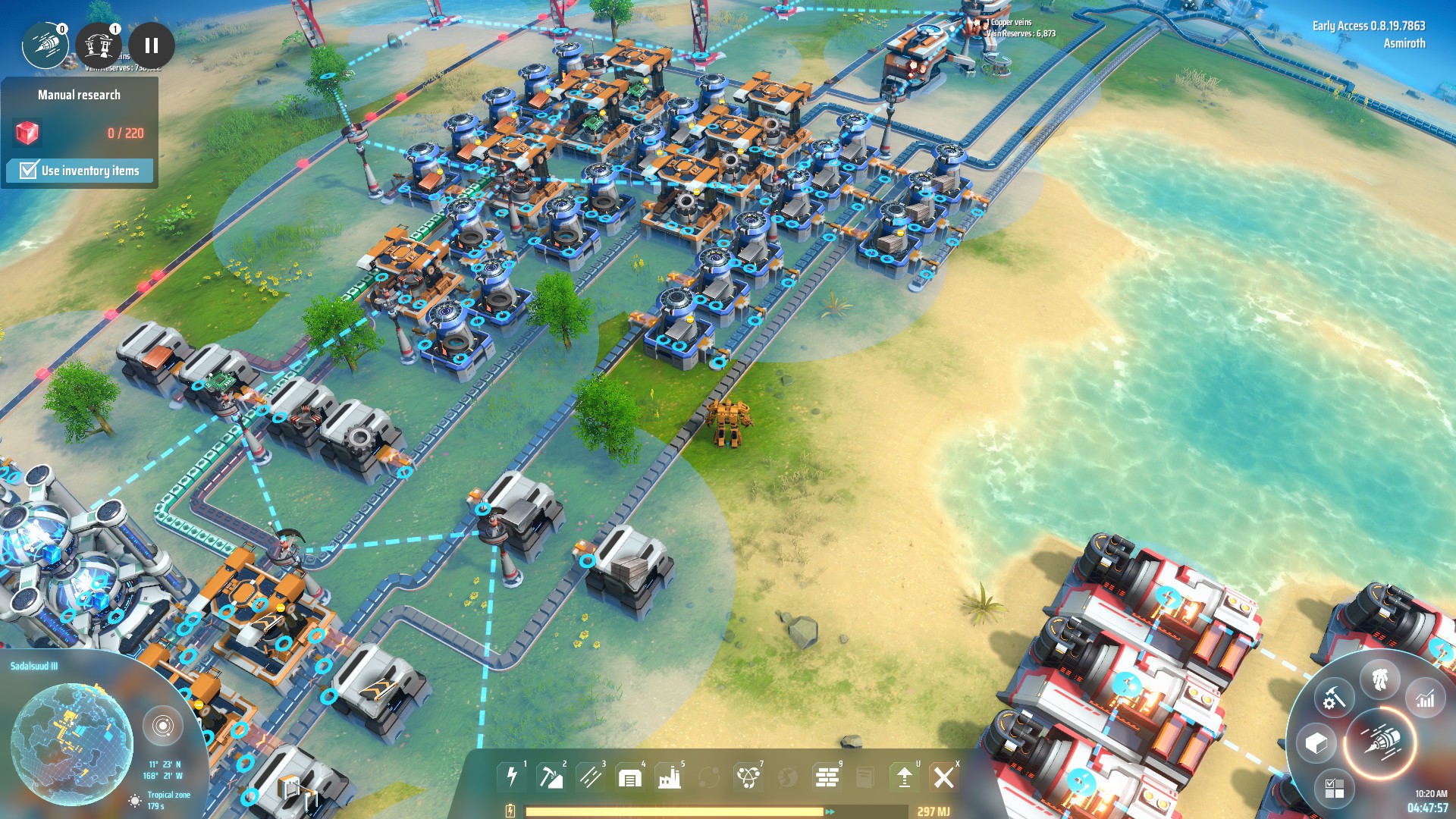
Dyson Sphere Program is a game in Early Access that attempts to tell that story. Think Factorio but in a 3d world that’s representative of a cluster of stars. Factory builders are fascinating less for their results but for their elegant complexity. Building an automated supply chain that has dozens of steps, each sustainable and clean, is an amazing feeling. Right up there with an optimized SimCity in feeling (but not approach).

Early Access is a tough bag. There are thousands of games in that mode and few ever get off the ground, or give you something of value. For every Hades or Valheim, there are bins full of bad ideas and money grabs. DSP is a reflection of the former type, with an extremely well fleshed out structure present, with a clear start and middle. The ending, that is building an actual Dyson Sphere, is present but not as fleshed out as the rest.

Factory Builders

First, How to Build a Toaster from Scratch.

RTS games – let’s go back to Dune 2 – started the tend of collecting things, putting them in something to make something else. That concept of collecting, refinement, output is the foundation. Just imagine that, but dozens of steps, and each step itself using a different tool to collect or refine. Most idle games on are variants on this model, where progress is logarithmic, then you “reset” for more improvements to get further the next attempt.

Factory games do this without resets, and it’s almost entirely a numbers game. It’s a pretty spreadsheet. You don’t have a village resident with a weird demand for a baseball diamond that comes out of nowhere. You simply have a need to make more of something to start making something else. Production is not linear, as the factories themselves need a lot of components and themselves can only produce so much in a given time. You end up with factory lines to maximize the collection and production of items, then ship those items to the next chain.

The progress is incremental but noticeable. The best ones have clear phases that generally line up to manual, automation, and then optimization. The transition between phases is often followed with a dramatic drop in productivity, often with complete rebuilds to accommodate. The worst ones are slogs that provide painfully slow automation (sped up with MTX no doubt!), linear construction paths (item are used for only 1 purpose), or a set of obtuse mechanics.

The Good

The pace of growth and optimization feels good for the first good chunk of the game. Your first planet has most of the material you need to get going and the tutorials are sufficient enough to get the basics going. There are some systems that could use more explanation (terraforming for one given the soil material), and the technology tree could be revamped a tad, but on the whole this part feels just like any other factory game. Collect base materials, process them, make something, that makes something else, that makes more stuff, and so on.

If you enter DSP with an understanding of factory lines, this will be a somewhat smooth experience. If you don’t, then you may find it feels a bit like spaghetti, not so much because you lack space to build (there’s plenty of that) but you’re lacking the materials to move stuff around.

The research portion is well done, with the need for ever more complex materials to move forward with more complex research. Some things seem useless until you realize they are core to other super important materials. The early access issue here does have a few bits of things that have only 1 use, which I expect to change over time.

The logistics portion is an interesting dance. While you can unlock the ability to ship things across the planet pretty quickly, the power and transport vehicle requirements make it painful to get started. The snowball effect, once you ship your first titanium package between planets, is substantial. This is when you enter the mid-game.

The Middling

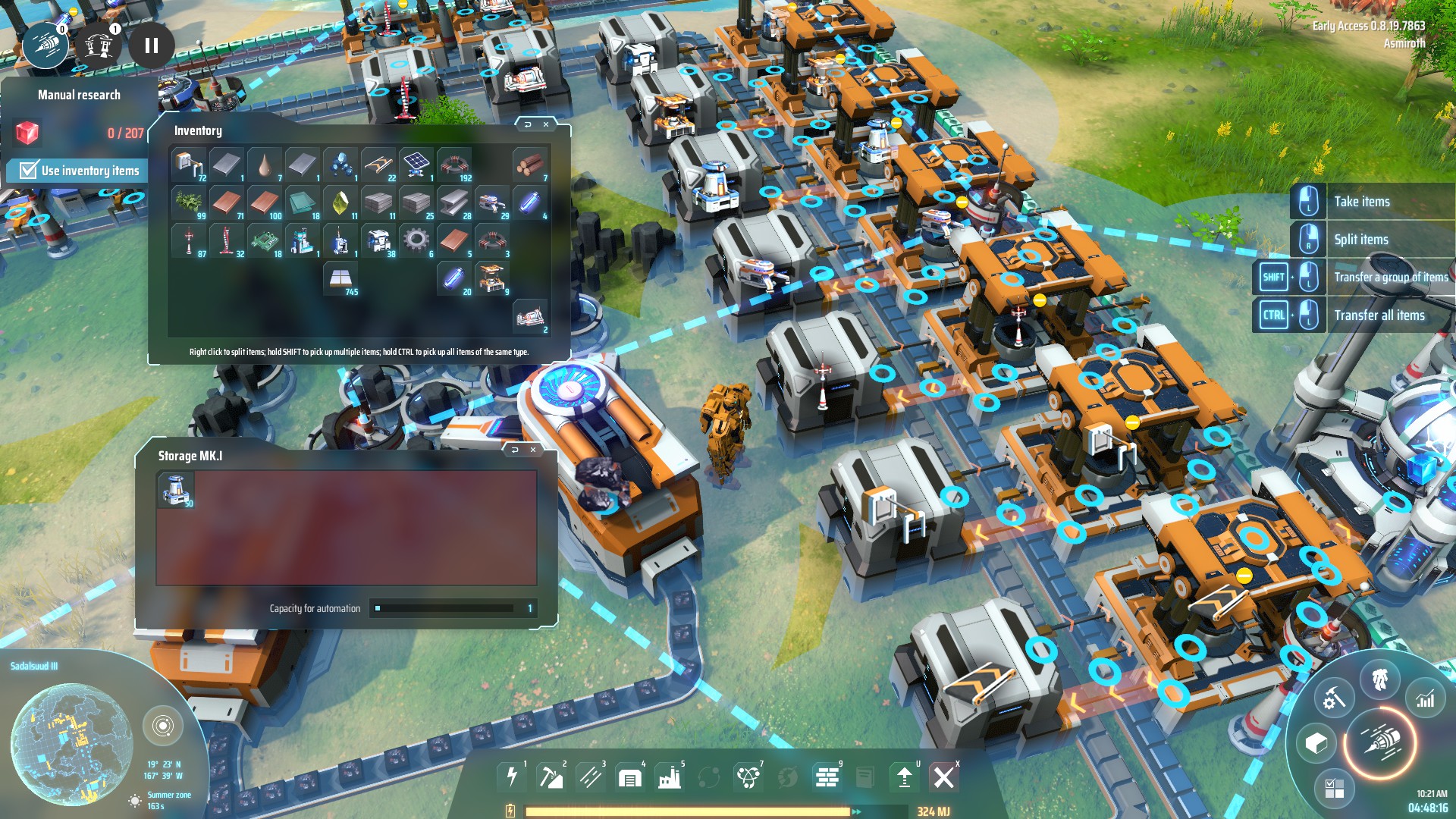
The largest pain point I have with any factory game is the minutiae of setting up belts and loaders. Early on it’s simple enough, you’re only building 1 or 2 things. When you need to build an oil refinement line, which has 50 refineries, it’s extremely annoying not to have the ability to blueprint layouts. Thankfully the game supports mods – and these are almost required in the mid-game. It’s somewhat ironic you can automate the creation of ships, but not of factories. The July 23rd patch is supposed to bring this in, I am super stoked!

The travel time between planets never really improves. I encountered an issue with power generation on one planet and it feels like wasted time having to go back and forth to sort everything out. The logistic vehicles are also speed/rate limited, so for ultra high-demand items, you’re going to need more stations rather than noticeable improve existing ones.

The mech improvements page has some major milestone improvements that are hidden in the text. Learning that you can fly to another planet was accidental. That I could warp, or stack sorters vertically even more so. All factory building games have an obtuse section of learning, where once you get it, then it changes your perspective on the game. DSP has a fair chunk of those – and the wiki doesn’t really help. YouTube videos for the win!

The Bad

Inventory management is painful, as are stack sizes that are inconsistent. Why does one thing stack to 10 and another to 200? Sure, you’re going to have storage chests lying around but with SO MANY items needed at any given time, it’s really hard to find out where they are. I’ve automated the creation of Oil Refineries, but I need to fly around the damn planet to find out where they are stored. Because Logistic Towers are limited to 5 slots and there are 2 dozen useful buildings, I’ll need to build a big complex to just store stuff.

Power generation has 5 phases. Wind, Coal, Solar, Hydrogen, Deuterium. The first 3 phases are all super quick and useful. Hydrogen feels almost accidental, especially once you collect from gas planets. It takes a long time to get to a place where that’s going to happen. Deuterium takes even longer as it’s a pain to collect. The early game has minor power issues, but the mid-game is when power generation is always an issue. And the method to address is (Accumulators + chargers) is it’s own logistical nightmare. When you’re low on power, things take longer to make, so it’s a giant snowball effect. And the game takes its sweet time to allow you to effectively store excess energy. That whole subsystem could be improved.

The actual Dyson Sphere portion feels like a different game, with it’s own interface. It has a very complex set of materials, a math-based construction period, and it’s own power generation system. You’re exposed to it quite early, but that version decays over time and it is not explained when you start. It’s friggin’ cool as all hell to see the sphere from the planet you’re on, but the system that underlies it all needs some more structure. Given this is the end game (and the name of the game), the devs are working on this point.

The Devs

5 devs, that’s it. How games like this and Valheim (FYI – the Valheim devs ALSO built Satisfactory) get built with tiny teams is beyond me, and frankly should make any studio over 50 in size start questioning a lot about their business models.

Patches seem to be almost weekly, and the devs are extremely forthright in their notes. It’s clear from their notes that they are responsive to player needs – optimizing belts was the most recent item that was a huge quality of life improvement.

Buy or Wait

There’s more here than in nearly any other factory game out there (save Factorio and Satisfactory). If the concept of building a vast production empire that covers multiple star systems intrigues you, then pick this up now. Be warned, you’re going to spend dozens of hours here… I’ve lost track of play sessions numerous times. Even if the game launched today, full release as-is, I’d highly recommend it.

I’ll have a few more posts in the future on this game…

Steam Deck

I own a Switch. My favorite games on it are all first party or exclusives. I bought it solely for Monster Hunter but have found it does a great job for other games too. The simplicity of Nintendo just works here, though I will be the first to point out the price points of everything after the console to be a bit absurd.

I own a PC and I have hundred of games. I’d argue that about 50% of my catalogue is best played with a controller. I’ve used Steam Link from my tablet to access games with no issue.

What both of these have in common is that they are fundamentally moved forward by quality games. XBOX sold like garbage for years because they only had exclusive FPS and racing games. Give me something like God of War and that’ll move units. Google Stadia had a really rough go to start because it lacked games, there’s some progress there I guess. But it’s still limited to network speed, which is a real pain in the butt. Mobile gaming needs some local footprint to reduce the network demands (e.g. gaming on the bus).

Steam Deck is not the first handheld PC, but it’s likely the one with the largest amount of backing. It’s directly competing with the Switch in terms of game quality, regardless of what anyone says. Bluetooth support alone (BTLE) is astounding that it’s not present in the Switch. It’s outside the Nintendo ecosystem… no question. But the sheer amount of games and peripherals available here are just mind blowing. That you can potentially play any game that’s on PC is a game changer (pun intended).

There’s the natural caveat that this could be another pipe dream from Valve, where the concept falls apart in the execution. Aside from Steam itself, Valve is notoriously bad at support post-launch. They have the best VR on the market, but it’s $1000 to start, which is beyond dumb.

I am not a person who lines up upon release to get something new. I’ll let all those lucky folks play with release 1.0 and wait for the next version. Not for the price drop, but the amount of patches that’ll be required to stabilize the darn thing.

As an aside, this to me really re-enforces the ultra niche appeal of customized PC rigs. Aside from the astounding costs of a high-end rig, the lack of mobility and need of major desk space to accommodate is the big hurdle. Gaming laptops give you the flexibility of some mobility and desk space, but they still cost a fair chunk. Getting a mobile PC rig for less than $500 that can play almost anything… that’s half the price of a smartphone.

I’m cautiously optimistic about this thing. We probably won’t see the true impacts until next summer (supply chain questions abound), and an ironed out system in time for the 2022 holiday season. Going to be a real interesting thing to watch.

Immortals Fenyx Rising

I picked this up on a Switch sale and played it through while on vacation. It’s ok.

The idea is simple enough – marry the map icon juggling of Assassin’s Creed and exploration of Breath of the Wild. The execution suffers for it because those two systems are wildly divergent in goals. Ubisoft is interested in the Achiever/Completionist player type. Nintendo is focused on the Exploration player type. It seems similar, but wow, much different.

Fenyx has all the trappings of an Ubisoft game. Towers to uncover the map. Icons of repetitive things to do, with no larger purpose than an actual in-game checklist. Parry-based combat. Mounts that serve little purpose. Subversive humour.

Fenyx takes a stride from Nintendo here in the exploration space. Early on you gain the ability to dbl jump and glide, which makes world traversal more pleasant – as it seems nearly everything is split on a vertical axis. Mounts are useless here because they can’t move up/down. It also comes chocked full of puzzles that fit into 3 main categories – moving blocks/spheres, shooting things with arrows, or the rare laser/knockout avoidance. Things start off easy enough, but the later trials are painfully complex or obtuse. Most of these are optional, but there are a few mandatory puzzles that I felt frustrated trying to complete the precise logic. BotW lets you solve most any puzzle the way you want, Fenyx has as specific solution to each.

The highlight is the main quest, which focuses on restoring 4 gods before climbing a literal mountain to encounter the last boss. They are caricatures or the greek pantheon, which is fine given the overall tone. There are enough hidden dirty jokes to make you chuckle along the way. Zeus is an interesting standout here… his lines are impressively delivered. His character development isn’t earned at all, and honestly not needed given that he doesn’t drive the plot. Your character Fenyx is about the purest person ever to encounter monsters… stopping at nothing to help everyone and everything. And the bad guy is just a bad guy – at least it’s not Kronos. There’s a setup in the plot for a sequel (it’s Ubisoft after all) since you don’t see Hades or Poseidon anywhere.

Thee exploration part is fun for a while, and the areas are distinct enough from each other to be thematic. There are no NPCs except for the gods, so it feels like an empty amusement park. The puzzles can be fun for a while, but they get super repetitive quickly. Once you have Phosphor’s double it dramatically simplified all “pressure plate” puzzles. Hade’s Wrath gives you a triple jump to negate a pile of puzzles. The ability to slow down arrows trivializes any shooting puzzle. Being able to lift giant stones gets rid of pushing puzzles as you can just walk out with things instead. It feels like these abilities are breaking the intent of the game, since everything is so contained. Oh, and you need to upgrade your stamina ASAP. There is nothing more frustrating that running out of stamina while climbing a wall, or when gliding around.

The combat portion is mostly about parrying. You can’t easily cancel moves, so you need to avoid mashing as much as possible. A well timed parry (plus a gear perk) will stun an enemy and make the fight trivial. Stealth is here too, and with a Phosphor perk you can chain attack a pile of enemies. Some enemies feel broken in their ability to chain stun you, but generally combat is the best part of the game. Sadly, it gets crazy repetitive and I turned down the difficulty to the lowest to be able to just ignore as much of it as possible.

While the game looks like it was built for a younger audience, that is far from the truth. Even on the easiest difficulty, death is a regular occurrence – especially in the puzzle sections. Mastery of player controls is essential to get all the way through. It does look good, and smart that for a Switch game it opts for less realistic graphics. It looks good.

Fenyx also has some DLC, and the game does give you a taste within the main content. Sadly, that content is the worst part of the game – timed puzzle completion. The controls and camera are quite poor (as with all AC games), so when you put a timer and expect precision, well I expect the game to support it in kind. Celeste this is not. Rare to find a game that does such a good job of pushing you away from DLC.

Fenyx is an interesting game, an attempt to marry divergent goals. It partially succeeds, if you avoid the checklist mentality of similar map-icon games. If you only play the main storyline you’re likely to have a good time – but it is absolutely not worth a full price game.

Puzzle Boxes

There’s this weird intersect where virtual and physical items meet. You look at movies and the old Harryhausen stop-motion creatures existed for decades. It took Toy Story for industry to realize that digital effects could be a viable alternative. Sure, we still have some serious uncanny valley issues, Star Wars notably, but by and large most things are turning into digital assets.

D&D is a good example of something that has bucked the digital trend. Sure, there are some amazing D&D games, and WotC has some digital tools to help with sessions, but the real experience is still only available in a semi-live event. Two reasons… it’s a whole lot easier to design and adapt a session with physical media, especially with real-time curveballs. Second, the face to face aspects still aren’t working perfectly through video calls. There was a time where digital media looked like it would take over, but the advent of 3D printers and massive price drop in miniatures has reversed that trend.

I’ll roll back the clock to Myst for a minute. Revolutionary at the time, it was a 3D puzzle game that focused on logic and the environment. There was a spike in that type of game, but eventually it became saturated with rather poor clones and frankly, bad puzzle designs. We reached a point of brute force clicking to find hidden clues, or solve puzzles. The genre didn’t die though, it embraced that commodity aspect and went straight to Flash’s waiting arms. For a decent period, JayIsGames was the hub for escape room games. There were all sorts of games here, good and bad, with multiple coming out every week. Some were click fests, others key hunts… but there was some gold in there. Long logic-based quests to save a planet, or get out of jail. The genre was tailor made for digital, as the solutions only had 1 answer, and the assets and logic could be reused later on. If you have the chance, you should check out The Room series on mobile… a near perfect example of solid puzzle design. And yet…

In the mid 10’s we started to see Escape Rooms come out into the real world. You and some friends paid money to get locked into a room and have to solve a large set of logic puzzles within an hour. The beauty of these rooms is that while they require some thought to design, they need next to no upkeep for a very long time. You can set up 3-5 rooms and never change them for a year and people will still pay to do them. Mobile Escape rooms are not available, letting you have a similar experience (though MUCH less tactile) from the comfort of your house. They are pretty much multiplayer Myst games.

Roll the clock back even further, and you have old wooden puzzle kits. Slider puzzle. Rubik’s cubes. Things that kept you busy for a while until you unlocked the logical solution. They remained somewhat ‘simple’ because the cost of construction was so darn high. Mr Puzzle is a great window into the ever increasing complexity of puzzle designs. C&C machines + 3D printers have opened up a new world of puzzles and complexity. For $20-$50 you can get some real brain teasers that will get you really going crazy. I recently opted to pick up a pair of wooden puzzles, with multiple steps.

Beer for scale

It’s an impressive feat to take the concept of a puzzle room, in that you solve one puzzle and use that result to solve another, in a physical form. It took me over an hour each to solve the puzzles. Each time I was stumped and came across the solution, I was frankly amazed at how the logic was physically applied. Nothing felt cheap or a cheat to get through.

I’ve got my eldest taking a look at one of them now. It’s supremely fascinating to see a child’s brain at work at solving these things. Maybe someday I can show her Myst and where I cut my teeth on the genre.

Terra Nil

Most builder games have you break down nature to add technology. Nature is viewed as chaotic and random, whereas technology is clean, orderly, and proper. Civilization and SimCity are the grandfathers of that particular mindset, and truthfully, it is often the foundation of most urban engineer educations. Yet, it’s 2021 and this planet is having a hell of a time supporting us. We are going to be gone long before it. So perhaps our hubris that we somehow mastered the complexity of millions of years of evolution and balance is a tad off…

Ok, weird rant aside, there’s an interesting game making some social rounds on rebuilding greenery. We’ve seen a few of these in the past, though mostly relegated to terraforming Mars in some fashion. (And then, only terraforming so that it can be torn down and technology can take its place.) The game in question is Terra Nil, which is a rather small demo you can find on Steam.

Small in the sense of less than a gig in size, and effectively just the tutorial without the ability to save. You get to see the large brush concepts here, and a “full” playthrough is about 20 minutes. As much as it’s a game, there are metrics and bars and whatnot, it also feels more like building a zen garden.

There are no people in the demo, and all the technology in use has as a sole purpose to improve the expansion of nature. I used a solar dish to burn a field, to make ash, in order to grow a giant lush forest. I’ve dug trenches to increase the sprawl of water and then turned them into marshes.

The rules of the game are pretty simple, and the tutorial is more like “here’s things, figure it out” than actually helpful. But games are more than a set of buttons. The best of them put you in the conductor’s seat for a private journey that feels self directed. A movie where you can’t really see the edges of the set. There’s a spark here of that, some potential. Who knows what we’ll get in the end.

Mario Party

There are few games that can break up siblings like Mario Party. Back in the day we had an N64, and we’d huddle around the TV with my dad and play whatever multiplayer game was available. Wave Race, Mario Kart, GoldenEye, and Perfect Dark all got tons of playtime. They each were digestible pieces of excitement. My dad really loved the racing ones, I’d like to think it was more because they were truly 3D and he could follow.

But Mario Party – that thing I’m sure has caused more divorces than the set up of IKEA furniture.

The game concept is simple. You roll a die, move around a gameboard, collect coins and stars, then at the end of each round play a simple mini game to collect more coins. Social boardgames are exactly that. There are highs and lows, and some crazy trashtalking. Heck, sometimes you just get impressed at some folks ability. The games generally last for an hour, which is just the right amount of time.

Where Mario Party moves the needle is in the competitive and almost backstabbing efforts players can take. The mini-games are either 1v1v1v1, 2v2, or 3v1. You’re never really in a team for more than a minute or so. And they are always competitive – like you can knock another player off the map. In the older games you’d often team up with another player, and then one would betray the other because, you know, there can only be one.

The board also allows players to steal coins and stars from other players. Coins are easy enough to get, and they are a method to acquire items or stars (10 per). The player with the most stars wins, if people are tied, then the amount of coins determines. The original Mario Party has so many catch-up mechanics, and gave out stars like candy that you could easily see 3 or 4 stars move between players per turn. I can’t count how many times I thought I had an insurmountable lead on the last turn, only to end up losing because my stars were poached. Local multiplayer + going from lead to 3rd place = outrage and laughter.

My daughter got Mario Party for the Switch, so we gave it a shot just the two of us. It’d been quite a while since my last go, so I wasn’t quite sure what to expect. We opted for the Bobomb board, and 10 turns on normal.

Countdown completes and you’re in the middle, say goodbye to half your coins!

It’s interesting to see all the new bits they added to the board, so that dice control is more than just rolling the biggest number possible (it still is for a LOT mind you). Being able to add more die to your pool is pretty cool too! The size of the board feels good, and tons of branching paths. I recall this being a challenge in the original, where you could easily end up continually on the wrong end of the board (hence the catch up stuff). The mini-game variety is good, with a lot of close calls. The 3v1 games are still the highlight to me, because the odds are just not in anyone’s favour. I do have a general dislike for the rumble games…

The game still has catch up mechanics, my daughter was given a +5 die roll item in the last 3 turns and she used it to go from last to first. I lost a star to an NPC. The final score had me with 3 stars winning the game. That’s a whole lot less than the 8-12 stars from previous games. It does mean there’s less “stealing” wins here, and puts a whole lot more importance on each turn being successful. There wasn’t a point where there was more than a 1 star difference between any player… and I don’t recall that being the case before.

The winning part wasn’t the cool bit. It was really the reactions we both had for each mini-game. Some were mundane enough, others were both of us at the end of our chairs, or standing up with the tongue out. The classic hot potato game is a highlight of craziness. We both had smiles for an hour and had a blast getting all the way through.

I can see some fun games nights ahead. I keep getting impressed by the social aspect that Nintendo somehow keeps bottled up. Guess that’s why Mario Kart 8 has sold something like 35m copies – there’s just something about playing with other people and it not being about headshots that is missing in gaming. I’m oddly enthusiastic about a new Mario Golf!

Get the Nintendo Lawyers

Super short one, just pure amazement at the brass set here.

I get that mobile app stores are chocked full of scams and reskins of other games. It’s marginally better than the cess-pool that is Steam. Any search for an easy dollar I guess.

Check this one out:

I’ve spent well over 100 hours playing Hades. It won numerous Games of the Year awards. It is built on the SuperGiant art DNA. There’s artistic license and influence, then what is effectively a cut and paste. It’s 2021… there’s no way that something like this isn’t going to get bad press. The only other game I can see from this developer is a FarmVille clone (there have be 10s of thousands now) that uses Disney princesses as avatars – heck even the Disney castle is in their material. Hence the brass set comment above.

The lawyers are certainly looking at this, but it’s a weird time here where you kind of would be interested to see what the Nintendo or Disney lawyers would do here.

ME 3 Thoughts

I finished up the campaign the other night and, as with most games, I have a couple thoughts I need to write out.

First off, ME32 has aged really well. It’s 9 years old, but would still be a decent new release today. There are many games that are a zeitgeist, where the only fit in their time period. ME3 is lucky in a sense that it was a refinement of as-new model of action and RPG mergers. And honestly, it looks better than Andromeda.

It would be hard to ignore the social impacts of ME3, where the gamers tried to take ownership of creative direction of a game, and the developer conceded. Without access to the ‘non extended cut’ version of ME3, it’s hard today to have a real apples to apples conversation about the changes. Instead we have to remember through wiki entries, where the original launch had quite stringent requirements on what options were presented to players, and then what the consequences where of those options. Not decided on actual choices in the game, but frankly by the number of planet scans you had performed. Curing the Genophage still has no actual impact on any gameplay, or ending. Saving Miranda in ME2 doesn’t change the fact that her father still does the experiments in ME3. The illusion of choice rears its head in fierce fashion in ME3.

Tangent Time!

  1. Asimov’s Foundation series is celebrated because of the ideas it brought to the table without the need for violence. It celebrated diplomacy and scientific prowess to solve galactic issues, and generally looked down upon the military complex (pre-quels aside). The series ends with the creation of Galaxia (a planet where all organisms are interlinked) and the merger of AI and organics (Olivaw). The concept here is that the resolution of differences is only accomplished by merger rather than annihilation or assimilation. That sociopolitical concept is still a challenge today, what with diversity feeling like a 4 letter word. Yet the concept has been essential in sci-fi for nearly 70 years.
  2. Final Fantasy has a habit of a last minute bait and switch on the villain, where 95% of the time you think the ultimate baddie is say, Kuja, but in reality it’s the essence of death, Necron, who was the bad guy. No setup, they just pop up and that’s the bad guy.

Back on Track

ME3 tries to take this concept and expand upon it, where you are provided the choices of Destroy (all synthetics die, but will certainly be re-created and cause a war), Control (which is arguably Dune 2.0), or Merge (synthetic and organic merge of sorts). The challenge with this line is that none of the options are earned, doubly so if you have not played the Leviathan missions.

ME1 is about the Reaper threat to destroy the galaxy. The reasons are not provided aside from it being a cycle. When the game ends, you haven’t stopped the threat, simply delayed it.

ME2 has little to do with that specific threat, but the proxies around it. It’s a borderline McGuffin, with a weird twist at the end for a human/reaper hybrid. But that’s not the story. The real story is the rebirth of Sheppard and the building of a team to explore the galaxy’s various internal threats. You fight political battles way more than Collector/Reaper battles. Heck, try naming the bad guy here?

ME3 merges these storylines into a concept of unifying the galaxy in order to fight the repears head-on. There are no compromises possible, that was made clear in the first two games and most of this one. There are no alternatives, it’s entirely focused on using the Crucible (which you don’t know what it does until you use it) and the Catalyst (which you don’t know what it is until the final mission). Up until the last minute, the only option you can think of is destroying the Reapers.

Then you learn that no matter what choice you have made, at any point in the entire game, none of them have any bearing on the larger choice. Instead, it’s a point system that determines what choices are present, and the scale of those choices (either Earth survives or doesn’t). It’s a curve ball, with no ability to prepare for the choice, limited understanding of the impacts (Control in particular), and up until the extended cut, no real understanding of why these choices exist in the first place.

There are hundreds of published sci-fi stories every year. Few of them are good, less so great. It’s really hard! Without a clear plan, and lots of effort creating the necessary breadcrumbs, it’s almost impossible to craft a complex story with a satisfying ending. I mean, look at GoT Season 8.

Even after all these years, the ending of ME3 still doesn’t work.

Paragon/Renegade

Just quickly here, the Paragon/Renegade improvements of ME2 are mostly removed here. There’s really only 1 meaningful choice here (genophage) and the rest is a tough wash. There’s only a few trigger commands available, and they are either giving a handshake or shooting someone who is about to shoot you. It’s a weird reversion to the ME1 model. Of note, the final decision you have to make is based on having explored every single Investigate conversation option across the entire game with the Illusive Man.

The Good

Enough with the bad. There’s a lot of good here.

The inventory is a great improvement on ME2, where you have tons of options and customizations. While there are simple stat upgrades, some changes are substantial (like shooting through shields). It’s powerful without feeling like its tedious.

The powers are also much improved, with faster cooldowns, more choice for a given power (e.g. recharge or damage). There are multiple enemies where fighting with powers is tons more effective than any weapon attack would be. This is a clear precursor to Anthem, and it feels really good. I will say that Liara’s Singularity power (with tons of recharge boosts) is crazy OP.

The fights themselves are generally improved, though a few too many ‘wave’ based fights. The cover mechanics work really well, and the enemy AI is generally decent. Guns have the right feel, the aim is solid, and the physics add weight to everything.

The companions are more integrated into the overall story, rather than being simple DPS items. Well maybe not James, who’s as useful as lips on an elbow. Javik in particular provides some much needed context in many quests, which further solidifies that he was pulled out of the game on purpose. It’s great to see them are more than window dressing.

The majority of quests (N7 aside) are well written and structured. The final Krogan mission with Mordin is the highlight. The DLC quest chains are a real highlight, with multiple steps and great scenery. Leviathan is foundational to the overall story, Omega is a real rollercoaster with a well-written bad girl, and Shore Leave is pretty much Ocean’s Eleven in game form. Fine, in the grand scheme they are meaningless, but on their own, they act as a sort of quality anthology.

I’d be remiss to not mention the audio. The bass reverb sounds of the reapers works to add some awesome atmosphere. The Hans Zimmer influence here is evident, with strong use of contrasting sounds. It’s an interesting mix where a video game has clearly influenced visual media in such a large form.

Residual

It’s impressive what Mass Effect was able to do. The series is a true landmark, where the sequels attempted to build on the prior ones. You can trace a lot of games and media to what was delivered here, and the Legendary edition is without question the best way to experience it all. Fine, the last 10 minutes did not deliver on the promise, but it would have been a miracle if it had. (Dark is the only thing that comes to mind that has ever succeeded in this.)

I really enjoyed my playthrough.

Linear vs Open RPGs

Still in the ME vein of things, given that it’s the series I’m waist deep in. A reminder that the games came out in 2007, 2010, 2012 and then 2017. Why do those dates matter?

  • 2007 had Bioshock and The Witcher
  • 2010 had Dragon Age and Fallout New Vegas
  • 2012 had XCOM, Dragon’s Dogma (Skyrim was 2011)
  • 2017 had Divinity 2, Breath of the Wild, and Horizon

Story

Those are potential markers for what the gaming landscape was at the time. ME1 didn’t have much competition, starting a new genre at the time. Also explains why the game was linear, and the options were really lower quality than the main line. Bioshock was a better game in nearly all aspects.

ME2 is different. Dragon Age and FO:NV were open games. ME2 could not take a linear approach in the larger context, it lined up better with Dragon Age in the sense of solid side quests and regular priority quests for major beats. ME2 worked because is was way less buggy than New Vegas, and mechanically a whole lot tighter than Dragon Age.

ME3 went the buffet route, with a journal chocked full of things to do and map markers to cover it all. It’s not Ubisoft’s map-icon-palooza but it’s the least directed of all the storylines. The result of this is that may of the quests are not bound into the larger story, which is much different than ME2. It’s further ironic as the quests in ME3 actually keep track of choices in ME2, but the results of these quests don’t matter other than a magical number. While there’s plenty to do (and it’s often great quality), it doesn’t tell a cohesive story.

ME: Andromeda… that doubled down on the buffet and open world. It’s really hard to draw a straight line through that game and see where the story goes. The other games listed all have this similar issue, where there’s just so much to do that it’s hard to see why it even matters. Divinity 2 has the joy of interconnected quests, though lacks a larger narrative pressure. BotW pretty much ignores the quest for the sake of exploration. Horizon actually has only a few core quests (which are inconsistent), then a hundred+ icons to fill out. In my personal take of ME:A, I struggled to see the purpose of the game. There are what appears to be meaningful quests, yet they don’t go anywhere (the AI quest is a highlight of this).

Action

I think this bears mention in that the mechanics affect the storytelling mechanic. If the story is directed, and somewhat linear, then the action itself is often reflective. Bioshock is focused, one room at a time. ME1 is the same, where it’s mostly narrow corridors. ME2 is also quite narrow, with a few side rooms for extra loot.

ME3 is where things start to change. Now you’re regularly facing waves of enemies in larger battle arenas. There are multiple paths everywhere and most zones are outside. While this looks amazing (truly), it compounds the lack of story focus. Progress is a blob, where you survive a way rather than reaching an objective. Sure, you get some war points to help a weird progress bar (who is counting, the Reapers?!) but there’s no story element that binds it.

ME: Andromeda just looks like it gave up. You’re flying everywhere, battles are almost entirely in extremely large environments, making it impractical to have close combat fights. The crappy planet quests of ME1 in the exact same small rooms at least had you move from one room to another. ME:Andromeda has no bounds, no real checkpoints. You just get a popup (or holster weapons automatically) when battle is over. I have to assume that BioWare took the ME3 criticism to heart and just avoided all the hard parts (coherent story) and opted for diving on the good stuff (combat).

I have to point out that ME:Andromeda is fundamentally the same as Anthem, in terms of combat mechanics. Given that game had no story and focused on exploration… well that worked.

What Is Mass Effect ?

My personal thought is that Mass Effect is KOTOR without lightsabers. Aliens, super powers, planets, ships, epic journey… that’s Star Wars. KOTOR is good because of the story, the combat isn’t exactly stellar. Mass Effect 1 was an interesting attempt to create a new complex story in a sci-fi setting, with generally poor combat (the queuing of 4 abilities is straight outta D&D). It resonates because at the time, the choices in the dialogue were novel and appeared impactful.

Mass Effect 2 tightened up the combat and added more meat to the story. It’s only a handful of mandatory quests, and a plethora of loyalty missions. It works even more because the story choices are more varied. The trigger events is a great touch, and allows for a nuanced playthrough. The final suicide mission is still a standout 11 years later. The world grew here.

Mass Effect 3 has a challenge when it comes to the impacts of decisions. Rather than the story being impacted you have a number in a menu that goes up – a menu that is only accessible in one place in the game. The quests are really quite good, full of great beats. The punchlines just don’t land. Which I can see why this would have been so hard, there were dozens of loose ends at the end of ME2 that players expected to close. The world ends here.

Story, choice, impact. The combat is the context. That’s Mass Effect to me.

Future Mass Effect

I doubt that ME4 could ever reproduce the game of the moment that ME2/3 had. Legendary really does a bang up job of showcasing yesteryear’s design choices and how they do or do not compare to today. ME works with a fundamental sense of exploration, of new, of today’s problems in a different setting. Why have a sci-fi setting if not for this reason?

It could try to follow God of War’s more linear approach, but that would require a crazy narrowing of focus which I don’t think BioWare knows how to do. It could try something closer to Baldur’s Gate 3 (which interestingly is not them) where it’s an open and complex work. I don’t think it has the capacity to tell complex intertwined stories like it once did. And it would be nice for them to tell a story that wasn’t based on some ancient race and a galactic threat.

It clearly doesn’t have the ability to deliver mechanically complex games. Sorry, let me rephrase that as the distinction is important. The management team at BioWare is not able to manage their project schedules to ensure the developers have sufficient time to apply the necessary polish.

I have truly no idea what type of game Mass Effect 4 would be.

Story DLC Woes

The really great part about Legendary is that you get all the DLC right off the bat. This has no real meaning for ME1. ME2 brings a lot to the table

  • Kasumi is a new companion with an interesting loyalty mission
  • Lair of the Shadow Broker, which adds some lore bits to the story
  • Overlord, another story-based DLC with a tad less punch
  • Arrival, which has you solo in some stealth sections (and is therefore not fun)

All of these came out after ME2 launched, and aside from Kasumi, can be played post-suicide mission. This helps because ME2 doesn’t really end, similar to The Two Towers. It’s all open on the threat to come in ME3. It allows them to be a sort of intermission between ME2 and ME3.

ME3 has 3 main DLC.

  • From Ashes is the day 1 DLC with the Prothean companion
  • Omega has you team up with Aria to take back Omega over a long series of quests to prep for the final battle
  • Leviathan adds a crazy amount of lore to the game, like the Silmarillion did to LotR.

I’ll quickly pick on From Ashes for a minute. This DLC was clearly carved out of the main game – the companion you get is integrated with speech into nearly every quest, and is of the sole race you’ve been trying to find for 2 games. It was insulting at launch not to have this included and the reason I didn’t buy any ME3 DLC.

Omega is weird one that adds a lot of side content and some war points to the final battle. It looks truly amazing, and I could always use more Aria. It’s also one of the only missions in all of ME3 where the Renegade path is actually preferred. It doesn’t add to the the larger story and is entirely optional. You’re not missing out if you don’t play it (but you really should.)

Leviathan I had skipped on principle. I had heard some good things, but given that it was primarily focused on lore, why go after that after you’ve closed the final chapter? The quest itself is a mouse chase of sorts, with some interesting set pieces for combat (the water planet in particular clearly inspired Star Wars ep: 9). Spoilers I guess? Leviathan are the predecessors to everything. They created the Catalyst, who then created the Reapers in their image. Each cycle creates a new reaper, and there are thousands of them. Cycles aren’t exactly 10 years long in ME, more in the thousands. It’s so foundational to the understanding of the world around you, yet you get it after you complete the game. Legendary gives it to you at the start, where it clearly should have been from the start.

Don’t tell me that’s not an awesome sight!

Post-Credit Story

For a long time, games had a finite end. If you wanted more, you got an expansion pack that added a new chapter (e.g. Diablo 2: Lord of Destruction). Adding things to the middle of the story just didn’t happen, though mostly due to coding issues. It’s always easier to add to the outside of a construct than the middle – really just like renovations. It’s often easier to build a new house than renovate an existing one.

There are certainly plenty of games that have a mode post-credits. Bethesda and Rockstar excel at this. These games more easily integrate story DLC, if that story doesn’t directly impact the main game storyline. You can add a new mission with a new boss, as long as it doesn’t reference the main one. XCOM2 has a lot of this, yet the quality here is a challenge due to the difficulty scaling of combat.

And yet, the games that have a finite end, where the credits roll and you’re done, those have serious problems with DLC. Final Fantasy 13-2 addressed this by launching the DLC along with the game (see From Ashes as to why this wasn’t well received), so that it would integrate well. Final Fantasy 15 had story DLC (episodes) 6 months after launch, which added lore for each companion. FF15 sold nearly 9m copies, so the market for DLC was there. The episodes were launched, but some re-org in SQUENIX stopped all future DLC… though let’s be frank here, if the DLC met objectives there would have been more.

ME3 suffers from this challenge, where the player base is substantial, yet the story is clearly at an end. Launching DLC after the game is complete, no matter how interesting, doesn’t make sense. Folks have spent 20-40 hours getting through a rollercoaster of events, 100+ if you consider all the trilogy. There’s a sense of closure, and not much interest in opening up that door once again. At least in the larger population sense.

Game Trend

It’s interesting to see the larger game trends that Mass Effect created or expanded upon. It’s hard to explain how important ME was to gaming in the west – we didn’t really have anything remotely close to an action RPG at the time. Play ME3 and then Outriders… you’re going to see extremely similar models.

You’re also going to see how story DLC is handled, or not I suppose. Games with a finite end rarely go through the efforts of any story DLC. Heck, even games that don’t have a finite end don’t want to mess with the gold (e.g. God of War) as they know it’s never going to hit 100%, and probably not even hit 20%. If they ever want to add a new game to the series, then you have to go in with different player bases and can’t rely on the prior DLC content to have been experienced.

Mass Effect Andromeda didn’t have any (nor any sales of ‘season passes’ common for EA), which is a fairly decent bookmark to this topic.

Given the quality of the story DLC for ME3 and the overall apathy for the content, I would like to think this is the best outcome forward. If it’s important, put it in the main game. If not, then wait for a sequel.