FF14 has a weird server architecture, at least by my understanding of how this should work. There are 3 data centers which impact overall latency, and each holds 8 worlds. To say that there’s been an uptick of players is an understatement… and the servers are struggling. Queues are present daily (you see your position, but not time estimate). S/E tried to fix this with a near 12 hour patch on Monday, with no real success (nor failure!)
As of this draft, of the 24 worlds, 12 of them will not allow new characters to be rolled – and one data center is completely locked. Side note, I transferred to this data center with less than 24 hours before they locked it…blame me I guess.
My field of work intersects with DC architecture. I know there are a lot of efforts to move out of the mid-00’s data center design, into the PaaS-type of design. This is not easy, as there are often specific lines of code in software that relies on specific OS/HW configurations. The ol’ hook/pull coding nightmare that all the cool kids thought was going to save the planet with their custom code. Upgrading is hard, you can’t break anything, and odds are you can’t fully test the load until you turn on the switch.
Yeah well, we’re still picking up the pieces of those decisions… and we’re going to be in a long tail of migration for a good chunk. Most large enterprises still have legacy code somewhere that they just can’t port over for A/B/C reasons after all. And in the gaming space, this particular code portability is the primary driver for sequels. No need to port if it’s brand new code!
Side note – a few years ago WoW updated their database architecture, which had a pretty darn big impact on skill calculations. They were using a DB structure that dated from Vanilla (well, more like 4 years prior to launch), and it was quite painful to move forward. They did it though! And the overall system load (if you read those reports) was significantly reduced. That requires some serious planning and smart people to deliver.
FF14, from the information that’s published, is talking about OS configuration issues and replacing some equipment with HPC. I do understand why they would not be moving to commercial cloud… that is a really bad idea for an MMO. Commercial (or even semi-private) cloud is absolutely not the silver bullet that some folks may believe – just like a buffet is not the best type of restaurant for all your food needs. Given the on-going supply chain issues, this is going to be a long-term effort to expand given capacity, let alone upgrade the components.
Hats off to S/E for the forthright nature in this issue. Fingers crossed that this is actually something they can actually address before November. Cause if queues exist before launch… well delaying launch is going to be right on the table.
It’s an MMO, there are quests everywhere. FF14 still takes a rather unique path here as it’s a mandatory process to go through the story quest (MSQ) in order to unlock a bunch of features. This is somewhat different than other MMO’s, where the quests themselves are more of a step in order to reach max level, and that once you get that final ding, you can ignore all the levelling content.
I remember back when I did the ARR MSQ and was confused when I found myself forced to group at an early level. I had no real issues with the step, it’s an MMO after all, but it was still jarring compared to others. And that the game had an LFG tool built into the entire process was really something. It still remains one of the few MMOs that goes to great lengths to harmonize the leveling experience and the end-game experience… what you see at level 20 is pretty darn close to what you see at the end.
FF14 has “groups” of MSQ, those that are related to the leveling portion, and then the post-expansion patches. The former group is usually enough to get you to the max level for a given expansion (ARR had some gaps, not sure if still present). The latter group is meant to be a mix of storyline and dungeon reveal. Again, you need to go through this portion to unlock said dungeons in the LFG (roulette) tool, so you’re certainly motivated from a mechanical perspective.
The link above refers to the arches of the quests. Each can have 3-5 substeps within, and FF14 loves to have steps cross the map. Leveling, this isn’t too bad as it points you around. Post-leveling, it can be somewhat ridiculous to teleport everywhere for a 30s cutscene, only to return to where you were. The 3.1 content has 1 minor battle with 2 small enemies, then an instanced battle with support NPCs that takes about 20 minutes to complete. The whole 8 quest arc takes about 2 hours to get through – that’s a lot of exposition.
The length of the MSQ can be seen as a downside, especially for attracting new players who want to be with their friends. From ARR -> end of Shadowbringers, there’s close to 200 hours of content to get through. You can buy a boost to get to the starting line of Shadowbringers, which still leaves you with a good 40hrs or so. Yes, this puts a burden on the players to get to max content, but on the flipside, it also makes sure that they understand all the expansion mechanics and group functions. It eases the transition to end game, rather than creating a quit wall.
The sort of benefit here is that the MSQ only needs to be done once per character, meaning you can level any other job/class while just worrying about experience. People say WoW is alt-unfriendly, well FF14 is both the friendliest and most punishing. The only reason I can think of having an alt is if you want a different looking character. There are niche reasons (RP, more retainers, raid lockouts, FC farming) but those would really wait until you have many jobs at max level on a main. And sanity wise, if you want a different looking character, pay the $10 for the race change.
So now I’m 2 hrs into the max-level journey at 60, with 8/44 quests complete before Stormblood. There are 4 dungeons and 2 raids in there too, so the estimate to get through this is about 25 hours. Let the journey continue.
Last week I uninstalled WoW and D3. I tend to keep my desktop icons relevant to the active games that I play, or at least indicators of those that I should be playing. WoW has been on the desktop since beta. Looking back on my posts for WoW, aside from really liking the world/art/music, there hasn’t been a positive post on the state of the game since Legion. Cripes, that was nearly 5 years ago! The whole ABK was just that larger realization.
I figured I’d give FF14 a shot again. The irony here was that I had not played since just before Legion, so just before the mid-pack of Heavensward. Playing 2 MMOs at the same time, in the way that I play them, required just way too much time. Sunk cost in WoW and all… FF14 went on the shelf.
Getting back into FF14 meant a choice – start anew or where I left off. Having completed 2 entire expansions (and ARR is quite long), I figured I could better use that time with an account restore. To do so, I needed to remember my old password. Let’s not shy from the fact that Square-Enix has invested a total of $10.25 in web UX design. Finding anything that makes sense here is an exercise in frustration.
I did finally find the password recovery page, which has security questions. 2 days. That’s how long it took for me to enter the correct answer to the security question. The button for “forgot security answer” doesn’t go anywhere. The answers appear to be case sensitive. And it would appear that I was forced to reset my answers in the past, as this is the only place, across all similar questions, that I put in that specific answer (which came to me while doing something else).
With the account restored, I needed to figure out the rest of the bits and bobs on the account. Back to bad UX design, actually getting another expansion is a 3 step process. First, I need to figure out which one to buy… Endwalker says it includes it all, but you can’t actually access it until the game launches later in the year. Fine, base version of Shadowbringers it is (making sure it is NOT the Steam version, which I don’t think you can buy anywhere but Steam). Buy that, then realize that it isn’t linked to my account. I need to find the game key, then add it to my account. Ok, done. Now to add game time, which is another weird process (since there are 2 levels of accounts, one which supports alts, which are an insane option in this game).
FINALLY, all the bits in place to actually log in!
Did I mention that this meant multiple downloads? I get a quick start download to get the client running, but it’s multiple large Gb downloads after that. I can’t think of any other game or platform that does this. Sure, maybe you’ll get a day 1 patch after you’re pre-loaded the game. But this is not pre-load, and we’re at the tail end of the current expansion. ARGH.
This time, I’m able to log in. Brynhildr is where I set roots long ago. I log in to a barrage of visual spam. Where WoW is a ghost town in almost every area that isn’t the current expansion’s capital, FF14 has people a plenty. The neat part here was that it automatically prompted me to join a “returning players” channel. That was a nice surprise, and woooo, were there things in that chat which were helpful! Still, as much as I liked that character (and time invested) I wasn’t interested in staying there. I logged out and went through the relatively simple (again, horrible UX) process of transferring to another server – Cactuar.
That took about 15 minutes to process, and I was finally off to the races (or perhaps, re-learning the races). If I exclude the time it took for me to restore my account, getting the rest all set up was about 2 hours of work. Perhaps this is a relic of the Playstation UI to help players get in the game. Still, with a few month’s work and a relatively small investment, the UI for the store/account system could be dramatically improved. This feels like the same comment I made way back when. One can hope!
Next steps are all about following the MSQ through the 2 expansions. I don’t think I can get all of that done before Endwalker comes out. Where I could plow through WoW’s content in less than a week to get to end game, it’s more like 40+hrs per expansion here. Let’s see how much fun this ride can deliver.
Way back in the olden days (2015), a conceptual game called 12 Minutes was pitched. The concept was that you’d be stuck in the same 12 minute time loop and need to find a way to break out. The game released on Thursday, and I dove in headfirst.
Time loop as a story mechanic is really hard to get right. You often need some sort of book to keep track of what’s going on. Only a few movies have tried it. Primer has like 40+ timelines on the go at one point. ARQ is a simplified time loop film, and really focuses on the anticipation of the next steps, similar to Edge of Tomorrow (which is almost a video game). Groundhog Day, well… that’s a form of hell if you think about it.
In terms of games with this model… is Mario Bros a time loop game? I mean, you die, and the loop restarts. Most incremental games have actions in one loop impacting the next. It’s so common we don’t think about it anymore. But in the strictest sense, where the purpose of the game is to break the loop, really Outer Wilds is the only one that comes to mind that did this in any way successfully. Like GotY successful.
That’s a heck of a bar to reach for any indie game! I guess that explains all the years of dev work. And the results…
A game that merges interactive fiction and point and click adventure mechanics, with incremental changes on each loop. There’s no “speed run” this game, you need to go through at least a dozen loops before you have enough bits and bobs to get close to the finish line. More than once I thought I was close, then quickly realized that the rabbit hole went even deeper.
The voice acting is solid (hard not to, how did they get these actors?), and there are some QoL aspects that let you speed through dialogue if you’ve heard it already. The graphics are passable, but it’s not like that truly matters in this type of game. Every puzzle has a logical answer, with plenty of breadcrumbs unveiled as the game goes. Even the music here is darn near perfectly placed to convey the emotional tone.
Side track on puzzlers for a minute. Some of them suffer due to size, or ridiculous solutions (Sierra!). 12 Minutes takes place in an apartment, one you can’t leave as it resets the loop. This smaller footprint dramatically reduces frustration as you know the answer is right in front of you, it can’t be anywhere else. And with only a dozen or so items to collect, it’s more about the order of using the items than the items themselves. Like if you do an action in front of an NPC, they will see you, but if you close the door, then you’re good to go. And if you’ve seen text before, it highlights in a different color, so you know what’s new or not. And the dialogue is the real puzzle here, every puzzle is about unlocking a new part of dialogue.
I will say that the only downside here is when you’re focusing on actions near the end of a loop and need to restart. Getting back to that point can feel a bit long, especially when you’re talking about 1 action that takes 2 seconds to perform. It does mean that you have to be considerate of time management and sort of plan out what you’re trying to do before you do it. There was a point where I was stuck in what felt the same loop for an hour, just not quite sure of where to go next. But that’s no different than being stuck in the belly of a whale, trying to tickle it’s “uvula”. 1988 and I am STILL ticked off at that.
I can’t talk about the plot at all. Really, any indication here would spoil the ride. I can say it’s a good ride, bordering on great.
I think the best compliment I can give 12 Minutes is that it’s one of the best examples of interactive fiction to come along in a long time, supported through a time loop mechanic that really delivers. This is the sort of game that can only come from an indie developer, and one I’m sure others will try to copy.
In the conceptual layer, the items described apply to any long-dev cycle of an evolving product, not just games. You’re competing against a finish line that is always moving, mainly because you’re competing against established market forces. Big bang successful launches are ultra rare in existing markets, they instead start small and grow over time. MMO’s are rarely given that luxury, as they are competing against expectations from long-established products. New World has 50 other MMOs to compare against… it’s got to be focused and refined to have a chance. You need a super clean vision and new flawless execution to have a remote change.
Wildstar, to kick that dead horse, had an incoherent vision and launched about 6 months too early. I had a blast in the leveling portion and really liked the crafting system. Hell, it had social housing and tons of cosmetics. It was a solid setting, with a decently solid 1-to-max experience. And then it shifted to the same place WoW has turned, the ultra competitive + fine tuned playerbase. It had no social tools for nearly a year, and all group content was either against a clock or required twitch reflexes to get through. Raids being only 20/40 was an insane choice that only works worse the farther we move away from it.
Could Wildstar have ever succeeded, even with more time in the cooker? I like to think so, as the bones were solid. Had social tools been there from the start, had the “timer” dungeons been an extra tier instead of the wall of quit (WoW ran with this as Mythic+), and had raids been much smaller, perhaps we’d be having a different conversation. People can understand balance issues at launch, but systematic issues are tougher pill to swallow.
Is this due to dev cycles, or poor vision? Maybe they just copied the wrong mechanics and should have pulled from FF14’s bag of tricks. I don’t think we’ll ever truly find out, at least not until there’s a deep dive on the topic with such a purpose.
Which is a right shame, as we’re seeing a larger push for games as a service, MMOs in nearly all respects, and those lessons just don’t seem to be learned. Or perhaps they are simply not being listened to while the bean counters run the show.
An opinion article, fine, but also one that really does a good job highlighting the compounding Blizzard woes of poor pipeline management.
There are multiple factors here, and all of them are compounding on each other. Nearly all of them deal with Blizzard’s management approach.
Content drought
The pace of content for any GaaS is predicated on keeping people engaged. OW has been borderline maintenance mode, in line with the WoW content pipeline approach. Is game development hard? HELL YEAH. Did it get harder with COVID, triple hell yeah. At we 18 months into the COVID model? Yup, and any management team that wasn’t able to adapt (not reach 100% of prior, simply adapt) really shouldn’t be a management team. So while yes, there are delays, no it shouldn’t be an all-stop.
Competition
Valorant is one, no doubt. But Apex, Fortnite and a pile of others still manage to release content on some cadence and take some eyeballs. Gamers are locusts and lemmings. Cool that you had something 3 months ago, but there’s a bright and shiny over here.
Fair to point that Blizzard made a point of keeping track with WoW to launch updates to compete with FF14, Wildstar and other MMOs. The shoe is clearly on the other foot now.
Sequel
Any “live” game keeps eyeballs as long as they know there’s a roadmap. Announcing a sequel, means that you’re pulling people from the current one to the next one. Halo 2 players moved to Halo 3. But those game launch cycles are 1 to 2 years. Overwatch 2 was announced at BlizzCon 2019. It will not launch until 2022, at the earliest.
The serious downside to sequels is that you need an A and B team. Each alternates between dev and support. It was made really clear that this did not exist for OW2, and that they needed resources shared between both. Why not add more people? First, the skills are hard to find, and second, that costs money.
Leadership
There’s no denying that Jeff Kaplan is the reason that Overwatch even exists. The game director leaving mid-stream is never a good sign. And we can’t shy away that this whole lawsuit is going to cause some leadership ripples (for now, this seems to be hitting Diablo 4).
Sponsors
It seems you only need to wait a day to learn about another sponsor dropping OWL. This is a financial consideration after all… HotS was shut down due to funding. OWL cannot survive without sponsors, and if OWL doesn’t exist, then there’s not much coming in terms of funding for future content.
End Result
This is a year and a half of content drought, nothing in the pipeline, leadership woes, serious competition, and diminishing funds. This doesn’t mean that OW2 is dead in the water, but it does provide some serious indications that OW1 is on it’s last legs as an e-sports item. It’ll move into the HotS bucket of maintenance mode.
I really didn’t think that OW would have reached this space this quickly. A fascinating set of circumstances.
More “departures” at Blizzard, and this particular photo is acting as a sort of hit list of easy targets for Activision to take action upon.
I have done some dumb things in my life, of that there’s no question. We all have. I’ve paid my fair share of consequences, enough to understand that while in a leadership position, there are some fundamental values and ethics that we need to share. And for a very long time, money allowed people to get away with almost anything. If you survived the middle trenches, it really didn’t matter what you did from that point forward.
There’s a fundamental concept in physics, that for every action there is a commensurate reaction. This applies to sociology as well, just that the timeframes are different. Sometimes that triggering event seems minor compared to other things, but it’s just a lack of awareness of the pressure on that given topic. Dam failures are not often caused by massive floods, it’s gradually eating away and lack of maintenance.
SUPER TANGENT TIME! I do want to point that the last US President is viewed as the final trigger for sexual harassment deluge. MeToo started in the mid-2000’s but truly picked up in 2017. The trickle turned into a torrent of allegations everywhere, and you can’t shake a stick without hearing/reading about it. The normalcy that he presented in sexual assault/harassment really pushed this thing over the edge. And where this current leads, I have no clue.
So more Blizzard leadership exits, and I’m somewhat sure that this will continue for the months to come. It’s a good message to leaders that there are consequences for actions, but it’s also years late. And for those who actually want to buy Blizzard products, the leadership exists here mean that dev cycles will slow to a crawl, which certainly isn’t helping things. It’s all bad news, with a sliver of justice for those who were abused in the past.
In my younger days as a programmer, I spent a total of 0 hrs thinking about how people used my products. I coded, and people were simply using it wrong. I then coded a program for tanning salons, something to help them book, scan cards, charge people, run the beds, and then tabulate the finances. Like an all-in-one app for a cash-only business (I learned a LOT about ethics here!) Where I spent 2 months coding (the interface to the beds was painful), I spent 6 months doing the user interface work – back in the day we called it UI. Let me tell you that the ladies working there were trying their best, but 4in press-on-nails do not work with keyboards, or small icons. From that point forward, I had a much different appreciate for ease of use.
A few years ago, the concepts of UI got rebranded to the totality of the User eXperience (UX), which covered more than just the buttons, but how the user feels when they are using it. Amazon is a great example, where the UX has been refined over the years to reduce the number of clicks required to complete a transaction. In quite a few cases, 1 click can place and confirm an order (you shouldn’t use this btw). Apple, under Mr. Jobs, had the UX as a core principle of design. I’ll readily admit that the mid 2010 Apple devices were super intuitive and much better than Android. The stuff just worked.
Games are very similar. Mobile games break with bad UI – the successful ones are predicated on simple interfaces that allow complex execution. Incremental games are successful based on the impression of progress where there is little – AdVenture Capitalist succeeds where many do not.
Controller based games simply need to be responsive. Input lag, slowness, poor button placement, TTK ratios all need to be refined through iteration. The user needs to feel like they have some sense of control of the outcomes. Hades and Dead Cells feel amazing because they are ultra responsive – and also rather simple. Keyboard/mouse games aren’t a whole lot different – LoL works because the interface allows it, and that each click matters.
There are quite a few reports on how Mario Bros on NES was designed with UX in mind. The pace of the obstacles, the music, the gradual increases in difficulty are all reflective of a thoughtful design. The NES is a fascinating exploration of good and bad UX (Battletoads is near impossible because of a crappy UX).
Bad UX on the other hand, dramatically impedes the perception of quality. WoW’s default UI is horrendous, and you’re practically mandated to use mods in order to make any sense of the game – at least with regards to the rails Blizzard wants you to run upon. FF14 is marginally better, due to simplified systems, but you’re still looking at 3-4 hotbars of buttons. Civilization as a series has refined this a lot over time, and looking at any other thematically similar game really makes you question why developers think they can do better (I do think Civ 5 is better than Civ 6 due to this).
Complex simulation games live and die on the ability to relay complex concepts in digestible and layered interfaces. Frostpunk is a set of disasters that need to be addressed before they cascade to total failure. When things are about to fail, you are warned. When they do fail, you get a big notice. SimCity doesn’t readily tell you that something needs tweaking, and you’re often stuck digging through a bunch of variables to see why things are not progressing. Factory games aren’t much different! The supply chains can fail at multiple points and it’s not often clear at a glance as to why. The ability to bring up a production report (Factorio and DSP have this) can give an indication because your consumption is equal to production (or above).
In summary, the general thought on UX is that its reflective of polish. Most QA testing focuses on bug catching, but there’s the risk of the people used to the interface becoming accustomed to it. It’s also quite hard to accurate measure, as it’s often a subjective view. The sort of good news is that most gamers have an appreciation for it, and that more and more ‘reviewers’ are taking it into account, A great UX simply enhances the total experience, and it really sticks out when it’s not present.
I won’t sugar coat it, Satisfactory was seriously making me question my sanity. ImKibbitz has a ton of videos on that game (and does a great job at it too), and his more recent one on the transition of late-game nuclear waste (the penultimate stage) is fascinating to me. You know how you watch a Minecraft video and it shows these massive cities? Satisfactory is like that. It’s a 24 minute video that honestly covers like 20 hours of effort. It’s glorious when it’s all running at the end. (There’s another video of a “full game world” with some artistic touches that has over 1000hrs of playtime. Craziness.
So I was thinking, is Dyson Sphere Project really that different? What is it about that game that makes it more enjoyable? A new playthrough with a different set of lenses, one that understands the mechanics and has a general plan, would certainly focus on the details and quality of life bits. At least, that was the thinking.
Starter World
The randomizer at the start of the game has some bits of interesting, like how spread out the star systems are. If they are too close, then the rare materials spawn less often. So a wide space is best. The number of planets per type doesn’t mean much – you’ll only ever have 1 black hole. With that set up, I landed and began immediately to survey the land.
Every starting planet has the same sort of temperate layout. You’ll have water, trees, rocks, iron, copper, coal, stone and oil. The “difficulty” here is in the land allocation. You’re often put in a space that’s somewhat tight in terms of land/water ratio, and the first few nodes accessible are low volume. Starter area after all. That makes it important to scout ahead and find where the larger ore piles are located and the larger land masses. You’re going to need it.
The Bus
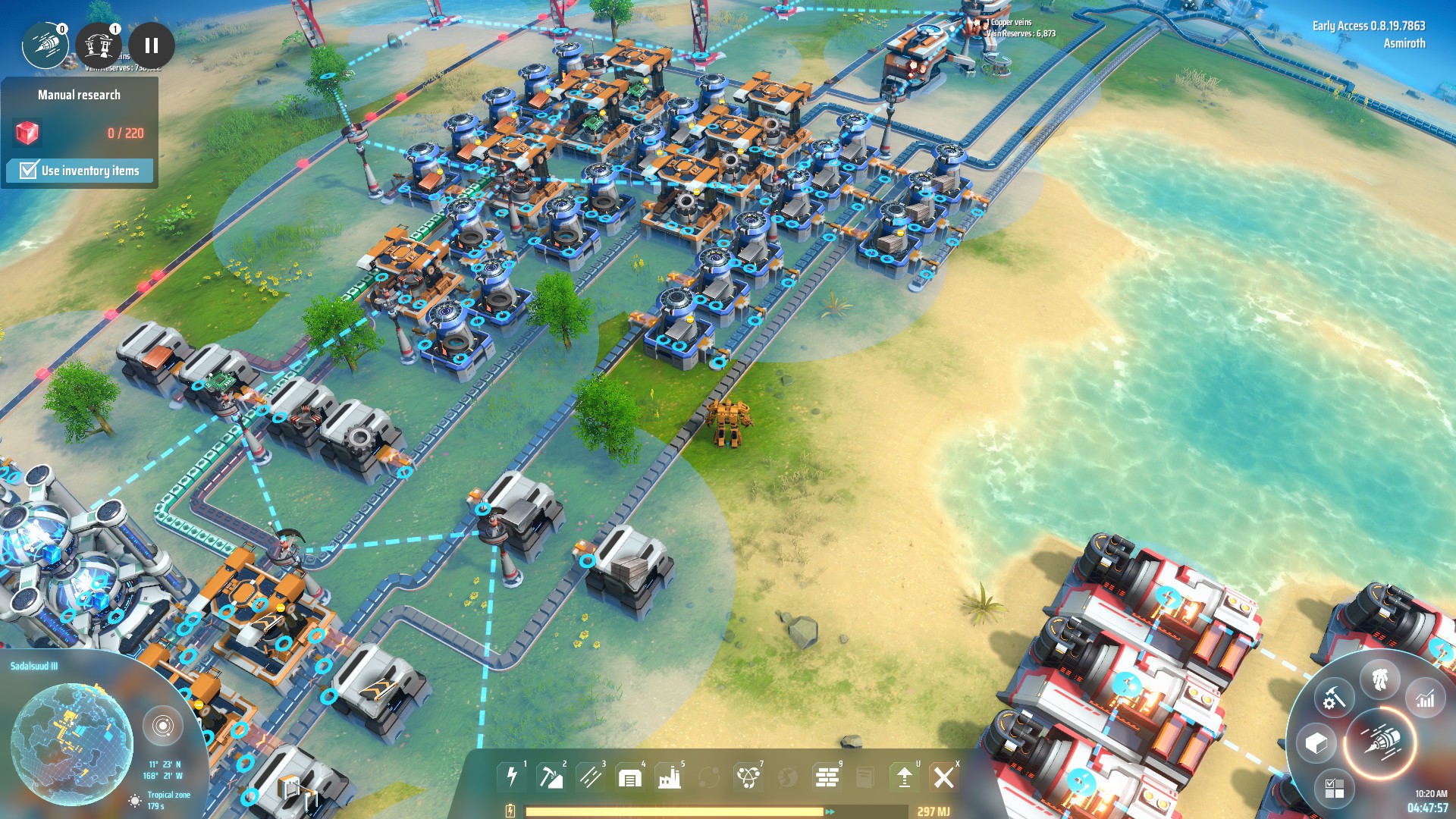
The concept here is that you want to build a highway of basic material, and then run it through a production area. The first “bus” area will focus on stone, iron, and copper. You’ll break it into 4 phases, basic material, assembled material, buildings, and storage.
Basic material is the initial smelting process. Stone to Bricks, Iron to Ingots and Magnets, Copper to Ingots. The assembled material will move into the simple items, Gears, Magnetic Coils and Circuit Boards. This phase then leads out with 5 lines to the buildings section (bricks, iron ingots, gears, coils, and circuit boards). You can make nearly every important building with these 5 items (Tesla, Wind Turbine, Belts, Sorters, Splitters, Storage, Smelters, Assemblers, Miners, Thermal Stations). Building all these things is important, but you’ll want to store them too. Setting the maximums is important, you’re unlikely to need more than 50 miners and a box can hold 1500. Best to restrict production so that the resources can be used for things “down the line”.
Since this bus takes space, you’re going to need some rather open room to build it all. I’ve personally split it into 2 groups – one for the first 2 phases, then another for the last 2. Breaking up a phase is not a good idea, you’ll end up with spaghetti lines. The best part of a bus is that if you empty an ore node, it’s really easy to run a new supply line to the start and not have to rebuild the entire thing. And since you’ll have 5 main outputs (and access to copper ingots), you can then work to have a more complex 5th tier of the bus to make things go.
The basic construction phase of the bus
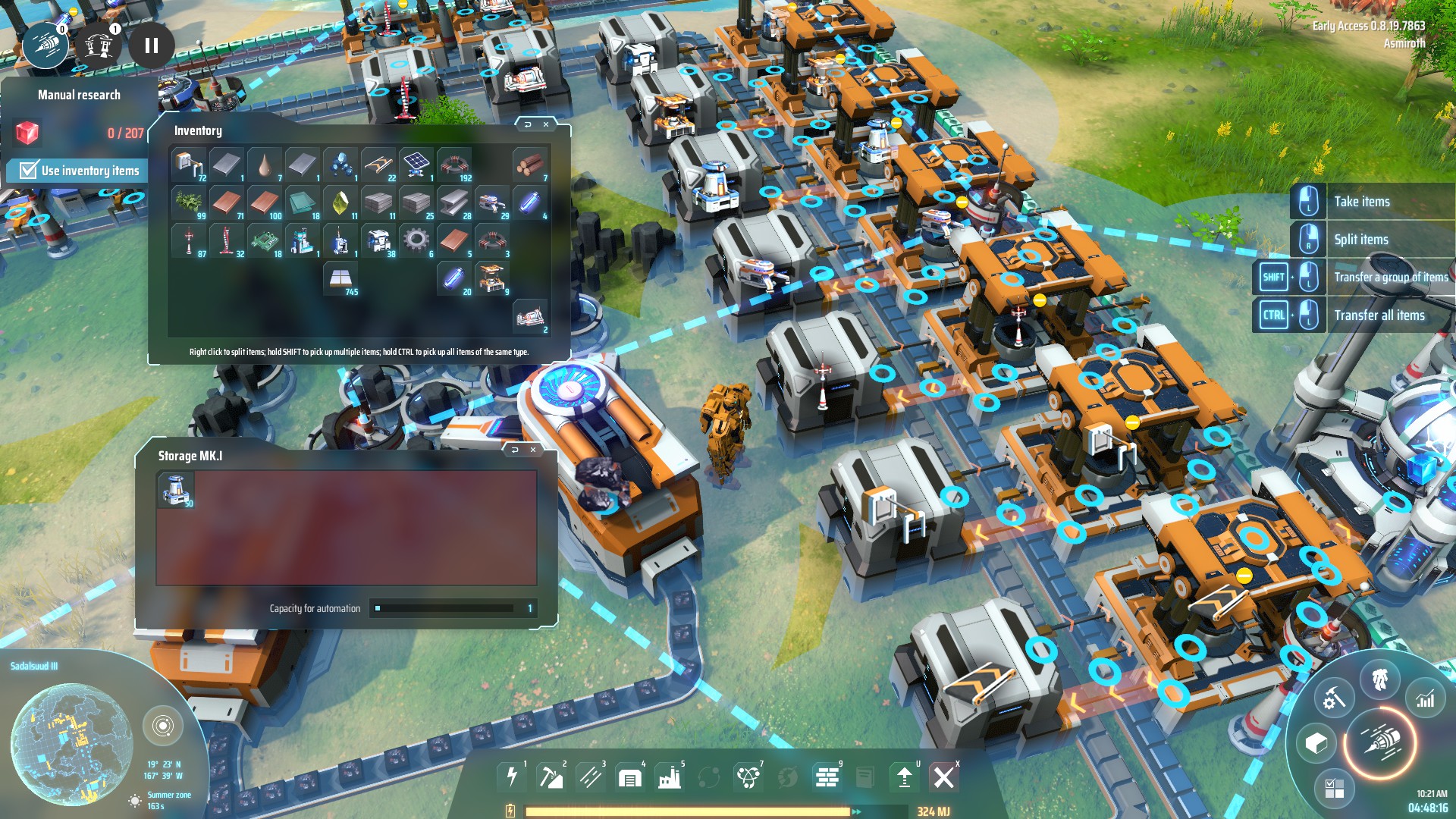
The concepts of buses are important, as you’re going to need to do it again for oil, and then again for silicon. You’ll have basic inputs, a transform phase, and then a storage phase. And then use that storage to kick off another transform & storage phase. The storage part is super important, as it allows you to make changes within the bus and not have impacts on the rate of production downstream. As supply chains get more complex, breaking an early part can have devastating effects down stream. It also allows you to create one-off items when automation isn’t practical (e.g. early logistic stations).
The assembler phase with storage
ResearchPlanning
The research tree in DSP is big, and it’s entirely possible to research a tech and not be able to build the items because it’s missing a dependency. It’s also not at all clear to a new player what’s actually important!
That’s only half the choices!
Having done a full playthrough, I have a much greater appreciation for what’s important for progress. You’ll reach pain points that prevent automation, so my general thinking is:
Basic power (tesla + wind turbines)
Mining (to get ore)
Smelting (to make ingots)
Logistics (belts and sorters)
Assemblers (to complete the bus)
Blue Matrix (research cubes)
Graphite (refined coal)
Thermal Plants
That’s pretty much all you need to get the main starter bus up and running. The upgrade tree (generic upgrades) are also good, where you really want to unlock Drive Engine 2 in order to visit another planet. The other planet will have silicon & titanium, essential for future growth.
Build Phases
The early game is all about Blue Matrix production. You need oil to get to the Red Matrix phase, which is a new bus that is more dependent on glass production (stone) and a completely different bus (water, sulphur, coal, oil). The Yellow Matrix phase is a right mess, because it needs Titanium and Silicon, which are only found on another planet. You need a fair chunk of it too, like 6 trips with full inventory worth, to get access to the real goal – Interplanetary Logistic Stations.
When you get access to those (~ the 8hr mark), the game completely changes in scope. For another post.
The internet is a funny place. There’s next to nothing that is fully isolated, most things are dependent on other things. That thing you treasure, odds are it’s dependent on a pile of other products to function. You hate Steam? Well how else are you going to buy that cool PC game? Want to boycott a car company? There are 300 different companies providing parts to it. Imagine for a second if YouTube shut down tomorrow, or Facebook? How many “influencers” would be out of a “job”?
ActiBlizz is no different. There are thousands of people that have tertiary relationships to the company and make a “living” from it. MMO-Champion and WoWhead would stop to exist without WoW. BlizzardWatch if the company went away.
Preach, Bellular, Evi+Tali, Asmongold all made a decent buck on the WoW wagon. Two of them have decided to move on, and certainly are going to bring a crowd with them. Where does Dark Legacy Comics go?
Overwatch League brings in a fair chunk of cash to the coffers. T-Mobile has pulled their ads and others are looking to do the same. Kellogg’s is out. That increases the risk that OWL as an e-sport is at risk of not being able to move forward – just like HotS went through. When HotS did close, there were a lot of people that needed to find new income streams – most outside of the ActiBlizz umbrella. It’s a hell of a choice to change your livelyhood, compared to a player changing what icon they are going to click.
This blends into the discussion of boycotting, where the impacts are oddly messed up into the idea of “winning”. Like if all the “good” people quit WoW, then the “bad” people have won. In what world does your monthly sub and in-game chat have an impact on the paycheck of a CEO? Does anyone think that the WoW direction is a positive one based on player feedback? The MAU certainly say otherwise. Do people think there’s any positive to come out of the LoL community? Nah, we just end up with tertiary actors mad at other tertiary actors.
If you’re paying any attention, ActiBlizz only makes decisions based on money. Their shares went up on the Q2 reports. As long as they are making money, and not risking losing money, they have no reason to make meaningful change. You paying them and expecting them to change is insanity. Why would they? They’ve got what they need from you.
You ever try to negotiate a bill or service with your internet provider? Ever have any success without threatening to cancel your subscription? They don’t care about you as a person, at all. They just want to ensure that you pay your bills on time. Big companies are the same.
If you want something to change, stop rewarding the negative behaviour and instead, reward the good behaviour.



 Leo's Life