#Diablo3 – Where Should I Farm (Numbers!)

This is going to be an analytics discussion, so some math is to be found.

Diablo 3 is a slot machine.  You pull the lever (kill the baddie) and stuff pops out.  Sometimes it’s good stuff but most times it’s crap.  You need to pull that lever a whole bunch of times to get something decent.  And the prize itself, while it might have a nice look, when you get to the meat of it, there are things wrong with it.  Such are the RNG (random number generator) gods!  For the purposes of this article, I’ll only focus on Legendary (or set) items.

In order to sway the odds, Diablo 3 has a whole bunch of number crunching below water. Enemy difficulty (regular, rare, unique, etc…) have different odds of dropping items.  Game difficulty (normal, torment, etc…) have different odds of dropping items.  Rifts and Greater Rifts have different odds of dropping items.  Actually, Greater Rifts are still under debate, so I’ll scratch that for now – in particular because it takes 11:30 minutes to clear one.  Some of these odds are additive, some are multiplicative.  Let’s start with that concept first.

Additive odds are simple enough; you just put the numbers together.  So 25% + 15% + 7% = 47%.  Multiplicative odds are harder to get around.  25% * 15% * 7% = 30.7% and much less obvious.  Sometimes you even add the odds and then multiply.  You get crazy formulas.

Enemy difficulty is also part of this calculation, where non-regular (so Rare, Elite and Unique) seem to have a sliver of a chance to drop even a rare item whereas a pack will drop 3+ items.  The quality of an item is dependent on if that enemy even drops something.  So you can’t say a normal enemy doesn’t drop legendaries, it barely drops anything in the first place.  You’re looking at a solid 100 enemies before seeing something.

Game difficulty and rift difficulty is as follows.  Normal until Master gives a 0% boost outside rifts and 25% in rifts.  Torment 1-6 gives 15% to 131% boost outside rifts and a 44% to 189% boost to drops inside rifts.  So at any difficulty level, it’s clear that you should be in a rift, the increase is noticeable.  Torment 1+ is required for level 70 legendaries.  Torment 2+ has  50%+ odds of dropping a legendary in a bounty.

Game difficulty also increases enemy hit points, where Torment 1-6 go from 819% to 8590%.   That’s a massive increase.  They also hit harder but that’s less important for this point.  You want to kill them fast.

Each build has a “clear on normal” build which is built on efficiency and speed.  Or, 1-hit-kill specs.  The clear builds mean you mow down everything on the screen quickly and get to focus on the elite packs instead.  The bonus from this is the extra experience from the kills, increasing paragon levels which increases your power and makes you kill faster.  So… yeah, killing regular enemies quickly is good.  This brings up the concept of “clear speed” where you can complete an objective in X amount of time – typically this applies to Bounties (5 quests with a chance at a reward) and Rifts.

So that’s a pile of information.  And you’re wondering, what the heck does this actually mean?  Me too!

Depending on your leveling path, you either did the content in order or simply re-ran bounties a bunch of times.  You hit 70, and finally started to use your Blood Shards with Kadala, gambling on gear.  You focus on armor, getting some decent stuff.   Unless you have a really crappy weapon, don’t bother gambling on one.  Find a good clearing build and run a few normal bounties in Act 1 until you have a better weapon.  Find a 1 hit kill build next and increase the difficulty from normal until you find one that is no longer 1 hit kill.  There are great odds that this stays on normal and that’s ok.  You’re going to reach a point where you’re 80% optimal on rare items.  This means you have imperial gems slotted, you have 80% of the maximum roll on your primary stat (plus Critical Hit Damage, Critical Chance), some critical hit and damage as well as a decent (~8K) life on hit.  Your weapon should have a gem slot and it should be an emerald.  You’re now ready for Torment 1.

Actually, maybe you’re not.  This is where the magic really happens is the Time to Clear (TTC, which is really similar to a TTK acronym).  Greater Rifts (GR) have a 11:30 TTC, if you want to increment your rift level by 1 (for more loot).  A TTC that’s lower means you need to leave the GR, so something else, then come back to kill the guardian.  The “something else” should be Act 1 bounties, trying to get a Ring of Royal Grandeur – a legendary ring from the bounty cache.  You should be able to clear all 5 quests in 2 GRs, depending on dungeon layout.  Once you’ve completed the Act 1 bounty and closed the GR, leave the game and restart.  GRs get harder over time, so your TTC will eventually reach and exceed the 11:30 and you’ll be unable to continue but have to restart.  The benefit of GRs is legendary gems (should have them all in ~15 rifts) and a decent chance at a legendary on the boss kill.  But you’re only killing the boss every 11:30 minutes plus. Due to this, greater rifts aren’t usually worth a whole lot until you can clear T6 rifts reliably – you’re not there for the gear but for the challenge and the gems.

The alternative, if you have a decent TTC, are regular rifts.  Once you’re 80% optimal, you need to run Torment 1.  TCC by that point is less gear dependent and more skill based.   The question becomes, “do I move up in difficulty?”  The answer is related to TTC.  Let’s look just at the difference between T1 and T2.

T1 = 819%hp, 44% bonus to legendary

T2 = 1311%hp (60% increase), 65% bonus to legendary (47% increase)

So let’s say your TTC in T1 is 5 minutes.  You get a 47% increase in rewards. The real metric here for choice is that your TCC cannot exceed 47%, or you’re actually falling behind.  That means a new TCC of 7:23 or less.  Other clear times are: T3 (10:13), T4 (13:31), T5 (17:09) and T6 (21:28).  Now the difficulty climbs too, due to the HP increase.  So your damage needs to climb as well.  Let’s say you’re at 200K DPS.  T1 to T2, to clear at the same rate, your damage needs to increase to 320K.  From T1 to T6 you need to reach 2.1 million DPS.  And that’s not even calculating the extra damage enemies will cause.

Given that you only ever get an average of X items in a rift, regardless of quality, you’re better off clearing them faster than raising the difficulty.  I could graph out the optimal place to run rifts, based on your damage output but there are a few other factors at play.  The goal is to clear as fast as possible, unless you can increase the difficulty and still remain below the new clear time.  So!  What you want to do is get a TTC of 5 minutes for a T1 rift first.  Don’t even bother with the other rifts until you can get this one down as it’s very unlikely you’ll get any benefit from harder rifts (exception is playing in groups).  Once you have T1 down to an art, then see if a T2 can fit in your time window (7:23).  If it can’t, then get better at T1 rifts.

That was a really long post that hopefully added some clarity on the “where should I be farming” discussion. The short answer is “T1 rifts until you can clear them in 5 minutes”.  There is very little incentive of moving up in difficulty if you’re aiming for optimal performance.
Raiding – Who’s It For?

I used to raid back in the day.  You know, when we trash meant something and you stayed logged on to farm mats.  Oh, what glorious days it was to raid 5 hours a day, 5 days a week and then farm the other 2 days!  Kids today have it much to easy.  What with the CoD, Destiny, D3 pop-in and play gamestyle.  Where’s the challenge of getting 20-40 cavedwellers to wake up from their late nap to log in? And then proceed to ignore all instructions for the first 45 minutes?  Oh, too easy I tell you, much too easy!

Some odd Wildstar numbers for you here.  So from the horses’ mouth, 120-150 20 man raids, 7 40 man raids that have cleared 3 of the 9 bosses.  The math comes to around 4000 raiders.

Let’s look at WoW for a second, where Raiding is arguably, no longer the top-tier end game activity (pet battles!).  Here’s the link and it accounts for data ~6 months after the raid released.  7.3 million character, 2.3 million accounts, looking at the final tier of raiding, SoO.  70% completed the first boss on LFR, 40% flex, 20% normal, 10% heroic.  50% completed the last boss on LFR, 18% flex, 13% normal, 0.8% heroic.  Assuming the “accounts number”, WoW’s hard mode attracted ~1% of the playerbase.  I’ve mentioned before that WoW’s heroic is pretty close in difficulty to Wildstar’s default raid level.

Back to Wildstar.  Assuming the same 1% ratio (and that’s a very large assumption) they are sitting at around 400k subs, which I think is a pretty decent number.  Of course, it takes magic math to get there.

But the crux of the argument is that their design vision, hardcore 40 man raids, are being consumed by a tiny, tiny fraction of the playerbase.  You’re leaving 99% of the rest of playerbase with next to nothing to do as end-game currently consists of either daily grinds, or getting into the raiding sphere.  Hate on WoW’s LFR as much as you want, they’ve found a way to get 50-70% of their playerbase to USE the material they’ve built.

Now you’re going to LFR for 1 of 2 reasons.  First, and I’m going to assume this is the minority here, to see the story/content through.  Raids, since BWL at least, have had pretty decent narratives.  If you didn’t raid Icecrown, then you’re probably wondering what ever happened to the Lich King after having seen him every 15 minutes while leveling.  Second, they do it for gear.  Gear for gear’s sake, or to get into the real “raiding” that starts at Flex.

Flex for a minute. This to me is the smartest move WoW ever made when it comes to raiding.  There were many months of tweaking, in order to avoid breakpoints but today’s implementation is near perfect.  Solid enough challenge, built for social guilds and allows you to take a night off with the missus.

Back on point, raids are by their very nature exclusive.  They require not only a decent amount of RPG-savvy (stats through gear + good build + good tactics) but also coordination of multiple people over long periods of time (3+ hours).  Sometimes the latter is the hardest part and calling a raid off because you only have 32 people instead of 40 happened often in vanilla.

So while Wildstar has it’s own little problem in that they need something for people to do other than raid, they also need to look at how they can make raiding more accessible so that they aren’t spending millions on content that only 4000 people get to see.

#Wildstar – What Works and What Doesn’t

Editorial alert!  Editorial Alert!  Bring out the pitchforks!

With Wasteland 2 out the door shortly, followed by Civ:BE a month after, I’ve come to the conclusion that Wildstar time is taking a backseat.  I like the game, certainly.  There’s just nothing left for me to do that I think is worth investing my time in.  Sort of.

What works

Good news to start.  The stuff that works, works really well.  The LAS and action combat is amazing.  I’ve only have this level of fun in Neverwinter but Wildstar takes it to a new level.  Picking and choosing skills between battles, applying strategy to it all, paying attention to what’s on screen.  All that works.  It’s a major skill gap for a lot of people but it’s great once you get the hang of it.

Raids.  Now this is taken from the subset of raiders who are actually raiding and the videos produced.  I’ve raided in most MMOs that have the option.  From EQ’s zerg-fest, to Vanilla’s healer rotation and Rift’s sparkle-fest.  There’s the right level of challenge and skill needed to beat Wildstar raids and the general consensus from raiders is that it’s worth the effort to get there.

Housing.  Outside of EQ2, and maybe some UO, I don’t think I’ve seen a better housing system.  And it’s getting better next patch.  This is really a super tool.

What doesn’t

Class balance and stats.  Bluntly, the system as it stands today needs some re-work.  At max level there are only a few useful skills, per role.  Esper DPS are using a healing skill for some reason, that’s a problem.  Stats are undergoing an overhaul right now, where melee and ranged attackers are getting normalized.  This isn’t as bad as SWTOR’s haste issue (where it was something you actively removed from gear) but the core stats is miles more important than anything else today.  There needs to be more softcaps and cross values from skills.  It sort of reminds me of the Diablo3 v.1, stack primary, issue.

Crafting.  Crafting has a great theory in the system.  There’s some randomness, which can be mitigated with a few things but the crafted gear today is better than raiding gear.  And that’s the level 49 gear, not 50.  There’s a ton of potential and the plans from Carbine on rebalancing drops makes sense.  At the least, it needs a use for low level items, otherwise it’s just a grind to max level with vendored results.

Attunement.  It currently prevents access to the best part of the game and the general cause of people leaving over time.

Stuff to do at 50.  Right now it’s just dailies.  Shiphands don’t scale to 50.  Housing instances don’t scale to 50.  Dungeons have no purpose other than attunement.  Adventures have no purpose other than attunement.  It’s like a giant funnel rather than an open field.  Dailies that take 30 days to max out…

The rewards at 50.  There aren’t any really.  See the crafting point above.  From 50 until you complete a raid and get a drop, there’s no real incentive.  Housing is the same at 40 as it is at 50.  Crafting can be maxed out at 30.

End Statement

There’s a ton of potential here.  The story is solid.  The combat mechanics are super solid.  The housing is solid.  The math needs some rework.  The “what the hell do I do at 50?” issue needs some massive investigation and likely a re-shifting in priorities.  The updates we get from Carbine indicate that’s underway.  Though turning a ship of this size takes time… time I’ll be using playing some other games in the pipe.

The Balance Between Challenge and Rewards

You should be reading Spinks.  The most recent post about Wildstar difficulty has me thinking….

I wrote about it in the difficulty curve post from last week but as a reminder, Wildstar has a rather ridiculous skill wall at the tail end of progress.  Getting to the first dungeon is an OK challenge, no facerolling.  Dungeons will kill you, repeatedly until you learn to avoid the red and interrupt.  Then level 50 hits and you hit a mountain of challenges.  Design for the 1% gets you 1% after all.  And we’ve seen Carbine pull back from that strategy.

So until the most recent patch, where attunement requirements were reduced to semi-sane levels (just need to complete, not complete in under X time), people were indeed faced with two choices.  1) spend the time to repeat content until you get what you want and 2) spent the time gaining the skill to do 1).  There are more players in 2) than in 1), that’s a given.

I’ll compare to WoW for a second, as it seems to be a decent baseline of easy-mode.  There is ZERO skill requirement for 2) on anything LFR and below.  Normal raids are more about paying attention than anything else.  Heroic raids… different matter, depending on your gear set.  Wildstar doesn’t have anything close to the LFR skill plateau, so there will always be time spent learning the skill.  No one playing Wildstar has ever played a LAS-active combat-NoTab-interrupt heavy MMO before.

Then there’s the time sink (attunement) to even get to the time sink (raids).  Let’s say everything is peachy and you complete a successful run on the first try.  There’s a solid 20 hours of attunement progress (not content, since you’ve likely already done it before jut not on hard mode) before you get to raids.  And that 20 hours requires X amount of time to get the skill to start it.

This reminds me a lot of ESO and their original VR system.  You got to 50, realized you only completed 30% of the game and had to repeat content/grind for another 60% to get to the end game, in a rather higher difficulty setting too.  Zenimax was smart enough to remove that after 2 months and VRs are going away completely before end of calendar.

All of this is taking about time, not even the rewards. If I’m going to spend 20 hours doing something, I’d like some progress to show for it.  Wildstar today, has crafted gear that’s on par or better than some raid drops and nearly all the attunement progress you could hope to get.  So it’s 20 hours with nothing to show for it.

I’m in Diablo3 right now.  It’s a loot pinata and there’s a certain challenge to it.  Even if I don’t get an upgrade in a session, I will get horizontal progress for Paragon levels.  I’ll get more gems, gold, crafting materials.  I get something if not a direct power increment.  Rift and EQ both have alternate advancement buckets, so that there’s some progress even at max level.  It’s well done in my opinion, adding some customization and benefits for continual play.  FF14 allows you to run another class on the same character.  Marvel Heroes lets you swap heroes in-game, using the same inventory/boosts.

It’s not about always giving away new cars ever turn of the road or a shower of purples.  You do need some indication of progress, some piece of the carrot on that stick that somehow convinces you “just one more turn”.  That the 20 hour attunement, or the 4 nights of wiping on a single boss is good use of your time.

#Diablo3 – Progress Report – Level 70 Crusader

So to my last post relating to the changes in Diablo3 indicated that I had spent some time there.  Well I did and in particular I decided to roll a Crusader in the softcore season.  I have never been a fan of the hardcore playstyle as an always-online game + 2 kids = you’re going to die.  Lag or framerate stutters are enough to snuff out the candle – in particular framerate issues where player optimization conflicts with game optimization (mostly movement speed issues).

A seasonal player acts like a fresh character as you don’t have access to previous paragon levels, crafting items or shared stash.  It’s like starting the game with nothing – other than the knowledge of previous plays.  Well, that’s not entirely true.  Since I had completed Act V with other characters, I had unlocked adventure mode without the need to do a full game run on the new character.  That saved ~6 hours or so I guess, given the odd balance sections in the game.

Adventure mode allows me to port all over the place and collect bounties, which award a cache with rift tokens and a chance at a legendary.  The legendary ring reward for Act 1, Ring of Royal Grandeur, gives a unique bonus of allowing set benefits with 1 less item (so a bonus of 3 if you only have 2). This allows you to stack multiple benefits with less items.  I did 1 through 70, exclusively on Act 1 bounties, and got 1 ring.  Each run was 2-5 levels worth of experience, depending on what I encountered.

Item collection is much different than before, at least while leveling.  Smart drops means that I had very few super-crap items.  Who needs an DEX sword as a crusader?  I’d guess that less than 20% of the items where things that I would never consider using.  Previously, I would only ever consider 10% of the items that dropped.  I remember my Wizard as the first one that leveled.  When he hit 60, I was still wearing items from level 20 due to poor drops.  When my Crusader hit 70, he has 1 item at 47 and the rest was mid-60s.  Big difference.

Bounties also awarded a bunch of blood shards, used for gambling.  Since I was accruing a decent stream of items while leveling, I played at Master difficulty after level 20 or so.  This gave me a boost to experience (100% I think) and double the blood shards.  I didn’t spend any of them until 70.  When I did hit 70, I gambled on each slot until I got an “optimal” piece per slot.  I think I was around 500 blood shards, so there was plenty of room to gamble and find decent stuff.  Each item costs 5 to gamble, so you can imagine the power jump I went through when I hit cap level.  My DPS went from ~40K to ~150K in 5 minutes.

Actually, this brings up the expansion power jump discussion.  From 1-60, the items are balanced decently enough and gems in particular have a nice scale of power.  61+ the items have a boost in power, significant at that.  Say from 250 stat to 500.  Gems that drop have 100 main stat boost instead of 40.  For example, my monk at 60 had ~200k DPS.  Just by upgrading gems and running blood shards, it went up to 500K.  That’s an insane power curve – (and likely why PvP will never go live).

So what do I do now at max level?  I ran a few rifts at normal, to see if I could get some decent drops.  I got a couple, in particular a nice flail that doubled the duration of my Steed skill (immune to movement control and deals damage).  With a bunch of cooldown reduction items I can use the steed ~50% of the time and kills most enemies in a single shot.  Easy farming for a bit.  Upgrades a couple more pieces then moved on to Torment 1.  Found some more items as pretty much completed all my crafting recipes.  I’m at a point now that there is absolutely nothing I can get that isn’t a set/legendary as an upgrade as I have “optimal” rolls for all my rare gear – you can say that the game is complete at this point.

Now I enter the true end-game, the gear farming space.  I know how this worked before RoS.  A future post will detail the progress.

Diablo 3 – Revisit

I’ve written a fair bit about Diablo 3 in the past. The two main points were as follows:

  • Building an single Auction House for 3 million people in an RNG system means playing the actual game has little value.  Only playing the AH actually accrued any value.  Plus the whole “real money” aspect was flawed.  (Disclaimer – I made enough from the RMAH to buy D3 and a few expansions, so the game was more or less “free” to me)
  • Extreme randomness does not align with a a design that focuses on 2-3 optimal stats. A 75%+ perfect roll was needed to even compete at top tier, with a less than 0.01% chance of getting it.  Extreme randomness rarely works at all but for it to have a chance, you need rather exceptional balance to make as much viable as possible.  (e.g Intellect for a Monk is never viable)

So Jay Wilson left (was let go?), they dumped the idea of an Auction House, launched a console version with lessons learned and then released an expansion Reaper of Souls that took that and went a bit further.  Doone got me thinking about it with a recent post on the launch of seasons and I decided to give it a go after nearly a year away.

What’s changed?

Loot 2.0 for starters.  This is a massive design change, where the odds of drops are tipped in your class’ favor.  Monks get monk favored drops (Dex, Crit, uniques, etc…) with a few non-Monk items.  The stats on the drops have reasonable ranges (300-400 instead of 100-700).  The balance against the stats makes sense as well, where mid-difficulty content can be completed pretty soon after you hit level 70 and the gap between the difficulties is solid.  Oh, and there are legendaries all over the place, with unique abilities, and they are much better than other items.  The game still has random spots but it is so much less punishing than before, it’s barely recognizable.

Adventure mode.  Once you finish Act V, any other character can port to any waypoint in any act at any time.  There are still shitty spots in the game (bees in Act 2, goliaths in Act 4) and you can skip them completely!  Combined with bounties, which are 5 mini quests per act that reward gold/xp and blood shards, you have a reason to go all over the place and see things but with options.  Blood shards are used for gambling, which is a nice feature.

Customization.  Transmog is there and that’s fine but the ability to re-roll stats on items is even better.  Have an item that’s perfect except for one roll?  Re-roll it for a better item!  It’ll cost you a pretty penny but hey, good way to get some nice stuff.

Crafting overhaul.  Crafting now is useful.  Sets, uniques and what have you.  It makes sense to make items now and actually use this system.

Balance.  D3 at launch was notorious for cookie cutter builds, which are indicative of poor balance.  When you’re given the choice of ~150 skills and 75% of the population ends up with the same selection – you have a problem.  Today, each class has 4-5 viable builds for max level (Torment 6).  That’s a hell of an achievement.

Paragon.  This was before 2.0 but it’s now across all characters.  You get points for each level past 70 (horizontal progress) to assign to specific fields.  Allows you a level of customization you might not find on gear.  Applies to level 1 characters too!

Seasons.  Well, this is a 2.1 change.  Seasons and ladders allow you to make a single character, apart from the Paragon pool and level them up.  Slightly different rewards, titles, legendaries and what not.  Once the season is over, you go back into the general pool. A wonder why this wasn’t in earlier as there’s competition.

Should I play this?

Most games get better with expansions/DLC.  Few games can reverse massive suckage, or simply poor design.  Marvel Heroes is one.  FF14 is another.  D3 is now on that list.

I have no idea who they hired to do the system redesign.  Whoever it is deserves a medal though.  The game is ultra smooth, has a clear progression path and rewards investment.  It’s responsive, communicates a lot more in what you can do to get better (or compare) and has done significant re-balance.  I’d almost go so far as to call this Diablo 4 since aside from the art, story and classes, this plays like a different game.

Gaming Value

Syp has an article in related to Collector Edition costs.  Syncaine has one related to FF14’s long term subscriber benefits.  I know UO for the longest time had veteran rewards.  And with all this talk about F2P, one has to wonder how much value you’re actually getting for your money.  And not just in the MMO space.

Value per hour

Let’s not kid ourselves.  Gaming is a very cheap hobby, assuming you have the console/PC to run it.  Let’s say you don’t though.  A console is $500 with enough controllers and cables and crap, then $15 a month for multiplayer.  A PC is about $1500.  Both get you a solid 5 years before needing replacement if you game heavily.  So let’s say it costs about $280 a year for a console and $300 for a PC (closer than you thought I bet!).  That’s less than a dollar a day.

Games run $60.  People play about 22 minute a day, 22 hours a week, for a core gamer.  Games run all over the place in terms of completion time.  Single player games are around 8 hours, RPGs run 20+, multiplayer is all over the place so let’s guess at 100 and MMOs are even larger so let’s say 200 (3 months @ 22 hours) – but they also cost ~$15 a month in subscriptions.

So a singe player game is $7.5/h, RPG is $3/h, multiplayer is $0.6/h and MMOs are $0.3/h for F2P and $0.5/h for a 3 month subscription.  That’s pretty cheap if you think about it.

Value per event

Single player events are contained – you finish the game and you’re done.  Only a few have replay value and the number of people who just complete a game are below the 25% mark.  Multiplayer games are different, each session can be a new event.  You can join a tournament.  You could be grinding like a maniac, and I consider that a single event.  MMOs are quite a bit different.  Sandboxes make their own events, though they do have patches.  Burn Jita is an event that has nothing to do with the developer.  And the value of a sandbox event is typically higher due to the player’s sense of involvement – mind you they are more spread out.  I mean, you hear about a capital ship battle once every 3-6 months.

Themeparks have a set number of events (or rides I guess), usually dictated by the patch/expansion cycle.  I will take an example that is not WoW, but instead a patch cycle of 3 months of content, 18 months for expansions.  So launch, patch, patch, patch, patch, patch, expansion.  Now, expansions shouldn’t ever cost more than half of a launch price – so $30.  95% of the content is already there and the development has been fairly well subsidized by your previous payments.  It’s not a new game, it’s a big DLC.  The patches, content patches mind you, should as a whole equal half the content of an expansion pack.   By that I mean, content patches should have new zones, new events, new items, new systems, etc…What an expansion provides is a vertical progress (new levels) and a LARGE package of content (zones, events, etc…)

Value for extra content

And that’s just baseline content.  The original CE issue is that the prices are all over the place.  Early access, beta access, a pinky ring, some scarf that no one can see.  All of that junk makes no sense to me.  But hey, people still believe buying lottery tickets is a smart move.  A CE should have actual value.  Physical items (like coins, statues, maps, books), digital non-game items (soundtracks, art), digital in-game items (mounts, re-usable dyes, titles, costumes).  Why would you ever pay for $30 more for an item that has 2 hours of use (such as a ring that grants extra experience for 10 levels).

Player value

And this gets me to my final point, you the player.  You pump in quarters to the machine and get to play.  The developer gets money.  You are content for other players (certainly in F2P games).  The deal can be broken at any time and the reason to keep paying is a personal/social one.  FF14 (and a few others) have tweaked that a bit.  Play for X amount of time and get this bonus item (a mount, a trophy, etc…).  Or if you are a subscriber, get a significant discount on future items, including expansions.  I mean, you’ve subsidized the game this far, why keep paying?  Certainly in this age of instant themeparks, if you can get 3 months out and there’s no new events, why keep paying (outside of social circles).  You can just hop into another themepark and drop 3 months of cash and cycle through.  Games that treat you with respect as a client earn more business in the real world.  It’s about time the virtual one caught up.

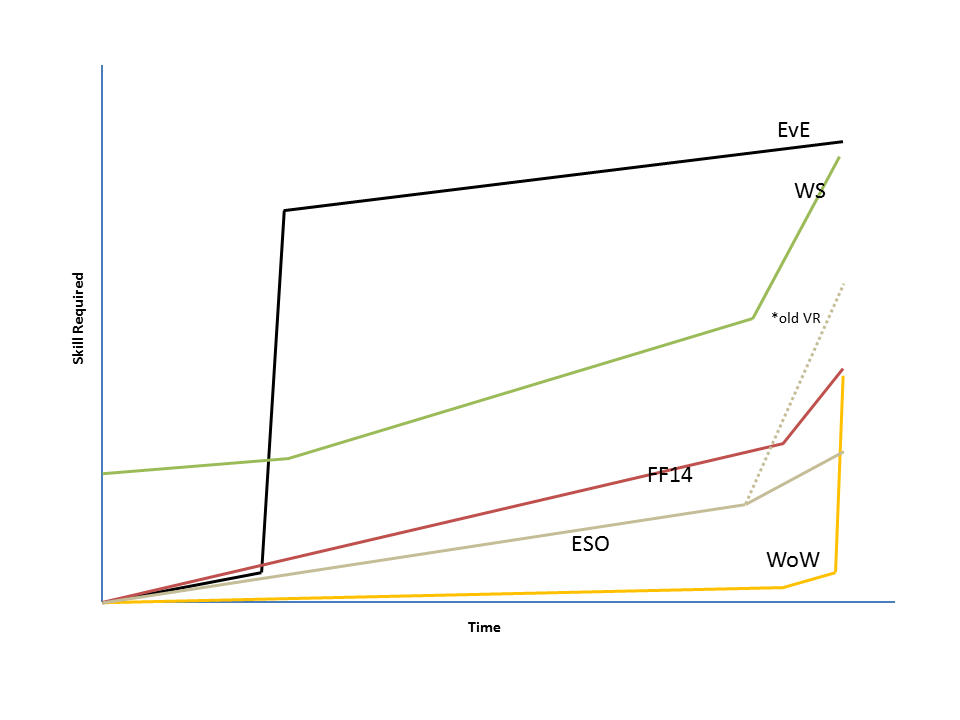
Skill vs Time – A Visual Aid

After reading Isey’s post on How to Lose an MMO Gamer in 10 Ways, and after pondering a bit more my previous post on Wildstar, I decided to draw out what I think is one of the larger hurdles for games to succeed – at least on a “massive” scale.  And that’s player skill.

Good game design is a series of meaningful choices.  I don’t think there’s any debate on that.  Where I think the kink in that comes from is in the ability for a person to have a an actual choice and appreciate the results (i.e. the ability to apply a skill and learn a new one).  I’ll go back in time a bit to vanilla Naxx and Heigan the Unclean.  This is the famous “avoid the fire spouts and you can solo me” boss – a dance really.  This was a massive twist in the traditional RPG space, where you just stood there pressing buttons.  Now you actually had to pay attention to the play space and move.  You couldn’t just absorb the damage.  I do know that many guilds at the time used it as a triage for recruits (combined with Thaddius) and it formed a massive skill wall for it’s day.   You either performed it perfectly, or you died.  That model, tried with a slight twist in BC, got the Ol’ Yeller treatment.  For good reason too, it wasn’t a meaningful choice and other than memorization and “no keyboard turners” there was little skill exploited.  WoW since then (with a blip in Cataclysm that they want to forget) has been more and more accessible at the lower end, with harder content for those who want the option.

To me, player progress is important.  Not only improvement itself but the opportunity for improvement and the evidence of improvement.  Huge spikes in difficulty is bad.  Difficult just to be difficult is bad.  No difficulty is bad.  A gradual increase in difficulty, where your progress is both evident and rewarded is the optimal solution.

On to the visual aid I promised!

skillvstime

What I did here was map the player skill required to complete tasks, assuming a time investment.  The skill portion is relative between games, where EvE is certainly the most challenging.  The remaining themeparks are ranked in difficulty, based on my play.  Over each in particular now.

EvE

Everyone has seen the EvE difficulty curve.  The game is rather simple to start, assuming you stay in high-sec and follow the themepark crumbs.  Try to move off that path, either through null-sec or mastering a trade and boom, welcome to excel online.  If you make the transition, you’re gold.  If you don’t, then you’re dead.  EvE has been able to succeed with a supremely polished game after the transition.

Wildstar

No game starts off harder than Wildstar.  Then you start dungeons and the difficulty starts to climb.  Reach max level and the attunement begins, with a massive climb in difficulty. There’s no help to transition between the stages, the difficult is very binary (you die in 1 shot or you take no damage) and the climb at the end is like no other themepark.

FF14

A game with a very gradual increase in difficulty due to skill unlocks being limited and the presence of force grouping at an early stage to progress on the solo train.  You learn to tank, heal, pull, DPS, stun, craft… everything.  And the change at max level is more along the lines of perfecting skills you’ve already acquired.  It’s a very good experience.

ESO

This one is a little odd, in that challenge as you level has no training and very little feedback but the skill level required is pretty low.  Given that there are actual “bad choices” the game design allows you to have a couple and still succeed.  If you make good decisions, then it’s like cutting Jell-O.  That said, at launch the game had a veteran system at level 50 that was significantly harder than the first portion of the game and accounted for 60% of the content.  Bad choices meant you were going to do.  Good choices gave you a 25% chance to die.  That system was drastically changed after 3 months to a more similar difficulty curve.

WoW

I could have drawn 1 line per expansion here but the power curve line is pretty close to this.  Today’s experience from 1 to 89.9 is a joke.  I leveled a Monk to 90 in a week and only died from falling damage.  Dungeons & LFR can be AFKed by 20% of the group and you’re still going to win.  Normal raids have some challenge but the real difficulty is in the heroic raids.  And not heroic raids because of the mechanics but because of the stats the players have on the content.  Remember that power curve line?  The difference in power between expansion launch and 2 months is nearly 25%.  People were clearing MoP raids in Cataclysm raid gear.

Others

I could have added other games, like LoTRO, STO, DCUO, Rift, Neverwinter and DDO where I’ve done the high level stuff.  They are all pretty similar to WoW, with the final spike happening earlier.  I can’t think of one that plateaus before max level – though TSW might be a candidate as it doesn’t really have a max level, just limited action sets.

Summary

I think the comparison between all the games is important for discussion.  Certainly each has their own variables but of you were to look at where players quit the game, I’d bet dollars to donuts it’s where you see a shift in the curve (assuming they get past a trial phase).  Difficulty is good.  Shifts in difficulty must be moderate.  The benefit of that difficulty increase must be evident.  All of the games listed have made changes since launch to their curves (yes, even EvE) except for Wildstar – but it’s also the youngest.  Here’s hoping they get the hint.

#Wildstar – 3 Months In

I want to talk about the negativity around Wildstar – which I guess is sort of a Streisand effect…

First off, Massively isn’t a gaming news site.  It’s an editorial/opinion/re-posting web service.  It’s one of the more prominent sites but to claim that it holds any journalistic merit, well you couldn’t be much further.  What it does, it does well – in that it generates buzz/comments.  So when you read an article stating that Wildstar isn’t doing well, take it with a grain of salt.  It should hold as much weight as when BoK posts something similar.

So let’s start with the facts.

Some Wildstar servers are ghost towns.  As with any MMO, once you can’t find anyone to play with, you stop playing, so this is really just like watching water leave a drain.  To combat this, Carbine will be implementing Megaservers (like every other MMO in the past 4 years – including WoW).

The game has a much harder difficulty curve than any other themepark.  The wall is early and it is high and it gets bigger over time.  I won’t say the game is complex, outside of coordinating interrupts, but it is very unforgiving of mistakes.  This by nature reduces your potential client base.  There are no planned changes for this outside of a “learner” dungeon in the next patch.  More tools to teach without changing the core system.

Itemization/Runes/Power distribution is not aligned.  Right now, the melee classes get a larger benefit from stats than ranged players, which is causing them to have ~50% more damage output.  They just scale like crazy.  Rune slots are also an issue, where “optimal” runes are 2-3x better than a normal rune.  What this means today is that there is little choice at max level, and making anything but the correct choice is a massive penalty. Both of these issues are going to be addressed by Carbine – the first part by normalizing power and stat gains and the latter by spreading out runes across more slots.

The next part is my observation.

The end game is forked into two parts – the solo side of dailies (that each take 30+ days to cap), customization (armor and housing) and farming/crafting and the group side of adventures/dungeons/raids.  Elder Gems are the max level currency and right now, it only has a use for the latter group.  Solo folk need more content and the next patch has some more dailies.  However the game needs more types – shiphand missions are an easy target – and a better use for Elder Gems.  Carbine has stated they are working on this but there are no timelines.

The group folk have a completely different problem, in two parts.  First is the attunement wall.  Unless you already have a raiding guild who wants to pull you through content, you’re not going to get through it – in particular because of the world raid bosses.  It took WoW multiple content patches to create this attunement wall (BWL and BT come to mind) and caused enough problems that the entire model was scrapped.  That Wildstar implemented this wall at launch…very odd choice.  Carbine is making changes to reduce the requirements of attunement but without Megaservers or an existing raid group, people are still out of luck.  The second part is the reward structure around group play, in that it’s “gold or bust”.  Given the above mentioned difficulty, and the fact that adventures/dungeons provide a significant boost in rewards if you achieve a gold medal, any failure is met with a group disband.  This causes an “elite” culture and provides absolutely zero learning curve for players.  Carbine has made some changes to the rewards structure in that now even a bronze gives something but there is still too large a gap between bronze and gold. (To compare, Gold runs in Wildstar are akin to Gold Challenge runs in WoW).

The good news is that I’m still playing and having fun.  It isn’t a daily thing mind you, but every couple days I log on and run a few things.  The group thing is an issue for my playstyle.

Is Wildstar in a rough spot?  Certainly.  At the very least, it will continue to hemorrhage players until they can implement Megaservers. There should be no larger priority.  Aside from that, there are plenty of balance changes on the way to address some of the concerns above – and soon too.  As for the group play at max level, that is going to require more time and more thought.  Had Megaservers been there at the start, perhaps the attunement issue would be smaller as there would be a larger player base to get through it.  My opinion (since beta) is that focusing solely on 20/40 person raids is a mistake.  Time will tell if Carbine feels the same way.

Your Voice Matters

I have a personal rule in my line of work, if no one says anything, then it’s approved.  I tried forcing people to approve things and nothing moved, so now everything has a disclaimer.

You have x days to provide comments, otherwise you’re indicating approval for the content.

It took 2 or 3 passes before people realized I wasn’t messing around and now feedback is quite quick.  It’s also something I use when talking to friends and politics comes up.  “Did you vote?  No?  Then shut up.”

The link to gaming, and actually more like social studies, is as follows.  A lack of action is an approval of another action.  In much simpler terms, if you’re not calling an asshat out, then you’re ok with their actions.  If you’re not /reporting someone for clear harassment, then you’re supporting them.

Now, people can make all sorts of excuses around that and that’s all they are, excuses.  If you aren’t standing up for something, then you’re standing up for nothing.  Things don’t change by just sitting there and looking at them.  They need action, they need people.

Greifer – someone who through their actions, costs you more than they pay into the system

I could care LESS about what people think about the UO Trammel split.  It was the solution, at the time, that was meant to stop greifing.  There was such a furor on the forums and in-game, people were simply just abandoning completely that Origin needed to make a drastic change.  You can blame the “carebears” if you want but the cause was always the greifers.  The solution… we can talk about that another time.

I won’t be linking to any hashtags or websites about the garbage going on today.  It’s really not that complicated.  There are a bunch of people who would rather stroke themselves and put everyone else down rather than share the ball.  I get that.  We used to call them schoolyard bullies.  They all ended up pumping gas for a living.

The gaming industry is undergoing a revolution.  The old days of pumping out shareware crap at Radio Shack are long gone.  The old guard of online games has long since retired or morphed into today’s MMO/online presence.  Today’s gaming must be inclusive.  It’s beyond financially irresponsible to ignore 50% of your market – it’s ignorant.  Gaming is a business, it needs to make money.  Focusing solely on greifers as your target audience is stupid.  XBOX One even has a cesspool of players with low score to avoid this problem.  If you want to be an asshole, that’s fine.  Go circle jerk with the rest and leave us alone.

There is a massive storm of ideas and mandates going on today.  It will not get better in the short term.  This is what happens when you want a revolution, people will get hurt, business will suffer and after what seems like an eternity, the industry will come out stronger.

But the only way this thing will change is if you use your voice, because every single one matters.