
Logistics games work on a rather simple concept. Insert material into a machine, extract the results. The complexity lies in the amounts of those 3 items, and their relationships. End-game factories have dozens of production lines to keep track of. The unique aspect of each of these games tends to lie with mass-distribution mechanics – moving things. Some use robots for low volume/high frequency, some use belts for a medium view, some trains for mass transport, and some ships for large distance transport where trains cannot work, normally providing less material than a train would.
DSP has robots, belts, and ships. It does not have trains.
- Robots are used extremely sparingly, primarily for keeping your personal inventory filled with buildings, but also in support of uncommon building requirements on a bus.
- Belts maximize at 60 items per second, which is only truly impactful in base ore processing. 20 smelters will saturate a belt. Stacking / piling is different (more on that in a bit.)
- Ships have 2 types, local and between planets.
- Local has some small limits that can be improved through research, and are generally effective at large scale transport on a given planet.
- Planet shipping is slightly more complex, as the time it takes to ship can be long, especially when travelling between systems. Large factories require dedicated off-world shipping, which then distribute locally.
Small Scale
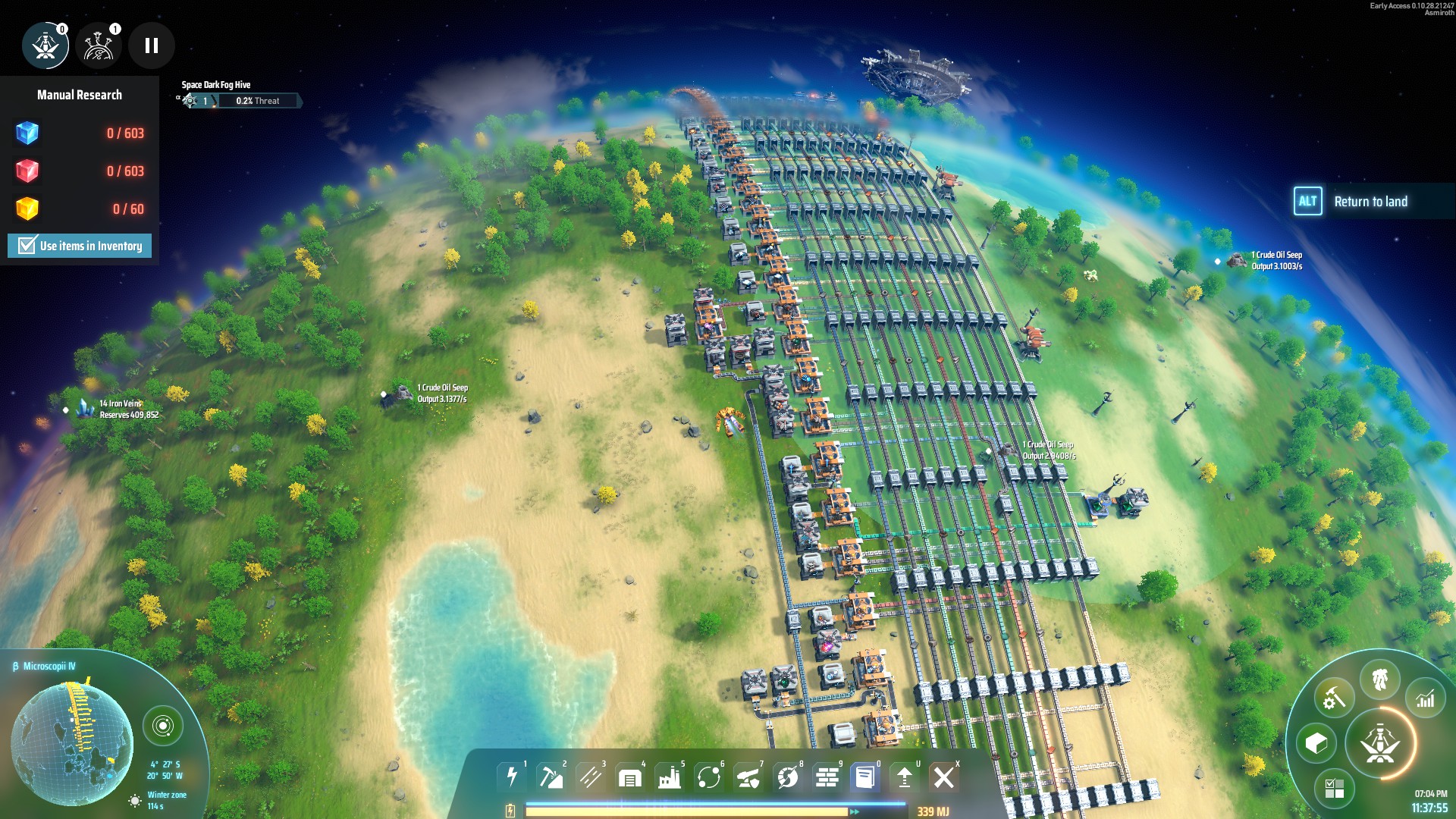
Until you unlock the ability to use ships, nearly everything is managed through belts. Throughput is low, a main bus can ship things effectively between buildings, and it generally keeps power usage low. The downside is that a significant amount of material is located on the belts at any time. Noting that this period also includes you travelling to another planet for silicon + titanium, smelting it there, and manually hauling it back to your main base.
Planetary Scale
When you do unlock ships, you’ll want to immediately move to the non-lava planet in your system. Some basic power options will be laid out, and you’ll focus on the basic smelting lines, effectively replicating all items on your starter planet here instead. That means all material up to yellow science.
Power is a massive issue here, as all logistic towers require an insane amount to charge, and you’ll be starved quickly. You’ll also have few ships available for distribution between towers, maybe 5 local and 1 planet per. That’s a start though, and enough to rebuild a main bus on this planet. Keep the starter planet running until you unlock purple science!
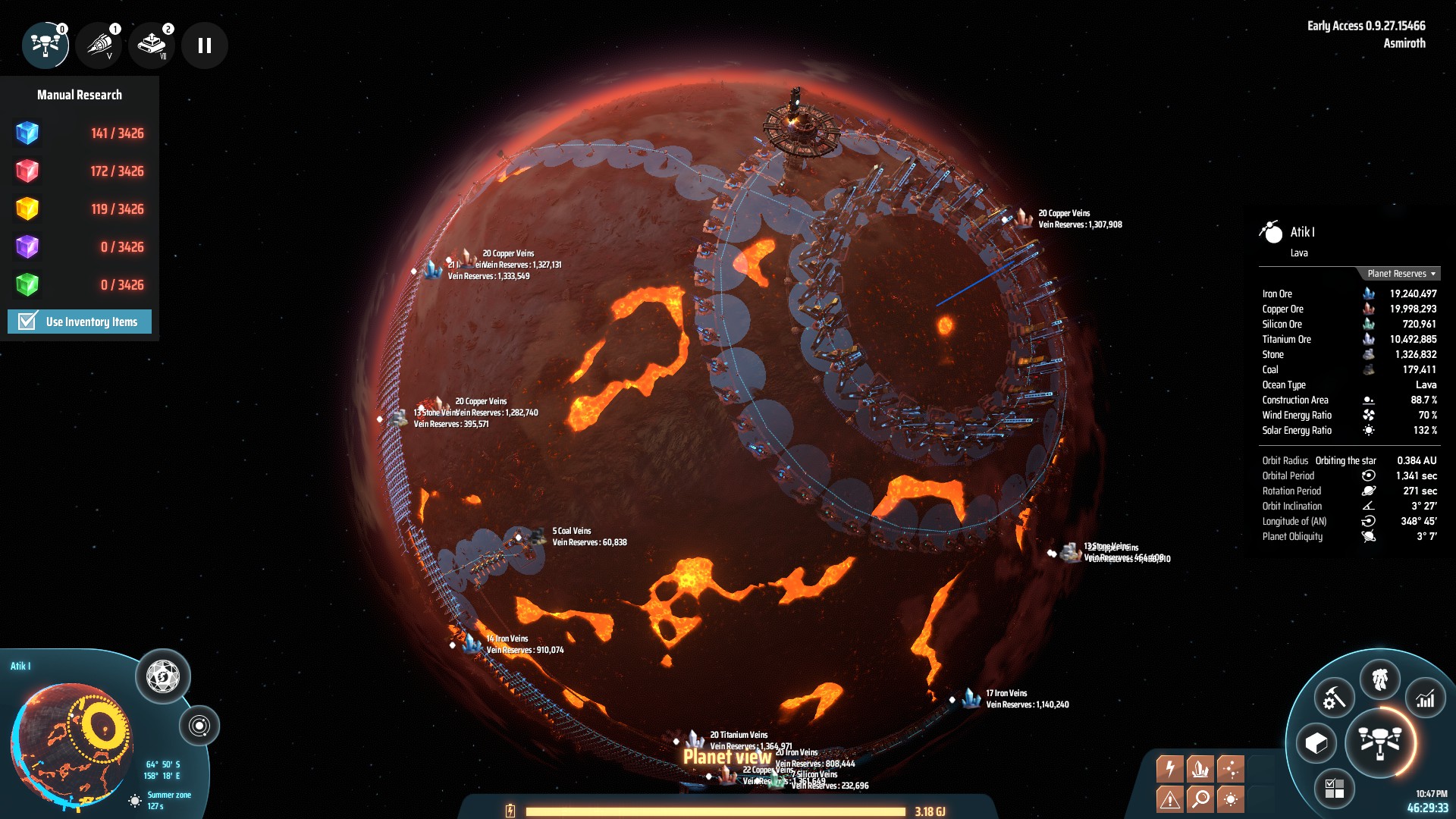
The power issue is going to be addressed by 2 methods. First, put as many wind turbines as you can on each pole, it will take a few hundred for sure. Next, on the lava planet, you’ll need to build a charging station, which requires a combination of wind/solar power and a battery construction plant. Use the extra power to charge batteries and ship them to your factory planet for discharge. Ship the empty batteries back. It’ll take a bit to build up, and charge rates are entirely related to the amount of excess planetary power… so keep improving it here. Eventually, you can supplement it with Deuterium Rods. Unfortunately, these batteries will be the only viable option until you get a Dyson Sphere running.
Proliferation
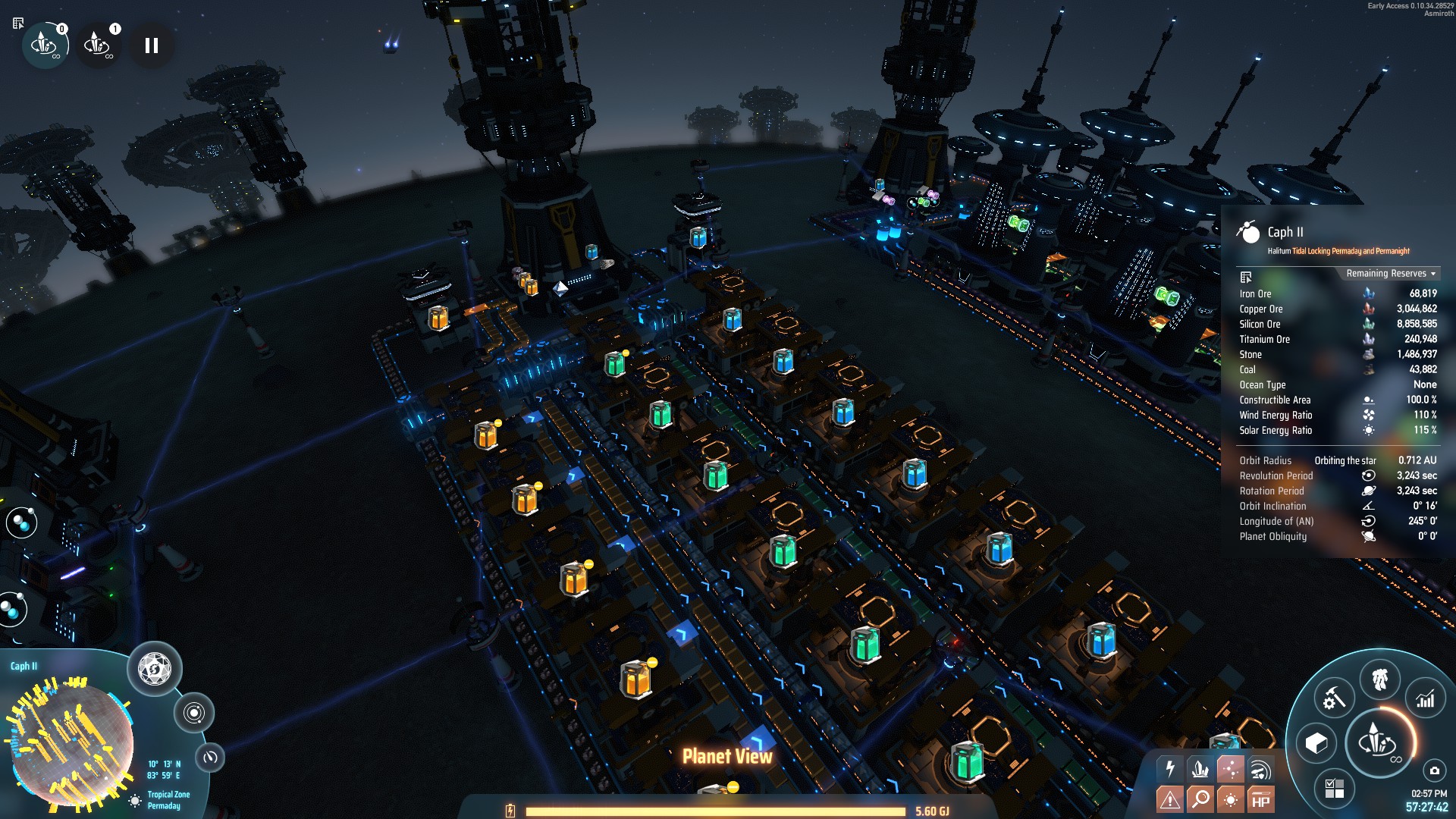
This is analogous to beacons in Factorio or Sommersloop in Satisfactory – they boost your output costing significantly more power. Mk1 sprays only cost Coal, and you should proliferate every single item (except raw ore, fuel, and dyson sphere components), including the spray itself. Make Mk3 spray once you unlock additional planets, as the nanotubes required need rare resources. Same rules. The 25% bonus to output is massive on multistep chains, which means you need less buildings, and therefore less power.
Interplanetary Scale
This happens when you start collecting rare resources outside your main system (kimberlite ore, sulfuric acid, and unipolar magnets all require level 4 exploration). These rare resources require warpers (green science) to move between systems, and dramatically simplify production chains. You can’t scale without these, and likely will need 1 dedicated logistics tower per.
You’ll likely build a dedicated manufacturing channel per item as well. Why? Because this is the only effective way to build a modular design that can scale to meet Dyson Sphere requirements. If you build a self-contained red engine plant, eventually you’ll need 8x more of it. It is much easier to lay down more belts and assemblers than to lay out an entire new blueprint. Further, each logistics tower can only accommodate 5 items in storage, or seen differently, the end product cannot require more than 4 ingredients per tower. Excepting white science, this isn’t an issue if you dedicate 1 tower per product. Complex builds will require multiple towers, which a) costs a LOT more power, and b) you have to build them a certain distance apart from each other. Modular builds ftw!
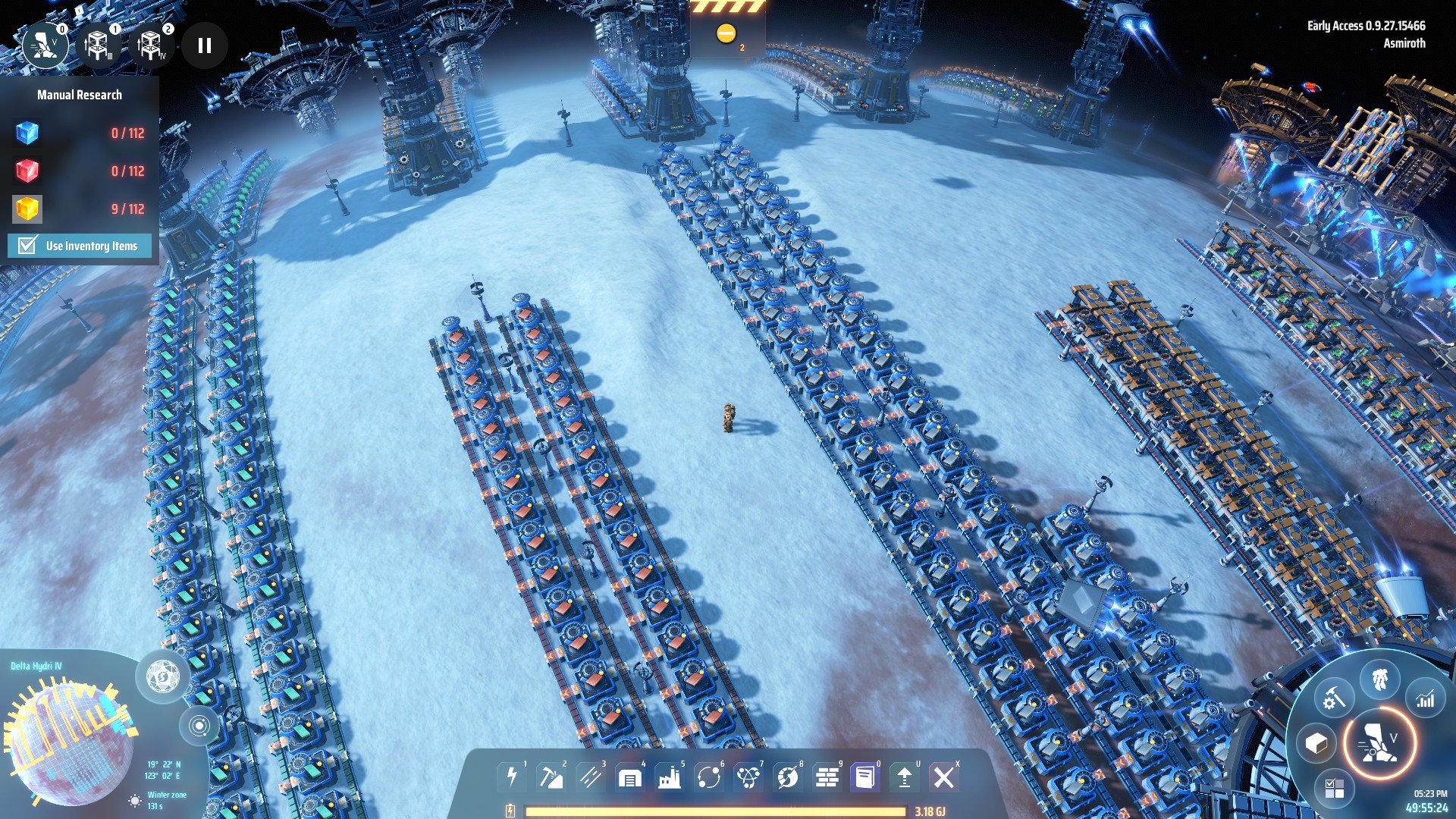
There are 3 main exceptions to this however. First, your main bus will have 5 towers to feed all the base material. Anything that is used in 4 or more buildings should be in the bus, the rest you can robot in. Second, your main construction material (inserters, belts, assemblers) should be in a concentrated build. It’s 3 towers of material to build level 1 through level 3 items. Extremely worth it. Third, proliferators. You will build Mk1, Mk2, and Mk3 items from the same tower, as it only requires 3 main ingredients and you will blow through them too quick to use ships. It’s only 1 tower mind you, but a very compact build.
Smelting Math
A Mk3 belt can support 30 items a second (1,800 per minute). That seems a lot, and for a decent part it is. A basic smelter takes 1 ore and gives 1 ingot per second. 30 smelters = a full belt. Cool.
Plane Smelters works 2x as fast, Negentropy Smelters (only with Dark Fog) are 3x. Your belt can neither feed in nor out that volume. Enter stacking, and two options, one of which is false.
Pilers take items on a belt and stack them. To get to 4 stacks, you need 4 pilers. You should never use pilers, ever. Pile Sorters are the right answer, through a relatively simple upgrade that automatically inserts and extracts up to 4 products. They take a lot of power, but they are better in almost every other way.
Noting that advanced logistics research (12k+ white science, multiple times) is required for logistics stations to automatically stack outputs. You want this.
Mega Basing It
So here’s the kicker that you eventually realize, there are only 2 main outputs of any given base, components for the Dyson Sphere (rockets + sails) and research, and you need 3 or more orders of magnitude less rockets than sails. If you want more than 1 sphere, then you’ll need to ship the material to another system, and build the relative ray receivers. I do not recommend this.
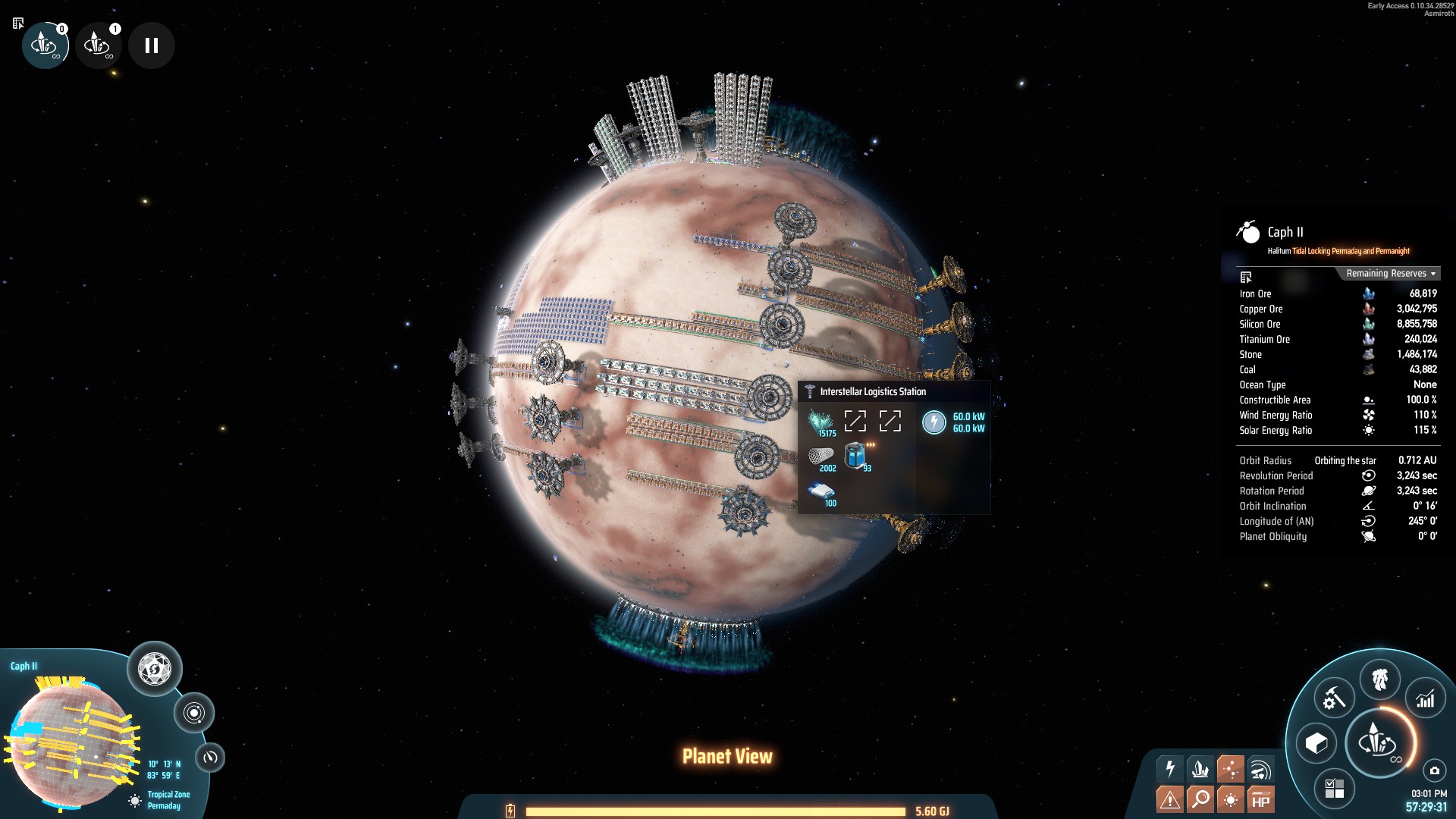
What you’re left with is the chase for more SPM, which is rate limited based on critical photon generation from ray receivers. It is unlikely you will hit that particular limit mind you, as you there are other key pieces along the path that you need to scale at late game. This assumes you have all stacking options unlocked (you want this for the recipes needing 12 Hydrogen per craft)
- Deuterium. Used for Strange Matter, you need a ton of this. A gas giant helps a lot here, more than one is better. Otherwise you need to make it from Hydrogen. You need a LOT.
- Plane Filters. The materials are easy enough to find, but it takes a lot of assemblers to make enough. This is likely where you will first use Mk3 assemblers.
- Carbon Nanotubes. You need these for so many things and will absolutely tear through production area doing so. Mk2 Chemical Plants are needed here first. The compression rate (6:1) should incentivize you to craft this on the planet where you harvest Spiniform instead.
For high SPM builds, you will want to dedicate other planets to specific research outputs. This will mean shipping Artificial Stars to get power running, fuel, and Mk3 proliferators on a regular basis to keep it running.
- Blue requires copper + iron. Very easy. All planets can do this.
- Red requires coal + hydrogen. Coal is generally limited to specific planets. Hydrogen you want from a gas giant. The starter planet + system is a good option, though there are plenty of others.
- Yellow requires titanium and organic crystals. No single planet will have both, so select a system with the latter and use 2 planets.
- Purple is a pain. You need rare resources. Fractal Silicon, Oil, Water, Fire Ice, and Spiniform Stalagmite Crystal. There are a dozen or so systems that meet this need. You’ll need to harvest from multiple planets, and be located on the one with Oil/Water.
- Green requires a lot of Deuterium, Grating Crystals, Fire Ice, Water, and Kimberlite Ore. There are not many systems that fit this bill – not sure if I’ve ever actually seen one that has Crystals and Ore together. Given you need Graviton Lenses for your Dyson Sphere collection, I would build this on the starter planet and just ship in the base mats.
- White requires antimatter, which can only be refined within a Dyson Sphere system, so no real options here.
It is entirely possible to hit 5k SPM on a single factory planet. It isn’t ideal, but is certainly feasible.
 Leo's Life