Control

When a game reaches multiple top 10 lists, my eyes tend to shift over.  When said game blends X-files, Lost, Fringe, Twilight Zone, Metroid, and Zombies… I’m doubly in.

Built in a New Weird setting, you play as Jesse who’s trying to find her brother within a secret government organization.  As you finally get through the front doors, you realize everything is going sideways, with a small war underway.

Cue the various exploration bits, and additional powers.  You have a weapon that can transform to other styles (full auto, sniper, shotgun, grenade launcher, handgun).  Powers are relatively simple.  Dodge and shield for defense.  Seize to convert low-health enemies.  Levitation to explore a pile of areas and make combat go full 3D.  And Launch – which is the bread and butter skill that picks up almost anything to throw it at targets.    The variety of items that can be thrown, and the distance… it makes for some extremely satisfying combat.

Enemies generally look the same, humanoids.  They are quite a bit different though.  Some are basic grunts, others launch grenades, some fly, some explode on death, some stealth and then shoot you at close range.  Then you have various elite enemies, and some exceptional boss fights.

Which does bring me to likely the largest hurdle for many gamers… this thing is hard.  Not to the level of Dark Souls… but enough that I died a solid 50 times before the end.  Sometimes it’s just bad luck and you end up between two grenades.  Sometimes you miss an important jump.  Most of them were the boss fights, in particular the last one and the few optional fights.  Levitation, dodging, launching, shooting.  It feels like pure chaos, but then you look back and go “holy shit”.

In fact, there’s one sequence near the tail end where Jesse says “that was awesome” and I cannot recall any game sequence that actually felt that awesome to get through.

There’s some RPG-ish elements here.  You get skill points to increase various powers/health/energy.  You get mod to modify yourself (better throws, less energy per use, more health, etc..) and your weapons (accuracy, rate of fire, ammo return, etc..)  There’s a huge amount of RNG here, and a massive difference between rank 1 and 5 items.  If you like min-maxing, there are some options here.

All of that stuff works, and generally works well.  But you’ve seen that before.  The extra bits here are the lore/setting.  There are dozens of lore items to pick up and read, listen to, or watch.  Some of it is absurd, like a rubber duck that teleports on it’s own, or a traffic light that teleports users when it’s red.  Some is freaky, like mold that takes like candy and transforms people.  There are various hidden puzzles too, like one where you cheat on a roulette table.  Piles of side quests that add extra flavor and bring you to the weirdest of places.  An extra dimension phone line.  The amount of effort and quality world building here is stunning.  You want to explore every nook and cranny.

And I want more Ahti.

Long story short, yeah, Control is one of the best games I’ve played this year.  That was awesome.
Looking Back at 2019

Still quite a few days left, but since the holidays are just around the corner, I’d be surprised if much else pops up.  Or that I properly digest it in time.

Macro

2019 at the macro level has been a new level of insanity.  Society seems to be going off the deep end, with the simple idea of respecting another person considered taboo.  Social media is a ridiculous enabler of the worst facets of humanity.  And when our global leaders focus on lying, ridiculing, insulting and just plain being poor role models… we’re not going to go far.  It’s depressing.

And that’s inclusive of the “woke culture” of finding fault with everything from behind a keyboard.  It’s a sad day when someone’s personal value is measured in the number of re-tweets they get.  Just focusing on problems instead of working on solutions doesn’t help anyone.  And “cancelling” is not a solution.

On the flipside, it’s making me much more conscious of my behaviour and the one I want my kids to emulate.  It’s a very strong driver for the extra volunteering load I’ve taken on.  We can all do better.

Micro

My year’s been solid.  Love my wife more and more every day.  Kids are growing up to be people I want to spend time with, and so far want to spend time with me.  Our social circles are all undergoing major mid-life crises (which I guess is normal at this age), making for some serious wake up calls.  I still have a lot of friends who are having trouble coming to terms with the fact that they are adults.  Both my wife and I are making extra time to support as many people as we can fit.  It’s impressive what a small gesture can mean to someone.  Sometimes just a 5 minute phone call can turn around a person’s day.

Career wise things have been going along at a breakneck pace.  There are days where I wish I was still a code monkey, but on the whole I am enjoying what I do.  Some day I’ll explain it, but for now let’s just say that it’s high enough to have global impact, yet direct enough that I can talk to the amazing people doing the work.  And I’ve entered a career development program that will both open new opportunities, and help me grow as a leader.  Lots (and lots) of work to get here.  I’m glad I can recognise it, and the support along the way.

Summer at the cottage was great this year, but went by a tad too fast.  Next year I’ll take some more time off and spend more with the fam.  There’s something special in seeing your kid’s face light up when you’re out on the water, or around the fire.  Something like that can make my week.

I blogged more than I thought I would, which is good.

Games

If I was to look at 2019, it would be the year of less is more.  The best games this year were able to focus on key aspects and deliver amazing experiences.  It didn’t take 40 hours to get through a slog of repetitive content.  Most were in the 8-16 hour range.

  • I started the year with a buch of indies.  Celeste, Frostpunk, Return of the Obra Dinn, Dead Cells.
  • I picked up Outer Wilds in the late spring and was amazed at what was presented (my personal GotY winner).
  • Bloodstained scratched that Castlevania itch, but didn’t really go beyond.
  • Outer Worlds showed everyone what can be done with a clear vision and a smaller set of resources – I’m looking forward to more adventures in that setting.
  • Jedi Fallen Order is an actually good Star Wars game from EA, and no loot boxes.  Call me pleasantly surprised.
  • I bit back into SWTOR to see what content I’ve missed over the years.  I do like what’s presented, and I’m going back with a Republic Shadow to compare both ends.  Won’t sugar coat it… it’s rough.  But that just means the game has progressed.
  • Lots of Dauntless, which has been a pleasant surprise.  Their official launch was in the fall, and their release structure should be applauded.  There’s tons of content here, it’s entirely cross-platform (Switch too!), and bite sized enough to make Monster Hunter look like paint drying.  Oh, their F2P model is impressive to boot.
  • Warframe has been an on/off thing for a while now.  It still has one of the craziest on-ramps I’ve ever seen, next only to EvE.  The depth here is stupifying.  Like if you went to a buffet, and found out there were 30 other buffets all linked together.  There are times where it feels like staring into the Abyss.


Overall

In terms of things that directly impact me, it’s been a really good year.  One of my best.  A year of reducing the complexities and at the same time spreading out to help more people.  I prefer to spend my energy on people who are positive, or are making attempts to be.  I try to let the negativity just slide off, and it makes for more enjoyable days.

As I get older (and hopefully wiser), I guess I’m just more appreciative.  Thanks for reading.

Warframe Update

Goals.  I need to set more of them.

Progress in Warframe is an odd measure, since it’s like saying you’re done with the soup section of a buffet and moving to seafood.  Ain’t no measuring stick for that!  But Warframe has a conceptual value called Mastery Rank, and it’s based on the rank of various pieces of loot.  Get a sword to rank 30, get some MR.  Same with companions, pets, main weapons, side weapons, and archwings.  Right now, I’m at MR7.  The max is MR28, though MR16 is where the final content is unlocked (Riven).

That makes one set of goals of getting more stuff.  There are 42 main line Warframes.  27 of them have Prime variants (better stats, much harder to obtain).  I’ve gotten all the ones that drop from planets up to Neptune.  I’ve got the main blueprints for Chroma and Octavia as well.  That also means I have a fair chunk of main weapons, secondaries, and melee choices.  I’ve leveled a fair chunk of them, though it bears note that leveling them is not the simplest of things.

From 1-30 takes just under an hour.  You can level multiple items at the same time, though most weapons level faster if you use them.  Helene on Saturn is a defense mission against Grineer, and is the go-to place for people to level everything.  Easy groups, generally small room, plenty of drops.  It can get repetitive though, so I try to interlay some other missions to break the monotony.

Upgrading items is done with mods, which work like points-based bonuses you can slot into gear.  You can upgrade mods, which increases their point value, but each piece of gear has a max amount, so it turns into this interesting (?!) puzzle at times.  Many mods are useful, though the best are quite hard to come by.  A full leveling run (from 1-30) can get me ~250 or so mods, though 99.9% of them are sold.

If I was to set myself some goals for the next month or so, they would be as follows:

  • Get to MR10
  • Complete all nodes up to Neptune
  • Complete Octavia & Chroma
  • Acquire Titania & Grendel
  • Complete Pluto missions (which should unlock lots of quests)
  • Get into a Dojo (guild)

Some of those are more achievable than others.  Octavia in particular requires a random drop from a 20 minute mission, which are level 25-35.  Guess that will depend on luck for groups.  Even completing all nodes can be a major pain.  Archwing missions aren’t all that muchr fun, and I have a large dislike for Mobile Defense missions.

Still, if I can complete at least MR10 and up to Pluto, I guess I can consider the basic stuff all complete.  Then I can start worrying about factions and whatnot.


Building and Maintaining Lore

World-building is dependent on setting up consistent lore, and then respecting that lore with the stories in that world.  In single stories, that’s certainly of value, but over larger series it’s essential to keep people invested.

Why?  Value.  If the stuff you put out at the start is discarded, then it means it has little value and consumers can easily skip it.  It also instills a level of doubt that the current story will have no links to the world and reduce it’s impact.

Game of Thrones has some serious world building going on in the books.  Even the TV show did a very respectable job of maintaining that world.  The issues with the TV show don’t relate to lore with respect to the world, but in respect to the actions taken by the characters.  Like how you don’t set up a main villain for 6 years and then dispatch him in 1 episode.

Harry Potter had a consistent world up until book 7.  Then the play came out and decided time travel was a good way to impact the main storyline and alternate universes.  The JK decided that twitter was a great way to pad extra content to the original books and throw in some major curveballs.  Now, if you ignored everything that came after book 7, odds are you’re a happy camper.

In the comic book world, there are plenty of retcons.  In some sense this creates larger arcs across multiple volumes.  Superman has undergone multiple versions, depending on the needs of the writers and society as a whole.  Batman has had tons of versions.  The slight difference here is that when a retcon comes along, there’s usually some advanced notice and the break is clean.  Rarely do they every try to blend both stories and worlds together.

Playing through SWTOR brings more of this to mind.  While nearly all of it is considered “Legacy” now, it still bears mind that it’s consistent.  The stuff done in Chapter 1 is not negated by anything in Onslaught.  That there are so many intertwining storylines and that they rarely conflict is quite impressive.  Typically the storylines would branch/fork and then come back to a mainline resolution.  Onslaught is a bit different in that space, as the branches/forks are still present at this point.

This is in conflict with the recent Star Wars trilogy.  The Force Awakens was somewhat consistent, with a few interesting bits.  Finn’s battle with a lightsaber against a shock weapon was a bit odd.  The Last Jedi took a baby & bathwater approach, which kept the setting but ignored most of the lore from prior.  Apparently the Force can help you live in space, it can transmit you across the galaxy, lightspeed can be tracked and can be used as a weapon.  There are a few dozen more examples.  The problem with this isn’t so much that they break the existing lore, but that they negate all tension in the film.  The implications of each of those changes the entire galaxy.  Think of it this way – every Xwing is now a nuclear bomb, capable of taking out a capital ship.

I know there are a lot of people who are more interested in the individual story, and that’s ok.  I’m much more interested in the thought process of the world, and seeing how other stories could add to the base presented.  Wheel of Time had some amazing world building.  Sword of Truth was pretty solid.  Lord of the Rings was only written because a world was built beforehand.  When it works, it means the sum is greater than the parts.  When it doesn’t, you get something like the Terminator franchise, where you burn the audience so badly that even when you do get quality (Dark Fate) no one cares.

I’d like to say I’m hopeful that is not the case with Star Wars, but given Kathleen Kennedy’s comments that there is no source material to draw from… that raises some eyebrows.

SWTOR – Shadow Musings

I’ve loved stealth classes for a long time.  They work in excellent form for quick combat, but generally get weaker as the combat duration lengthens.  In WoW, Monks have pretty much replaced Rogues in that respect.  But it’s hard to ignore their benefit of group stealth for time-based challenges.

In my Republic playthrough, my current character is a Jedi Shadow.  By level 25, aside from a stealth button, there really isn’t much there that screams “I’m a shadow ninja and you can’t see me.”  I’d have to triple check when my toolkit from stealth actually has a purpose other than bypassing groups of enemies.

I’ve just finished the Nar Shadaa / Taris grouping, then the tiny ship event that follows.  I’m chasing a Sith that is infecting Jedi with some sort of mental plague, turning them to the darkside.  My secret weapon, which I learned at level 5, is to take their illness for my own – sucking the poison as it were.  I finally found the Sith, and now to chase him…

This is an odd storyline.  Why in the world would the Jedi Council assign one of the largest threats to its existence to an initiate?  When  you’re already short staffed and someone is poaching your team, I think that merits more than the rookie’s attention.

The story beats are all similar too.  Each planet you find a Jedi turned dark, complete some quests to finally meet them, then use the shield ability to cure them.  Feels like I’m a doctor running around giving vaccines.  Aside from the very final part (in the ship), there’s no tangible progress.  If I recall, that is a point for quite a few of the Act 1 class stories, yet in this case it seems really apparent.

I generally liked my companions on the Empire side.  Sure, some annoying ones but it worked.  Qyzen is the whole honorable warrior shtick.  It completely conflicts with the light side Jedi options though.  Tharan Cedrax is meh.  His own companion, Holiday, is where it’s at.  There’s something about the exploration of AI in the Star Wars universe that’s always been interesting.  The whole Iokath/SCORPIO line is where it’s at for me.

I still maintain that the leveling experience is jarring compared to later content.  Planets are large swaths of nothing, with the hub/spoke model that has side quests that are not at all near where your main quest points you.  I’m sure I spend 75% of my time on my mount getting from A to B.  If not for investment in Legacy Quick Travel, the trip from B back to A would be all the more annoying.  It’s more of a gripe though, since I’m able to clear an entire planet’s quest (class & planet) in about 90 minutes.

I’ve thought about doing multiple classes at the same time, enough to allow rested XP to get me to 50.  Good news there is that since every planet scales to my level, that’s not needed.  So off to Tatooine I go.


Phoenix Point Quick Impressions

XCOM of attrition.

I rather enjoy the tactical/strategy squad genre.  I played the heck out of the original XCOM (even wrote my own mouse driver for it).  I’ve played every iteration since.  JAG was decent enough.  Syndicate is a top 20 all time game.  There are a half dozen in that vein every year that seem to pop up.  Sattelite Reign was a recent one.  Hard West.  Phoenix Point is a bit different, in that it’s designed by the same guy that made the first XCOM.  And hooo boy does that show throughout.  Couple thoughts after a few missions.

  • Squads?  Check
  • Alien bay guys?  Check
  • Research & manufacturing?  Check
  • Geoscape? Check
  • Factions?  Check
  • Action points in tactical mode? Check
  • Classes?  Check

The foundational parts are all there, it’s a relatively familiar system.  What Phoenix Point (PP) does differently is apply the concept of time management to equation.  One effective strategy in XCOM is to take a more defensive approach to combat, primarily due to the rather low hit points, and extremely long periods of recovery after damage.  Losing a top-end Sniper for a couple weeks due to really bad luck rolls was super painful.

PP instead puts the clock front and center for a lot of actions.  You need to collect material to build things, and you get more material if you finish a mission quickly.  You are presented with multiple attack choices at the same time, but never really enough soldiers to complete them all on time.   There will be times when you simply run out of ammo.

PP also adds a fair chunk of hit points to every enemy, so that it takes 3-4 attacks to take out even the lowly grunts.  Rather than throw a half dozen enemies at you, there are less of them, but they last longer.  The net effect is that each map is the same time duration, but there’s always something going on, and usually more than 1 active target.

Free Aiming

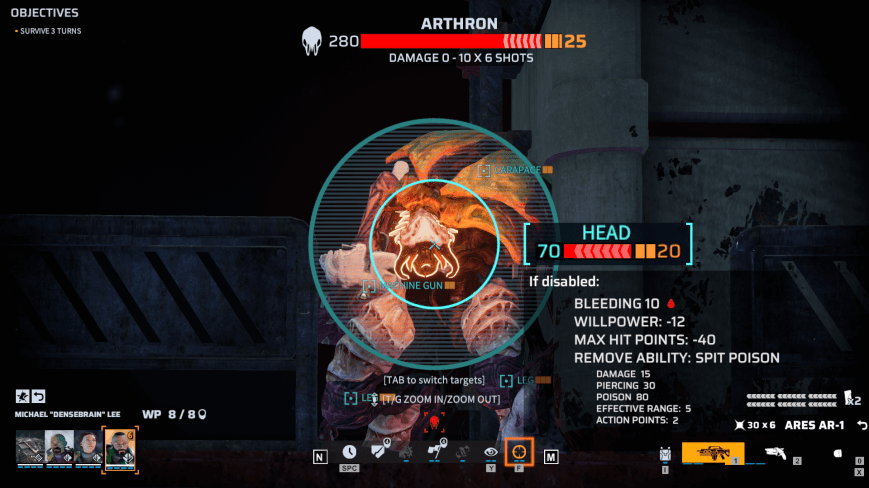
Everyone has missed a point blank shot in XCOM.  It’s absolutely infuriating when it happens, and often at a key point in battle.  Hip shots still exist in PP, but it also adds a Free Aim mode, which is a much more realistic combat mechanic.

phoenix20point6028129

Dead to sights

In most cases, you can bring up your sights and find 2 concentric circles to assist with aiming.  There’s a 100% chance of it hitting the outer circle and 50% chance of the inner one.  As you get closer or farther from the target (or swap guns) the circles change in size.    Picking a part of the enemy has differing effects.  Maybe it disables an attack, maybe it restricts movement.  For some shielded enemies, maybe you can get by the shield and hit an exposed part.  Or perhaps you just want to take out the wall of the building to get a better shot next time… that works too.

This customized shooting makes a tremendous difference in combat.  XCOM sometimes felt like Excel with graphics, just a pretty pain on top of a number crunching machine.  PP says enough with that, and puts a lot of control in the player’s hand.  Yet with that control comes a suprising amount of challenge.  If you aren’t attacking the right enemies, what seems like a sure win can easily turn into a loss.

It will take some time to come to terms with PP.  There’s a lot to unpack here, and it’s going to take some time to get through it all.  From what I’ve seen so far, it should be a fun ride.

Exploration vs Achievement

At work, we’ve gone through psych profiles (NOVA, Insight, Myers-Briggs), and for a long time I’ve been super dominant in one aspect.  I am not a cheerleader, I am a trailblazer.  I see broken things, I want to fix them and find more broken things.  We have an annual review of these profiles, and that allows any new staff to better understand the drivers of teammates.  Which then makes for much more pleasant conversations where both people are aiming for common ground.

There are analogies to gaming.  Bartle posits a 4 quadrant player profile, including Social, Killer, Explorer, Acheiver.  Everyone has a bit of each profile within themselves, though there are certainly dominant aspects.  In that space, I am strong in the Achievement section, with some exploration bits included.  I have next to no drive for the Killer persona, and the Social one is fairly weak as well.  In both of those cases, people will play shitty games because either they are dominating other people, or the other people are the reason to log on.  Generally speaking, an FPS is much more about the Killer model, and an old-school MMO (UO, EQ, WoW Classic)  is more about the social aspect.

I tend to strike more in the Exploration & Achievement sections.  Not in the absolute sense of finding every nook and cranny, and the obscure/grindable achievements though.  Both of those have very long tails.  I have little interest in ever getting a 100% complete, or a Platinum only to have a badge show up.  Now, if content is gated behind the activity, then sure, it’s a tad more interesting.  Things like FFX’s Monster Arena is a good example, and WoW’s pet menagerie is a bad example.

When I “finished” Jedi: Fallen Order, the rest of the game was about unlocking new cosmetics.  Meh.  No real interest.  Outer Worlds I had done nearly all the quests and explored all the zones, but only in the context of playing a specific character build.  To get “more” content, I’d need to restart with a different build.  I’m giving myself time to forget my first playthrough to make it more enjoyable the next time.

SWTOR is in an interesting spot.  There’s piles of content I missed (the near entirey of the Republic 1-50 storylines), so there’s a fair chunk there to face through.  I don’t have much interest in the end-game.  There was a time that I used to.  I raided a lot in early WoW.  I was runing dungeons a-plenty until WoD.  WoD’s implementation made me reconsider my gaming choices, and that meant looking at my gaming catalogue.  Instead of spending a few hours dungeoneering for extra gear, I would rather play something like Shadow of Mordor, or Slay the Spire.  I get why people would commit to a single game, and the social bonds therein.  But I’m good with having to go through 5-6 other GotY candidates instead.

Reviewing what I have left on deck game-wise, that leaves:

  • SWTOR Republic class quests to 50.  Maybe, just maybe, get one of them out to Onslaught.
  • Warframe. Not much more do to here until I get a Platinum coupon, allowing for a much larger inventory.  There’s a post here about online pricing…the coupon is the actual price.  Everything else feels like a penalty.
  • Phoenix Point.  The XCOM successor of sorts from Julian Gollop who created the series.  I don’t expect it to be at the same level as XCOM2 at launch, but then again XCOM2 took it to another level with War of the Chosen (DLC) and the Long War (mod).

Diablo 4 – Itemization

Part 2 of the dev watercooler discussions is up, and it deals with thoughts on itemization.  Since ARPGs are typically driven by the desire for better items, it’s worth a read.  First though, some history.

Diablo 2’s character power structure was a combination of items and skills.  The point investments in skills has a generally larger impact on gameplay than items did, yet there was still a lot of value in grinding for that perfect drop.  I won’t even get into the insanity of Runes.

Diablo 3’s character power is entirely driven by items, and the scale of randomness on rolls made some drops “god tier”.  Legendary items were eventually buffed to apply skill bonuses that impacted gameplay, and some bad luck protection with Kunai’s Cube.

Diablo 4 appears to be aiming more towards D2’s model, with skill point investment and items making up the power levels.  They are planning to eliminate the RNG on top of RNG (Ancient drops) from D3, yet still maintain some element of greater power structure.

The addition of horizontal stats to grant additional skills is an interesting touch.  Get 50 Demonic Power total across all items and get +2 Fireball sounds interesting.  Clearly they want to keep the zero DPS (ZPDS) support roles as viable, and there’s some diversity here in the choice between +proc and +damage.  Balancing those two seems a near impossible task mind you.

There’s also some drive to make rare (yellow) items viable, by having a random drop provide legendary affixes to non-legendary items.  Which, I guess is ok.  But that would require the difference between Rare and Legendary items to only be affixes.  If they have the same stat ranges, then this is reasonable.  If legendaries can roll say 20% better stats, then this is a useless system.

I’ve made a point recently that added complexity does not necessarily make for more interesting gameplay.  There’s a benefit of doubt here since the D3 live team has done some solid work.

This does beg the question relating to player progression, which is still a bit mysterious to me.  I think I understand the intent, but the devil is certainly in the details.  I guess another month before more clarity is provided.

In the larger lens, these types of conversations show that D4 is long ways off.  These are not minor questions, they are the fundamental to the game.  The sort of questions that Anthem should have asked themselves and avoided a horribad launch.  So both a yay in the fact that D4 is taking the planning seriously, but also a oooh in that Path of Exile 2 is most definitely going to launch prior.  Should be an interesting 2021.

Life is Full of Plateaus

I’m in a reflective mood of late.  Usually happens when I’m overloaded and the brain simply turns inwards for some rest.

I was thinking back on the various games I’ve played this year, and while quite a few had actual endings, most of them had more stuff to show.  Yet I tend to move on from those games and with no real regrets.  I was asking myself why and came to the conclusion that I’d hit plateaus.

could have kept playing Jedi: Fallen Order and collected all the extra stims and cosmetics.  I could have completed every side quest in Outer Worlds.  Those are more achievements than actual content.  The parts I liked were closed, and I’m sure at some point I’ll give it another go.

The living games are a bit different.  Dauntless I went full in for a season pass, and took the next one off.  I’ve completed every single hunt, and the Beast Mastery system is an insane grind.  Drips and drops moving forward.  I’m more than content with the hammer, fists, swords, and guns as weapons.  I could learn pikes and axes, but I would need some serious crafting investment to make decent weapons.

Warframe is still there, but right now I’m simply looking for a 75% coupon for Plat to expand my inventory.  It’s like a buffet that never ends, and my ability to focus my goals is the real hurdle.  With Frost Prime and Soma Prime, I have one of the strongest setups.  Pretty much any other mix/match (for MR gains) is going to be a downgrade, or relearning.  I guess I should focus on getting all the nodes open for the first half dozen planets.

SWTOR I’ve done the main story quest for my dark side sorcerer.  Daily Onderon quests are there.  There’s at least 5 years of content that’s there for me to dip my toes into.  Plus the entire Legacy quests for the Republic side – on full opposite alts (e.g. Jedi Shadow).  I could run flashpoints til my eyes bleed for 306 gear, but then what?  I’m sure just regular bits will get me there eventually.  I am looking forward to the crew skill (crafting) update coming, cause woowee, is it ever a painful process currently.


I think this applies to a lot of stuff in my life.  I tend to go full speed until my main goals are achieved, never really striving for 100% but enough to consider myself a journeyman of sorts.  I’ll try things I absolutely have no interest in, a few times as well, and see if perhaps there’s something more to it.  Or, I’ll jump full to something I think looks really neat, only to see that the deep end is way deeper than I have time for.  Even at work, I generally only do one job for a couple years before I’ve learned everything I want to learn.  Not to say that I quit something, just that I’ve moved on to something else.

Hockey is a good example.  I’ve been playing since I was 5.  I’ve played all sorts of levels, and on a dozen+ teams as an adult.  If I don’t feel challenged, or that the team itself is “healthy”, I move on.  I took up coaching duties this year, and it’s certainly giving a different perspective on the sport.  Lots to learn, lots to share.

I still play games. That won’t end any time soon.  It’s just that the various goals I set for myself are achieved, even if there’s more to learn.  I hit my self-set plateau and choose to move on.

SWTOR – Time Travelling

By missing the middle part of SWTOR, I really missed out on the large changes in direction the game has taken over the years.  Sure, reading blogs helps keep somewhat up to date, but the details are generally glossed over.  I know Galactic Command was reviled, but without experiencing it, I can’t articulate exactly why.  Whereas I can at length and detail, describe why garrisons in WoW acted as a wrecking ball.

And to that point, SWTOR is a themepark MMO, and it’s judged in a similar vein.  How is the world built, how does the story flow through, are the classes interesting, does crafting have any merit, how many bears do I have to kill?  Each themepark takes a different approach to answering them, though in fairness SWTOR at launch tried to answer them by coping off WoW’s dev bible without understanding why.

I’ve gone over SWTOR at launch to a fair degree.  Bugs aside, it lacked a significant amount of social interaction, the worlds were open and empty, the classes lacked thoughtful design, and the game just ended at level 50.  Within a few months of launch, the game subs dropped by 90%, and the F2P model was applied (with absolute horrible mechanics).  Various attempts to salvage were applied, expansion packs and content at various degrees, and it’s in a relatively stable space today.  I’d argue in the west that SWTOR today is #3 after FF14 & WoW, though Daybreak may have a thing to say about that.  More to the point, dozens of MMORPGs have come and gone, and SWTOR is still kicking.  So ya to that!

Looking Forwards and Back

Having done the KOTFE/KOTET and the Onslaught storylines (or rather, the mandatory ones) I wanted to clean up some space in the legacy side.  I finished up my Sith Warrior’s storyline to get the entire Imperial story unlocked.  I also started up some Republic characters to see the starting areas once again.  Bear in mind, this is content that has never been retouched since launch (8 years ago!) and my mind is set in content that is current.  In WoW terms, that’s when Cataclysm launched and redid all the 1-60 zones.

The more recent SWTOR is focused, and designed with intent.  While Onderon may be a jungle planet, there are distinct areas to visit, and with a quick glance you can recognize your place.  Trainers are close by.  Transports are evenly distributed.  Quests follow a logical sense.

Compared to something like Corellia, where the zone is 4 times as big but has 10x less content.  Enemies are seemingly randomly placed, and the various objectives have you going to one corner, then another quite a distance away.  It’s like someone threw darts at a map on the wall.  Other planets aren’t much better.  Tython has you going through open spaces and over hills, plowing through raiders with no real rhyme or reason.  The world is artificially big, like it was padding for time.  Coruscant is a great example, in particular the sewer/power plant area which serves no actual purpose.  It’s just a wall of meat.

I can see the growth from KOTFE’s more linear structure through KOTET’s attempts are wider zones with clear paths.  The breadcrumbs throughout pull you along.  It feels like it respects your time more, with a narrower scope.  It forces you to do stuff rather than spend 75% of the time getting there and clicking an object, only to be told to go back to the starting point.

Always Forward

Every MMO hits a few crisis points along the way.  Some are caused by an individual, some by ignorance, some simply by accrual of bad bets.   FF14 took the trophy on that with the original launch, and since then has taken a very long term approach with every decision.  WoW looks only to the next expansion, and the lack of planning paints them into corners every so often.

I’m not sure how far SWTOR looks ahead.  I know KOTET was planned to be 2 expansions but due to feedback from KOTFE it was condensed to a single.  I would assume that episodic content in a similar style is in the cards.  From what I can see so far, it’s generally receptive to player feedback and course corrects where possible.  I don’t think it can really afford not to.  Moreso, with the Disney/EA partnership on Star Wars coming to an end, I’d expect that concrete roadmap plans are shared early in the new year.  Should be interesting.