XCOM2 – Lost

One of the more interesting aspects of strategic RPGs is the character growth… and XCOM is no slouch in this matter.  My end-game sniper from my last playthrough could take out an entire 6 man rookie squad solo.  Going from that mindset, to starting fresh, well it’s quite jarring.

The last mission I did involved most of the new mechanics (rebels, chosen, bonds, new skills, mission types, research boosts), but this post will only focus on the Lost portion.  The mission started with me splitting my 4 man team into 2s, then doing two separate maps with a guest character to add to the team, each.  Once those maps were done, both teams joined up for the next mission.

The Lost are a zombie-like faction, with low hit points, but they attack in a swarm of 3-6 at once.
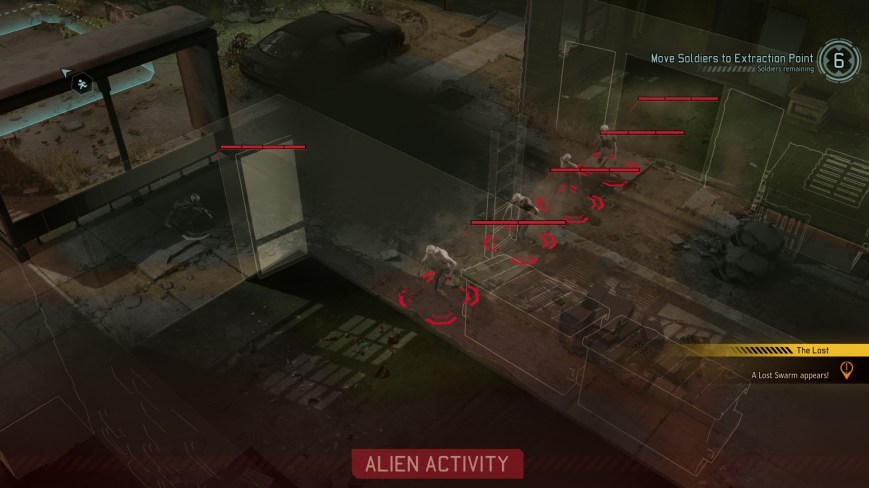
20170913192757_1

1 of 4 swarms this mission

The neat feature here is that if you successfully kill one you get a free action back.  That’s useful when you have a rather large squad, with solid aim and a lot of ammo.  I have very little of that at the start of the game.  Aside from one guest character (sniper) everyone is at 60-70% aim chance, even at point blank.  Those aren’t exactly top odds.  And grenadiers only have 3 ammo –  another resource that needs to be managed.

The good news is that I have grenades.  Lots of grenades.  And each does enough damage to take out a Lost, but I don’t get the action point back.  Choices.

I forgot to mention that Lost are attracted to noise, so the more noise you make, the more swarms come towards you.  Even more fun.

All told, I killed a few dozen enemies in that set of maps.  Thankfully it was all Lost and no other types.  A solid mix would have made it a pile of pain.  It was certainly an entertaining set of mechanics, feeling more like “horde mode” from other games.  I’m quite curious how that will work out in later missions, where ammo isn’t so scarce, and my aim% is much, much higher.

XCOM2 – Return

I can still clearly remember playing the original XCOM back in high school.  I was completely fascinated by it.  The computer I had at the time didn’t have a working mouse driver, so I had to make one.  I was a little nutso for it, and still get chills thinking about Cydonia and losing nearly every member of my squad.

Terror from the Deep was the original on steroids.  Apocalypse was a try at real time battles, with an interesting take on city-scape management.  I skipped Interceptor, and Enforcer, and I was looking forward to a future entry – but they were all cancelled.  The XCOM reboot in 2012 happened 17 years later. It had some flaws but overall was a solid game.  The Long War mod addressed a lot of them, and brought back the strategic play from the first game in the series.  I never had a chance to finish it though.

XCOM 2 was a significant step forward.  It used the same engine, sure, but the tactical combat was much improved.  Melee was viable, as was stealth.  Ship combat was finally gone.  Maps were better designed.  More mission types, motivation to move out of the Overwatch syndrome, and generally improved chances to hit enemies and be missed.  It felt harder as well.  The psionic portion was a little too weak/late for my tastes, though the steam workshop (amazing mods!) fixed that pretty quick.  I played through twice and had a pile of fun.

The DLC never really took my attention.  Alien Hunters lacked balance, and Shen’s Last Gift added Mechs, which couldn’t take cover.  Long War 2 was released but since I never finished the first one, I didn’t really see the need.

War of the Chosen recently came out and that’s a heck of an expansion.  New enemies, new classes, new maps, new objectives, new weapons, new mechanics.  There are negative traits for characters (like Darkest Dungeon).  There are rebel factions to join with, zombie hordes, as well as bonds between characters that increase their skills.  I’ve seen sequels with less content.

So far, I’m a few intro missions into the game, trying to remember what I did last time.  Grenades are still your best friend for low levels, given that they 1 shot weak enemies, and break cover.  There’s nothing worse than an entire squad missing an enemy 4 spaces away.  I’m quite excited for this playthrough!

Dishonored 2

I picked it up during the summer sale.  Haven’t really put a lot into it yet, or at least it doesn’t feel like I have.  I picked Corvo and I’m up to mission 4 – the clockwork tower.

I really liked the first one.  There was a lot of freedom of movement, and you could approach nearly every mission from multiple angles.  There were only a few “hard walls” that required you to take a different path, and after about half of the game you had all the tools you really needed to move forward.  I played relatively safe, with only a few kills.  Plus the art/style was neat.

Dishonored 2 is different.  The skills are similar enough, two for movement, the rest for attacks.  The teleport/pull skill works well enough, making some portions easier to move through.  The shadow walk skill is less fun, since it changes your view point, slows you down, and enemy suspicion seems inconsistent.  It does allow passing through grates, bypassing some sections, but rarely to any benefit.  The art is still really solid, and the story/characters are better than the first.  Atmosphere-wise, it hits all the right notes.

I am not a fan of the map layouts.  Rather than have multiple paths that meet at certain points, this one feels more like a maze of dead ends.  There are generally less enemies, but there are more locked doors/paths, forcing your hand at specific puzzles.  I would rather entirely avoid the 3 guards than try to distract/stun the bunch and run through in shadow form.  There’s one part in the clockwork mansion where you slip between floors then are given 5 paths to take.  Two were locked, 2 were dead ends, and one was the way forward.  I must have missed something there.  I also seem to spending a very large amount of time in buildings, rather than outside of them.

I also dislike the clockwork robots, since you can’t take them out with stealth moves and they hit like a truck.

Exploratory/stealth games are measured by player failures.  Your ability to recover from a mistake.  I may just be worse at it, but I find myself reloading a lot more here than I ever did in the first game.  I really like trying out new ideas/paths and seeing what happens.  I just find that the timing is off and some places are designed for a single (or minimal) solutions.  It feels as this is a rogue-like game more than an exploration game.

I don’t necessarily regret the purchase, it’s just not what I had envisioned.  I’m sure I’ll end up completing it at some point, but over a larger span of time.


How Long is Too Long a Grind?

My answer in 2017 is much different than it was 20 years ago.

Diablo 3 is the simplest example of a skinner box at hand and I am playing it in spurts.  Pretty much every game today has some form of “grind” within in order to artificially extent the end of the game.  Most are built on the concept of logarithmic power curves – that is, progress at the start is much more pronounced than at the end.

D3 has this in spades.  It takes relatively little effort to be able to clear T6 content.  A fresh player may take 4-5 hours.  An established player can get someone from 0 to T6 in about 20 minutes.  Getting to T10 can vary, depending on rolls for gear and some luck.  Let’s say another 10 hours or so.  T13 is another ball game, as it required near optimum pieces of gear and rolls.  Not only do you need the proper item, you need it with the proper stats.

For example, for one build I am trying, I need to equip a Ring of Nailuj Evol.  This ring has never dropped for me, and I’ve seen hundreds of legendary/set rings by now.  I had to craft around 500 to get 1.  And rings can roll pretty much any and all stats, whereas I need 3 core – crit hit chance (1-10), crit damage (10-50), and a socket.  I can make due with 2 of the 3, since I can enchant another part.  If I don’t have those 2, then I need to actually re-roll the item entirely.  That requires Bounties (clearing 5 quests per act, for a total of 25).  Each Bounty clear allows me to reroll twice (at T10).  It was about 30 runs before I had the 2 minimum stats, and each run is 15-20 minutes.

That was for 1 piece of gear.  I have another ring, an amulet, gloves, and a weapon that are hyper dependent on stats, all pulling from a large pool.  I’m drawing the line at 30 hours here.  I may hop in here and there, but I think my D3 time is done for this season.  Can’t really complain for 30 “free” hours of gaming!

I’m finding that diversity of grind has an impact on me.  Seeing the same stuff non-stop, pressing the same keys again and again, that’s not much fun.  WoW’s legion invasions and activities kept me going a whole lot longer than I had expected. I stopped WoW not for the grind but because I had done all the content I cared to do, and maxed all that I thought useful.

I am not against that grind.  I understand why it exists – content locusts are all over the place.  Heck, I spent weeks camping the boots in EQ, and I raided in WoW for extremely marginal gains for a long time.  I’m certainly not asking the game to change, more than I am realizing that my threshold for the grind is so much lower than where it was before.

I am trying to keep up to date on the Destiny 2 news.  I know what’s involved, I’ve seen enough streams.  I’ve read numerous places that the end-game activities are lacking, which is the main reason I’ll be looking at the PC version rather than PS4.  I’m somewhat hopeful that the staggered released approach will be mostly completed a month from here.


Gaming is Learning

My eldest (and youngest to some extent) is bitten with Pokemon.  For kids that age (7), cards are relatively cheap, and there are plenty of books with neat pictures and stories.  There’s the obvious Pokemon Go, but there’s also the TCG mobile game.  And of course, what seems like 20 years of animated shows with Ash & co.  What is fairly interesting is that due to Nintendo’s all-gamers approach, the entry level for these games belies a more complex system.

TCG games as whole are predicated on the concept of deck building.  Either you play a preset deck, or you actually build one by hand.  For now, the kids are happy with just a random deck that I throw together.  I mean, no sense in having Fire Pokemon in a Psychic deck… Once drawn, the card plays are fairly straightforward.  Add energy, run an attack, draw a card.  It is hard to make a mistake, even with semi-random choices.

But then you start paying a bit more attention to the cards.  Some have resistances, or skills that work better on other types.  You start adding and removing some from the deck, piece by piece.  Eventually you realize that some cards are just not fun for you, or that they interrupt your play.  You realize that more cards means more chances, but it also means giving up other items.  Now you’re talking probabilities.

I’ve experienced this myself, when I had my first set way back when.  I thought Magic was way too complicated/expensive for my tastes (still think so) but wanted some sort of TCG experience.  It was fun learning the inner workings of the game.

Now I get to see that again in a kid’s eyes.  It’s small at first, tiny little lights going on.  Then it starts snowballing.  They become comfortable with the concepts.  Then they start sharing them with others.  Then they start looking for similar tactics in other games.  It’s really quite amazing to watch curiosity at play.