MMO Economies – Sinks & Drains

The previous post in the series went over a high level view of economies and focused primarily on the taps (system generated wealth), the transfer of wealth and the patterns/tools that enable both.  This post will focus on the other end of the equation, spending.  This is accomplished in a few methods, but systematically through sinks and drains.

Down the drain

A system drain is one that is pervasive to all players.  It’s always there, always active.  Very few games have effective drains as it’s a continual upkeep.  F2P games have drains, where there’s an energy cost to perform an action.  Repairs are sort of a drain but if you avoid combat, it doesn’t matter.  EvE’s clone system is a drain but if you never die…

Sinks are targeted for activities that remove wealth from the system.  Auction house fees are the most obvious example and the easiest to measure.  Repairs, housing upkeep, crafting, travel fees, NPC purchases (like training and mounts) are all sinks.  There’s a baseline sink, based on assumed wealth at a given time.  This is strategic planning, where you decide if you want the sink to be an inhibitor to progress or simply an afterthought.

So shiny!

WoW is a solid example, given it’s age.  In Vanilla, mounts were available much later in the leveling curve and unless you were penny pinching, odds are you couldn’t afford one at level.  When you saw someone with a mount, it was prestigious.  As the game progressed, and the monetary barrier went away, everyone had a mount.  Eventually Blizzard reduced not only the level requirement but it made the cost a fraction of what it was.  A sink of 100g for 7 million players to a sink of 10g, is an order of magnitude.  Prestigious mounts in WoW today are acquired through achievements and boss kills, rather than outright cost – with a few minor exceptions.

Sold!

Auction house sinks are the most common and related to real life.  A vibrant AH community will flush out millions of gold per day.  There’s a catch here, where an AH has or does not have a posting fee that is non-refundable.  In the latter case, the AH actually acts like a bank and misses out on a massive sink.  It doesn’t have to be a large posting fee.  RIFT at launch didn’t think this part through and their non-refundable fee was much too high and it prevented a market from opening.  It should be large enough to pull money out of the system but small enough that commodity sales are not negatively affected.  

EQ1 didn’t have an AH for a long time.  It suffered from massive inflation, where an item would increase in platinum price on a near hourly basis.   The Bazaar came in, and while it wasn’t ideal, it drastically reduced inflation and made the game much more accessible to new characters.  AH design, or wealth transfer, is the heart and soul of an MMO economy.  The better thought out the toolset, the more responsive and intuitive, the easier it is to control the economy.  I’ll get into this in another post.

Kaboom!

Item loss is a great money sink.  Outside of UO and a few smaller sandbox games (SWG of a sort),  the real prodigy here is EvE.  Darkfall, for all Syncaine’s rumblings, does not get the concept of an MMO economy.  Items in EvE take time and money – sometimes lots of both.  A Titan will take months to build and to buy.  Losing it has a massive value, emotionally as well.  But the smaller crafts, they have value too.  And because EvE has a net-loss system for PvP (where you always get less than what’s available at the start), there’s a constant drain on all resources.  In most MMOs, the Uber Sword of Awesome only gets replaced when you find the Awesome Sword of Uber with better stats.  It then makes all the previous content obsolete and useless to the economy.  If there’s always a chance at item loss (which is an entirely separate discussion) there is much more trade, and therefore more drain on the economy.

If you build it, they will charge you

Housing and player customization is my absolute favorite money sink.  It is 100% optional and can have some crazy fees attached to it.  Prestige/comfort/individuality are traits that align very well with people who have a lot of wealth in the first place.  A person doesn’t buy a 100,000g mount for practical purposes, they buy it to show off.  Same with a house and costumes.  Where player customization has a one-time cost, per item, item acquisition is constant.  Housing also has a bunch of one time fees (smartly they should be upgrade costs on the domicile, instead of entire new plots of land).  It also should include an upkeep cost, comparative to the value of the house.  A shack should cost X, a cottage filled with items Y and a castle with butlers Z.  If you can afford the upgrade, you can afford the upkeep.

To sum

Sinks and drains are designed to keep inflation in check.  They are there to systematically remove money and counteract the system taps.  When there is a lack of balance between the two,  money starts to lose all worth for older players.  It does however make new players start at a massive disadvantage.  If the average player is sitting on 10,000g and a new player can only acquire 1g per day, that’s a pretty big hill to climb.

Few games launch today with adequate understanding of MMO economies.  Many look to WoW and try to copy today’s implementation, which has gone through 9 years of refinement and inflation.  WoW today is not a good example of an economy.  It will take some smart people to fix that gap.

MMO Economies in 3 Easy Steps

I have an unhealthy passion for numbers. Spreadsheets everywhere. This covers my gaming habits – at least the more complex ones. I map out strategies for Starcraft, scribble trading notes from a small town and run giant spreadsheets for MMO gold making.

The next series of posts will focus on MMO economies and covers the inputs, outputs and systematic requirements for balance. It will focus primarily on PvE, since there are very few PvP games to use as examples outside of EvE.

Let’s get started.

Economics has two major fields: macroeconomics, the study of systems as a whole and microeconomics, the study of individual markets. Few people get either of them but most understand the basics.  Interesting fact – if you’ve ever written a personal budget, you’re in the top 10% in terms of financial management.

Open That Tap

At a macro level, MMO economies function on a tap/sink model. The tap is how much money the system generates and the sink is how much it takes back. Most taps seem small at first but due to scaling factors, pump in tons of money.

Let’s take a 1 hour play session as an example. You complete a few daily quests for 25g each, collect some materials for 2g each, kill some enemies who drop 1g each. In an hour, without actually trying, you’ve made nearly 500g. This is what I call easy money in that everyone has access to it with zero skill required. It’s also a constant flow, so that the available money in a system (the total across all players) is continually increasing. WoW, growing at 500g per hour, generates about 300,000,000g per hour across all characters.

I Can Eat Air

Still in a macro view but now focused on wealth for the playerbase, the large majority of money is found on only a few players. This is due to a very low standard of living cost. For a typical player to consume the game, there are some minor hurdles – typically reserved for travel and repairs. This is a true pittance, somewhere around 20g per hour, in bad cases. They don’t actively need more money so they don’t think about getting more. That’s where the moneymakers come in – people who make money just to make money.

On a good day in WoW, I could make 50,000g from the auction house – one day it was 300,000. I made 10,000g per day from Rift and more Astral Diamonds in Neverwinter than I knew what to do with. People that didn’t need/want the money, didn’t pay attention to markets and I made a killing.

Buy Low, Sell High

Macro view once more and this one deals with patterns. Did you know Tuesdays are the highest profit day in an MMO? That Saturday nights are the best time to buy? It has to do with player logons and priorities. Weeknights have less people who have less time. They are more focused on getting things done, like raiding. Weekends have tons of people and the market is flooded. People just post items, dropping the price by a penny each time. I did this in Diablo3 to test a theory on gems. Started with 100k and at the end of the month had about 150,000,000. Expansions are good too, where people are leveling up new characters. Farming low level materials for a few weeks before, then selling them at a huge markup makes a lot of money.

Crafting

Crafting is more micro-economics, in that you move wealth from one person to another on the basis of time and it’s highly volatile and specific.  “I don’t have time to make this, I’ll buy it”.  The “ore shuffle” dance being the exception, no system generates more (a tap) from crafting.  If items are not consumable/destructible, then the market gets flooded and the floor drops.  Glyphs in WoW are a perfect example.  In LK, they were consumed upon use, then in Cataclysm you only ever needed one.  PvP games are much better at this type of market.  The recent battle in EvE had a $300,000 opportunity cost and people will want to replace what was lost.  There’s a real market here as there’s a real cost of living expense.

To Sum

In all games, there are system taps that put money into player’s pockets.  Some systems make it easier than others.  Given a general low cost of living, most people don’t even think twice about economies.  Games that do however, be it with large sinks, PvP costs, housing maintenance (all in the next post of the series) make players much more conscious about the economy.  Finding the proper balance between both is key.

When There’s Nothing to Lose

Massively may not be the best place to read about MMO “news” but it tends to have a decent touch on the gaming pulse.  Eliot may not be the strongest writer but he tends to have a more realistic approach on all his posts.  They aren’t optimistic or pessimistic, just grey.

So when he write about the TESO beta being ho hum – adequate but nothing special – the comments start flooding in.  I will say that keeping expectations in check, that TESO isn’t trying to revolutionize the MMO world, just expand on it, is a solid message.  It should temper expectations a bit.

That said, the kicker in all of this is that the NDA is still up for non-gaming press.  Opinion pieces have to be gated by Zenimax/Bethesda before being posted.  Players, in the beta and not, have no such limits and it’s next to impossible to moderate all of them.  You essentially have a forum for 800 people to say whatever they want, semi-anonymously, and no one can really attack or defend any given point with proof.

If you break the NDA, as a gamer, the worse that happens is that your beta access is revoked and likely your TESO account.  If you aren’t planning on playing more beta or getting the game, then there’s absolutely nothing lost.  Those that like the game and want to continue in the beta (or get into more than just weekends) can’t do much without risking getting booted.

That said, TESO apparently is selling well enough.  It’s #2 in the Canadian Amazon listing and #7 in the US.  The value of the latter is questionable if Path of Exile is #1…  Any way you look at it, there are a lot of people with a vested interest in this game.  That’s a lot of potential positive spin.

Skill Gap

In every game designed, there is always a threshold of skill required to complete a given task.  In PvE games, that bar tends to be rather low as it’s a static bar for all players.  For example, the leveling portion in nearly all MMOs is rather simple and hard to have issue with.  PvE end-game, different story we’ll get into.  PvP games are a different beast as player skill is extremely dynamic and can be influenced by many factors.  I’ll use StarCraft 2 as an example.

SC2 campaign is a PvE single player game, with a relatively low default skill threshold.  Nearly everyone should be able to complete each mission, given enough time.  SC2 vs bots (or training) has a much higher skill level, where your actions per minute (APM) need to be above a certain level to compete – round about 100 or so.  PvP has all sorts of levels of skill but the truly elite are around 400-500 APM.  So think about how people play on the normal campaign and that they’d need to be 4-5x faster in order to be elite.  That’s a skill curve – just with a concentration at the lower end.  You find people at all levels of skill but most are under the 100APM.

Skill gaps occur mostly in PvE content, where there is a gating mechanism of some sort for progress.  Patchwerk in WoW (Vanilla first) was like this, where the only hurdle was getting your DPS number high enough.  Too low of a skilled player (much more so than gear at the time) and you couldn’t progress.  This far, no further.  Oddly enough, later in the same raid we had a second type of skill test.

Heigan was a nightmare for many players as movement was not required by any class other than tanks at the time.  Ranged attackers could rarely move and attack, melee just stuck to a boss’ butt and barely looked around.  This one battle could be completed with absolutely zero DPS skill but needed pretty damn good movement coordination to complete.  Keyboard turners (those that use WASD to move) hit a massive skill wall and progress ended for a while for a lot of people.

I’m not sure if people remember but the Firelands raid had some extremely interesting progress statistics and pushed the launch of LFR.  Most guild cleared the first 2 bosses, then there was a massive drop of progress.  Heroic Ragnaros had a <1% completion rate a full 5 months after being made available.  LFR came out with a super low skill level and today you can clear all of MoP’s content in a week or 2.

RIFT went back to a more aggressive situational awareness, SWTOR did a bit with it but let it drop due to a low top-end skill. FF14 decided that AE attacks were going to be tough again.  A single dragon breath could knock off 90% of your health.  Each Titan battle has a single part of the fight that if not executed properly guarantees death.  I’ve mentioned a few times how I thought that was an ingenious way to retain players but pushing others away.

If the players who reach max level have been through multiple skill trials, then odds are they are more likely to integrate into the high end skilled events.  Quick compare.  My 3 year old could level up to max in WoW.  She would be unable to do anything once there, outside of pet battles.  Assuming ALL skilled gamers have tried WoW by now, the only available new market are people like my daughter.  FF14 my daughter wouldn’t be able to hit level 10.

When I look at TESO and WildStar I really start to wonder.  TESO, in my limited experience and the videos we’ve seen, has a rather low skill level requirement.  PvP is perhaps (hopefully) different.  WildStar however, what with the twitchy OCD mechanics appears to have a rather large skill level requirement from the start.  How this translates to later content is a mystery.  PvP has some interesting implications though, in that understanding circle-strafing is important.  The game really does not seem to favor keyboard turners.

In the end, this would seem to give TESO the larger broad appeal.  Lower skill level means more people can play and progress.  WildStar already turned some people off with the art, and the combat appears to favor an uncommon skill level.  I personally think that the former is not sustainable from a vision/resource perspective, unless they actively communicate their developers intent.  SWTOR is a fairly good example of how this can go wrong.  WildStar, with an admittedly (and oft communicated) focus on a more skilled game, will necessarily attract less people but likely retain more.

But that’s just my opinion.

NDAs vs Betas

To continue my thread of NDA discussion, and related to the comments those posts generated, a few more thoughts come to mind.  First, a dev quote relating to why more people aren’t in the WildStar beta.

Some quick answers:

a) We’d rather have the game be as ready as possible before most people see it. Now, it’s pretty ready in many ways, but we still have work to do: Overhauling UIs, elder game testing, etc. etc.

b) The pent up demand is pretty extreme, honestly. I won’t mention signup numbers in case we want to do a press release or something, but: Big. We don’t have anything like the hardware ready to handle it yet.

c) We’ll open up more mass exposure and testing during different phases of beta going forwards as well – we need the 24/6* testing everyone’s getting now . Why? So we can have people legitimately make it all the way through the levelling content and test the elder games with context. But not every stage needs to be like that; some will be aimed more at giving people a taste of the game so they can buy it or not with full info.

(*we shut down the servers on Mondays to incent everyone to come talk with devs on the forums)

Still here?  Good.

NDA’s protect assets that are unfinished.  While betas provide access to unfinished material, they do so gradually.  Pre-alpha is usually the devs, alpha is a closed knit of testers, beta is a significantly larger pool who “stress test” a particular feature to find balance/bugs and provide metrics to the developers.  Open beta is nearly always around final polish and stress testing.

Taking that into consideration, at which point is a developer comfortable opening the kimono?  If a vendor has an NDA and they are offering a collector’s edition and few specs around their product, a veteran player is going to be skeptical.  EQ:L sales are going to be indicative of what a NDA/pre-buy combination looks like.  I would expect sales to increase now that the NDA has dropped.  TESO has likely hit critical mass when it comes to pre-orders, until the NDA drops, when a new spike occurs.

If the NDA only drops a few weeks before launch, does that not cause a rather large lull in potential sales and a super spike at launch?  It certainly makes it difficult to plan server capacity for launch day if you’re unable to judge interest.  I understand this problem from the past, what with box sales dominating.  Today’s Steam mentality, where you can buy digital copies should provide more than enough metrics to accommodate launch.

Having and NDA makes sense if there are parts of your product that are under design review.  You want to control expectations.  Lowering the NDA means that you’re likely in polish mode for that feature.  It provides positive (hopefully) hype for your game and will likely drive sales.  Staging beta by features also makes sense.  MMOs are massive and opening the entire thing to the world early on doesn’t provide a whole lot of useful feedback.

I am arguing that the timing of an NDA drop, relative to Beta status and release window is a significant indication of the health and quality of a product.  The longer that curtain is up, the more pessimistic people become.  The timing of the drop is important, so that the positive spin and hype can be ridden right up until launch.

Space is Big

Pre-amble.  When I met my wife, she said to me that stars were essentially space rocks that reflected light from our sun.  I laughed and then I realized she was serious.  Astronomy gets too little attention compared to astronomy.  I’ve been trying to explain the cosmos to my eldest daughter, just shy of 4.  My goal is to have her have a passion for the sciences rather than a fear.  The absolutely hardest part of explaining space, is the actual space between the things.

You’re thinking, what does this have to do with gaming?  Well I’m here to tell you.

Sid Meier has stated that “a game is a series of interesting choices”.  I would expand that to say that the pacing of said choices has a large impact on quality.  If I gave you a bunch of interesting choices, every 10 seconds or a game that gave you the same choices over a week’s span, your experience would be vastly different.  D&D exemplifies this where combat can take a few hours, where if it were digitized, it could take a few minutes.  The path between those choices, shortened, provides a different experience.

I played Earth and Beyond with a few friends back in the day.  I would venture to say that it was a pre-cursor to EvE, in terms of particular design elements (namely the social/trade aspects).  E&B was big, very big in the day.  EvE is even bigger.  Wilhelm has stated a few times that there’s more time (and fun) getting to places that actually being in places.  Star Trek Online provides a smaller space, a compartmentalized one at that.  But you still spend more time travelling that you do in other games.

intensity

This “waiting” or travelling period provides a lull in content.  Sort of like the camps in EQ where you waited on a spawn, or using a griffon to travel in Vanilla WoW.  If everything is on fire, then nothing is really on fire.  A good example is XCOM vs Battlefield.  The former spend a lot of time in the travel space, waiting to unlock a battle, or strategically placing your players.  The actual act of taking a shot is less than setting up the shot.  Battlefield is the near opposite, where it’s shoot the bullets with more bullets.  The type of player, and I am speaking generally here, that enjoys a steady stream of action vs one who prefers a nuanced experience is massive.

I want a world to feel big, that the space has meaning and purpose.  I don’t want it to be a highway to the next decision.  I want to be able to finish a decision and then just be amazed at the world around me.  To remove tunnel vision and say “look at that!”.  That’s why devs are putting all the time and money into it, right?


I Gave Cryptic Money

No surprise here, I think Neverwinter is a great game.  Many people don’t and that’s great too.  I comment a fair bit that it’s amazing that we’re in a time where there are more games for more flavors than just a few years ago and the WoW-clone-a-thon.

Neverwinter’s F2P model is slightly different in the MMO space as it was designed with two things in mind.  First, it’s a western MMO, where combat is an integral part of the game with a relatively small social toolset.  Second, it was designed as F2P from the start, based on a lot of experience from Champions Online and Star Trek Online.  The only knock I have against their model is the constant spam about people “winning” items from lockboxes.  Peer pressure and all that I guess.

You can play Neverwinter from start to finish without dropping a dime.  Your experience is not diminished in the least.  You can play the end-game content without money too.  The auction house works with Astral Diamonds, which are fairly simple to acquire.  Zen (the unified Cryptic currency for real cash) allows you to purchase player customizations, such as respec tokens, other companions and mounts.  Oh, you can also trade Astral Diamonds for Zen.

Respec tokens are useful but not something required to play.  Pick a spec and have fun.  You shouldn’t really be swapping between choices all that much, given the large “point padding” provided.  You can get most skills you would need pretty easily.  Plus, if there’s a patch with significant balance changes, free respec!

Companions are a bit different.  For leveling are the start of end game, they are relatively bland choices and have not much impact. If you want to do top-tier gaming, then a zen-cost companion does have some benefit.  Not much mind you, maybe a 5% difference, so only the min-maxers really care.

If you want to fool around with costumes, then Zen comes into play and that’s super.  Player customization is entirely optional.  Mounts too, since each zone is relatively compact and the difference between a basic 60% and a 90% mount is pretty negligible on the whole.

So what did I spend?  I put in $30 for 3,000 Zen.  It gave me a new character slot and some customization.  If this had been a sub game, I would have spent a lot more than $30.  This way, I can come and go and feel that I am the one deciding where to put my money and when I can play.  Would I have subscribed if that option was available?  If that would have unlocked everything and there was no store, most definitely.  However, even games with a hybrid model offer a store, which drastically reduces my enjoyment.  SWTORs non-sub hurdles are notoriously bad, as an example.

So yes, I support Cryptic’s F2P model for Neverwinter.  I think it’s one of the most “fair” implementations I have found in any online game.  Marvel Heroes follows a similar model, in terms of lack of real restrictions.  I’m kind of hoping that this style takes a hold across more games.

NDA’s Are Bad

Let’s say you have a new product coming to market.  You budget about 10% of your overall budget to PR.  That’s a fair chunk of change on a $100 million project.  Now let’s say you realize later on a few things.  You have something that exceeded your expectations and you think there’s solid interest.  You also realize that your PR budget allocation wasn’t well allocated, in that what you spent didn’t really get you much or that you spent the money elsewhere.

Today’s internet is exponentially more interconnected and fast than 5 years ago.  I get a dozen tweets a day, multiple facebook posts, tons of feedly, a sub-Reddit and then the old school emails.  I can watch a stream on twitch or a series on youtube, with voice commentary.  What a team of 10 can do for a company pales in comparison to what 1 person with social skills and a solid social network can do (e.g. the Lazy Gamer comes to mind).

You know what NDA’s do?  They protect assets from espionage (no really, that’s what they are for).  The end result is that any word of mouth becomes basement driven and usually negative.  People are much more willing to be skeptical than trusting, certainly without evidence.  One post that says “stay far away” without content to back it up will do more damage than a PR video showing combat.

NDA’s today serve a single purpose in the minds of gamers.  They hide bad games from the masses until launch.  Aliens – Colonial Marines is a prime example.  Movies that do not have critic screenings are the same (R.I.P.D. is a recent example).  You either are confident in your product when you allow people to test it or you are not.

That brings me to the elephant in the room.  EQ Landmark dropped their NDA yesterday upon launch of alpha.  Alpha is before beta and always lacking polish.  But given that it cost $60 to get into alpha, they know everyone wants to have a good experience, so they are likely to talk about it in a positive light, even if there are bugs.  This is a really smart move because you now have a few thousand people talking about your game and generating hype. WildStar is driving me mad with their player streams because it looks just like the game I’ve wanted to play for years.

If TESO doesn’t open the doors this coming week, or Bethesda doesn’t start with a massive PR blitz, I have a strong feeling that they are going to get swept under the rug.  My Feedly on that game is near dry right now, and you know it’s going to fill up with EQ:L soon.

The Mobile Basement May Not Yet Be Found

Not making this up, but this post appeared in my feed. Video has profanity.

Related to my previous post, the video and post quite accurately highlights the problem with high profile F2P mobile games.  It’s really quite sad.

I would be highly curious as to who in their right mind would pay for the “value price” for gems/coins/mushrooms/whatever.  Are there really that many people who would pay money for that sort of thing?  Apparently the answer is yes as games like this get made.

The final quote is pretty solid.  You can either spend that money on a full price game, with no sales, say BioShock Infinite, or you can destroy 56 blocks in a mobile game.  Hell of a choice.

Dungeon Keeper and Gamification

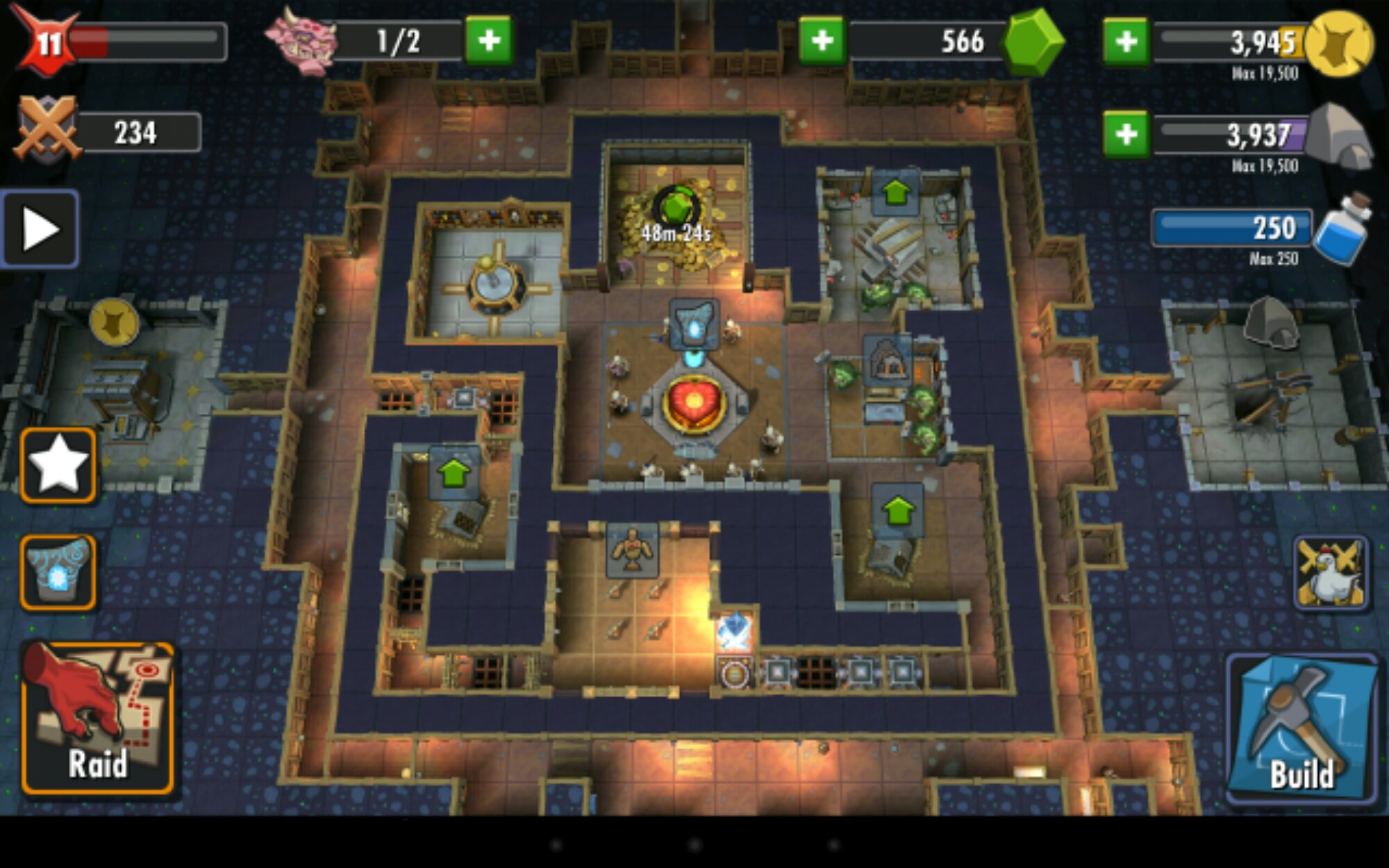
Last told, I installed Dungeon Keeper on my tablet to give it to the man.  The man being EA.  DK is in the same vein as all the other Clash of Clans clones – though I’m not sure anymore which came first.

Anyhow, the premise is simple.  You have a base, you can build things on the base to increase your offense and your defense.   You can summon a squad of monsters to attack other players (offline PvP).  Everything is managed through 2 main resources.  Gold and some alternate.  In DK, this is stone.  All items can be upgraded, which takes time and a minion of sorts.  You buy more minions with real cash.  Most games start with 2, then give you a 3rd one after a few weeks of play through alternate means.

Upgrades are the meat and potatoes of this game and where the real world cash impact occurs.  An upgrade can take 5 minutes or 2 days, and you can speed it up.  You should be spending money for time not for anything else.  At least, that’s the defacto model for these types of games.

The other resources work on a balance approach.  You can harvest them on the base, typically at a decent enough rate to pay for a low level upgrade in an hour or so.  The start of the game is usually pretty quick, to get you into the meat of it all.  You can attack other players, but that’s usually not forced for the first 2 days.  Raiding others typically returns enough materials to equate to 10 or so harvesting hours.  You just have to be strategic of your targets and your minions.

EA being EA, they went a different route.  There’s a tutorial (in all of these games) that lays out the basics and sends you on your way.  Typically after the tutorial, you can play for a solid hour tinkering around and then come back every 30 minutes to tweak some upgrades.  It keeps you interested.  EA decided to end the tutorial against a money wall.  You harvest ~100 resources per hour and the first upgrade is 5,000.  The second is 15,000 and the third is 50,000.  My harvesting spots are at their current maximum level without upgrading the “heart” of the base.  They take 10 hours to make 1,500 resource each and the upgrade in the middle is 50,000.  That works out to 60 hours of waiting.

image

Raiding other bases doesn’t work much either, since they are in the same boat.  A solid 90% of the bases are under 1,500 resources each.  It costs me about 1,000 resource to get those.  At best I make 500.  Out of 50,000.

And I won’t get into base redesign, where the largest and most important part of your base cannot be moved.

I think it’s pretty funny that they could have taken a direct copy of any of the dozens of Clash of Clans clones, used the exact same mechanics and provided a better game.  I mean literally, cut and paste the system but change the art.  Zynga would not have messed this up.

Way to keep up the good work EA.