Thar Be Trolls

As long as the interwebs have existed, there have been trolls. Shielded by anonymity, they wreak havoc on a community and you can often find the trainwreck on forums.

Reddit has a very interesting way of dealing with trolls. It’s a democratic system that downvotes into oblivion. The truly bad cases are PM-ed to the nth degree. It’s hard to find a post that’s been on reddit’s top list that doesn’t have at least one deleted account posting. So, social tools ftw I guess.

Game forums are, by and large, based on the old phbb forum. You get a post count, stickies and the ability to ban. Even the largest game on the planet has notoriously horribad forums. 

Enter some contenders. LOL has a tribunal system where the really bad people go, based on warnings/votes. XBONE has a 3 tier system based on reputation scores, with more or less a hell layer for the worst offenders. These systems work well enough as the games typically cater to small set of players, 5-50 and the games are relatively short.

MMOs are long and contain thousands of players at once. Other than building a dedicated server for bungholes, the penalties are all related to time-outs or outright bans. To further complicate things, the in-game activities are not usually linked to the forum posts, where the trolls have the largest audience.

Trion is trying something new in that the actions on the forums carry the same weight as in-game. You can potentially be banned for forums activity. Time will tell if it works. Reaction is mixed and I think that has more to do with a culture saturated in trolling.

Respawn has a post touting the right of free speech and takes to a logical extreme the courts have outright rejected (at least outside the US). Freedom of speech gets you just far enough to where the other person’s rights begin. You’re certainly allowed to say what you want but you have to be ready to live with the consequences.

To be quite blunt, games are miniature societies who have their own rules. You don’t have to play them, there are hundreds to choose. If you want to be an asshat, I’m sure EvE is looking for more players. If you want to be a part of a society, then you play by those rules. If that society judges (and that’s the most appropriate word) that you are more a hindrance to them then a boon, get ready to be cast out.

The concept of individual rights superseding those of society is a separate topic and way too political. Depending on your location on our planet, the answer changes drastically. For games though, they are on the internet. And the internet is getting mighty good at fighting trolls.

Fun Times

Oddly enough, after a few rounds in the TESO beta and some postings around, I’ve more or less come to the conclusion the game is a mashup of GW2 and TSW.

And I have a massive dislike for GW2, hence my issues with TESO. PvP has no value for me in MMOS, outside of filler content. The simplistic controls and lack of class structure make for a bunch of monkeys on keyboards. I’m sure people love it (Bhagpuss sure does) and I do like reading their stories – but they are their stories, not mine.

That leaves TSW and the other half. I played at launched, played at B2P and a few other times. Each time I left was due to other commitments. Summer breaks, holidays, work hours and so on. My fallout from Rift is quite parallel. Reading my RSS feed of late and seeing the Monday night crew in TSW, I wanted to go back and I did.

Apparently I had a full roster of characters too. I wanted a fresh start though, to see with a new set of eyes. Plus I wanted to keep my nickname (going on 20 years using Asmiroth now) so I deleted my old guy and created a new one. Templar on Arcadia.

Off to Kingsmouth, to live the nightmare.

TSW has 2 unique properties. First is the lack of levels and rather a system of skill points and skill trees. It’s complex due to skill synergies but if you pay attention, it’s a whole lot of fun. Plus I like Meta. The second part is quests.

Quests in most MMOs are a means to an end. Either the reward is the prize or the destination is. I have a new sword or I’ve found a new zone. No one pays attention to the quest itself. TSW is different in that the rewards and negligible. The quest itself however, is multi stepped and complex.

For example, one quest had me chase down boxes of eaten squid to reach a big bad guy. No quest trail, no arrows, just me looking at the ground. Another asked for zombie body parts (like slow and dry) so I had to find them. They were not very close to the quest giver.

Investigation quests are mini sleuth exercises. While on their own they are fun (you can cheat but it’s way more fun to give it a shot) they really shine in a group. I tagged up with Septakill for some other quests and we fell on this murder investigation. Went to city hall, found some records, went to prison and talked to a ghost, looked at a wall (which was oddly the most complex part) and followed some pigeons. The pigeons were the best part. 7 of them, each saying a different thing. Based on the clues given previously, you needed to touch the pigeons in a certain order. Each of us took a few stabs at each step and it was a lot of fun figuring it out.

The second breadcrumb

Long story short, I remember why TSW hooked me previously. It’s an experience rather than simply a game. You feel a part of it. Skipping quest intros makes no sense because that’s the point of the game – to be a part of the mystery. If ever you’re around, feel free to send me a message.

Sounds Like a Dare

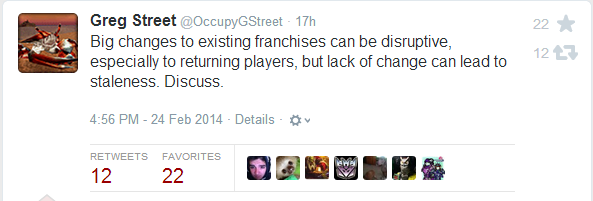
Greg Street had the following tweet recently.

gstreetdare

That really does sound like a dare more than a discussion, as it’s the core of many rants.  Still, dare accepted.

I am going to assume that he relates to WoW and his tenure but it also applies to other franchises.  Sure, CoD has made a bajillion dollars on an simple formula.  GTA and Assassin’s Creed are in the same boat.  Tomb Raider has seen multiple iterations, mostly crud for recent years until the last reboot.  Final Fantasy, ever the iterative franchise, has found glory and shame for nearly 30 years.  It’s hard to debate that the original FF14 was a positive step, or that any of the FF13 games were solid.  Diablo 3 and Starcraft 2 took two wildly different approaches – which would you call successful?  But we’re talking about separate games within a franchise stream, not the same game.  A separate game should take risks, there’s a transition break between them for players.  Mass Effect may transfer saves between games but the experience between the 3 is not the same.

When Greg talks about franchises, I see it more more along the lines of a single product.  Expansion packs and DLC for games are where this discussion truly has merit.  These games are living entities, whose beating hearts are the players within.  Certainly, after a while people grow old within the confines of the game and some new life needs to be injected.  Blizzard has traditionally focused on iterative design and that design usually takes 18 months to 2 years to be applied.  Icecrown Citadel was current content for over a year after all.  Let’s avoid the talk about SWG + NGE ok?

I think that changes over time, tweaks and system adjustments make sense.  Jarring changes, like adding/removing entire sub-systems changes the scope of the game.  It took 9 years but WoW finally figured that Pokemon was popular and Pet Battles were the result.  If I recall from previous stats, Pet Battles are currently consumed by more people than raids – so a change in direction much.  Let’s try and summarize the big changes.

Raid size changes – This was a big one from Vanilla to BC.  It destroyed many guilds and changed the way raids were implemented in every game since.  Iteratively, there have been many more changes, with the largest benefit coming from Flex Raiding.  My thoughts are that all games should support this last model.

Stat changes – Remember when you needed resists on all gear just to step into a raid?  Or magic power and healing power being different? How about armor penetration?  Stat bloat due to item levels?  All are gone in WoD. On their own, they were somewhat small changes as they coinciding with expansions which naturally replaced all your gear.  Systematically, it changed the entire way battles and planning worked and rejigged balancing.  These changes were needed, primarily due to poor planning on Blizzard’s part (ArPen in particular).  Talents have undergone a few revisions, but the near removal of the system today means leveling has little merit.  Pretty much a precursor to the “buy a 90”.

Itemization – A few things here. Item drops turning into tokens.  Valor/Honor points for gear.  Role specific drops.  Transmogrification.  All except for the last one had a rather large ripple effect on gaming.  Most were implemented to avoid the issues with raid gear allocation and the headaches of DKP systems.  Too often, an entire raid’s gear drops would be disenchanted and a group could make little progress.  How often did I scream about Shaman gear dropping on an Alliance raid…

Social Tools – These are iterative but massive in scope.  Guild levels is a small one and one that is poorly implemented.  Extremely poorly implemented as it makes no sense to be a in a guild that isn’t level 25, especially if you have an alt.  LFG came in patch 3.3 and absolutely destroyed any sense of society WoW had at the time.  The era of go-go-go was born and I am still a firm believer that WoW’s implementation is flawed at the core.  LFR was implemented because no one raided.  It was under 10% at the time, less than 1% for heroic Firelands.  It was a logical step to take, but again had a massive impact on existing raiding groups and wasn’t fully integrated.  Flex Raiding is still being tweaked but is where the natural evolution of this problem should have lead 3 years ago.


Now, did these things need to change?  Yes, clearly.  There were some significant design issues at the core of the game and the demographic for WoW has changed over the years.  Where the initial focus was a combination of EQ and Warcraft 3 players (young males) today’s MMO landscape is more around a 30-35 year old individual (male and female).  Time to play has gone down while available income has gone up.

Did the actual changes implemented address the design issues?  For the most part, no.  In fact, by and large, they introduced even more significant issues.  The BC to WotLK phase saw this the most.  Cataclysm took a drastic turn and simply disconnected all the systems instead, to avoid chasing down balance issues.  The big items listed above are still “broken” in their implementation.  LFR is a good idea but WoW’s version has been a cancer on the community.  The consistent focus on the individual instead of the group has been a core driver for too long and really has had a disastrous effect on the industry as a whole.

So while Greg’s tweet sounds simple, the crux of the argument is not that changes are / are not required.  It’s that the changes implemented must be quality changes that improve the game yet maintain a core vision and cohesiveness.


Learning Through Trial

I’ve been thinking more about the skill gap issues that most MMOs have today.  Skill gap in that the game from 1-max rarely requires any effort and then people are put into group situations that they simply are not prepared for.  Cataclysm is a prime example of this problem.  It would be interesting to see statistics of how often stuns and interrupts are actually used during the leveling curve…

A couple games recently have taken a somewhat different approach to this problem.

FF14 has trials and forced grouping all the way through the levels.  From the very start you learn about situational awareness, prime targeting, interrupts, line of sight and avoiding the red.  If you don’t learn, if just one person doesn’t catch on, then you simply cannot progress.  This is great.  Your leveling experience is complemented with the system intricacies.  Outside of tank defensive cooldown usage, it really primes you for all group combat.

The Secret World takes a more direct approach with the Guardian.  Given the structure of the game, you can fill any role, so it gives you the choice of defeating him as a DPS, Healer or Tank.  All of them are tough battles in that you need to have a very solid understanding of the role, skill synergies and how to manage interrupts.  I know some solid gamers who were stuck on this guy for a while, he’s no cakewalk.  TSW already has a pretty punishing skill level and this just brings it up to 11.  Still, it makes sure people are prepared.

WoW has trials.  There’s rumor that they are going to expand on that system for WoD, likely using the Silver medal rank as the baseline.  Having done those, I can say that Silver isn’t all that hard to achieve if you’ve ever done group content and were awake.  For those that have not, those that have just leveled and done pet battles, then this could be a tad challenging.  It’s also quite a shock, since nothing up until this point actually requires skill.

I’m getting of the opinion that all games should have this type of system.  While I prefer FF14’s, since it’s from the start, both TSW and WoW have decent interpretations.  It certainly will help with bridging the skill gap at the start of end game activities.  That naturally will help with the animosity of “noobs” and “l33t” players.  Raising players knowledge of the game systems is always a good thing.

Raids Are a Nightmare

Sensational title for the win!

WildStar, if you didn’t already know, is pushing for a fairly difficult raid environment.  Compared to other games that have a variable player count per raid (or only 1 size), WS is taking a slightly different step.  There will be 20 man raids and 40 man raids, completely separate from each other.  I know that the resources required to develop either size raid are equal but it seems to be a waste somewhat, and that’s what I’ll be discussing.

I played Vanilla WoW.  I did Molten Core and Blackwing Lair.  AQ & Naxx were off my list because of the first two.  I won’t argue balance on these raids, they were relatively new takes on EQ’s zerg-fest, and had their share of bugs and issues.  What was challenging was the logistics.

Today’s raiders have it easy.  You need enchants, potions, buffs and whatnot.  They are easy enough to find and the challenge is getting the gold to buy them.  Let’s say a raid session sets you back 500g, at top tier.  In Vanilla this was a bit harder.  Tubers were BOP, gear needed resistance on it, enchants were rare (diamonds anyone?), repair bots and money was scarce.  It honestly took me longer to get ready for a raid than it did to be in one.  It just was not fun to slog through prep work to raid.

Then you get into the whole herding chickens aspect.  I was a role leader, DPS.  That’s 30+ people you need to corral together on a  set target list.  The difference between top DPS and bottom was massive.  Losing a single top DPS player could break a raid.  How does 1 person make or break a raid?  We had penalties for not showing up on time, in a day when summons were rare and travel was hard.  Sign-up sheets and a bench.

It is logistically impossible to consistently raid with the same people every time.  People have things to do and you can lose 2-3 per raid – most times in the middle of a raid.  Having a bench means people are on a waiting list to have fun.  What?  Math and people do not mix.  If I need a bench for a 10 person raid, then I need 1-2 people, max.  If I need a bench for a 40 person raid, I’m looking at 5+.  That’s 5 people, heartbeats, that are on a waiting list.  Maybe they just go to another place where there is no list and then you have to backfill that slot.  Managing people like this isn’t fun for the raid leader, guild leader or the people being managed.

Now we get into fairness, specifically around loot.  Enter the DKP systems.  Enter the master looter role.  Enter tribunals.  You have 40 people.  You have 5 pieces of gear (at best).  You have 35 people who are not getting anything for the effort.  You have a ton of gear wasted if they are class specific (shaman/pally gear….) and no one to collect.  As fair as you want it to be, people will be upset for many reasons, most stupid and selfish.  But you don’t have a choice, you need those people to actually raid.

Finally we get into simple usage metrics.  Raids are vastly underused compared to the effort developers put into them.  Until WoW put in LFR, the top tier raiders, 40 man raid target audience, accounted for less than 1% of the entire population.  LFR currently sits around 60% of all players having consumed raid content and 10% at top tier.  If the most accessible raiding system can’t get higher than 10%, and this is with recycled content (LFR, 10 man, flex, 25 man, heroics), how can other games expect more?

Perhaps this 40 man raid idea is an experiment.  Maybe there are a ton of tools surrounding this structure to help move it along.  Strong class balance, LFG tools, partial lockouts, tokens, flexible sizing to cap among others come to mind.  I am waiting with fingers crossed that there’s more coming on this topic.

Content Balance

J3w3l has a post up, albeit high-brow sarcastic, about the detractors to TESO and Wildstar.

I have a bunch of thoughts on both games.  The gist of it is the value of the items within the current market.  There are only 2 AAA games that require a subscription – WoW for themeparks and EvE for PvP (though this one has alternate payments).  They own their respective fields, with a significant  market share.  Any game that releases has to justify their price point against these two games if they want a subscription.  Then they have to justify the time spent against all the other games on the market, F2P and others.  That’s simple market reality and there isn’t much to debate about.

What there is debate about is the content types and their balance.

TESO has some features to discuss.  First is the class balance and skills.  Given the open framework, there are probably hundreds of possible skill combinations possible, many of which are not viable.  Beta has shown  few of those (blade furry).  Experience from balancing talent trees, not even skills, has shown that.  You want skills to be balanced against each other, so that it becomes hard to gimp yourself.

Next you have crafting/items to balance.  TESO doesn’t hand out items liberally and has a decently complex crafting system.  You can make top end gear, if you have the right parts.  Most themeparks cannot manage this and early indications say TESO has a good hold on this.  Top level activities are veteran dungeons, exploration, open world anchors and PvP. There are no raids.  It makes for an odd end game to be honest, where the long term activities seem to focus near solely on PvP.  GW2 launched with this model and them promptly added more PvE content (to much furor) through gated fractals.  Perhaps if TESO has an analog to the Living Story, every few week have a content patch.  I honestly compare this game as a combination of GW2 content and TSW skills.  That’s a pretty solid mix.

Wildstar  is more or less WoW on steroids.  Skills are pretty static but talent builds (AMPs) provide some variety.  There isn’t as much class variety as TESO but there are more classes.  Crafting is missing details.  I hear that there are 2 crafting systems, one to pump out items, another for customizing said items.  Top level crafting is supplemented from raiding, so while you can craft top level items, it’s a bit of chicken and egg here.  A bit like Vanilla WoW raiding I guess.

What is the same as themeparks is the focus on dungeons, battlegrounds and raids, difficult ones to boot.  You could call this more of the same and I would agree.  What adds a bit of flavor is the rest of the elder game.  Housing, ship missions, war plots and adventure provide some horizontal options.  This provides three goals.  PvP, PvE gear and customization.  Balance on the first two is always hard and I really have not found a game that could address this properly.  You always end up with a PvP stat (e.g. Resolve) that puts a massive sick in the ground that says “PvP only”.  While there is a lot “of the same” from what we’ve seen before, it does appear to be iterative.  It’s almost a kitchen sink approach and time has shown that is really hard to do.  The devs are all experienced MMO folk though…

So while it would be nice to compare both games, they really don’t have a lot in common outside of high level stuff – levels, crafting and group content (PvP and PvE).  They really do seem to be aimed at different market.  That’s great for the genre.  More options is a good thing.  Fingers crossed that both can find success.

Strategy versus Tactics

Everyone knows than an RTS is for real time strategy (or you do now). Most people actually play it tactically. Recent sessions with XCOM really drive that point home.

A strategy is a high level plan, one with goals and structure. You can say that your strategy is to focus on new weapon research and satellites. It is a set of guidance rules for decision making. “How does this choice affect my long term goals?”. In XCOM, I select engineers whenever possible as a reward as they have a very high value and help me in getting satellites launched.

Tactics are the actual decisions you make along the way. Using the grey market to fund a project is tactical – I lose a few components now in order to get them back later. The battlescreen is a better example.

My strategy is to split the team into 2 groups, use cover and flush enemies. I keep a high ground sniper in the back for help. This works up until I find a Cyberdisk and 3 Mutons next to each other. Thank goodness for no time limits!

When I get into a pinch, I have a general attack order that’s preferred and I execute. Shredder rocket, a grenade if I can get there, Sniper shots (double tap), ranged attacks and finally run and gun. That works most of the time, unless you get really unlucky and that first rocket knocks down a wall with 3 Thin Men waiting.

Tactics then HAVE to change. Each action should accomplish one thing but if it doesn’t (say a miss or more enemies show up), then a new choice is needed.

Back to RTS games. Few people actually have a strategy here other than “build big, swamp enemy”. I’ll take StarCraft 2 as an example.  There are single player challenges available.  People who have completed those on the hardest difficulty are in the vast minority.  And those folks would get wiped on ranked ladder play.  You need a complete understanding of all pros/cons for each object in the game, fast mental reflexes and the agility of a cat to get enough clicks in time to defeat your opponent.  Most folk think “50 zerglings > anything else”.

You can put this into MMOs too, raids and mass PvP.  Thanks to TiDi in EvE, you can be very strategic in the battles as well as have enough time for smart tactics.  Support first, then capitals and so on. Raids are in the same vein.  You can visit WoWPedia for the enemy abilities and develop a strategy for the battle.  Once you’re in the thick of it, and someone makes a mistake and dies, you need tactics to recover from the loss.  World First raiders have supreme strategist (generals if you will), that evaluate all the variables.  They also have great tacticians, that can adapt quickly to a situation.

I know my strengths are in terms of strategy.  I write gaming guides which are all about strategy.  I love Civilization and XCOM for the strategy, the long term plans. I think this blog and all the posts over the years makes that point quite evident.

XCOM – Redux

I picked up XCOM – Enemy Within during the winter Steam sale and finally took the time to install/play it.  I had played the base model, Enemy Unknown in 2012 for a few weeks, maybe a few dozen hours.  I played the original, back in high school, for a few hundred hours.

In the original, there was a significant level of randomness though there were certain patterns.  The game ratcheted up in difficulty and death was constant.  Once you breached a certain tech level though (namely Blasters) the game became much easier.  I’ll always remember Cydonia and half my team panicking and bombing most of the zone.  Huge battleship ground battles were a ton of fun.  Good memories.

The update from 2012 was pretty good too, if not simplified.  Where the original put more emphasis on strategy than tactics, this new version attempted to balance it through 2 gameplay modes – base building and battles.  Base building was simplified in that you had one base but added complexity based on juggling priorities (satellites, research, engineering, etc…).  Pick the wrong thing early on and you were guaranteed disaster.  Pick the right thing and get a lucky roll on the missions and you were coasting from then on.  Battles were an odd one.  Most fights have some RNG to them but missing 4 shots at 75% accuracy was infuriating.  Saving didn’t help as the numbers were pre-rolled for your turn.  Didn’t matter how many times you reloaded, your sniper just was not going to hit that guy 2 feet away.  This portion of the game got harder as you increased in levels – especially if you wanted to capture someone alive.

The expansion added a few new twists.  A few more settings at the start allowed for more variables in the game (like true RNG).  It added Meld, a time sensitive resource that pushed you forward or you lost it.  It added player customization through genetics or building mechs, through the Meld compound.  It added medals too, which gave bonuses to players of your choosing.  It also reworked the skill choices to provide more balance, which is great.  It’s rare that I find DLC worthwhile (Civ5 and Borderlands2 are the only ones that come to mind) in that they actually change the way the game is played in a positive light.  Too often it’s just a re-skinned re-hash of existing content (Assassin’s Creed 4).

Back to the game.  When I had played originally, I had restarted a few dozen times to get a more optimal strategy working.  I tried that same strategy here and so far, it’s working.  It seems like more countries are in a panic but none are freaking the heck out.  That means more chances are more money through satellites.  Engineers are always the preferred task option, given that Panic won’t go overboard.  Research enough to get laser weapons and carapace armor out quickly, which should get me to mid-game.  Strategically, the game is someone similar, with a few tweaks.  Injuries seem more common, which impacts roster choice.  Skill selection is tweaked where some skills that were previously useless now have actual value.  It makes for a much more diverse skill set and that means I can play my way, rather than the only way.

2014-02-18_00001

Battles are where the tactics have changed.  I mentioned Meld before.  You have 5-10 turns to find the 2 canisters per map.  They usually have a group of enemies around them.  Where previously you would play defensively, if not outright turtle, this Meld resource is used for character upgrades – so you want it.  More enemy types also makes a difference as a stealth enemy appears early on and can cause havoc on back lines.  Where some maps I split the team up, when I see these buggers I have to keep everyone tight knit to avoid ambushes.

The pew-pews are more fun but I don’t know if that’s related to a more accurate RNG (75% actually means 75% now) or just past skill in making choices.  Understanding terrain, destructible items, AE attacks and skill synergy from past games makes a repeat attempt more fun.  I guess it’s like experience from raiding in MMOs then restarting a new character.  Combat flow is natural, you understand patterns and it isn’t just keyboard mashing.  Having 4 squaddies take out 7 bad guys in a single turn is a LOT OF FUN.

2014-02-18_00002

I’m about 2 months out from my Meld integration strategy, with an immediate focus on money and more satellites.  Once I hit 1 per continent, I should be more than capable of refocusing on squad development.

MMO Economies – Finding Balance

Previous posts in the series dealt with taps and sinks.  This one will go over the balance requirements to keep an economy stable and useful.  I realize that this is next to impossible to achieve over time, in that inflation is always an issue, but hopefully games can avoid hyper-inflation or a barter-only system due to poor economy.

Crafters

Your typical MMO has crafting and that’s supported through harvesting activities.  Many of these systems provide a linear scale of quality for components, where after a certain point the material has no further use.  This is often parallel to actual content (e.g. dungeons).  It’s a problem during the life of a game and exacerbated after an expansion.  You’ve just invalidated and entire stream of content and material and killed a potential market.  I’ll use mining as an example.  You’ll find bronze, iron, steel, and mithril – increasing in quality and level.  The downside is that once you’re able to craft mithril items, bronze has absolutely no value.  Iron and Steel are just as bad.  In a 4 tier system this is 75% of the content. In a 10 tier system, you’re at 90%.

Complex crafting systems use all material at all times.  EvE is a good example where even the low level materials are still useful for refinement in other components.  Sure, there’s a bit less value due to sheer volume of low level items, there’s still a market.  A system might trade 1,000,000 bronze and only 10 mithril but both are trading.

Item Levels

Making the former issue worse is item levels and redundant crafting.  Every patch increases the available power to players but rarely does anything for crafting.  So while at launch the top tier crafting is about 5% lower than raid gear, by patch 2, you’re looking at 25%.  Having the ability to perhaps upgrade previously crafted gear would be a huge bonus, to close the gap somewhat.  This ensures items are always relevant and always part of the economy.

Item Loss

This is a bit tough for systems to integrate if they don’t do the first 2 things above.  If item acquisition is extremely restrictive, where there is only one path (typically raiding) then item loss cannot work.  PvP games, or sandbox games allow for multiple paths for gear acquisition so that item loss isn’t so drastic.  If you died in UO and lost some gear, you could always find a crafter/vendor and re-equip at about 90% of the power you had before.    Similar to EvE where ship loss is common.  Losing items means an exchange of gold (or other currency) is required to replace that item.  There’s typically an AH tax or a vendor upkeep tax on that transaction.  For a typical themepark MMO to include item loss, it requires an extremely robust item exchange service below it.

Stuff the tap and open the sink

In design planning, there are set sinks along the path of progress.  These are usually linked to training costs, travel costs and equipment costs.  The first is easy to calculate, heck in some places it’s nothing.  The second is a bit harder but in most linear games it’s easy enough.  If the game is open, say as GW2 is trying for, or TESO appears to lean, then costs can get a bit higher.  Mounts factor into this.  Equipment costs are much different if there’s no item loss.  In a themepark that just throws out items continuously, repairs are meaningless as is item cost.  In a controlled item environment, say like FF14, repairs are expensive and item acquisition is only available through crafting/dungeons.  Depending on the estimated costs for leveling (a sink) you can estimate the actual requirements for the taps.  If you need 100g from 1-20 but the basic taps are giving you 500g, then there’s going to be a massive problem.

This gets worse at max level where items cannot be traded.   Neverwinter straddles this line with top gear being tradeable if it hasn’t been equipped.   Item loss isn’t possible but there’s a larger money sink (by players skipping time) to move up the ranks.

Trading done wrong

Diablo 3 is a perfect example of a broken economy, even though it’s not really an MMO.  It’s so broken that they are going to pull out the heart of it in a few weeks.   From 1-60 the cost was nothing.  From 60+, if you were farming inferno and dying, then the costs were based on repair.  It was a binary system of progress, where content was gated upon stats.  For example, you could clear Act 1 rather easily but Act 2 was impossible for some.  This meant that you farmed Act 1 until your gear level increased and amassed hundreds of thousands (or millions) of gold.  Since the gear that dropped was so poor, you HAD to use the auction house to progress.   Gems and recipes were useful for everyone so a “commodity” market exploded to support it, regardless of level. You ended up with a choice.  Either play a few dozen hours and make no progress or spend the same amount of time “playing” the auction house and doubling/tripling your power in order to progress.

Trading done well

Similar to D3, Path of Exile has a complex crafting/trading system based on bartering.  There is no gold.  You have all sorts of modules that can increase the stats on an item and there’s no baseline for trading.  3 orbs of transmute are the same as 50 identification scrolls as 1 orb of alteration.  It’s hard to keep track of it all and the result is that if you want to trade, you need to be educated.   It makes for a system of interesting trades with no floor or ceiling.

Moving forward

We’re in a spot now where we can look back and see at what worked and what did not and hopefully avoid future problems.  Clearly there are core design issues that need to be addressed – it’s not a simple fix after a few months.  Items drops, crafting, item binding, travel costs, vanity items, repair costs, gating and dozens of other sub systems all need to work together.  Beta metrics are usually pretty good on this front, in that you can measure income and expenditures and make holistic changes across the board.  The more knobs you have to play with, the easier those changes can be.  The end result is that games today need more sinks to combat the ever increasing taps.