
I like factory builders, and I enjoy the simplicity of incrementals. Widget Inc. is such a game, and nearly free.
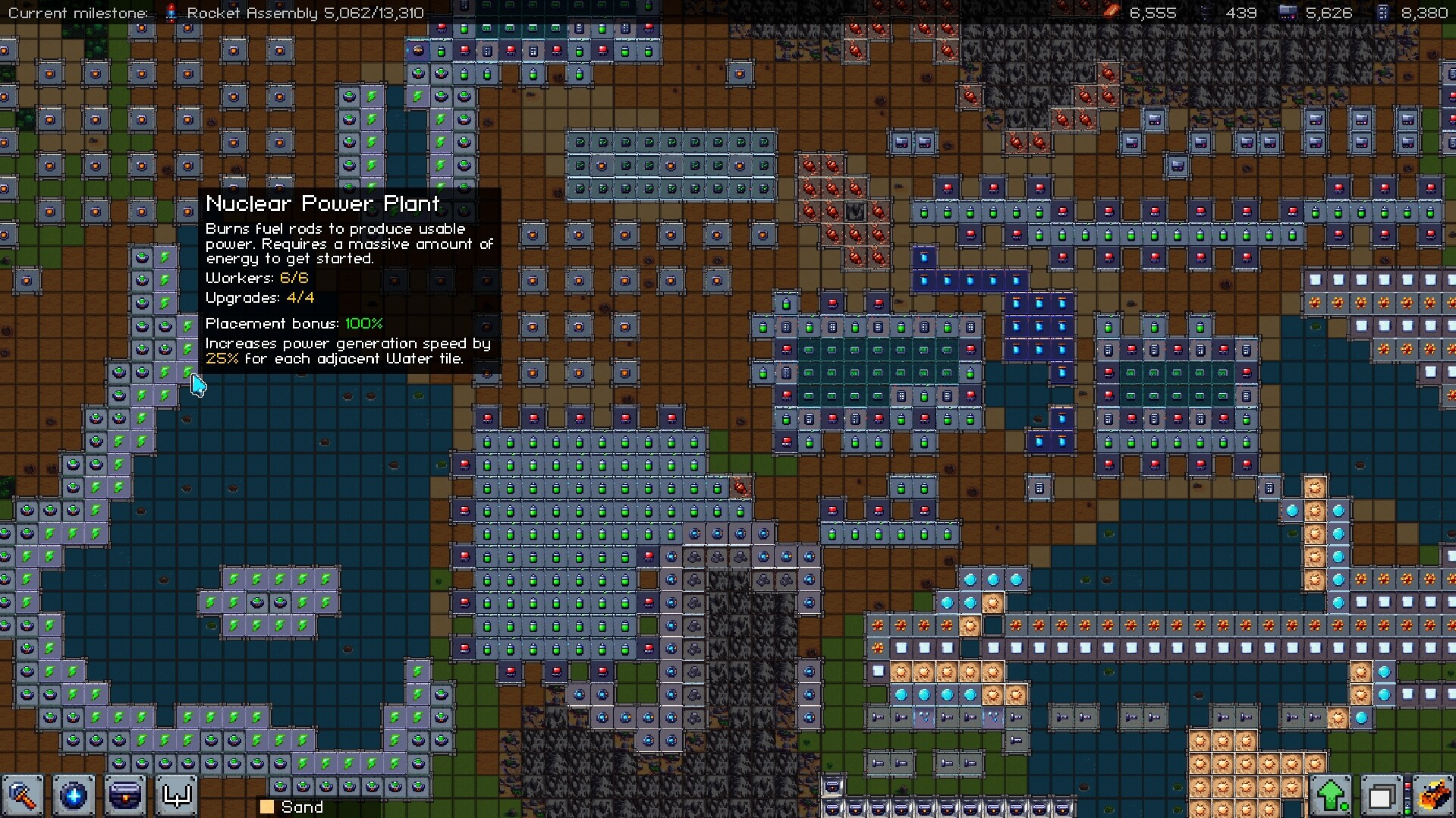
The main goal here to launch rockets (hah!) and to do so, you need to build a factory made up of a bunch of various widgets (the squares on the map). There aren’t any distribution mechanics to worry about here, just inputs and outputs. The ratios start simple, with either 1:1 or 2:1 options. They get complicated through a few different mechanisms.
- Research can improve the speed and/or productivity of a widget. More productivity = more free material created. More speed = you need more ingredients.
- Synergies per widget improve productivity if certain conditions are met. Mines are better on rocks. Power plants near water. Some need to be 100% isolated. As much as possible, you want these synergies active.
- City & Logistic bonuses. Placing buildings on city tiles or next to logistics widgets improves productivity, at a cost. Very useful at the later parts of the game.
- Temporary boosts. Glitched widgets can temporarily boost speed, productivity or other aspects. These are quite powerful.
Combined, by the final stages of the factory, there are no real ratios to work with. You’ll look at production gaps and simply build more of an item to fill a production gap. When compared to nearly all other factory builders, this game provides the bare minimum of data points required to make proactive decisions. In general, you’ll be constantly resource starved, though admittedly there’s no consequences other than time to resolve it. There are no cascade failures, no major power outages, no destroyed buildings by bugs. You just keep building until you reach level 12, then put a LOT of parts on a rocket platform and get ready for the next step.
This leads to ascension, the incremental portion of the game. You get a 100% production bonus per rocket launched, and each additional rocket costs 10% more to launch. As reference, the first rocket took me nearly 2 hours to get all the materials up. You get the typical ascension tree with various upgrades that should simplify the next iteration. I read through that tree quickly, and some options are really quite questionable in terms of value per points. In nearly all cases, you want to improve the speed of production or the number of ascension points you get. Anything and everything else is noise. More storage? Why? It’s a weird mix.
It’s an interesting mix of chaos, where it is both similar and quite different than others in the genre. It’s like when you mix flavors together and you get something quite a bit different. It has elements of factory building, but lacks the logistics components to make ‘good’ decisions. It has the incremental portions, but lacks the complex iterative systems where new things show up in future runs. Time will tell if scaling applies as in other incrementals with exponential growth – from what I’ve seen so far, that is not the case.
Still, for a game that costs less than $5, this is a very solid package. More so that nearly any F2P version I’ve seen.

