
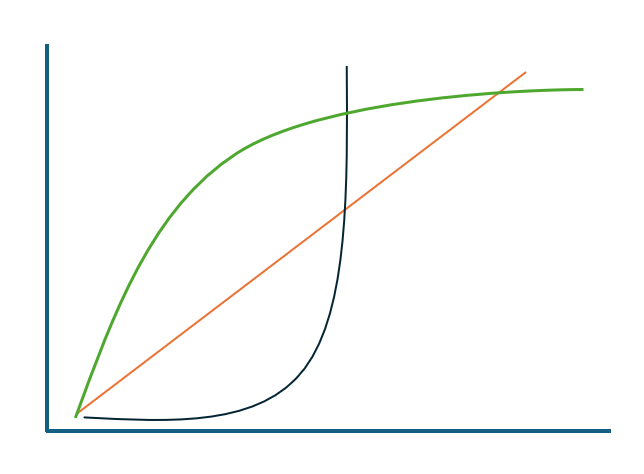
Quickly. Linear (orange) is a straight line, easy to understand for everyone involved. Exponential (black) takes a while to get going, but then takes off like a rocket ship – there is rarely a ceiling of power here. Logarithmic starts really quick, then has only minor improvements over time. These give the impression of progress at the start and a very long grind at the end (ARPGs live here).
Also important to note, that these are macro trends, not micro. You are likely to think every game is linear from level to level, and will only appreciate these large trends when you look across multiple levels. A game like Diablo sure feels linear at any given point, and then you get to end game and truly appreciate the actual curve.
This is an interesting balance mechanic in RPGs, where you need to manage expectations at any given point. A D&D battle at level 1 is extremely simplistic. A battle at level 10… well that depends on which version you’re playing. 3rd edition, warriors were linear and mages were exponential.
Playing Valheim, Enshrouded, and now Windrose really highlights how each of those games has tackled this particular challenge. All of them function on a linear power creep, where your progress is very relative to any other point in the journey. Seen another way, the difference in power between levels is relatively similar and constant. Where you ARE vs where the game EXPECTS you to be is effectively the difficulty level of the game. This goes both ways, where you can be over- or under-prepared with meaningful difficulty. It also means that even at max level, you do have some perceived challenge from level 1 enemies. Most single player games use this mode, as game balance isn’t terribly important or complex, nor longevity. Mass Effect… who cares how long it takes, right?
In an exponential curve, you eventually blow through that difficulty and never really end. Something like Balatro fits this, where the increments in numbers are so large that you can’t easily represent it anymore. In some cases, the power curve is less about discrete numerical advantage, and simply about tactical ones. D&D is the most common but likely least understood unless you’ve played a high level mage. At level 1, you can barely light a fire. In later levels, you have dozens of spells that can take out entire rooms and alter reality. A warrior by comparison can hit an enemy, and eventually, they can hit that enemy really, really hard. That’s certainly less the case in today’s D&D world, point made on that. The challenge with exponential curves is that designing encounters for players is related to the curve. An exponential growth in power leads to an exponential growth in challenge, otherwise it’s a cake walk. This works in tabletop games, it rarely does in other formats. Think about it this way. A level 10 challenge may have 5 enemies with 100 hit points. An exponential increment could mean level 11 challenge has 25 enemies, level 12 has 125. You’re in Dynasty Warriors territory here, where it’s just fodder, and earlier content becomes completely irrelevant.
Logarithmic curves are where live service games exist. The initial part of the curve is usually balanced to resemble linear progression, but eventually you reach a break point where you need to invest more and more to get less and less. Diablo for example. In a couple hours, you go from level 1 to 60 and difficulty generally decreases as you get stronger. Nothing is really a cakewalk, just a bit easier. Then you hit Torment levels and quickly realize that you need to spend an equal amount of time leveling to get increase a single Torment level. T4 could take you 10x as long as it took to get to level 60. MMOs are like this too, where you level up in the content, hit max level, then grind for 2% increases in stats through raids within a major patch. This model is easier to balance (the easiest of the three) as the range of player power is much smaller than in other models, therefore you can balance it for more people.
Kind of related here are the terms ‘ahead of’ and ‘behind’ the curve. The curve in this case is the expected and designed challenge level given a set of basic factors. A designer will math-out where a player should be at a given point in the journey and design an encounter that is challenging for that expectation. For linear games, like a JRPG, the 4th boss fight assumes you’ve tackled the first 3 and have a given level and set of stats. For non-linear games, like Elden Ring, the game has no concept what power level you are and simply designs a difficult encounter you are going to shed tears upon failing.
What makes a game hard? Is it the stats of the character, the design mechanics, or the individual player’s skill? At a glance you’d think the former has more weight, but the more and more you think about it, the more you realize it’s the latter two. Higher stats simply allows you to ignore certain design elements, and compensates for lower player skill. Up to you to decide where you fit on that continuum.
 Leo's Life