Age and Time

Kids have a way of making time seem ephemeral.  I’ve had pets, I’ve been single, I’ve been in relationships.  There is nothing in my day that makes time fly by more quickly than kids.  DINKs, that’s the way to go!  I have a few friends that are in that boat.  They can put in as many hours as they want at work, spend time with their S/O, travel, relax.  Have a lot more money.

And this isn’t about fulfillment.  I know quite a lot of people who are happy and feel fulfilled without kids.   Just like I know people with or without kids who are depressed.  It’s just another piece of life.

In my case (as I can’t write about yours), my kids are a window into a different way of thinking and being.  I have a passion for learning, and they are nothing but sponges.  Mundane items are spectacular to them.  They have zero concept of time – “are we there yet”, “is it lunch time?”, “bed time already?”  they just flit from one thing to the next, with no cares and a focus on just being happy.

The heck is wrong with us adults?

What with work, eating, mandatory chores (washing, groceries) I am down to about 6 hours a day to work with.  That gets filled by time with the kids, a workout, a guitar lesson, optional chores (garden), hockey, fishing… and at some point games and sleep.  And the older I get, and the older my kids get, the less overall free “me-time” is there.

But it’s not a bad thing.  Spending more time with the family, and the kids, means that more stuff is shared.  Simple example is just having dinner together and listening to the banana reactions from the kids.  Or asking my eldest what happened on Trollhunters.  She lit up and explained everything over 15 minutes.  I get to play hockey / basketball with the kids.  We go fishing as a family.  We play really interesting zombie boardgames.

I’m rather enjoying this phase of life.  It’s a thousand times hectic than before, and I always feel like I could use a nap, but that’s a fair trade.  I’ve passed on things that make only me happy and now can do things that make me and other happy.

As I grow older, I find myself more content with the general chaos.  Or perhaps just growing used to it.  And as long as I go to sleep and wake up with a smile, things are working out just fine.

Now for some nice weekend weather!

The RPG Creativity Curse

I love me some good RPG.  That feeling you get when the dice roll your way, the story is working, and your character is built the way you want to play… like ice cream on a hot day.

Only few console games allow you the freedom to truly build a character.  You may customize a character, in how they look and a few of their skills.  Actually building one is something usually reserved for PC games in the D&D vein.

Open world games like Elder Scrolls/Fallout do have some building, but aside from what you look like and a few initial perks, you aren’t painted into a corner down the road.  You can eventually unlock the majority of the character skills.  You can, with time, become a master of all.

This post is focusing on the more traditional RPGs, where your initial decisions reduce the options of your character – in terms of power, skills, and story.  A solid game provides a lot of options, where poor decisions can be negative but not painfully so.  I would argue that Divinity: Original Sin has “correct” builds, and if you do not select one of those you are unduly punished for it.  Other games simply have builds that aren’t optimal – but are still playable and fun.

A long time ago, I wrote a guide for Dragon Age: Origins (still on gamefaqs if I recall) about character builds.  I spend a stupid amount of time crunching numbers and seeing what I could make out of the various characters.  I replayed that game half dozen times from start to finish, to unlock every secret and every advantage.  My blood mage tank was a wrecking ball, with near full immunity.  But if it wasn’t built just-so, it would break under the first sneeze.  And this was a game with only 3 classes.

Compare that to something like Baldur’s Gate… and you may have spent more time at the stat rolling screen than the combat.  And I know way too many RPGs where I reached 10-12 hours and realized I made a mistake at the start… usually because I didn’t even know what the choice actually meant.

Enter Pillars of Eternity 2.

classnames

All the classes and subclasses

Without a lie, I spent 2 hours going over this list and the various previewed skills to get an idea of the character I wanted.  I played the original a few times through and preferred both the Monk and Cipher roles.  They had interesting mechanics, and good damage potential if played smartly.  If played poorly, then you face tanked the ground.

With multi-classing, it was then about picking 2 classes that complemented each other.  I started looking at the Cipher and then it’s lovely 3 lovely sub classes.  One was a spell battery, where it took time to charge but then entered god mode.  Another was increased damage on targets vulnerable to stealth (paired well with Rogue).  The last was a glass cannon that blew all its spell points on a massive attack.  My focus was on that last one, and shoring up the weakness of not being useful before that shot was available.

There are therefore two modes to be used here… one is to generate Focus (points to use the cannon shot) and then a strong weapon for that shot to be based upon (two-handed weapon).  Focus is generated based on hits that connect with targets, so Perception (accuracy) is key.  That means that I need a sub-class that excels in two-handed weapons (fighter/barb/paladin) and that have a decent chance to hit.  Interestingly, the Paladin has a subclass that has a single strike attack with +10 chance to hit – a perfect fit.  That meant an Inquisitor.

All that time was spent looking at the skill preview trees and trying to see if the pieces fit together.  Call me crazy, but I found this process a lot of fun.  PoE does a solid job of presenting a lot of data early on, so that while you may spend lots of time thinking, it doesn’t feel like you’re picking in the dark.

Which is a tad ironic given that in the traditional pen & paper RPGs, you had a dozen books to refer to nearly 50 years ago.  It’s taken this long for the PCs versions to catch up (ignoring wikis that are not part of the game).  Progress.  Fun progress.

The Art of Unlearning

Inspired by two articles – Zubon’s on Scaffolding  and grumpy ol’ Matt’s on Tanking/threat changes in WoW.

The core argument in 2nd post is how BfA will revert a rather longstanding tradition that threat is a meaningless item in group content, and bring back active management.  This reminds me a bit of Blizzard’s attempts to bring back crowd-control into group content – and that died a horrible death.

For better or worse, any game that is meant to played over long period of time has an issue with static difficulty and growing power curves.  This means that as the game progresses, players get stronger (numerically) and smarter (tactically), while the actual game remains the same.  Things just become easier.  The longer the duration of the game without a difficulty reset (an expansion, a large patch, a gear reset, scaling content) then the more players become accustomed to that “easy mode”.

WoW really found this out the hard way with Lich King.  The start of the expansion had some difficulty – in particular with the optional trials on boss fights.  The tail end of that expansion had a lot of length, and the power curve provided a “permanent farm mode” on nearly all the content.  People were simply too strong and the culture of “go-go-go” took hold.

Cataclysm tried to revert that easy-mode to the earlier LK launch.  The start of the expansion had groups dying on the first few pulls.  People had to re-learn to play the game.  Fine, this was a restart after all.  But the devs went a step further and curtailed the power curve by applying mechanics that could not be absorbed through numbers alone.  Even if you were decked in super gear, you still needed to avoid Shatter.  This was not met with smiles.

MoP went a very odd route and said at the start that small group content would only be relevant for the initial launch.  Gear progress was better off in raids and daily quests.  I won’t even both talking about WoD – that was atrocious.

Legion though, there’s an interesting bit.  Dungeons started off quite easy.  Stayed that way too.  What was added was Mythic+ mode, with increasing difficulty.  To succeed at high levels, you needed both good players, the right classes, and adequate stats.  CC/Stuns are required.  There was easy-mode (ala Raid Finder) and then hard mode.

So it’s an interesting model to re-jig the base game towards the lessons learned from Mythic+ mode.  I get the feeling that Blizzard saw that people were able to ignore specifically designed mechanics to progress further than they had planned.  Game the system if you will.  And the majority of the “controversial” changes from BfA are meant to address that exact issue – more abilities tied to the GCD, this threat change, class revamps, breaking down the homogenization of classes.

People that have spent years on “easy mode” without Mythic+ will have to relearn the game. And if WoW has shown us anything, it’s that wide scale base-game changes are rarely appreciated when they add difficulty.  I’m quite curious as to how this all plays out a few months after launch.

PUBG vs Fortnite

Full disclaimer, I am not a fan of the genre or either game. That said, I can appreciate the development approach to both games.  And is it ever an interesting approach.

PUBG is licensed off Epic.  It’s a B2P with micro transactions.  It was first to the party and was the king’s poop for quite a while.  Unfortunately, it was poorly optimized (read crashes and bugs), had long and empty stretches of nothing happening, and a struggle with customization/individual play styles.  Going for it — it was the only one on the market.

Let’s not dismiss that fact.  PUBG was first to market and spend nearly a year making more money than I could ever count.  It was proof that early access games could work.  It was also proof that early access games require a lot of polish to get ready for prime time.

Epic came in only a few months ago.  It already had the engine and needed a few tweaks to get the BR mode working.  By being 2nd (ish) to the game, they had the ability to play a ton of PUBG, read all the forums, parse their noted, and build something that addressed every single gap.

Let’s time travel a bit shall we?  EQ was the first “major MMO”.  It was on market for a while and made a lot of money.  WoW wasn’t much of a thought at first, but they did something smart.  They hired the EQ top-end guild members to help build their game.  These people came in with minimal game development expertise, but a ton of actual gaming know-how.  WoW addressed nearly every single issue that EQ presented to gamers and provided a level of polish that wasn’t found before.

The irony here is that EQ had plenty of feedback to help address their gaps.  The choices they made to address some and not others is what paved the path for WoW.  It was like a giant beta test for Blizzard’s benefit.


And here we are now, looking at the PUBG vs Fortnite development teams making dramatically different design decisions for the playerbase.  PUBG missed nearly every single development milestone, and is grasping to stay relevant.  Fortnite is going full bore in marketing, the lowest possible denominator.  You know you have a winner when schools are talking about banning it during class.

The lesson here is that it’s meaningless to be first out of the gate if you aren’t actively trying to stay at the top.  PUBG had an unexpected amount of success and no plan to manage it.  Epic played it smart, saw all the foundational mistakes, and built a better product.  Given their size and history, they certainly have a much better chance at staying #1.

That is, until the BR craze dies down and the next big thing hits us all in the head.


The Mystery Box

I’ve talked about this in the past, what with JJ Abrams fascination with the concept.  There are a lot of parallels with the real world.  We are often more fascinated by the unknown than the mundane facts.

I mean everyone likes rainbows, but once you figure the science behind them… it ruins the mystery.  No pot of gold! Northern Lights, bird flight, magnetism, electric static, the sun…all of them have captivated imagination for years and cause amazement with children.  Adults who understand the mechanics move on.

That said, it’s important for there to be a explanation for that box.  Sure, there are a dozen reasons why the box exists, and in literature it’s often just a plot device (see MacGuffin). But it’s a delicate balance between being a plot device, or being the actual plot. When it’s the latter, then the actual box needs to have an explanation to justify the rest of the story.

Recent example is Avengers Infinity War.  The gems/gauntlet are a plot device, and they come with a very high level background.  Across all the films, only the Soul Stone gets something of merit here and in the final movie no less.  The Maltese Falcon, Raiders of he Lost Ark, Fifth Element – all examples of plot devices.

Lost originally had these as plot devices, little side conversations to the actual character growth.  Then after season 4 it went full-on mystery island mode and tried to explain the inner workings.  It did a really poor job of it, and the character development suffered for the new plot.

The flipside to this is someone who is more fascinated with the inner workings of the box that the people interacting with said box.  Zach Snyder is all about detailing that box in minute detail, ignoring the actual characters.  300, Man of Steel, Watchmen, BvS… they are all decompositions of story.  BvS could have been about random people, with the exact same plot, and it would have had the same impact; a dud.

Westworld is in the 2nd season now. I’ve watched 3 episodes.  I really enjoyed the first season as it followed a good balance between hide and reveal.  Season two is a bit too much in the hiding part right now.  Dolores “sees all paths” but the actions taken seem extreme and without reason.  It’s also very liberal with the action pieces and across 3 episodes there hasn’t been any character development to speak of.  Teddy might be a small exception here but what he does with the new information is meaningless.

It’s a hard balance to achieve in storytelling.  Very few ever reach it, or reach it on a consistent basis.  Even Steven King has a pile of weak stories, among his amazing ones.  Just enough mystery to keep people involved, not so much to make them question every motive, and some background thought as to how that mystery actually works.

Solo Tanks

In a world where $83m is considered tanking, no less.

In all seriousness, who is this movie for exactly?  Die hard SW fans already know everything they need to about how he came to be.  Even passing fans have a general idea by watching eps 6, 7 & 8.

We all knew the end point of Rogue One – someone gets the Death Star plans.  What we didn’t know was who, and how.  That story was fairly decent.  It was certainly the best “prequel” to the older story line.

In Solo, you know all the main characters ahead of time.  You know the major plot points – Chewie as a slave, Han winning the ship in a card game, a bro-mance with Lando. There’s no big story tie-in, not set up for something else.

It gets compounded by the divisiveness of The Last Jedi, as much as the fact that movie is only 6 months old.  It sure does smell like cash grab more than anything else.

Interesting take away is what’s next for Disney on this front.  They bet a lot of money on some good stinkers along the way.  John Carter and The Lone Ranger come to mind.  With 2 more “side stories” in the pipe, maybe this is the first and last of the bunch.  If Han, arguably the most likeable character in the SW universe cannot make it work, what change do Obi-Wan and Bobba Fett?

Or maybe audiences just have had enough and Disney has to show some effort.

Weatherman Woes

This has got to be one of the most interesting jobs, right?  Whether you’re right or wrong, it doesn’t appear to matter much.  I’ve seen the same folks on TV/internets giving weather forecasts for years – and even saying what temperature it is currently can be a challenge.  This is more likely due to the large surface area they need to cover, but even so…For example, this weekend was supposed to be rain with a 90% chance from Friday through Sunday.  Most of the daylight hours.  It turned out we had 20 minutes on Friday, a storm overnight, then a sunny day Saturday, and overcast on Sunday.

What was supposed to be a weekend indoors at the cottage turned into a large labour effort in the yard instead.  Physical work always feels good, offsets the office hours nicely.

Friday Game

That said I did get a couple chances to play some Friday.  This is the solitaire/war – like card game for solo players.  I had mentioned that it was a hell of a challenge due to the RNG at the start.  That trends continues.

The game provides you with 4 phases – green, yellow, red, and pirates.  The first 3 phases are growth phases, where you are attempting to grow the power of your deck, by acquiring new cards and getting rid of bad ones.  Each of these phases moves forward once you complete the “challenge deck” – which shrinks in size over time.  The pirate phase is a set of bosses, where your deck is locked and you have to take on 2 large challenges.  The overall goal is to complete both of those challenges, with at your health points remaining.

Each card has a power level (ranges from -4 to +4) and has various skills attached (more health, card swaps, duplication, doubling of power).  The starting state is poor – you have many negative cards.  In order to grow the power of your deck, you need to beat various numerical challenges (e.g. get 2 points across 3 cards). Beating a challenge has you gain that challenge card.  Losing a challenge allows you to sacrifice life points and get rid of poor cards.  In the green phase, you want to do both, though losing is arguable more efficient in the long term.  At best, by the end of this round you have shrunk the challenge deck in half (from 30 to 15).   More likely, you’ve shrunk your hand deck from all negative point cards and acquired 5 challenge cards.

The yellow phase is the same as green, except that you need more points for the same set of challenges.  The goal here is to win as much as possible and shrink that challenge deck as much as possible.  This is hard, since most cards are only 1 power point and you need an average of 1.5 to beat any given challenge.  Skills come into play now, where you swap/boost other cards.

The red phase is attrition.  Whatever challenges remain are nigh impossible to win unless you have the best cards.  The weakest challenge cards from Green are actually the hardest now.  What was a 1 card pull for 0 points, now requires 5.  There are no 5 point cards.

If by the grace of some deity you complete red, you move onto pirate mode.  These require you to draw 6-10 cards to meet specific skill point values.  One has a 10/40 cap, which means you need an average of 4 points per card.  The only way to do this is with specific skill cards – doublers and copy cards.  A near perfect deck.  The other pirates aren’t much better.  Either you attack points are worth less, or you need to fight all the remaining challenge cards, or a set of other handicaps.  So in truth, it isn’t about surviving the first 3 phases.  It’s entirely about preparing for this one.

Across a dozen games:

  • reached yellow majority of times
  • reached red half the time
  • reached pirates a quarter
  • defeated 1 pirate once
  • never defeated both pirates

That 1 pirate victory cost me every single card and life point.  And it was a softball card compared to some others.

There’s some strategic growth to be had, but it’s clear that only a single strategy will work and that the card-to-card tactics require more card counting for success.

Single Player Strength

PCs are dead.  RPGs are dead.  MMOs are dead.  Everything is dead.  In the gaming world, nothing ever dies, it just gets transformed.

God of War (and Isey) put this into perspective for me.  There was arguable a large drought of single player games for a long time.  The big-bandwagon for nearly 10 years was MMO or competitive shooters.  The former genre seems to have peaked, while the latter is moving into the Battle Royale flavor-of-day.

Side-note: I would guess that the large amount of player toxicity in multi-player games is pushing people away.  The big companies are trying to address it, but we’re still plenty of years away from that getting better.

That’s not to say we didn’t have quality single player games – we most certainly did.   But they fell into one of two main categories: shooters or RPGs.  The Mass Effect series (I only count 1 & 2) moved between these 2 models.  Uncharted went from puzzle focus, to action movie mayhem.  Divinity: Original Sin, Pillars of Eternity, Planescape, Tyranny are all quality examples of pure RPGs.  XCOM and Civ are outliers that nearly dominate their own genres.

Not too many puzzlers, though Firewatch and The Witness certainly shine.  Or add a massive indy library of puzzlers.

Why though?

Technology

The obvious one here is that technology has progressed so far that imagination can be transcribed to a game.   Complex numbers can be crunched in fractions of a second.  Amazing AI can provide a level of realism that was not possible only a few years ago.  Graphic fidelity is almost absurd today.  I mean, compare something like Avatar to God of War, Monster Hunter, or Horizon.  The line between game and experience is being blurred further.

Stories

The snowball effect of quality storytelling is taking shape.  Mass Effect, BioShock, Uncharted – all are great examples of risk taking in the story.  Some of them play more like interactive movies but others feel like a choose your own adventure.  Hundreds of hours of options and dialogue are created for a game, and only a small portion will ever see the light of gameplay.  Developers are willing to put in hard branches on the story.  Killing off everyone in town means that you lose all the quests in that town for the rest of the game.  Real, actual, permanence.  Something that nearly all multi-player games are incapable (EvE and perhaps UO excluded).

Cohesion

The kitchen sink approach to gaming was all the rage for a while.  A whole bunch of systems, things to do, but none of it linked together.  Games like Fable tried to bridge that gap, with only marginal success.  Most JRPGs are a single story, joined by multiple smaller settings.  One long corridor where the background changes every few hours.

The forward progress here is in the experience provided to the player, through the characters.  The worlds are fleshed out.  The story line has logic and the areas are thematically linked.  Take the Tomb Raider reboot.  If you took the mechanics/visuals and applied it to previous games, it still wouldn’t work.  What does work, is how the island setting (or mountain in the 2nd game) feel like they exist in a real world.  The set pieces flow with the story, and Laura experiences something memorable in each.  I will remember that zipline down from the tower for a long time.

Choice

Given the player choice, or agency in the game, brings the player into the experience.  There is a very large difference between a sandbox (e.g. any Ubisoft game) with a bunch of tasks, versus an open world with a toolset to deploy as you see fit.  I’ll pick on Horizon here.  Sure, there are tasks and they are thematically similar – hunt, discover, hide.  It could even be the same task; kill a bear-cat robot for example.  It’s the setting and your set of tools that determines how you approach that task.   Are there other monsters around?  Do you have stun ammo?  Fire Arrows?  Is there cover?  Do you have a mount?

God of War provides a similar amount of choice in the various battles.  You can go full offense, play defensively, use Atreus, dive into deep damage from skills, or head the stun route.  Each option is viable, in a given situation.  That level of complexity, variety, and choice means that the game doesn’t feel stale.  The variety of events that you’d get from a human player can now be simulated to great effect in a single player game.

Don’t Call It a Comeback

Single player games never really left.  The cheap availability of networking allowed for multiplayer games to move from the living room sofa to the Internets instead.  That growth shadowed the single player realm, and it kept puttering along.  Now that the multiplayer market has neared (if not passed) it’s peak, it’s a great time to pay attention to excellently crafted single player experiences once again.

God of War – Story Complete

There’s still a fair amount left to complete.  2 more zones, a bunch of Valkyrie (in a later post), a dragon, some quests.  But the story is done.  Minor spoilers I guess inside.

I’ve talked about the early parts of the game.  Kratos and his son Atreus have a quest to spread their wife/mom’s ashes on the highest peak.  They directly meet the world serpent, Mimir, Baldr, Magni and Modi along the travels.  They also meet a pair of dwarven brothers who help with crafting.  The story seems small but ends up growing into a really neat epic tale, that explores the Norse mythology before vikings.  It works.

The meme of “BOY” makes sense in this game.  As much as it applies to Atreus and Kratos’ rough exterior, it also applies to Kratos.  Atreus ends up learning a whole lot given his sheltered upbrining, but it’s Kratos that finally understands his place in the pantheon.  He hides his story from Atreus for most of the game, and in a cathartic moment finally reveals it all.  It’s Atreus’ response to that, and Kratos’ acknowledgement of his past sins that makes this entire arc work.

Along the path they learn about the various nordic gods – in particular about the marital woes of Odin and Freya, the destructive will of Thor, the higher learning of Tyr, and the fate of the Jotun (giants).  You get to see the Bifrost and Yggdrasil.  You get a great feeling that the presented world is integrated and cohesive.  The underlying efforts to integrate the lore – in particular with Mimir’s stories while on the boat – make it feel like the world is lived in, even if there are only a handful of NPCs.

It is also a beautiful game.  I cannot recall any other PS4 game where I saved as many screenshots.  The final shot of the game…wow.  That was someone’s imagination, and someone else’s skill to make it reality.  Superb.

There are 2 main twists in the story.  After the first, there’s a bit of a dip in how Atreus is portrayed, without much justification.  It rights itself eventually and grows a lot from that point.  The final twist I saw coming from earlier on (given that I like Norse mythology and a main part was missing from this story), but the actual reveal is very impressive, and quite sad.  There’s no credit screen either, just a somber Kratos telling Atreus the origin of his name while they walk back towards home.

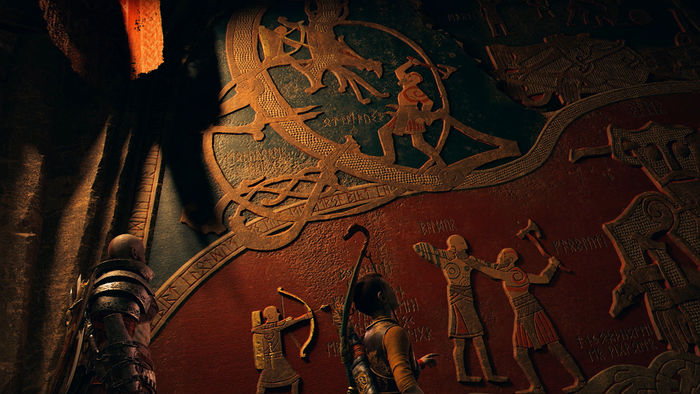
700px-48_mothersashes-mov-00_11_20_07-still002

Scene shortly before the end – these murals are great

You don’t actually visit all 9 realms, and I’m ok with this.  The 3 remaining realms are way more complicated and lively than the rest of the game, at least in terms of lore.

I agree with the lead dev, in that the game is story complete and does not need any DLC.  I don’t see how that could ever be adequately contained in typical DLC.  It’s not like Odin’s house is DLC – that’s more like sequel territory.

God of War is so far beyond what the previous GoW provided, and clearly has taken the new single-player story driven mechanics to heart.  It bears note that Naughty Dog bears the burden of this trend swap, what with Uncharted and Last of Us.  Games since then have improved on that model – Horizon and now God of War included.


Master of None

Prefaced by the obligatory “jack of all trades”.

I am an information hound.  I live to learn new things.  Maybe not apply them so much, but at least have it in my back pocket.  I think it’s more to do with pride of having to ask for help.  Or maybe it’s the whole waiting for them to show up part.  In fact, it could simply be that most experts are anything but.

My wife and I did the majority of the renos within the house.  I have a more than solid understanding of framing, roofing, wiring, flooring, plumbing, and finishing.  I would prefer to avoid finishing work (except maybe painting) given that it takes me longer to set up/get warmed up than a real pro would take to do the entire job.  I recall a friend who split his house baseboard work into 2 zones.  Upstairs for 1 pro.  Downstairs for 6 guys.  The guy upstairs was done a long time before the downstairs folks.  Clear experience in working efficiently.

Plumbing is a bit different now.  Before, it was an upfront investment to get all the equipment to run pipe.  Copper lines of different sizes, PVC drains, cutters, connectors, valves…And that’s without counting the fact that the solders have to be rock solid or you’ll have a mess.  Nowdays, a child could lay out PEX pipe, without any tools but utility knife.  Sure, you need to know where to put valves, but it’s not rocket science.   (the main, in/out of hot water, exits to outdoor connections, before each end point.)

Flooring is easy until you reach a door or transition, then you need some magic hands.  Plus it kills the back without the proper tools on hand.

That leaves me now with electric work.  My dad’s an electrician, so that’s part of the history here.  But aside from the main panel, nearly all connections are extremely straightforward.  There are 3 wires, color coded, and it’s quite hard to mess up replacing something.  When you are installing something, then it gets a mess.  Want a 4 way switch?  Go get a book from the library.  Ceiling fan install?  Get half a case of beer.  When it comes to troubleshooting, then just retire because so much can go wrong.

Trailer Woes

I have a boat.  It has a trailer.  And I have a hitch.  The trailer lights flickered on an off for a while now, and no matter what the diagnostics said, no one was able to find the root cause.  I got fed up last night and started digging some more.

I checked the wire harness with a tester – everything was ok.  I checked the trailer, all the connections are on 3 wires – meaning the ground (essential for this to work) is in the wiring and not directly connected to the metal in the trailer.  Since it’s a boat trailer, and it goes in the water, this makes a lot of sense.

I went back to the wire harness and started tracing it back.  Ever try to remove the filler in the back end of a vehicle before?  It was 15 minutes of unclipping things to trace a 12 inch wire.  I finally lost the wire behind a panel and could not figure out where it went.  Out comes the screwdriver to take off the screw holding that panel.  Lo and behold, this screw was holding the ground and had come lose.  Tighten it up, put the connector on, and things are fine.

That went through 2 mechanics, 3 people who own hitches/trailers, and 2 years of wondering what the hell was going on.  For a single screw.

Moral

I guess the end result here is that as much as there are experts, it’s important for you to know what they are talking about and to challenge the assumptions/conclusions.  I didn’t do that for the trailer, due to lack of understanding of the mechanics.  I don’t need to know everything, but I need to know enough to have a conversation about it.  Otherwise I would have waited a few more years to get this fixed.