Satisfactory – Post Coal

Steam says I have 24 hrs in, and I’m trying to fill up the items for the next phase of the Space Elevator to unlock ranks 5-6 research. If that means nothing to you, Satisfactory has 4 main “phases”, blocked into sets of 2 ranks of research. 0 is the intro, 1-2 are the starter, 3-4 are the basic (coal + steel), 5-6 are mid (oil), and 7-8 are the end (nuclear). So I guess I’m at the end of the basic phase.

Sandbox

Satisfactory is bound by two main factors – belts of mined items and power. It doesn’t matter what you want to build, the power limits are going to prevent you from automating much to start. Even coal power is quickly consumed with the need for massive (I think) power plants to get things running, then large powerlines to get it where you need.

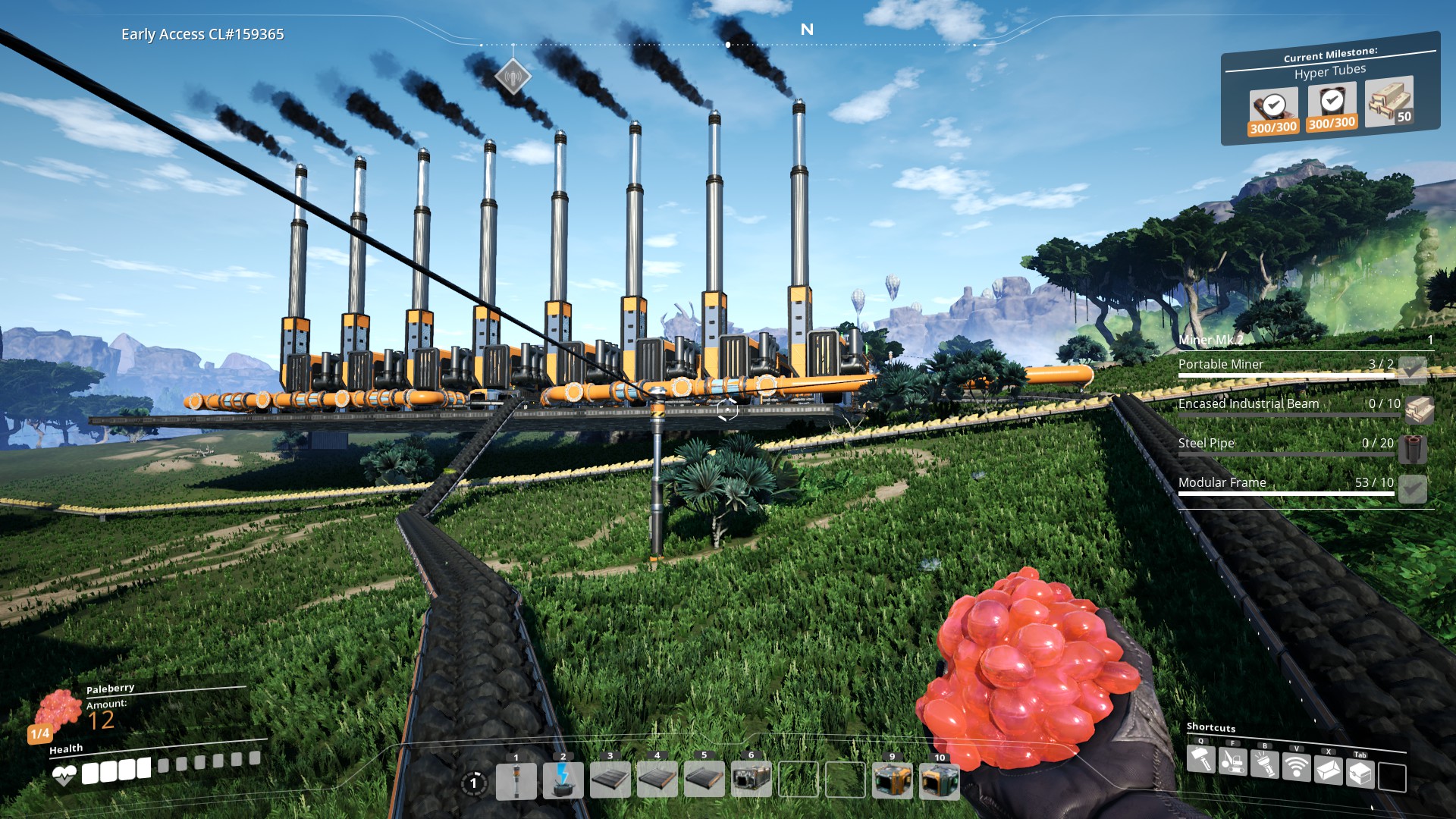
The coal miner way in the distance
My 600MW set of factories.

It took me a while to figure out this layout and the math required to make the water pressure make sense. Let alone the sheer volume of Mk2 Belts needed to get the coal there in the first place. Mines have different production rates, and you need to make sure the belt can deliver it to the intended target.

Mk1 Belts are really easy to get going. Mk2 require Reinforced Iron Plates, which comes from screws and prior plates. At a rate of 7.5/minute. My coal run above has nearly 300 pieces of belt. That’s 40 minutes of waiting, assuming I don’t need the pieces for other bits (I do). Mk3 are based on Steel Ingots, which are used for even more things. It’s insanely tedious that basic logistics are so painful to manage. Heck, my Sulfur mine is a good 600 belt pieces away (30 belt pieces per 100meters).

Map Size

No sense in shying away from it, the map is frickin’ massive. I’ve seen maybe 5% of it in 24 hours. DSP is massive – it’s solar systems after all – but it also comes with some serious improvements to player movement early on. And getting stuff from one location to the other is not about walking for 5-10 minutes.

I will state that having a world THIS big and no map is beyond dumb. (I know I can unlock it, with Quartz 1.5km away.)

I do read about vehicles being an option, even jetpacks. That would be awesome! There’s even the option for trucks and trains at some point! Wouldn’t that be great! For now – I get jump pads to move vertically. Honestly, it’s just better to build ramps everywhere, even if they are kilometers long.

Conveyor Belts

This is the general way to get things from one place to another. The expectation here is that belts work under cardinal rules, meaning 4 directions possible and that you need to worry about belts overlapping not about them being able to connect to the end point. Satisfactory has guide lines to help with belts, but that only applies to items with a single entry/exit point. If you have 2 things going in, then it’s a right nightmare to line it all up.

It’s also quite weird to be able to overlap belts without issue (not the splitters/mergers). I can certainly make it all work, but I’d need a fair chunk more space… and the inability to easily move vertically at this point makes that a painful experience.

This shouldn’t even be possible.

Blueprints

Building a factory gets even more finicky as the game progresses, as you need to start splitting and merging more lines. The game doesn’t automatically line stuff up, which makes for a lot of trial an error to make the whole thing make sense. Blueprints would dramatically help in setting up basic lines – or at the least a better “grid lock” system. It’d be really cool if the foundations you laid down did a better job of “locking things”.

This is about 2 hours of effort to build.

MAM

I thought progress was only in the main base, but it actually is a lot in MAM. Not only do you unlock key items here (like explosives for rocks) but you can also research “alternate” recipes. The screw I mentioned above takes 1 iron rod (1 smelted iron ore, crafted into 1 rod) at a rate of 40/minute. A steel screw takes 1 steel beam (1 iron + 1 coal ore) and gives you 260/minute. Ridiculous efficiency… and hidden behind RNG. I only know this recipe exists because of the wiki and figuring out what Hard Drives were. There are more hard drives than there are recipes, so that’s cool. But it’s probably 40 hours to collect them all.

Factory Goals

I wrote earlier that a good factory game focuses on the numbers and making the logistics balance. It is not about resource scarcity, it’s about optimizing the resources you have. It’s not about waiting for things to happen, it’s about testing things out for hours.

Satisfactory is about exploring first, then about not having enough materials/inventory on hand to get the things you find back home. Then fighting with the interface to make supply chains. I am convinced there is a balance point somewhere, where the logistics finally take shape and I can build a real factory. Like cripes, just let me build a ladder – I have a vertical belt but no real way to use it. Right now, I can’t fathom waiting hours to build new belts to get all my stuff to a new location (since I’d have to build new power plant). I’ll be parking this until it’s spent a bit more time in the hopper – it has rough edges in a space where there’s no room for it.
ActiBlizz – Part 2

Let’s start with a disclaimer in that the all the allegations of abuse at Activision Blizzard are abhorrent. At no point am I defending any of those actions, and I’m not too far away from the idea that it’s simply too corrupt to continue. It’s a farce to believe that capitalism exists – it’s an oligarchy driven by a sole purpose, more power through more money. Power corrupts, plain and simple.

In my prior post I was somewhat curious as to what the fallout would be of the DFEH lawsuit. Considering what came before it, the odds of any significant impacts were rather low. A few shuffles, but generally not much else.

We’re at 2 weeks now, and J Allen Brack is gone (no surprise, he was named in the suit) as well as a formal release of the head of HR (who was out of that position in January, indicating knowledge this was all coming). That’s expected. The replacements with Kotick-assigned members is also expected, given that has been the trend for nearly 10 years now.

There are other bits in this too, all standard things that are part of the corporate dance. There’s an internal bad cop, the staff express dismay and write a letter, the good cop steps in with some sort of plan to address it (but not). Shareholders complain that the value of the stock is tarnished. There’s a lot of hand waving is what I’m getting at.

Kotick is a smart bugger, you have to give him that. Employees wanted a big response… they got one from one of the largest law firms on the globe. A firm that will report to Kotick, and zero reason to anything other than the bare minimum.

Tangent for a second. Amazon treats most of their employees as garbage and disposable (enabled by our massive consumer tendencies). They account for turnover rates near 150% per year. Amazon employs so many people and turnover is so high that they have a corporate risk that there are not enough people to replace those leaving and that they will have burned out that pool. In other words, they are at a point where it’s possible there are not enough people who want to work for Amazon in order to keep the thing moving. This is a new concept, where most companies figure that cheap labour is practically infinite (and to Amazon’s credit, they somehow found the value of that term.)

Kotick has only one concern here… making shareholders happy. Doesn’t matter who is stepped on to get there, there’s always another job applicant waiting to fill in the ranks. The stocks dropped by about 10% when the news broke on July 26 (the volume commensurate to shorts) and then bounced to halfway to continue the year-trend of a downward slope. The anticipation of the Q2 report had another dip (5%) which has pretty much bounced back after they reported that they met their financial targets (well, Activision did. Blizzard is still hemorrhaging players and their pipeline is even dryer than before.) And if you think he’s not going to do everything in his power to crush any possibility of a union, then you’re not paying attention.

Is it a good thing that Activision is trying to build a corporate culture on top of a “bro” culture? Honestly, yes. Corporate cultures evaluate risk to make decisions. Blizzard assumed (from the allegations) that a reminder was enough to stop the bad behaviour. If anything this raises the floor of bad behaviour to the industry average, rather than the bottom. Industry is still very bad, so it’s more about the lesser of two evils. There’s no “return path” for Blizzard here.

All back to the topic of actual meaningful change. I don’t see that actually happening in this case, not unless there is a massive financial incentive to do so. I’d love for that to not be the case, but we’re talking about companies that rake in billions of net revenue dollars per quarter (close to $10b a year). It’s like if you had $10 dollars and I said you need to pay me 10c a year and do what you want to your employees.

If ever there was a time for me to be completely wrong, I wish it was here.

Zelda: Link’s Awakening

There’s just something about first party games – doesn’t matter the console. I firmly recall playing ZLA on my Gameboy back in the day and enjoying the hell out of it. It was also a 5 year wait until we got OoT, so time a plenty to get every ounce of joy out of it. Color me intrigued when they announced a remake for the Switch in 2019. I still didn’t own the console (and wasn’t planning to for a remake) but with that in hand, I’ve been giving it a shake.

First though, a slight time travel back to the days of the Gameboy. Two main things are important here – the fact that it ran on 8lbs of batteries and lacked an easy-to-use save feature and that it had 2 action buttons. That concept is crazy to anyone under the age of 30 (as are punch cards to me). So imaging playing one of the best games of all time with 2 buttons, no easy way to save, and a ticking clock that you could not predict. Batteries run out at the end of a long dungeon? Too bad. (the fact that it was all in grayscale is another matter)

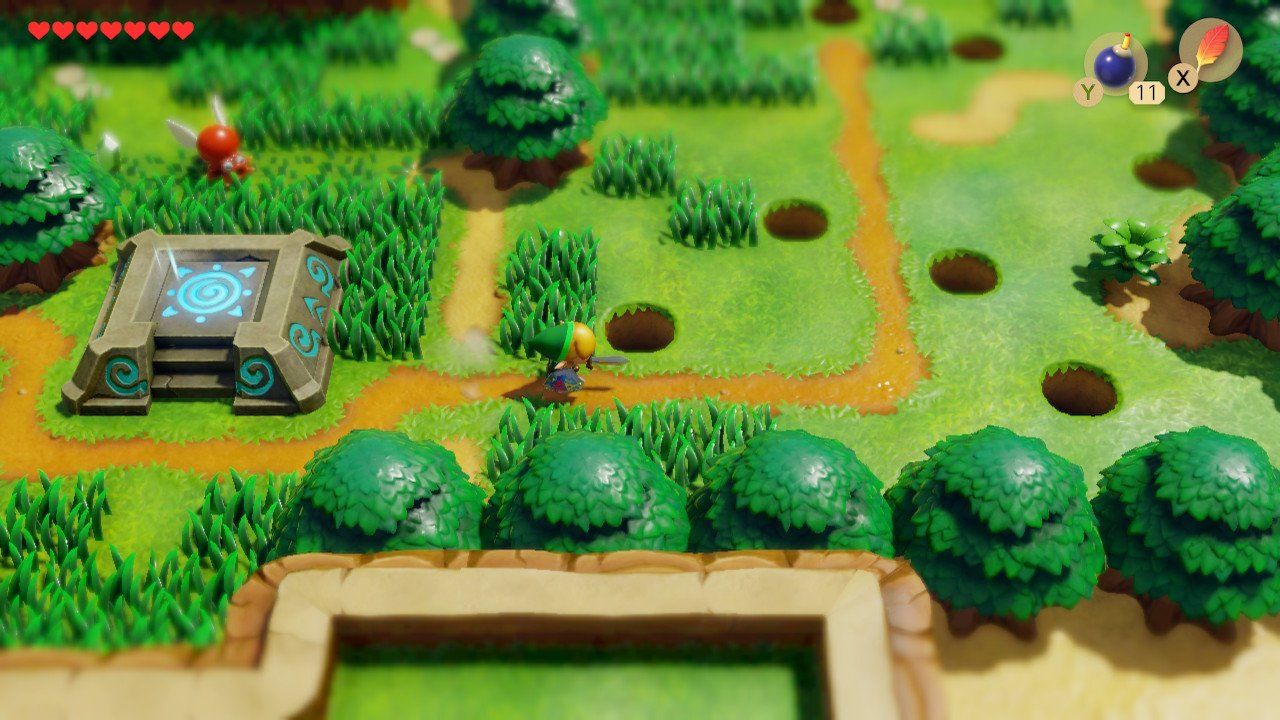
The first big thing about ZLA now is that the game looks spectacular. It has a blurred focus effect, so that it feels like you’re playing in a diorama world, where the focus is all on you. I can’t spoil a near 30(!!) year old game, but it does also give that dream effect. The controls are reminiscent of the GB version, with only 2 items being useable at any given time. This’ll sound crazy, but having DASH, SHIELD, ATTACK, and LIFT not bound to those 2 buttons is awesome – I can’t believe I had to write that. There’s a certain pace of movement in a Zelda game that is present here, a sort of dance to the underlying beat. It feels right.

It feels like you’re playing with toys

The game isn’t terribly hard by any stretch. It is however somewhat obtuse in what you should be doing. There’s a literal help line in the game that gives hints as to what the next steps should be. I still recall getting stuck at the monkey bridge section, no idea how to progress. It was a really weird thing to have a trading mini-game be a gatekeeping exercise for progress – and back in the day I was taking notes of who wanted what.

There are plenty of other mini-games here too – most are clear precursors to what came out in OoT, like the actual ocarina. It’s probably here that my love of fishing took root too. Dampé’s shack is a strange addition, where as you clear dungeons you get “tiles” of those dungeons you can use to solve other puzzles. The concept is ok, where you need to slot in the right tiles to complete a puzzle, but the actual running of said dungeons feels somewhat tedious. There’s no way I could achieve the focus/flow in a 5 minute effort compared to a game designer spending weeks on it.

It’s a complete joy to play this game on the Switch.

Satisfactory Initial Thoughts

I’ve completed the large majority of Dyson Sphere project tasks. I’ve got all the cubes to finish the last quest, about 3/4 of the tech upgrades complete (like more construction drones), and the actual Dyson Sphere is more about waiting for solar sails (took about 17,000 rockets to make the structure, so maybe 300,000 sails to fill in all the holes?) to do their job. The roadmap includes adding some combat/NPCs, and I have to assume some sort of technology bridge to make the waiting portion of the game more progressive. The blueprint addition is a massive boon, so perhaps I can go back and optimize even more in a few weeks. But for now, time to try something a little different.

I did look at Satisfactory when it was announced nearly a year ago. The concept seemed really interesting, but it was always missing some pretty big pieces to make any sense of it all. I won’t shy away, a game needs to have an early and mid-game to even be worth looking at, and the bar that Factorio has set is ultra dang high. Satisfactory was conceptually a good idea (multiplayer, FPS factory game) but the actual game had a lot of rough edges. Patch 3 came out this winter 2020 and brought pipes (for liquid transport), and patch 4 was in March with aerial movement/transport (essential in any 3D game) and then some late game content balance/changes. In terms of functional content before the 1.0 release, there’s some balancing and a signalling system for trains – so pretty much what’s there now is what’ll be there til the end. Might as well take a good stab now, right? These are thoughts up until the Coal unlock phase.

Starting Information

DSP doesn’t give much insight to a starting planet, and frankly, Satisfactory doesn’t do anything on that front either. There’s no RNG in Satisfactory though so the starting location is simply where you land on the big overland map… nothing preventing you from physically moving elsewhere.

I will say that it’s quite jarring to have to build buildings that dwarf your character. A smelter is 4 times bigger than you, and the ability to place things bigger than you in first person mode is not a pleasant one. Worse when you’re trying to connect things, as you’re never quite sure if they line up or not. I do miss the concept of a locked grid here… though that’s quickly (1hr or so) fixed when you unlock foundations.

The flow from base material to more complex stuff is pretty simple to grasp. Not a terribly large fan of only being able to manually construct in a single location (you could build another crafting location, but then that takes material rather than the actual building – so you’re likely to run out of mats). Reminds me a lot of the concept of a crafting table in Valheim, but extra not-portable. The ratio to craft stuff is well structured.

Power management is not pleasant. There’s never enough power to run what you need, and then you have maximum outputs per generator that need to be respected or you blow a literal fuse. It’s unpleasant minutiae that really should take a cue from other games. Focus on production, not the logistics of power – especially when you need to worry about a spaghetti layout for a factory. I will say that the need for biomass (leaves and wood) forces exploration, which is a super pleasant experience. The hostile NPCs can go jump off a cliff (knockback here is crazy), but the idea of finding new locations and stuff is really cool. The interface for power usage/consumption is really good. Not sure how relevant that becomes at the larger scale, but since stuff either works or doesn’t, it’s super good to know how much is missing.

I am looking forward to using the Z axis in the 3D world. Early game puts vertical as a hurdle that is almost impossible to surmount. Mutli-story factories are a thing I am looking forward to using.

I dislike the UI to build stuff. Clicking a menu, then scrolling, then clicking is way too long. You can add things to the hotbar, which is frankly mandatory and I don’t quite understand why it’s not default.

Progress Information

Where I think DSP really hits this well is that it tells you well ahead of time what’s possible. The research tree is open from the start, which in 2021 is like having the wiki page just built into the game. Satisfactory obscures nearly everything, which makes creating goals painful. I desperately wanted to know how to automate power generation… I had to randomly pick progression paths to figure out that was even possible. Not sure why you wouldn’t want to let people know that Coal production is eventually possible.

Which gets me to the larger point of progression targets. Satisfactory has tiers and sub-tiers. Tiers are relegated to upgrading the Space Elevator (which looks frikkin’ cool as beans), and the sub-tiers are related to upgrading the hub. You need material to upgrade the former, things that you may not be able to do until you upgrade the latter – but no real explanation of their relationships. It’s cool that there are no bad choices.

Speed & Scale

I wish I could do a better job explaining this, but it feels like trying to move an iceberg. Production rates are extremely slow and the buildings you are using are massive. You end up with a massive (relatively) factory that is just producing 6 things, and at a rate of 10 per minute. The construction part is a challenge because lining things up is not automatic, you can (and will) mess it up because things slide while placing them.

A pet peeve is that creating new factories requires that you have the resources on hand. It’s not like it’s 2 clicks to stock up again, or that you can “pre-fab” the items. If you are short on Rotors, well you need to walk to the Rotors storage, pick out a pile, and then run for a few minutes to the location you want to build. It’s infuriating busywork.

Factory games are great when the progression of automation is the goal. It should snowball into the logistics of competing demands. Your time is spent on thinking of new ways to automate the recent construction bits. It’s not RNG – your focus should be on managing outputs and demands so that the math works. Satisfactory does not focus on any of this right now. Placement is finicky, production rates are atrocious (limited severely by power constraints), and progress feels stymied. Perhaps I should reframe this to say that standard progress in a factory game is about making more complex things.

So far, So Good

I need to reset some expectations here and move back from the 100hrs invested in DSP (and I don’t know how many in Factorio). This game takes a much different approach to the early game as compared to those. Exploration is way more important here than automation, which is a weird twist. As I move to progress into more complex tiers (and frankly, I am drooling at the idea of coal power), I’m certain it will shift into more familiar territory.

It’s not a bad game, it’s just not what I came in expecting (a 3D factorio).

FF14 Uptick

The market is saturated, meaning that it’s extremely unlikely to find new consumers. The MMO space is competing with all other online games for eyeballs, and the time investment required here is a big disincentive. It’d be hard to say what the total playerbase is across all MMOs, as it’s a sort of Venn diagram across other game types, but we’re not going to see major swings up or down that do not come at the cost of other products.

FF14 is moving on up. There are dozens of reasons for this, but the largest trigger appears to simply be Asmongold’s stream moving to cover that game instead of WoW. There are enough people throwing shade at Blizzard, I don’t really need to pile on there. The short of it is that the playerbase’s expectations are not being met, and Blizzard has more than enough issues outside the game that are not exactly helping things out.

FF14 has a rather positive reputation in gamer circles, so it make sense that some folks would give it a look. It’s also important to note that FF14 has no interest in the elite gaming circles. The game is focused a lot on the social and story aspects as compared to difficult/progressive combat. I’m not saying it’s easy by any means, but the lack of this top tier competitiveness means that you don’t have the huge gaps in expectations that WoW has between world players, M+ players, and raiders.

It also takes a LOT of time to get through all the FF14 content. The MSQ (main story) is mandatory for each character, and forces you to group multiple times. You’re not going to plow through everything in a week, and the mandatory grouping likely means that you’re going to be exposed to other players, increasing the odds of making friends and increasing stickiness. The final interesting bit here is that the game is not built on the idea of go-go-go, you need to use all your skills from the start (crowd control!!), so that the experience at level 20 is very similar to the experience at max level.

All that combined means that you either enjoy FF14 early on and then have a designed sticky factor to get to end-game, or you bounce really early. It also means that if you do hit the end-game, you’re not hitting a wall of a new game mode, and generally if you made it that far, you’re going to stick around for a bit.

A point here is that FF14 is not a WoW-killer. It’s a themepark MMO that built a similar set of rides, but for different reasons.

So the ultimate question with the FF14 uptick is, “is this going to last?” It’s certainly too early to tell, and that early split on liking the structure or not only shows up after a month or two of play. It’s certainly sucking up the WoW playerbase that is not happy, and it will scratch a certain itch for them. If those players are the KSM-type, then it’s unlikely that FF14 will be a long-term abode. Is that the majority of WoW though? Reports are tough to find, but it seems around 10% per patch from the digging I’ve done. That leaves a LOT of players who may find FF14 a good fit.

It’ll be very interesting to see what the player pop numbers look like in October.

DSP: 100 hrs In

Maybe not 100 hrs of pure gameplay here, which I’ll get into, but enough to see pretty much every aspect of the game.

The proverbial start of a Dyson Sphere

The best factory games have a sort of research/progress tree that requires specific material to move forward. DSP has that as well, where you create Matrix Cubes from base material. That effectively breaks the game into 6 phases (1 per cube type). The pace of progress between cubes works relatively well, with some weird bits near the end.

It’s something else too, since late game production rates are simply massive compared to the start. The most basic material, Iron Ingots, is running full pin to keep my inventory at 10,000 units. This means 200 factories set up to make it work – a far cry from harvesting 1 at a time at the start.

The Iron Ingot chain is too big to capture

By the time you start working on the 2rd cubes, you need to build outposts on another planet – the material simply doesn’t exist on yours. It’s also the start of the very weird oil phase. Not sure if this was a poke at the real world or not, but regardless of what you do, you will never have enough oil. Even with multiple planets all extracting, that’s the one material for which you’ll need 400-600 factories to get the basic materials for the end game.

A small pet peeve here, is the ability to find stuff in other systems. There are some ultra rare nodes you can mine, that can dramatically bypass the oil issue – but the game really doesn’t do a good job of explaining where they are. You need to invest in a specific upgrade to see that information, and it took me a heck of a while to figure that part out. Which I think falls into the idea that the game eventually reaches a level of complexity that the in-game tools are not yet equipped to explain. Pretty much everything related to the Dyson Sphere is crazy obtuse.

There’s also the challenge of logistics that are solved with a sort of sledgehammer. There’s just so much stuff to create and move around, that by the 4th cube, your belts moving stuff around is just too complex. The solution is logistics towers, both local and interplanetary. They can store or transport a pile of material almost anywhere, and it’s a real snowball effect once you start your “factory planet”. You reach a point where every single every item will have a tower, and there are over 100 different things to build. Don’t get me wrong, it’s really cool to see it all run, but it’s not as impressive as Factorio where you have 4-5 different things all on the same chain of production. Here, I make 10,000 Iron Ingots, then ship those to a half dozen other towers for the next steps. 8 steps later, I have rocket ships to build a Dyson Sphere.

Then there’s the actual act of building the sphere. The plan itself only works if you have a specific level of research unlocked. You build a structure, shoot rockets to build it, then generate massive power output. Once the structure is solid, then you try to fill it with sails. All solid, but the mechanics to actually build everything means that you need thousands of items, and then shoot them at the sky with dozens of buildings. You pretty much need a planet that is covered with these things, and even then, you’re probably 10 hrs of waiting for it to all complete. There isn’t much after the Dyson Sphere right now – an artificial star which helps with power in other star systems I guess, but wind turbines are more than enough.

For a complex game in early access, these are minor wrinkles. There are ample YouTube videos to explain these concepts, and an amazing Steam guide on the sphere itself. The orchestration required to plan these massive chain factories is substantial and super fulfilling when it works. The addition of a blueprint system is all about saving sanity. I’m sure it’s 20+ hrs in there that I could have had back. The last patch was a huge QoL improvement for anyone entering the final bit of the game.

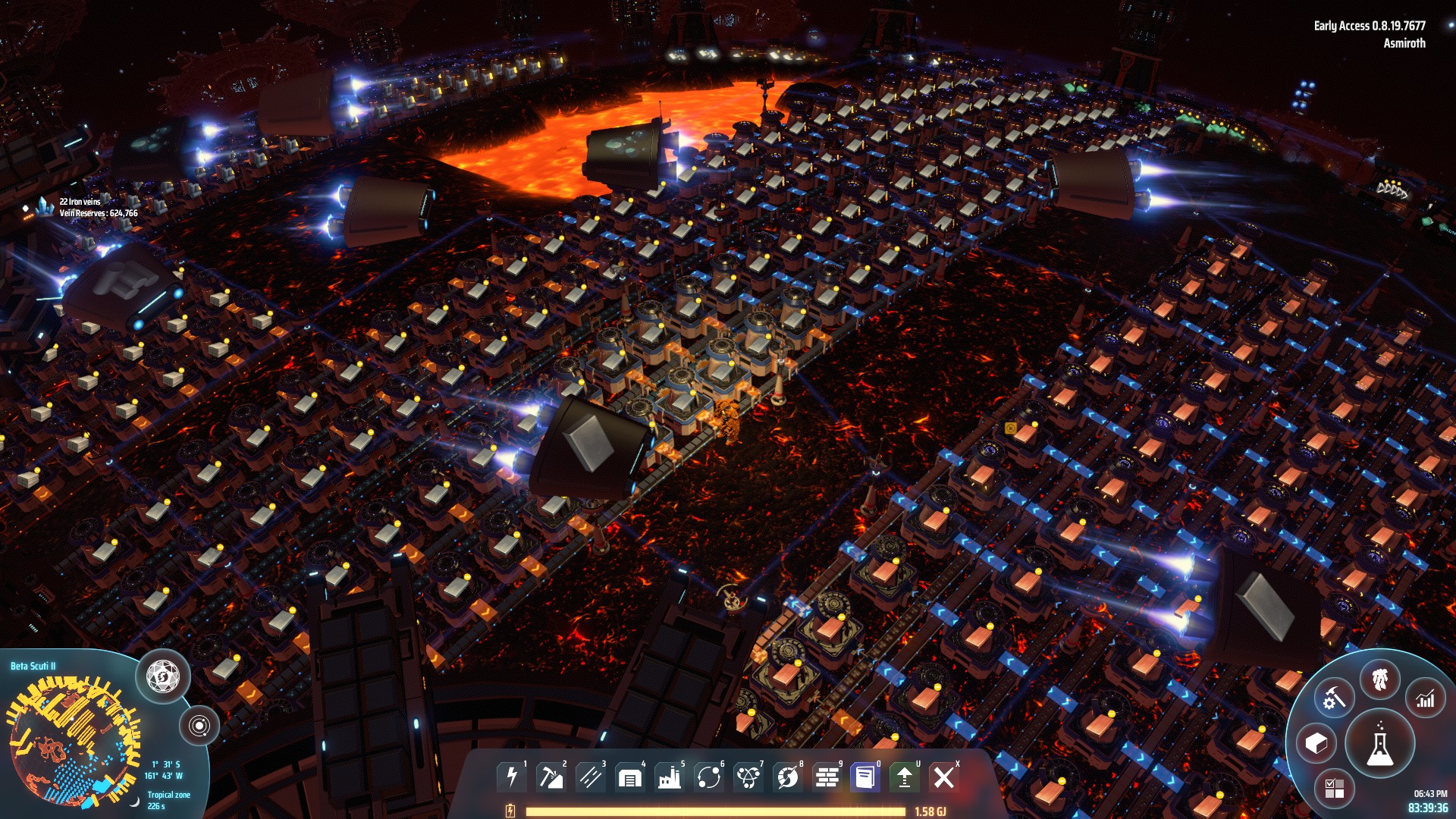
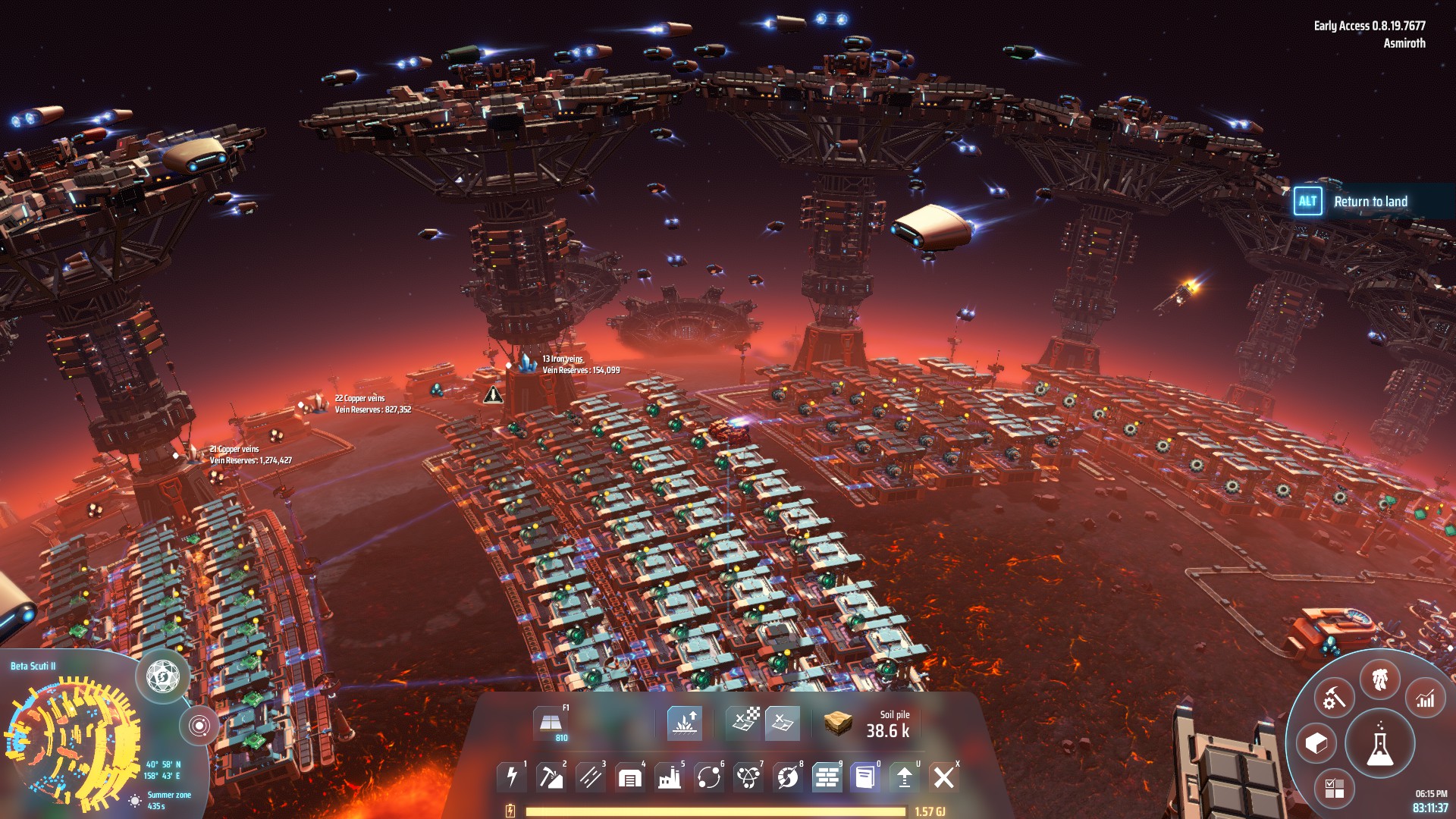
Look at all those transport ships! (lower left is all the production on this planet). Blueprints would have helped a lot!
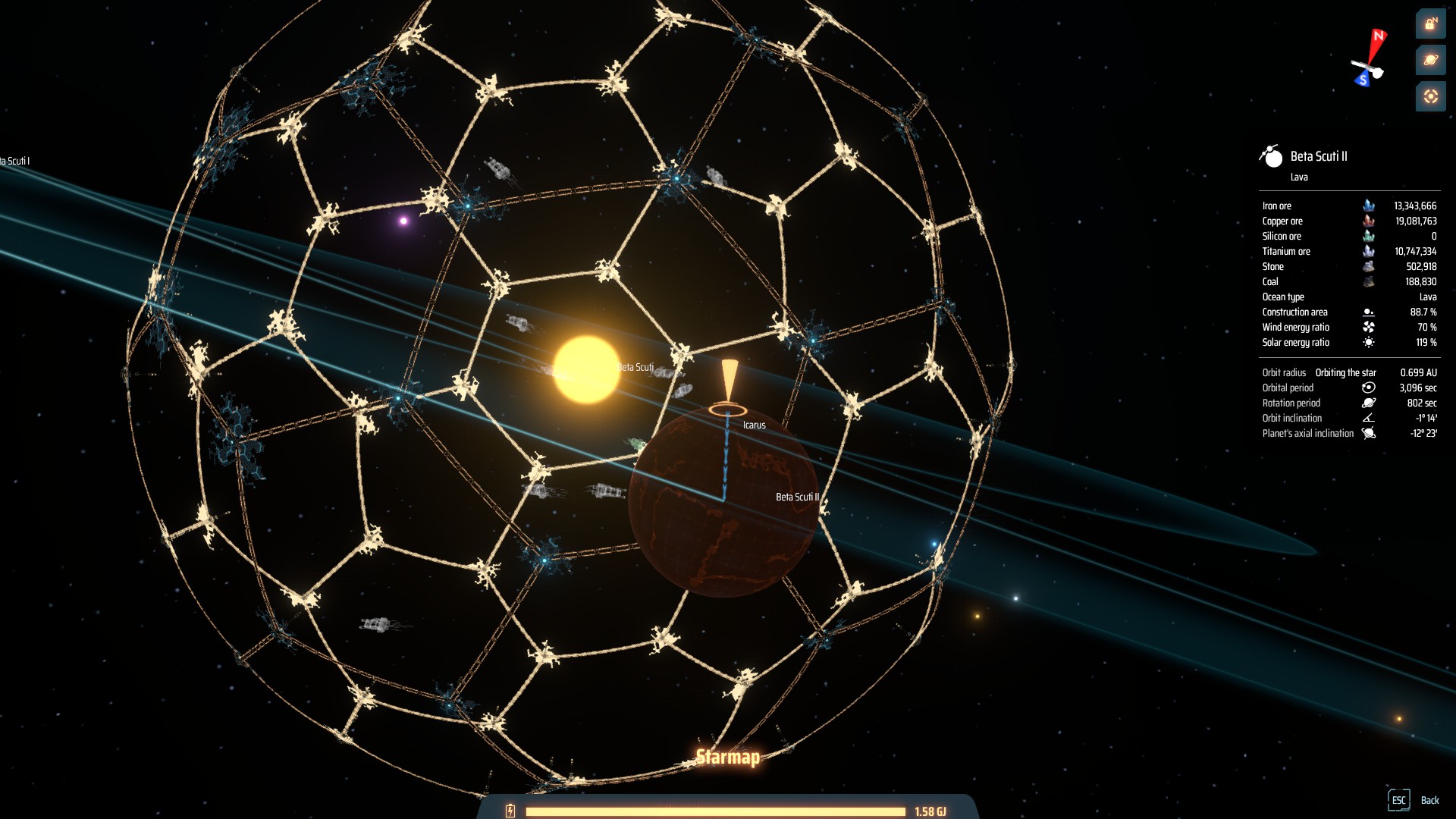
Each of those dots is a single sail. I need tens of thousands to fill all the sphere. Plus it looks amazing.
The interface to build the Sphere. TONS of sails.

Acti-Blizz Lawsuit

I guess it’s current affairs and game related…

Riot Games had a similar suit in the past, which had relatively small impacts in their organization. There were a fair amount of reports on it too, Kotaku’s of note. Curious to the larger outcomes. The $10m payout is peanuts for that company.

In this case, Acti-Blizz is getting his with a state-level lawsuit over discrimination. Personal lawsuits in the US are a dime a dozen. State-level efforts, that frankly millions of dollars invested just making a case. They don’t get issued without a rather high level of confidence that it can be proven. The penalties are not financial – Acti-Blizz revenues are $2b per quarter, so $10m is a hiccup. The penalties here are public, which is weird that we’re in the mode today.

High odds here that there are few execs that are shuffled, maybe a could lose their jobs (Afrasiabi left last year), but I would be really surprised is anything meaningful happens outside of some larger pay-outs to some impacted people. I say this because the executive leadership within that company has been extremely consistent that the only thing that matters is money.

Sidebar – I am convinced that EA has been doing an internal review for years prepping for their eventual suit.

I do understand how these events come to pass. Gamer culture for most of its existence was a “bro” culture, in particular in the more competitive space. Hell, IT culture was full of “a/s/l” questions and then pouncing on anyone that claimed to be female. Picking on Acti-Blizz here, but it’s rampant across the industry. It’s better now, but that’s like comparing a forest fire to a house fire. There are still some big issues to sort out. Riot Games is an interesting example here, as they went to great lengths to build a corporate culture that was reflective of their gaming culture – competitive and aggressive. Wilting flowers got nowhere. Acti-Blizz seems on another level though, where it was outright abusive, and top brass was aware.

What I find the most interesting in all this is the response that Acti-Blizz put out afterwards (emphasis mine).

We are sickened by the reprehensible conduct of the DFEH to drag into the complaint the tragic suicide of an employee whose passing has no bearing whatsoever on this case and with no regard for her grieving family. While we find this behavior to be disgraceful and unprofessional, it is unfortunately an example of how they have conducted themselves throughout the course of their investigation. It is this type of irresponsible behavior from unaccountable State bureaucrats that are driving many of the State’s best businesses out of California.

I have experience in how this process works, though obviously in another country. The company is made aware of pending litigation (if individuals are not indicted), giving the company some time to prepare their statements. The legal team at Acti-Blizz had time to prepare this statement and get it approved. The wording is purposeful.

Ad-hominem arguments are an extremely effective defense – they question the ability of an individual. You’ve seen enough where the defense questions the integrity of a witness, not the actuals facts of the case. The media has conditioned us to look past the facts and at the ideas – Nancy Grace is the best example that comes to mind. But this only works on individuals. It’s a big challenge to sway public opinion on an organization that is established to support people’s rights.

I remain curious as to where this path goes.

Logistics & Analytics

I’m an analyst by training, with a somewhat disturbing fascination with numbers. Not so much in the discrete numbers but the story that numbers can tell. There are 3 main phases – the pure numbers, the sanitation of the numbers, and then the trend of the numbers. Reddit has a neat DataIsBeautiful section that presents the mid-point of analytics. This is the flex point where data goes from being objective to subjective. You can make numbers tell any kind of story… CNN and FoxNews use the same data sets to spew completely different opinions after all. That aside, making the numbers do something is the foundation of factory games.

Factory games are a sort of inverted view, where the goal is set up and you are given some basic numbers to sort out. Like if I said, collect 100 lumber. You would go out and cut some trees to get there. Which trees, and where is up to you. Maybe you want big trees with a lot of lumber, or tons of smaller ones that are faster. Maybe you skip doing it and instead build a sawmill to speed up the process and save time later. The only thing that matters though, is getting 100 lumber.

At the start, factory games are simple affairs. Click a few buttons, collect things, make things, next. They quickly spiral to more complex things, were you need multiple steps working together, in order to meet an order. If I moved from 100 lumber and said make me 20 tables, well you’d need a saw, nails, and lacquer. Then I’d say, make me 50 houses. Then a town. Then a country. And so on.

The gains at the lumber space are linear. You will collect 100 lumber in 5 minutes of a game. Building a table though, each one may take a minute, so you’re 20mins to complete that task. And as you move farther along, more and more time to get there. Time to create is a limiting factor, but only in the linear sense. If you make more factories to make tables (say 20 of them), then it takes only a minute to make all of them. Of course, you now need 20x the speed of collecting the base material to feed the factories. And then the logistics of moving the material from the collectors to the factories.

But then you need to worry about space. You can’t just pop up a factory anywhere. Building them too far apart means you need to ship material all over the place. You will end up with “hubs” of factories that are closely linked and can share the supply chain. They need to be close enough to the base material and the transport method needs to support large volumes so that you always have material on hand to make things. Nothing worse than a factory sitting idle because it has no material to craft. And yet, you need real estate to build this stuff. There’s only so much land available to build upon, so things need to be tightly built next to each other to optimal.

Finally, you need to power all of this stuff. Sawmills might work with water, if they are near it. But if they are out in a field, then you need to get power to the mill. Same with the factory. Making power means finding enough sources of energy, and the mechanisms to process them, in order to over-supply your needs. You want more, so that you have flexibility to add more factories quickly. Not enough power means that your things run slower (if at all).

Frostpunk

Frostpunk is a really interesting game because it’s about failure avoidance. Most builders, if you step away, things just don’t progress. Frostpunk instead escalates bad events, either sickness, hunger, power issues, or ever increasing levels of cold. You rarely have enough resources to do anything, and need to send out expeditions to collect more materials. They take time to get there, time to get back, and there’s a chance they will die. You need to always be pushing the “safety blanket” level to best absorb the ever shifting disasters.

You’re limited in base resources, but also in power and location. Buildings fit into slots of sort, and you have a maximum in any area. Then you need to get power there, and importantly, heat the buildings where people are located (night buildings without worked don’t need heat, robots never need it).

It isn’t a factory game though, because it has multiple levels of RNG. Maybe you’ll get a giant 3 day storm, or maybe you find a huge hoard of coal. Your best plans can be completely trashed because of it. Factory games are about predictability. Frostpunk instead does a superb job explaining the limitations of a factory game.

Math Exercise

Factory games often benefit greatly from spreadsheets. Understanding the rates of items is key to optimization, so that you are as close as possible to the place where you are using 100% of capacity, without causing backlogs. If the table factory consumes 10 wood per minute, and you have 20 factories, then you need to be collecting at least 200 wood per minute. 150 per minute and then factories will stall. 250 per minute and you create an overstock of lumber that needs to be stored somewhere.

That’s a simple example. Multiple tiers of complexity later, you’re going to be consuming multiple products that are created at different rates with different material. Maybe factory 1 needs 100 wood per minute, and factory 2 needs 20… and factory 15 needs 75. Figuring out the base demands means you need to find more material and harvest more things. I’ll have a good example of this in a future post.

The spreadsheet helps to keep track of all the requirements, or the quick math needed to see how things work with each other. In particular if you’re looking to optimize, as even the smallest of numbers early on can have cascade effects at the tail end. The number of times I’ve had bottlenecks and tried to figure out why was often resolved through a look through the numbers.

Factorio tight design

It’s really hard to make a factory game, hence why there are so few. Factorio is the platinum standard. It spent 4 years in Early Access. Cripes, its hard to make any game, but the people who plays these games are looking at every detail. They are nitpicky by nature! So when something like this does come around, and it works, holy cow does it feel good.

Dyson Sphere Program

I rather enjoy hard sci-fi. Ringworld scratches a crazy itch, and it’s been revised a few times by scholars to be more accurate in terms of setting. I would guess that most people were introduced to the concept of a Dyson sphere through TNG’s episode with Scotty. The concept is amazing, but the practicality of completely enveloping a star at a planetary radius is just mind-boggling in scope. It’d be millions of Earths in size. You’d need multiple solar system’s worth of material to build just one.

Dyson Sphere Program is a game in Early Access that attempts to tell that story. Think Factorio but in a 3d world that’s representative of a cluster of stars. Factory builders are fascinating less for their results but for their elegant complexity. Building an automated supply chain that has dozens of steps, each sustainable and clean, is an amazing feeling. Right up there with an optimized SimCity in feeling (but not approach).

Early Access is a tough bag. There are thousands of games in that mode and few ever get off the ground, or give you something of value. For every Hades or Valheim, there are bins full of bad ideas and money grabs. DSP is a reflection of the former type, with an extremely well fleshed out structure present, with a clear start and middle. The ending, that is building an actual Dyson Sphere, is present but not as fleshed out as the rest.

Factory Builders

First, How to Build a Toaster from Scratch.

RTS games – let’s go back to Dune 2 – started the tend of collecting things, putting them in something to make something else. That concept of collecting, refinement, output is the foundation. Just imagine that, but dozens of steps, and each step itself using a different tool to collect or refine. Most idle games on are variants on this model, where progress is logarithmic, then you “reset” for more improvements to get further the next attempt.

Factory games do this without resets, and it’s almost entirely a numbers game. It’s a pretty spreadsheet. You don’t have a village resident with a weird demand for a baseball diamond that comes out of nowhere. You simply have a need to make more of something to start making something else. Production is not linear, as the factories themselves need a lot of components and themselves can only produce so much in a given time. You end up with factory lines to maximize the collection and production of items, then ship those items to the next chain.

The progress is incremental but noticeable. The best ones have clear phases that generally line up to manual, automation, and then optimization. The transition between phases is often followed with a dramatic drop in productivity, often with complete rebuilds to accommodate. The worst ones are slogs that provide painfully slow automation (sped up with MTX no doubt!), linear construction paths (item are used for only 1 purpose), or a set of obtuse mechanics.

The Good

The pace of growth and optimization feels good for the first good chunk of the game. Your first planet has most of the material you need to get going and the tutorials are sufficient enough to get the basics going. There are some systems that could use more explanation (terraforming for one given the soil material), and the technology tree could be revamped a tad, but on the whole this part feels just like any other factory game. Collect base materials, process them, make something, that makes something else, that makes more stuff, and so on.

If you enter DSP with an understanding of factory lines, this will be a somewhat smooth experience. If you don’t, then you may find it feels a bit like spaghetti, not so much because you lack space to build (there’s plenty of that) but you’re lacking the materials to move stuff around.

The research portion is well done, with the need for ever more complex materials to move forward with more complex research. Some things seem useless until you realize they are core to other super important materials. The early access issue here does have a few bits of things that have only 1 use, which I expect to change over time.

The logistics portion is an interesting dance. While you can unlock the ability to ship things across the planet pretty quickly, the power and transport vehicle requirements make it painful to get started. The snowball effect, once you ship your first titanium package between planets, is substantial. This is when you enter the mid-game.

The Middling

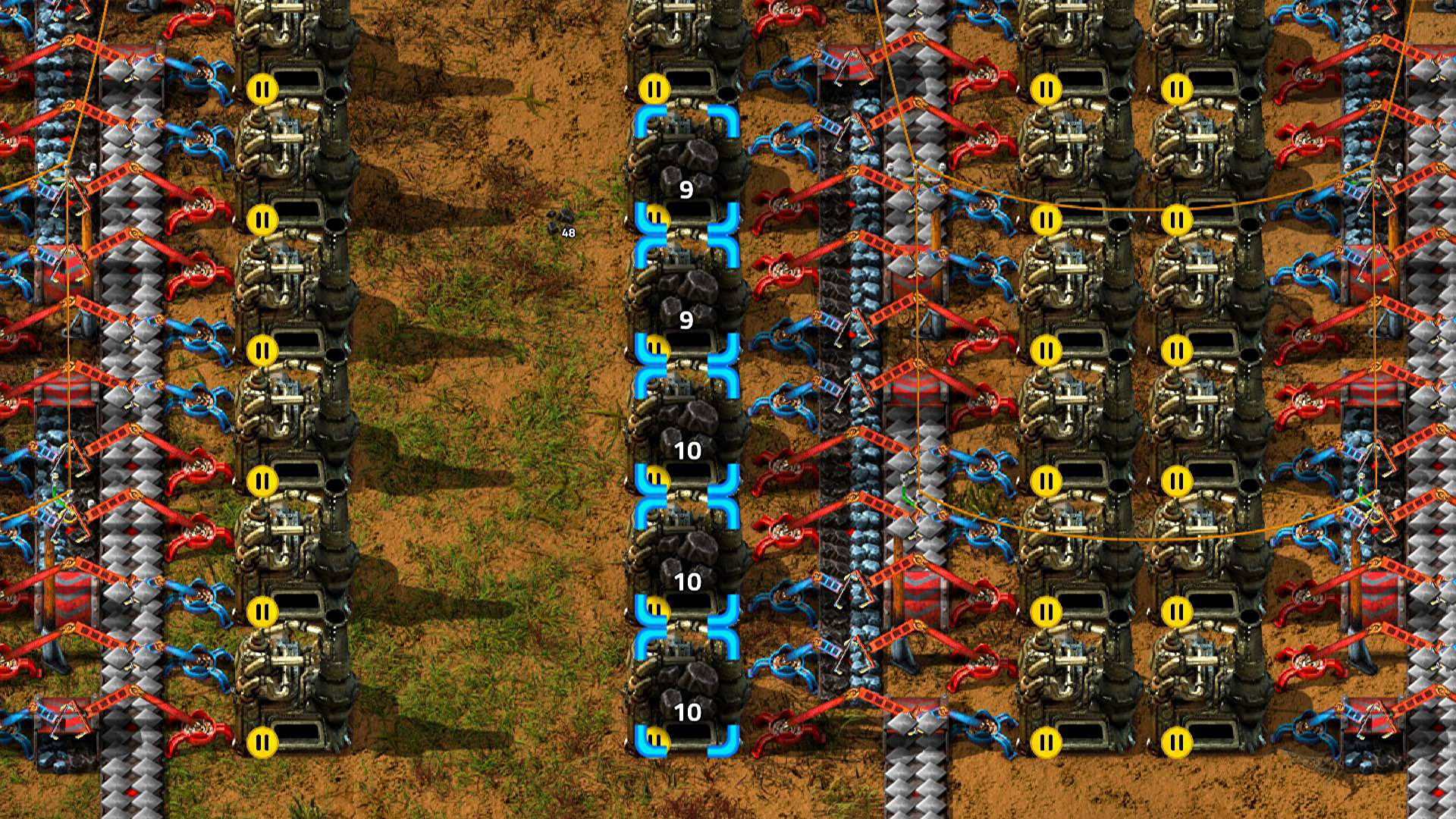
The largest pain point I have with any factory game is the minutiae of setting up belts and loaders. Early on it’s simple enough, you’re only building 1 or 2 things. When you need to build an oil refinement line, which has 50 refineries, it’s extremely annoying not to have the ability to blueprint layouts. Thankfully the game supports mods – and these are almost required in the mid-game. It’s somewhat ironic you can automate the creation of ships, but not of factories. The July 23rd patch is supposed to bring this in, I am super stoked!

The travel time between planets never really improves. I encountered an issue with power generation on one planet and it feels like wasted time having to go back and forth to sort everything out. The logistic vehicles are also speed/rate limited, so for ultra high-demand items, you’re going to need more stations rather than noticeable improve existing ones.

The mech improvements page has some major milestone improvements that are hidden in the text. Learning that you can fly to another planet was accidental. That I could warp, or stack sorters vertically even more so. All factory building games have an obtuse section of learning, where once you get it, then it changes your perspective on the game. DSP has a fair chunk of those – and the wiki doesn’t really help. YouTube videos for the win!

The Bad

Inventory management is painful, as are stack sizes that are inconsistent. Why does one thing stack to 10 and another to 200? Sure, you’re going to have storage chests lying around but with SO MANY items needed at any given time, it’s really hard to find out where they are. I’ve automated the creation of Oil Refineries, but I need to fly around the damn planet to find out where they are stored. Because Logistic Towers are limited to 5 slots and there are 2 dozen useful buildings, I’ll need to build a big complex to just store stuff.

Power generation has 5 phases. Wind, Coal, Solar, Hydrogen, Deuterium. The first 3 phases are all super quick and useful. Hydrogen feels almost accidental, especially once you collect from gas planets. It takes a long time to get to a place where that’s going to happen. Deuterium takes even longer as it’s a pain to collect. The early game has minor power issues, but the mid-game is when power generation is always an issue. And the method to address is (Accumulators + chargers) is it’s own logistical nightmare. When you’re low on power, things take longer to make, so it’s a giant snowball effect. And the game takes its sweet time to allow you to effectively store excess energy. That whole subsystem could be improved.

The actual Dyson Sphere portion feels like a different game, with it’s own interface. It has a very complex set of materials, a math-based construction period, and it’s own power generation system. You’re exposed to it quite early, but that version decays over time and it is not explained when you start. It’s friggin’ cool as all hell to see the sphere from the planet you’re on, but the system that underlies it all needs some more structure. Given this is the end game (and the name of the game), the devs are working on this point.

The Devs

5 devs, that’s it. How games like this and Valheim (FYI – the Valheim devs ALSO built Satisfactory) get built with tiny teams is beyond me, and frankly should make any studio over 50 in size start questioning a lot about their business models.

Patches seem to be almost weekly, and the devs are extremely forthright in their notes. It’s clear from their notes that they are responsive to player needs – optimizing belts was the most recent item that was a huge quality of life improvement.

Buy or Wait

There’s more here than in nearly any other factory game out there (save Factorio and Satisfactory). If the concept of building a vast production empire that covers multiple star systems intrigues you, then pick this up now. Be warned, you’re going to spend dozens of hours here… I’ve lost track of play sessions numerous times. Even if the game launched today, full release as-is, I’d highly recommend it.

I’ll have a few more posts in the future on this game…

Steam Deck

I own a Switch. My favorite games on it are all first party or exclusives. I bought it solely for Monster Hunter but have found it does a great job for other games too. The simplicity of Nintendo just works here, though I will be the first to point out the price points of everything after the console to be a bit absurd.

I own a PC and I have hundred of games. I’d argue that about 50% of my catalogue is best played with a controller. I’ve used Steam Link from my tablet to access games with no issue.

What both of these have in common is that they are fundamentally moved forward by quality games. XBOX sold like garbage for years because they only had exclusive FPS and racing games. Give me something like God of War and that’ll move units. Google Stadia had a really rough go to start because it lacked games, there’s some progress there I guess. But it’s still limited to network speed, which is a real pain in the butt. Mobile gaming needs some local footprint to reduce the network demands (e.g. gaming on the bus).

Steam Deck is not the first handheld PC, but it’s likely the one with the largest amount of backing. It’s directly competing with the Switch in terms of game quality, regardless of what anyone says. Bluetooth support alone (BTLE) is astounding that it’s not present in the Switch. It’s outside the Nintendo ecosystem… no question. But the sheer amount of games and peripherals available here are just mind blowing. That you can potentially play any game that’s on PC is a game changer (pun intended).

There’s the natural caveat that this could be another pipe dream from Valve, where the concept falls apart in the execution. Aside from Steam itself, Valve is notoriously bad at support post-launch. They have the best VR on the market, but it’s $1000 to start, which is beyond dumb.

I am not a person who lines up upon release to get something new. I’ll let all those lucky folks play with release 1.0 and wait for the next version. Not for the price drop, but the amount of patches that’ll be required to stabilize the darn thing.

As an aside, this to me really re-enforces the ultra niche appeal of customized PC rigs. Aside from the astounding costs of a high-end rig, the lack of mobility and need of major desk space to accommodate is the big hurdle. Gaming laptops give you the flexibility of some mobility and desk space, but they still cost a fair chunk. Getting a mobile PC rig for less than $500 that can play almost anything… that’s half the price of a smartphone.

I’m cautiously optimistic about this thing. We probably won’t see the true impacts until next summer (supply chain questions abound), and an ironed out system in time for the 2022 holiday season. Going to be a real interesting thing to watch.