I’m about 5 days away from a major project milestone, the initial delivery. Quick rewind, I onboarded to this project in September, did some homework, and relaunched it at the start of October. So about 10 weeks to get to the first delivery point. Projects of comparative size/complexity usually take 2 years to get through, given the amount of gates & approval stages required. So delivering anything in this timeframe is already a major achievement, getting something useful is practically unheard of.
I remember watching variety shows when I was a kid. Sort of like America’s Got Talent today I guess, but it wasn’t a competition. I always enjoyed the magicians. There were a few acts that were edge-of-your-seat – think of knife throwers, tightropes and whatnot. One particular act involved putting bowls/plates on long poles, and spinning them. It started with 3 or 4 of them, and then they just kept adding more and more. You’d see the plate start to wobble, ready to fall, and they’d magically find a way to get it back on track.
Project management is a lot like this. It shouldn’t be, I’ll readily admit that. Not everything goes perfect in any project, and with adequate planning and time you can manage a few wobbling plates. With less time, a LOT less time, you still have the wobbling plates just not enough time to get between them all. As as result, you need to prioritize which ones need to keep spinning and which need to crash.
The biggest problem here is that while I am talking about spinning plates, the reality is that each one represents actual human beings. They have a vested interest in keeping that plate going. Most of the time, the wobbles are outside their control and they just need a quick hand to get things back on track. Telling a group of people that the work is a lower priority and therefore has to stop, well, that has all sorts of impacts. Sometimes they take it well, sometimes not. In the current work climate… stopping work isn’t usually a good sign that the work is going to exist long-term.
Right, more analogies.
We are all sponges. We can absorb a lot, but we need time to release it in order to absorb more. We each have different reactions to being oversaturated, sometimes mental sometimes physical. I know that my symptoms are primarily physical. The body just doesn’t want to fully cooperate, sleep is hard to come by. Without some relief, the mental part starts to fade with lower engagement and lower patience levels. I can still problem solve relatively well, but I gradually lose the ability to consider the people impacts and focus solely on the end goal in order to get some respite.
So right now, as I’m typing this, my lower back feels like it’s gone through the wringer. Sleep is fitful. Patience is low. The stuff I generally enjoy has lost a lot of shine. I am convinced that this will release next week, and I’ve already set time to take some steps back and breathe.
I remember playing Arkanoid when I was a kid and being amazed at what a mouse could do. Ball x Pit is pretty much Arkanoid on steroids.
To state clearly for the record, this is not a game you play forever. After about 20 hours or so, you’ll have seen pretty much everything. The NewGame+ mode isn’t more than reskinned + harder levels. Still, for the price of entry it’s hard to find a better deal.
And as always, the game is amazing on the Steam Deck. Very easy to pick up and go.
The Basics
You have a character, they shoot 1 or more balls towards enemies that gradually move towards you. There are 2 mini bosses and a final boss per level. Complete the level with a few characters (that you gradually unlock) to get access to more levels. Rinse and repeat.
The Twists
There are a couple big ones. First, you have a home base where you place buildings and farmable areas for resources. This is the meta progression of the game. These unlocks come through random drops (blueprints) in levels and gradually increase in power.
Second, you are provided ‘special’ balls that have additional effects, like more damage, poison, frost and so on. You can combine these balls to new balls (evolution) or merge them for mixed effects (fusion). Understanding how these work together is important at first, and less so as you progress when you can brute force some pieces. Iron + Fire = Bomb, a super strong option for early levels. Ghost balls pass through opponents, quite useful.
Third, each character has a perk of some sort that you need to work through. Maybe it’s more balls, maybe the balls come from a different location, or you use a shield to bounce them. The last character allows you to AFK. You also acquire passive boosts per run on your character, pick those that complement the character perks. Increasing a character’s stats, even by 1 point, has a significant impact. Trophies for clearing zones improve the more character’s clear it, also a significant boost.
The Optimization
Rogue-like games always have optimizations and here is no different. Resources are key to progress and initially gold is a huge bottle neck. To start you can only harvest once per visit to town, which resets every run. With a few gold mines put together so that the harvesting characters ‘pinball’ in a small place, you can acquire some gold, start a run, quickly fail it, then get more gold.
Eventually you gain the ability to buy more harvests, and as long as each harvest is 75% or less the cost of a purchase, you can farm more and more gold. With all characters and max gold mines, you should be able to get 3,000+ gold per harvest. Takes a while to get there though.
Harvesting wheat/wood/stone is different and honestly less than pleasant until the final building is unlocked. 1 farm, 1 lumberyard, 2 quarries gives you 4 people harvesting big fields every few minutes, with everyone else in a gold mine. You can use the gold you get to buy more resources through the market. When you finally DO get the last building, then it’s honestly about being offline (game closed) with 3 farms, 3 lumberyards, and everything else in quarries. When you restart the game you’ll have tons of items, probably 500k gold worth. With that you can upgrade the infinite buildings for more stats.
The more stats piece is only relevant to the NG+ mode in truth. By the time you get there, you should have a good grasp of the game.
Maraxsis is a planet mod that’s meant to be available at the same time as Aquilo, which means a significant amount of challenges. One of the challenges is spelling the name of the planet!
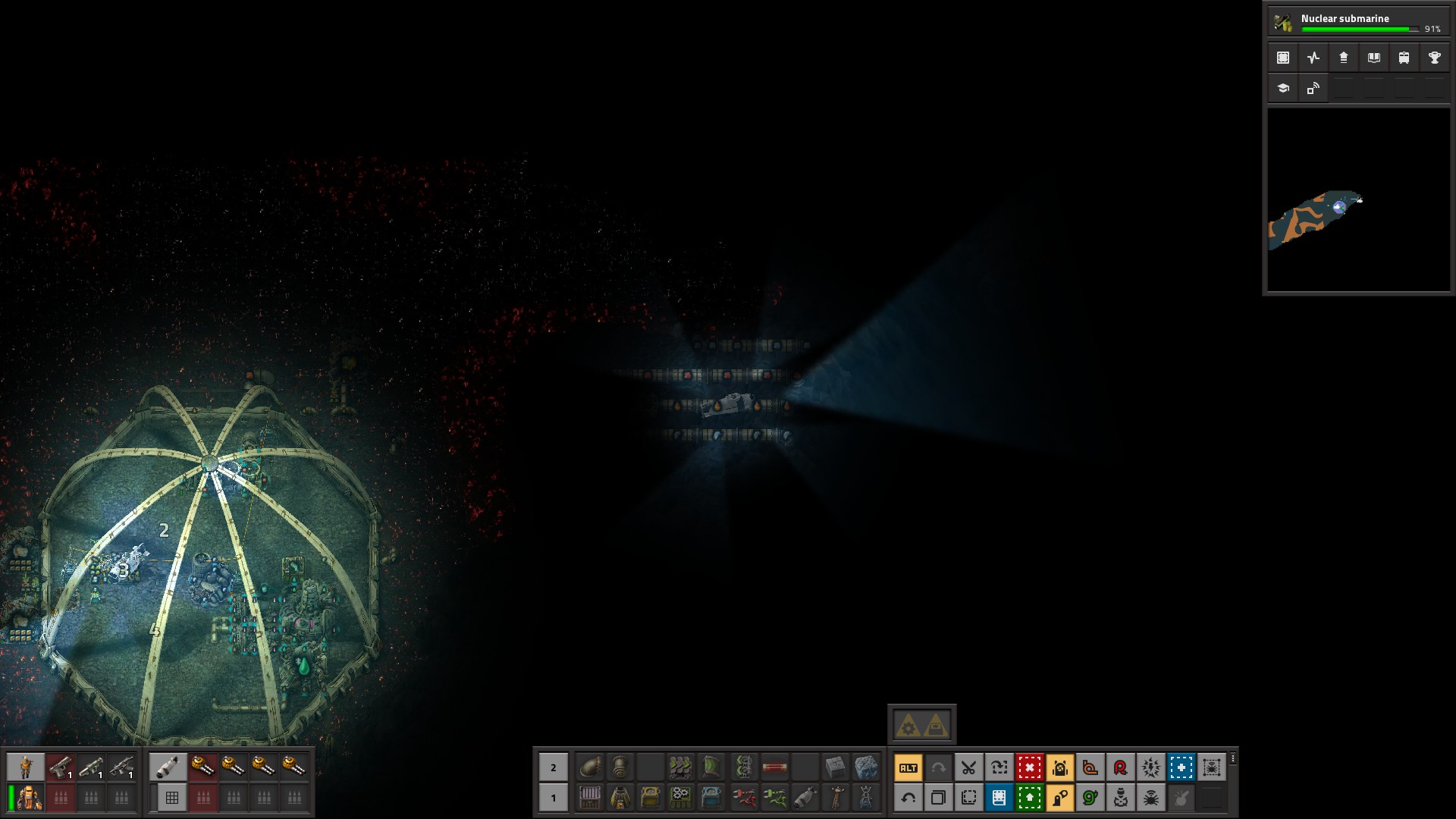
The planet is covered by water, preventing most buildings from functioning on the surface. You need to build pressure domes, which significantly limit your floor space. The good news is that these act as roboports, the bad news is that you need to ship in barreled atmosphere to get them to work. You can overlap their logistics range so that robots can work in and out of the domes, and across them. That leaves space between them for other buildings and dramatically reduces the need for belts. Maraxsis also has spots on the map that lead to a trench that has no light, very high pressure preventing nearly all buildings, spots of lava, and no method to move things between the trench and surface.
Now, the real pain in the butt part of Maraxsis is the main new building – the Hydro Plant. This building gives a base +50% to quality, which means you need to deal with 5 potential outputs/inputs. There are ways to get logistics to filter based on quality but it’s finicky. You can either build 5 versions of a building (useful for salt filters and research) or you can just recycle the material based on quality (e.g. rocket fuel).
Maraxsis requires a ship that can head to Aquilo, needing rockets and significant storage space. If you’ve already solved Aquilo and unlocked fusion power, you will solve some fairly large headaches. If you haven’t optimized Vulcanus / Gleba / Fulgora you will have a bad time. There’s a ton of back and forth here as you need odd items that shouldn’t be crafted on the surface (such as 8 types of new pipes – required to interact with the trench).
Note that once you land on Maraxsis you are stuck there until you solve all the core puzzles, which unlocks rockets. And it will take longer to solve this planet than most others.
Complex vs Complicated
These things are very similar. Quite a bit of life is complicated, where things are intertwined without a whole lot of rhyme or reason – lacking design principles. Everyone’s initial attempt at automation games is complicated, with belts everywhere. This is normal – you don’t know what’s coming and can’t really prepare for it. At the start, a single mine with a single smelter produces more than you think you’ll ever need. Eventually you’ll dedicate a planet and have hundreds of smelters. You can either build those one at a time, and have a complicated setup, or plan better.
Which is where complex lines up. Complex is when order and efficiency is applied to complicated. Computer chips are complex. They are tiny little things that perform magic miracles. Your phone is infinitely more powerful that the tube and vacuum computers of the late 50s which took up floors of a building.
Factorio is notorious for complicated. Space Age even more so with the roulette aspect of legendary materials. Some pieces can be ‘easily’ simplified. Others are insane. Try building a legendary upcycler for quantum chips on Aquilo – that is a wild exercise!
Maraxsis is very complicated, as it throws a bunch of curveballs at you. Multiple types of quality, very limited construction space, complex production chains that require buildings from every planet except Aquilo, and a near permanent shipping of off-world items to keep the planet running.
Starting Off
Consider this a first landing on any planet, and one where you will need at least 10 of every building you can make – including Biochambers and Agricultural Towers. You’ll also need a decent shipment of blue chips, tungsten plate and carbon fiber. Depending on if you have fusion power or not, you’ll be shipping that or nuclear plants. You’ll also want to build a diesel submarine as soon as you land – you’ll die in 15 minutes of exposure to the planet surface otherwise.
Place the landing pad, bring down a chunk of stuff, build a sub, then delete the pad and explore. You want to find a spot that is near a trench (a dark gash in the map) and near a coral reef. Your eventual base will need quick access to both eventually. The closer to a trench, the more cliff explosives you’ll need to clear the land.
Your first goal is to lay out a power grid – I always use a 50×50 one which is based on roboports (which cannot be used on this planet). Build a hydro plant, and then build a pressure dome. Placement of that dome should be 1 grid away from the trench and generally in the middle of the grid. Without power you can’t really tell how much range it has, but pretty much anything within the 50×50 power poles will be withing robot reach. So place down the landing pad in that spot, and eventually it will connect to the dome network!
The power pressure dome, which also processes atmosphere. I had done Aquilo thankfully – yay fusion!
From there, the progress is somewhat linear. You need to refine the salt water, then you need to pump lava from the trench to get foundries running. That will require a new production line on Vulcanus for the new types of pipes. From here, you’ll need to set up a fish farm and refinement with biochambers + towers – very similar to a Gleba setup, nutrients and spoilage to manage. This part starts complicated but design experience here helps a lot to optimize with an external pipe bus. You only need to unload atmosphere in 1 dome, and you can pipe that to the next ones. The hardest part here is going to be the shipping of logistic bits to the planet.
The factory dome. Note the recycling station in the top. The left side is the water filtration plant and a really simple quality management option.
After having solved Gleba, this was pretty easy. A good example of complex vs complicated.
Phase 2
After you solve the fish farm part – now it gets complicated. You need to create material in the trench, which has no power sources. Maraxsis went through some design changes and the salt reactor is both simpler and more complicated than before. It’s a nuclear plant on steroids, and you need to pipe the supercritical steam down to the trench to power a specialized turbine. This also means you need to build a patrol for the submarine to move material from above to below and back again. This requires ports and is quite similar to train logistics – if a bit more finicky. This unlocks the hydro science – which has 5 types of quality ingredients to manage, so you need 5 production plants. Feels like details at that point. Project Seadragon opens up and allows you to build rocket launch pads! Finally an exit!
The Trench. Wyrm processing on the left (and power) and the 4 ducts leading into and out. Not shown, a recycling plant to manage excess quality items.
Phase 3
Except it isn’t. You need to build sealant. Sealant requires gas from the planet and heavy oil. Heavy oil is acquired in the same way as on Vulcanus – painfully, oh so painfully. This part honestly sucks, because it’s complicated instead of complex. Interacting with the trench yet again to create sulfur, breaking down carbon with calcite to get coal, kickstaring coal liquifaction, then a chain to refine light oil and petroleum oil. This production chain takes up half a dome, and pretty much completes the planet.
The processing dome. Science in the bottom left (double regular), and sealant processing on the right. So many pipes.
By the time I left I had 4 domes.
One for power, steam, atmosphere, batteries
One for foundries and assembler crafting
One for processing fish products, research and oil processing
One for power in the trench
Residuals
There are 3 pieces left to manage here.
Prometheum science is unlocked with this planet’s research. You will need to export it and bring to Nauvis. This sucks because you need to import 5 different qualities of research packs, and then set it up on Nauvis for import and distribution to your labs. Aquilo research is required, so head’s up there too.
Balancing is an issue. 99% chance you don’t have enough salt and you have way too much hydrogen. You will need to apply balancing here, notably flare stacks (another mod) that burns any excess gas – a pump with a condition to only activate over 20k in storage is enough. There are other balancing issues you’ll need to sort through, notably wyrm containers having so many quality types
Extra Research. More cargo landing pad space is a weird thing to need – but I guess it has uses for late-game 1million+ SPM folks. The nuclear sub costs is 5x the cost of a regular sub for twice the benefit, and the diving equipment just means you can survive outside a sub. There’s a new type of beacon with greater range and less effect (which I’ve yet to craft) and some other bits and bobs. Other than gating prometheum science, nothing to write home about here.
Conclusion
Maraxsis is a very interesting puzzle. It is more like Aquilo in that it requires near constant babysitting with space logistics, and a generally limited floor plan to get the pieces working together. The quality piece is a choice – either you manage it through logic gates or multiple stations, or you just chuck all the stuff you don’t want in the recycler.
The only true negative piece I have here is the interactions with the trench. The duct piping is annoying to manage as it has to be crafted off-planet, has too many pieces, and getting what you need in/out requires a very specific placement of vertical pipes. Getting power down there was harder than it should have been. I was able to solve all the problems myself here, which was different than Cerys’ death machine of a nuclear plant, so that’s something. I am not a fan of Maraxsis research being tied to late game science productivity mind you.
The overall good news here is that while Maraxsis is a very complicated planet, it allows enough flexibility to optimize to reach a complex state. I’d recommend a pressure dome flow away from the trench (e.g. trench on left, domes progress to right), with the pipe bus on the opposite side of the fish farm (above or below). 5 topside domes, spaced for maximum roboport distance, allows you ample room to build everything at massive volumes, and have a good quarter of one dome meant solely to recycle/destroy excess items. There’s a lot that can be done to optimize here.
Again a note that Cerys was attempted right after the starter planet (Nauvis). The net impact is that some research pieces are not complete… but honestly none of that matters as you can’t ship anything to the planet. Generally, what you can build on Nauvis you can build on Cerys, so you need to be somewhat creative in your options. This excludes robots for a very long period, as lubricant takes a long time to sort out.
The initial landing is a mix between Aquilo and Fulgora. You have nothing but your suit and a mining pick. You need to mine some nuclear scrap and then, just like Fulgora, recycle it to semi-useful components. This feels more like the start of the game where you just don’t have tools or automation ready to scale, so you’re hand crafting everything. It’s super important to run across the small map and manually collect all the material you can see… it gives you a chunk of solar panels, accumulator rods (more on that in a bit) and blue chips. The same rule of thumb remains : don’t recycle items you cannot craft.
My version of a recycling plant.
Power is interesting here. Substations are easy enough to create and solar+accumulators work in the cold, so the lower right part of the map is the best location. Using a grid approach, you can generally map out and power the entire moon surface. Generally.
The issue is the slew of heating towers, crushers, and Cerys factories. Heating towers melt an area around them (if there’s water, it needs bricks to stay solid) and need solid fuel to work. I opted for a stupidly complicated sushi belt of solid fuel across the map to feed towers that were close to the middle, and then a second ring for the outer parts, on a lower priority. It takes about 10 recyclers running 100% on nuclear junk to generate enough solid fuel for the towers. This means you need to have a re-processing plant for all excess material, effectively doubling the number or recyclers needed. This is a fun exercise of logistics, compounded by a very limited workspace.
A plant in the middle of nowhere with belts feeding in and out.
Due to the nature of the frozen moon, you can’t easily build a main bus and you don’t have robots… so it takes a while to get it all sorted out – mostly through manual means. This is mostly stop-gap until you un-freeze the first of multiple factories, and where the 2nd major step takes place.
These factories are part of the map, cannot be moved, and must be kept thawed. Unlocking each requires blue chips and repair parts (which don’t stack). You can then use the factory to produce a given item – all of which are needed to proceed further. It’ll take about 10 of them by the end, all producing something different, in order to complete the moon. This will generate spaghetti runs of pipes + belts to move things from one factory to the next. Ya gotta do what ya gotta do I guess.
It takes a bit to unlock all the various pieces in the research tree, which is fine enough with goals. You then reach a challenge in acquiring 3 key items: Carbon, Fluorine, and Plutonium. None of those have obvious methods.
*Spoilers*
Carbon is normally only craftable on Gleba or from space material. You can’t build rockets on Cerys, so you’re going to use Gun Turrets to shoot the small (and specific to Cerys) asteroids, manually pick them up, and use the thawed crushers to turn them into Carbon.
Fluorine is on the right side of the moon, which is permanently frozen. You need to activate the main nuclear plant and use heat pipes to extend far enough to melt the mining locations (all of them), then use the Fluorine to make Lithium. It is a VERY good idea to have liquid storage containers in a thawed area in case the nuclear plant loses power. It will lose power.
To get the plant to work, you need plutonium. The only way to get plutonium is a random event where a particle interacts with nuclear ore. There are no instructions on how this works until very late in the puzzle. Complicating matters is that the nuclear plant, when active, shoots deadly particles that kill you in 3 hits. There are no explanations on how to prevent this from occurring but the answer is oddly simple… liquid storage containers with liquid water – not ice – water. You need to run heat pipes out from behind the containers, so a minor puzzle to sort that out. Getting enough plutonium is a crazy stupid exercise of trying to manipulate particles using the charging rods with polarity settings. Odds increase the more uranium per container, so the problem gets easier to solve the further along you are.
That this is the solution to not dying is obtuse. Hope it saves you time!
My version of the plutonium generation plant. Particles move left to right and use magnetism to hopefully trigger a reaction on these boxes. Each has 500 uranium at least.
*End Spoilers*
Once you have those pieces sorted out, the immediate priority is building robots through lubricants. Roboports are easy enough to create and having a dozen logistic bots completely trivializes all the puzzle pieces. Heating towers + plutonium problems all go away. Collecting asteroid chunks is 100% automated. Cerys factories can be easily automated. You’ve effectively solved the planet and can move on…
After you leave the planet, it’s still a good idea to keep researching Holmium boosts as that is a right pain to manage on Fulgora long-term.
End Thoughts
I rather enjoyed the puzzle aspects and the need to really be aware of the total environment. Expanding the available area takes a while to sort out in any sustainable manner. It’s fun to have different things to sort out without the typical toolkit of buses and robots. Honestly it reminds me more of the first time I played Factorio and just trying to figure out how to get 2 buildings to talk to each other without me being involved.
More directly, I would recommend Cerys more for new playthroughs and the first planet visited rather than adding to an existing save. You don’t really gain anything super long term here, but the loss of all automation tools is extremely jarring, even if the duration is ‘short’.
My brain works in interesting ways. I tend to gravitate towards correlation and inference quite naturally, which doesn’t always work out. It makes the world this giant spiderweb of interconnected pieces, where pulling on one tiny bit can have effects at seemingly completely randoms spots. Things like climate change impacting well water, which impacts purification, which impacts hockey rinks, which impacts hockey teams being able to play, which means more travel, which means more traffic and more planning, which means a tighter schedule, which means improved meal plans, which means… it can be paralyzing at times. The whole thing is this giant puzzle that’s always moving.
Then you have mystery boxes, which require you to just accept that things go in and things go out, but without causality. Using the connected pieces above, it would be more like going from dry well water straight to scheduling with no real reasons between. I struggle tremendously with letting go of my desire to understand and mystery boxes absolutely fascinate me in their complete breakdown of logic. Put in a chicken, get a thunderstorm. Put in another chicken, get soup. Like what the heck? Under most circumstances the magical box is simply a quick method to gloss over details. In the poorer versions, like say a science fiction serial, mystery boxes become writers crutches. Star Trek’s holodeck is absolutely notorious for this.
Games
Return of the Obra Dinn and Strange Antiquities are good examples of puzzles with inference. You are given contextual clues (e.g. this item turns blue when next to a flame, or this person’s bunkmate was taller) and from that, you need to extrapolate answers. Given the amount of questions present, there’s a validation exercise for each guess, and more clues are discovered as you go. There’s a quiet joy when you make a stretch guess and it opens up a new area to discover. The development challenge is difficult, as you need to create breadcrumbs to a conclusion you’ve already come to. You can’t give the answer, and you can’t give super obtuse clues that conflict with others. The sanity check alone is massive, and frankly harder and harder to do as more and more people know the answer.
I like factory production games because they act as mystery boxes when fully formed. If you do it right, you put in a few items and out pop rocket ships. Often, these games focus on logistic puzzles so that you can optimize the box – logistics mostly about moving things from one place to another.
Factorio vanilla, DSP, and many others in the genre focus on belts/trains to move things around. Foundry’s recent-ish patch for space trading implemented a giant mystery box that negates 90% of the logistics issues.
Factorio Space Age broke this model, or rather evolved from it. The start planet still has logistics issues but by the time you leave, quite a few of them are negated through fleets of robots. Robots have amazing throughput options and absolutely remove a pile of spaghetti design for logistics.
Cerys
Cerys is a mod for Space Age that puts you on a planet that’s a mix of Fulgora (materials generally come from recycling material) and Aquilo (the planet is frozen and needs to be melted in a very linear fashion). I’ve completed the game a few times now, so I’m quite aware of the tools and their applications. A recycling plant is not hard to build, but building logistics between ‘islands’ of thawed areas, or fixed production plants across the planet is challenge for sure. Bots are not an option until the puzzle box is solved.
The good part is that with a set of knowledge coming in, most of these challenges can be sorted out. The less good part is that there are 2 new core mechanics introduced that do not make any sense on the surface – both relating to particles. How you can control, defend, deflect these particles is fundamental to the larger planet puzzle. I was able to infer to a degree how one of these mechanics worked, but it’s also quite RNG based and hard to validate. The second mechanic absolutely eluded me and had zero in-game context that I could find. I still honestly have no idea how you’re supposed to figure it out. That said, once the solution was present it wasn’t terribly difficult to work my way around it.
I’ve yet to complete the planet, and I don’t see any particular benefit long-term to maintaining a presence (aside perhaps Holmium productivity boosts). I also don’t really see how anyone could appreciate this particular puzzle box without first having spent time on Aquilo in a previous playthrough. I figure I have a few sessions to go to close out this mod and then try a new one.
I don’t think I’ve ever gone this long without a post! I’m sure my mental space is in rough shape because of it too!
While my kids’ hockey seasons are well underway (started end of August and both play competitive), that is not really a difficult bit to get through. The real challenge is work.
New Project
I was approached in August to provide some experience to a key project that appeared to be struggling. My approach is always focused on getting the emotional state sorted out so that the material items can be tackled. The key players all need to simply vent their frustrations before logic can be applied. Complain first, get it out, then get to work. I basically went on a listening tour.
A few bits came from that exercise. First is that everyone wanted the idea to succeed – a key piece in buy-in. Second, there were some quite significant concerns on the ambition of the plan – sort of like trying to get people on the moon in 3 weeks. Third, the team leading the change did not have the benefit of experience to guide them, which meant they were building and learning at the same time. Overall, there was a sense of confusion / exhaustion, where they were all working super hard but not moving forward like they wanted to.
To be clear, I am no saviour, I have no super powers. I bring experience and a wide network of contacts. My arrival by it’s very nature brings disruption and change. And it’s not like we don’t have enough change all around us anyways, right?
Without getting into the details, the change has had mostly the intended results. Things are being delivered, people are focused, there’s a clear path to success. That’s the good. The less good is the human impact, where some relationships have come under significant strain, if not outright broken. Point one above was about everyone wanting this to work, and it really sucks when there are people issues along the way. There are always people issues, I get that part, but it still sucks. Doubly so as replacing each of them takes some time and the project can’t really afford any delays.
So guess which lucky person gets to pick up the pieces until the right folks are at the table? The great news about networks is that you can often find some friendlies to help you out. There’s a lot of that right now. Every day has a half dozen escalations that need to be managed, which means more people-ing.
All this together adds a level of exhaustion I have not felt in years. It has a ton of impacts outside of work. And clearly, none of this is sustainable.
The good news here is that there’s a large amount of support to make this sustainable, and the recommendations are for the most part, accepted and implemented in very short order. And there are a lot of changes.
Gaming
Most of this has been on pause, or rather extremely sporadic. There are a few though worth noting
Strange Antiquities: A neat puzzle game where inference is key. I like these games as a fun distraction, and it works well on the Steam Deck too. It should be played with a specific accessibility function enabled (auto-label things), and has some margin of replayability. Well worth the entry price.
Hades 2: A GotY candidate, and an improvement in nearly every single regard to the original. I had bought this in EA over a year ago, and many aspects have been improved, quite a few dramatically so. I think there’s more build diversity here as there are more levers and choices present, compared to the first one. Thing thing rocks on Steam Deck. It’s a very, very good ride. Still think Clair Obscur is the best game this year though!
Assassin’s Creed Shadows: I’ve played most of the mainline AC games, and did play Mirage. I also have a love of Ghost of Tsushima, and the larger structure of that game. AC Shadows is, well, it’s ok. Certainly NOT worth the AAA price though. The dual characters work for the narrative but not in the gameplay. Combat is too long, the world is empty, the stories are all fairly identical in execution of entering a base, stealing something or killing someone, and then leaving. The bandits in the wild all use the exact same layouts, which is ridiculous. This game could have been cut by 3/4 and been better for it. I entered the third zone (of 7 I think?) and quit; it was identical to the first and second zones. The bells and whistles (like seasons) are cool, but the core of it isn’t terribly good. Nearly every open world game I’ve played in recent years (including Mirage) has done this better. I feel bad for Ubisoft.
Factorio: The staple! I have opted for a new world with planetary mods. The first time I played Space Age, I applied vanilla design principles. That was a VERY cool experience of learning as I went. The second time was taking the lessons learned from the first playthrough and seeing what I could optimize – my playthrough was about half the duration as a result. This playthrough applies all the lessons learned for a super optimized starter planet (Nauvis) and from there explore some additional moded planets. Each of these is a small puzzle to solve that adds some later functionality. Cerys is first, which is a moon off Fulgora, doesn’t allow you to ship things down, leave, is a frozen ball that needs to be thawed, and has complex construction chains. Quite enjoyable, though I’ll admit the start-up portion is longer than I’d hope.
Next Update
Given the pace of work and lack of free time, curious as to when I can find time for the next post. Hopefully as I progress in my Factorio run. Fingers crossed!
This time of year is usually quite busy, with the return to school and hockey season going into full swing. By the end of the month, I’ll have a grand total of 1 day where I wasn’t in a rink. Thankfully I enjoy it! Still, it takes up a huge chunk of time. The neat side effect is that I’m quite a bit more physically active as a result, which is great for my health. It’s not super for my back mind you, that physio needs to continue so that I can get more than 4 hours of sleep a night…
I did miss out on the launch of Silksong, which depends on your perspective of ‘miss’. After years of waiting, a few weeks or months more doesn’t really change much in terms of expectations. In fact, it’s a larger benefit since some stability/balance patches are going to be deployed before I press the buy button. It’s on the list, and again the Steam Deck provides the near-perfect tool to play games I really enjoy.
Given the extremely sporadic game time, I’ve opted to get super nostalgic. I can remember the Christmas where I received Hero’s Quest (now called Quest for Glory). I’ve owned the anthology from GoG for a long time now, and the improvements to DOSBox are quite noticeable. Not to mention the slew of game patches provided since to address a wide range of bugs.
This image is seared in my brain
QFG1 takes only a few hours to get through, and I know I took weeks to get through it all as a kid. It is pure nostalgia. There’s a VGA option for point and click, though I honestly enjoy the very limited text parser option from Sierra.
QFG2 only offers EGA on GOG, but you can find a free VGA version through AGDi. In this one, the VGA version is quite a bit better, if only for the really painful map option present. It is quite a bit more linear than the first one, but it offers a much more interesting playground of things to do. You can see the devs were reaching here and got most of it done.
QFG3 is VGA, point and click, and relatively simple. This model was retro-actively applied to QFG1+2. I wrote my own mouse driver in order to play this game! It is substantially shorter / simpler than prior games and has quite a few bugs in it. The final area is amazing mind you, and quite a bit different than the content that precedes.
QFG4 is a big departure. Everything is voice acted and more cartoony. The combat model here is quite poor, but is entirely offset by the amazing writing. I played this on release but encountered soooooo many bugs I had to shelve it for years. While it has my favorite storyline by miles, the game is a challenge to get through.
QFG5 is, well, it’s a cap on the series. It’s 3D before 3D was a thing. It addressed dozens of plot points from the prior game. It had a ton of interesting lore bits, puzzles, and challenges. I bought it really close to release and played the heck out of it. It was an amazing capstone of 5 games across 9 years. That dev cycle is insane to write out for an RPG series.
It isn’t a stretch to say that the modern RPG has a ton owed to this series. Multiple character types, different solutions to puzzles, stats that go up with use, cross-game saves, dialogue trees, 3D characters…. Do you think games like Mass Effect would be around without this foundation?
Nostalgia is a heck of a thing and really speaks of a golden age of game design where bold ideas were common, whether they stuck or not. Glad GoG has so much to pick from.
Clearly, I am an advocate for bus mechanics. It has a tremendous amount of advantages, significantly so when the items on the bus have an infinite shelf life. It saves you from spaghetti factories, allows for improved logistics, and overall more efficient use of material. With that, there are some interesting downsides that really only start to show in specific cases.
Available Space
Bus architecture is on the whole smaller than dedicated lanes, but it also comes with larger space requirements. 15 small paths take up more overall space than 1 large one, but that large path cannot be deviated. If you have mines, water, or obstacles in the way, you may not be able to build the bus. Satisfactory solves this with vertical factories. DSP can pave over planets. Factorio has this issue when you leave the main planet, which can certainly be mitigated through cliff explosives, landfill and ice.
Item Queues
A bus generally operates on a saturation model, where all parts are full. Any item on the bus is one that is not being actively used, and therefore you have a major buffer of items. This is good to manage burst demands, but can be bad when you have very expensive items sitting idle on the bus. This is a major issue if the items on the bus can expire, as the time to travel / wait, can cause it to spoil. Satisfactory will have a massive bus and a giant ‘waste’ of materials (which are infinite, so you’re wasting time). DSP doesn’t really have too much of a problem here as the ratios generally are in your favor. Factorio only has issues here with items that expire, mainly Gleba items.
Accuracy
The greatest benefit of a bus is the flexibility and simplicity of use. You can clearly see with your eyes if it’s working as an empty bus = not going well. The solution to an empty bus is relatively simple, add a bunch of items to it at the start until it backs up. No math, nothing fancy, just jam it full of stuff.
The flipside to this is that it becomes increasingly expensive to scale the end result items as each individual item on the bus may cause bottlenecks. Or, you may simply run out of space and need large scale transport logistics. In these cases, it’s often better to build mini-factories that are offshoots of the bus, especially in late game aspects. The net benefit of this model is that the input and outputs are controlled, and easily replicated with blueprints.
Satisfactory is very binary here, as you either make mini factories from the start or you make a bus all the way through, simply because there are too many items. You may end up using this model for a Nuclear factory though, even though it will take about 20 or so different ingredients to work. The lack of large scale blueprints absolutely prevents effective use of factories. You can make them for sure, but it’s going to be hours of effort. If the production chains weren’t so complex…a Ficsite Bar for a power plant has about 30 different production steps.
DSP’s bus is very different as there are 2 buses. One for buildings, of which you won’t ever build factories for. Another for everything else with Logistic Stations – which is like watching mosquitos fly around, moving items between towers feeding dozens of mini-factories. For late game, when focusing on SPM, there is some value in building factories dedicated for this as you can ‘easily’ increase your SPM by putting down a new blueprint. The game is extremely modular and flexible in this regard, with the absolute best production dashboard information around. An analyst’s dream.
Factorio’s bus is such that you will only ever have mini-factories. The bus itself is only ever relevant for items that are created in very high volumes. Where the starter planet may have a bus that feeds construction of buildings, this is absolutely not the case on the next planet as robots & requestors can address this for you. This is a net effect of simplified production chains, as compared to others. The casino portion of acquiring legendary material is a completely different topic highlighting the pitfalls of a bus, and while ‘fun’ to puzzle out an optimized method, absolutely sucks.
More Positives than Negatives
While there are niche cases where a bus is not particularly useful as the volume of items created are highly specialized (e.g. Nuclear Plants in Factorio), the wide majority benefit from a main bus for common refined raw material (e.g. the step just after raw material such as iron plates). Normally this main bus has 6-8 item types, generally in the space of iron, copper, coal, oil, then 2 more liquids and solids.
Full buses are different, where all items that have more than 2 uses are put on the belt. For some games, this means that the bus has 20 items. For others, 40+.
As a general rule, anytime I play a game with production elements, I opt to build some sort of bus in order to math out the long term requirements. They are relatively easy to build, provide a lot of flexibility, aesthetically please my eyes, and allow me to quickly diagnose production issues. Optimizing that bus would mean making it as small as possible, which really only comes from experimentation, knowing which items only have a short-term need. And with most of the games in this genre being in Early Access… well a patch can change a lot.
The thing I like the most about DSP is the scale of it all. Visually seeing a planet turn into a factory is absolutely amazing every single time. Scaling at that level is, for 90% of the game, a cut and paste affair with little math required. Sure, the start is relatively linear as you have power and throughput challenges, but once you lay down the first interstellar transport, you’ll have 60+ smelters in a chain in no time.
The cracks do start to show once you hit that point though. Resource mining becomes a bottleneck that becomes harder to manage, opening the door for smelting planets. A fully upgraded set of smelters and belts will need pilers to stack items effectively and quadruple throughput. Adding proliferators to the chain is a choice, one with a not insignificant cost.
Mathing it Out
Put plainly, DSP has too many items that have multiple purposes. There are only 3 that come to mind that have a singular purpose and therefore fit into a production line. A production planet will have 50 odd production lines for various items in need in other lines. Add another 30 or so for the PvE portion.
The net effect of this diversity is that late game production chains will break earlier production chains and there are limited options to manage this ahead of time. Quantum Chips are a shining example, where they have a lot of late game usage, require about 120 raw material, and close to a dozen sub-steps. It’s not really practical to design a single factory to create Quantum Chips, as you’d never be able to effectively scale it, so you’re instead going to leverage existing production lines and pull from them.
Generally, it’s easier to add a dozen more smelters to a iron plate line than to rebuild an entire quantum chip factory. The exception to this is sub-factory planets.
Massive Scale
I’ve talked a bit about the starting phase (Titanium), the middle phase (moving planets), and the end phase (building the Dyson Sphere). Late game is about SPM, or science per minute, specifically white science (Universe Matrix) for the infinite research. Building one of these requires 1 of each other type of science block + 1 antimatter (requiring a Dyson Sphere).
Given that each science block requires a set of materials that are the sum of all previous ones, this acts as a sort of cascade of material. Each white science takes about 250 raw material to make, but involves almost every production step in the game (weapons, buildings, and sphere related items are not required). It is exceptionally easy to make blue science (1 per 3s), it is inversely difficult to make green science (1 per 24s). You can saturate these ratios, but then at larger scales that serves little purpose than to block storage and waste material. The production rate is set at 1 per 15s for white, so we get interesting ratios from it.
1W : 1.6G : 0.6P: 0.53Y : 0.4R : 0.2B
These numbers don’t really line up well…making it better to over supply to some degree – notably Green (wide effect of being used for Warpers too). To that end, I prefer a 1: 2 : 0.75 : 0.75 : 0.5 : 0.25 ratio that can withstand scaling needs and math. 100 SPM can be done somewhat simply by the time you have the resources generated from a completed Dyson Sphere. That’s 25 buildings making white science.
1000 SPM… that is not something that can easily be done. 250 buildings for white = 500 for green, and each of those requires around 500 raw material per minute of items…so 250,000 material processed for a single step. At that point, you’re better off building dedicated planets to meet your demands – and specifically invest in vein utilization research in order to extract more items for longer durations, having already researched increase transport to max level (and a similar level of transport speed).
Interstellar Transport
By the late game you’ll have access to a couple hundred solar systems, each with different materials. At first you’ll just ship back the rarer material to simplify production lines from a half dozen. Eventually, you’ll need to build smelting planets for specific components. A solar system that has a high iron count likely will have a central planet that receives all iron and creates ingots from it in bulk. There is no transport efficiency here, but there is space efficiency as a planet that’s dedicated to building 1 thing can build tens of thousands of them quickly. Now, you won’t need a planet for Quantum Computers, but you will need a planet whose sole purpose is generating blue + green science, one for yellow + purple, and finally one for green.
While power won’t be an issue at this point, what will be is the specific fuel used to warp ships about. Travel in a system is just regular power, charged at a station. Travel between systems requires warpers, 2 per round trip. At 2000 items of storage, this starts going sideways when you reach massive scales and create some bottlenecks that are hard to diagnose. Since warpers can be constructed from green science, that’s one reason for overproducing above.
Overall Math
I really like DSP’s gradual shift towards exponential growth. There is a big difference between when you put down your first smelter and when you complete an actual Dyson Sphere. From the small corner of a planet to an empire that controls multiple star systems. This is quite a bit different than Factorio’s linear scale but increased logical complexity. I really appreciate that in both games, if you want to go all the way, that the games give you the tools to do so. You may get a ‘Game Won’ message, but if you want, there’s still enough there to sink 10x the time in and build massive production empires.
And all of it though logical mathematical design. Ooh that scratches an itch!
This is more of a set of thoughts regarding production logistics, where I can lay out some ideas that help drive some design choices. Key to this is a simple design concept that works at all scales.
The actual implementation of the concept varies to a degree, in particular the middle storage piece where it is often an option. Large scale factories apply the concept so that any one component can grown to meet production need. Example: Ore to Bars in Factorio.
Miners generate ore
Belts move ore
Ore is put into storage
Belts move ore
Foundries create bars.
You can increase the capacity of any production step, or the process as a whole. Want more bars? Create more foundries. Running out of ore? Create more miners. Miners are backed up? Create more belts. This adds a ton of flexibility, at the cost of design space. There’s a limit to how many miners you can place, and if you build too tightly, you won’t be able to add more foundries.
Which brings me to the design principles of Saturation & Just in Time (JiT).
Saturation
Saturation is where all steps past Step 1 create a backlog. This is most evident when looking at production chain, where the transport layer is backed up (e.g. belts are full). This mode of production allows you the flexibility to add more steps down the production chain without the need to completely redesign.
As complexity increases, saturation becomes more difficult to achieve. Saturating ore or bars is relatively simple. Saturating rockets, less so. In that regard, saturating raw and basic materials is a best practice.
Just in Time (JiT)
JiT is when you produce only what’s required for the next step. Useful when items have an expiry date or are complex to product. These designs are notoriously fragile as they rely on precise mathematical relationships where the ratios between any two steps must be maintained.
A very simple example of ore to bars. The math says it takes 2 ore to make 1 bar. A miner extracts at 1 per second, a foundry produces a bar every 2 seconds. JiT means you need 1 miner per foundry. Let’s say you upgrade the foundry to be 10% faster, so 1 bar every 1.8 seconds. You miner is no longer sufficient to meet that need, and adding another one means you are saturating the production chain.
A complex example would be building a rocket though a half dozen raw products and steps. Anyone of those steps changes, even a little bit, and you will break the production chain. The earlier the step, the more impactful. Your choice then is to either upgrade everything, or redesign.
The core advantage of JiT is that it is more compact and less wasteful. You won’t fill a belt with expensive material, which saves costs in multiple areas. You can optimize to a crazy degree here, which limits resource utilization and often allows a more rapid production.
Saturation & JiT
In my mind, the best examples are when both principles are applied together and where bus architecture truly shines. To achieve this you have three key pieces
The main bus has basic material that is created in a single step from raw.
No intermediary products are put on the bus. Intermediary in the sense that the sole purpose of the item is to create another item.
Final stage items are created with JiT designs from the raw materials in dedicated production chains.
Satisfactory example now. Let’s say you want to build a computer. That requires Circuit Boards and an AI Limiter. Those require Copper, Plastic, and Caterium. Rather than put the Boards and Limiter on the bus and pull them to your production chain, you would create what you need from Copper, Plastic and Caterium in order to build the Computers. Note: Satisfactory is the best/worst example as you actually need Circuit Boards + AI Limiters as final products.
Dyson Sphere Program does not have any cases where JiT actually makes sense as the transport steps have near-infinite capacity and scaling is a major requirement.
Factorio lives in this space, where there are dozens of intermediary steps that need optimization, with often limited resources and transport methods. You will inadvertently saturate belts, but the main goal is to do it just the right amount to build what you need of that final product.
Constraints
In all designs you limits as to what can and cannot work. Even games that have unlimited scaling will eventually suffer from CPU/GPU limits (DSP can grind to a halt at galaxy scale production rates). The overall goal of ‘the factory must grow’ is a neat idea, and it will require some thinking to achieve.
Space: You will eventually run out of real estate to grow. This could be at the micro level where a building is taking up too much space to fill in the blanks and you either rebuilt from scratch (Satisfactory) or you build another factory somewhere else. In most games, raw materials are limited in extraction rates or simply the amount available – in those cases you need to find another area with raw materials to extract.
Power: Most production games have power limitations, where you need to generate ever increasing amounts to grow the factory. In some games this is easy, in some it is very complex. In all games, there reaches a point where power gains are exponential and extremely manageable. (DSP has you harness the power of stars).
Rates: This is on a per step basis, where a building has a maximum input/output rate, and belts have a maximum throughput rate. You can often upgrade these, but you’ll still find spots where you have too much output and not enough input. While it’s often easy to build another building, expanding transport layers can be very difficult. Moving more items between planets in Factorio often means needing more ships, which are not cheap to build.
Enemies: While I personally dislike having this in my games, quite a few have enemies that will react to your expansionary behavior and attack vulnerable portions of your production. You need to build adequate defensive structures that are furnished with production items. These often overlap with Space restrictions, where you need to take over territory in order to expand your factory.
Putting It Together
Factorio – Red Circuit Factory
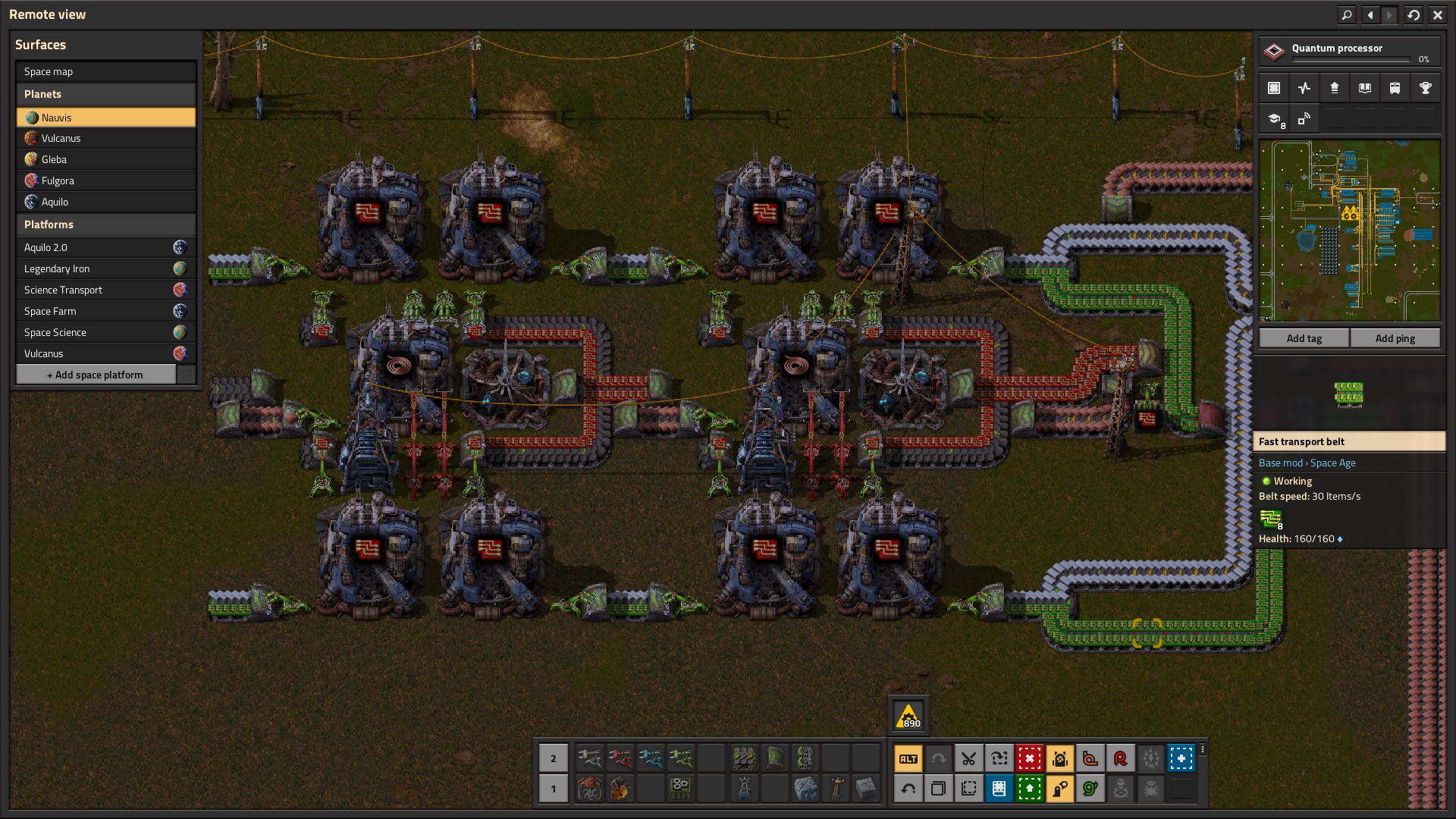
Factorio has the best mix of models, and circuit production is a highlight. The image above is an example of saturation. Copper, Green Circuits, and Plastic enter on full belts. The various production buildings select from the full belts and then put their end products which merge back into another saturated belt. At the right is a box that acts as a storage buffer for bots.
Since I use a main bus with that includes processed raw materials, it’s somewhat simple to pull into a factory. The wire is the middle building, which supplied the 4 outer circuit plants. The beacon is added to boost speed, and finally the belts are added to supply the material.
The wide majority of saturation builds in Factorio follow the same design principles. Place buildings so that material can be moved with inserters, place beacons, feed materials from the inside, exit materials from the middle.
DSP – Main Bus Late Game
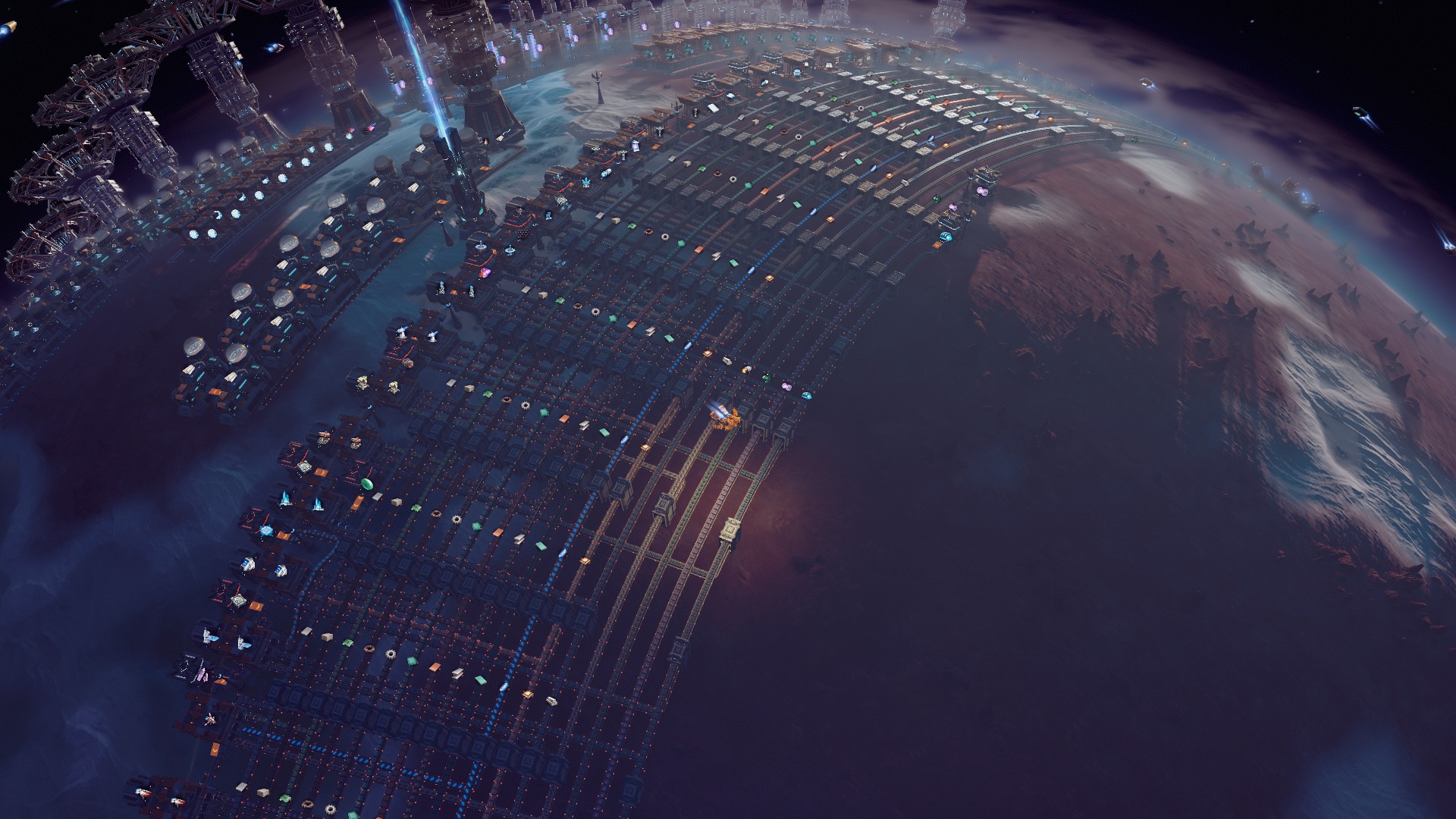
Most other games follow an expanded main bus due to significant intermediary steps. DSP is like this, were there are 15+ items on the bus needed to make 90% of all buildings. This is also a saturation model, and vertical splitters allow this construction. The bus is on level 2, and it feeds each building on level 1, which then stores material in a container.
Satisfactory is the same model, but slightly worse. You need a mod to manage storage limits (no one need 48 stacks of Computers), buildings are exceptionally large preventing effective blueprints/design, and you need to move things vertically at multiple points. The bus and factory floor are on the same level (2+) but the belt weaving is done underground. The end result is a thing of beauty, but more comparable to cable management in PCs. Hide all the junk in the back.




 Leo's Life