Cascade Failures

I’ve been pushing a tad more in IXION, and I keep hitting walls – literally in some cases. When you truly start the game, it boldly announces that you have a 6% chance of survival. Quite true.

This is a game where you’re consistently managing failures, but the tools to manage them are scarce. Resources are limited, but the goals of the game require a rather substantial amount of balance to keep the ship going forward.

For example, in order to complete the first act (not the tutorial), you need to collect 500 cryo pods. These are containers with frozen people in them. You don’t need to thaw them, just hold them. You start this act with around 100 people on board, and in a broad sense, the resources to feed/house twice as many. These people also have continual request from you, such as constructing a new building, or repairing an item. These tasks rarely have any strategic benefit… building a 3rd of a building will keep you off balance.

Completing this task in time gives trust, failing to do so lowers it. As long as you are balancing resources (not tasks), you should be gaining positive trust. If you fail to balance, you lower trust. 0 trust, game over. Ignoring the task has zero consequences – so you learn very quickly to ignore tasks. The reward for the task (a temporary boost) does not at all compensate for the loss of overall economy balance. In the case where you actually need to gain a boost of trust, your population is probably half on strike, you’re low on resources, and it’s nearly impossible to complete the task at all, making it a double negative. It’s unfortunate because this could be an interesting part of the game, but as it stands, the risks exponentially outweigh the gains.

Back to the cryo pods. Now, if you have too many people and not enough work (the only item you can overproduce is food, everything else is restricted), trust goes down. It’s simply not possible to have enough work for everyone. For every person you have, you need to house them. The basic building houses 15… so the math isn’t in your favor here to house 500. Not enough housing, trust goes down. If you have more cryo pods than you have people, trust goes down.

I should add that the space limitations are managed through opening new zones. Each zone you do open though, increases the stress on the hull, increasing your need for resources to repair it. You can open 1 extra zone in the first act and get through. Open a 2nd and you will be on very thin ice, with limited tools to balance the next failure.

Access to better buildings and housing is behind research. The housing requires level 2, which can only be acquired after you have collected the 500 pods due to an in-game event. What this effectively means is that you are forced into a failure state, and given a very limited set of options to proceed. A set of options that you are not aware of until the failure occurs.

You can construct specific buildings (which take space and resources) to boost trust. You don’t need these buildings if things are going well, and space/resources are scarce enough that it’s frankly seen as wasteful. Like buying a snow shovel in a city that has snow once a year… you can get through that day.

You will likely reach the point in act 1 where collecting these cryo pods works, and things are balanced. You will also reach a phase where there are too many cryo pods and you lose trust. Then a point where you have too many people and not enough food/housing. Then not enough resources to build new housing, or the necessary research unlocked to build the thing that fixes the problem. Then trust will dip. Then they will go on strike and stop producing the things you need (like food, which *blows mind* is so dumb). In 10 minutes you’ll go from a super content and balanced population to a cascade failure that you just aren’t equipped to get out of.

And then you’ll get a task requesting thawing more people.

I am super into games where there is an optimal way to play… I am less into games where there is only one way to play. IXION without doubt has an optimal way to play, but it also has a very narrow window of successful options. I am sure I can get into the right mindset to crack this nut, bu holy macaroni is it not today.

The Carry

A tale as old as time, and one that can be hilarious or frustrating. All multiplayer games have this, even board games. There are those that have a passion for the meta and those that are checked out. When success is determined by the whole, then this can lead to friction.

In challenging content, the group enters with an understanding that each member needs to bring something to the table. Top-end raiders need the best gear, potions and strategies. Many games avoid any random group generation for this, as the skill levels are next to impossible to figure out… or if they do, then MMR is the way to do so (with accompanied gripes.)

In non-challenging content, the group rarely has any understanding and there are opportunities to simply check out. Especially if the content is repetitive and seen as “filler”. Maw runs from WoW/Legion were a good example. FF14 MSQ (pre 6.1) was the same, where cutscenes were 3x as long as the actual content. The interesting bit is when randomness is applied to the challenge.

FF14 has a random group finder for raids. Raids that are scaled down to a given level. Some raids are extremely under-tuned so that you really don’t have to pay attention to anything. Others have 1 shot mechanics that require group coordination. Access to these events is gated through the main quest, so it is entirely possible to have a first time player surrounded by veterans.

While not a challenge to spot the AFK players, it can be hard to tell the difference between a new player or a troll. The sprout icon (indicating less than 168 hours, or not having completed Stormblood) is sometimes an indicator, but unreliable. Hell, there are times where you simply forget the mechanics because there’s just so much frigging content to begin with! There are 13 Alliance Raids, and over 30 Leveling dungeons…that’s a very absurd amount of content to remember.

FF14 doesn’t support mods like other MMOs do, and it doesn’t have meters either, giving a much more cooperative approach to content. Mythic+ runs simply do not exist, which is a glorious thing for the social glue of the game. In the 10 years I’ve played, I’ve seen less than 10 vote kicks total. Lucky if I saw less than 10 in a week while playing WoW.

Now, that’s not to say that I didn’t need to adjust my own expectations here. Moving from the go-go-go mindset into a more relaxed approach was jarring. I had to re-evaluate why I was playing, so that the journey was as valuable as the goal. That a 5 minute delay (if that) doesn’t matter. That if the tank did go LD/AFK, that the group honestly could still progress rather than fully stall. This mindset doesn’t apply so much to the end game crowd exactly, as the purpose of the game when all your classes are 90 is way different, but for the core game it slows it down just the right amount. Enough so that people generally have ample patience with “slower” players, where info is shared and bad puns.

And when the stress levels drop and you have more opportunities to chat with players, it tends to make for a much more pleasant environment. I’ve got enough stress in my day to day life, no reason for gaming to be one of them.

IXION

Frostpunk may be my all-time favorite city builder. It provides you with a limited set of tools, a near constant set of cascade failures, really tough choices to make, and the tiniest spark of hope throughout. That balance between the edge of control and the edge of failure is what makes the game superb. And it’s success certainly pushed for imitators.

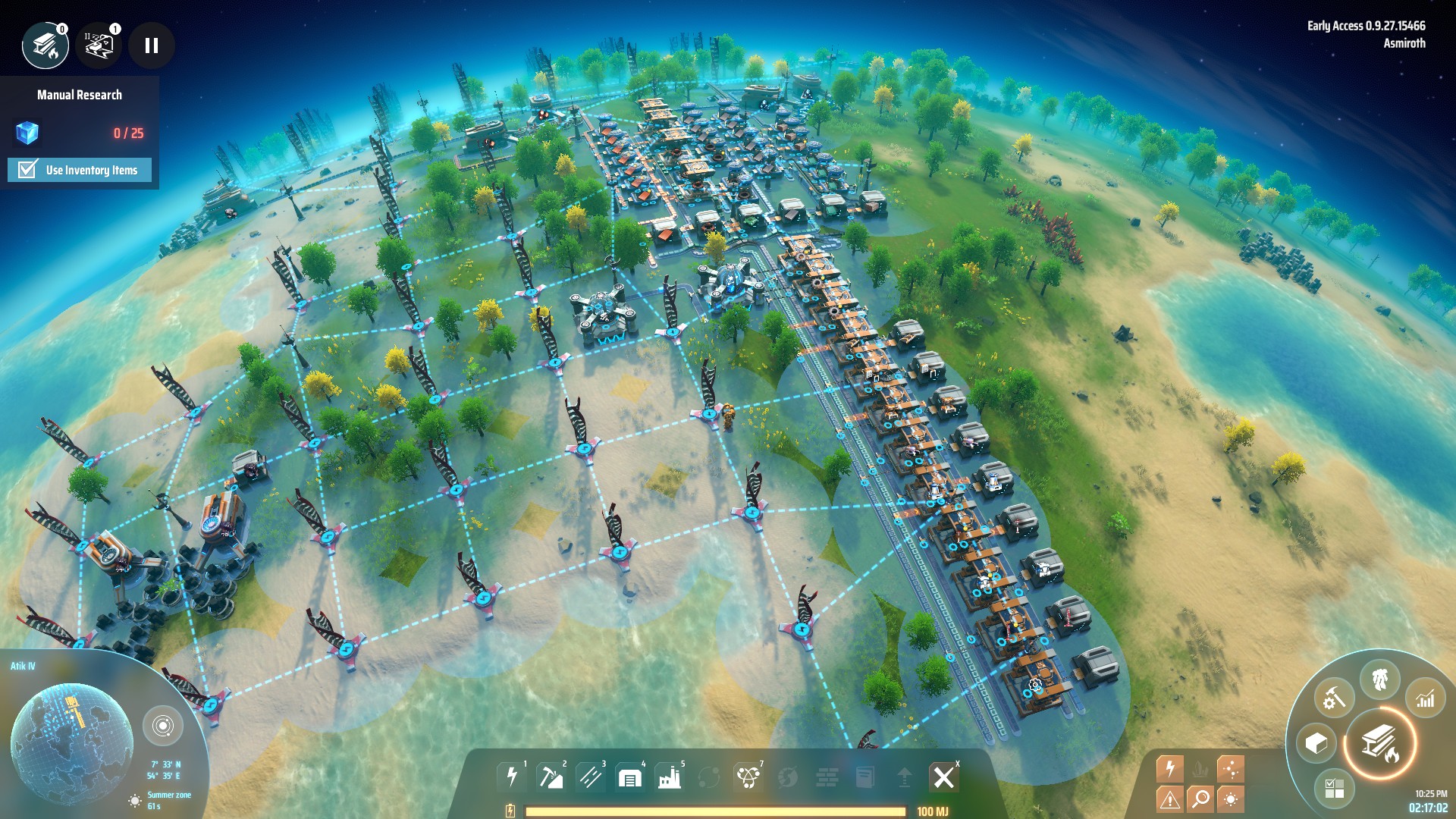
IXION is such a game. The story is simple enough, the future of humanity is focused on an ark of sorts, that is on a space journey. The challenges are also cascading, with balance a constant battle. The tools are your disposal take a while to uncover, and some decisions can massively hamper your progress… to the point where save scumming is a running thought.

The start of phase 3

Space to construct is limited, and each building has a specific set of location needs. Build enough of a type of building and the sector (of 6) becomes specialized, providing a bonus. As with most games of this genre, small percentages have large impacts, so you are likely going to want to specialize.

Resources are scarce. You can find more people in frozen capsules – which feels really weird when you population quadruples somehow. These people need food, shelter, work… and if they don’t, then you start to lose trust, which causes a mutiny and game over.

The ship you are in is in continual decay, and each mission makes the damage greater and harder to repair. This means a constant drain on resources, and intelligent use of time as there are periods where you have to stop repairs to improve power generation, or move the ship. Oh, and each sector you unlock also adds to decay.

Research is both hidden in layers, and difficult to progress. Each “zone” has a limited amount of research points to collect, effectively giving you a soft-wall of progress and forcing you to move, and therefore increase difficulty.

Combined, as is the genre, you can be going along smoothly, only to encounter a massive cascade of failures because one small piece stopped working. Like collecting iron… which repairs the ship and helps construction, which generates housing, which causes trust and decay to increase, and that’s the end of that run.

I do enjoy the logistical challenge of keeping resources balanced between sectors, and overseeing the various needs of the population. That said, I also think there are some balance passes required in how they interact and how they are set at default. Logically, the system should default to complete balance between the storage in each sector… but it doesn’t. Food created in one sector won’t move to another unless you set up that swap… which caught me off guard and caused a rather negative event.

I also enjoy the compounding complexity of various decision points, where you can have a general idea of how something will help you in the future. Some of those decisions are very obtuse… like research for items you won’t be able to use for a very long time. Given the scarcity of some resources, it makes it so that there’s an order of priority that simply is not evident on your first playthrough, and little grace for those types of mistakes. I will point that each chapter requires a very long process to complete, which not only feels like padding, but is likely to generate additional challenges. Like how collecting 500 cryo pods creates discontent as its faster to collect than thaw… Discontent that increases accidents and deaths, making it spiral.

I’ll also point that the pace of the game is rather odd, with random acts of sabotage that you can do absolutely nothing to prevent, and that can hobble you substantially if you’re in a balancing act. They act as time padding, preventing progress for the sake of making the game longer. The rate of accidents increases substantially as happiness decreases, which happens when there are accidents.

I will point out that some decisions you will make can have dramatic consequences down the road, to the point where you won’t realize it until it’s too late. Some mission options have catastrophic consequences, so that you’re better to save scum that hobble through. Some sector construction layouts (in particular around things requiring external walls) can be disastrous… to the point where it’s better to revert to a save an hour+ ago than to rebuild. In a “normal” city builder, you are not continually facing failure, just delays. In here, to a stronger degree than I was expecting, a single bad decision can be enough for a game over.

These are quality gripes, and I can only see them because I’ve been fortunate enough to play Frostpunk. If you’re coming from something like Surviving Mars, then you may not notice these smaller bits. The pace and impact of decisions, in particular hitting massive milestones that alter the gameplay, are key to these types of games. If it’s just continual fire fighting, then that loses appeal quickly as you run into the next fire before the last is put out. IXION straddles that line, and doesn’t always have that work out. For a game that’s been out a month or so, this is super normal and balance passes are part of the deal. I’d still recommend the game in its current state, but can only imagine how amazing this game will be with a few small tweaks. All the pieces are here.

Scaling and Multiplication

Over many years, I have written a lot about power curves. Most games have a logarithmic scale, which climbs quickly at the start and then slowly increases near the end. At least in the context of the “main game”. Some RPGs provide god-tier weapons, but those are also meant for god-tier challenges.

MMOs also follow this curve, yet this is most often within the constraints of an expansion or a major patch. The major patches add minor increments to the end of a curve, while expansions write out an entirely new curve. This to the point where it normally invalidates a large amount of the previous curve, so that “fresh” players don’t have to grind through content at the end of one expansion to access the next. Some games really abuse this model, where the top tier gear from one expansion is replaced by starter gear of the next expansion – thankfully this is much less common today (WotLK was notable).

Base logarithmic curve

The power curve is related to the challenge curve. Depending on where those two are, you either need to perform better or can blindly plow through. If you are on the right side of the curve (high power) and are facing the basic enemies at the start of content (low challenge), you can faceroll most of it.

Power vs Challenge

In most games, this relationship is static. Picking on WoW for a minute here, these were initially hard-coded, making the item/level squish activities very complicated. Changing the value of a Challenge isn’t easy, less so when it hasn’t been looked at for 8+ years.

FF14 has a similar structure in overworld content, and explicit group content (un-synched). You can, if you want, plow through low level content with a high level character (in fact, its the best way to do Wonderous Tails). However, the game has had scaling applied since ARR came out. The Duty Roulette (LFG tool) automatically scales your power relevant to the content, if too high. The net effect is that you can ignore a few mechanics, but not all. FATES also have a sync feature if you want to extract any rewards.

Now, where things really start getting wonky is how games apply bonuses to power. Scaling only applies to the base elements of the power curve, and temporary bonus to apply throws that scale out of whack. Temporary (or borrowed) power is not an issue with FF14 – the bonuses are usually in the 10-20% range and very limited in sources (food, some temporary buffs). You may see 6 buffs total on a character. WoW has had issues here for years, where the temporary boosts are measured well over 100%, if not bursts of 1,000%, from dozens of sources. It’s meme-worthy to have a couple dozen buffs active at any given time, let alone seeing how they interact as they can compound. It makes it next to impossible to balance or scale… hence why borrowed power simply does not work in Timewalking content (scaled). It’s also why some content tuning feels impossible until you get the right RNG, then it becomes trivial.

In general, I enjoy content that has some level of challenge, and where progression is noticeable without being god-like. If there was no challenge, then just turn on some streaming service instead. FF14 is able to make nearly all of the content relevant and challenging (to a degree) so that I do need to pay attention. One key issue with WoW was that the challenge was focused on 2 areas – raiding and Mythic+ – content that built less-than-pleasant social constraints. There was no middle ground left.

I could go on about how Monster Hunter applies this model… though in super simple terms it moved from near-assured death to this is fun. Way different model.

Forspoken – And Why You Should Not Pre-Order

I’ll say this, no one ever plans to do a bad job. Especially in a creative field. Everyone wants to do the best they can, and depending on how complex things become, it can be insanely hard to make all the pieces fit together. A great leader is one who can find all these good ideas, and make them sing together in harmony. And in today’s age, those leaders have bosses, who may not have harmony in mind.

On to Square Enix. I have no idea what’s going on in this place, aside from the fact that the number crunchers are on some serious meds. Aside from FF14 and FF7 remake, they have struggled to get anything out the door that made a lick of sense (Babylon’s Fall) or remotely within sales expectations (Outriders). Marvel Avengers has to be a painful realization on top of it all. There’s a meme somewhere in here that as a publisher, it just can’t get it right.

Forspoken had a really weird vibe in terms of generating buzz. Amy Hennig (from Uncharted fame) was a big name involved here, so there was some confusion in what was being presented vs what people had come to expect. A game with good writing can be undone with gameplay, and vice versa after all.

The real kicker here was that it appeared few media outlets (IGN is the only one I can find) were provided any release codes to the game, meaning that they’d get their hands on it when the public did. This is no different than movie reviews, where if critics aren’t allowed to see it, then that’s usually a very bad sign. And well..

Back to my first point. I am convinced that everyone involved here had the best of intentions and wanted to knock this out of the park. The end result is a good reminder that even the best of intentions do not make a great result, and further re-inforce the need to not pre-order until the game is actually out.

Been a really, really long time since a game before release actually ended up being impressive. Maybe Fallen Jedi? There’s just dozen more examples on the other side of the coin.

Hopefully, Square Enix can learn something here and find some new groove where they can release games that people are interested in playing. There’s only so long you can just give away money…

FF14 Bender

I hear Dragonflight launched? First WoW expansion I have not touched, nor do I have any FOMO here. I will give some credit, is that WoW in the moment-to-moment aspect scratched a hell of an itch. Outside of that, it’s been on a downward spiral for years.

FF14, in contrast, has a tremendous investment in the relevance of the game, and respect for player’s time and effort. Systems are generally integrated so that progress in one field impacts multiple others. Borrowed power only exists in discreet areas (e.g. Bozja) and is explicit. The is certainly slower, as the GCD is set at 2.5seconds… which is certainly less hectic. I personally enjoy it as it’s much less stressful.

I’ve spent the last few weeks trying to “complete” as many systems as I could. It feels like going to a buffet, being stuffed, and realizing there are 3 dozen more buffets down the line. The main quest line (MSQ) may take nearly 200 hours to fully complete, but that is only about 10% of the actual game content. And most of it stays relevant, due to the Duty Finder system that syncs your level.

As with most MMOs there’s a carrot thing here, a goal of sorts. FF14 certainly has the MSQ and gearing treadmill, giving access to raids. Things that we’ve been told have to be there. And it’s good, don’t get me wrong. But there’s more. Treasure maps are fun. Housing is just stupid awesome in possibilities. There’s a private island for some odd farmville-like perks. Collecting cosmetics is there too. Making a lot of money is always interesting, and way more complex here due to the limits on selling (which is wicked smart). Right now, my goal is just to level up my various jobs.

The crafters are all fine. The combat ones need work. I’ve got bags and bags of gear that I just can’t see to use, so leveling up the characters seems the wises path forward, so that I no longer need the gear. FF14 operates under their expansion levels, with plateaus at 50, 60, 70, 80 and 90. Leveling-wise, the 90 portion isn’t exactly relevant, giving 4 major milestones.

I’m in the general process of getting everyone to 50. Currently 16/19 jobs at 50 or above. I’m in the process of closing off the melee DPS character: Monk, Dragoon, Ninja. This is not a terribly pleasant experience, for one main reason – the general lack of abilities. At max level, there’s nearly 3 hot bars of skills on any given job, plenty of tools for nearly any situation. Most jobs don’t unlock the ability to hit multiple enemies until the mid-20s, and the real abilities only show up in the 50s. To combat this, the Palace of the Dead (PotD) works as an option from level 15-60, effectively putting you with level 60 abilities in a rogue-like dungeon. It’s not hard, though you do get the odd really bad RNG. Heaven on High (HoH) works from 61-70, same concept.

PotD really only works during peak hours, so that the queues are near-instant. If you need to wait 7+minutes, it’s likely better to just solo queue Duty Support (dungeons with NPC support). These are slow as molasses, but better than nothing. Yet you are stuck with relatively crappy tools, especially if you are under level 30.

50+ there are many, many more options present. Hunting Bills are a daily option to kill specific enemies for a good chunk of xp. Beast Tribes are super easy quests for quick xp. MSQ/Leveling/Alliance Raids in the Duty Finder give a few trucks of XP (first time each per day). Wonderous Tails is ~3/4 of a level, but only once a week. Bozja (at peak time) is decent XP from 70-90. Heck, even dungeons are an ok option as your toolkit is more developed.

This gives a sort of time travelling view of the game, where content from 10 years ago still has worth today, as you can queue for a dungeon at level 89 and end up in a level 15 dungeon.

My routine right now is a simple one. Beast tribe dailies (all 12), Duty Roulette if it procs while I’m questing, then the Island Sanctuary to ensure everything is running smooth. Time left over is to get the melee DPS up to 50. There’s a fair chunk to do in that last bit, probably 70 or so runs of PotD. Breaking up that routine is nice.

It’s a welcome distraction.

Self-Fulfiling

I took a month off from pretty much everything, work included. Helpful for mental clarity and overall health.

I did spend a fair chunk of time in FF14, with a goal of getting a bunch of alt jobs up to 50, and getting some more to 90. Island Sanctuary and a bunch of other unlocks too. It’s enjoyable. Cleaning out the bags and sorting some stuff around gave me 7m gil too, so no complaints.

This particular post is more of a mental note on Netflix’s penchant for cancelling shows on cliffhangers. More specifically when an action moves from meme to reality. It would appear that cancellations are based on completion rates, not hours watched. So less people watching, but for longer stretches. If people aren’t watching episode 8, then why make a 2nd season? In the isolated space, this does make sense. But nothing is isolated.

For years now, Netflix has cancelled multiple series that fans enjoyed and provided zero context as to why (still don’t). Nature abhors a vacuum, so people have all sorts of ideas why. Standard cable cancellations are extremely black and white… the ratings are poor.

Netflix has conditioned people to do 2 things: binge watch, and expect something “good” to be cancelled. Combined, this results in people not bothering with a series until it is well established… at least the 3rd season, before binging the entire thing. I’ll raise my hand that I’ve done this. Something looks interesting, and the first/second episodes are ok, but I don’t want to bother for something that is going to be axed.

The binging part is also not helpful, because the peaks are so high and short. In the olden days, a season would end, you’d have a couple months, maybe a year to wait, and the new season would start. Stranger Things is interesting because the gap between seasons was 1.5 to nearly 3 years. Compared to something like the Boys, where the time between the final episode and first of the new season is around a year. It’s a very weird system where a show gets cancelled the first week or 2 after launch, rather than allowing it to be digested.

I’ve reached the point now where a good 90% of Netflix series are of no interest to me, because the time investment just isn’t worth it (Archive 81 is a good example). Honestly, the only reason I still have it is because the kids get to watch cable series that have been ported.

Hoping that the numbers Netflix collects can be coloured with the behaviors they’ve instilled on their client base.

1899

I love Dark. Without hesitation it’s the best representation of time travel I have ever seen, and one of the best sci-fi series ever. It closes every single loop and thread with focus. It is a LOT to digest the first time through, especially since it’s in German, but it also sets a seriously high bar for any future series.

1899 is a new series from the same writer/producer group from Dark, and takes a similar mystery-box approach to storytelling. The general plot is about a group of strangers on a steamliner heading from Europe to New York, each trying to escape some event. A main point is that a sister ship in the line was lost at sea 4 months ago, and quickly in the first episode that ship is found.

The characters are varied, with multiple layers, and multiple languages. I think Netflix made a mistake in the “default” run for this series as dubs are an absolutely horrible way to listen to this series. I’ll offend a few people here, but if you need dubs to understand what’s going on, this series is absolutely not for you. It’s a really important part that the characters don’t all speak the same language, and that gap is a plot point. I will say that one of the challenges here is that there’s a lack of empathy with the main character and that there’s a tad more exposition here than I would normally enjoy.

Where Dark had an absolutely astounding soundtrack, 1899 suffers from remakes of classic rock songs that really focus on the anachronistic aspects of the show. It’s sufficiently eerie during the main parts of the story, it’s the bookends that aren’t as good. Heck, I still listen to the Dark soundtrack because it’s so effective at getting the paranoia across. In this series it feels distracting.4

The plot itself is complex, without getting into large spoilers. There’s a gradual slow reveal of bits that just feel off, and that builds in pace over time. It takes a while to tell what is real and what is imagined in any psychological themed series, and 1899 doesn’t break that particular mold much. With only 8 episodes, the mystery box is opened by the end of episode 5. The last 3 episodes are almost horror sci-fi in peeling away the layers of this box.

I enjoyed the first season, even with high expectations set by Dark. I’m still amazed that series like this are even greenlit in the first place. Happy that we can get content that requires the viewer’s attention!

What’s really tough here is that 1899 compares poorly to Andor in terms of writing/production, which is horrible timing in the streaming wars. If you take the step back and look solely at what Netflix is able to support in terms of series, 1899 comes out way above the rest. Resident Evil, Archive 81, Locke and Key, Warrior Nun, even Sandman compare poorly to what’s presented here. I am hopeful we get a 2nd and 3rd season to close out 1899. Though with Netflix, it feels like a throw of the dice.

The Mystery of Star Wars

The season finale of Andor came out Wednesday. Superb. Just an amazing all around story, with absolutely stand out performances, writing, music, cinematography and weight. I’ve been thinking a lot about why this series is good, and I’ve got ideas.

First though, there are “blocks” of content, if not better articulated as “eras”.

  • The original trilogy
  • The Expanded Universe
  • KOTOR
  • Prequel trilogy
  • Clone Wars
  • Sequel Trilogy
  • The Disney Universe

The beauty of the original series is that it dealt much more with the mystical, the portions that were not shown on screen. The final arc of a large and mysterious world. You remember the characters much more than the action.

The expanded universe was largely inaccessible to the public. Unless you were a super fan, Thrawn means nothing to you. Mara Jade even less. These books/comics focused primarily on the recesses of the universe, and there was some insane junk delivered in those years. There’s a reason that all of this was retconned when Disney bought it…a right mess with some minor bright spots.

KOTOR decided to just ignore every movie and most of the EU to time travel to the “wizards everywhere” phase. The best parts of here are not related to the Jedi, but the power struggles and lore of the Sith, as well as the overall good/bad aspects of the universe. Understanding why Revan took his path is truly amazing.

The prequel trilogy is quite bad, with a few exceptions. It’s a spectacle for the eyes, no doubt, and the stunt work is practically a dance. And the pod race never disappoints. Yet the writing is atrocious and the editing even worse. Midichlorians are a ridiculous addition to the mystery, and by the end you’re actively rooting for the Jedi Council to be wiped out due to ineptitude. The need to explain everything in logical terms goes counter to reason people liked Star Wars in the first place – fantasy.

Clone Wars provided a medium to tell the hidden stories of the world, which effectively became Expanded Universe part 2. It’s somewhat ironic that the Anakin character in these stories had more complexity than the films, given the budget and attention. This is pure fanfic and goes to great lengths to focus on the characters rather than the events. You could tell this was led by passion.

The sequel trilogy is a pure money grab, and a reskin of the original trilogy. The Force Awakens is a bad attempt at remaking A New Hope and skipping all the bits that made you invested in Luke and the rebellion. Then again, it’s set up as a mystery box from a director known for mystery boxes – you want to know what comes next, not so much what’s going on now. The Last Jedi feels like an alternate cut of an existing movie, more to prove a point about how the universe keeps moving and how insignificant the rest of the stories are. It’s a movie of extremes, purposefully testing assumptions. Rise of Skywalker is like Marvel’s Avengers but with Star Wars paint – where you simply have to put your brain in a drawer and let the spectacle go forth. The teleporting lightsaber still makes me want to vomit.

The Disney Universe is much more complex. Rogue One is fascinating because for the most part you can’t really tell it’s a Star Wars movie. It focuses on the little people doing big things and paying a tremendous price for it. Solo didn’t work because it was telling a story no one really wanted to hear, about a character everyone thought they knew, with details that removed the mystery surrounding them. Obi-Wan barely passes the bar here because the same actor played the role, but it’s fundamentally flawed for the same reason as Solo. Mandalorian works because it’s not about things we know about, and goes to great lengths to not explain things, letting the practical and logical story just flow. Star Wars is the setting, not the purpose (with some exceptions). Andor is very similar, in that the story isn’t so much about him, but the people around him. People will remember the Ferrix brick because it’s not a prop, but a believable part of that world’s culture. It’s focused on the people and the reality of their actions – not on some hand waving space wizard.

I’m hopeful that we can get more grounded stories from the Star Wars universe, where the threat is ever present due to their size, not their magic sticks. Where a person can try their best and still fail. Where the bad guys are hard to tell from the good. Guess we’ll see.

Living Ships

The whole Twitter stuff is enough distraction. I disabled my account yesterday and I’m moving on.

No Man’s Sky doesn’t have many timegated systems, 2 that are quite obvious – Frigate missions and Settlement Upgrades. The latter doesn’t have any real impact on gameplay today, and feels more like the seed of an idea. A sort of ant farm really. The former is a very weird (for this game) system that allows you to send smaller ships on missions, where they can return with various items. With two exceptions, these items can be found through other means, so this activity acts as a more passive gameplay than much else.

Obviously, I am not considering mining operations as timegated.

In 2020, the Living Ships update was added. This is a quest that starts in the Anomaly, requiring 3200 Quicksilver (a unique quest currency, takes less than a week to collect this much). Using the Void Egg, you embark on a quest that spans a few systems with relatively simple steps. Each quest then has a 24hr timer, so it ends up taking about 5 days to get to the final part, where you unlock a new starship. Living Ships are starships in a practical sense, all S class, and cannot take any normal upgrades. Selecting your ship is dependent on the system in which you unlock it… so some save scumming is advised to get a look you want. All told, about 2 weeks or so to get one. Now, aside from looking cool, in nearly every other regard it’s worse than any exotic ship due to the upgrade issue. Less cargo slots, slower speed, less damage…

One of many, many designs

In July 2022 the Endurance update added an upgrade path for Living Ships. You need Psychonic Eggs, which only come from Frigate Missions, and then only from missions where there is an Organic Frigate. To get the first Organic Frigate, you need a Dream Aerial, which is a random reward from a normal frigate mission. Getting more Organic Frigates pretty much requires Anomaly Detectors (found in asteroid fields), and then pulse driving until you get the proper encounter (could take 20 mins). Frankly, that is a ton of RNG and timegating to get something that does look cool, but is a real struggle to actually improve. I’ve got my ship, 10 Organic Frigates (that was not fun), and 3 upgrades. Now it’s just a matter of sending them on mission and hoping for RNGesus.

A view of some of the organic frigates

I do get that none of this actually matters in the larger scale, and it’s truly more of an end-game customization thing. The real joy in NMS comes from the discovery and building phase, and then slowly drifts off as the new-car-smell fades away. That joy lasts for way longer than I had expected. There’s a true sense of achievement when you finally reach one of your goals – be it automated mining, a cool base, or a new ship. The fact that you’re not pigeon-holed into a single activity in order to find progress is amazing.

I know I’m in the long tail now. I could reset the universe (crazy typing that out), build an underwater base, or complete a full farm setup for every remaining element (there are only 4 I don’t mine currently). Regardless of where this goes in the next few days/weeks, this ride has been absolutely amazing.