Planet Crafter – Part 2

I thought a bit more after my last post on the game, and came to the conclusion that further exploration was needed.

The largest driving factor here is that the dev team is 2 people, and what is here is frankly absurd given the resources at hand. I generally love small dev teams as the games are a direct representation of their passion, and Planet Crafter certainly hits that mark.

While I certainly highlighted it, I want to strongly state that the ‘issues’ with the game in it’s current state relate to balanced progress. The easy comparisons are games that have been polished to a high degree, putting the bar somewhat out of reach. And that risks are taken here means that some things will work, and others not.

Planet Crafter has effectively 3 phases, and the game dramatically shifts between them.

Survival

This phase is the smack dab start of the game, where you have no sources of food, water, or air, except for what you find. Every system is new, inventory is a massive pain in the butt, and you frankly are lacking all the tools necessary to move forward. This mode is the one that’s most familiar to players given the genre explosion. You have a very small base (for air), explore for seeds (for food), and need to collect the most basic of material to progress towards new tools.

This phase ends when you have the ability to generate water, which is near the 3 hour mark.

Exploration

This phase is the rough one. You now have the ability to stay alive, but progression is now limited through scale of operations. You absolutely need to explore the map to find iridium and uranium in order to build rockets (massive production increases) and to build power generation for machines. The balance in this part is really challenging, primarily because the things you need are so spread out. An ore extractor will get you some materials – but not uranium (or osmium).

The balance issue here is that you know what you need to do, but lack the material to do so. It’s also the phase where you learn that building a simple & door is the only way to effectively explore the map. I had a dozen+ little camp spots throughout the map. Progress slows down dramatically, and the RNG of blueprint/microchips shows its head.

The phase isn’t broken, it’s just jagged and has what feels like too many steps. This phase takes about 8 hours to get through.

Optimization

This phase is more weird than anything else. You’ve found a way to generate every resource reliably, you’ve been to every area in the map, and you’ve crafted at least one of everything. Given that progress is a math formula based on multiple aspects, you’ll focus on one and then another and then another. Progress is very slow, where you are the hiccup in the supply chain.

Now, in most logistic games, you end up with a hub of sorts that does all the things. That is true here, but getting there is another story. There’s an auto-crafter that automatically collects things from range to build another thing. What you end up with is a very large room with storage that stays within range of the crafter. You then hit a wall where you can’t craft something because the box is empty, then go out to collect said thing to fill said box.

Automation of that collection comes much later in this phase with Drones. The setup is very manual, and slower than you might think, but it does work.

From this point forward, the issue is a combination of time and scale. Time in that you are waiting to unlock more things, and scale in that you want at least 5 of every machine possible, including rockets. But I don’t need 5 beehives you may ask. You may not need the honey, but you need the insect generation.

Future

Functionally, the game stops providing “new things to do” at the breathable atmosphere stage – which takes ~20 hours or so to reach. You’ve explored every bit, crafted every item, and the world is green. The systems that remain past that point deal with complex organics, fish now, frogs soon.

Back to the original post on this, the game has a ton of rough edges, but the concepts here are pure passion. The majority of the quibbles deal with balancing in the exploration phase, and just plainly a lack of data to help make decisions. Once you get to the optimization phase and understand all the systems and have access to all the tools, the game turns into something much different. On the whole, it’s frankly amazing what’s here.

Planet Crafter

Came up on my list and I’m giving is a shot, Planet Crafter is a hybrid game in the survival/exploration/crafting genre. The “definitive game” of this genre is Subnautica, a rather impressive mish-mash of ambience and story, with crafting elements. Planet Crafter emulates this to a degree, but with the polish expected of an Early Access game.

Now, I generally avoid Early Access games unless it fits a certain set of criteria, typically focused on a small development team trying to iron out an idea. I really like Subnautica, and I like crafting games, so this hits the right marks. That said, if I am paying for Early Access, I will review it to a degree.

The concept here is that you are stranded on a deserted planet to serve out a prison sentence. You have some very basic tasks to complete in order to get a “foothold”, and the larger goal then turns to terraforming the planet. Now, planet in the general sense, as you’re really only given a single map to explore, which undergoes various points of transform over time. That map is quite large, even when you’ve got a ton of movement abilities available. It takes a long time to reach a point where you won’t starve/asphyxiate/dehydrate to death while crossing it.

There’s a very basic shelter that allows you to restore oxygen (which insanely always requires a door to be constructed), so that’s one part easy enough. Creating extra water requires a decent amount of progress, and frankly knowledge that it’s possible. Starvation requires growing food, which is simple enough. So with those pieces in hand, you can explore the world, collect minerals, build stuff to unlock more stuff to build and so on.

Progress is gated through a terraforming index, which is calculated through other milestones (heat, pressure, biomass, etc..), as well as random blueprints. The net effect is that it’s entirely possible to unlock the ability to craft items long before you have the material to do so. Further, these milestones are weighted so that progress is not linear, but more logarithmic. The game progresses quickly to begin, then there are wide swaths of frankly waiting for a number to go up. The balance of this progress is not necessarily broken, as much as it needs optimization.

This is not Satisfactory

The act of crafting requires things. Material does NOT stack, and there’s so much out there that you will end up with 2 dozen chests of things just to stay sane. This creates a back & forth process of collecting things, bringing them back to storage, and collecting more things. Movement and inventory improvements quickly become essential to your sanity. The lack of “world diversity” here also means that it feels, and is, time padding.

And creating things is what you will spend 90% of your time doing, in particular one mid-tier element that is used everywhere (super alloy). You’ll end up creating 5 or so of every item at any given tier (e.g. there are 5 tiers of heaters) in order to make those numbers move. There lacks some balance with regards to materials needed to construct, and energy requirements for said things to run. This becomes glaringly obvious as you enter the nuclear age and there simply isn’t any obvious renewable source of uranium. Again, balancing.

The thing I have not talked about is story, which frankly there simply isn’t much to discuss. There’s no discovery carrot, and exploration is driven by the need to find a specific material rather than the desire to see more. The risk of exploration remains relatively the same from start to finish, which diminishes any real reward as you’re always walking around with what feels like a sword over your head.

One piece I think that is important to mention is friction. These are design choices that impact systems and interfaces that are counter-intuitive. The flow between interfaces and menus is an example. The ability to easily understand information. The expectation here is that you start with a lot of friction and that you gradually reduce that over time. In that being proficient with the systems is based on player skill as much as the actual systems. The largest point of friction here is the system complexity/dependency and lack of tools to address. You need a scale of material to move forward, but inventory sizes are so small, and the near complete lack of logistics (drones come at end game, essentially after game completion) mean that you are stuck in minutiae rather than progress. Super Alloy Rods are important, and you need 9 ingredients to make it, and needs 49 base materials. Collecting that material takes about 20 minutes, no matter what point of the game you are in. Now, I realize that Planet Crafter is not a logistics simulator, but friction points such as these are not fun.

In the current state of the game, there are some rather interesting ideas, ideas that are not found in their totality in other games. However, split across multiple games, those ideas are significantly more refined elsewhere. It’s a bit like how a buffet is cool to try things, but if you want good Italian food, you go to an Italian restaurant. Increased content is certainly a big piece of this puzzle, but at the same time, there’s a balance/refinement pass required as well, in particular for the mid-game. It’s an interesting sandbox to play.

Steam Deck Streaming

I’ve been a proponent of a gaming laptop for some time now. Sure it helped that the pandemic “broke” the video card market, and the niche custom PC build market has pivoted back to the mid-90s chaos of compatibility. Plus, I don’t have the time/patience to build a liquid cooled rig. You can get an amazing laptop rig, delivered to your door within a week, for nearly the same price as a custom rig – heck, during the pandemic it was the same cost as a video card. The screen of a gaming laptop can be a bit harder to figure out… but it’s not really different than a custom rig.

What does this have to do with anything? The Steam Deck uses it’s native streaming mode to play games that are installed on your PC over the Switch on any home network. I’ve used this on various streaming devices, and it works “ok”. The best experience so far was from a “normal” laptop to my gaming laptop, with expected video degradation. The Steam Deck’s streaming option makes all of that go away.

I can certainly install a game like Fallen Order or Control on the Deck, and they play quite well. A drain on the battery of course, so the sessions are a bit harder to manage if I’m not docked on 45w. But streaming… that is another thing. The gaming laptop has no performance or power issues, and it plays almost identical to the native Deck mode. I’ve yet to give it a shot at Deck + Stream + Dock mind you, which would certainly put it through some crazy paces. It would effectively fully replace a console at that point (which is a separate topic about the future of XBOX).

The natural downside to all this is that “gaming on the go” isn’t really an option if you’re streaming. However, you can run it in dual mode, with a local install and the option to stream is always present. I tried this with No Man’s Sky and it worked flawlessly.

I realize this is part of a series of glowing recommendations for the Deck, and yeah, that’s right on target. The lack of integrated mouse + keyboard controls makes some games more complicated than others (e.g. you can’t really play any RTS or ARPG without a dock), but the rest of the features make it feel like a massive step forward in gaming.

Ant-Man: Quantumania

Right. This was weird. But the wrong kind.

Reminder, this was the actual promo trailer for the first Ant-Man.

Ant-Man is one of the most unique Marvel superheroes because a) he doesn’t actually have any powers, b) he’s average at best, and c) is generally naïve about the world in general. An everyman superhero in a world of folks flying around. It feels like he wins through sheer luck.

The first two movies were more heist films than actual superhero films. Sure, there’s a sci-fi part to the larger elements, but they were still grounded in the “real world” with human problems. I will say one of the good things about this film is that you don’t need to watch 85 Marvel movies/tv series to understand what’s going on. Nice.

Ant-Man 3 is not this. Ant-Man 3 spends all of 10 minutes in the real world and then goes 100% green screen in a trippy reality jump that never grounds the people. Ant-Man 3 is not a caper (except for a 10 minute CGI-a-thon that struggles to land). Ant-Man 3 is not a comedy, it’s borderline a war/guerilla movie. Ant-Man 3 lacks villain logic (Loki did this much better). And Ant-Man 3 has made-for-TV CGI.

On this last point, which certainly made the rounds. Rarely have I ever met any artist that was happy with a mediocre result. The artists here had to do almost all the lifting. I can’t fathom the pressure of timelines to get this done. Hats off to what was able to be put out.

Ant-Man 3 ends up being a shining example of the excess of the superhero genre, the tonally deaf response to more spectacle. CGI is not the means AND the ends. Ant-Man 3 is a mediocre because it goes against the first 2 movies and the set up that Paul Rudd put in place. He’s not a superhero, doesn’t want to be. Not sure how that message was lost along the way.

Diablo 4 and the 2023 ARPG

There have been hundreds of action role playing games, probably thousands, since the first Diablo launched in 1997. I remember heading to a PC cafe to indulge and marveling at, well, everything!

Since then, the genre has taken some interesting twists and turns – and to a degree some forks in the road. Some have bridged back, some pruned, and some flourished. What we’re left with is effectively 3 main streams.

  • Diablo 3 – RoS. The “fast food” of ARPGs. The original launch is best forgotten, and what we have now is a rather well-integrated, drop-in/out, meta-of-the-season approach.
  • Path of Exile. The “hardcore” of ARPGs. This game requires a community approach due to the trading / RNG mechanism and is F2P done right. Only WarFrame has more systems maintained over time.
  • Grim Dawn (Titan Quest). This is the middle ground where you have complexity, integration, modding, and the general foundational systems of ARPGs present. Frankly, I’d consider this the “trunk” of the ARPG tree.

I have not talked about Lost Ark here because it’s a much different game that has more in line with a branch that is frankly being pruned – the mobile ARPG. These are games with extremely simple interfaces, minimal choice, and an RNG upgrade path that is supplemented by a cash stop. There are certainly whales willing to play these games, and feel free to navigate them ethical waters. I’ll get back to this…

The key bits that set ARPGs apart:

  • There is moment-to-moment activity
  • There are levels, and character customization over time
  • There are multiple item slots, variety in said slots, quality that impacts power, and synergy between said items
  • Most of the game focuses on RNG, both in zone layout, monster spawning, and most certainly in item drops
  • There is the option for increased difficulty, which also increases RNG factors
  • There is a “long tail” progress system with logarithmic gains (e.g. you quickly gain power, and later on power comes more gradually). This makes the game relevant for years.

Diablo 4 is out, and it does cover the first 5 bullets in this list. There are going to be multiple balance patches for the next 6 months as people find new and interesting ways to exploit the foundations of the game – that’s expected.

The larger questions remain around the “long tail” portion of the game, which were frankly non-existent in Diablo 3 for nearly 2 years. Well, I’ll caveat that in that the end game was farming the auction house. RoS brought it to rift farming. PoE has map farms. Grim Dawn also has a sort of map farm. It will take some time before Diablo 4 figures out that dance.

The very interesting (to me) part of Diablo 4 is less about the gameplay and more about the mobile ARPG aspect – namely the cash stop and monthly passes.

  • The game has a box price of $70
  • There’s a seasonal pass, with paid and free tiers. Paid unlocks more cosmetics, provides gold/xp boosts, but no “concrete” power.
  • There’s a cosmetics shop with the natural shennanigans of using another currency for items so that you always never have enough to have a zero balance.
    • The items in the shop are hovering near $20-$25. I can quite literally buy game of the year candidates for that price. These are macrotransactions.

This is an interesting experiment for Blizzard. Clearly Diablo costs money to run and maintain, and there’s always an opportunity to milk out some folks of extra cash. Ubisoft has been doing this for years, and EA has no real shame in this space.

However, the Diablo crowd is different – or perhaps more accurately the ARPG crowd is different. The game has the value, less the window dressing. If the moment to moment stuff doesn’t work, or there is no long tail, ARPG players just won’t stick around… there are simply better options out there today. It will be quite interesting to watch how this develops over time.

Knowledge is Preferable to Ignorance

I spent a day at the lake this weekend, staring out on the water and simply pondering.

As I am inundated on a daily basis by willful ignorance, I turn to look at my 2 children and ponder. What role do I have in leaving a legacy, or guiding them on their personal journey of self-discovery? What tools am I giving them to make their way through the multitude of opinions and power-grabs? What confidence can exist in a world governed by popularity rather than humanity?

I could, and do at times, fret over society’s joint ignorance and futile grasping at truth-sellers. To avoid the truth laid bare and accept a lie that comforts rather than confronts. To think that one person somehow has more value than another, simply by the conditions of their birth. That the stratification of education and knowledge is some duty born by self-elected gatekeepers.

It is evident that society resists change and that said change can take a very long time. We have ample evidence of such. Our growing ability to share is offset by our inherent need to protect. There is so much out there, that it can seem like staring into an abyss, and with that, who can truly judge someone simply turning around for the safety of the familiar.

Humanity has a beautiful flaw, in that it pushes back against the inherent chaotic nature of the universe. This is an upstream battle that will last well after we turn to dust. We kick and scream for a place at the table, where we are but a crumb on an intergalactic scale.

I get by on a word shared by many, and that is one of faith. Not faith in that the answers will be laid bare if I simply submit to the will of another, but faith in the grander humanity. I marvel at the magical randomness of cosmic order. That every day we unlock another fractional facet of this eternal mystery. I have faith not in that there are answers, but that we will search for them.

That is the path upon which I guide my children, the legacy of continual search for knowledge, and the character to face the abyss and not look away.

Overwatch 2

Adding to the fun Blizzard news of late, Overwatch 2’s main selling point of having a PvE mode has been more or less scrapped. This particular link has an interview with the devs on the topic, which I think provides a more complete take on the situation.

Context here seems the more important bit. Yes, a developer should cut content that doesn’t meet their quality standards, and we’ve seen Blizzard do this over the years. There are dozens of examples of “promised” content that hit the floor (WoW housing and Titan system are notable, Ghost even more so). Now, the argument can be made here that selling a car with the promise of it having locking doors, then never delivering on said doors, is an interesting approach. Blizzards has never launched something with a promise of future delivery, they have instead outright cancelled the work before asking for money.

Overwatch 2’s primary existence as a sequel was predicated on 3 main items. Moving from 6v6 to 5v5, implementing a battlepass, and PvE. Overwatch 1 stopped all content delivery for 3 years so that they could figure of the PvE component. It would be a stretch to convince me that this particular model required an expansion and a content drought (which enabled Fortnite and Apex to take a massive chunk of this space) when you can look right at WoW’s massive mechanical changes over the years. I can understand that the knee-jerk reaction here is not positive. Though realistically, if you were waiting for PvE in Overwatch2, you really aren’t playing today, right?

The next bit of context is Blizzard’s staffing exodus. More than ample reading on that topic where executive decisions and culture have caused people to leave the org. And as any manager will tell you when you lose a key member, you likely lose 3. Dead wood / negative people are typically isolated when they leave. Strong skill sets and positive people will automatically pull people towards them. These are like papercuts, annoying but you can usually get through. However, there’s a point where you simply cannot find qualified resources to fill in those gaps… which is 99% incentive based. The “glory days” of Blizzard are well in the rearview mirror, so the pride of having that on your resume isn’t as strong as it once was. Is it an environment that a senior developer would want to enter? Can you fast track existing junior employees (who then get poached)? So yeah, there’s the fundamental question if Blizzard actually has the capacity, let alone the competence to deliver their lofty goals.

Tangent, as I tend to do, I recently had a town hall event where there were diverging styles presented, one of management and one of leadership. There is a very large gap between both, and not every manager is an actual leader, just like every leader is not necessarily a manager. In the larger business news context, the wide majority of CxO positions are held by managers. Makes sense, only the bottom line ever seems to matter. Leaders take risk and take accountability – ain’t too much of that on the scene today. A manager that takes a pay increase while cutting 10,000 jobs, well, it would be quite hard to articulate that as being leadership qualities.

I do have hope that Blizzard can find some effective leadership in the proverbial pile of rubble that is there today. As much for the nostalgia in me as it is for the development team that is certainly trying their hardest to get things done. I have no doubt that everyone actually coding goes in with the best of intentions and want to deliver amazing quality products. I do hope that they can achieve that goal, without gamer pitchforks being launched.

More Thoughts – Steam Deck Battery

One of the interesting bits about my Switch is that the battery generally lasts across multiple sessions without a charge. The even better part is that nearly any USB-C charger is sufficient to charge the thing while I’m playing, or at least dramatically reduce the draw. I’ll be up front about it, I play on Airplane mode 99% of the time and that alone appears to have added a massive amount of battery performance. We are light years away from the massive battery packs that kept my GameBoy going, yet still a long ways to go before we read Nintendo DS levels (seriously, that feels like black magic).

Now, the Steam Deck is a different beast and each game takes a drastically different draw from the system. The geek in my absolutely loves the performance overlay options, where you can see moment to moment how hard the device is working. There are plenty of forum posts which give tips on how to squeeze out the most of the Deck with game-specific configurations. Certainly, turning off the network portions has an impact, but also changing the display options can make a world of difference. Perhaps I haven’t see it yet, but auto-detection of docked and un-docked mode (dual profiles) would make a big difference here.

What I will say is that when I’m playing offline mode, on something like Dead Cells (it’s still stupid good) can go for many, many hours before needing a charge.

However.

The charging of a Steam Deck is primarily done through a provided 45W charger and that is more than what many people use for their other USB-C devices, which seems to be closer to 20W-30W. This seems a minor quibble, but it’s important to point out that ineffective chargers means you’re going to wait a very long time to recharge the system.

My general rule of thumb is that charging should take half as long as the duration of the battery. The Switch is honestly at another level here, as the battery duration can be 6-8hrs and a full charge in less than 1. Wild! The Steam Deck gets 4-6hrs of play but it can take up to 2hrs to get all the way back. Which is certainly good, and way better than any gaming laptop on the market, but an adjustment all the same.

That remains my larger comment with regards to mobile gaming, in that the Switch is made to be simple stupid easy to use. The Steam Deck provides so much customization and knobs to turn that you can make it what you will. It’s missing a bit of that KISS principle, or perhaps providing the various devs out there the ability to provide a recommended Deck profile.

‘Cause honestly, this is an insane amount of progress for mobile gaming and I can only imagine what the next few years will bring as battery tech continues to evolve. Never would I have imagined this when I was a kid at LAN parties. Feels like holding magic in my hands.

Cult of the Lamb

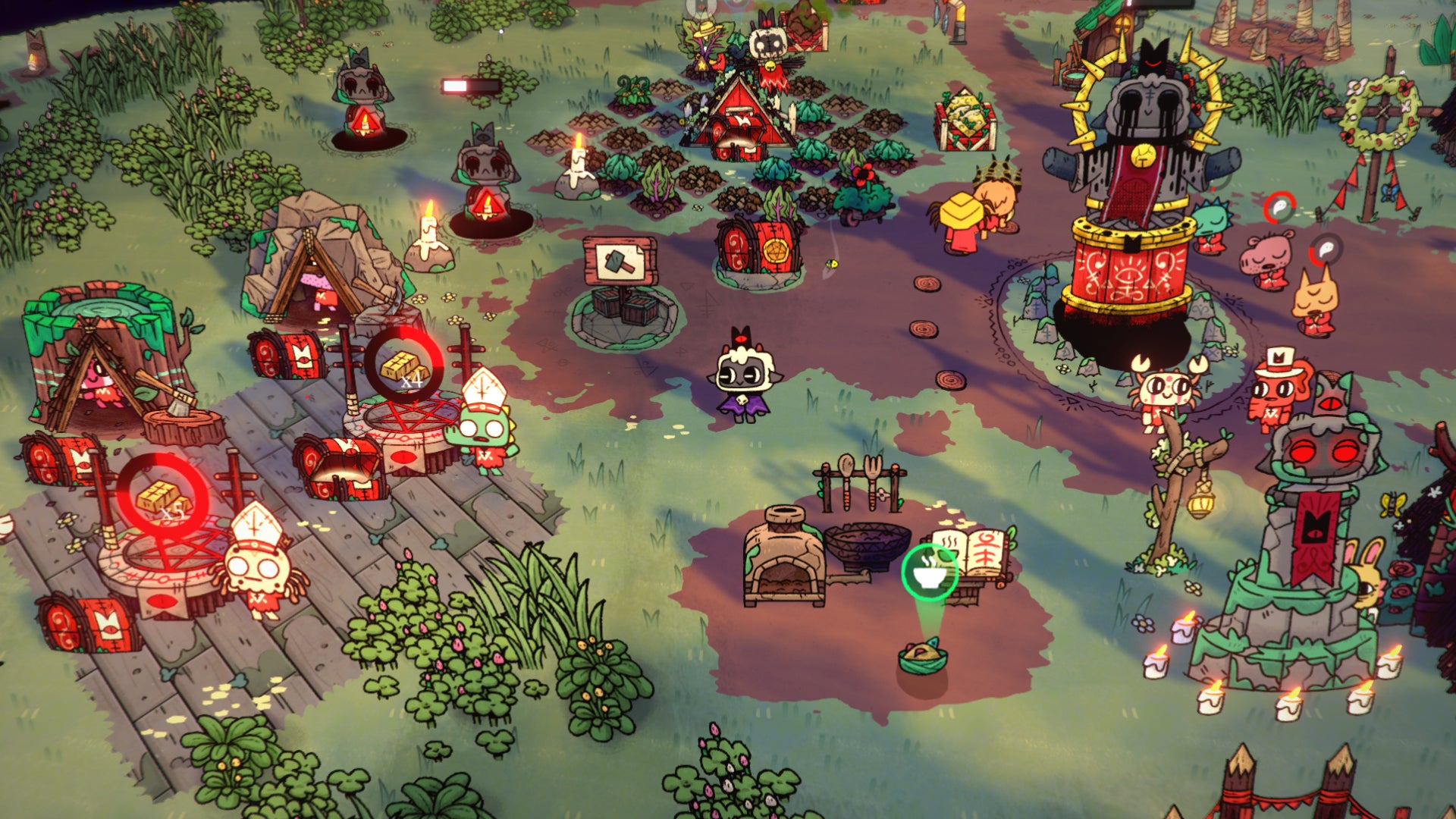
It would be hard to argue that Cult of the Lamb is a cozy horror game, but I supposed the aesthetics can give that idea. It’s more of a rogue-like with city-building elements, with a cute visual overlay. Honestly, you could change the visuals to eldritch horrors and the game wouldn’t really miss a beat, except for perhaps some of the minor humor elements.

The core concept of this game is built upon rogue dungeon runs that have branching paths, multiple weapon/skill upgrades, and the now-typical dodge-roll/i-frame mechanic. You run a dungeon enough times, unlock a big boss, do that 4 times, then free an elder demon. The runs themselves are rather quick, less than 10 minutes, so it’s a bit more of a fast-food approach than something like Returnal’s multi-hour journeys. Dying is a small speedbump, rather than anything horrible.

Oh, and works solid on the Steam Deck.

Camp Koolaid

Between runs, you build up a literal cult at your camp. This means finding new followers, passing new doctrines, collecting worship (to unlock more buildings or more power in combat), and then keeping all those followers alive. See, they need food, sleep and get old and die. There’s a small logistical puzzle involved, and for 90% of the game, that puzzle has no disastrous consequences. They die, you find another. Which I suppose is the critique of cults in the first place.

I will say that the logistical beats are oddly balanced, where at the start you are severely under-resourced to keep it all going, and then reach a point where you have a flood of resources and no real good way to spend them. Perhaps that more my playstyle and your mileage may vary.

The step-by-step items are interesting. You need an outhouse to collect fertilizer to grow food to cook to then use an outhouse. You can research the ability to ascend or revive a follower. You can marry them, get a fishing bounty, build idols, or complete some menial tasks. The system works rather well, all told. There are side-areas as well you can visit, with some optional content: a stacking dice game, simplistic fishing (!!!), quests, or gambling. There’s enough without it feeling overwhelming.

Battle Runs

The dungeon runs are a mix of combat and path choices. Each of the 4 zones has a somewhat unique set of enemies and mini-bosses, plus a unique material that is used for your camp. The combat is mostly melee combat, with a spell (curse) attack that has limited use and recharged as you kill enemies. There’s also a relic mechanic, which is a sort of super move with a similar cooldown. You have hit points that recover though some random elements, so you’re really looking at the more typical attack/retreat model for these games. The bosses themselves are straightforward enough, with telegraphs, minions and a decent dose of bullet hell. I’d argue that most people will hit a wall the first time they reach a real boss, then again at the final boss, as new mechanics typically show up at those points.

You need to successfully complete each dungeon 4 times to proceed to the next. Runs past 4 primarily provide resource benefits.

Unfortunately, the mechanics of battle are less pleasant here, as there are some practical portions that aren’t well balanced. You start each run with 2 random combat items presented (weapon + curse). Combat is predicated on quick reactive movement, and in some spaces, the ability to plan attacks based on patterns. Sadly, the bosses have a significant amount of random, making planning quite difficult. There are 5 weapons, of varying speeds. Daggers are quick, gloves are fast, swords are normal, axes are a bit slower, and hammers are glacial speed. To a point where hammers are frankly un-usable, and axes are borderline depending on the luck of the run, due to their attack speed and “attack lock”. If hammers acted more as mortars, then this would be offset, but they are instead melee range only.

For the base game, you will reset a run if you get a hammer, and give the axe a chance. This is the only item in the entire game where I had a negative experience, as it defeats the core concept of a rogue-like.

Post-Game

The core gameplay loop comes to an interesting conclusion sooner than I had expected. Or perhaps the gameplay loop was just so pleasant I hit it before the shine had rubbed off. April 2023 had a free DLC added that extended the post-game portion, which feels like a decent content patch. It’s not new content so much as it is an extension of the existing ones… more doctrines, more automation in the camp, quality of life boosts, and more customization of followers.

The more post-game you complete, the more automation you can set up for much longer runs. It’s an interesting feedback loop with a decently long tail. The skill hurdle can increase through optional modifiers (e.g. deal more / take more damage), though I’d argue that if you go this path, you’re going to reset runs until the combat weapon is one you want.

Overall, the game has a good loop and feedback structure, with enough “just one more bit” to keep you hooked for longer than you’d plan. I’ll have a future topic on how I am finding the sweet spot of gaming to be at this entry level. $30 today seems to get you a lot more than a $70 AAA game.

Dredge

The short of it is that this game has no right to be as good as it is.

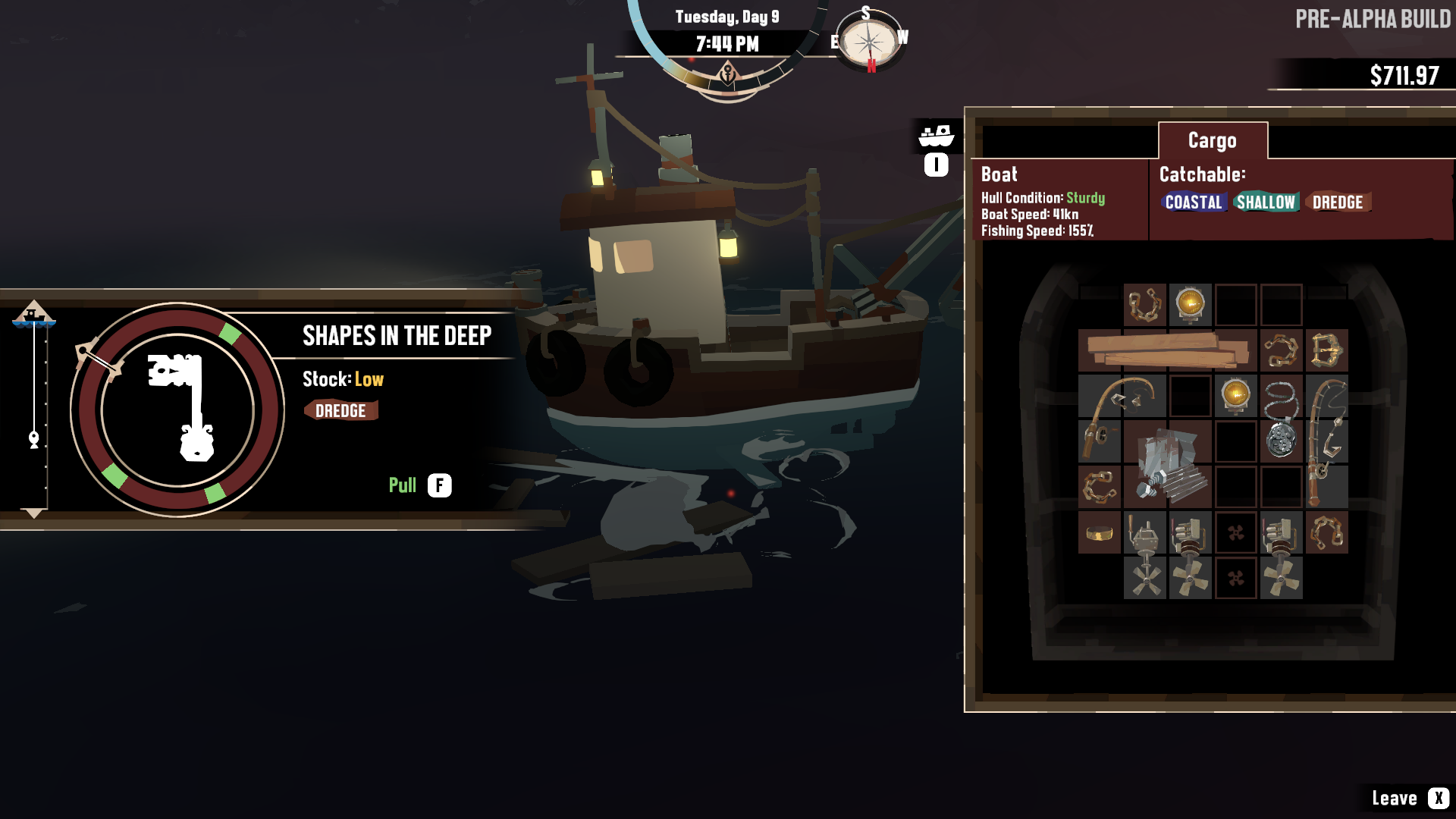
The sales line for this game seems like someone through some words together: a cozy Lovecraftian fishing simulator, with RPG and Tetris components. This just simply works, despite the weird elements. Now, I’ve gone on record multiple times saying that any game with fishing automagically moves up the “wanted” list, primarily because no one in their right mind implements fishing without an appreciate of the zen aspects. Dredge, at its most basic, is a fishing game, and everything else comes after. And that core gameplay loop just works dammit.

The start is simple enough, you’re a fisherman who washed ashore and need to get back on your feet. You get a loan and a boat, then go from there. The interface is simplistic (it should be) and fishing can never truly fail. The stuff you collect can be sold to various merchants. The RPG elements allow you to research improved boat components/rods, and slot them within specific areas. Fish also have their own habitats/requirements, so you need both the right location and right tools to harvest.

The game is wrapped in 5 continuous chapters, where you’re tasked to do something in the local archipelago, then sent to the next. Each of these areas has it’s own hazards, which can wipe you out fairly quickly to the last saved port. The various zone mechanics are also interesting, such as blasting cores to get rid of rocks, or bait to quickly collect some fish. The surreal abilities you get are also quite useful, like a teleport to the home base, or the ability to just collect all the fish around you instantly.

There’s a sanity meter that’s best left for players to discover. Suffice to say, it gets progressively more interesting as the game goes on.

But that’s the wrapping, like on a chocolate bar. The beauty of this game is the pacing and fluid controls. You’re never under the gun, and the controls themselves are precise when they need to be, and floaty otherwise. The art is a sort of camp call up with a comic book feel. The sound is eerie without being haunting. Combined, it’s a game where you can just have a cup of coffee on a rainy day and enjoy the experience. Ideal for the Steam Deck or Switch.

The storyline isn’t terribly long or complex. I’m sure you could speed through if you wanted to, but then you’d be missing the point. It took me nearly 10 hours to get to the last step, and I put in another 5 or so to fill out my fishing log.

Dredge is yet another example of a small scale game that shows that longer is not better. Crazy graphics are not required. Complexity isn’t needed. And that a simple story, crafted with care, can still impress. An absolute gem of a game.