Techtonica v0.3

I picked Techtonica up in the Steam Winter Sale, though it launched in EA back in July. I’ve got something for production optimization games, obviously. It recently hit v0.3, which is all about efficiency, my kind of patch!

For starters, Techtonica is what Satisfactory (mod-free) would be on a smaller map and much, much less finicky controls. Factorio-3D to a large degree. This reduced scale improves accessibility, because you don’t need to build a 72-step factory in the early game that takes up all your screen space. Techtonica instead focuses on exploration and gradual automation. Progress is gated behind milestones, each bound to a specific station. You start with Lima, which acts as a tutorial. Victor is next, and the game effectively opens nearly every aspect here, and gives you the space to build a multi-floor factory. Xray is next, and that is about large scale automation with monorails. The milestones aren’t incredibly burdensome, you’ll need 200 of a given item and most production rates are enough that you can get buy with a half dozen harvesters. Compare this to Satisfactory where you needed dozens upon dozens of harvesters/foundries to get even the most basic elements running.

An extremely large quality of life feature is that the game is more or less voxel based, meaning there’s no real possibility of being mis-aligned or not clearly understanding how space is managed. You can’t clip objects, which re-enforces the mathematical optimization. Vertical belts (rather than super spaghetti) allow for cleaner and more optimized multi-story factories. The ability to quickly copy objects is the first step for blueprints (which really only matter in large scale things), and the replacer tool almost acts as an upgrade mechanic.
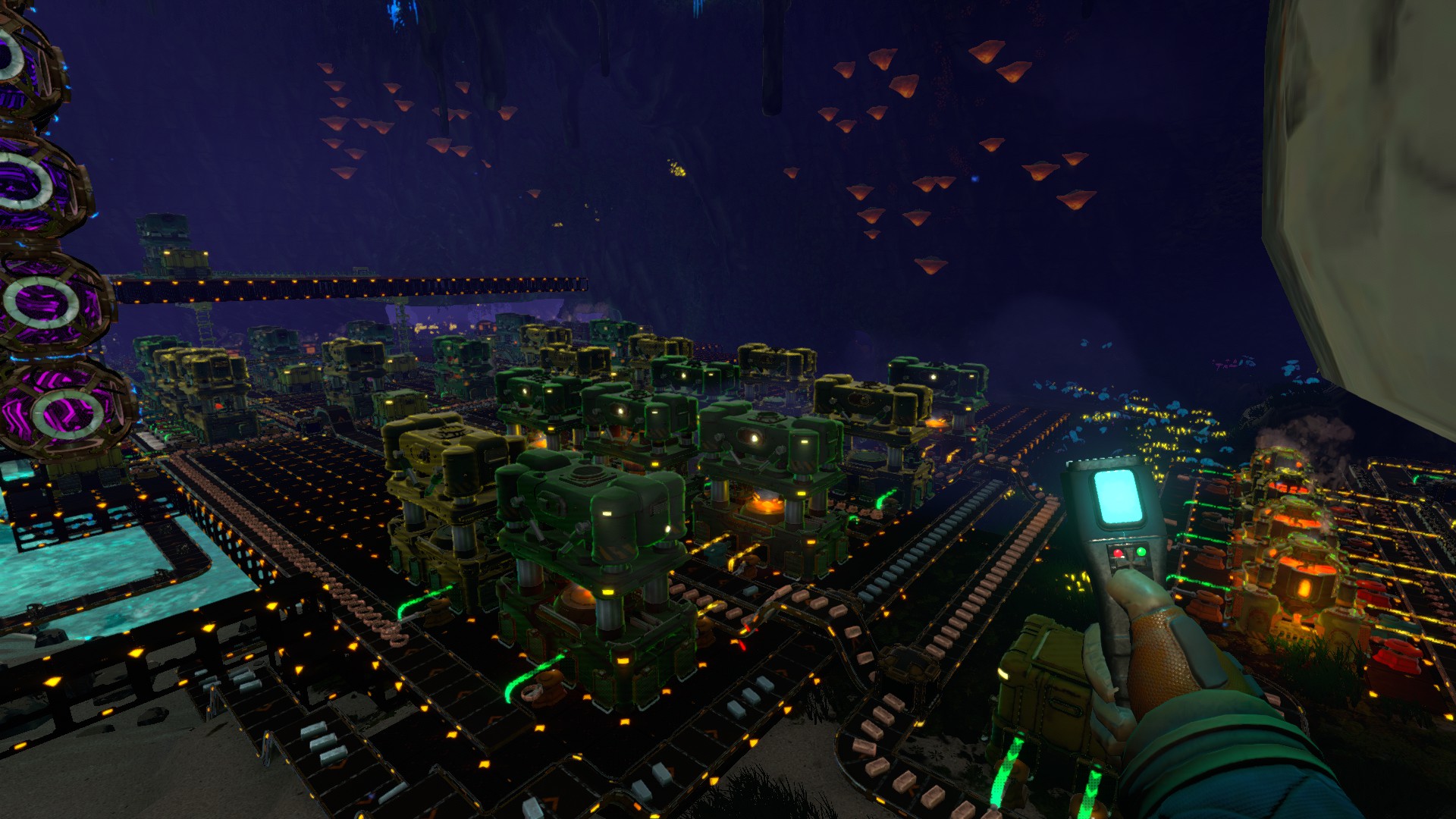
The main production floors. I really like the aesthetic.

Now, Dyson Sphere Program (if you turn off Dark Fog) is still the gold standard here, and Techtonica has some rather large QoL bits to figure out. Some items require tremendous amounts of material and the results can stack to crazy amounts (you’ll know when you make monorail bits), which makes it hard to manage crafting chains. Research is done through cores, which must be physically placed in the world, taking up huge chunks of room. Assemblers have rate inputs that simply cannot be met by inserter tools, certainly the long variants, which adds unnecessary puzzle mechanics and overly complicate production chains (you’ll need many storage containers to manage overflow).

Research cores in the back, plant products in the middle, power in the front. It looks damn cool when it’s moving.

One piece that annoys me to a great degree in these games is the concept of intermediary steps, especially those that are single material ones. The only purpose they hold is to create artificial time gates – or allow scaling when belts/inserters cannot provide. For example, Iron Mechanisms. They need 100x Iron Components. Those require 2 Iron Ingots, which come from 2 Iron Ores. Do the math, and each Mechanism takes 400 Iron Ores. Related, when you encounter one of these steps, your prior balanced production rates of say, 10x/minute now require 100x/minute, which means more scaling is required.

Now that is an issue with the genre as a whole, and if the tooling is there to manage the scale issues, then no real biggie. Again, Dyson Sphere Program completely knocks it out of the park when it comes to scaling tools, which Satisfactory is the lead-chip-eating-cousin. It remains to be seen how Techtonica addresses scaling as more content is added… because it’s not like you have infinite space to build with.

As for a roadmap, with “Desert MIRAGE” as a content point, I am assuming that open space may be on the horizon. Given prior history, it’s likely 6 months away. At this point, I’d recommend a watchlist rather than giving it a shot. It’s good, but unless you really love the genre and willing to have the odd bug muck-up an optimized belt maze, well… your library is likely chock full of options.


Pacific Drive

I do like games with finality to them, what with a credit screen or some sort of last big hurrah. A line in the sand that someone else put that says “it’s ok, move on”. I’ve noticed of late that I’ve been drawn more to games with a seemingly infinite tail, but an unstructured one. I played Return to Moria much longer than I needed to, Enshrouded certainly fits that bill. Valheim I’ll get back to when the next continent launches. Survival games in general have this longer tail, as there’s a need for an optimized cycle that seems to scratch my itch. Probably why rogue-lites work well with me, it’s about incremental progress and juggling multiple variables.

Pacific Drive is a survival rogue-lite that is really quite a bit different than anything out there. Perhaps that’s unfair, Pacific Drive is a mix of multiple known ingredients in a different meal, and a damn fine meal too!

It’s a story driven survival game, with pieces of horror. High level, you get sucked into a contaminated area that is always trying to find new ways to kill you. You get to drive a station wagon around this zone, collecting materials, and then returning to base to upgrade both the base and the station wagon. There’s a pile of story in here, both as to why the zone exists and who brought it to be.

The rogue-lite portion is more about you dying on these voyages, and losing whatever you accumulated on that run. The larger challenge here is that each run is friggin’ long. The first few runs are fine, you have a single zone with some things to avoid and a bunch of stuff to collect. The risk factor is rather low, and the pace of collection follows. You then get multiple hops along the path, needing to select “safer” routes. There are actual stable zones, meaning there’s nothing trying to kill you – so optimal to collect stuff. Normal zones escalate in difficulty, and you have generally around 15 minutes before it goes all out to kill you. And then there are deadly zones, which are to be avoided at nearly all costs.

Red = you gonna die man.

The challenges of any roguelite relate to the risk/reward formula. Progress is gated behind materials (some of which are only found in later zones) and energy (which has 3 tiers, and again per zone). I hit a point where progress was gated behind a set of mid-point resources and I got absolutely wrecked through zone obstacles. I lost an hour of progress, shut the game, and left it alone for a few days.

When I returned, I went into the options and disabled item loss on death, which dramatically changed the approach to a run. Material collection was the sole priority, and as long as I collected enough materials to “rebuild” the car, everything else was a bonus. Rebuild in this case was the bare minimum, as survival wasn’t even a thought anymore. Risk dropped to next to nothing and it felt more like a farming game. This was not better.

The only answer I can provide to this model is a mod that allows you to instantly teleport to a previous discovered zone. You’re only in the “easy” zones to get to the hard ones, and this would save the 5 minute drive per, and avoid what feels like extremely bad RNG damage. It’s a weird spot. It can also be that I simply value time in a different metric than the target audience.

I like Pacific Drive, or at least I think I do. The concepts are cool, the storyline is quite interesting (all NPCs are through the radio), and you have meaningful progress to track. The art is really well done, the ambiance is constant, and you always feel the need to push just a little further. My personal challenge here is that there are tons of other games in my backlog that fit my time constraints.

Paul Atreides is a Villain

With Dune Part 2 releasing, this nearly 60 year old novel has some new light shone upon it. There are two aspects of the novel (and ensuing series) that are important to understand. First, it was published in 1965 (serialized in 1963) and the character context is from that period. Namely, that women empowerment had not been accepted, that widespread experimental drug use was common, and that religion was still core to most world powers. Second, the novels are a clear critique of following a messiah who’s entire construct is manufactured by a shadow party.

Paul Atreides is a very interesting character. He is officially groomed to be the Duke of his noble house, one that has relatively “good” values, or perhaps more relatable ones. He is unofficially designed to be a pawn in a galactic power struggle. It is clear that the Arrakis culture has been structure with religion and promises of a future messiah, a hope that today’s pain will be rewarded with future miracles. (Sound familiar?)

The difference here is that while Paul is thrust into the role, one he doesn’t want to start, he simply keeps walking forward as a matter of survival / revenge. Once he drinks the spiced water and gains prescience (the ability to see the future), he quickly pivots to fully embrace the messianic role. It takes time in the novels to explore what that future portrays (the Golden Path), but across them each of the protagonists knows that their are taking actions where the ends justify the means. This is the philosophical dilemma that Dune truly presents to the reader.

In today’s world context (or woke-ness), people may think that Paul is a white savior, or that people lack empathy, or a dozen other aspects that ignore the actual purpose of the story. Paul knows that his actions are evil, that each step forward has a tremendous cost to people he loves, but he takes it anyway, convinced that the results are worth it. It may not be “mustache twirling” evil here, but there was a multi-billion dollar film franchise where the villain thought killing half the universe’s population was a good idea – clearly, math was not Thanos’ strong suit. Paul is evil because he knows his actions are wrong and takes them anyway, effectively becoming a pawn along the Golden Path. This is a different approach, and bleaker, than say Foundation, where Harry Seldon uses math to dramatically reduce overall human suffering.

This is not a complaint about Dune, quite the opposite. The book is FULL of evil people in charge, and Paul is the LEAST evil of the bunch. The entire concept behind the series it that a population’s stated desire for peace is in direct opposition for its need of conflict. Humanity cannot grow while in Eden – and you cannot truly appreciate something until you no longer have it. In that context, Paul (and much more his son Leto) embrace the villain’s garb in order to force humanity to evolve past its limits. And more specifically, that humanity learn to be self-sufficient and not put all their trust into any oracle.

Which, if I look at the news today, seems like we still have lessons to learn.

Dead or Alive Service Games

There is a very wide continuum between trend setting and trend chasing. In both cases, people will look at you weird.

Trend setters are on the edge of greatness, a particular idea that has great potential, but struggling with the clear execution. They are first out of the gate, and may get credit, but it’s those just behind them that have the opportunity to learn, correct, and improve. Meridian59, Ultima Online, Everquest, and World of Warcraft fit into that model, each larger than the last.

Trend chasers are those that are late to the party and don’t quite understand why everyone is dressed in red. They then show up in red at the next party when everyone is now in blue. This is the group that only see the what and doesn’t understand the why. They may personally experience joy in the consumption of the thing, but don’t quite digest exactly why that is. I could list a dozen themepark MMOs here, but without question Wildstar is one of the best examples.

As with most trends, time is short and fickle. MOBAs are done. Auto-battlers had like 5 minutes of fame. Puzzlers are extremely rare. A small group of developers who are agile can get something decent out the door, with low overhead and some potential decent returns. A large corporation may take 4 years to get something out, by which time it’s simply too late.

I’ll pick on Anthem here for a minute, because damn, astoundingly poor leadership killed that game. The why of the co-op shooter genre should not be hard to digest. Surmounting increasingly difficult challenges as a group of people, and receiving incremental rewards hits just the right spot in the back of the brain. I get better because we get better because I get better. The why isn’t what killed Anthem. The how killed Anthem. Bugs aside (and were there ever bugs), the mechanics of group play were generally broken as the “door to entry” wasn’t tested. Individual progressing was in line with Diablo 3 at launch, meaning dozens of hours of absolute garbage for a miniscule % increment. At launch, more time was spent promoting cosmetics that addressing shortcomings. Had they paused for a year, and addressed the absolute obvious issues, I’d wager we’d still be playing Anthem today!

Today’s corporate drug of choice is live services. The need to have multiplayer content that is subsidized through micro-transactions that are time-gated. Battle passes are one thing (which makes money off FOMO), but the sheer concepts behind them that if you build it, they will pay money, is just mind blowing. I mean, I get it. Live Service games were a huge lifeline during the pandemic to keep social bonds. We are not in a pandemic, we are in a near global recession, where money spent in one place cannot be spent elsewhere. The conversation of “value vs. money vs. time” is now top of mind, and as more options are on the market, the choice of said value is multiple.

So, if I have the choice of spending $70 on say, “Skull and Bones” or “Suicide Squad”, I am in fact comparing those games to every other coop looter/shooter live service game. This is no different than Warhammer Online launching after World of Warcraft, with worse quests, more bugs, worse graphics, and poorer social tools. Or, as above, Wildstar launching with no social tools and only hardcore content. Do you understand the market segment? You’re late to the party, so you need to show up with near-perfection.

Will these games kill live service offerings? Not a chance, they are the model for today’s microtransactions and the lifeline when games cost more than $100m to develop. And honestly, live service can work! Do they remind developers that they actually need a GOOD GAME for folks to want to spend their money and stick around? That is also unlikely, at least at a large scale when you have accountants at the game development table. If it’s a good idea, and it’s well executed, people will want to play it and want to pay you for it. You can make more money with decent marketing and thoughts about monetization, but that’s after you have a good game, not before. You shouldn’t have a game mechanic that is designed to extract maximum $$$ from players (*cough* lootboxes *cough*).

Now, do I think this is the start of the end of major studios dominating the gaming space? I would wager a yes on that. Game development is democratized and has a very low barrier to entry now (Valheim had like 3 developers). The lack of quality for AAA games, combined with real world financial pressures is making people pay more attention to where to spend $70 a go. Embracer Group may be the best example of why consolidation for assets is not such a great idea if you are the asset.

In that vein, I remain optimistic about the gaming industry. Great developers are out there with amazing ideas. Navigating the chaos of the boardrooms has become unattractive, so let’s see what the new model looks like.

Enshrouded – Quick Tips

Of note, the first large patch was released recently, which was more in the “this is obviously broken” than anything truly balance related.There are still some fairly large outliers.

Where Enshrouded starts as most survival games (punch a tree, kick a rock, build a hut), it quickly takes a turn out of the natural punishment of the genre, and instead focus on exploration. Probably best viewed as an action-RPG with survival elements. What I mean by that is that the risk / reward mechanisms skew much more to the latter. There’s no perma-death, no item loss, things never get destroyed, your death leaves you with all your armor/weapons, and teleportation has very minor limitations. Compared to Valheim where death causes skill loss, all items are dropped, and you can’t teleport metals… well this is easy as cake.

Some general tips however can save some time and help guide the more confusing parts of the game:

  • There is an absolutely massive balance issue between ranged attacks and melee. Wands are what combat should be, the rest feels under-balanced.
  • Magic attacks are strong but initially require “charges”, which you need to craft. Eternal Ice (no charges, more mana use, less damage) is unlocked through a quest, other Eternal spells come through exploration of new material. Eternal Acid Bite = insanely strong, but you won’t see it til very late.
  • NPCs can craft armor and very weak weapons. Open chests to find new weapons. Chests respawn when you reload the world.
  • Flame altars are cheap to build (5 stone), provide free teleportation, and a respawn point. Use them, especially near higher points where you can glide.
  • Armor stats are broken, except +dmg, +hp, +mana. Rings generally don’t work.
  • Levels (25 max) matter due to skill points, and progress is extremely slow until the teens. 
  • For skills, Double Jump is mandatory. Water Aura (and INT) are currently the meta, and negate most healing requirements. Resetting skills costs 10 runes, which is pretty much free.
  • Bow users need to craft arrows. The material costs are high and long to acquire. Feathers in particular cannot be found without killing birds… very frustrating, and less damage than a wand.
  • A roof, walls, fire and place to sit provided a Rested buff, which increases stamina. You lose it when you die. Try to always have it active.
  • Comfort level extends the duration of Rested. No real need to invest here that much as the material requirements are kind of high.
  • Berries are a great healing option til the mid point of the game. Bandages are ok.
  • Collect the 5 NPCs as a priority. They provide quests (they are the breadcrumbs for progress) and unlocks that make a massive difference in options.
  • Clearing “Wells” outside of the starter quest is mostly optional. It does provide a skill point, but can be quite challenging until you’re about level 15. Shroud Roots (hit with an axe) provide the same skill point and no real challenge.
  • You will need a lot of water. A lot. Collect it when you can, and build a well when you have the option.
  • You will never have too much Flax. Quite ridiculous in point of fact.
  • The rake is OP. Use it to create level surfaces anywhere (better than a pickaxe). Use it to “extend” farm soil for free – then use a pickaxe to collect the free soil!
  • Food buffs are “meh” for most of the game. The top tier ones give +5 to a stat but require complex materials and go away when you die.
  • Upgrade the Flame Power (the middle option) as that allows you to enter more dangerous shroud (red), and create more portals (up to 8), plus gives attribute points. The final piece for each upgrade is tied to an NPC quest to kill a boss. If you’ve got the final piece, then upgrading is now the #1 priority.
  • Keep your first base, it has trees, berries, nearby water, shroud material, flintstone, and clay. There’s no good reason to move it aside from aesthetics. Which of course, matter later! (I moved to Fort Kelvin, looks cool)
  • There are 5 large beacon towers (you can see them clearly). Unlock them quickly, as they open the larger map and allow teleports. Gliding from a tower = very fast travel.
  • The basic gilder + hook should be built ASAP. The next glider upgrade is very useful. The 3rd is not, because the 4th glider is in a chest in the south end of the map and comes around at pretty much the same time. (Updraft skill is moderately useful, but can only be used once per glide. If you could use it multiple times, it would skyrocket in value.)
  • Carry at least 5 lockpicks at all times.
  • You’re going to need a lot of storage. Magic Chests allow NPCs to craft from chests (not stations), but the costs are quite high to make them until later in the game. 
  • There are a LOT of materials in this game. Every time you see something new, chop or chip it to see what it may give, especially in Shroud areas. 
  • Most crafting options only unlock if you harvest the material, not if you find it in a pot/chest/ground. 
  • There are 6 bosses:
    • Thunderbrute: avoid standing directly in front of them. Can find them in pairs.
    • Matron: Dodge to avoid the poison throw, which may 1-shot you. Usually fought in tight quarters and the primary example why melee is broken in this game.
    • Brawler: If you are too far out of range, they will jump, stomp the ground, and 1 shot you.
    • Wispwyvern: Strafe until it takes a deep breath, shoot an arrow to stun it, then attack. Insects will attack you at the same time. Thankfully only 1 of these.
    • Monstrosity: Always found in the Shroud, shoots projectiles in front for low-ish damage. Didn’t even realize this was a boss.
    • Sicklescythe: Floating death. Dodge forward to avoid the sickle projectiles, and run like hell when they do their AE charge attack. Even at max level, with the best gear, you will die to these.

I would personally consider the game “complete” when you acquire the final glider, as pretty much everything past that point is cosmetic.

I get that many people will be comparing Enshrouded to Valheim. Sure, they have survival mechanics and base building, but that’s about as fair as comparing Valheim to Minecraft. Enshrouded has way more in common with Return to Moria. I’m just happy the genre is exploring non-PvP options and we are able to see some really amazing results from some small/mid-sized developers. It’s much more than punching trees.

Enshrouded – Quick Thoughts

I have yet to be completely burnt out in punching trees.

More seriously, I think Valheim was a near perfect swing at the concepts of pure exploration meeting PvE challenges. The procedural world meant that it could only be self-directed – it is incredibly hard to implement a quest/complex narrative if the world is random. This is one of the reasons I enjoy Minecraft – you are given some simple tools and an infinite world to explore. You make of it what you want. Valheim’s large issues stemmed from the rather massive difficulty spikes and limited base building tools. Once it hits release, I’m sure to give it another go.

Enshrouded is in the same vein of game – build a base, collect things, build things, collect more things and die a lot along the way. The key difference is that the world is fixed and built with purpose. The tower in your world is in the same place as mine. This reduced randomness is a double-edged sword.

High level quick thoughts:

  • Base building is simple and effective. Very impressive. Tip: build as high as you can.
  • The game looks great, renders well, and performs impressively. The map is large. The map tool itself auto-marks multiple spots of interest, but the ability for you to make markers is very limited. Let me add a label.
  • Monster variety is nice.
  • There are multiple types of dungeons, they are really well done.
  • Grappling is so-so, more to cheese out enemies. You’ll trigger it by accident more often than not.
  • Gliding is really cool and with a very vertical map, essential for travel.
    • There are 5 very large towers that cover the map. Gliding from the top of one clears a ton of the map.
  • When you die (a lot), you leave a marker with items from your bag. Items in your hotbar stay with you. Inconvenience rather than penalty. I’ve died more here than in Valheim. Way more.
  • There’s a level structure to the world, from 1 to 30. I’m at the midpoint of that now, and quite simply, levels matter a LOT. 
  • Your levels give skill points (or through special dungeons). By level 15 you’ll have ample points for the core things you want (double jump is life, water aura gives life).
  • Get the 5 NPCs ASAP, they open new crafting options and quests to move forward. Bags, gliders, grappling hooks are all based on NPC quests.
  • Quests provide direction, and the NPC quests are mandatory for progress. There are numerous bugs if you skip ahead. Quests are based on the world, not the player. Major implications for multiplayer.
  • Crafting is dependent on multiple components and steps. Finding some of the components could use more clarity – Amber and Shroud Sacks are the first “roadblock”.
  • Combat is unbalanced, especially for melee. 
    • Armor doesn’t work. Enemy AI is insanely aggressive, attacks with multiples (insects particularly attack 6+ at a time), and can stun you. Bosses deal absolutely massive damage, especially in melee range, and counter if you are at range… so you need to be mid-range. 
    • Shields/parry are mandatory. 
    • Weapon damage is very low, even if you put a lot of effort into skills. Wands are currently the only viable option as a result.
    • Magic has casting time and ammo, which could work if it did way more damage. There are infinite ammo options that do less damage and cost more mana, that are absolutely better options.
    • Weapon durability is very low. By the mid-point you’ll need to repair more often than empty your bags.
    • Weapons are 98% acquired through random numbers in chests found in the world. They respawn on logon. You will want to “farm” at level weapons every 5 levels.
  • Base building is limited to flame size (which is specific to a single base) and flame power (which is shared). Size impacts how much space you can build with, which is rather meaningless until the mid-point. Power has massive implications and is a critical priority
    • It impacts how long you can stay in the shroud
    • It impacts the difficulty of the shroud you can enter (red shroud kills you until this is upgraded, preventing map progress)
    • It lets you create more bases, which allow world teleportation. Bases act as respawn points too. It goes 2, 4, 6, 7, 8, 8. 
    • It gives character attributes, which are very secondary.

In most respects, Enshrouded has taken an iterative approach to the survival PvE genre. There are many great ideas here, and the world feels alive. Balancing combat is a numbers thing, which is “easily” fixed as compared to building entirely new systems. There is a lot of potential here, and with some tweaks can really provide more of the “do what you want” feeling that these games thrive upon. Worth a peek for sure.

Ubisoft & Niche

Ubisoft has some rather serious internal issues to resolve. Similar to many large AAA studios, they have been chasing trends rather than focusing on quality. No one, and I mean no one, outside of a board position would think that NFTs are a worthwhile investment at scale. If the focus is chasing trends, then what are you really doing?

The recent Prince of Persia game is an unfortunate example of this. Metroidvanias are “in”, so much so that the concepts themselves are simple enough to understand, should have a relatively “low” development cost, and are generally easy to digest by the solo gaming masses. But if you don’t understand why the genre is popular and you’re simply mimicking others, then you need to hit that thing out of the damn park! Charging AAA prices for something that is less than other smaller shops have done is insanity. Now, for a smaller shop selling 300k and making $15m would be amazing. For Ubisoft…I saw the credits roll at the end, there were a lot of people involved and this wasn’t a weekend’s effort. Would it have sold more copies at a different price point? That’s a marketing question, but a $70 entry fee when there’s a literal glut of great games out there seems an odd choice – and I won’t open up the subscription convo here.

Anyone recall the Avatar game that launched before the holidays? It was supposed to launch next to the movie, but was delayed. Next film isn’t out til 2025, so that’s a heck of a no-man’s land. No real marketing push, the game is decent (from what I hear, but I’m not paying $70 for it) and most certainly won’t make it’s money back.

For a long time, it was a developers market. It was certainly shareware city in the 90s (and virus city I guess), but the 00’s to 10’s centralized development into mega studios. For every Horizon Zero Dawn, Steam will see 20,000 games come out – admittedly of middling quality. Big studios have some existential questions facing them. It simply is not sustainable to ask 200 people to spend 5 years building something and think that’s a realistic investment. Nor would it seem like industry wants to continue that path. Quite an interesting pivot ahead.

Survival Games & Microsoft/Blizzard

To the surprise of absolutely no one, Microsoft cut 1900 employees following their deal close out for Activision/Blizzard. Bobby Kotick got a nice sunset paycheck reward as a result, and Ybarra was shown the door. It’s simply continual sad news to be in game development these past few years, mostly because the price to entry and return on investment math is long gone (like the themepark MMO rush of the mid 00s). Blizzard in particular has simply been unable to right the ship of poor investment decisions that don’t have the word “battle pass” attached.

I want to pick on a particular thread in this larger convo though, and that’s specifically on survival game that’s been in dev for 6+ years – Odyssey. The math on this is simply mind boggling… and a testament to both the deep pockets and sheer madness of game development today. Tangent first:

Survival games are by their very nature, niche. And I say that in the context of a AAA game shop, where 1 million players is niche compared to things like Call of Duty. PvP games in this setting are popular yet struggle with tremendous griefing (try Rust for a week, let me know how that goes). PvE game are a rare event that can truly capture attention for more than a few weeks without procedurally generated content (Palworld and Enshrouded attention spans will be interesting.)

Minecraft is the absolute perfect example. Designed by a very small team with a fixed vision, it truly launched the survival wave with simple voxel mechanics and procedurally generated environments. Content was added over time, for FREE, and the game made mint. So much so, that Microsoft bought them, and has made every attempt under the sun to further monetize the game (Realms has had moderate success as a server hosting option, Dungeons and Legends failed big time). Taking the “big corporate” view on Minecraft simply has not worked.

In that vein, Blizzard’s seeming game direction was to not use an industry tool, but an in-house mobile variant to support 100 players simultaneously. Make it big and maintain the boil the ocean approach of “when it’s ready”. Throw a ton of developers on it, and invest a lot of capital. Which is truly a quite fascinating approach for a company who has struggled for decades to launch any new IP outside of Overwatch.

Reports internally were that the dev team was relatively enthused by the potential, but hamstrung by the executive choice of dev engine. Morale-wise, that’s got to be a hell of a slog. I’ve harped enough about the glory days of game dev, and rose colored glasses abound. There’s a larger reckoning underway in the games industry, where the ideas are less important that the boards. The democratization of development is making AAA game studios seem more and more irrelevant. And the kids’ dream of being a game developer has become even less clear than before.

Prince of Persia – Lost Crown

I have a soft spot for metroidvanias. It’s a genre that seems to scratch many itches at once, and the floor to entry is rather low in terms of development. They can be taken in bite size chunks, can have varying levels of difficulty, typically have some interesting storyline, and the branching paths make for some interesting options. Hollow Knight, Ori, and Blasphemous still sit way atop for me, though there are many others close by, like Bloodstained. Heck, Dead Cells has a good foothold in the genre too!

The recent Price of Persia game is a full on reboot of the series and most closely emulates the Hollow Knight attempt at the genre, to varying degrees. About 15 hours or so to get through for the basics, 20 if you want to reach closer to 100% (which I do not recommend).

The map is absolutely sprawling, with most branches relating to trap traversal, followed by backdoors to skip it in the future. You have a core melee attack, a limited range option, and then “magic” of sorts. You have amulets that provide passive skill buffs, which you are limited to equip. Movement traversal skills (like double jump) come after key boss fights. There are side quests, health boosts, upgrades from materials and so on. Those are the pieces of a metroidvania, it would not be one without.

Should I talk about the ability to take pictures of the map? This is neat but not groundbreaking… every metroidvania has had the ability to mark the map with specific icons. Guess I’m just not getting it.

The heart of a metroidvania is more than the pieces, but how they connect. And the true heart of a metroidvania is in the fluidity, the balance between combat and movement. Hollow Knight is a gold standard for a reason, it nails this absolutely perfectly. Blasphemous 1 went a bit too much into combat, an issue admirably resolved in the sequel. PoP struggles in this area due to design choices. By the time you’ve acquired every movement power, the fluidity is there as you can quickly zip across the map and avoid tough enemies or plow through simple ones. But that’s truly the last hour or so of gameplay, with 20 prior being a relative slog of imprecise controls.

I mentioned that most of the game relates to trap traversal, which is not a bad thing in itself. Platforming can be fun, if the tools are there to help. Sadly, I have been spoiled with games like Celeste. PoP doesn’t have fixed camera angles, it zooms in and out depending on the map, which messes with visual cues. Second, it has imperfect pixel placement, so that a jump done once will work, but done the same way a second time will not (this is exacerbated in the late quest “Impossible Climb”). I completed all the challenges, and the wide majority on the first go, but it’s clear that there are issues here. And hats off to the developers on this… they added an accessibility feature that allows you to skip all “normal” trap traversals. This is a massive sanity check near the tail end of the game.

I’ll also pick on the magic system for a bit, because it’s interesting in concept and flawed in execution. You have a magic source – athra – that fills up a bar up to 3 levels. You have about a dozen skills to choose from that empty 1 to 3 bars and either deal damage (11 of them) or heal you (costs 2 bars). You can only slot 2 of them at any time. For most players, one of those will always be the healing option as healing alternatives are quite low in the game and damage comes from everywhere. So you effectively have 1 skill to chose from and generally want to keep close to 2 bars ready for a heal. Athra gains are slow, you may fill up 3 bars total in a boss fight. Which in practical terms, means you’re only going to use a simple melee attack (as it’s the only consistent damage source) and never a tier 3 option, which effectively wastes an entire game system. Sure, you can supplement magic moves through amulets, but those are best reserved for melee augments.

A quick note on the parry mechanic which is becoming more and more popular. It’s here, there’s a visual queue for what can be parried or not, and is a great option for bosses. Miss the timing and you take extra damage. It works great in 1v1 battles, and horrendously in group settings, which is fine by me.

Bosses and mini-bosses are a highlight. The fights are well structured, reward memorization, and with a single exception, avoid super cheese. I’d have liked more of them to break up the exploration portions, especially the middle part of the game (turn on Guided mode, trust me). Everyone has multiple stages, and the final fight feels like it will never end. Quite well done.

There’s one movement skill that’s interesting, a sort of timewarp where you leave an impression and can zoom back to it on command. It’s never used in standard combat, a few odd times in optional trap levels, a lot in the optional puzzle rooms. It can be great for some boss fights, if you put is somewhere “safe” and want to avoid an AE attack. Cool idea.

The “extras” are odd here. There’s a few quests, nothing too ornery (the bird one was bugged and could not complete). There are some “hidden” puzzles for you to figure out, which was fun. Also some optional trap traversal areas. Combined, they reward you with partial hearts (yay!), amulets & slots (cool!), ore to upgrade weapons (yes!), gems to buy stuff and coins to upgrade amulets (YMMV). So you’re going to want to do most of these, with the exception of the extra coins. See, you can upgrade every amulet twice, the first time for gems, the second for gems + 1 coin. There are 37 amulets, you’re going to upgrade maybe 6 of them.

Notice how I haven’t talked about the story or lore? Yeah, well, there’s not much there. There are 50 odd lore objects that provide near zero added context. Persian mythology is ripe for options here, lost opportunity.

While PoP is a good metroidvania, it doesn’t dethrone any of the pantheon. I am not a fan of the AAA pricing on this game, not when there are dozens and dozens of frankly better metroidvanias you can get for less than half the price. The great news is that the demo should still be available – give that a shot as it’s a pretty good approximation of the mid-point of the game.

Dark Fog – Part 3 – Spaaaaaace!

The most impressive part of any factory production game is the rhythm. You are just barely getting anything going, and then boom, a near perfect production chain just works and you can watch it run its magic. It’s like if each factory had it’s own voice, and you could see them sing. Ok, maybe that’s just me?

Following that analogy, each piece of the factory has it’s own specific sound, and when you can get enough of those voices working together, it’s extremely impressive to watch. To point, entering the late game means warpers, which require green science (Gravity Matrix). Each one of these requires over 120 pieces of something collected, which are processed at just under 20 different stations. Which if we’re talking main production lines, is going to be about half of a given factory. So half of everything you own is going to have a part in building this 1 thing. And by the time you reach end game, you’ll be producing a few hundred of these per minute. 

All that to say you’re going to be running rather impressive production chains across multiple planets, and the need to harvest from many locations.

Ground Stuff

The last post talked about ground bases, which in truth are rather simple to manage. 8 Missile Turrets with pretty much anything in them will destroy any base that has a Signal Tower close by. The only issue is that the Dark Fog will continually create NEW bases, which are all but impossible to defend against given the power/material requirements to fully protect a planet. This needs a rather significant balance pass.

Space Stuff

A disclaimer that the devs have stated that the space portion is not complete, and space stations should be coming.

The first post mentioned that you should not attack space relays (the thing in the sky connected to ground bases) because that turns the space fleet against you. This remains true for the duration of the game, as even if you had 50 turrets on the planet, they’d take a whooping from any space attack… that means battlebases to keep them all repaired, which is more wasted energy.

And currently, there are no star system based options for attacking space fleets, aside from you piloting up there with some smaller ships. Which has the following issues:

  • The size of the fleet (# of ships) is very limited until the late game due to research requirements. Even at late game, with ALL upgrades, you are going to blow through 500+ ships to take out any hive above level 5.
  • The ships themselves require a significant amount of resources to craft, which are not available in bulk until well into the late game.
  • The power/durability/attack speed of the ships is dependent on a rather substantial amount of research.
  • Your own power levels continually decrease while your ships attack, meaning you need late game upgrades to power levels/charging/deuterium rods

Even at end game research levels (e.g. all “colored” research complete), you will go through a double stack of space ships to take out even a level 1 space base. Which you will be required to do as the Dark Fog is continually sending “seeds” into star systems to generate space bases, which you cannot defend against.

Sulfuric Acid + Unipolar Magnets

These two items are only available in late game star systems, which prior to Dark Fog wasn’t much of an issue. The Sulfuric Acid is available in infinite supply (and essential to alleviate some oil production chain issues), and will generate a bottle neck in the late game. Unipolar Magnets are a very limited supply, and only used in end game.

By the time you unlock the ability to find these items, those systems will have Dark Fog present, with multiple ground bases and a space base. To actually clear all this out, you need a Missile Turret blueprint (6 or more turrets, a storage container, a signal tower, and belts to feed it all) and some really basic power generation. Take out one base, install a thermal plant for a new power source, and move the turrets next to it, and a space station to ship extra missiles. This should allow you to install mining equipment, put a signal tower to defend it, a battlestation base to repair any damage, and harvest all you need. A sort of back door harvest I guess. 

Overall Thoughts

I think this is a great first pass at scalable enemy AI. They are logical, the threat levels are manageable, and the attack patterns are defensible. I never felt like I was fighting an exponential curve that required diverting too much material. But I’ve also played this game for 200+ hours and know how to optimize. I also didn’t generate a space attack until I was ready. No joke, a space base attacking your planet before late game will pretty much mean a full restart, it is that strong. 

The ground portion generally works, though the material provided from combat is clearly just placeholder for now. It makes no sense to “farm” ground bases for material at this point. But it generally works. I don’t quite understand why you’d run laser towers, or cannons though, as missile turrets are infinitely better in absolutely all cases. New power distribution options will be required to support planetary shields as well, as this is the first time you truly need to use the entire planet’s surface (space stations?) And there are simply too many things to build on the ground to have true value (laser turrets are a great example)

The space to ground portion is not yet balanced. Protecting a planet from new bases requires too much power and at the absolute most optimal 10 towers (connected with 100+ poles), which makes no sense before end game. Having the ability to have orbiting space stations may do the trick. It really changes the end-game portion to wars of attrition, which I don’t find terribly interesting.

Net result is that the initial star system is cleared of Dark Fog, and 2 others (to get all the rare material). Those last 2 were multiple attack runs with nearly 600 ships destroyed. And now, every 30 minutes or so, a new attack happens in those systems because it’s not possible to protect a system, only a planet. So, play session complete until the space portion is in.