Foundry – Part Drei

As I move further into the tech tree and unlocks, I’ve come to the fun “this is early access and not yet balanced” phase of the game.

Most production games are a balance of collecting enough materials, to feed multiple stages of production, all while having enough power to run the whole thing. You can’t truly full invest in any particular thing, as there’s often an upgrade that negates the model just around the corner. You just keep on plowing through, making adjustments here and there as new material is constructed.

Now, the fun part here is that the majority of the game can be run from a main bus, which allows you to produce a ton of stuff used for building. Do you need 40 boilers? Hell no, but you can have them on the side in a crate and never have to worry about crafting them again. But you’re going to need a crate with 1000 foundation blocks! In that sense, you can have the main bus simply run very long chains of materials alocg a crafting path, and then fork off what you need to create/store/augment the main belts.

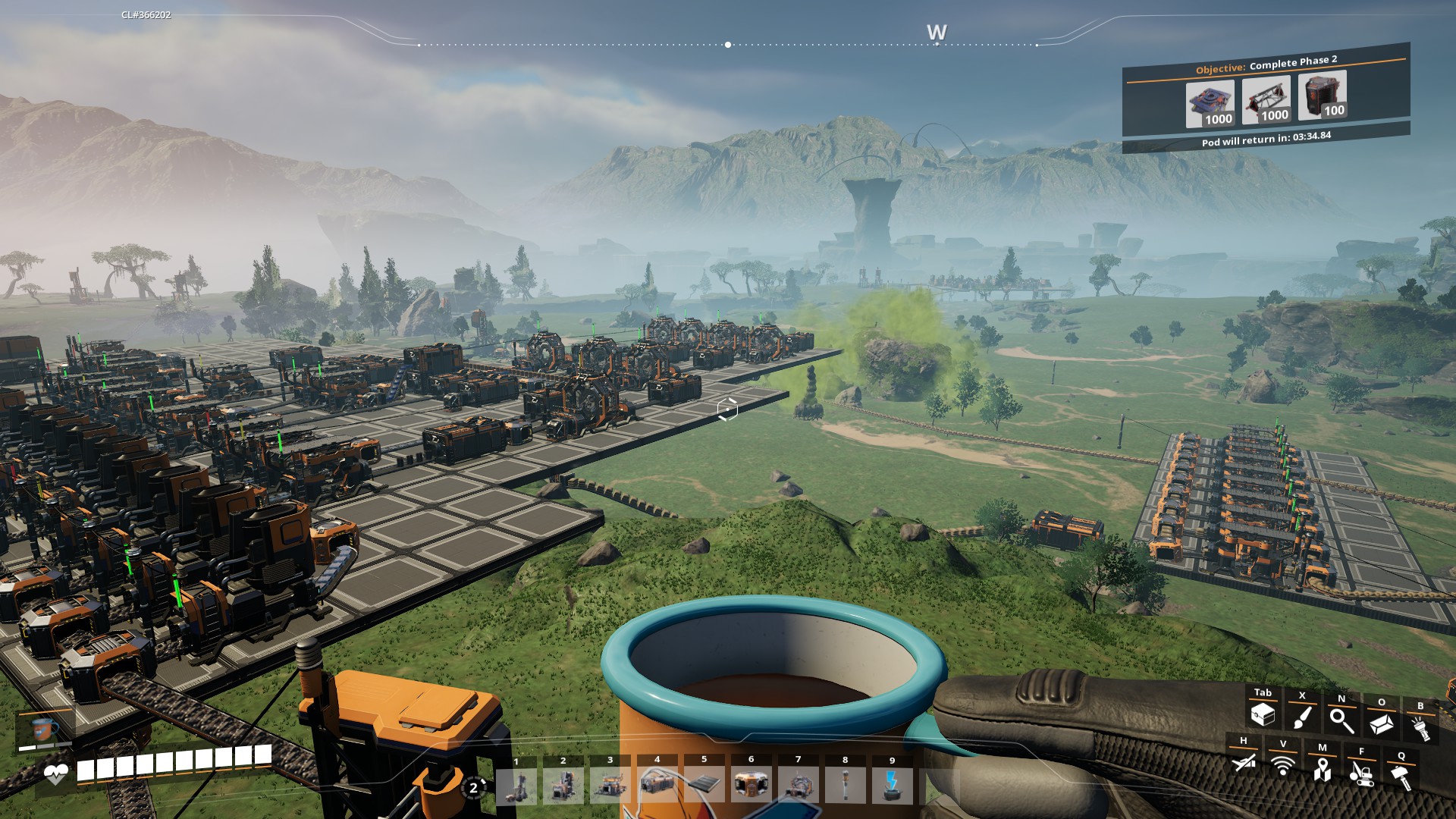
The bus in the middle, solar farm bottom left, and space shipping building in that big thing (that is 10x larger than it need be)

An example is Circuit Boards. They are a mid-tier item, crafted from Electronic Components (which likely is item #4 on the belt as it’s early) and Polymer Board (an item crafted from oil, early in tier 3). Crafting Polymer Boards is best done close to where you harvest the oil, then shipping it all towards the main bus. And a quick off-shoot from the bus (the components) allow you to create Circuit Boards and then add those to the bus lanes. Other similar products are Advanced Machinery, Glass, Concrete and so on.

From there are two core challenges. First are in-line upgrades. Basic belts are needed for tier 2 belts, and tier 2 is needed for tier 3. You will unlikely make space for that issue and have to tweak the bus as a result as you unlock more advanced tech. Second is research cores, which require a weird set of materials that are not on the belts. It turns into some belt ninjitsu to get it to work, so the actual base construct of the bus needs to accommodate enough space between the constructs to add extra belts. e.g. build with flexibility in mind. These cores also need the main material per tier, which should provide a decision point. The lack of balanced ratios unfortunately prevents such events, and you’ll just slow down.

Balance in these games is notoriously complex. Production chains are complex, with multiple steps, and there are some core principles that need to be adhered to so that the experience is managed. Your mining operations should be relatively balanced, so that you know the effort required to open a new mine. The last mineral you unlock doesn’t follow this principle – you only need it for 1 thing, and each one of those things requires hundreds of the mineral to produce, but in a chain so complex that you can’t actually refine it in a smaller station. It means that logistically you are transporting time, rather than material.

One final bit here, with a cleaner bus set up, is that there are simply too many things that do the same thing. At my count, there are 5 buildings that use belts & pipes. They are different sizes and used for different end results (which thematically don’t make much sense). A great place to optimize!

Next up, tier 5.

Foundry – Part Deux

Levels. Levels everywhere.

I’ve unlock Tier 4 research, which is a rather significant milestone as the game pivots from terrestrial to space-based. Well that’s a stretch… see, you crashed from a space station and you need to build connectivity to progress. It’s a rather massive shift of objectives, where all prior efforts were simply “build more stuff”, you now have major (and massive I may add) structures to build.

This is way bigger than the image does justice.

The main challenge at this point is simply scale. Where before most things needed 1 to 10 material to craft, these things require hundreds. So optimization and spaghetti belts is the name of the game! Two terms that run counter to each other.

You should see what it took to get the stuff here.

I find in most of these games you reach a point where you just simply realize your initial design is bad. Like really bad. DSP has you figure this out once you leave your planet, when you’re essentially forced to scale up and build new. It also has great tools to help. Satisfactory’s main burnout factor is exactly this, where you know hours of work in a design have to be redone because all of a sudden you need to mine 12,000 copper instead of 300.

Foundry does not yet have built-in rebuilds. You need to tear down and restart. It also doesn’t deal well with mini-factories because the raw materials are used for a ton of stuff (well, not Technum so far). Plus, if you do want to rebuild, then scale becomes a very, very interesting challenge as inventory limits (like Satisfactory) make things complicated. You’re going to need a scalable main hub. This thing has tons of belts (2 wide, one for the belt, one to split) in order to create material for later use (which you will store, or perhaps add to the belts. You may get lucky and a material is only used for one thing (say…Ignium Powder). Maybe.

You’ll have a belt for each of these items (and more past tier 4).
You will craft and store each of these items. Some simplification is required here.

The general concept is base materials, sent to belts. Then you fork off the belts (with splitters) to craft whatever items you need. Maybe you add them back to the belts if they are used down the line. So you’ll start with 4 base materials, then 8, and by the time you reach tier 4 you’ll be near 10 items (or 20 wide).

The good! news in this is that the map has no size limits, so you can build as much as you want as long as you clear the trees. The less good news is that the more you spread out, the more you need to travel (and the more belts you need). The medium news here, and frankly logistical craziness, is that you will likely need to truck from a 1000m away the base material to feed this machine.

So guess what my next plan is? Oh, it will be glorious!

Exploration

I had put Satisfactory aside for a while, mainly due to the frustration of the map. That’s really what the core of it is, because getting from point A to point B is painfully long, and if you have any vertical walls to traverse, the tools are atrocious.

In something like Skyrim, you travel somewhere, unlock fast travel and sort of forget about the travel path next time. Well, maybe you don’t because there’s some sort of emergent gameplay along the path, or some random chance at something. Satisfactory has none of that. The world looks amazing, but every single thing is placed with purpose and once you’ve found that purpose, the path between points is simply padding.

So I started to think about why the map was so frustrating, or more specifically why I needed to engage with it so much. The answer boiled down to two main things. First, the world-building tools are quite limited, in particular regarding trains (the slope limits make some paths much too complex), so that you’re having to be extra creative to build things. A nuclear plant is going to be 99% over water, because it’s the only open space you can use at that size. Second, the puzzle pieces provided to build things are too limited – your inventory is simply too small. The map is so darn big that you’re going to need thousands of meters of belts, but can only carry a few hundred.

The answer to this is mods. Or was mods. So:

  • Increased inventory. Found a mod that gives 300 inventory slots. It is crazy how useful this mod is.
  • SMART! which allows building multiple buildings at once. It used to provide the ability to link belts too, but that broke in v8. This cuts factory build time by a good 75%, especially if I want to line up splitters/mergers above ground.
  • Teleporters. Once you unlock plastic, you can unlock the ability to build teleporters. I cannot explain how amazing this is. I remember having to walk nearly 10 minutes from one corner of the map to another. Amazing.
  • Flight. Ok, this was a mod but has been a game option since v8. It makes building things so much more fun and removes the inventory management nightmare of the actual jetpack. It does trivialize Power Slug collection. Which I am ok with because you never needed it at the start of play anyways, and by end game, you had near infinite jetpack fuel.
  • Unlock all alternate recipes. This was a mod, not an option in v8. Alternate recipes are variants to construction that provide alternatives depending on your available materials. Some are absolute bangers in improvements, some are more of a mess. Unlocking them meant exploring, pulling power cables all over the map, and having inventory of dumb things… then waiting 10 minutes for RNG to unlock something. I get doing it once, but it’s a good 8-10 hours saved.
  • Docile creatures. The PvE elements in this game are pointless. Effectively it knocks you down cliffs. So turn this off. Also a game setting thankfully.

I am conscious that most of this reduces the value of the bespoke world building the devs have applied here. Things were placed with purpose, and the first time I went exploring, it was a truly fun journey. But this is like a puzzle, the first time you get it done, it feels great. But if I put that puzzle as a requirement to open your fridge, then you would have a different opinion quickly.

Does it allow me to focus on the parts I enjoy, like building big factories? Heck yeah! Is that one of the best parts of this game? Double heck yeah! Is laying belts and running out of material and having to trek 20 minutes back and forth fun? Anyone? If I’ve got the mats, let me use the mats! Especially when we’re talking about laying out factories with 40+ smelters.

Tangent – I still think not having the ability to pre-fab buildings is a bad choice, but also realize that it’s made entirely because of inventory / scaling issues. I’d rather have 15 manufacturers in my bag than the mats for 15. Also means that you’ll build a wall of containers holding mats to collect from.

Back to the topic. Exploration is good. Once it’s explored, it doesn’t need exploring anymore. I want to conquer that exploration, to tame it, or to simply avoid it altogether. This isn’t Valheim where the environment itself is the challenge, and you gradually get better at defending against it. I want to build factories that reach the sky! That sprawl to the end of view! That pump out so many iron plates that the planet’s gravity shifts as a result! Thank goodness for an absolutely rock star mod community.

Foundry – Early (early) Access

I like production optimization games, what can I say?

Foundry is a voxel based production optimization game, a sort of weird hybrid of Minecraft and Factorio. It had a sneak peek demo of sorts last October, and I’ve been somewhat intrigued since. I like both of those games, and the dev company is a relatively small Canadian one, so why not give it a go.

At their core, this genre of game is Excel with graphics. The goals are about making numbers go up, which feed into other numbers, who also need to go up. And then somewhere in the middle realizing “what a sec, I need WAY more numbers” and truly appreciating the scale of the games.

One important part about Excel (or math in general) is that every new variable added can exponentially increase complexity. So the pace of added variables has to be one that’s controlled and mathematically sound. You can’t have one recipe need 5x and the next one need 100x. It’s also bad form to add so many variables and the inability to balance them – which is mostly found through a starter bus. In these games you need to produce everything (foundations, belts, smelters, etc..) and the number of variables is directly related to the ability to ingest. e.g. If a machine can only accept 2 materials, you can only have 2 materials.

So what does Foundry bring to the table?

  • Voxels, which is a fancy word for grid-based exploration in 3D. Think Minecraft.
  • Tons and tons of decorations, all from the start. Neat.
  • Procedurally generated worlds. Every world is different, so there should be inherently less complex construction as the world is variable.
  • Multi-player. While I haven’t done this, I can see tremendous value.
  • Exhaustible resource nodes. You can’t just mine the same spot forever.
  • Foundations to power everything. You need factory floors, which is a very annoying bit as your character can only jump 1 voxel.
  • Loaders. These are initially limited to 1 space, then within an hour 2. The 3 space loader takes a while to unlock.
  • Many machine types. Smelters, miners, assemblers, casters, pumps, etc…Many. Frankly, too many.
  • Storage and the ability to limit. Used for buffering. This is great!
  • Farming. Sort of. It takes more energy than it produces, not sure of the point yet.
  • Research cores and stations. This is how you move along the tech tree to unlock more things to do.
  • Low voltage and High voltage power. I dislike this a lot, more on it later.
  • Subterranean mining. This is is interesting.
  • Tasks. Not much for now, but an attempt at world-building.

Looking at the above, you can see a ton in common with Factorio, Techtonica and Dyson Sphere Program. There isn’t much in common with Satisfactory here.

Voxels – This is more related to world construction & destruction. You’re given a hand drill and you get to drill (or blow up) blocks to make open spaces. It’s also used to clear trees and rocks, that block foundations. In 99% of cases, your lack of vertical mobility means you need to go through things rather than above them (e.g. mountains). It’s interesting but finicky, in particular when laying down belts.

Procedurally Generated World – The map is infinite in size. “Seed hunting” make little sense. There’s no long-term travel options (e.g. trains or others), which means belts everywhere!

Foundations – You need a LOT. And when you think you have enough, you need more.

Loaders – They initially only grab 1 space away, then you get a 2 space loader which is essential for a main bus. The 3 space loader is a long ways out, and generally not needed.

Research Cores – I really like this model. You can self-direct the path of advancement. The research tree needs some serious QA work. One panel for crafting, one panel for mech, one panel for decorations would be ideal. Research is also a major bottleneck near mid-game, where the scale of later (tier 3+) items require a TON of material.

Machines – All machines have a config panel that is placed in such a way that if you put loaders in front, you cannot read it. They do what you think they do. It would be nice to have throughput data more obvious than 4pt text. Machine ratios can be a bit weird.

The panel is a pain to get to (bottom middle) and the red X means I can’t use that exhaust… so I’m stuck in this configuration. Which functionally means compact builds are hard as heck to build.

Low Voltage – High Voltage – This is how you power things. Most basic things need low voltage, which is simple enough to manage. You can also convert high voltage to low, which replaces early tech. Cool. You cannot convert low to high, and the only way to transport high is through power poles & wires, which have a 15 square limit. So like 50 power poles to get to from a generator to an extractor, which is 2-3x more than it should be. I’m sure this will be tweaked. Oh, and a platform can only take 1 transformer at a time, which is 25MW, which means “pods” of power. It breaks up foundations for a purpose I have yet to grasp. Oh, and power pole can’t clip, so your best bet is to dig them underground. I guess this is the ‘new to the genre’ part.

Belts – This is a weird thing to me. Straight belts are fine. Want to turn, you need to manually select. If you want to go up or down though, you need a different type of belt and cannot click-drag them in place. If you want to split or merge, you need a specific tool. It’s finicky. And you need a ton of them.

Advanced Pieces – The concept of a main bus lasts about 1 hour, until you need to build mk 2 belts due to insufficient plate throughput. You’ll quickly need to build those upgraded belts, but to actually do so needs some ninja belt pasta because it’s an offshoot of the main bus. Once you unlock steel production, you’ll simply conclude that a main bus doesn’t work here in the traditional sense, and you’ll have “pods” of construction. This is advanced logistics, and while I do expect it, it comes a little too early here.

Elevators – I think this is a really cool part of the game, where conceptually you dig a giant hole, put an elevator, then mine below ground. I say conceptually. Digging that hole requires explosives, and the field of view means you’re likely to fall into said hole with no way out (Jetpack is the only practical option). Then actually putting an elevator in needs substantially more room than you would think as it will be blocked by seemingly random things. And finally, once you do have an elevator in the hole…now you need a cave to mine and power within. The finicky parts of this are just ooooozing potential.

I’m curious as to how this game as an EA will move forward. It really doesn’t do enough to distinguish itself from its peers, where I’d argue Techtonica is the closest comparison and is a few years ahead. On the very positive side – it doesn’t crash, is fairly well optimized, has good art style, is fluid, and has generally “good bones”. If my gripes are all about quality of life, I think that’s an amazing achievement.

I mean truly, this does look cool as hell.

Shogun

Off the bat, this is a must watch. Just absolutely masterful in every nearly every regard.

Before I get too much deeper though, watching Shogun really makes me wonder how executives across the film & TV industry manage to keep their jobs. Do they greenlight things because of side deals? Like how does Zack Snyder get anything approved? How many Shogun or Andors get put in a closet never to be talked about? How many pure passion projects with clear auteurs are we missing?

Right, back on track. Shogun is based on a novel and was also a series in 1980 (before my time). It has a clear start and a clear ending, and as a limited series, there’s 1 season with 8 episodes to tell it all. That framing provides motivation, as each episode needs to go somewhere, all while exploring a culture that most of the planet simply cannot comprehend. There are many comparisons to Game of Thrones, at least the earlier seasons. Sure, as much as there are words and characters they are similar… but Shogun doesn’t have dragons or magic or zombies. It’s a period drama.

The setting is authentic to my poor eyes, where everything seems in place and purposeful. Religious/cultural artefacts are everywhere, from chairs, to ponds, to walls. It feels like a real place you could visit. The acting is stellar, with every character having multiple layers to explore. Sanada’s character in particular has to convey complexity through very subtle means, and Anna Sawai just knocks every scene out of the park. You want to see the new definition of believer, there it is.

The only detractor here for wide-spread acclaim is going to be the fact that 90% of the dialogue is in Japanese and the subtitles aren’t the best. You’ll need to infer intent more frequently than not, which is why the acting part is so outstanding. I personally prefer this approach as it focuses you on the actors and not the words on the screen. I guess you could try listening to the dubs, but that’s like watching an action movie without looking at the screen… why take away from the craft?

By the time the final credits roll, you feel that the story is complete, that the larger mission is accomplished, yet there are still threads that could lead elsewhere. It is a satisfying conclusion, where all the characters end where they need to end for their own sake and not the plot’s. I’m still in awe as to what was presented. Glad I had the opportunity to experience it.

(The) Gnorp Apologue & To The Core

I would like to think that we all have a switch in our brain that likes to see things improve. Incremental games are like a scratching tool made specifically for that itch, where the focus is almost purely on numbers getting bigger with tactical decisions. The word ‘prestige’ is more widely spread now.. mainline games call it New Game+, but with incrementals its the mechanic of restarting, but having to do this a dozen or more times to reach the end.

(The) Gnorp Apologue is a very simplistic game where you control gnorps trying to break a rock. As you progress, you get more options to create more wealth. Get enough wealth, get a talent point, which unlocks more options. The joy of this game is that the source of wealth changes as the game progresses, so that an early obvious choice becomes rather useless later on. Your strategy changes multiple times, and there are multiple options to get all the way through. Personally, I went fire arrows, guns, rockets, and then grenades (for weak points). There’s a wonderful feedback mechanic where the screen just gets filled with more stuff. Yeah, I like more stuff! Game is about $10, enough to reach the end of it all by hours 8 or so. There’s replay options with time-trials, or different builds. It also plays decent on the Steam Deck.

Yup, it’s eye candy.

To The Core has you piloting a ship meant to mine various planets and destroy their cores. Each core you destroy causes a planet prestige where it gives 3x the resource but has 8x the health. This is NOT an idle game, with a rather substantial amount of tactical decisions required. I will say that the first hour is a right slog, where progress is very limited. You’re given minor tools, little information, and progress is very incremental without feedback on progress. Once you move to the 2nd stage (of 5), you get a better appreciation for targeted activities to reach specific goals. e.g. I want more health, I need more coal, I will farm the coal. As you progress on this path, more options present themselves – like having rockets, or poison, or electrical orbs. You eventually reach a point where you don’t even use your ship, just let the doodads do all the mining for you. The largest difference here compared to (The) Gnorp Apologue, is that the progress tree is hidden until you hit certain milestones. This honestly sucks, because some of those milestones are useless, but gate amazing things. Had I known that farms were a thing, darn tooting I would have beelined for it! The game has a decent concept, but the execution is a bit wonky. Also, it does not play well on the Steam Deck due to mouse/keyboard commands and needing active play.

Video does this one more justice.

You may be sensing a general theme in gaming of late, where smaller dev teams are focusing on ideas rather than graphic fidelity. I’ve got a post on that coming up, but in the widest space possible I think it fairly obvious that people would much rather play a great game with bad graphics than a bad game with great graphics.

Anyhoot, incrementals that have an end, great mechanics, and a solid loop, and have figured out how to scale are worth my $$$. Many more out there to try!

Turbo Kid

If you saw the cult film, then this may ring a bell. Now there’s a metroidvania (ish) game that’s out and about, and indie in the name of the game. I am a fan of the genre, I liked the movie, and I have an itch to support small dev groups, so I picked this one up.

The game is about 10hrs or so to complete, with a decent chunk of content done. I’m sure you could blast through it in half that, or spend another 5 or so hours trying to hit 100%. Following the genre, you start off weak, get various upgrades, which unlock different areas. But this is more like Mega Man, in terms of you have 4 options, pick the one you want, and the items therein may be better designed for another boss. I opted for Sewer, Skatepark, Junkyard and then Wastes. Each areas gives you a skill and a weapon – the Sewers has by far the best skill, and the Wastes a ridiculously OP weapon.

You can get a bad ending, or head to the final dungeon and what is arguably a super boss. That one was a mix of frustrating due to some weird RNG.

First, this is not Hollow Knight or Blashphemous. I am friggin’ spoiled for having played those games and put the bar so high I can barely see it. Turbo Kid is a smaller game in almost all respects, and does a decent job of hitting its targets.

The difficulty of the game starts very high, then peters off as you get more health, then spikes again at the final levels. Most of this is related to finicky controls that are not precise enough for involved platforming. You can kill every boss without taking a hit (once you figure out their patterns) due to dodge rolls, but the environmental hazards are the real pain in the butt. Enemy spawners can fill your screen and the knockback effect of contact can throw you into blades and your doom. The video above shows the use of a bike, and while true, this has the depth of control of Excitebike – especially when you are attempting the various trials.

There are minor quests, a battle arena (ugh), vendors, slotable passive upgrades, and a decent amount of stuff to find. In most games of this genre, I like going back to explore more fully the world, but here every zone looks pretty much the same, and navigating the world requires near constant use of the map as a result. I really like the ideas this game is trying to reach, but the execution is a tough one. Maybe with a few patches, these quibbles will be addressed.

It’s an interesting take on the genre, its a rather small dev team (30 people) and I still think it was a good purchase. Plus, works great on the Steam Deck!

Horizon: Forbidden West

First, always bet against this IP. I have no plans game releases for Sony, but good golly, they seem to release right next to other major IPs. Which stinks, because this is a real crown jewel in open world games for a dozen reasons. It’s now out on PC, which is the full package, and is both optimized and looks absolutely spectacular.

(Optimization Note: PC ports have had some absolutely notorious optimization issues. H:FW is a glorious exception on the main game – as it was designed for PS4. The Burning Shores expansion was built for PS5 and has a unique asset caching process, which can cause massive slowdowns if it doesn’t load properly. Aside from that, holy cow does this game look & play amazing.)

The original game was a very interesting take during the “put bows in everything” phase of game design. The general storyline blended social issues and hard sci-fi, with very impressive combat mechanics. The game looked amazing, and had a rather groundbreaking way to manage field of view and memory allocation. Issues were mostly around character art, and the Ubisoft-put-icons-everywhere-on-the-map minutiae. The sequel came out in 2022 on the PS5, so I won’t rehash too much on that front. I still don’t own a PS5 because I know that Sony will release the 1st party games eventually on PC, so the value-add there is quite low.

Forbidden West improves on nearly every single aspect of the prior game. The story is more coherent, with a relatable protagonist (Aloy may be my favorite female game character), with more world flavor and better design. The enemies have more variety and added tactical options. The skill tree adds more options for customization based on your preferred playstyle. Customization/crafting is both streamlined and easier to track. Accessibility options are amazing. Questing has more variations. You get a glider! It also leans much less on the old-world story as a crutch, as that story was complete in the prior game. It’s all about the now and what’s next.

The combat mechanics here are really quite fun. Each enemy can be addressed in multiple paths – speed, rewards, or brute force. Speed is achieved through exploiting physical and elemental weaknesses. If you do this properly, 1 or 2 arrows may be enough to take down almost any enemy. This is all but required when you have multiple opponents. Equipment becomes key here, as you need as many elemental attack options as possible. Hunting for rewards is a risk/reward activity where you are aiming to maximize item drops for crafting purposes. This only works with Tear damage, primarily from arrows, though you can optionally use gauntlets which are deal more of this damage but you can’t really target. Finally, brute force is simply attacking blindly, including melee damage. It is the “oh shit” mode of combat, which is harder than both the other paths. I do feel there are too many combat options on the plate, especially short-range options. You’re not going to go toe-to-toe with a robot T-Rex or a flying robot bat. Lack of defensive options means that any non-ranged attack is at a MASSIVE disadvantage… and 99% of combat will simply revert to hunting bows.

While the first game suffered from having too many things to do, Forbidden West provides a bit more flexibility here. Things are more targeted rather than simply a bunch of map icons to parse through. If you zoom all the way out, the ? icons are things worth exploring and all the other icons are more or less “fluff”. You don’t need to collect 40 doohickeys, which is great! Case in point, there are less cauldrons this time, less rebel bases, less proving grounds. I will say that there is a long-tail option here, namely the Arena that you open up near the tail end of the game. If you want to have more combat difficulty, this is the place to play.

The storyline is better (?) in that is closes every question mark from the prior game, adds a ton of world building, and does a good job of setting up the next installment. The plot flow is just fundamentally better. The villains are lackluster, effectively being gods with no moral compass – quite similar to the issues Marvel has. For the most part, they are simple plot devices that can quickly be moved past.

I would like to take the time to truly appreciate the overall complexity/balance/design of a game such as this. It’s astounding that a world this big can be entirely seamless and populated. That every NPC has a voice actor. That the breadth of content has tools to help parse and direct your play. That you can pretty much apply the combat approach that fits your feel. That there are SO MANY ACCESSBILITY options!! At no point have I felt the game was unfair, or questioned the decisions made in the development. It all has purpose and all feels like part of an integrated system (so meta!)

If anything, Forbidden West reminds me of what I truly expect from a AAA game, and how much of a gap exists between games developed with clarity of vision and obvious leadership, and those that do not have such. An absolute gem.

Techtonica Pt4

Final post for a bit on this topic. I’ve talked about the mechanics and the math so far, and to a degree the limits of an early access product. The game is only in v0.3, which is two content releases from the basic portions. And in a game that is about production optimization, it is missing some key components to “make things clean”.

There are two core examples of this challenge.

First relates to constructing bases, meaning floors/walls and whatnot – not required at all but are about visual customization. There are about 30 items you can create to build a base, each of which uses a different set of material to construct. In practical terms, this means that you cannot practically automate construction of building forms and create each piece individually as you need it. This issue means that you need to haul around a lot of materials in your bag, and that if you need to experiment, you’ll end up with a bunch of crafted pieces in your bag that eventually need to be sorted out. There are two possible solutions here… building materials are split into 3 base items (concrete, steel, biomatter) and that you can “transform variants” of established pieces OR you can disassemble a piece into it’s base material to avoid inventory bloat.

Second is crafting tiers. Research tiers are a different thing, I specifically mean the two crafting tiers – Miners and Blasters. From the start, you have miners who give you basic ores, which can be refined in various stages to create every single item in the game. Eventually you unlock Blast Miners and Blast Smelters, which allow you to operate at scale – instead of 100 ores you need 1 slab, making it incredibly more space efficient. Most, but not all items allow crafting with tier 2 materials. Sadly, 3 things do not: Electric Motors, Steel Slabs, and Cooling Fans. Effectively that means that you cannot optimize those items without causing breaks in Blasting lines. The solution here is rather simple, there are missing 3 recipes and I could cut out a whole pile of spaghetti. I’m rather confident that v0.4 will have these, as v0.3 added others. I won’t rehash the Mining Charge math.. that has efficiency (and supply) issues.

This reminds me a lot of Satisfactory as the game added more content over time. Each patch had three types of changes : Quality of Life, Production Optimization, and Content. That game’s world is substantially larger, with way more than 4 node types. Satisfactory is finally going to reach v1.0, which has been a very long time coming. I still have some significant gripes with the game – that the engine is way too finicky (this is Unreal related and I honestly don’t think fixable), inventory sizes are too small (the mod is all but mandatory), transport across the world takes too long (this is dumb, put in a personal transporter), and that there are no tools to build at scale (I can’t fathom anyone playing past oil without this mod).

Satisfactory – Plastic factory, with weird angles everywhere.
DSP – a main bus with extremely clean lines.

Techtonica is different because it’s voxel-based, meaning that the world is naturally smaller, that spaces cannot overlap, and that tools to build at scale are less important currently as the end-tier material doesn’t need 100+ miners to build 1 item. Helping Techtonica’s case is that you can automate the construction of every single object – material and stations. Dyson Sphere Program is a closer comparison in terms of tooling/structure, though that game has a significantly larger scale that Satisfactory (and infinitely better tools as a result).

Similar to DSP, I can see myself spending 10+ hours per content patch in Techtonica to rebuild the world with the new tools at hand. If I had to guess, there are at least 3 content patches to go from here.

Techtonica pt.3

Let’s start with 2D crafting first and the grandfather – Factorio. Crafting stations produce X items if you feed it Y material. You want to ensure you are feeding it the most to get the most production. Factorio uses inserters to transfer items to crafting stations. These have different speeds, depending on type, and different ranges. At scale you will have multiple stations running from a single belt, but won’t be optimal without a lot of work.

Dyson Sphere Program uses inserters and they marginally slow down at range. However you can research stacking options, so that you get max reach and max speed. Crafting at scale here is extremely easy to achieve.

Satisfactory doesn’t use inserters at all and only relies on belt speeds. This is good for many reasons, mostly to offset weird alignment issues (and boy are there lots of those!) This essentially means that any crafting station will simply take in (and give out) everything up to its stated max, and allows for “buffering” of items on the belts. The challenge with this particular model is that you’ll need to work belt magic if ever you need to split items between multiple crafting stations if you are unable to produce MORE items than the belts can buffer. For example, if you create 100 iron ingots per minute and have 2 stations requiring 30 each, you’re fine. If you have 2 stations requiring 60 each, then you need to split the belts rather than buffer so that both stations work.

Techtonica uses inserters like Factorio but is 3D. The progression of the game has various inserter types:

  • Regular – these move items 1 distance at a rate of 20 per minute
  • Long – these move items 2 distance at a rate of 15 per minute
  • Filter – these move items 1 distance at a rate of 15 per minute, but allow you to select the type of item moved (which is about half of all crafted materials)
  • Fast – these move items 1 distance at a rate of 40 per minute. In most cases you are better off using 2x regular, if you have space
  • Stacked – these move a stack of items (3/6/9/12) 1 distance at a time at a rate of 60 per minute. Caps at 720/minute.
  • Stack Filter – these move a stack of items (3/6/9/12) 1 distance at a time at a rate of 50 per minute, but allow you to select the type of item moved (which is about half of all crafted materials). Caps at 600/minute.

(Note: as with other factory games, create an automated supply chain of inserters, storing 250 at a time. Basic Assemblers make 45/min, more than enough speed.)

When to use these is the key piece is the math part. One recipe requires 904.9 items/minute, meaning that you need 2 Stacked filters to even have a chance to meet the requirement. Nothing too complicated so far.

This is inefficient, as the inserters only support 30/min, but the output is actually 90/min. Stacked Filters are the ONLY option here, which don’t exist until the final upgrades. Meh.

When looking at having a main bus, things start off simple enough as long inserters typically have enough speed (if you put 2) to run 30/minute. At later points, especially with advanced assemblers, you need 100+ items inserted per minute. Creative needs call for creative solutions.

A larger space option that is 2D
This multi-stack option with vertical belts allows for very tight bus work.

I do like this creative aspect of the game, which is much more similar to the belt ninjistu of Satisfactory. The larger challenge is not so much building these things, but the lack of blueprint tools to repat them – an item only solved through mods in Satisfactory and yet to be available here.

Now, one caveat to all this, and it relates to Blast Miners. Through upgrades, you can get 5x the material with 15x the explosives, and at max level that means 60 explosives per minute, per miner. In fact, it goes 3x, 5x, 10x, 15x in terms of requirements for benefits.

  • Base: 5/ minute
  • 3x: 15/minute – a long inserter can do this well enough. The worst ratio and the best option.
  • 5x: 25/minute – this is horrendous belt ninjistsu
  • 10x: 50/minute – as bad as 25/minute
  • 15x: 60/minute – 1 fast + 1 regular inserter sending to a stack inserter, or you need belt magic. Let alone the fact that you can only realistically create 75/minute until you invest heavily in end-game automation.

For the 5x/10x variants: Option 1 = ignore the 25 per minute and only do 20, save the hassle. Option 2 = belt magic with a ton of splitters to break down materials across multiple belts.

The white numbers show how to get 25/minute on a single belt.
A much more compact version of above. 40 in, split to 25 + 15. Put in 80 and you get 50 + 30. Modern art and takes 5 minutes to build.

I am chalking this mostly up to Early Access foibles here. First, that the “end game” scaling has some really weird magic math, and second, this Blast Miner balancing act is trying to be fancier than it need be. I enjoy mathing stuff out. This one though, right on the edge of madness! Which I think is what keeps me coming back.