Early Access and Fickleness

What I love about Early Access games is that by and large, they are experimental. Or at least, the only ones I’m ever interested in. EA gives small teams the ability to grow an idea. Darkest Dungeon, Planet Crafter, Hades… all games that would not exist without EA.

Sometimes though, sometimes a dev has a small-ish idea and just goes straight to the deep end quickly. The game starts in one area, and then takes a massive turn into something completely different. In most cases, these “twists” generate a lot of negativity, which modifies the EA promotion algorithm, and then the devs have paved their way to obscurity.

I have three examples, of varying degrees here, all in the same factory-automation genre.

Dyson Sphere Program : an absolutely stellar game from start to finish, where its taken years to get the “math” right on optimization. PvE combat has always been in the roadmap, though the implementation is only half way there now, and has some rather obtuse requirements. The other half is sorely needed, and it’s taking the time it needs to bake. A result is that the reviews have gone from Overwhelmingly Positive, to Very Positive. It seems like a minor thing, but that has effectively removed it from many lists.

Techtonica : The game as it is now appears to be missing a fair chunk of content (like 2 more zones) and a lot of optimization (mid-tier? resources are not balanced). They had a somewhat clear roadmap and a very accelerated release framework – something close to every 6 weeks had a major patch. And then v0.5 released, with PvP laser tag and teleportation (this is akin to putting a garden simulator in CoD). A name for v0.6 was provided, but nothing about what was in it. Reaction to this has been extremely negative, where the devs have provided a mea culpa on poor communication and held a live stream to explain what’s next – which unfortunately had much more “we can’t talk about this yet” that folks wanted. It went from Very Positive to Mostly Positive, which frankly means only word of mouth can save it now.

Foundry : Only released a bit more than a month ago. The devs put out a journal asking for feedback on some system development, namely more time spent in the resource simulator of selling space stuff. Feedback on this was clear and unanimous – fix the game first. Devs responded that they heard loud and clear, and the reviews have stayed stable as Very Positive. I would like to think that this approach is a result of watching what happened with Techtonica.

EA is an interesting space. Devs get to test ideas and are in turn subsidized for that exploration. This is a two-way street, where there are now expectations on that funding. Clear communication is required, and the timing of it it matters. Satisfactory may have the gold standard here, but DSP is darn close – the language barrier here is why it’s all text, but it is fullsome text. Techtonica has a similar structure to Satisfactory, which does give me some hope that they can recover from this mistake. (And for clarity, the Laser Tag / teleportation is not the mistake, it’s that they didn’t communicate why they launched it instead of the clearly missing content.)

I’d like to think that the golden age of EA is moved on, where free money and loose promises are drowned out by a more realistic relationship with the community that keeps the devs afloat. Like it or not, there’s a recipe to success in EA, and it is much much more than simply pumping out a product. Given the lack of investment stability, EA is likely to be the place to get most funding, if you can figure out how to cheat the algorithm and build crazy word of mouth.

Hades 2 – Early Access

This post likely won’t hit as well if you haven’t played Hades, which may be my favorite roguelite of all time. Developers (Supergiant Games) have never made a bad game… heck, I’d go so far to say they’ve only made good games.

Hades 2 is certainly in EA. There’s missing half the content of Olympus (2 zones, 2 bosses), some NPCs have early art, and there’s still some rather “interesting” balancing bits to work out. So, what do you get here ?

  • 6 zones, 6 bosses. (2 more zones/bosses should come)
  • Fully voices NPCs and gifts/relationships. There are a good 30 NPCs in here, with hours of voice acting.
  • 5 weapons (there should be 6), with alternate forms.
  • Harvesting systems (mining, souls, seeds/farm, and importantly – fishing!!)
  • A ton of random upgrades (boons, upgrades, etc..)
  • Chaos challenges – preset loadouts in specific zones to meet increasingly difficult challenges

If you played Hades, then most of this seems familiar. Hades 2 does add some interesting changes though.

  • Combat is much more strategic instead of tactical. Zagreus was all about melee attacks with speed. Melinoë is about spell casting, which takes longer and requires placement. Some weapons are frankly atrocious if you’re not using an alternate form.
  • Weapons are a mixed bag. The staff is weak, but has good casting options. Blades deal cat scratch damage in a very small area, and require a specific boon set to work. Wands are insanely OP when you figure out how to use them. The axe… feels amazing. The gun is undertuned right now.
  • Boons had preferences for certainly attack styles. Some are always good, some are extremely particular. The secondary effects (burn, blast, push) are generally weak until combined with something else.
  • Boons can have infusions. Each has an affinity, and collect enough affinity to unlock more powerful options. There are times where it makes more sense to take a bad boon to unlock a good one.
  • A new type of boon, called a Hex, that provides a powerful effect when you’ve used enough magic points per fight. I really dislike this boon type, as the effects are too weak (except the healing option), and don’t allow infusions.
  • Rather than clear unlocks, you get Arcana Cards for passive boosts to future runs. You select which cards you want to use, limited by Grasp (an upgradeable resource). You can upgrade cards too. I really enjoy this system, as you pick what fits your style.
  • The enemies + sub-bosses are all decently balanced with some minor exceptions. I would avoid all sub-bosses in the last 2 zones. They don’t provide enough rewards for their HP amounts / speed challenge.
  • The bosses are fun and hectic. Hecate, the Sirens, Cerberus are all solid fights. Polyphemus (cyclops) is anti-melee, and therefore quite hard with blades – some fights are fun, others very painful. Eris takes a bit of learning to figure out (use the posts) but then gets a lot of fun when you do.
    • Chronos – this guy is something else. He hits like a truck (with inconsistent hitboxes), has a mountain of HP, there’s nowhere to hide, and his 2nd phase has so much AE (the hourglass adds, ugh) that it hurts my eyes. There are times this fight feels unpossible. That’s right.
  • The Chaos Challenges are cool. Small packaged challenges that force you to learn the ins/outs of a given weapon. More bite-sized.

The rest of the game is pretty much Hades, but all the edges sanded down. No more fighting the RNG gods a dozen times to get that 1 drop, you can queue it to craft based on other drop. There are menus that explain where things come from. The artifacts you get, in almost all cases, are useful. You generally have more control of choices before you start a run, though you still may want to end a run quickly if the first 3-4 rooms have truly bad RNG. High fear runs (Heat in Hades) do require specific builds… a piece that has yet to be sorted out yet (re-rolling rooms/boons are in cards, which cost too much to select in most runs).

Oh, it also plays amazing on the Steam Deck, with superb battery life.

If I was to guess, we won’t see the full release til 2025. What’s here has more polish than most of the stuff I’ve played this year, but given the prior track record of these devs, there’s still a fair chunk to go.

Ghost of Tsushima

2020 feels like a generation ago and this particular game game at me for my first playthrough when my grandfather passed from COVID issues. As a result, it has a very particular place inside my skull, which results in overly rose-tinted glasses. The game is not perfect, but it’s so much better than its contemporaries that even 4 years later it’s a gold standard for open world story-telling.

Without really rehashing the core plot, you play as Jin Sakai, a samurai who is trying to find a path of redemption after his known world is turned inside out by the Mongol horde. It takes very broad strokes on the concepts of honor & duty being more important that results, and through Jin, you navigate multiple storylines that see how you and other NPCs try to find a viable future. Some people are blinded by rage, others by love. Some make a set of bad decisions that simply snowball to evil. If I were to truly summarize the entire storyline, it’s how people manage grief and find peace with themselves and others. So… a tad on the nose given my state of mind when I first played this game.

The PC re-release doesn’t add any new content (assuming you played the original and Iki Island), but it does add a ton of visual enhancements. Straight to the point here – Ghost of Tsushima is friggin’ beautiful. It takes large strides to force you to slow down and appreciate the environment, with very long vistas. Many of today’s games add a ton of stuff on the screen, and make it look realistic, but few decide to give you the horizon as a goal. If the Switch actually had processing power, the closest comparison would be the recent Zelda games.

Mechanically the game still feels ahead of it’s time, with an open world with relatively minor icon sprawl. You could play most of the game without the map, as there are plenty of in-game mechanics show you a way forward. A golden bird brings you to interesting content. Following white/black smoke plumes brings you to new quests. You see a lighthouse on the horizon, you can get there. Follow a road, you’ll encounter a chunk of content das a result. Combat is focused on the parry/dodge/counter mechanics of the time. Sure, you can opt to sneak everywhere (and honestly, it’s the only option when hostages are in the mix), but you can just run right into a camp and take everyone out “with honor” if that’s your choice.

The natural flaws here are in the set of values being presented. As a modern, western society, our core set of values conflicts with what’s presented. It seems simplistic and naive. Each NPC espouses a specific set of views that are monochromatic. Taken together they paint a complex painting, but as individual pieces there’s just not much there. (Do I think that Ubisoft’s AC Shadows, set 200 years later will do better? Hell no. AC is as historically accurate as a Dan Brown novel and purposefully built that way.)

4 years later, Ghost of Tsushima remains a shining example of open world design and story structure. It is meant to be experienced, rather than played. Not too many games fit that definition. And it still hits me as hard today as it did then. Feels a bit like time travelling…

V Rising – Servants

A final post here, as I’ve killed Dracula and have a huge backlog of games. A point of issue in a prior post is the need to farm material in order to craft things that aid in progression. In a multiplayer game, many people make short work of any farming route and it’s pretty easy to split the work. As a solo player, there are some rather substantial farming bottlenecks. As Azuriel pointed out, this hits hard at the Power Core unlock.

To counter this, V Rising has a servant & mission system, where you can send them out to collect material for you.

A mission screen to collect later-game materials

Servants have multiple factors, where they are collected, their blood type, and their blood quality. Their location matters, as it improves the amount of material collected from the same location. Their blood type matters, as it reduces the difficulty by 100 of a given battle type (monsters, battles, etc). The blood quality has a minor impact as it impacts their power level, but as long as you have 70% you’re fine. Keep the 100% blood for merlots.

Each servant must be equipped, and the gear level has a flat *10 applied. 45 gear level = 450 power. Add blood quality (at most 30) and there’s your score. This score matters based on the area you are sending the servant. You can select various durations which increase the odds of success but give diminishing returns. 3 sets of 4 hours give much more than a single 12 hour run, but they will be harder to do.

The challenge here is that you need to MAKE the equipment, and at the end game, you’ll need a some rather strong armor/weapons to max out the locations. Most locations can take 2 servants, though some are 1 to 3. So even if you did max it out, you’re likely only going to get 30-60 of any particularly meaningful foray. In nearly all cases, this is the equivalent of you personally farming for 10 minutes. In practical terms, this means that while a clan may send out multiple servants, a solo player is unlikely to find much value. It is not helpful for progression, but I can absolutely see it being helpful for repairing in PvP battles.

Once exception. At ~75 gear level if you capture an 80% draculan servant, they can do a mission on the far east of the map to collect a few hundred Greater Stygian Shards. Now, a single rift run should give you about 1500, but this allows you to supplement with not much hassle.

I do think it’s an interesting system, as it can’t be too rewarding or people wouldn’t go out of their castles. Finding the appropriate balance here is hard. My only true gripe would be that if you dramatically overpower a location that you get more materials as a result. What you get instead is shorter missions and therefore more rewards, but that means more logging in to collect them. Maybe allow a queuing option?

There are many cool ideas in V Rising, and almost all of them work. Clearly it is designed for group play and PvP at the end game, every system funnels into that concept. But that there’s a decent PvE game here too, wow. I really wasn’t expecting this and am beyond surprised.

V Rising – Combat

Most APRGs that people have played are 2D constructs that are in the vein of Titan Quest. V Rising is quite similar to that model, with a few differences. One of the most substantial changes is that PvP is baked in from the front, which really changes the larger context of the game.

Players are provided some standard tools to keep the gameplay varied, which are unlocked gradually throughout the game. At the start, you’re given a dodge (with i-frames) and options for basic melee weapons with basic skills per weapon type. As you progress, you unlock magic skill points that unlock various abilities that fit into the ‘attack/defend/ultimate’ constructs. You can equip 2 core abilities (5-10s cooldown each) and then 1 ultimate (2 min cooldown). You can use gems to modify these abilities, like more healing, more damage, added stun and so on. Chasing perfect rolls isn’t all that meaningful. Eventually as you progress through bosses, you unlock other weapons – pistols, whips, reapers and so on. Higher quality items also unlocks a 2nd skill per weapon, so by the mid-40s you’ll have the core tools for the rest of the game.

In the 50s and then the 80s you get access to rifts, which drop shards. These are used to unlock passive skills that add some rather strong benefits to the game – more damage, more summons, more speed. Those shards can also be exchanged for stronger weapons… and the 80s version of the shard exchange has a chance to unlock legendary weapons. Combined, these make a massive difference in overall power levels.

Lots of passives. This one is amazing.

Another factor, in the vampire theme, is that you need blood to survive. There are various blood types (worker, brutes, scholars, etc..) and each provides a different set of bonuses. The higher quality of the blood, the higher the bonuses. Early on, you get the ability to ‘farm’ blood and if you find a 100% quality blood, you absolutely want to collect it. Later, you get the ability to use that farmed blood in the field. It is worth every second invested to have 100% blood quality farms – Scholar for magic attacks, Rogue for physical damage, and Warrior for defense.

There are stats – this is an RPG after all – measured through gear level. Every level you are below a target, you suffer 4% more damage and deal 4% less. Every level above, it turns to +1%. So 5 levels under, you’re 20% in the hole, and 5 levels above you’re +5%. This is important for farming, but ultra important for boss fights.

In terms of outright player power it generally goes – gear level > blood >>> abilities > weapon skills

Fully kitted end-game gear. SOOO many runs to get those guns.

Combat itself falls into 4 different categories. Farming, Bosses, Rifts, PvP. Farming is simple enough, combat is against multiple targets that are protecting resources – it is very AE focused, and sunlight considerations are required. Bosses are bespoke battles, that progressively add complexity, and where you will face a lot of challenge throughout the game. In most cases, these are 1v1 battles, and the wide majority of your time playing will be here. Rifts are a combination of both farming + bosses. Two AE fights, followed by a weakened boss enemy. End game is almost exclusively focused on this activity. Finally is PvP. As much as there are sieges (attacking other castles) the wide, wide majority of PvP will be while rifts take place as the resources are coveted. The majority of that combat will focus on burst + movement restrictions.

The guide above shows you a fair chunk of the level of complexity that is brought late in the game. Adam is the penultimate boss, and I would argue more complex than the final one.

I’ll close this post by saying that the ARPG parts of this game are really well done. The incentives for progress are constant. There is continual risk due to the gear level math. All enemies progress in difficulty (though NOT equally). And rarely have I ever played a game that did such an amazing job at multiple meaningful and memorable boss fights. I would argue that because you will unlikely beat any boss on the first pass, it forces you to pay attention and therefore memorize that character. Really impressive work here.

V Rising – Home Base

I’ll cover the ARPG in another post, this one is focused on the concept of your base of operations within the context of a survival game. The genre tends to focus a simple concept – you need a place to live, and in order to build that place, you need to collect material. As you improve said abode, you need to travel through more obstacles to collect different things.

Where the genre splits from this point is in the definition of the obstacles. Early games in the genre really pushed the PvP portion where people fought over a limited amount of resources. The next generation was focused heavily on survival – think thirst + hunger mechanics. The current generation instead seems to focus on environmental obstacles – substantial AI enemies or physical obstacles preventing progress.

V Rising straddles all of this, to different degrees. There is optional PvP (and the game is certainly balanced in this space). There are minor survival mechanics, you need blood to live and sun kills you. And the PvE construct puts bosses and other enemies as gating mechanics to collect more advanced material.

Your castle lair start off rather neat to start. Floors + walls = automatic roof which protects from the sun. It’s honestly super simple to get set up, and serves as an initial foray into base building. As you progress in the game, you unlock more options for the castle, which adds a decent amount of choice. Now, most games in this genre focus on the practical – you will build a box house, put stuff in the box, and move on. The customization/decoration part comes much later. This makes sense as those games allow you to have multiple bases, so that each future one looks different than a prior. V Rising only lets you have 1 castle, so the tools to customize come quite early – moving a castle is possible, and should be done once you access Dunley Farmlands.

And interesting bit of castle construction is multi-floor options, lockable doors (for PvP or servants), and truly having double the space you actually need to build something practical. The end result is that the majority of a castle can be constructed for pleasure rather than practical. You may not have freeform tools like Valheim, but it’s also not mud brick walls.

An interesting bit is the ability to optimize production buildings. Naturally, you will have a roof, which increases production speed. If you have the proper floor down (and 4 walls and no core), then the resource costs are reduced by 25%. That is not much at the start, but I can assure you that late game resources are a pain to collect, so any reduction is absolutely required. You can create multiple crafting stations if you like, though I haven’t found much use as I can’t manage to feed them enough to merit.

You can also build gardens, with plant seeds and tree saplings. The trees have some smaller use, though not much comparatively. The garden however, that’s something you want. Plants are needed for potions and some mid-tier item crafting – so anything you can do to reduce the need to farm material is a good thing. Ghost Shrooms in particular are a bottleneck at late game.

One piece I haven’t really tackled is the map, or more specifically where these resources are located. You start down south, move to the middle of the map and then reach out to various zones in a sort of hub/spoke model. Assuming you build a castle smack in the middle of the map, you’ll spend the majority of your late game farming runs heading west (silver, grapes, gold), north (tech, grease, batteries), and north east (crystals, shrooms), and finally, east (rifts for stygian shards). Getting to these locations isn’t terribly hard, what with teleport gates around. Getting BACK with your stuff is a right pain in the butt if you haven’t set your server to allow teleporting all material (please do this).

You will need to farm a decent amount in this game. Onyx Tears are the best example, as a final tier item needed to craft weapons – normally 3 per item. Each of these requires 9 different farmable materials, in differing amounts. Charged Batteries alone are a pain to collect (depleted ones first, which are drops, then charging stations to fill). The net effect is that when you reach ~80 gear level, you will spend your time farming material while waiting for rifts to spawn. It’s a cycle at that point, which is a different structure than almost everything up to that point. I suppose this is why PvP exists, because the farming of material to craft 1 item taking hours is not super incentivizing. To the stronger point, I would absolutely recommend using console commands (if solo) to spawn the top 3 items that are a major pain to craft that also do not drop (Shadow Weave, Bat Leather, and Onyx Tears). If only because crafting 1 of those items alone is about 30 minutes of farming, and you need much more than 1.

Now, the absolute great news in all this is that during the entire experience up until this farming cycle, your base will continually expand, you’ll be given a TON of customization options, and the feeling of being a gothic vampire with a damn cool castle/lair is fulfilled. I didn’t actually realize how much fun this part could be until I stepped into the shadows.

V Rising 1.0

I have many opinions about Early Access games. Nearly as many as there are EA games in fact! I would say that in most cases, EA games are interesting incubation projects and investment in that space is solely related to my desire to help a small dev team try out an idea. I am far from an angel investor, as my only return is the ability to experience that idea (and maybe, maybe, influence it). Then there are outliers, horrid ones and beautiful ones. For every Valheim there are a thousand or more bad apples. How many Stardew Valley clones do we need?

V Rising is much more like Valheim in terms of getting the essence of genres down together, in this case survival + ARPG. First and importantly, both of those genres are notoriously complex to balance. Survival is just… it’s having a moment. The concept of building things, then using those things to collect more things to build more things, all while not dying is the rage. Finding the balance between reward and challenge is the hurdle. Things like Rust where you can lose dozens of hours of progress, well that just plain sucks. Others like Enshrouded where it just rains power, maybe a bit less so. ARPGs well, that is all about the flow of moment to moment battles. If it isn’t responsive, if you can’t make out heads or tails of what’s going on, then it just doesn’t work. Where survival and ARPGs intersect is the idea of RNG loot. You can’t just get lucky and get a god sword in a survival game, it would break everything.

V Rising has found a way to balance both, where your survival and power is gated through progress on bosses. Each boss increases in difficulty (as does the area of the world in which they reside), providing more crafting options and therefore more power options. You’ll get new spells, new modifications, new weapons, new armor, new minions. It generally works. It absolutely shines as a co-op PvE game. It has the construct of PvP games (I am avoiding that altogether, for reasons). As a solo game, there are periods of very high frustration, primarily due to the lack of scaling based on number of players. That effectively means that some boss fights can go on for quite a while as a battle of attrition, as the power curve is almost always putting you at a disadvantage. With very few exceptions, each boss takes multiple attempts until you figure out their mechanics. Some take many more attempts. Some are frankly walls due to tuning, or perhaps a very clear reminder that this game is meant for 2 or more players on a boss.

Two parts to that. First, each boss has a clearly indicated power ranking. You have one as well, based on equipped gear. Improved gear comes from killing bosses and unlocking crafting options, or somehow you get RNGsus to bless you with a random recipe (that you likely cannot make due to crafting options). The end result is that you’re nearly always 5 or so power behind in each fight. But 5 you say, that’s a small number! Each point your are below, you deal 4% less damage and take 4% more, so that’s a 20% penalty both ways. Second is the environment. Some bosses are solitary, some are not. Some patrol. Some are inside or outside. No two battlefields are the same, so mechanically you are fighting the environment (and sun = death here) as much as the boss itself. This has a net effect of every boss being substantially different which is an amazing experience!

Combat mechanics are solid. A bunch of weapons, each with strengths and weaknesses that fit your style. There are a ton of spells, though I’d argue few have much use outside of niche situations. For the most part, an offense spell and defense (shield) spell are core. It takes a long time to figure out how healing can be integrated into your gameplay. This is a game that rewards tactics and drastically punishes brute force.

I think the castle building portion is extremely well done. You feel like you have a lair with flair. The progression of the various mechanical bits sort of works, but you end up with a tad too many machines for my likes, which makes the castle have a much more practical approach. The game plays on a Steam Deck, or a controller. Both put you at a serious disadvantage in complex combat due to the way the camera works and how some spells need to be lead, which is infinitely faster and more accurate with a mouse. One boss in particular was 20 failures on the Steam Deck, then a first attempt clear on the PC.

The game has a very rudimentary teleporting function, with about 10 gates strewn about a fairly large map. Rudimentary in the context of 75% of the items you can collect cannot be teleported, meaning long treks back to base. I get this construct in the first couple zones. It doesn’t impact corpse runs, so this is just the huffing-it-back-to-base part. Sure, you can move your base – which is a simple item to trigger, but honestly 30+mins to put everything back in place – but why? I’d strongly recommend that in the server setting options you allow teleporting with all items. Trust me, you’ll spend MORE than enough time corpse running, you won’t need it for farming too! That said, if you want to travel faster, find a horse with 10+ speed, and 6+ acceleration.

Overall, V Rising is a rather interesting game and one that successfully navigated the Early Access quagmire to come out well ahead. The game manages to blend two complex gaming genres into something that is smooth, enjoyable, and challenging. If you can play co-op, then you’re going to have a blast! Solo work, expect a fair chunk of challenge throughout. A few more thoughts to share on this coming…

Foundry – Final

I’ve done it, or rather I’ve decided I’ve done it. I’ve shipped robots in exchange of space metal.

This whole thing comes out of nowhere, but its damn cool.

I thought I needed tier 5, but I was wrong. The end of tier 4 unlocks assembly lines, which allow you to complete a 10 step process to create and sell robots. You need to craft torso, head, 2x arms, 2 legs, merge them, weld them, and finally paint them, in a very interesting approach to creative game play. It doesn’t really work because actually selling the robots causes a tremendous loss of resources, and it’s clunky as heck, but damn if it isn’t cool! (As it stands, you should only create 1 robot to complete the quest, and do so manually. The Firmalite cost / return is effectively a sink.)

Tier 4 and Tier 5 (which I did unlock) bring new buildings, material, and processes to the gameplay loop. You need to access a new mineral that is only found in a vein (which itself requires a massive radar to detect – which looks friggin’ cool), a deep mine, installing a mining drill, and somehow shipping it back to your main base. This mining station requires power, logistics, and a transport ship. I forgot a few pieces more than once, ran out of foundations (needed nearly 1500 total) to get it running, which was annoying. When it did run, it was entirely self-sufficient though!

This new resource has a 5 step refinement process to make CPUs, which has unbalanced ratios between buildings. CPUs are used for tier 5 science AND the parts for robots, which is a weird pain in the butt to manage. A great target for refinement and quality pass.

It would be cool if late game mining had less friction/complexity. It would be even better if research didn’t take 4 hours to complete because getting more materials to the base is still too complicated. Tier 3 belts should not require 8 hours of research – and my solar farm to power everything dwarfs my actual production line. But at the same time, what IS here is damn impressive. It takes a tad too long to unlock the space portion (which is poorly explained and missing content) and way too long to get assembly lines going (20+hrs to get there), so that the rather unique portions of this game can truly come to light.

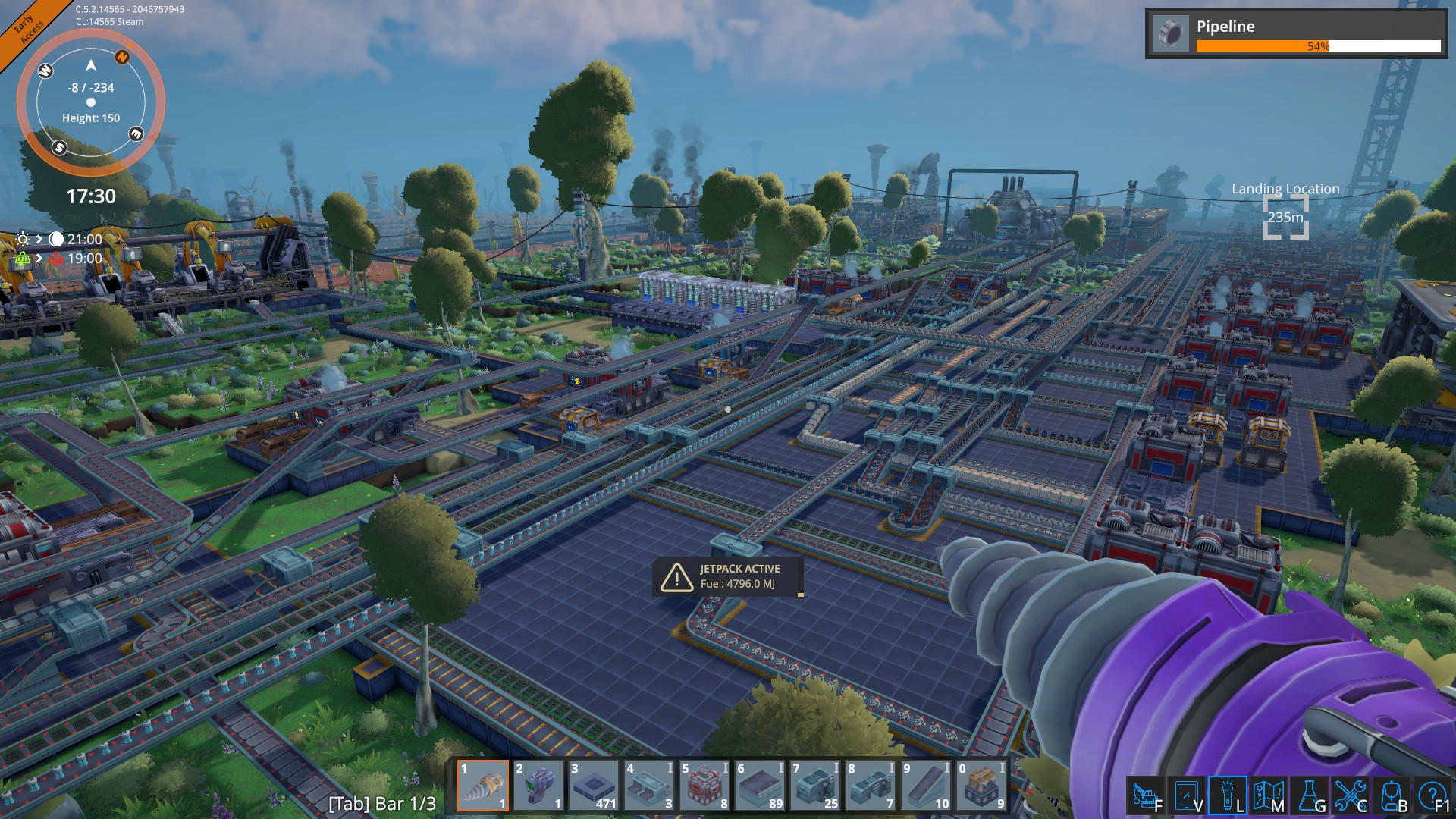
Final shot of the base, with barely a scraping of the robot part factory on the left. The bus lines still look damn cool.

I’ve sent in about 50 odd feedback submissions thusfar. Some are QA, where the information/labels are wrong. Some are bugs (belts that are close can do weird things). Some are related to balance (too many building types that do the same thing). And finally, some are more strategic (like how to optimize mining stations to make them easier to set up).

I’m quite hopeful to what comes out of Foundry in the long term. There’s already more here than most EA games, and the 2 new systems here have a ton of potential – Assembly Lines in particular! I wouldn’t recommend it just now, unless you REALLY LOVE production games, but I’ll certainly be back for another run at the next content patch.

Given that this is a relatively “niche” type of game, comparisons are natural. Satisfactory is its own thing, and while people will naturally compare, they have less in common than it may appear. It should however be compared to Factorio, which is the golden grandfather of the genre – everything up to tier 4 is a 3D interpretation of Factorio. If you’re looking for a 3D version Dyson Sphere Program is the top recommendation without any hesitation. Techtonica is another option that is about as close to Foundry as you can get, but still has quite a few rough edges to work out – I’d say it’s a good 6 months ahead of where Foundry is.

To close here, this game is a friendly reminder that AAA game studios bankrolling $300m dollar games, and then closing studios of amazing developers is just plain dumb. A small team was able to build a very complicated beast, and will continue to do so. Impressive.

Foundry – Part Drei

As I move further into the tech tree and unlocks, I’ve come to the fun “this is early access and not yet balanced” phase of the game.

Most production games are a balance of collecting enough materials, to feed multiple stages of production, all while having enough power to run the whole thing. You can’t truly full invest in any particular thing, as there’s often an upgrade that negates the model just around the corner. You just keep on plowing through, making adjustments here and there as new material is constructed.

Now, the fun part here is that the majority of the game can be run from a main bus, which allows you to produce a ton of stuff used for building. Do you need 40 boilers? Hell no, but you can have them on the side in a crate and never have to worry about crafting them again. But you’re going to need a crate with 1000 foundation blocks! In that sense, you can have the main bus simply run very long chains of materials alocg a crafting path, and then fork off what you need to create/store/augment the main belts.

The bus in the middle, solar farm bottom left, and space shipping building in that big thing (that is 10x larger than it need be)

An example is Circuit Boards. They are a mid-tier item, crafted from Electronic Components (which likely is item #4 on the belt as it’s early) and Polymer Board (an item crafted from oil, early in tier 3). Crafting Polymer Boards is best done close to where you harvest the oil, then shipping it all towards the main bus. And a quick off-shoot from the bus (the components) allow you to create Circuit Boards and then add those to the bus lanes. Other similar products are Advanced Machinery, Glass, Concrete and so on.

From there are two core challenges. First are in-line upgrades. Basic belts are needed for tier 2 belts, and tier 2 is needed for tier 3. You will unlikely make space for that issue and have to tweak the bus as a result as you unlock more advanced tech. Second is research cores, which require a weird set of materials that are not on the belts. It turns into some belt ninjitsu to get it to work, so the actual base construct of the bus needs to accommodate enough space between the constructs to add extra belts. e.g. build with flexibility in mind. These cores also need the main material per tier, which should provide a decision point. The lack of balanced ratios unfortunately prevents such events, and you’ll just slow down.

Balance in these games is notoriously complex. Production chains are complex, with multiple steps, and there are some core principles that need to be adhered to so that the experience is managed. Your mining operations should be relatively balanced, so that you know the effort required to open a new mine. The last mineral you unlock doesn’t follow this principle – you only need it for 1 thing, and each one of those things requires hundreds of the mineral to produce, but in a chain so complex that you can’t actually refine it in a smaller station. It means that logistically you are transporting time, rather than material.

One final bit here, with a cleaner bus set up, is that there are simply too many things that do the same thing. At my count, there are 5 buildings that use belts & pipes. They are different sizes and used for different end results (which thematically don’t make much sense). A great place to optimize!

Next up, tier 5.

Foundry – Part Deux

Levels. Levels everywhere.

I’ve unlock Tier 4 research, which is a rather significant milestone as the game pivots from terrestrial to space-based. Well that’s a stretch… see, you crashed from a space station and you need to build connectivity to progress. It’s a rather massive shift of objectives, where all prior efforts were simply “build more stuff”, you now have major (and massive I may add) structures to build.

This is way bigger than the image does justice.

The main challenge at this point is simply scale. Where before most things needed 1 to 10 material to craft, these things require hundreds. So optimization and spaghetti belts is the name of the game! Two terms that run counter to each other.

You should see what it took to get the stuff here.

I find in most of these games you reach a point where you just simply realize your initial design is bad. Like really bad. DSP has you figure this out once you leave your planet, when you’re essentially forced to scale up and build new. It also has great tools to help. Satisfactory’s main burnout factor is exactly this, where you know hours of work in a design have to be redone because all of a sudden you need to mine 12,000 copper instead of 300.

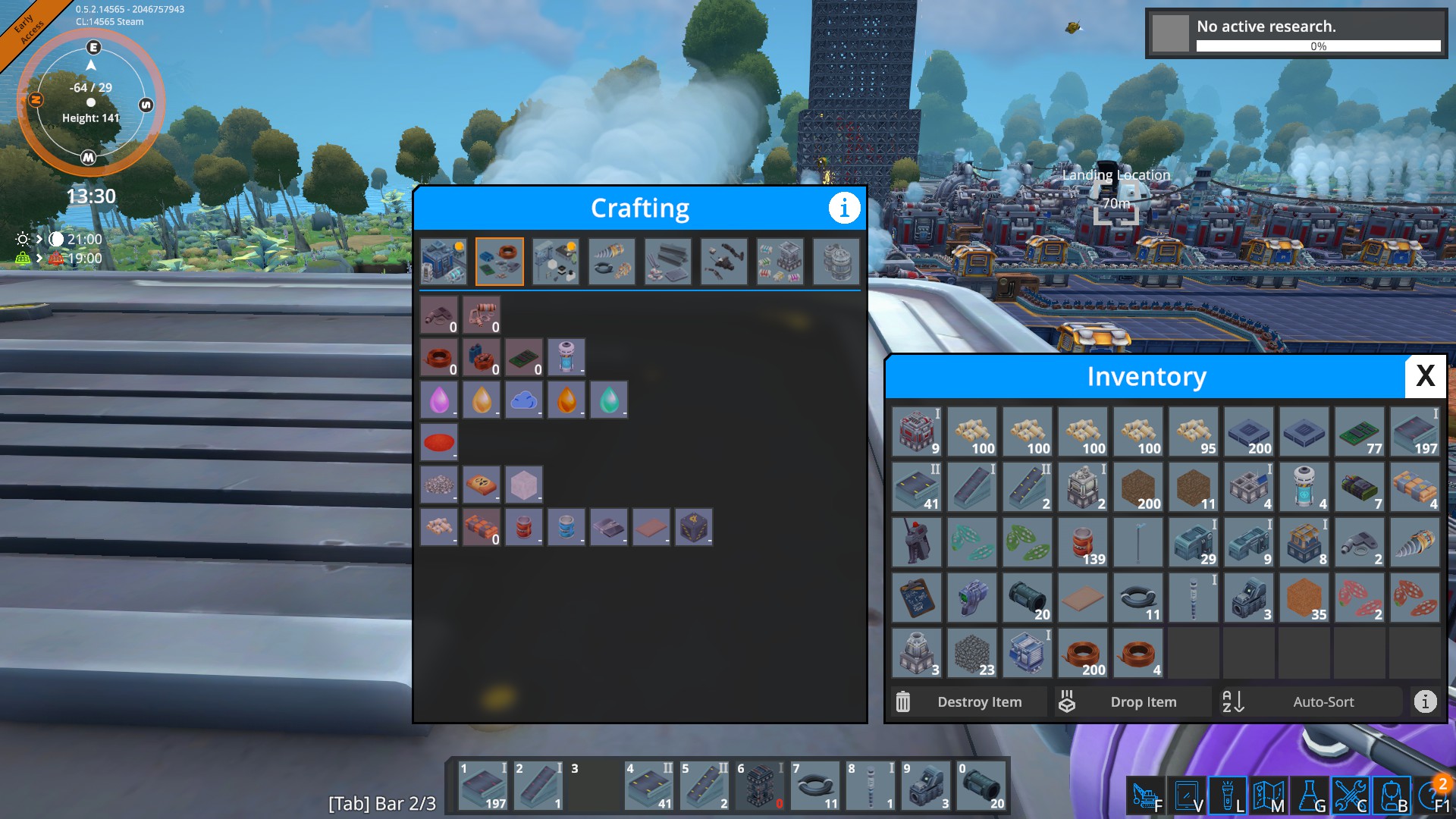
Foundry does not yet have built-in rebuilds. You need to tear down and restart. It also doesn’t deal well with mini-factories because the raw materials are used for a ton of stuff (well, not Technum so far). Plus, if you do want to rebuild, then scale becomes a very, very interesting challenge as inventory limits (like Satisfactory) make things complicated. You’re going to need a scalable main hub. This thing has tons of belts (2 wide, one for the belt, one to split) in order to create material for later use (which you will store, or perhaps add to the belts. You may get lucky and a material is only used for one thing (say…Ignium Powder). Maybe.

You’ll have a belt for each of these items (and more past tier 4).
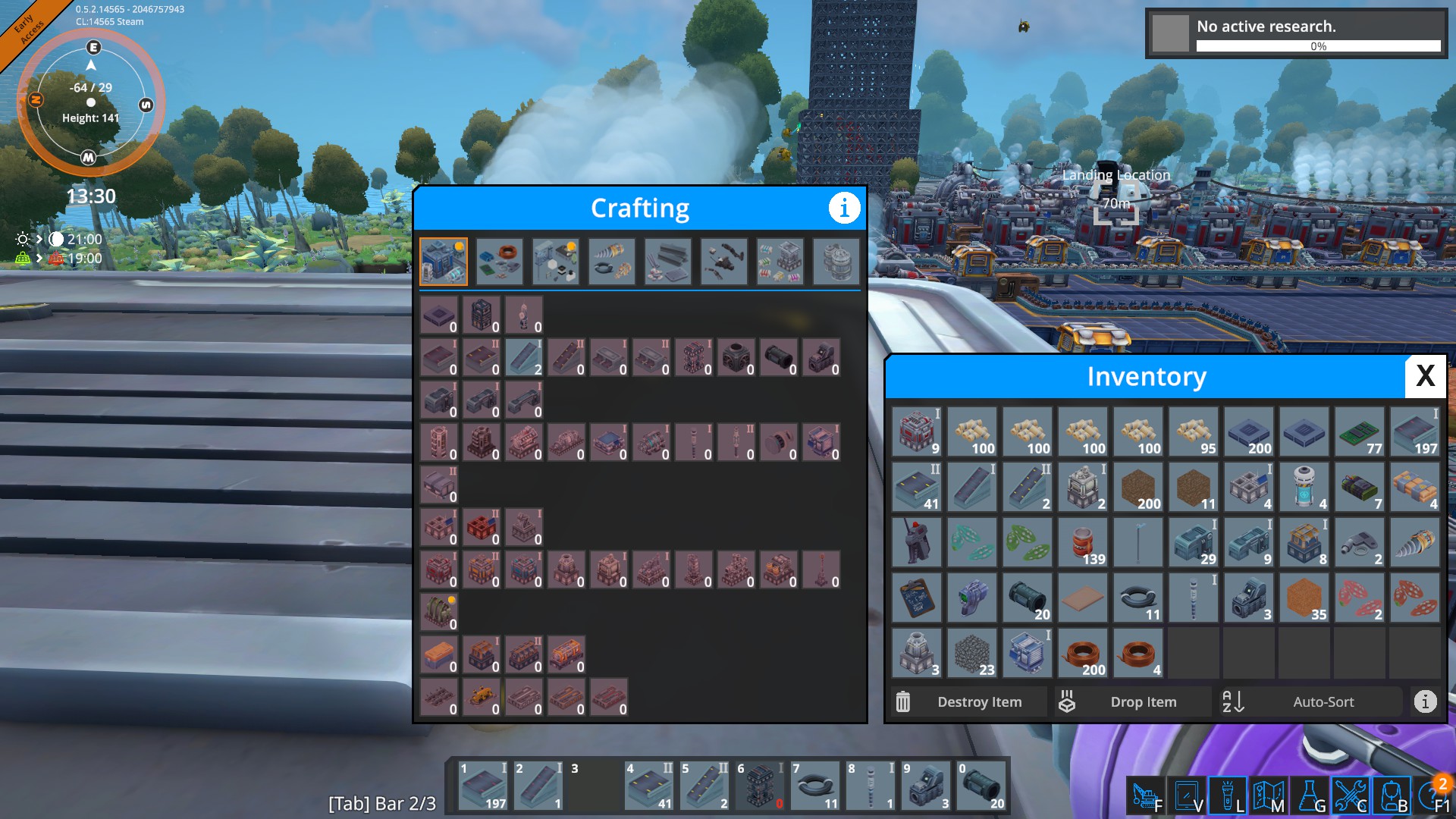
You will craft and store each of these items. Some simplification is required here.

The general concept is base materials, sent to belts. Then you fork off the belts (with splitters) to craft whatever items you need. Maybe you add them back to the belts if they are used down the line. So you’ll start with 4 base materials, then 8, and by the time you reach tier 4 you’ll be near 10 items (or 20 wide).

The good! news in this is that the map has no size limits, so you can build as much as you want as long as you clear the trees. The less good news is that the more you spread out, the more you need to travel (and the more belts you need). The medium news here, and frankly logistical craziness, is that you will likely need to truck from a 1000m away the base material to feed this machine.

So guess what my next plan is? Oh, it will be glorious!