The Ebb and Flow of Game Time

If you were to follow a release schedule over any given year, you often see the fall spike, winter lull and spring/summer oddities.  I am sure most people have the most free time in the fall but the other months are a good question.

Being a Canadian, our dogsleds and igloos don’t get much use in the summer.  Then again, they don’t get much use anytime.  But the summer months, as short as they seem to be, as a prime time to take advantage and step outside.  I think if I lived in a more temperate climate I’d have more options but as it is, I have snow season, rainy season, bug season, 2 weeks of ok time, then the fall which is also pretty neat.

Scree brings up an interesting/sad story about the death of a guild.  After 10 years, people have simply moved on.  Looking back 10 years, I was in the WoW beta prepping some guides.  Funny side story actually, I was posting on wow.net forums doing what eventually became known as theorycrafting.  I had 3-4 offers to write guides for it and took it up.  Considering I was making ~$15/hour at the time, it seemed like a great deal. Over the years, it’s paid for every piece of tech in my house.

So, 10 years ago I was in a relationship, living on the cheap in an apartment.  I had a fair amount of free time outside of my shift work.  A year or two in, and I got a new job doing some tech support for a pretty decent chunk of change.  Without shift work and with more money, I had more free time.   Eventually that relationship ended while I was starting a new job with a rather huge time commitment.  If I recall, I dropped most everything to do some 7-7 days, along with some overtime on the weekends.  Gaming really fell to the side but was used as a de-stressor.

That job evolved into something else and I found a new relationship.  Eventually got married about 5 years ago and I guess you’d say I grew up then.  I still found time to game a fair amount, while the S/O watched TV or did her own thing.  I did however ensure I put some focus on RL commitments as she didn’t share my passion for gaming.  A few kids along the way cut even more out of my schedule.  I think the largest impact was while playing Rift.

I was in a fun guild and we were trying some of the public raids (big rifts).  It’d be 10 at night, they were rather pick up and play, but with a baby crying you’d need to get up and take care.  It really changed my priorities.  I haven’t really raided in a focused mindset since then, since the call of RL typically trumps any gaming moment.  Heck, most social settings require this and I’ve always found it weird to hear about people holding kids and giving bottles while raiding/grouping.

Reading the previous paragraph, I think that’s the core of the issue with people who grow up.  While I can set away a few hours to play a game of hockey or a night out with the guys, it’s quite hard to do the same when you game in the same building as your family lives.  There’s still a social stigma, as they see it more like TV, where you can just “poof” stop and don’t see the people on the other side.  It would honestly be easier to leave the house.

Today’s gaming time is an odd mix of an executive career’s time commitments, juggling kid’s expectations, finding time with my wife, exercise and then finally getting some downtime to game.  I could, and have, gone 2-3 weeks without 15 minutes to myself.  I’m still working on finding balance and perhaps, once the kids get a bit older, I can share some time with them in a game or two.  Until then, it’s best effort.

#NBI – Motivation

No two ways to shake it, blogging takes commitment.  The ability to just write a sentence really is just the tip of the iceberg when it comes to it.  If you want to know why the NBI is a good idea, then here are a few things I’ve found of benefit.

Blogging is a social circle

Believe it or not but most bloggers read other blogs and use them as inspiration or for dialogue.  Very few people live in silos and blogging is a non-physical way to get to know new people.  It also helps expand horizons.  Gevlon, Tobold and Syncaine are all on my list of reads because they somehow manage to play complete opposites to each other and each has a valid point of view.

Blogging is cathartic

Back when we were kids often times we were told to keep diaries or journals.  You often here of war veterans who kept them during battle, as a way to keep grounded and provide a version of the story if ever they didn’t make it.  Blogging is a way to write down, publicly, your thoughts for the internet to host forever (until it becomes sentient and enslaves us). It allows you to get those troublesome ideas out of the head and put them on (virtual) paper.  This is incredibly therapeutic and has helped me tremendously in organizing my ideas.  Plus, it’s something I can show my kids later on.

Blogging improves communication skills

The more you practice something, the better you get, simple adage.  There are two ways to go through this.  Either you type and correct before posting or you type and go “I can’t believe I wrote that” after you posted.  I aim for the latter.  My career path involves a lot of writing, either technical, executive or through briefings.  It also involves a lot of public speaking.  Over time, I’ve found that my writing voice has changed due to a combination of “practice” writing through blogging and real-world application.  Word diversity, thematic representation and overall sentence structure has improved (or evolved I suppose) over time.  While it seems fairly non-evident here, I have a profound appreciation for the semi-colon (;), the dash (-), parentheses, and the oxford comma.  Blogging has also changed the way that I speak and vice-versa.  Sentences are typically succinct, or spread out with apostrophes for dramatic pause.  There’s a cadence/rhythm to my ideas that makes them easier to digest.

Blogging is excellent for introverts

I am one.  My wife is not.  Blogging allows, by some stroke of luck, for my wife to see inside my mind and get a better appreciation for my thought process.  Because it takes longer to type a sentence than to say it, you end up putting more weight to the thought.  This is a core concept of being introverted – not wanting to say the wrong thing.  Blogging also can lead you into breaking out of the shell, either through gaming guilds or podcasts or a bunch of other social vehicles with other bloggers.  I’m not saying it’s a cure for introverts because that simply does not exist.  Instead, I am saying that it’s a great tool to compensate for some of our more social inhibitions.

Blogging can be done anytime, anywhere

Posting requires an internet connection, blogging does not.  I write posts on my phone on the bus, or on my tablet in bed, or on the laptop in front of the TV.  I have 3-4 posts going on at any one time, sometimes just to collect ideas for future posts (I have 1 app to collect those).  Sometimes it takes me a week to finish an idea, sometimes 5 minutes.  There’s nothing wrong with getting a streak of ideas, just schedule them for posting every day or so.  That way, when you think about potential updates, you have time to go back and edit. Plus, you’re not spamming the world to read 5 posts in one sitting.  It’ll give people a chance to comment on one stream, then come back for another.

For all those reasons and more, blogging is something that’s a fair amount of fun and provides a fair amount of return on investment.  Much more than is likely apparent at first.

#Transistor – A Solid Indie

I will start with a clear message.  Go and buy Transistor.

From the same folks that brought you Bastion, comes Transistor.  You can watch a ton of YouTube about the art and flow of the game, which really is only a portion of the fun.  The real meat and potatoes is the strategic combat.

Background first.  You start in media-res, with little explanation as to why you have a talking sword (the game’s namesake).  He points you around and explains things briefly but the core story is like reading a book, gently exposing more and more story as you move along.  The game is set in a virtual world, where the Program determines people’s outcomes.  Your sword can absorb people’s essences or you can acquire them through choices in the level up process.

Purty

These essences are the skills used in combat.  Each has 3 functions, either as a primary attack, as a boost to another primary attack (2 per), or as a passive boost (4 max) to your character.  Each has a set “value” and you can only equip a certain total amount of values at any given time.  As you level up, you get the choice of adding more to that cap, or unlocking more boost and passive slots.  You also get to unlock Limiters, which drastically increase the difficulty of the game but also increase your experience rewards.  You could enable enemies to deal double damage and respawn quickly for example.  It adds a serious level of challenge.

The core skills are varied enough.  Some are direct short attacks, others long range of over time.  Combining the skills provide additional lore and can make a heck of a difference in combat.  I use a long range DoT attack, that also has a front end damage spike and an AE effect upon contact.  Combined with a Stealth-get-out-of-dodge move, I play a more defensive/stealthy game.  I’ve also tried a brute force attack, which was a combination of a “vacuum” pull attack combined with a big AE and knockback.  I think I’m at about 15 skills now, so the options are pretty wide.

Combat also runs in two distinct modes.  First is the regular active combat in real time.  You also can pause time and use “Turn()” to plan out attacks.  Each attack takes up a portion of the meter but you move so fast that sometimes it’s better to use it defensively.  After you send the attack, it takes a while to generate more Turn and your skills are locked, so you’re pretty defenseless.  You need to really think things through!  If you do end up losing your hit points, you lose access to one of your active skills.  Lose them all and it’s game over.  You can restore skills at save points.

You do get a “home base” of sorts, with challenge rooms.  Some are pretty darn hard but once you complete them, it really changes the way you look at the game.  The game proper is only about 6 hours but there’s a New Game+ option.  The dynamic combat, quick pickup and play and system flexibility certainly give it a lot of replay value too.

I will end with a clear message.  Go and buy Transistor.

#Wildstar – Getting Ready

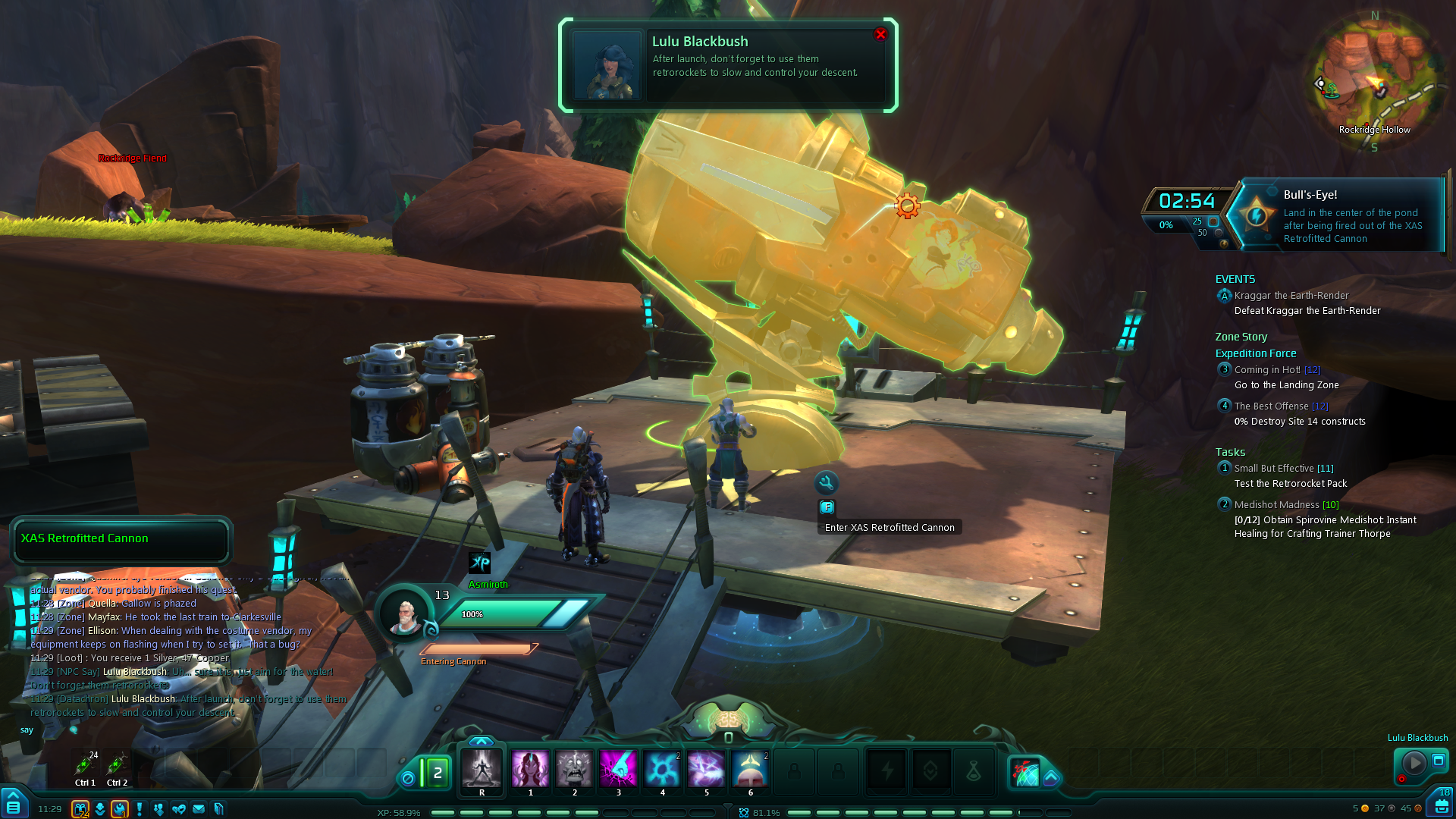
To the surprise of no one, I have a rather large hankering for some Wildstar.  Given that the game’s approach to classes is akin to SWTOR (every class plays DPS and either Tank or Healer) and that time has shown me that I have no tolerance for tanking, I am going heals baby!  That and telegraphs in your face aren’t so much fun thanks Neverwinter!  That leaves 3 classes, Esper, Medic and Spellslinger.  I have played all of them to about 15 in the beta.  They play drastically different from each other.

Side note, Wildstar has a “tiered” difficulty setting, per zone.  The starter zone and the tutorial (once you actually land) get you to about level 7-8.  They are cake and meant to show you how all the systems work together.  The next zone (2 per faction) gets you to level 15-18 and shows you every other system but mounts.  It is quite a bit larger than the previous and a fair chunk harder.  The next zones…those ones are where the real difficulty starts.  Multiple enemies, you have access to all core skills, lots of telegraphs, new quests, lots of exploring.  So, tutorial ‘til about 7, learner’s permit ‘til about 15, meat and potatoes after that.

Back to classes, I have to say that I’ve found more fun in the Esper than the other two.  Medic has to get into near-melee range and the Spellslinger’s mechanics with Spell Surge don’t particularly jive with me.  The Esper is a pain in the butt to start, given that their core attack skill requires you to stand still, but the payoff later is a lot of flexibility.  The upside is that they are by far the least played class in the game, which means that if I stink, there’ll be less people to compare to!  I do plan on running Dominion too, just because I like their storyline a bit more.  Unfortunately, the race selection or rather restrictions, mean that I can only really run a Chua Esper.  Not so bad but I was hoping for more choice than Human and hamster.

I also reserved my name.  Even with the tech issues, no one is getting Asmiroth but me.  Dibs for sure!

But that’s the core of a themepark MMO.  The framework.  What really makes a difference is playing the game.

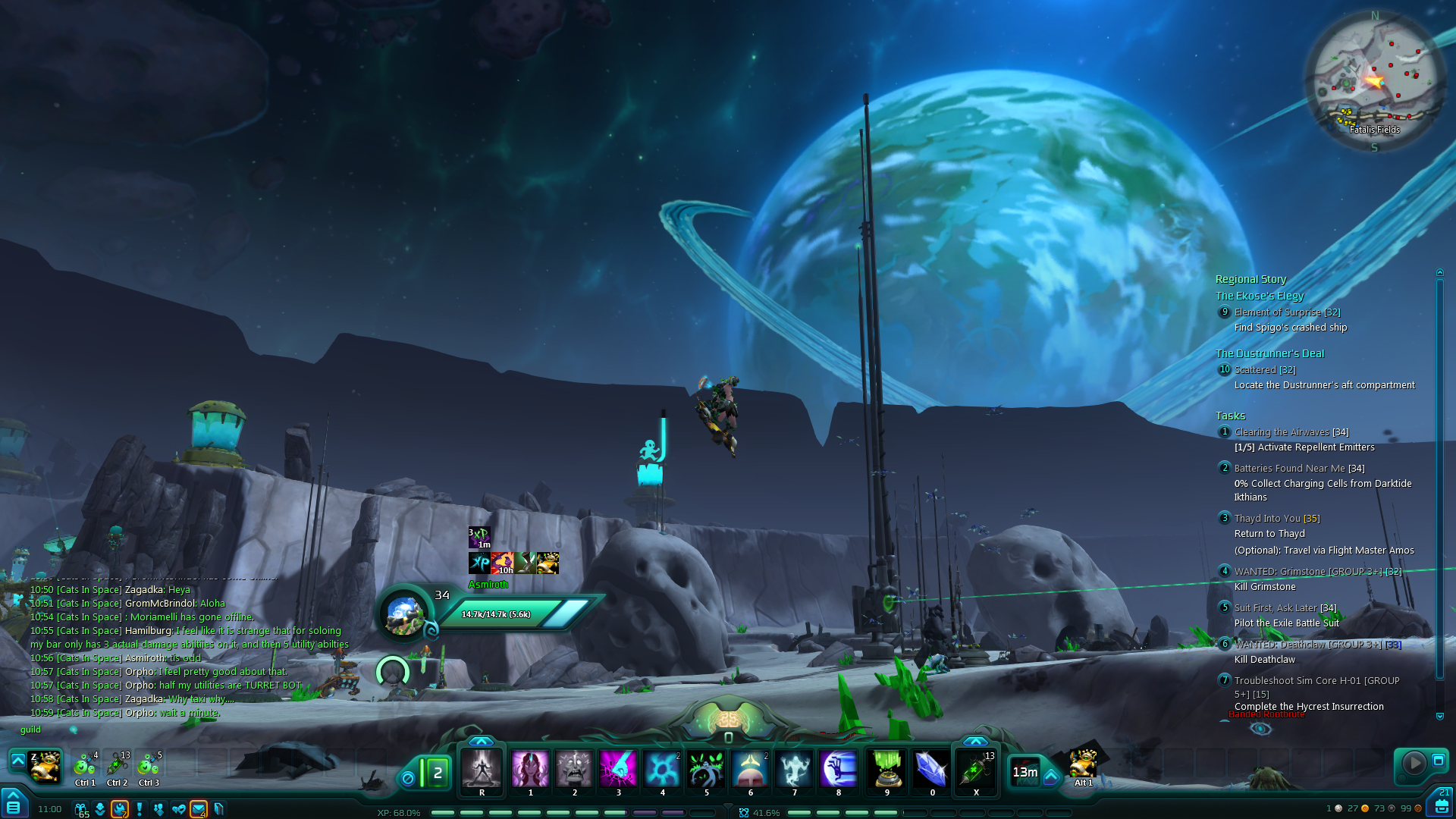
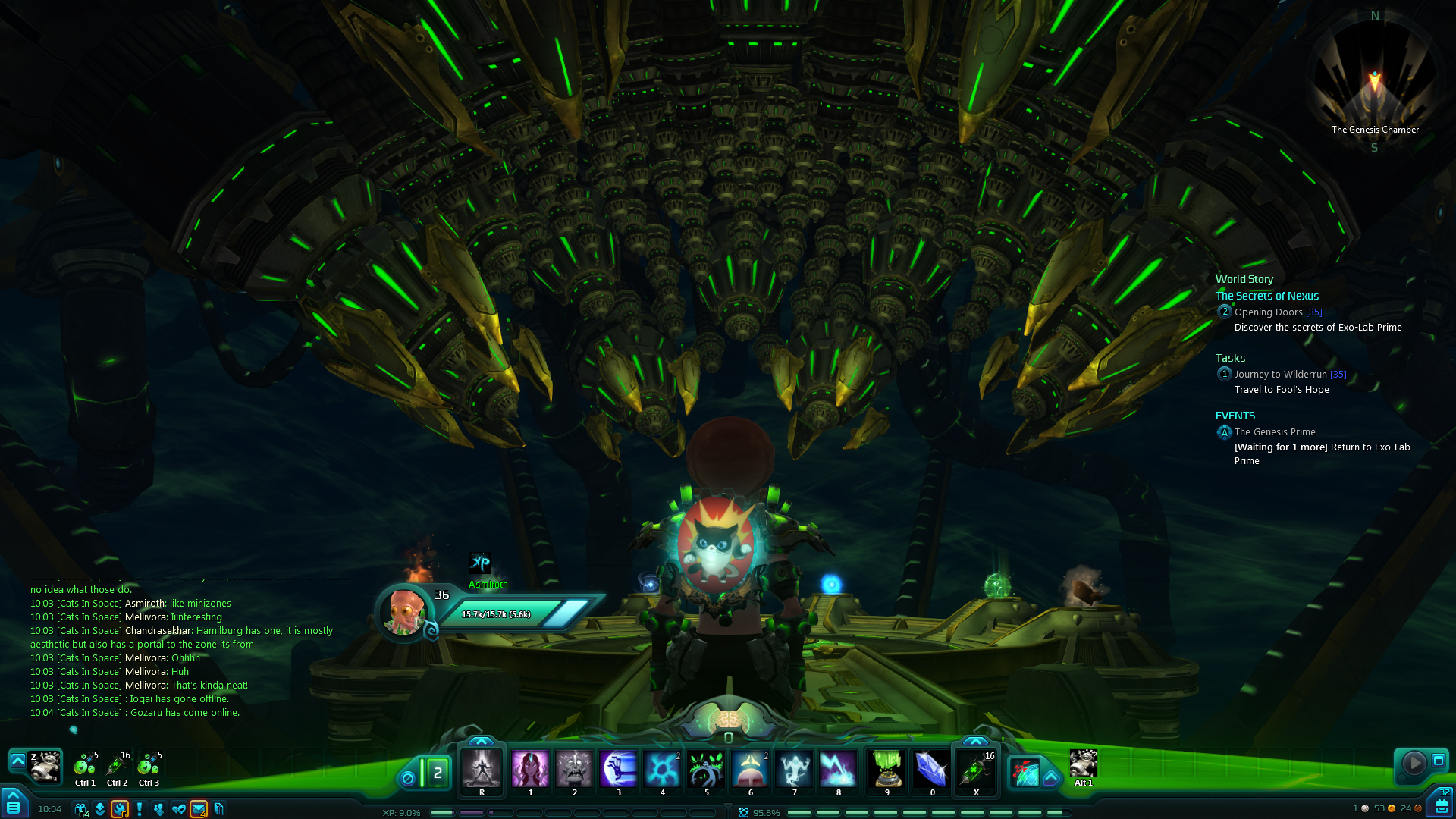
UI – I like the UI.  It’s a combination of MOBA action with tab-targeting for some other skills.  There’s a lot going on but the simple UI keeps it tidy.  Movement is fluid, telegraphs are very visible, effects are clear, graphics are solid.  The extra bits, lore and whatnot, are in additional UI elements that are hidden from the core set but still accessible.  Even the Path UI elements work well.  The only thing that doesn’t is costumes, as you need to be in the capital city to access it.  I expect that to change.  I also like the art style, which I think is going to be the #1 thing for most people.

Combat – Things work.  Check YouTube for a ton of streams that show how combat actually flows between the various skills.  Resource management works.  Priority skill management too.  Active combat does have some hectic parts but it isn’t so overwhelming.  You aren’t tasked with doing 8 things at once.  If you have to avoid stuff, then that’s all you need to do.  The good part is that you need to pay attention and the bad side is that you need to pay attention.  The days of face-rolling and standing in the fire are done.  Red stuff will kill you, which is going to make for a very steep skill wall for most players.  I think that FF14s success has shown that players are ready for this.

Lore & Flavor – This part is often overlooked but is the heart of the game.  How the various pieces interact and the reasoning for moving forward.  The storylines aren’t throwaway, they are consistent across the entire faction.  While SWTOR set the bar on story delivery it lacked a fair amount of cohesion.  ESO lore is excellent and I can easily compare Wildstar to that.  Lore pieces are everywhere.  Each nook and cranny holds something new.  All the paths except Solider also provide a fair amount of insight into the lore.  I do like that NPCs consistently appear between zones and mean something.  Hemmit Nesingway resounds with people.  I expect to have dozens of those examples within Wildstar.  Plus housing.  I could write an entire post on housing.

Social – The grouping tools were pretty smooth, guilds too.  You can downlevel to play with friends and instances use a Rally system to level you to the correct level for dungeons and PvP zones.  There is little phasing that blocks grouping too and since there are so many open quests that you can re-run, there’s plenty of opportunity to find other folk.  Downside is the spawn rate on some of those open quests.  I think that GW2 and FF14 use this system very well and it seems to work here too.

Economy – This one is a bit different.  Auction house is similar to GW2 with buy and sell orders.  It also separates commodities from items, which is pretty neat.  Beta was not a good example of how this system will work, just due to poor volume and low level characters.  It’s a solid thought but I’m curious as to how volume will “bottom out” the market as it is in GW2 currently.  Crafting is solid though, with 2 separate streams, similar to the AH.  Consumables use a hot/cold mini game to craft.  Items can be mass produced or customized.  They are also generated every other level like ESO, which avoids the “item gap” present in most other games.  A talent-like system is also there, which provides some customization.


Now I know this comes off as very fan-boi and there’s a whole lot of truth to it.  You basically have to like the art style, the “theme” of off-the wall zaniness (which I personally find closer to irony than otherwise) and the combat model.  If those 3 click for you, then you’re in for a fun ride.  If they don’t, then there really isn’t a point in trying.  For me, I’m really quite looking forward to a new take on the themepark model.

#Wildstar – Music

So, while I am rarely a OST fan I think WildStar might be doing me in.  Here’s a quick (super quick) video of the 2nd starter zone for Dominion – Ellevar.  When I say starter zone, I mean the level 7+ zone.

While this is more gregorian chant, the music actually changes to a more instrumental violin affair after about 5 minutes.  While my wife is not a gamer, she was highly impressed by the music – which is the complete opposite normally.  I have earphones on all the time but this one is a likely exception.

Hats off Carbine.

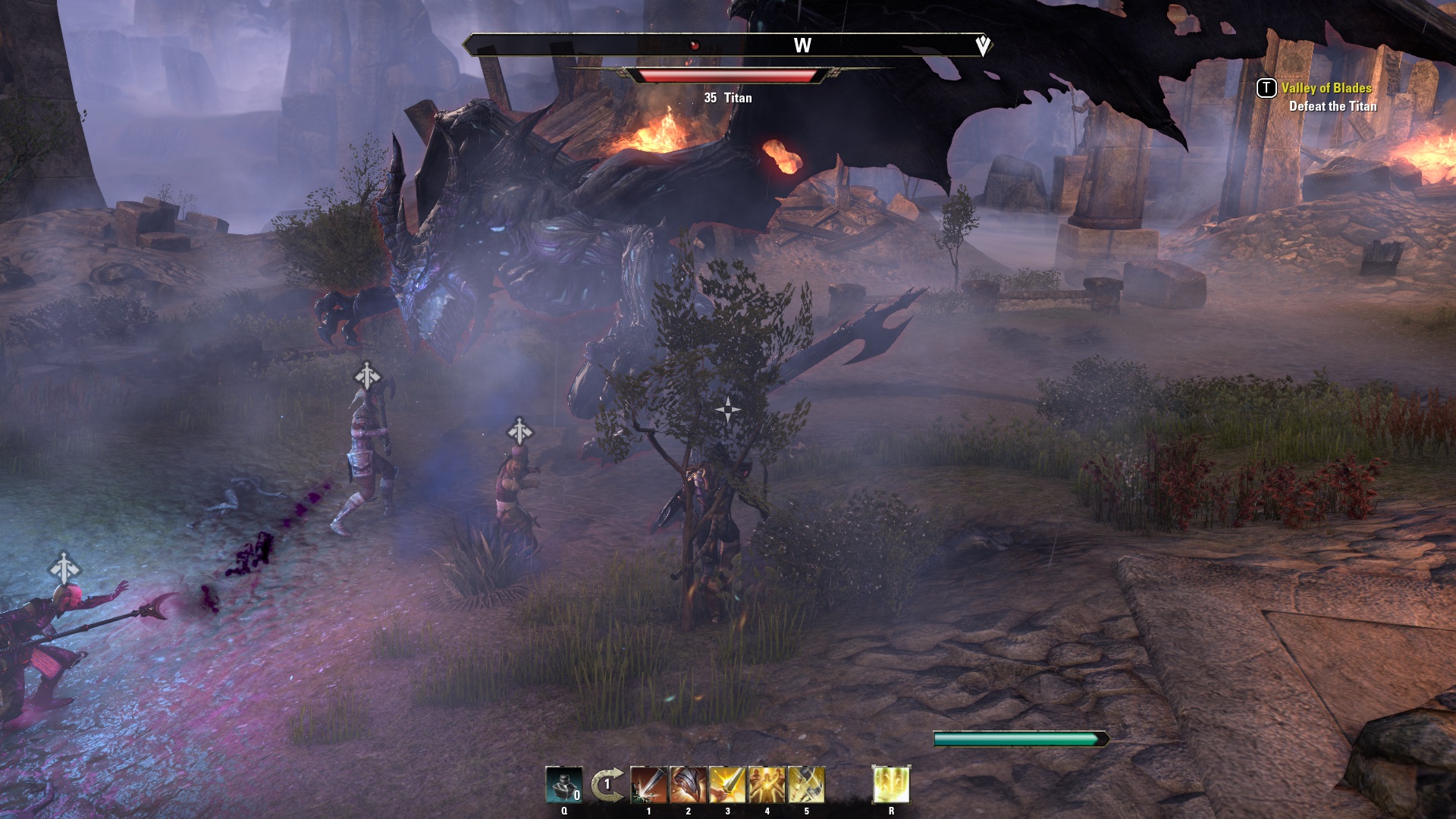
Neverwinter – Devoted Cleric at 60

Apparently, I’m still near the top of the Google index for Neverwinter search terms I wanted to add a couple more posts on the game.

Getting to 60

There really isn’t much strategy here.  Follow the sparkle path in each zone.  Do your incantation every hour (ctrl-I) for buffs and experience.  Take Leadership as your Profession and focus on maximum XP per hour per task.  Try to get some Astral Diamond rewards too, that way you can upgrade your minions through the AH rather than wait 18 hours multiple times.  Make sure you do the Neverwinter Graveyard (I think that’s it) as the final quest (Clockwork Tower) gives you your final free bag.  You can’t miss the one before that.  Also take the Artifact quest in the mid-teens, it’s a stat boost.  Do run skirmishes during the bonus hour, the queue times are super short.  Don’t run dungeons.  Do run the Foundry during the bonus hour.  Slot +exp enhancements.  Don’t do any of the above if you want to “experience the game”.

My DC did everything by the book, saw every skirmish and dungeon along the way and I had a ton of fun.  My Guardian Fighter did the first 2 zones and has been leveling through incantations and professions since, and is 42.

At 60 – Gearing

The first thing once you hit 60 is to head over the the auction house.  Search for rare (purple) level 60 equipment.  Try to get a set bonus, doesn’t matter much which for now.  Use level 4 enhancements and slot a 2:1 ratio of Power/Crit across the equipment.  Utility is +movement.  Defense is +defense.  Slot your companion with level 4 enhancements that give you a stat boost from their stats (6% each I think) and give them blue-level gear.  Use all the enhancements you’ve acquired from leveling to refine your offensive enhancements to level 5.  Once all are at 5, work on getting them to 6.  Weapon enchants can wait.  Refine your artifact to level 29 but don’t upgrade.  With everything at level 4 your gear score will be around 9000.  Level 5 plus a boosted artifact will have you above 10,000 gear score, eligible for 99% of all content.

Now you can worry about getting gear improvements through dungeons and raids.  Try to aim for 3000 power, 2000 crit, 2500 recovery, hopefully in that order.  Defense is useful, as is movement.  Lifesteal, to me, is superior to regeneration based on skill usage.

At 60 – Skill Set

I will make this somewhat generic as through play you’ll likely find more options.

Dailies: Hallowed Ground and Flamestrike

Hallowed Ground is great for group play, heals for a chunk and has a great boost for players.  There really isn’t a better option that I’ve seen.  Not as useful for solo play.  Flamestrike is for when you need to deal damage/knockdown, pretty much any non-boss encounter.  “Saving” dailies is rarely useful.

At Will: Sacred Flame / Astral Seal or Lance of Faith / Brand of the Sun

Sacred Flame and Astral Seal are the group based at wills.  They don’t do any damage but do provide some hit points to the team.  Astral Seal should always be up on the boss.  Lance of Faith and Brand of the Sun are solo skills.  The latter does ~75% damage to a normal enemy at 60, so I tag everyone.

Encounter: Sunburst, Astral Shield, Forgemaster’s Flame or Daunting Light

Divine Power is needed for most of these.  Sunburst gives you breathing room and a small heal.  Astral Shield gives a buff plus healing if you use DP.  Forgemaster’s Flame with DP heals nearby targets, which is oddly super powerful.  Daunting Light I use in solo play as it will kill 3-4 normal enemies in a single shot.  Great for bosses who summon friends.  Plus, no need for DP.

Some people will use Bastion of Health but that requires aiming, which is pretty hard to do consistently.  Healing Breath doesn’t get you much further as the regen is offset by damage.

Passives: Healer’s Lore and Foresight

Healer’s Lore is a decent boost for healing power and Foresight gives a defense boost to everyone.  Divine Fortune is an option if you find yourself DP starved.

Feats:

This is my selection.  You can move stuff around if you like but it works for me.

neverwinterdc-feats

At 60, Targetting

The biggest challenge in any action-rpg is aiming.  Wildstar is going to have the same problem.  Neverwinter doesn’t have fixed targets, everything is soft lock or aimed on the ground.  Soft-lock attacks, mostly the at-will skills, will require you to move to avoid hitting something else in front of it, due to line-of-sight.  As most bosses are taller, you can always aim up too.  Ground aiming is a bit tougher.  For buffs, I aim the center of the buff slightly behind the tank, unless I have people attacking the rear of the boss, then I move it around 180 degrees.  For damage attacks, I use the edge of the area on my primary target as hit boxes are pretty darn big.  This means you hit the big bad guy + a couple minions.  This takes a ton of practice to do while running around.  The good news is, that if you’re aiming and hitting an at-will attack, the AE attack will auto-center on your target.

The other thing to worry about is threat.  There’s no easy answer here, as threat is a weird beast in Neverwinter.  You don’t want to land a huge heal at the start. You’ll never be able to keep everyone at 100%.  In fact, the only person you should be directly healing is the tank, everyone else will be hit by AE effects or your at-wills.  Knowing where to place AE heals so that you can stand close enough to heal but far enough to not get hit is through practice.

Lastly, running away is a valid tactic.  As the game is heavily based on timers, a second or two of running away is likely going to save you.  HoTs and AE heals will work while running away.

Your best bet is to run a few skirmishes to get a hold on how to triage healing and aim.  Then when you have a solid feeling, move to dungeons.  They are more complex due to walls and corners and bosses with tons of adds but you should have enough basics down to move forward.  And don’t be afraid to take a lower level dungeon to practice.

The good news is that as we’re the only healing class, there’s a massive demand.  Yay.


Neverwinter – Icewind Dale

I make no secret that I am a rather huge D&D fan.  I don’t get the chance to play the tabletop version anymore but the world and rules have always fascinated me.  Neverwinter has that near perfect combination of lore/structure and action-oriented combat to keep me coming back.

Expansion #3 is out today, Curse of Icewind Dale, and it seems to be adding a fair bit of content to boot.  Raids, dungeons, a new campaign with daily quests, new paragon path for the Ranger, a new profession (Black Ice) and dynamic group content (aka Public Events).  While there is some vertical progression, as the game uses a gear score, there’s actually a fair amount of horizontal progression as well.  Experience is no longer “wasted” and you continue to gain “levels” of a sort.  These give you points to allocate to your active skills.  You can’t slot more skills, you just have more skills to choose from.

The previous post spoke about the 3 phases of ESO.  Neverwinter has 2.  First is the leveling aspect, from 1-60.  You have access to companions, customization, foundry (awesome), dungeons, skirmishes (5 minute dungeons) and a whole slew of other features.  Phase 2 starts at 60 and adds 2 things.  First, elite dungeons and raids, where the gearscore/skill requirement is a fair bit higher than before.  This is the typical end-game for themeparks and the time commitment is manageable.  Second are campaigns, which are themed daily quests with gates.  Pretty much what 1-60 gave you, you’re just limited to about 1 hour’s worth per day.

This new expansion seems to add a few more 1-60 things to do without the need for typical end-game progress, which is pretty darn good.  I know that breadth doesn’t equate to depth but we’re not talking about a game that is aiming a whole lot at the latter – it’s an action RPG after all.  I do know from my experience in the dungeons/raids that you need to be attentive to what’s going around.  Proper stat allocation is also pretty important but that part is rather hard to gimp yourself with, due to core mechanics.  SWTOR’s customization (and WoW’s now-dead reforging) provided way more options than Neverwinter.

It’s free, there’s a ton of content.  Give it a shot.

ESO – Veteran Levels

It’s a simple fact that all games that want to have retention need re-useable content.  Sandboxes have a distinct advantage here as the content is generally created by the players and not the developers.  EvE, UO, ATitD are examples of user-generated worlds.  Themeparks have contained experiences that, by and large, are the same for all players.  The “ride” is balanced against other rides and provides a more uniform experience.  UO, until the shard split, was  near death-trap for any new players venturing outside, with a completely different experience depending on time spent in-game.  Themeparks are the same formula from 1-max level, with a few variations at the top (raiding, achievements, PvP, collecting, etc…)

While I have posted a bit about Wildstar and its approach for end-game activities (there are many), ESO has taken a slightly different approach.  First though, some quick context.

ESO has 3 main “phases” compared to the typical 2 in other themeparks.  There’s the 1-50 phase, following a central quest structure through a half-dozen zones for your faction.  As you level, you have full access to PvP and level appropriate dungeons, across all factions.  Once you hit 50, then you reach the veteran levels, of which there are currently 10.  That’s phase 2.  This phase encompasses a central quest structure for the other 2 factions, split between the levels, with a bit more challenge.  Phase 2 is therefore twice as long to get through as Phase 1.  You still have PvP access and you now have access to veteran-ranked dungeons, which are rather unforgiving in terms of tactics compared to their regular variants.  Phase 3 is what happens at veteran rank 10, and this is where the new Craglorn content comes in to play.  Group-based open world objectives, is the main gist of it. That said, there are dozens of quality of life changes in the pipes (fixing many grouping issues).

J3w3l goes into it from her personal experience.  Phase 1 is simple, phase 2 is significantly more complex and unforgiving and then phase 3 has no relation to either previous phase.  Due to the odd grouping mechanics, where it’s rather difficult to find someone to play with during Phase 1-2 (phasing, quest progress, etc…) you’re in a solo-only world for about 400+ hours.  I am curious how Phase 3, with a heavy if not singular focus on group content will work with the player base.

On top of that, given that 99% of the content is consumed by phases 1 and 2 (all quests across all factions) and that you have enough skill points to fill out 80% of all skills (which works out to more than 100% of the useful ones) there’s no replayability, outside of the 3 class-specific skill lines.  There’s a difference between a Dragonknight and a Mage but not enough to fill out 400+ hours.

Finally, as current metrics seem to indicate that the wide majority of players are in the mid-30s at the end of the first month, or somewhere around 60 hours in, and that the new content requires 400+ hours to even access – you need to wonder about the design direction.  I give a lot of flak to Wildstar for their 20-40 person raid commitment as end-game content (it’s just stupid to do in 2014) but ESO deserves a fair amount of head scratching too.  If you want to retain people, there’s only so many turns on the Magical Tea Cups that people can stomach before heading to the door.

The Weekend Approacheth

I know they say April showers bring May flowers but it seems like it’s raining every other day here.  With 2 kids suffering from cabin fever due to a near 6-month winter, good weather is sorely needed.  Fingers crossed that Mother’s Day is sunny so the kids can leave my wife alone.

Neverwinter

I am short on gaming time, with under an hour per night, if I can get a night.  Neverwinter does scratch an itch with their daily quest progress.  I can do Sharandar and the Dread Waste quests in about 30 minutes with my Cleric.  I have noticed that a Cleric deals, oh, about half as much damage as any other class but I am quite literally impossible to kill.  I also have a Guardian (tank) who is quite good at soaking up damage but wow, Cleric in Neverwinter are a solid choice for the solo player.

Also have a Rogue (mid 40s) who is a ton of fun to play but has trouble on elites or long fights.  I made a few AH purchases and my “gear score” went up by 50%.  That made a difference.  Anywho, it’s like playing a 3d arcade game really.  Scratches a heck of an itch.  Plus, for a F2P game, it doesn’t scream “give me money”.

Wildstar

Open beta has started, which is a good thing for anyone wanting to give it a shot without forking over some dough.  Plus, you get access up to level 30, which is more than previous beta had.  I think I’ll try a couple more classes up to level 10, see if there’s another option out there.  Right now though, my sights are on a Chua Esper.  A squirrel that shoots birds.  Come on, that’s cool!

Recent patch had a fair chunk of fixes, including the GW2 overflow server concept.  I am really hopeful this becomes the defacto launch practice (outside from mega-servers like ESO)  Nothing worse than trying to play on the same server as your friends only to see “server full” or “queue ETA is 1 hour”.

1849 – Android

I like city building sims and this one takes it to the frontier using a scenario approach.  Rather than the delicate balance of self-sufficiency, 1849 requires you to continually trade in order to keep your folk happy.  Some scenarios let you log, others only let you hunt.  So each is unique in a way.  The hardest part is juggling the housing, and employment ratios.  Sometimes I prevent upgrading just to save me the hassle of too much unemployment, then an increase in crime.  Suppression for the win!

I’ve played a bunch of tablet city sims, they are all F2P money grabs of some sort.  This one is an actual sim, with a $5 entry cost, with what I expect to be a solid 50+ hours of gaming to boot.  It’s rare enough to get a decent tablet game (last one was Room 2 for me) so I highly recommend it.

Continual Content – Gated Dailies

Themeparks have to give you a reason to run the ride again and again.  There’s a carrot somewhere that makes that switch in your brain go, “ok, one more time”.  Way back in the day, this was more or less organic – run a dungeon.  Eventually it turns into formal quests as we know them today – dailies.  For a very long time, this was mostly about money.  Free cash!  Just jump up and down!  Then this became a reputation grind to get items.  Just 18 more dragon eggs before you get a new shoe.  Then we reached a really weird stage where dailies were the precursor to more dailies. Hello Golden Lotus!

Dailies were also typically capped in terms of how many you can complete in a day.  Not only are the individual quests on a timer but you could only do X amount per day.  The reason for this was three-fold.  First, this was a massive money tap that could be exploited easily.  Millions of gold entered an economy per day unchecked.  Second, they often rewards reputation scores for better gear – which was vertical progression.  If you could do them all, then you would be progressing very fast.  Third was the natural gating requirement of time.  The game should last Y amount of time.  People would (and did) burnout.

Using WoW as a solid example, dailies went through many iterations and nearly all based around expansions.  From BC to MoP, there have been different flavors.  The main driver, or success if you will, for dailies is an alternative progression path.  Certainly, given the choice people will naturally take the path of least resistance.  Dailies however give you a chance to “quickly” make progress through alternate means.  The tabard/daily quest reputation grind made sense.  It fit both playstyles.  The “only-dailies all the time” approach of MoP put in an artificial gate that could not be bypassed.  Don’t get me wrong, I like the cloud serpent faction as the quests were related to the outcome.  Pat Nagle progressed through fishing-related activities.  Golden Lotus had (before 5.4) no purpose other than to gate access to 2 other (and more rewarding) reputation grinds.

SWTOR takes a slightly different approach in that “zones” have daily quests that share rewards.  Tokens/progress is made.  This supplements the raiding/dungeon game with modifications.  There’s a fair amount of horizontal progress as well (customization).  It works for me.

Neverwinter is an odd mix.  Daily quests reward Astral Diamonds based on activities – been there since day 1.  It works in that the rewards are the same, regardless of the content consumed.  Most of that content is social so, more people doing things together = good for the community.  The last 2 expansions added “gated dailies” where the rewards are not item based but content based.  You complete a few and get access to new dungeons.  A few (a lot) more and you get passive stat buffs that are not gear related – you keep it forever even if you get new items.  You complete more and get a better chance at loot.I like that this is daily and gated but that brings me to the final daily hiccup.

If you miss a day, you miss a day of progress.  Missing a raid means you have, usually, another shot in the week (assuming the timer is a week).  Miss a dungeon, then run 2 the next day.  Dailies are the only content with a short expiry.  I personally think it would be great if you could “store up” daily quests for a period of 3-4 days, or perhaps have the rewards reflect that “store”.  Have it run at a reduced ratio too, say 25% per day missed.  I know a game wants a hook to have you login often but unless that game is offering off-line progress (and an interface), then after a while you just lose interest.

If I knew that after a long weekend I could come back and make some additional progress, even reduced (which would be double daily rate based on the numbers above) I think that would motivate me to login and spend more time.  Especially if it related to gaining access to new content (and not items).