Factorio – Aquilo

The game up until this point is about building self-sufficient planets. You start off with only a few things, then need to get a cycle running, then expand the local resources, and finally enter the research phase. The challenges presented are certainly more complex as you go (Gleba’s production loops are something new), but nothing that makes you question your sanity.

Aquilo is not that. Aquilo makes you question everything you now about the game and you will likely fail multiple landing attempts due to the environmental issues. I will say that the difficulty on Aquilo is mostly in the ability to create fail states that feel unrecoverable. It is the only planet where I needed to revert to earlier saves. It doesn’t have overly complex production chains, but the logistics of getting stuff around is the real challenge.

Getting There

Whatever ship you have, it’s not good enough. Medium asteroids are on the path to Aquilo, and you’ll need production capacity to fill missile turrets + gun turrets to survive. You’ll also need much more storage than prior, as Aquilo has very few natural resources. I made a lot of mistakes here. Overprepare.

Planet Conditions

Solar only works at 1%. There are no natural resources, though you can collect Ammonia from the oceans to make rocket fuel. This means you’ll need to ship all basic materials to Aquilo, or build a farming space platform and put it above the planet (I did both).

The planet is also ice cold and nothing works without being close to a heating pipe, which is heated from a Heating Tower. It takes 2 fully moduled chemical plants to create sufficient rocket fuel to power 4 heating towers. All power + heating will come from these for a very long time.

Ice is everywhere and a huge byproduct issue. You’ll melt what you can to make water, transform the rest to ice platforms (that need concrete above to not melt). Every other ice needs to be recycled.

Oh, and it’s so cold that robots take 5x the power to operate. So mass robots fleets are not really viable.

Lithium and Fluorine are two other liquids on the planet you will need to harvest for the planet specific items.

Making Space

Aquilo requires you to create more room for the factory, and requires concrete to be laid down on top of the ice. The starting footprint is barely enough to get going, and you’ll reach a point where even that is so poorly optimized you’ll need an ammonia + water bus to feed all the various machines. And when you hit the power issues (you will) it will likely cascade into a full factory outage.

Very important note. Heating towers can only boil water in heat exchangers when above 500 degrees. They can burn until 1000, so you will absolutely want to have a condition on your inserter to not add more fuel if the heating tower is above say, 550 degrees. Otherwise, say goodbye to your rocket fuel.

Second important note. Heating pipes to thaw equipment will drain more heat from the tower that you may think and easily force you to continually add fuel to keep above 500. If in doubt, disconnect the heating pipes to generate power – pipes only need to be around 30 degrees to work

Aquilo Science

Getting to this point is a lot of yada-yada of heat + power management shenanigans that includes unlocking Cryogenic Plants and science packages. You will need efficiency modules to reduce power usage to eventually claw your way to unlocking Fusion Power. That requires a TON of quantum chips (cryogenic chamber with 8 production modules and 2 speed beacons is sanity).

Aquilo is extremely slow and quite hard to design due to the heat limitations. I barely scrapped by with 4 heating towers. However…

Aquilo Power

Fusion Power is insane. Completely insane. It works on a 4:28 ratio (less reactors messes up the ratio), requires a cryogenic plant (operating at 16/s, so add modules) to cool down material in a closed loop. You will prime it with ~100 barrels of Hot Fluoroketone and never touch it again. It will then give you GIGAWATTS of power. Every single power management issue you’ve ever had, ever, is gone. I don’t mean managed, I mean gone. And it burns near-free fuel at a super slow rate, with no after product and self-manages load. Every disadvantage to nuclear is gone, at 10x the power output for 10% the space requirement.

Moving On

Once you have this unlocked on Aquilo, that pretty much to me means you’ve beaten the game. There’s a minor step of building a ship that can go past Aquilo and will require ~6 railguns and ammo to survive long enough. Given all the work up until this point, that is a very minor detail.

And, similar to the base game, you can complete it and move onto prometheus science which unlocks the ability to speed up research. Which is super useful if you are planning to scale up to insane levels or chase quality levels.

Factorio – Upscaling

Or perhaps worded as the most optional, grindy aspect of the game, which is required for optimization but NOT in reaching the end.

Factorio Space Age has some rather foundational changes that impact significant portions of the game. First, is that each planet has a source of infinite resources. Second, each planet offers a unique building that provides a massive inherent productivity boost. Third, quality of an object has substantial impacts on production chains.

Infinite Resources

Nauvis offers infinite water + oil. Vulcanus has infinite iron, copper, stone, and sulfuric acid. Fulgura offers everything but coal, but in random amounts. Gleba is very weird – you could argue it has every base item in infinite quantities if you can get the production chains running. Aquilo has water, oil, and unique planet-based gases.

Space, with the appropriate set up, gives you infinite iron, copper, sulfur, coal, carbon, calcite and ice.

Production Boosts

Foundries, Electromagnetic Plants, Biochambers, and Cryogenic Plants all offer absolutely insane production boosts, not only in quantity but speed. You would be insane to create green/red/blue chips in an assembler instead of an EM Plant. This drastically reduces the value of production modules.

Quality

The difference between a normal and legendary item is substantial. The item could be 500% more efficient as a result, meaning you need less of them for the same result. Every planet has space restrictions, so you need to build more compactly.

The challenge in creating quality is that you can either gamble that something gets better, or practically build with at-level material. You can hope for a rare assembler after 100 tries, or you can build a rare assembler with rare (and only rare) materials.

Enter upscaling

Upscaling

The act of brute force gambling. This is only possible due to the two other factors – infinite resources + production boosts. If the odds are 1:100, then you will do it 100 times because you can. If you want a legendary item, you would need to do it about 18,000 times.

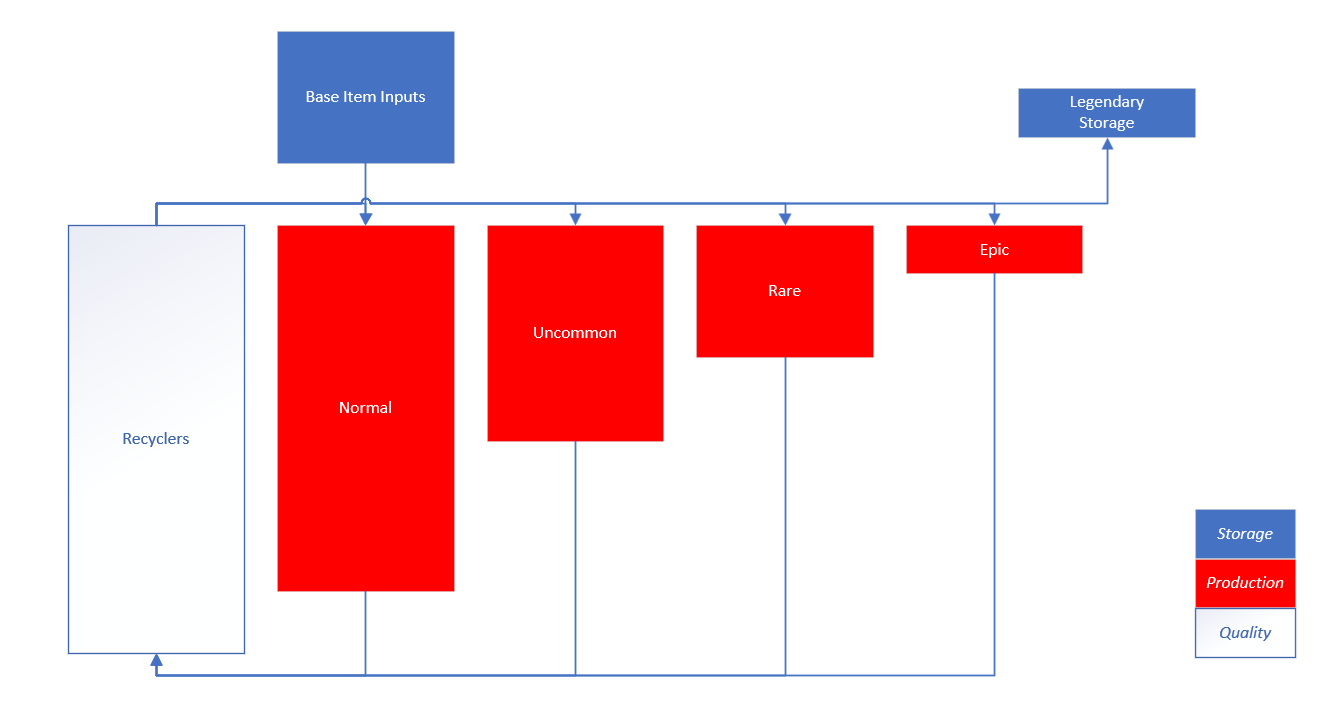
To make this process faster, you can upscale. The concept is as follows:

Upscaling concept

The model can be applied at large (belts/trains) and small (bots) volumes. Until you unlock rare + epic research, rare is going to be amazing in its own right, and chasing legendary is a very long tail.

The builds are somewhat straightforward. You feed a set of production-boosted machines with base material. You send all the results to a set of recyclers with quality modules, which will randomly increase the quality of the output. You will only get back 25% of what you put in, but with enough iterations you’ll eventually generate legendary items.

Thankfully at later parts this isn’t a required activity for all material, but unfortunately it is for some specific items. And more importantly, this shifts the mindset from creating legendary end items to creating legendary materials.

Let’s say you want to crate legendary Quality Modules. That needs legendary superconductors. Those require plastic (easy enough), copper (strangely a byproduct from plastic), oil (quality doesn’t matter) and holmium plates (that are liquid based, therefore can’t be legendary at base). Oddly, the best approach is to build an upscaler for supercapacitors instead. If you recycle those, you get legendary batteries, green circuits, supercapacitors, and holmium plates. As you progress here, you can go from 2.5% quality to 6.2% quality in the recycler (so 10% to 24.8% as they can have 4 each).

The concept of upscaling really takes off on Fulgora, but the true end goal is only do it for base / intermediate material and actually craft as much legendary as you can.

Nauvis

  • Biter Eggs need a quality upscaler. And turrets as they can spoil to bugs.
  • Uranium seems to be best with ammo, and then you can dump it in a kovarex plant to make tons.

Vulcanus

  • Calcite comes from upscaling on a space platform.
  • Tungsten is best to upscale the raw ore. You can get bars from Mk3 belts, though not sure that’s efficient.

Fulgora

  • Holmium Plates and superconductors come from a somewhat complex upscaler.

Gleba

  • Gleba is easy because resources are infinite.
  • Gleba is hard because no plants have quality, so you can only upcycle end items.
  • Gleba is hard because you need to maintain normal quality items for science and bioflux, meaning 2 factories
  • Gleba is hard because your pollution will likely double, meaning more stompers.
  • Jelly + Yumako Mash needs to be upscaled. Everything depends on these 2 items.

Aquilo

  • I think the devs took pity because almost everything on this planet is liquid. Lithium takes 1 Holmium plate… with 8x production modules you get 200% bonus.

Factorio – Gleba is Rotten

Gleba is a very weird planet, one that I find overly complicated and a real pain in the butt to manage. It has enemies that will attack you the more you produce (sort of like pollution), it has a ton of water, it only has stone as a natural formation, it has very specific locations to place buildings that can be a pain to defend, and importantly, almost everything on the planet has a timer where it will spoil. Spoiled items in a production chain suck, as you’ve lost time/resources invested. Oh, and one particular item when spoiled spawns enemies. It is a right nightmare to get going, but once it is running, it feels like free everything.

Power

50% solar power sucks, so to start you really need to limit your power usage. You’ll quickly unlock a Heating Tower, which is sort of like a nuclear power plant. Put in fuel, transfer to Heat Exchangers (4 per), and then to Steam Turbines (2 per exchanger). Save yourself the headache and ship all of the material to Gleba to build this power plant.

You can use different fuels, and the start up time takes a lot of materials. Once it hits 500 degrees, the burn rate slows dramatically, so you really really want to use a conditional inserter that shuts down above 530 degrees. I recommend using Rocket Fuel, as you can easily import it. Be warned, it will take about 10 just to get it running.

Early Gleba

When you first land, you’ll find it painful. Set up the power as above, install a Big Miner on the nearby stone patch and have it start creating Landfill. From there, you want to go exploring. You’re looking for water patches that have Copper or Iron Stromatolites. Collect these and 1 minute later you get basic ore. You can set up a basic foundry with imported Calcite to create Copper + Iron plates + Steel.

The next step is finding Yumako (yellow) and Jellynut (red) trees. Each will give you a fruit that can be refined into seeds and unlock the Agricultural Tower. Processing 1 stack of the fruit should give 1 seed which can be replanted for another stack of fruit. Mk3 Assemblers need productivity modules to ensure you don’t lose the seeds. You’ll place the towers where you collected the trees, the ground icons will be green when placed (have at least 4). Use robots to ship seeds to, and bring back the fruits.

You can use some of the plants to manually create Nutrients, 10 will unlock the Biochamber and open up a world of optimization & pain.

Biochamber

Biochambers have a 50% productivity increase on their recipes, and all of them are specific to this planet. Create one in an assembler, then use that product to create more. You’ll need pentapod eggs, which are found on Gleba’s enemies, so go hunting.

Biochambers do not use power, they use nutrients as fuel. Efficiency modules reduce the amount of fuel burned, while production modules increase it. This is great for power generation issues, but horrendous as you need to find a way to create a few tons of nutrients to power everything. Oh, did I mention that Nutrients spoil in 5 minutes? You still need them as the productivity bonus is the only way to ensure you get enough seeds from fruit.

Biochamber Crafting Tree

There’s a complex interaction between all the products on Gleba, and most of them focus on Bioflux, which is created by combining the products of the 2 tree types. Bioflux is then used with other things on the planet to create most other products. This creates some really complicated dependencies, and you’ll need to work in modules to craft specific items to be used elsewhere. More than any other planet, robot speed & amount will make or break your production chains. 1000 logistic bots will not be enough.

You’ll have crafting modules for:

  • Nutrients
  • Yumako
  • Jellynut
  • Bioflux
  • Rocket Fuel
  • Pentapods
  • Science
  • Plastic
  • Carbon
  • Sulfur
  • Lubricant
  • Carbon Fibre
  • Iron Bacteria
  • Copper Bacteria

I would not recommend starting any given module until the Nutrients one is up and running (Spoilage + extra Bioflux should be used to create Nutrients). The bacteria ones are optional, not much use for copper on this planet – iron has a lot of uses though.

The main challenge here is space. You’ll only be able to fit 4 or 8 Biochambers with an Efficiency Beacon for any given product. You’ll need to send nutrients to each item on a cycled belt, then the actual basic material to the Biochambers. You’ll need to ensure that spoilage is removed from every step (active provider chests are the only real option). You’ll also need to collect the material for distribution elsewhere. Adding too many nutrients will cause spoilage, so you’ll want to rate limit inserters in many cases. Pentapod production will spoil into enemies, so you’ll want turrets protecting that module.

The goal is to unlock the planet’s science, which you guess it, can spoil. You will need to modify your science hauler to go right to Nauvis after Gleba, and even on Nauvis, have a burner to get rid of any potential spoilage.

By the end, Gleba looks something like this, or rather all mini-factories look like contained nodes.

Dealing with Pentapods

There’s the short term answer of Tesla turrets around the base, as they are the only effective way I’ve found that deters them.

The long term answer is to look at your map, check the Pollution tab and see how far the spore cloud has gone. Build a defensive wall around the cloud and only collet fruit from trees when you need them. That should limit the spore cloud from growing.

Next Steps

Honestly, this planet is a right nightmare to manage, as much from the spoilage mechanic as it is from the rather insane nutrient requirements to power Biochambers. And I haven’t even begun to talk about the enemy spawns, land configurations and PITA logistics present. I enjoyed Fulgora as it presented logistical challenges to sort through a pile of stuff with limited room. Gleba has more complex production chains and a continual timer that makes things go poof.

Biolabs have no use outside of Gleba, which makes it an outlier. You will be exporting Carbon Fibre, Stack Inserters, Biolflux, and Science. Spoilage is used for efficiency 3 modules but since it doesn’t spoil naturally, odds are you will have tons of it on other planets. Given the multiple logistic challenges on this planet, large scale factories are not practical. Modular is the only way… and that will cause future challenges if you want to focus on quality items.

Factorio – Automated Space Logistics

This page was updated on Nov 18, 2026.

This specific post highlights the one part of Factorio that is not found in other games. Heck, it had next to no real purpose in the base game as you could just saturate belts. Space Age logistics can be a huge pain in the butt to set up, and if not managed can absolutely drain a planet’s productivity.

Logistics in the simplest sense is getting materials from where they are produced to where they are needed. In the complex sense, this is about minimizing buffers, where you have too much material waiting to either be delivered or produced. In the base game it was simple, an empty belt was a problem. In Space Age, you can’t create belts between planets.

Space Logistics can be automated, but it’s a multi-step activity. The easiest way to explain it is that Space Platforms are mobile storage chests. You want them to always request the maximum amount of material needed so that it can be drawn down where needed. From there, each Landing Pad should only request what they need, which is not obvious.

In a practical example, every ship will always ensure it has 1000 Rocket Fuel. That way, it can distribute whatever each planet requires. Early on at low volumes, having 2 ships do a cycle on the inner planets (Nauvis, Vulcanus, Fulgora, Gleba) is more than enough. Later on, you’ll likely want dedicated platforms for say, only Red Circuits. Aquilo needs a dedicated ship given the size of asteroids.

Landing Pad

The landing pad can accept 3 rockets at a time. Add cargo bays if you need to receive more bulk. Each landing pad should have inserters heading to active providers (purple chests) with 20 or so storage (yellow) chests nearby. This ensures that you landing pad is empty and that all the items are in your logistics network. You should only use steel chests if you want items inside them to be “hidden”.

Again, you MUST store items in colored chests for it to count to the logistics network. Items on your character, in wood/steel chests, or the actual landing pad do not count.

Supply vs Demand

I will use these terms a lot. Supply is what is available from a space platform. Demand is what you actually need in a landing pad. Demand is the difference between what you have on a planet, and what you should have. Ideal – actual = demand.

Fill the Supply

In the Space Platform interface, you can create groups. These should be logically broken down to items from each individual planet. If you have an item in multiple groups, know that they are additive. These groups will change as you progress throughout the game.

  • Nauvis: Nauvis has 3 phases. The first time you leave you will offload a pile of stuff for a first landing eslewhere. The 2nd phase is keeping up delivery (e.g. circuits, electric poles, robots). The 3rd phase will be nuclear, biter eggs, and Mk3 Productivity modules
  • Vulcanus: Foundries, Big Miners, Green Belts, Cliff Explosives, Calcite. (Eventually, 80% of your production will be here). Mk3 Speed modules are later.
  • Fulgora: Recyclers, Electromagnetic Plant, Mk3 Quality modules. You’ll add holmium plates and superconductors later.
  • Gleba: Plastic, Rocket Fuel are easily made here. Carbon Fiber, Rocket Turrets, Bulk Inserters, Spoilage and Bioflux are good to have (the last one spoils). Mk3 Efficiency modules later… though they have very niche use.
  • Aquilo: Cryogenic Plants, Railguns, Foundations.
  • Fusion Power: Fusion Generator, Fusion Reactor, Power Cells, Cold Fluoroketone (barrel)
  • Rocket Parts: Low Density Structure, Blue Circuits, Rocket Fuel

The first landing on each planet has slightly different requirements, so make a group just for that and adjust as needed – like making sure you have a landing pad. Each Space Platform should move between planets and requests a full load of all the respective groups. You may need more (or higher quality) cargo bays on the platform to store it all.

Well, the exception here is science. I’d suggest 1 ship dedicated to collecting 2000 of each planet’s science output, and only science. Gleba should be the last planet you collect from, to maximize the time before spoilage.

Set The Demand

Two options, static and dynamic. Static is simple enough, you set the item demands in the landing pad interface. If you request 200 red belts, then you will receive up to 200 red belts. If you don’t want red belts, you need to change the demand. The landing pad becomes the logistics network and you must ensure everything is stored here and nowhere else.

Dynamic uses combinators and math. It’s a relatively easy set up to repeat and understanding it on a planet makes ship building much, much more effective.

Requesting Magic

The concept here is that you want a Landing Pad to only request the items it needs and not any more than that. The groups are the maximum amount you ever want on a planet. What you have in the logistics network is subtracted from that maximum. Your request is the difference.

A practical example. I want to have 200 Bulk Inserters on Vulcanus. My logistics storage has 68 in stock (found in 3 boxes and connected landing pad). I therefore need to ship 132 down to the planet.

How does that work with the tools in game? Some simple enough steps.

  1. A Constant Combinator that is set to include all the requests for a given planet. This is the maximum amount I will ever need. Constant because it will not change. (Using the above example, that would include 200 Bulk Inserters)
  2. An Arithmetic Combinator that will be connected to the Constant Combinator and the logistics network roboport. I will subtract the available amount from the demand. (Using the above example, it will be 200-68)
  3. Connect the Arithmetic Combinator to the Landing Pad, and set the Landing Pad to set requests automatically. The result is that the Landing Pad will only request the items I need from the available space platform.
The Combinator set to the planet’s needs
It’s important to read each and subtract each (the yellow icon) from opposite wires (the checkboxes)
The Cargo Pad is set to “Set Requests”, which will only order what’s missing from the passing space platforms

This helps for numerous reasons. Importantly, it ensures I always have the minimum required items on any given planet which dramatically reduces waste. Second, it ensures that if I produce an item on the planet that I don’t request it from a space platform. Third, it limits the amount of items shipped to a planet so that I only need to produce what’s needed across the entire space network, and allows a planet to focus on the more critical items. This is important in the mid-game when sending rockets to space is relatively expensive.

Finally, and most importantly, I never need to worry about it again. That means that once I leave a planet, it stays operating in the state I left it forever. I can focus on the next task, without having to worry about the prior one.

Techtonica – Elevator Explanation

The main focal point of Techtonica now related to digging to later floors and leveraging the Elevator. In the EA versions, the Elevator was the final part unlocked and teased more content. Well it’s here now.

Basics

You unlock the elevator in the tutorial on floor 1. It teaches you to insert mining bits to dig to the next floor, and that’s about it. In truth, the elevator does quite a bit more.

  • Every elevator floor has power floors surrounding, and each of these transmits power from other floors. Unfortunately it doesn’t do a good job of explaining how power is transmitted in 2 groups – floors 1 to 11, and then 12-16.
  • You can interact with the elevator to manually insert or remove 1 stack of something on a given floor.
  • Every floor has 30 ports that allows
    • Exports to any other floor (adjust the # above the port). No need to filter, so you could technically have a sushi belt (a belt with different things on it), but I’d recommend not given that you’ll create backlog eventually.
    • Unfiltered imports (adjust the # to the floor you are on). As these are unfiltered, you need a filter inserter, and eventually a stack filter inserter to only remove the item you want.
  • There are 2 more ports for mining bits. You can only insert 1 stack at a time across both, so in reality there’s no need for 2 at all.

Intermediate

Given the basics above, the elevator should become a bus hub of sorts between floors. What will likely happen instead is the following:

  • You will designate a floor as a main factory. This will likely be Victor, but it may be another.
  • You will designate a floor as a power generator – I’d suggest Freight given the abundance of water.
  • You will designate a floor for the Core Composers, shipping research cores to take up space. This can be the same floor as power generation as they can be placed above.
  • You will designate more than 1 floor as a distribution centre.
    • This floor will intake items, store them, then distribute them to the proper floors. You need to do this for Blast Charges and Biodiesel.

Complex Scale

Understanding how to work with the elevator, and it’s limitations, will impact your ability to scale. The real challenge in all this is that production chains will massively change over time as you unlock more research. If you want to build at scale, you’re going to have to dedicate entire floors to a specific purpose, and send them to a logistics floor.

  • Multiple mining areas shipping chunks/bricks.
  • A foundry floor for basic items. This includes all ingots, slabs, and bricks. Saturated belts are fine here.
  • A fuel generation floor. Initially only for Biobricks, but eventually Biodiesel. It is amazing how much material you need for Biodiesel.
  • A plant-based floor. This will generate a LOT of byproducts and if my math is correct, be the largest consumer of power.
  • A building logistics floor. This is a different beast, as you want to send the items to the elevator storage so that you can draw down from it on any floor. This part sucks because any item on a belt heading to the elevator is wasted. Stick em in containers instead and head to the floor to fill up.
  • A research floor. This may seem straightforward, but the scale of material needed is eye opening.
  • 2 intermediate construction floors. 2 simply because there’s so many materials.

The challenge with this model is that you will lack information on throughput. You may be building 30 Relay Circuits a minute but have no real indication of how many are being consumed.

In the EA game you needed all of this, but on a single map which caused rather significant performance issues. With the floor model you are presented with the option of doing 90% on a single floor, or spreading out the love. You can most certainly take option 1 and reach the end of game (I did) but if you want to make it scalable, you’re going to need to build on multiple floors. I know I needed to build a logistics floor for fuel + blast charges… shipping each of those to 5+ floors takes up too many ports.

Satisfactory – New Stuff in 1.0

Some bits of 1.0 are related to Tier 9 production, which is brand spanking new and with my new save, I can’t really comment upon aside from saying it looks to have taken the scaling challenge and double dared it.

For the non-tier 9 stuff, there have been recipes tweaks, node changes, and balancing across the game. Net result is more stuff to collect, and generally simplified recipes and math. Alternative recipes have been tweaked to actually be useful! It’s quite good changes all around. New items and things are quite fascinating. SAM Ore, Mercer Spheres and Somersloops now have a practical use, and one that is frankly game changing.

Dimensional Depots are virtual containers that allow you access to materials without actually having them in your inventory. You need SAM Ore + Mercer Spheres to create boxes in supply chains to automatically add them to the storage, and you also need them to upgrade the boxes themselves. At max upgrades, you can virtually hold 5 stacks of any item, and re-upload them at a rate of 240/minute. With the exception of massive foundation layouts, this means that any tweaking of layouts can be done without worry of inventory levels. No more running out of stuff and having to trek back for something stupid like 12 rods.

Alien Power Augmenter is a power structure that boosts your total power generation by 10% (up to 30% if you feed it end-game items). It takes 10 Somersloops to create, and with 106 total available, you can’t build infinite amounts. 10% doesn’t seem like much, but let’s say you add 5 for 50%. That’s half your power output for very, very little cost.

Production Augmenter is a new entry for machines that double their output for no additional input but 4x the power cost. Hitting a bottleneck? Throw a few in the chain and quickly solve it. Want to cut space elevator production in half? Boost the final items.

Teleporters allow you to link 2 portals anywhere on the map for a major power cost and a new item that requires 1 Nuclear Pasta (!!). I had a mod that did this, but was limited to tier 5 components and for practical reasons meant I didn’t need hyperloop canons (which are cool but dumb). This new version is worse in almost every way (availability, cost, complexity) and I fully expect it to get tweaked substantially over time. Just like the Parachute had near-zero usage due to the cost, this is conceptually sound but practically useless. (Listen, I get the argument against fast-travel. I really do. Exploration should be meaningful. Running back to base for a stack of concrete half the map away is the dumb we don’t need. The guesswork in a hyperloop canon is something that can go in a corner.)

New Cosmetics in the shop and HUB. You can change your looks, and have new paint options for the base. Not needing to collect flowers to paint is AMAZING.

Straight Belts are now an in-game option when building. This seems minor, but from a visual perspective it cuts the time laying belts down by at least half, if not more. Also applies to railways (CTRL) to make super straight lines. YAY!

Clipping is less an issue now than before. For those who don’t care what it looks like as long as it works, this is heaven. It’s also the only way a main bus can work without drinking yourself silly.

Drones can use any fuel, not just batteries. They go faster with better fuel, but now you can have backup options instead of a totally crippling production failure.

Mk6 Belts are here (1200/min). The costs are crazy, so for practical reasons you’ll only use them on the output of 250% Mk3 Miners and then split them to Mk5 belts (2x 780/min). So… win?

Blueprint Designers have Mk2 and Mk3 now, which go from 4×4 to 5×5 and 6×6. I guess this has some use for Nuclear Power Plants or Particle Accelerators. I don’t see why this needs upgrades, it should just be 1 version. And a larger one at that.

Overall, 1.0 brings a rather significant set of changes to the game across all spectrums. Lots of quality of life changes, more flexibility in production chains, better crafting tools and a brand new tier of tech (first since like 2019). I would have easily argued the last major patch (v8) was enough to launch, but this is more like an expansion.

If you haven’t played, you should. If you have played and put it aside, hard to think of a better time to spin up a new factory!

Techtonica – Wishlist Roadmap

This is more for me, and honestly maybe the search engine virtual gods get this to the devs. From a prior post I mentioned that Techtonica has a communication issue, which perhaps is an identity issue. The launch of Laser Games (a weird FPS mode) instead of any news whatsoever on factory improvements wasn’t well received. In that space, I want to collect my thoughts on what should be on the future roadmap.

First and most importantly. Techtonica does not work well for large factories. You will have 2 machines producing wire, at MOST. This is fine as almost all the game has no need for it, but the late game portion would certainly benefit a lot from it.

New

Things that should be added to the game, that are likely resource intensive and will take time.

  • Resource Tier
    • Currently there are 2 tiers for minerals. I don’t think this game needs liquid resources, but it does need a 2nd tier for plant-based production. These are closed-loop items, and needed to optimize the 2nd tier of minerals. The issue is that it is not currently possible to have enough of this and it needs a 2nd tier.
  • Blast Tier Resources
    • Not all material can use Blast Tier resources, so new options are required allowing you to remove all first generation miners.
  • More Inserters
    • Stack filters are amazing, but they need filter options for mass production chains.
  • Research Station
    • Each station unlocks a new tier of research and base building options. Another is needed. Or perhaps, some use for the XRAY station as it currently has none outside of research unlocks (which could simply be a locked door instead).
  • Storyline
    • The game “ends” at the large elevator, a tremendous opportunity is present to expand the types of biomes present (only 1 currently), as well as more terraforming options. I think the MOLE is awesome, more please.
  • Blueprints
    • This is less important at lower scales. There are some niche use cases (Blast Charges).

Change

Things that should be fundamentally changed as they don’t work. These are hard to do, but less so than new content as their purpose needs clarity.

  • Inserters & Complex Crafting
    • Everything that requires 2 ingredients can be optimized with Stack Inserters.
    • Everything with 3 or more ingredients is a complex build, requiring direct belt inputs, rather than a bus. Either Fast Long inserters need to be added, or the recipes need to be modified.
  • Research Cores
    • The amount of space required to store these is beyond excessive. Making them smaller is not an option, but alternative storage options or compression is required for late game.
  • Trains / Mass Transport
    • These are borderline OP once they are running and researched. However, they only work on 1 product at a time, meaning late game builds have dozens of trains and massive manually constructed logistic stations. It’s 5x larger than it needs to be. Logic filters would help.
  • Power Options
    • Tier 2 crank generators are 10x more powerful than their normal cousins, and something should be applied in the mid tier as scaling is an issue. I had over 60 normal cranks, and they were replaced with 7 tier 2. Transferring power between locations is also painfully complicated, and 99% of the time easier to simply use power floors for super long distances.
    • Atlantum should be an optional power source, it’s not used for much currently.
  • Concrete Production
    • Base building is cool! Having to pre-construct from a list of 50+ items is not, and your inventory cannot hold it all. This should be a concrete base item, a steel base item, and paint. Create a building tool that uses these products as base material to construct different shapes.
  • Research Acquisition
    • I like that you need to scan to unlock new research items. I like that most of these are locked behind rooms with material requirements to unlock. I absolutely hate that some research are in hidden caverns, under flower piles. The OmniSeeker tool needs to point towards missing research, as a sort of compass (it used to).
  • Exploration
    • Finding hidden nooks is amazing. There’s a pile of hidden stuff in the lower east corner. You need to dig like a madman to get to it. It looks amazing! And once you’ve seen the space and scanned it, you’ll never return. The entire game is based on one base at Victor, and some storage near the elevator (or a late game factory). It needs to leverage exploration to use the space explored.
  • Jetpack
    • It needs a vertical climb option, even if it needs Atlantum fuel to get there. Vertical factories are a nightmare to manage without it.

Optimize

Mostly math-based changes, where the content itself is minor but the impacts are significant. Almost exclusively QoL, which is where Factory games shine.

  • Mining ratios are generally OK.
  • Crafting ratios are ok in the early to mid game. At late game, you get into spaghetti as the ratios are fractional and not balanced. 7: 2.5 : 1 production chains require a hub/spoke model, which due to the way transport options are present, it just doesn’t work.
  • Alternative crafting recipes need to be more efficient. Especially the plant-based ones. They currently shift bottlenecks around, rather than getting rid of excess material.
  • Blast Core ratios are less about optimizing and more about absolutely stupid belt pathing. Getting 3 blast cores every 12 second to a blast miner feels like magic instead of math.
  • Seeds. There are not enough in the game in order to have a late-game build. They are not consumable, so it’s a closed loop and therefore math exercise. Either a new tier is added here, or a 10x ratio applied to the crafting path.
  • Stack Sizes need to be standardized to common levels. Say 5 (buildings), 50 (mid-tier material), 200 (base material), 500 (construction material). Why stack sizes of similar material are all different is mind blowing to me. It makes transporting things to unlock doors a pain when you need 20+ inventory slots of stuff. It also messes up storage containers.
  • Item destruction needs some tweaking. I’ve got a factory setup just to burn through excess materials. I truly think Satisfactory has the best model here with the SINK. It also takes much too long to unlock, so you’re going to have too much plant material for a long, long time.
  • Sand/Gravel needs a real purpose. Currently two uses, a very complex crafting process for alterative recipe or destroying things. I should not need 5 steps of crafting for an alternate recipe.

I think Techtonica has more potential than other games, if only because the foundation itself seems more sound. Clearer communication and a more firm roadmap can help guide the player feedback for quicker development. It’s clear after playing that there’s a ton of potential here, I really hope the devs are able to focus their efforts and reach it.

V Rising 1.0

I have many opinions about Early Access games. Nearly as many as there are EA games in fact! I would say that in most cases, EA games are interesting incubation projects and investment in that space is solely related to my desire to help a small dev team try out an idea. I am far from an angel investor, as my only return is the ability to experience that idea (and maybe, maybe, influence it). Then there are outliers, horrid ones and beautiful ones. For every Valheim there are a thousand or more bad apples. How many Stardew Valley clones do we need?

V Rising is much more like Valheim in terms of getting the essence of genres down together, in this case survival + ARPG. First and importantly, both of those genres are notoriously complex to balance. Survival is just… it’s having a moment. The concept of building things, then using those things to collect more things to build more things, all while not dying is the rage. Finding the balance between reward and challenge is the hurdle. Things like Rust where you can lose dozens of hours of progress, well that just plain sucks. Others like Enshrouded where it just rains power, maybe a bit less so. ARPGs well, that is all about the flow of moment to moment battles. If it isn’t responsive, if you can’t make out heads or tails of what’s going on, then it just doesn’t work. Where survival and ARPGs intersect is the idea of RNG loot. You can’t just get lucky and get a god sword in a survival game, it would break everything.

V Rising has found a way to balance both, where your survival and power is gated through progress on bosses. Each boss increases in difficulty (as does the area of the world in which they reside), providing more crafting options and therefore more power options. You’ll get new spells, new modifications, new weapons, new armor, new minions. It generally works. It absolutely shines as a co-op PvE game. It has the construct of PvP games (I am avoiding that altogether, for reasons). As a solo game, there are periods of very high frustration, primarily due to the lack of scaling based on number of players. That effectively means that some boss fights can go on for quite a while as a battle of attrition, as the power curve is almost always putting you at a disadvantage. With very few exceptions, each boss takes multiple attempts until you figure out their mechanics. Some take many more attempts. Some are frankly walls due to tuning, or perhaps a very clear reminder that this game is meant for 2 or more players on a boss.

Two parts to that. First, each boss has a clearly indicated power ranking. You have one as well, based on equipped gear. Improved gear comes from killing bosses and unlocking crafting options, or somehow you get RNGsus to bless you with a random recipe (that you likely cannot make due to crafting options). The end result is that you’re nearly always 5 or so power behind in each fight. But 5 you say, that’s a small number! Each point your are below, you deal 4% less damage and take 4% more, so that’s a 20% penalty both ways. Second is the environment. Some bosses are solitary, some are not. Some patrol. Some are inside or outside. No two battlefields are the same, so mechanically you are fighting the environment (and sun = death here) as much as the boss itself. This has a net effect of every boss being substantially different which is an amazing experience!

Combat mechanics are solid. A bunch of weapons, each with strengths and weaknesses that fit your style. There are a ton of spells, though I’d argue few have much use outside of niche situations. For the most part, an offense spell and defense (shield) spell are core. It takes a long time to figure out how healing can be integrated into your gameplay. This is a game that rewards tactics and drastically punishes brute force.

I think the castle building portion is extremely well done. You feel like you have a lair with flair. The progression of the various mechanical bits sort of works, but you end up with a tad too many machines for my likes, which makes the castle have a much more practical approach. The game plays on a Steam Deck, or a controller. Both put you at a serious disadvantage in complex combat due to the way the camera works and how some spells need to be lead, which is infinitely faster and more accurate with a mouse. One boss in particular was 20 failures on the Steam Deck, then a first attempt clear on the PC.

The game has a very rudimentary teleporting function, with about 10 gates strewn about a fairly large map. Rudimentary in the context of 75% of the items you can collect cannot be teleported, meaning long treks back to base. I get this construct in the first couple zones. It doesn’t impact corpse runs, so this is just the huffing-it-back-to-base part. Sure, you can move your base – which is a simple item to trigger, but honestly 30+mins to put everything back in place – but why? I’d strongly recommend that in the server setting options you allow teleporting with all items. Trust me, you’ll spend MORE than enough time corpse running, you won’t need it for farming too! That said, if you want to travel faster, find a horse with 10+ speed, and 6+ acceleration.

Overall, V Rising is a rather interesting game and one that successfully navigated the Early Access quagmire to come out well ahead. The game manages to blend two complex gaming genres into something that is smooth, enjoyable, and challenging. If you can play co-op, then you’re going to have a blast! Solo work, expect a fair chunk of challenge throughout. A few more thoughts to share on this coming…

Foundry – Part Deux

Levels. Levels everywhere.

I’ve unlock Tier 4 research, which is a rather significant milestone as the game pivots from terrestrial to space-based. Well that’s a stretch… see, you crashed from a space station and you need to build connectivity to progress. It’s a rather massive shift of objectives, where all prior efforts were simply “build more stuff”, you now have major (and massive I may add) structures to build.

This is way bigger than the image does justice.

The main challenge at this point is simply scale. Where before most things needed 1 to 10 material to craft, these things require hundreds. So optimization and spaghetti belts is the name of the game! Two terms that run counter to each other.

You should see what it took to get the stuff here.

I find in most of these games you reach a point where you just simply realize your initial design is bad. Like really bad. DSP has you figure this out once you leave your planet, when you’re essentially forced to scale up and build new. It also has great tools to help. Satisfactory’s main burnout factor is exactly this, where you know hours of work in a design have to be redone because all of a sudden you need to mine 12,000 copper instead of 300.

Foundry does not yet have built-in rebuilds. You need to tear down and restart. It also doesn’t deal well with mini-factories because the raw materials are used for a ton of stuff (well, not Technum so far). Plus, if you do want to rebuild, then scale becomes a very, very interesting challenge as inventory limits (like Satisfactory) make things complicated. You’re going to need a scalable main hub. This thing has tons of belts (2 wide, one for the belt, one to split) in order to create material for later use (which you will store, or perhaps add to the belts. You may get lucky and a material is only used for one thing (say…Ignium Powder). Maybe.

You’ll have a belt for each of these items (and more past tier 4).
You will craft and store each of these items. Some simplification is required here.

The general concept is base materials, sent to belts. Then you fork off the belts (with splitters) to craft whatever items you need. Maybe you add them back to the belts if they are used down the line. So you’ll start with 4 base materials, then 8, and by the time you reach tier 4 you’ll be near 10 items (or 20 wide).

The good! news in this is that the map has no size limits, so you can build as much as you want as long as you clear the trees. The less good news is that the more you spread out, the more you need to travel (and the more belts you need). The medium news here, and frankly logistical craziness, is that you will likely need to truck from a 1000m away the base material to feed this machine.

So guess what my next plan is? Oh, it will be glorious!

Exploration

I had put Satisfactory aside for a while, mainly due to the frustration of the map. That’s really what the core of it is, because getting from point A to point B is painfully long, and if you have any vertical walls to traverse, the tools are atrocious.

In something like Skyrim, you travel somewhere, unlock fast travel and sort of forget about the travel path next time. Well, maybe you don’t because there’s some sort of emergent gameplay along the path, or some random chance at something. Satisfactory has none of that. The world looks amazing, but every single thing is placed with purpose and once you’ve found that purpose, the path between points is simply padding.

So I started to think about why the map was so frustrating, or more specifically why I needed to engage with it so much. The answer boiled down to two main things. First, the world-building tools are quite limited, in particular regarding trains (the slope limits make some paths much too complex), so that you’re having to be extra creative to build things. A nuclear plant is going to be 99% over water, because it’s the only open space you can use at that size. Second, the puzzle pieces provided to build things are too limited – your inventory is simply too small. The map is so darn big that you’re going to need thousands of meters of belts, but can only carry a few hundred.

The answer to this is mods. Or was mods. So:

  • Increased inventory. Found a mod that gives 300 inventory slots. It is crazy how useful this mod is.
  • SMART! which allows building multiple buildings at once. It used to provide the ability to link belts too, but that broke in v8. This cuts factory build time by a good 75%, especially if I want to line up splitters/mergers above ground.
  • Teleporters. Once you unlock plastic, you can unlock the ability to build teleporters. I cannot explain how amazing this is. I remember having to walk nearly 10 minutes from one corner of the map to another. Amazing.
  • Flight. Ok, this was a mod but has been a game option since v8. It makes building things so much more fun and removes the inventory management nightmare of the actual jetpack. It does trivialize Power Slug collection. Which I am ok with because you never needed it at the start of play anyways, and by end game, you had near infinite jetpack fuel.
  • Unlock all alternate recipes. This was a mod, not an option in v8. Alternate recipes are variants to construction that provide alternatives depending on your available materials. Some are absolute bangers in improvements, some are more of a mess. Unlocking them meant exploring, pulling power cables all over the map, and having inventory of dumb things… then waiting 10 minutes for RNG to unlock something. I get doing it once, but it’s a good 8-10 hours saved.
  • Docile creatures. The PvE elements in this game are pointless. Effectively it knocks you down cliffs. So turn this off. Also a game setting thankfully.

I am conscious that most of this reduces the value of the bespoke world building the devs have applied here. Things were placed with purpose, and the first time I went exploring, it was a truly fun journey. But this is like a puzzle, the first time you get it done, it feels great. But if I put that puzzle as a requirement to open your fridge, then you would have a different opinion quickly.

Does it allow me to focus on the parts I enjoy, like building big factories? Heck yeah! Is that one of the best parts of this game? Double heck yeah! Is laying belts and running out of material and having to trek 20 minutes back and forth fun? Anyone? If I’ve got the mats, let me use the mats! Especially when we’re talking about laying out factories with 40+ smelters.

Tangent – I still think not having the ability to pre-fab buildings is a bad choice, but also realize that it’s made entirely because of inventory / scaling issues. I’d rather have 15 manufacturers in my bag than the mats for 15. Also means that you’ll build a wall of containers holding mats to collect from.

Back to the topic. Exploration is good. Once it’s explored, it doesn’t need exploring anymore. I want to conquer that exploration, to tame it, or to simply avoid it altogether. This isn’t Valheim where the environment itself is the challenge, and you gradually get better at defending against it. I want to build factories that reach the sky! That sprawl to the end of view! That pump out so many iron plates that the planet’s gravity shifts as a result! Thank goodness for an absolutely rock star mod community.