If the first post was a ‘you should go and buy this’ post, this one is a bit more in mechanical, and likely more niche as a result.
RPGs make or break on two core aspects. The story itself needs to be engaging and relatively well thought out. The details matter. Veilguard is a good example where this part didn’t work. The second is the mechanical portion, where you actively engage in the world. Mosf often through combat. This is where SW: Outlaws had serious challenges. Also hard to balance.
Clair Obscur hits both of these well out of the park. Note that I speak French, a huge plus to my enjoyment.
The story rather succinct and each zone is relatively unique and never overstays. It’s a game where grief is the villain, not a particular person, which is always an achievement in storytelling. It may have the best soundtrack in the past 10+ years – earworms a plenty. The end of act 2 is a fascinating act of setup and payoff. The end of act 3 is the only time I can recall actually stopping to think about the right choice to make – simply from a story perspective. There are no weird logical gaps, everything has purpose and meaning. It’s a very satisfying experience to be part of the unfolding story, and one where you as a person come out reflective for the broader meaning.
This is the boss track for the end of act 2. There are dozens of this quality.
The combat portion is the balance of three distinct systems. The actual tactical portion of pressing buttons to avoid/retaliate to incoming damage requires a significant amount of attention (which can actually be exhausting) and so extra rewarding when you pull it off. The skill mixes and cadence between the player buffs/debuffs and skill systems is wild to me, a more simplistic version of BG3 where one character’s actions impact the next, allowing for some strategic elements. Finally the picto/lumina passive skill system feels straight out of FF7/9 in both the simplicity (equip it, win 4 fights, everyone has access) to the complexity (how to find synergies between passive boosts that fit a character’s playstyle). Going from 5k damage in one moment, to 5m the next is a crazy fun feat and why I love RPGs. Break the math.
I’ve now completed all the pieces where I feel a ‘need’ to complete. There are 2 other late game parts I can tackle (they are still red gates, indicating higher difficulty) that I’m partially through, and are distinctly in the ‘want’ category. The mechanical portion doesn’t interest me here, the story does, which I think speaks volumes to the remainder of the game.
It’s going to take a bit for my brain to adjust to normal games after this. What an amazing achievement.
Stack logistics are a super interesting problem to solve, very analogous to real world logistic issues. It boils down to how of much of a thing can be shipped in the same space between locations. Compression ratios are another way to look at this. Real world, it is easier to ship aluminum powder in bulk than it is to ship aluminum boxes, due the stack size of the objects. Stack sizes in game relate to how much of an item can be stored in 1 inventory location, or on a given belt, are are up to the designer to decide. Maybe you can stack 100 of an item, maybe only 1. The why of it is interesting.
Knowing what the limit is of a stack impacts a lot of decisions, in particular in the amount of items required in it’s production path.
Iron Ingots require 1 Iron Ore. They each stack to 100. No difference.
Energetic Graphite requires 2 coal. Each stacks to 100. It is 100% more efficient to ship the graphite than the coal. Coal is used for other things unfortunately, so you will still need to ship it.
Carbon Nanotubes require 6 stalagmites. Nanotubes stack to 100, stalagmites to 50. That is 12x more efficient. Stalagmites are not used for anything else, therefore you never want to ship stalagmites.
Understanding these bottlenecks can also determine if you want to create a mini-factory or ship to a planet factory. Something like Blue Science stacks to 200, which has a 10x+ efficiency rating for shipping.
In the simplest of phases, you only ever need to ship raw material (except stalagmites, titanium ore and silicon ore which should be refined first), and then distribute to a main factory. You can reach rather stable throughputs in a somewhat straightforward 1:1 ratio of interplanetary logistics station between planets.
If you want to complete a Dyson Sphere in less than 12 hours though… you’re going to need a different model where you have multiple raw-material dedicated input stations that then distribute material out to the factory. This will require about a dozen planetary mining operations to sustain. I’ve done this before and after Dark Fog. I can attest that is sucks big time with Dark Fog on.
Stack Inserters + Pilers
DSP (and Factorio) enable stacking material, which adds a base compression ratio. 4 stacks of items in DSP is a big deal, in particular when dealing with bulk base materials like ore + plates. In a large scale factory, upgrading a producing building (e.g. a smelter) to higher production rates means more items out per minute, which will likely oversaturate a belt, causing a slew of production issues. Choice #1, build more belts – unlikely as you are limited in the inputs at the destination. Choice #2, don’t upgrade and simply build a new production chain – this is actually super valid and as long as you have space to build, way more efficient. Choice #3, use pilers to create stacks which quadruple the amount possible on a belt – the best option when you are space constrained, which is likely the case by the time this problem presents itself.
Side note: this particular concept is an interesting result of the math not mathing. Factorio vanilla didn’t need this as it was dirt cheap to simply build a new belt lane with infinite build space and rather low througput. Space Age though… legendary buildings + mods on Vulcanus change your throughput rates by a factor of 5-10. More belts won’t fix that and stack inserters become mandatory. Satisfactory should have this, it would save massive builds with 70 odd belts of the same material going everywhere. And don’t get me started on fluids… that system is infuriating.
Rate Limits on Transport
If you consider real world implications, a courier, a truck, a train, and a ship have different throughput rates. A courier is the fastest but can only carry a very small amount. A truck will be faster and more precise, but can only carry 1 load to a destination. A train can carry more, but takes longer and is less accurate (it needs a train station after all), but can carry 100+ loads. A ship takes weeks to complete a shipment, can only distribute to ports, but can transport thousands of loads in a single run. And that assumes there’s a truck/train/ship available when you need it.
DSP has 4 modes of transport as well. Drones, belts, intra and inter planetary ships, which follow a similar construct as the real world. Factorio goes bots, belts, trains, ships. Satisfactory is dimensional depots, drones, belts, trains.
If you only need a few items at a time, the lower rate / higher speed options are fine. Sometimes it’s so complicated that while math says belts may be best, having a saturation of drones is actually easier as the complexity of the network is too much to overcome. Gleba in Factorio comes to mind, with spoilage coming from dozens of locations.
Interesting note for DSP is that hub distribution limits do exist. Interplanetary hubs can hold 100 intra and 10 inter planetary ships. Intra ships can move 200 items each (so 20,000 items total) and inter ships can move 2,000 (also 20,000 items total). The distance each of these ships travels is key, one stays on the planet and one goes between them…so in nearly all cases they are emptied faster than they are filled. To offset this limit, you need to build multiple hubs for the same material, then group them. A full factory planet that is optimized will likely have 5 or more hubs dedicated entirely to iron ore, and the intra ships can pick from any of them to fulfill their needs.
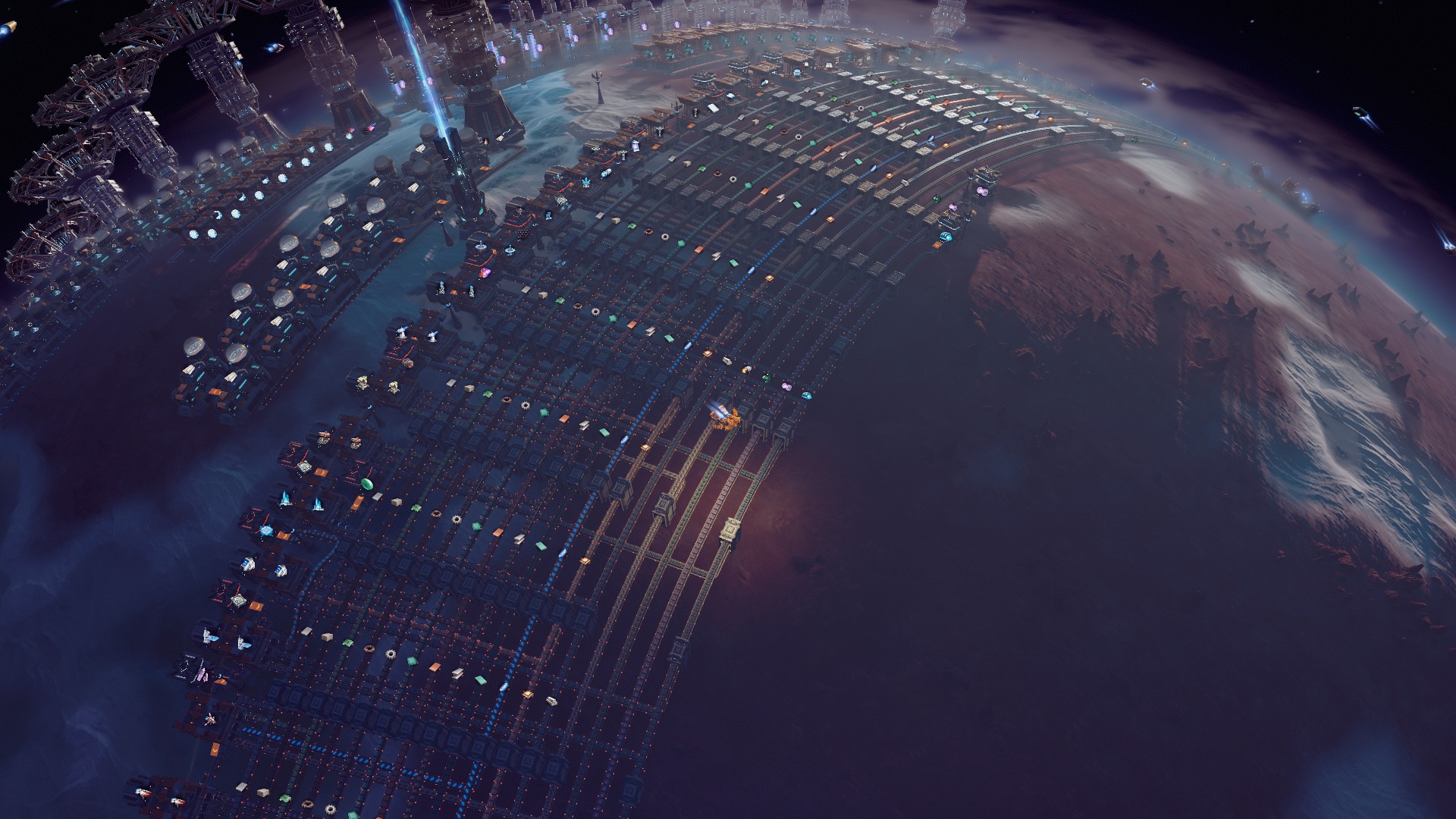
DSP also has a fair amount of customization in terms of grouping + prioritization, which helps dramatically with optimization. The totality of the game space (meaning all system + planets) have more tools here to effectively distribute items that Factorio does (primarily due to rocket limitations in Space Age). It’s also looks friggin’ amazing to have a planet factory running.
DSP has a special place in my brain. It’s hard to properly describe how friggin’ cool it is to build an actual Dyson Sphere! All factory games make numbers go up, but the actual end goal is a relatively downer. Factorio gives a ‘game complete’ screen when you fly to a planet, something you’ve done 5 times before – even in the vanilla days it was about sending a rocket. An actual meaningful goal that isn’t found elsewhere is impressive.
The end goal is amazing, but is the journey there still fun? That’s the question.
A bit more than a year ago, Dark Fog launched, which brought PvE combat to the game. The planet-based combat is decent enough, though I still question the amount of ‘trash loot’ that results from it all. The inability to destroy things in game is still an annoyance to me. Space PvE combat is still quite bad, and long-term space-faring objectives suffer from it. I opted to start over without Dark Fog, and that means that around 1/4 of the research in the game is useless. It also removes a lot of the early game friction.
The lack of PvE and amount of game experience means that the game itself has some rather serious pacing issues. It takes about an hour to build a main bus, with the main gap related to getting foundations to fill in water holes. Once you have that running, it’s a very small step to move into red/yellow research using oil. That opens up around 80% of all research in game, nearly up to the point of actually building the Dyson Sphere proper. You’re effectively rate limited on research based on oil extraction math, and then rate limited based on green engines which open up interplanetary logistics.
What’s interesting about DSP is that each planet is the same size, and the layouts differ based on latitude (less room on the poles). You’re never placed into a position where space is a challenge (building vertically is damn cool), only throughput. Where Factorio allows you to effectively brute force base material production to fill a bus, DSP’s bus is actually made of intermediary materials which can be much more complicated to make en-masse. Making something in bulk in Factorio usually isn’t terribly painful, as you can make a dedicated factory for it. DSP not so much, if you need end-item bulk items, it has thousands of base material requirements which is much more like a pyramid of production than distinct chains. A late game factory planet will have 200 iron plate factories – that never exists in Factorio.
By not having Dark Fog at all, I will not be able to unlock the Mk4 Assembler (100% boost on Mk3) or Mk3 Foundry (50% boost on Mk2). I have completed this game nearly 10 times now, and not once was this ever an issue. Throughput and power are. It is a much more difficult thing getting enough iron to a factory planet than it is to have enough machines to smelt it. It is possible, and honestly a terrible idea for 99% of the game, to terraform an entire planet and dedicate it to only base foundries (iron, copper, glass, stone, coal). More on that in a future post.
Which brings me to blueprints and more specifically, force builds. Blueprints are all but needed in Factorio as the small factories can be terribly complex. DSP is more about scale, repeating the same pattern dozens and dozens of times. Factorio implemented ‘force build’, which means that it will remove whatever is there and place the new blueprint. DSP does not have this – if there’s a conflict, the blueprint won’t work. That means that DSP blueprints are either very small (1 building and connectors) or very large (a full factory on a blank canvas that has been paved), and you’ll need to make connections to the rest of the plant. Reminds me a bit of Satisfactory’s blueprint limitations – where scaling is in the middle of DSP + Factorio.
Side note: Satisfactory’s main bus is ridiculously large because you can’t pre-fab buildings. Factorio’s main bus is extra long to support multiple mini factories. DSP’s main bus has about 15 things on it because you can in fact pre-fab buildings, but on the other hand, there are nearly 60 buildings you can construct and need to store. With Dark Fog, the main bus can wrap half of a planet.
A reminder that DSP follows some rather straightforward phases:
Initial Landing + automation
Main bus + blue science
Red science (oil)
Yellow science (titanium + silicone)
Planet factory + logistics
Purple + Green science
Dyson Sphere construction
Photons + end game
Right now, I’ve completed the yellow science phase. I’ve got research queued for a while, and trying to set up my Deuterium ring on the lava planet. Next up is a battery charging station on the lava planet, which will allow the ice planet to slowly transform into the main production hub. Power is always a challenge on that ice planet… there is a massive gap between the later phases and therefore essential to scale growth over time. It will be interesting to see how I can make blueprints work in my favor this pass.
The more I play, the more the EA gremlins pop up. Pacing & unlocks are not yet balanced, so I find myself in spaces where I’m told I need to do something, but don’t have the tools to do so. Example, the second zone is flora based and you need to collect Nitrate. The only way to do this is through manual means with an Atomizer, even though you can see mining stations. You also are required to use Uranium to unlock chests, and will not unlock the ability to craft that for at least 3 more zones (hours later). Weird.
The concepts however are really interesting, and the mechanics of them are rather impressive. The game effectively asks, why do you need belts? And honestly after a few hours, I am left wondering why they exist at all other than a resource sink. I’ve made tons of posts related to main bus architecture and logistic distribution models… and while the concepts remain, the implementation is so different here. Except fluid/gas, and that implementation sucks here but is standard in other games.
As you progress in the game, you unlock different buildings that produce more complicated things. It’s more or less voxel based construction, and allows 2 levels of construction. The game will automatically route items between buildings, if you set the path. At first this is simple enough, but later on gets extremely complicated. Not being able to measure throughputs adds to complexity.
I don’t mind complexity, and I don’t mind brute force methods. The math however doesn’t always math. Upgraded miners are good, as are the docking stations. You need to upgrade storage to hit 360 items a minute transfer rate. Smelters are the first production level. You either create 39 or 52 items per minute – so 9.2 or 6.9 buildings. That will saturate a production chain. If you need more than 360 items a minute, you need to build another entire production chain. No belt upgrading here. You won’t know you need more than that until your storage empties.
One important note on logistics is compression ratios. If an item is refined to a lower rate (or larger stack) it is often best to refine it before shipping. Like 2 iron ore to 1 iron plate, you are 100% more efficient on shipping. So far, the only material that benefits from this is superalloy, an item you won’t see for a very long time.
First Zone
This will be your ship production zone, and 100% of everything you produce is meant to construct ships. It will look horrible and you will suffer from less than ideal design decisions if you don’t plan properly. 90% of it can be tweaked some with one exception – your ship building facilities must be close to your fueling station and close to open space. This is the only way the tug will be able to move ships for fueling and then park them in the open space. 25 ships is easy. 250 ships take up a TON of room.
How it started. This part is really amazing to watch. Bit like an ant farm.
Second Zone
This is a weird one. You collect Nitrate, which has no use at all other than a construction milestone. You can collect Hydrogen, which is used to power Fusion Plants for power (more on that later), and you can build what are effectively windmills for 3x the price of solar panels for a 50% more power. Not really worth it there.
Third Zone
This is your 2nd asteroid belt and should be treated near identical to the first zone, with one exception. This is your base material factory that will allow you to expand every other base. It will be powered through the 2nd zone’s hydrogen and scaled to give you as many construction materials as needed – up to computers. Massive QoL game changer when you get this running!
A later phase with way too many ships. The fueling portion here is not fun, and building/placing 375 ships is super tedious.
Fourth Zone
There’s nothing here of use at this time, other than 5 talent points to quickly harvest. You likely won’t have completed harvesting the points in the 2nd zone by the time you end this one. The quest you unlock here is likely to be your quit wall, as the volume of the builds will choke all production for a few hours. That’s honestly fine by my account, as what’s done up til this point is more than impressive.
Power
Mining stations, when upgraded and with defensive bits, need 3 solar panels to function. Set it and forget it. Absolutely dirt cheap to set up.
Production bases should be Fusion based. Hydrogen is extremely easy to find and infinite in supply. You can build power links between mining stations and your main base, but the material costs are more than 3 solar panels and a power outage impacting an entire zone sucks… so why bother? Power storage is a thing, but I’ve honestly never seen a use for it.
The last little bit. Not that fueling / hydrogen / power was shifted. The low center portion is dedicated to complex construction and avoids central storage. Production rates are so slow at this point (well under 50%) that is doesn’t matter.
Moving On
As an EA game, I’ve had my fill for a while. The main quests up til about level 8 are a good exploration of all the meaningful mechanics. After that point, scaling of logistics becomes simply too painful to manage. To reach the next step, I’d need to fill in zone 2 with Hydrogen Farms to build an infinite power supply field for every other zone, with 1 warp station per product type, which would then make a mega station.
More to the point, the inter-zone logistics is a major hurdle and my major design issue with the game. It is absolutely possible to scale everything with a warp per product. I am not interested in that complexity for now.
That said, for an EA game, it may be the best experience I’ve ever had in terms of quality. Holy cow. Quite curious how this game will go long term, certainly the strongest start I’ve seen in a long time.
These games all have very long tails, and Factorio is entirely bound to the legendary farm. In the goal of ‘making numbers go up’, the long optimization requires the productivity bonus of legendary material.
Let’s math it out:
Normal: A Cryogenic Plant has base base speed of 2, productivity modules (x8) of 4% and -5% speed, beacon of 1.5, and speed modules (x2) of 20%. Works out to 2.2 speed x 1.32 items = 2.904
Legendary: A Cryogenic Plant has base base speed of 5, productivity modules (x8) of 10% and -5% speed, beacon of 2.5, and speed modules (x2) of 50%. Works out to 4.25 speed x 1.8 items = 7.65
Factorio is often (outside of Nauvis) about building in confined spaces, so having 2.5x the productivity for the same footprint is amazing. Getting all the material required to reach that productivity is it’s own challenge, and one that’s been optimized by more invested people (with blueprints!)
I am not interested in reaching 10kSPM (currently at around 3k), as it would require a near complete retro-fit of my entire production line. Getting to the Shattered Planet in one piece, and then returning to Aquilo is ‘complete’ enough for me. That can certainly be done with normal items, and in fact should be normal weapons. Upgrades to Rail Gun speed/damage to the 100k ranks is ample.
Closing Thoughts
The experiment here was two fold. First, build more compactly on Nauvis. Second, only use normal items.
Compact on Nauvis is a cool puzzle set and relatively less challenging than I would have thought. The largest impact is on science production, and then not a whole lot. Coming in knowing that I didn’t need massive oil production chains saved a ton of space. It also made my roboports much more effective as the distance was a fraction of what the last playthrough was. Until the game allows multiple landing pads per planet, Nauvis really should stay small.
All the other planets were already 50×50 builds due to space limitations, so not much changed in that regard. Having existing blueprints, or at least advanced knowledge of the puzzles dramatically sped up my playthrough – Fulgora a bit, Gleba by a factor of 10, and Aquilo was simple enough this time.
Playing without legendary items is a more pleasant experience, in nearly every regard. Fulgora benefits from uncommon/rare batteries, but that’s truly the only super useful instance. Aquilo was completed with normal stuff, and then I opted to try to optimize prior legendary builds. I could have (and did for personal reasons) built a normal-quality space ship. It goes slower and needs to be a bit bigger to effectively buffer/process all the things, but it works. A legendary version is useful for the crushers, foundries, assemblers, and chemical plants. Legendary weapons are bad in this game, as it increases the range and wastes ammo (laser weapons would be the only exception).
Overall, I really do like the puzzle aspect of Factorio. Making the numbers go up while your investments is rewarding. Each planet brings a new set of variables to adjust and there are optimal solutions for each. I still think Aquilo’s bar for entry is too high as you can’t fail-forward. I think that the legendary ‘farm’ is a red herring for many players, and one that could have been implemented differently or behind a later research gate. There are only two meaningful quality types – normal and legendary. Everything else is simply fodder along the chain.
Factorio remains the gold standard, if only because of the QoL and detail applied to every single step. Moving from here to any other logistics game feels like time travelling backwards. It’s frankly astounding the level of depth present, and I remain convinced that it should be required in any engineering program. If you can’t solve Aquilo, then I don’t want you solving anything that matters.
A legendary farming space platform runs a simple concept. Recycle chunks with quality mods for a percentage chance to upgrade them. Each recycle has an 80% success rate, and they can take 2x mods. Regular Mk3 mods are 2.5%. Epic are 6.2%. So double that per attempt.
You do it for regular, uncommon, rare, and epic. Then you crush it for an output. This assumes you have the type you want and don’t need to recycle the legendary chunk.
A legendary farming platform
Compound math is both simple and not intuitive. If I ask the odds of flipping a coin, simple 50% chance. If I ask the odds of flipping heads 5 times in a row, it’s 0.5^5 or closer to 3%.
So let’s look at the difference between regular quality mods and legendary mods in this setup.
The first stage has an 80% chance to get something, and of that result, 5%/12.4% are upgraded.
The result is 4% and 9.9%
This happens 4 times.
Regular odds: 0.0003%.
Legendary odds: 0.01%
There are 2 zeros between those odds. Or put differently, you should get 3 per 1 million chunks for regular and 1 per 10 thousand for legendary. No need to explain why that is a great improvement.
The challenge is getting legendary quality mods. It is more of a time sink than seems at first as you need a lot of blue chips. Way more than you think.
Real World
Compound interest applies in the real world, mostly with banking and credit. I won’t delve into the ethics of credit, but the math is super interesting. Let’s pretend you have a $500,000 mortgage, with a 25 year amortization (total duration)
At 5%, and monthly payments you would pay $34,800 annually. After 5 years, you’ll have brought the debt down by $57,000. $117,000 in interest.
At 6%, and monthly payments you would pay $38,400 annually. After 5 years, you’ll have brought the debt down by $50,800. $141,200 in interest.
A 1% change increases your payments by nearly $4,000 a year (so $20k over the 5 years), but end up reducing your debt by $6,800 less. That’s $26,800 gone due to 1%… not what you may instinctively think as being $5,000 (1% of $500,000).
Option 1 – Farm Materials
Build a legendary farm space platform to collect iron/copper/coal
Get LDS research to 15.
Use coal to make legendary plastic, iron + copper to make legendary blue chips
Make 4 legendary Mk3 productivity chips first, put them in a foundry. That gives 300% productivity.
Make LDS from 5 legendary plastic and molten (free) metal. Get 5 legendary plastic + 5 legendary steel + 5 legendary copper.
You can do this step before LDS research at 15, you’ll just lose plastic. Which may or not be a big deal depending on how much legendary coal you can get, and investment in plastic research.
The copper (recycled) can be used to craft blue chips.
Option 2 – Upcycle Materials
Get blue chip research to lvl 13.
Build blue chips on Vulcanus (materials are free here). Start with normal Mk3 productivity chips. Upgrade to legendary when you can to give 300% and no-loss recycling.
As above, you can do this before research 13, you’ll just lose materials.
Recycle the material with recyclers + quality mods.
Use those results to build uncommon chips, and recycle those
Same with rare, and epic.
You now have mats for legendary materials.
This process improves the more you research blue chip production. At level 14, you technically could recycle legendary blue chips for more mats than you put in.
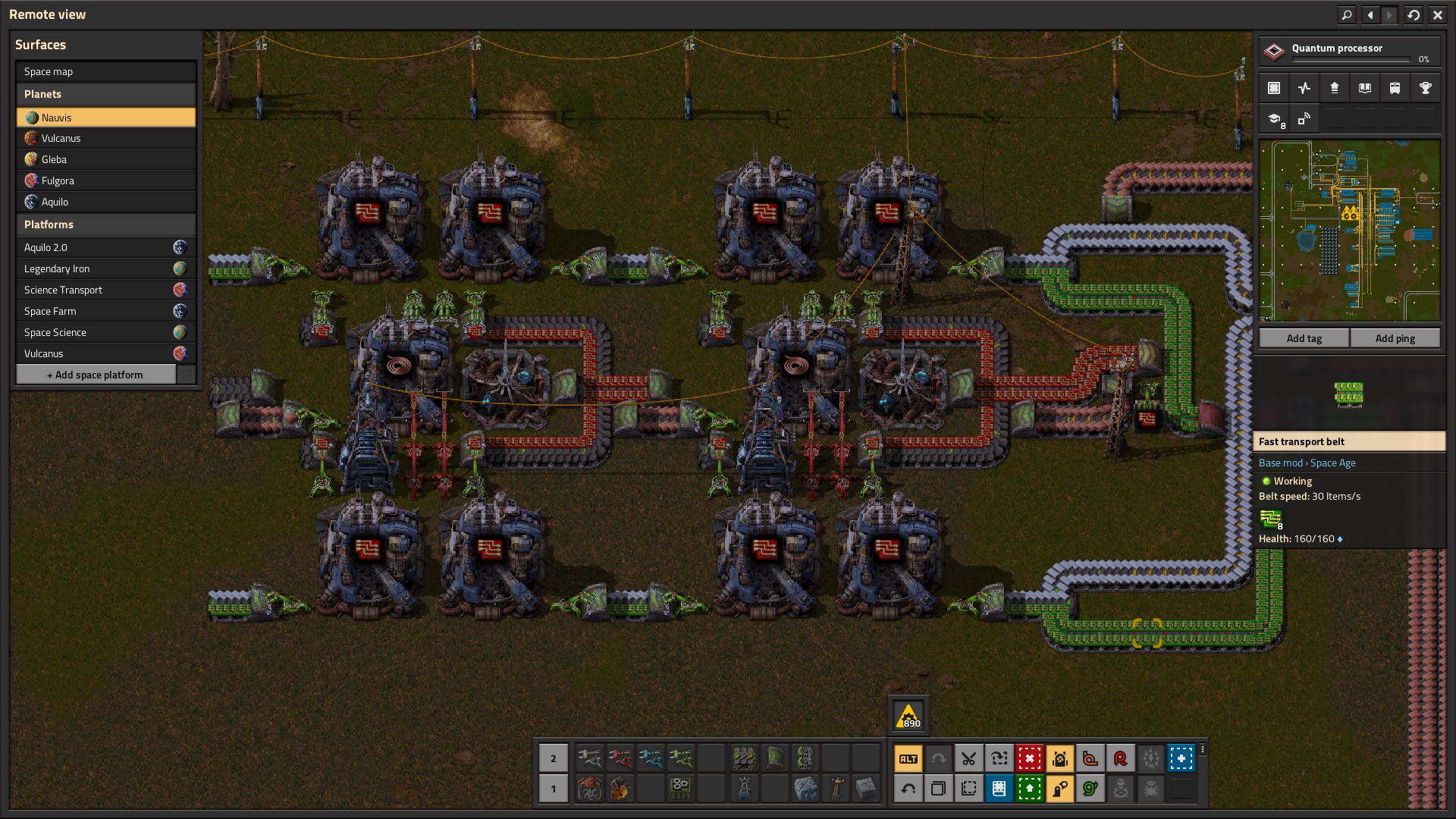
A simple blue chip upcycler.
Option 1 is where you will end up eventually. Option 2 may be faster, it’s significantly less research but it’s also on Fulgora. Research there takes up material you’re going to want to use for other things. Option 1 can be done 100% on Vulcanus. Next up, legendary production.
The first time I landed on Aquilo, it went really bad. Scratch that. The first time I tried getting to Aquilo it went really bad. And then it went worse.
See, the ship you use to get there needs to be built in a specific way, and is the first time you need rocket turrets to survive. The challenge here is that rockets need a rather specific set of ingredients to be built, which are rather uncommon, and they do no real damage at the start. You need to invest in research to get max shooting speed (340%) and a good amount of damage (~400%) so that it doesn’t take 9 rockets per asteroid.
In my second run, I forgot this. I didn’t lose this ship on the way there, but it wasn’t able to build enough to survive in orbit. That took ~30minutes for me to figure out and a save reload. And then a heavy investment in explosive research. Meh.
Landing
This is the hardest part of Aquilo as you’re likely not bringing the right amount of stuff with you. Aquilo has oil and 2 other gases that are specific to Aquilo tech. Nothing else. It’s also so cold that everything needs a heat pipe nearby to function, robots take 5x the power, and solar power gives 1% return. The first 10 minutes or so of Aquilo is basically survival with the tools you brought. I did mention in the past that I parked a space farming platform above Aquilo – it gives iron, copper, sulfur, coal, carbonized coal, calcite, and ice.
I opted to take a slightly different approach this time. 50 solar panels to get some trickle power, then a heating tower power by rocket fuel that I brought along. It burns crazy fast until you hit 500 degrees, and with a logic control to only feed if it drops below 550, I could set it and forget it. 2 heat exchangers + 4 steam engines was enough to get the basics off the ground.
Rather than having a bunch of rocket fuel heating towers and complex routing, I opted to focus on solid fuel. That gives more than enough power for the rest of the build.
This thing is a miracle. Takes 400 heat pipes mind you.
Growth
Expanding Aquilo needs ice platforms, which take a while to build. And concrete if you want to put something on top of it. Stabilizing Aquilo means Foundries for iron, steel and copper. You can build most things with just that.
From there, you’ll build the first Cryo plant – no production bonus but does have 8 mod slots. From there it’s a rather small jump to a lithium plant, then to fluo liquids, cryo science, quantum chips, and finally fusion power. Never had a power issue this time, which was glorious!
Note about fusion power – it allows you to put production modules in all buildings, along with speed module beacons. Doubles the planet’s productivity. Doing this before fusion will cause a power outage.
I added a rocket fuel plant later on when the rest was stable, and then built my old fusion plant layout. Honestly, I think Aquilo took less time than Gleba. If you know what you’re getting into, and ship the correct materials, it’s not that bad. If you’re going in blind, and don’t have any blueprints, then things are going to be rough and take forever to ship what you need to get going. This may be my favorite planet to crack.
Self-sufficient and overly complicated due to heat pipe needs. Takes about 15 minutes to “warm up”.
Planet Power Shifts
Fusion power is needed on other planets, and that takes a huge amount of materials to get done. Vulcanus is the urgent one, in order to scale productivity. Legendary space farming platforms are next, followed by Fulgora and Gleba. Nauvis doesn’t need it, Nuclear is more than enough for everything that will remain.
28 generators max at 50MW each…this thing gives gigawatts.
Next Up
Legendary farming. Unfortunately this run was significantly faster than the last one. I think I ran through the entire thing in just over 10 hours. Since I haven’t created upcycling farms, I don’t have any legendary mods. That’s going to be a hurdle. Research is also quite a bit behind, with most near level 8. I need LDS to be 15 for self-sustainability, which is like 100x farther to go.
That means, I need to optimize the heck of out Vulcanus, and ship out a constant feed of research packs. Compound percentages are the enemy… more on that in a bit.
Actually, three of them. One for basic material (which is needed for Aquilo) and two for legendary material. Both can be built early, but can’t really be used until certain steps are completed.
Basic Farm
A square shape, that has walls, gun turrets, and rocket turrets. A belt goes around the whole thing, with the space material on the inside, and the weapon material on the outside. You can power most of it through solar, but that is likely to create problems down the road. Nuclear (only feed it when needed) is the best option. Remember to request nuclear fuel!
There are areas to generate fuel (near the engines), areas to generate ammo/rockets (with foundries), and importantly, the actual farming area.
A logic gate.
There’s one loop per rock type, and each rock can give you two results. The arm has a logic gate that opens if you need the material (less than 2k copper in this example) or the belt has room (less than 60 on the belt). The results go to the main storage, and overflow is split to the right and dumped over the side.
More logic.
Since I don’t want storage overful with one item, I limit each to 2k. The arms shut down if I have that amount. The line naturally backs up to the splitter, and excess is dumped. The left side is a chemical floor that splits Carbon into Coal. End result is 2K coal, carbon, sulfur, iron, corrpe, calcite, and ice.
Recycler
This is the real magic, since there are times where you have too much of one rock and not enough of another. This is the metallic trigger, where too much metallic (80+) and not enough of another (less than 10) causes the metallic rock to be transformed into a random other one. This is important outside Aquilo, where 80% of all rocks are Oxide (ice). If you don’t recycle them, you won’t have enough metal for ammo.
It is possible to finish Aquilo without a space farm, no question. Be aware that you’ll need to ship an incredible amount of iron, copper, calcite and coal as a result – you will hit bottlenecks.
Legendary Ship
Think regular farming ship but twice the size. The idea here is the last bit I put on the regular ship – recycling. More specifically, upcycling.
Using Quality Modules (the best you can), you recycle rocks with the hope of getting a higher quality result. Do it again for uncommon, rare, and epic rocks and maybe you get one legendary from it. Crush that legendary stone and get either iron/copper/calcite (one ship) or coal + sulfur (another ship). I have a future post on why you want to invest in legendary quality modules – short answer, they are 100x more effective.
Since you don’t need to head to Aquilo (Vulcanus to Gleba has the best type of chunks), you only need gun turrets. Power is a challenge. Since you should unlock Fusion power before Legendary items, it’s a straightforward thing to put fusion on a ship as it runs on it’s own once primed. Again, remember to request the fuel!
Yes, this thing is massive. I needs nuclear (or ideally fusion) to really work.
These legendary ships are 100% optional and 10,000% end game. My entire run, with the exception of Fulgora power batteries, with only normal items. This is different than my first playthrough, and I honestly prefer it. If I took the time to find a mod that allowed multiple rarity items to be used in crafting, then we’d be talking. But the sheer amount of waste in gambling drove me crazy.
Biolabs are amazing. Not only do they have an innate 50% productivity boost but they go twice as fast (5x at legendary level). It may not seem like much, but when research takes 1+hr and 10k science packs, it’s massive.
The challenge here is that they require biter eggs to build. 10 of them in fact. You can only acquire these by sending capture rockets at biter nests in the wild, then feeding them bioflux to create eggs. You can eventually build your own nests, but only after completing Aquilo. I waited last time, I will not make that mistake again.
Main Steps
Get Bioflux to Nauvis before it spoils. It has a 15m shelf life, so a direct path from Gleba to Nauvis is required.
Build a capture rocket. That needs Bioflux.
Find a biter nest. This may be the hardest part with no enemies. I’ve yet to encounter a single one on Nauvis.
Capture the nest, feed it bioflux and harvest the eggs. Manually.
Create 40 Biolabs, which is 400 eggs.
Profit.
Normal Play
Biter eggs normally expire, and spawn, well, biters. In a normal game, you would need to defend buildings with eggs in case they expired. No enemies means that this risk is entirely gone, as is the challenge of actually acquiring the initial eggs as they would often be in the heart of biter land. This is a very welcome change.
Upgrading Nauvis
This is an interesting decision point, as the value of Nauvis drops massively once you’re done with Gleba, and becomes only useful for research and biter eggs when you complete Aquilo. As I plan to build a legendary factory on Vulcanus, it does make sense to keep Nauvis running for a little while as it’s my ship building yard (no meteors). Building any ship requires a few truckloads of steel, and the absolute best way to get that is through Foundries – from less than 5/s to over 40/s.
So I figure if I’m going to upgrade that, may as well upgrade the rest.
Foundries on Steel, Iron and Copper. This creates a significant need for calcite shipments.
Electromagnetic Plants for red/green/blue chips
Big Miners everywhere
Steel Foundry. It’s great!
Red chips. Super efficient.
Next Steps
Aquilo is next, but to get there I need a farming ship and a rocket-enabled ship. The last time I did this, it did not go well.
I have a large dislike for Gleba, and the list of grievances is long my friend! In order.
First, the enemies. I don’t mind biters, you can build walls and by the time you launch a rocket, no biter will ever enter your base. Gleba has stompers. These buggers take a beating, and each step they take breaks stuff. Walls are meaningless. And you need to farm material from quite a ways, so the spaces you need to defend are massive. You need lightning guns that have AE/stun attacks and they are constantly firing. Turning on no enemies mode is awesome!
Second is that nearly everything you can produce on this planet has a spoiler timer. There are only 2 practical items you can ship off planet as they have 15m+ timers. The rest you need to have built-in off-ramps to remove spoilage. It means you cannot truly have a main bus, and instead mini-factories that are rate controlled to reduce the chances of spoilage.
Third, the Biochamber is the only way to build anything here, and it takes nutrients as a power source, which you guessed right, spoil. Creating nutrients is a fun little challenge, as it starts off being from spoilage itself, then you realize Bioflux prints it for free.
Balancing items #2 and #3 are a fun little puzzle. Trains are useless here, and only robots can get stuff around quick enough without spaghetti belts to actually be optimal. It takes 200 or so running at all times to keep the basics going. Everything becomes modular, so you can’t really add 1 or 2 buildings, but a cluster of them to keep it working. The end result is a very organic factory, with dedicated cells. I really do think that this is an amazing design achievement.
This actually is way cleaner than my prior build. Closer = the bots have less distance needed to fly around. I opted not to ship Calcite and use Foundries… likely to revisit that choice.
Having #1 around meant that I was always under attack and non-stop messages about armies attacking my base. I had a ship just flying between Gleba and Fulgora for lightning ammo and to replace busted pieces. It was also an absolutely massive power draw. Without enemies, Gleba is actually fun!
Sure, shipping the spoiling science packs requires some extra math, but it works! Power issues are non-existent. Supply is easy (mind you collecting Pentapod eggs is it’s own journey), expansion is simple, and the planet went by in a relative jiffy. The items research unlocks are extremely useful – access to Aquilo obviously, but also stack inserters (amazing for Vulcanus), essentially free plastic/rocket fuel from Gleba, rocket turrets (needed to get to Aquilo), and Biolabs (which give a 50% bonus to research production).
Next step is not actually Aquilo but:
building a farming space ship to put above Aquilo, since the planet has no natural resources
building a space ship to go to/from Aquilo
moving all research production from Nauvis to Vulcanus
getting Biolabs
Upgrading Nauvis to use Foundries + getting enough calcite to make it run
Starting the build of a legendary farming station. It takes a long time to build and I’d rather have it ready for when I need it.