Satisfactory – Phase 4

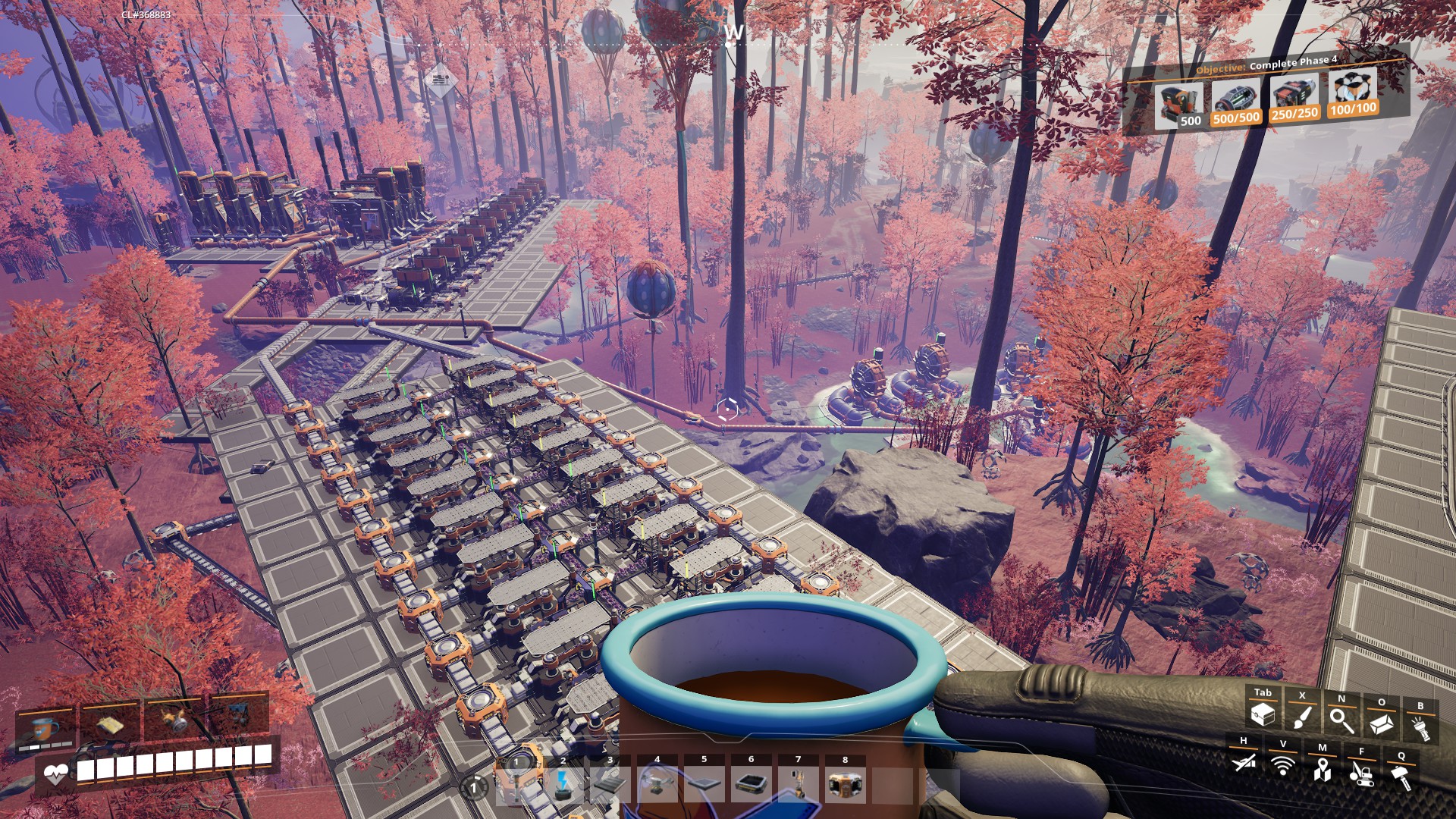
Or perhaps it’s more like phaaaaaaaaaaaaaaaaaase 4. Where each prior phase is more or less determined by unlocking a new type of power source, Phase 4 is that and more. Biofuel is a simple 2 step process, Coal is 3 steps, and Oil starts simple enough, then turns into major fun time. Just look at this thing!

1 Pure Oil at 250% = 80 Fuel Generators

Phase 4 has you unlock Aluminum – a complex process that requires 4 different things and a by-product you need to build back into your lines. (Small note, pipes prioritize the lower flow; see here) Alternative recipes allow for a major increase in productivity, and as a result, trains become life bringers to a main factory.

Sloppy aluminum = way more silica than I originally thought!

I know it’s possible to “finish” the game without ever using nuclear power – there’s ample oil with each node giving ~20MW of power. A nuclear plant, on a single node of Uranium, should be able to give you 250MW, but sweet baby sally, the setup required to get it going is bonkers.

The boxes mid-left are storage containers for materials I need to ship in. There are actually 8 different materials shipped in. Things on the right are all radioactive, and I am “sinking” the nuclear waste. This setup was about 4 hours of effort.

I recall in all prior patches that the complexity of phase 4 builds meant multiple (dozens, honestly) trips to central storage for materials. Just look at the foundations used there, that’s honestly enough concrete+iron plates for 2 full runs to base. Dimensional Depots to the rescue! It has the same feel as playing in Creative Mode, but it’s so much more rewarding because I know I’ve set up the production chains to make it work.

Side note: Mk5 belts are easier to deploy and use than any other belt in the game. And not by a small margin. Mass-produce aluminum, feed sheets into 2 Dimensional Depots and you’ll never have a belt problem again.

Note that while I was waiting for Nuclear to fill the up the belts (it operates on a manifold) I went and collected every Somersloop on the map, and an extra 100 Mercer Spheres. The former gives me a 70% boost to power levels, and the latter means that my Dimensional Depots are fully maxed, and have every item needed for crafting available – there are more than you would think. The net effect is that a) the entire map is discovered, b) I’ve got all the boosts I can get, c) the ‘narrative’ seems to have reached a conclusion or I’m simply bugged, d) I’ve collected enough slugs to power Manhattan, and e) I have a newfound appreciation for map design. Sure, let’s stick with appreciation.

So now I’ve got all the pieces of Phase 4 unlocked, nearly 100MW of power to get things going, and time to unlock Phase 5. Most of that is simple enough, as it’s just mixing items I already have. Except for Nuclear Pasta. That is it’s own battle.

The great news in all this is that my main factory bus is still functional.

Ubisoft & Outlaws

It’s quite an indictment of the industry that a game which sells 1m copies is deemed a failure. Moreso that this is somehow seen as the end of Ubisoft. Perhaps the downward trend of the past 4 years is enough to shift them to go private or bought out, but they are far from going away. I tend to think of this a bit like Bethesda or Bungee, where ideas + corporate tend to lack alignment.

Gone are the days where only large game companies can deliver quality games. My backlog is massive, and entirely dwarfed by the glut of gaming possibilities. The odds of any game breaking into the scene and dominating share requires a near perfect storm of factors. The most important of which is that the game absolutely nails the core gameplay loop. Not just throwing stuff at the wall here, but hits it out of the park.

Wukong + Space Marines are perfect examples of this, where the games have an absolutely crystal clear focus on a single aspect, and don’t sprawl out into crazy town. I don’t need a game that offers a buffet of options – I have 12 to choose from already. Fallout 4 has more players today than Starfield, and they are both janky messes of games with too much going on.

If Outlaws failed at 1m in sales, then the failure is in the expectation. The game is not good enough to hit that target, plain and simple. Jedi Survivor didn’t even hit that target in the first month, and it’s a game with lightsabers! Outlaws did have an absolutely massive media push, which certainly cost a pretty penny, but from the first play sessions the vibe was not a positive one.

Buzz is based on balance of positive and negative feedback. You need more of the former to ride a wave forward, and there will always be a ton of the latter. If the first bit out of people’s mouths is “speeders feel bad” or “stealth has issues”, then you’re in for a bad time.

Reputation is also a big part of it. Ubisoft has struggled tremendously of late with their open world games, with just too much stuff and no focus. There’s a fatigue portion to just mini-map icons and the same skinner box with a different coat of paint. And Star Wars is probably at it’s lowest point in a very long time, with a cash cow that’s running on fumes. Andor may have had success, but it’s really the only Star Wars good news story in the past 5 years. The Acolyte set a new low (which is another topic).

I refuse to believe that the dev team thought the game was ready for launch. The “emergency” path to address the stealth problems means that this was in the QA file for a while. The “kitchen sink patch” for speeder control and enemy placements is another damning point for the game director. The game will launch on Steam on Nov 21, which is the last real kick at the can to make some of the investment back.

That AC: Shadows was delayed is hopefully a sign that somewhere, someone in a suit is paying attention. It will also raise expectations that the time is used effectively. Unfortunately, that is after the holiday season and lands right in the pile of the following games that have a similar genre:

  • Kingdom Come 2
  • Avowed
  • Monster Hunter Wilds

If anything, I hope that Ubisoft learns to be humble. The days of AAA dominance are well behind. Wallets are tighter than ever. Gamers have tons of choice, and will spend where there is perceived value. There’s a tremendous opportunity to find that sweet spot again.

Satisfactory – Alternates

Flexibility and complexity are a matter of perspective. Buying toothpaste is the best example. They all do the same thing, but have different boxes and sales pitches. I just buy whatever is on sale.

Satisfactory has a similar bit, and a whole subsystem of exploration that digs into it – alternate recipes. Strewn about the map are broken cargo containers. Each has a set of requirements (either power or specific material) which when provided gives a hard drive. You then use these hard drives to unlock alternate recipes. Each unlock takes 10 minutes to complete (you can “store” research mind you in 1.0) and provides an random recipe based on what tier of research you’re at. You can’t get Oil alternatives when in Tier 1, so you are generally incentivized to use them earlier than later.

There are 118 sites, and 113 uses for them (96%), which pretty much means you need to collect them all. Forgot to mention most of these are in difficult to reach places, where a jetpack is all but required. I will say that the first time I found them, I found it quite a fun exploration challenge. It took time, time that allows my production lines to complete their jobs. Then I needed to re-build my production lines with the new recipes (which is feasible when small). The 4th time I tried this though, I was frustrated. My 1.0 playthrough has opted to unlock all alternate recipes from the start. I build BIG factories, and resetting them for alternate options without mass construction tools is not fun.

Right, so that’s the method of unlocking recipes. The value of a recipe is the real kicker. Prior to 1.0 there were really only a handful of critical alternate recipes. Anything that removed screws from production chains was amazing. Solid Steel ingot is life. And the golden alternate remains Diluted Fuel – which alone doubles your power output. With over 100 uses, quite a few recipes were poorly balanced and to a point where you would only use them in emergencies.

For example – any alternate that uses Petroleum Coke is a bad recipe, because you should never have Petroleum Coke produced. That’s 7 “useless” recipes. There are plenty more. But there are some where you just need to get it done, or you have an excess of something and can afford to burn it.

Some recipes require a complete rethink of complex chains, which shows wonders in Aluminum production. The basic process (2:3 ratio) has weird mixes of Bauxite, Water, Coal and Quartz, and if not done correctly will stall production. Sloppy Alumina changes the math and layouts to sanity levels, and improves the ratio to 3:5. If for some reason you have excess Sulfur, you can add Electrode Scrap and even further increase the ratio to 21:40. No matter what alternate you use, it will require a complete rebuild of the factory chains.

My favorite alternate recipe examples are the “pure” items made in a Refinery. For things like Iron, there are ample nodes and this isn’t all that useful. For all the others, you are likely going to want to use them – Copper in particular. The basic recipe is a 1:1 ratio, and only uses Smelters. Simple, straightforward, and available at the start of the game. Pure Copper is a 2:5 ratio, which is a 250% boost. However, it requires a decent amount of water (simple enough) and twice as many Refineries as Smelters. That’s 15x the power requirements, so it’s not going to be even remotely viable as an option until you have nuclear power available. But it’s also the only viable path to Copper Dust, the core ingredient in late game Nuclear Pasta. You need 600 copper/minute to make enough Copper Dust to make 1 pasta/minute (for a total of 1262 copper/minute!)

Having flexibility in Satisfactory is a good thing. The node placement means that you’re not often going to have ideal circumstances for production chains, and your challenges will vary over time. As you unlock more things, and finally get a decent amount of Nuclear power going, the problems will just boil down to throughput.

With limits on mining (you cannot get more than 36,900 copper ore/minute), you will have ceilings to manage. Alternate recipes allow you to effectively fudge the math and increase copper output to 92,250/minute. Knowing which ones are worth it… well that’s a tougher sell. There are maybe a quarter that are amazing, half that are ok, and the last quarter that really should be used as a desperate last resort.

Satisfactory – Phase 3

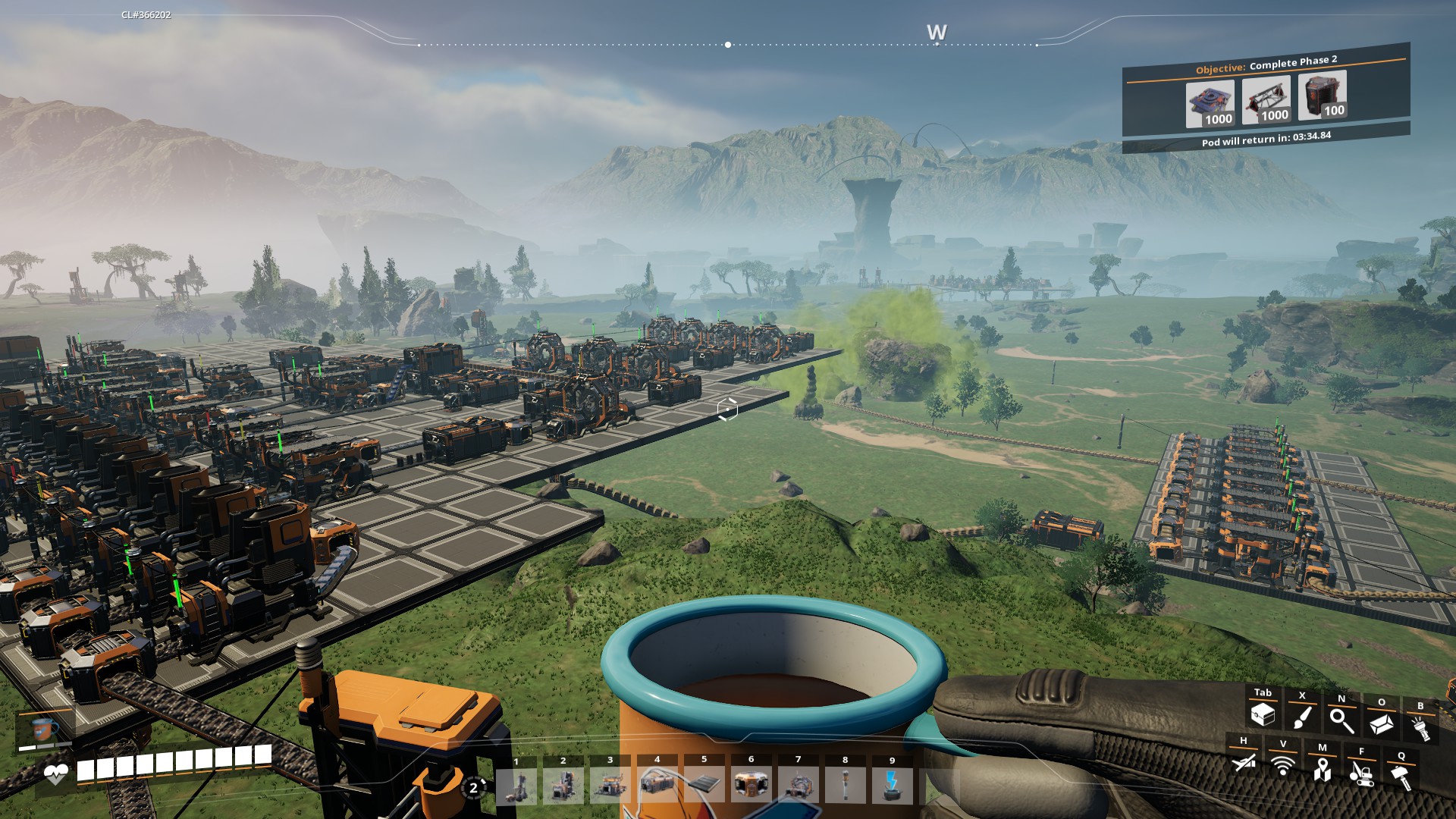
Satisfactory currently has 6 phases. The tutorial (0), Biomass (1), Coal(2), Oil(3), Nuclear(4), and well the new stuff that I guess I’ll call Ficsite(5). The tutorial is exactly that, giving you the foundational parts that don’t require power. Phase 1 has you collecting plants and wood (with a chainsaw!) to have a basic powered production line. You need to grow over time, and unless you’ve played before, you will have spaghetti lines everywhere. Let’s just say that floors/foundations are the key to staying sane. Phase 2 is Coal, which should give you a huge chunk of power to make a decent sized factory work. You’ll learn about buses, load balancing, and manifolds at this stage. It is long, as the items needed to move forward require massive boosts to basic productivity at the start of a chain – a theme that continues. Oh, you get trucks at this phase to help transport items – you should not use them as belts will be infinitely better for some time.

Phase 3 is where the game jumps from backyard to the next town as you need to process oil into plastic, rubber and fuel. No matter where you start in Phase 0, oil patches will be a distance away, so you will need to use the build queue system to ensure you have enough material to build what you need in the new location. An additional hurdle here is that all oil production chains produce by-product, and you either need to use it for something or “sink it”. (The AWESOME Sink is a powered building that acts as a garbage disposal and rewards points used for cosmetic items.) Petroleum Coke should absolutely get sunk.

Phase 3 gives access to trains. Trains are life. Trains bring life. Trains. Ok, back on track (sorry!). You will need to build your first train line at this phase to bring plastic/rubber back to the factory, belts will not be enough and don’t scale. Building your first railway is a massive investment – it will look horrible and get the job done.

Fuel generators will dramatically (5x) increase your power output and allow for the next phase of factory construction. Without this major step, you cannot create enough machines to produce space elevator parts.

This specific phase is where Satisfactory starts to enter the scaling challenge. You will have 16 fuel generators, sitting on nearly 300 foundation pieces. Your train railway will require a thousand base material. You will need Manufacturers, that have 4 inputs, which take a few minutes each to configure. Blueprints help (a lot!) but they are really limited in size (4×4) and do not allow connections to other blueprints. Mods (which are currently broken) allow you to chain multiple buildings and configs to quickly construct massive production lines. Click and drag 8 smelters, 8 mergers, 8 splitters and have them all automatically lay down belts is insane quality of life. I miss that a lot.

I opted to build a main bus line to get me through this phase, which is both the best idea and worst idea. The best is that it is extremely scalable, easy to follow, and beautiful. The worst in that it causes absolutely massive sprawl with belts that seem to go on for infinity which will make your PC melt. It works, and is what allows me to maintain sanity when I have a fleet of 50 smelters working to feed a beast to make 1 space elevator part.

Train in the foreground, massive factory floor in the back. Stretches nearly to the end of the map. Below that platform is the army of smelters.

One item that has helped with sanity is the Dimensional Depot. I’m able to store 2 stacks of items on top of my regular inventory, and the visual aid shows when I’m about to run out. I’d love to automate adding items to the depot, but I need like 20 Mercer Spheres for that step. Oh, and I have Somersloops boosting a handful of production buildings – the space parts are always boosted when running. The setup is a right pain, but the truth of it is that I can simply let it run, and very easily scale it to my needs.

In short, Phase 3 is really where the proper game begins. You need to use more of the map, more material types, have major logistical hurdles, and truly need to manage scalable production chains. To paraphrase, you need to math the sh*t out of this. (Quick tip: press N, and you can use that as a calculator.)

Satisfactory – Dimensional Depots

I touched on this one, but didn’t get the chance to fully appreciate it at the time. Dimension Depots (DD) are a sort of virtual storage that is available to anyone on a map, from anywhere. I had some minor use for it early, but found it impractical. And then I actually thought about it.

DD are unlocked through the MAM research trees. They need Mercer Spheres and refined SAM Ore for each phase. It costs around 100 Mercer Spheres to unlock all the research, and 1 Sphere per constructed box. There are around 300 Spheres, so ample room here… if you explore enough to find them. Jetpacks + explosives are required, as these aren’t all lying on the ground.

The research tree has 2 arms. Upload speed (4 ranks, caps at 240/minute) and stack size (4 ranks, caps at 5 stacks). Stack size is irrelevant until mid-game if you can get your upload speed to be higher than your usage speed. When you take a few minutes to think about it, the only things you’re going to use in mass volume at a high rate are Iron Plates + Concrete. You may at some point lay down extra long belts, but it’s really the floor of a factory/train that takes all the material at speed. You can add multiple boxes on a single item chain (I have 4 DD attached to my concrete production), which means upload speeds are well beyond my ability to spend. For all other material used for construction, I have 1 box.

The implicit downside to this is that for slow producing items (e.g. super computers) you are cutting your production rate by putting it in virtual storage, which may impact downstream production. Low stack sizes reduce impacts to production lines, but conversely reduce your ability to build large factories as you wait for boxes to fill.

What’s the practical use though?

I built 2 lane railway around the entire map, with no interruptions based on my DD storage. “But Asmiroth”, you ask, “is that really a huge benefit?” And to that I say, the math to build a railway that size would have required all my inventory space be dedicated to crafting materials + 4 trips to refill. Trying to build a Nuclear plant at the north, missing 1 damn rotor, and losing 30 minutes going to and from drove me nuts. I also built an entire Diluted Fuel plant (5 Water Extractors, 10 Refineries, 8 Blenders, 40 Generators) without any inventory issues. Wild.

It is absolutely game changing, and removes the need for central storage systems that were core of mid/late game builds. And it’s such a major change, that it completely changes my perspective as to how other factory games are built. It’s right up there with survival games that let you craft from items in nearby containers.

Satisfactory 1.0

It’s been a heck of a journey for Satisfactory to reach full release, one of the few bright star Early Access games to actually achieve that goal, and find a way to maintain focus over their total roadmap. I say that in the context of other EA games, in particular though in the automation genre. I do think that Dyson Sphere Program (DSP) was a better overall game but has really lost it’s way in recent updates, with simply way too much end-game bloat, and the focus on PvE is highlighting that chaos. Techtonica has potential, but Laser Tag was not on anyone’s bingo card. Foundry is more demo than game at this time. Valheim, Enshrouded, Nightingale are all games that are trying to find some footing.

With that said, Satisfactory 1.0 is here, and with it is a rather substantial amount of change. There are the regular balancing items, things moving between tiers to smooth out player progress and exploration, things you’d generally expect. There’s a new larger story to explore, using the odd items laid about the map. It’s not like it’s a mandatory portion, but does provide a more cohesive experience to players. There’s also a new tier of technology, and finally an way to effectively manage all nuclear waste, convert some material into others, and a new power source.

While I am sure others have used older saves to dig into this new tier, I opted for a new world. And a new world using low friction settings – specifically that alternate recipes are unlocked immediately and that flight is there from the start. I have these settings because the exploration part of the game is one that I enjoyed the first few times, and realized that I do not enjoy it anymore. I want to automate factories, not build a bajillion platforms to traverse a world, which all becomes useless in a few hours when the jetpack is available.

The only real downside so far (private server issues aside) is that all my mods are broken. This really sucks, as the inventory size and blueprint system are just too small to be used at scale. The good news is that I am in the early game and it doesn’t matter much yet. So fingers crossed that by the time I get to the oil refinery tier that mods are available.

The tail end of Phase 2 – the Coal phase.

A quibble here, and one that relates more to pacing than much else. The starting experience, the one up until you unlock coal power, still feels “off”. There’s a gradual progression mechanic with factory automation games, where you start off doing everything manually and eventually automate the basic stuff, then the complex. Now, there are multiple paths to achieve this goal, and the most interesting ones come after hours and hours of playtime. Spaghetti factories are how most people start, with gradual increments of productivity. This is extremely hard to balance at the start, since it will exponentially impact the end game, so the limiting factor often relates to power – how you get the machines to work. Biofuel options have been all over the map, and while it’s awesome you can now feed belts (instead of manually feeding), the power generation abilities are still too small at low levels. It’s not broken by any imagination, just still feels off.

Oh, and Phase 2 still has a weird end-state. 1000 of anything that is produced at a rate of 2/min = 8 hours of production time. This is the point in the game where you go “damn, I need to build wide instead of straight”. It is also the point where you realize that a starter factory is soon going to need to shift to a bus approach. And a bit later you’ll see that a bus approach doesn’t work, and you need dedicated factories to specific mid-tier outputs, and even more so, why this game is in 3D. It’s one of those games where you think you’ve solved it, and realize that the next challenge requires a new approach.

I do want to hit on something that I really enjoy, and it’s math problems. Coal Power is based on supplying coal and water to generators. You need 15 coal and 45 water per minute. Miners give you 60 each (at the start), and water extractors give you 120 each. Through math, you want 2 miners, 3 water extractors, and 8 coal generators to use 100% of the resources. Now to get the stuff around. Belts (for coal) can supply up to 120 at Mk2, so it’s easy enough to set that part. Water pipes cap at 300. 3 extractors give you 360, so you’re short 60. The answer is to split pipes, so you have 180 on one end, and 180 in the other. Logistics, after all, isn’t only about building stuff, it’s transporting stuff as well. You could build the world’s largest factory, but if you can’t supply it… well you have a big gym.

But I am getting ahead of myself. A few more things to produce, and then Oil + Trains are next. Doing either of those without mods is going to be less than ideal. Still, solving the math problems with a visual result, who wouldn’t want some of that?!

And I’ll talk about the new updates to 1.0 in the next update.

Wukong – End Game

6 Chapters. 81 bosses. A pile of mini bosses. What feels like new types of blisters.

Wukong is simply an amazing feat. I am not quite sure how a game like this can be built in today’s ecosystem. Scratch that, I can understand because we have things like Baldur’s Gate 3 and Elden Ring. But those games are a result of years of design investment and a series of games to get there. Game Science has 3 games under record, the first two of little notice here. They started work on Wukong in 2018 and this is the result. Wild.

I’ve gone over a fair chunk so far. The long and short of it is that the game hits some amazing highs and struggles to get through portions of tedium. Chapter 1 and 2 are relatively solid, exposing you to the fundamentals of the game and building confidence on the way forward. Fights are a challenge, but not particularly long.

Chapter 3 is the size of any other 2 chapters, double the difficulty and double the confusion on direction. The pagoda portion is a true nightmare, and once completed, what follows is massive in scale. Chapters 4 and 5 are relatively straightforward, and Chapter 6 is a tone turn with an open world approach. By the end of the game, the difficulty splits into a) a single easy attempt or b) death incarnate.

Where people struggle with the first optional boss (Wandering Wight), it is a drop compared to Erlang, Ying Tiger, or the Broken Shell. These are bosses where you need to dodge a half dozen times per attack chain, have limited options to attack, and need to make very good use of specific skills.

Erlang – the final optional boss. This is phase 1 of 4.

It is hard to state how magical it is that you can reset skill points, and try out different strategies per boss. I can easily say that the method used to beat a boss in Chapter 3 is vastly different than the tail end. Being able to move things around and experiment… that’s just crazy fun.

Where Wukong struggles is in the clarity of purpose and sheer length of the game. Poor descriptions, a lack of a map, and no real tracking of progress means you never really know where you are along the path. It is really easy to miss the secret areas per map, and moreso possible to lock yourself out of some rather powerful upgrades. A bit more clarity, or tracking options would be great! 81 bosses, of which nearly 70 are mandatory, is a HUGE amount of content. I am sure I spent more time on Erlang (above) than I did in all of Chapter 1. It’s not a complaint here… it’s just that compared to the rest of the absolutely amazing stuff here, these two items come out “ok”. Wouldn’t Rocksteady have liked for Suicide Squad to be “ok”?

I put in nearly 50 hours on Wukong, and don’t regret it for a minute. Put this on a watchlist, full price is worth it, and any sale is doubly so.

Diablo 4 – $150m in Cosmetics

Aside from WoW, I think Diablo may be the game with the highest amount of posts on this blog. To say that it was a massive factor in my gaming years is an understatement.

With that said, it may come as a surprise that I have not played and do not own Diablo 4. My personal boycott of Blizzard games (both Overwatch, the last 2 expansions of WoW included) has been rather easy to maintain since a) there are alternatives in the genre that are as good or better and b) have you seen the amount of quality non-Blizzard games out there? I keep posting more and more of them!

Though clearly Diablo 4 is played by a lot of people. It made $1b in box sales and an astonishing $150m in micro-transactions. All those micro-transactions are cosmetic, so folks out there are spending ~$10m a month for new rags. It’s just a lot to digest, you know?

People paid $70 for the box ($40 more for the expansion) and then paid another $11 of cosmetics. Ok, clearly that’s not what happened and rather a very small subset of the population spent money on battlepasses or individual cosmetics. Enough of them to inflate the %. Unless my math is wrong here, this is borderline MMO subscription numbers here. So I guess congrats to Blizzard on finding a monetization method that works? I guess this helps their execs sleep better on cushions of cash while they layoff more developers. That may be snark, but it’s also the entire farking point of being part of a multi-billion dollar enterprise, that when one part does well, it offsets another. But who am I to judge?

Back to topic. Clearly there are a lot of folks with disposable income and clearly there are companies willing to exchange virtual temporary goods for those dollars. Also, the Earth is round. Deep Rock Galactic and Path of Exile would not exist if that wasn’t the case. Color me impressed at how Blizzard is able to get people to part with their money, at such high rates. And I guess to those who have not bought any microtransactions, you should probably thank those that do, as they are the ones who are paying the server hosting fees and future development costs.

No wonder AAA game development hasn’t fully crashed. It keeps getting propped up by stories like this one and the hope that someone else can find a golden goose.

Balatro

I generally don’t like rogue-likes, and prefer rogue-lites. I think I’ve defined those a few times now, but the difference boils down to incremental in-game progress. Rogue-likes mean that YOU get better at the game, where rogue-lites mean the GAME gets easier. Something like Slay the Spire is -like, and Hades is -lite.

Balatro is a rogue-like game, using poker hands to progress. You have 8 rounds of 3 hands, with each 3rd hand being a specific challenge to surmount. You can modify the parameters of the game in a run through adding/removing cards, adding bonuses to cards, increasing the value of set hands (e.g. pair, straight) or by using Jokers. If you complete those 8 rounds, you’ll unlock a different difficulty modifier, so that the game is continually getting harder as you progress. Rather straightforward, until the Joker bit.

There are 150 Jokers in the game, and each adds a modifier to the game. The simple ones make more money, have more chips, or have a larger multiplier. The complex ones depend on you using a specific card, or randomly boosting an item, retrigger existing cards, or some other strange effect. The joy of a run is finding the right combination of jokers that maximize your points. Typically this is a combination of +multipliers, +chips, and x multipliers. RNG being RNG, odds are you are going to be trying multiple times (and re-rolling) to get what you want. Some runs go ultra smooth, others are bad from the start, and the perfect runs have you waiting til the last possible hand to decide if you win or not.

When I first started, I was hunting for cards that increased my chances of winning with a Flush, a relatively easy hand to make that pays out well. That worked a few times, but there was always a wall somewhere that stopped me – most often a boss that locked out all the benefits of a single suit, or forced me to play a specific card. When I pivoted to a hand-neutral strategy (play any card) that focused on multipliers, it changed everything. There’s still a lot of RNG in this mode, as you’re quite dependent on a subset of Jokers, but it seems a lot more forgiving.

Balatro has found the right balance between random and fair, with the drive for ‘one more run’. The hardest hand feels like it’s the first one, as after that you’re basically looking to break the rules, which feels like you’re always winning in some fashion. It’s a game that re-enforces my belief that the democratization of game development allows people with amazing ideas to share them with the world.

Also of note, this game works amazingly well on the Steam Deck. If you haven’t yet, give this game a shot – it’s up there as a GotY contender for sure.

Wukong – Mid-Point (I Think)

Right, to the point. This game needs a map and I am going to see if I can find a mod that does so. The world is absolutely beautiful, something I have rarely experienced. It does a fantastic job of providing atmosphere. Unfortunately, the atmosphere is so damn good, that just like in real life, I get lost in a forest that looks the same everywhere I turn. I do enjoy the exploration, but this is not a linear game and the multiple paths interconnect at various points, making it easy to get disoriented, and frustrating to find your bearing. Here I am reminded of manually drawing the EverQuest maps and printing them out in a binder…

And that’s about it in terms of issues.

Sure, the game is hard as nails in some spots, and you need borderline twitch reflexes to get through some bosses. The mechanics behind some skills/stats is not obvious, and potions become pretty much mandatory for bosses from the midpoint on. There’s great spell variety, and the ability to easily re-spec is amazing as some work much better than others depending on circumstances. There’s oodles of enemy variety, multiple methods to get through it. The distance between save points is (with 1 exception) entirely reasonable. The early part of Chapter 3 (the Pagoda) is the stuff of nightmares due to being knocked to your death continuously, but the other zones are a solid mix of exploration & risks. Enemy variety is extremely high, which is frankly amazing to see.

Bosses are generally on a progressive curve, secret bosses aside. If you find the first optional boss (Wandering Wight) hard, then it’s going to be a pain train all the way through. The game dramatically rewards aggressive play, and generally provides enough options to mitigate damage. It isn’t perfectly balanced, but what game truly is?

I’ve encountered a few game-breaking bugs, but less than I had expected. A few system crashes, one boss that was 100% invisible, and another that had frame skipping making it a nightmare to manage. At no point did I feel like I lost hours of work, as the checkpoint system is extremely generous, and death has no penalties aside from a short run back to where you were.

So far, Wukong is a very strange game to release in 2024. This is clearly not an indie endeavor, the production and sheer size of it all show that. It’s also not what the west would instinctively consider a AAA game, as the depth & complexity isn’t there. I’m sure there’s 30hrs of play in here if not more, with over 90 bosses to fight, which is absolutely a good number (Elden Ring has nearly 250). But compared to something like Suicide Squad, or Concord, or a myriad of other AAA games that have absolutely bombed and led to job cuts, this game is truly astounding. You’d be hard pressed to convince me that Star Wars Outlaws is a success, and truly makes me question where the industry is going. Maybe, just maybe, there’s some hope for the games industry if games like Wukong can be successful.