OW – Couple Planets In

One is a space station, and the other is the same planet I started on.  So…

The larger change is that I am now level 18 and have 4 companions, which means generally more options to resolve the various tasks at hand.  Where the tutorial planet gives you a taste at quest variety (like choosing between Persuade, Lie, or Medical responses), as you progress the requirements to execute those options are higher.  Tutorial wouldn’t need much, say 20 points.  Now, I’m seeing requirements in the 50-60 range, which means that players need to focus on a specific skill set.

My character is a focused primarily on long guns and stealth skills, so I’m using companions, equipment, and meds to boost other skills as needed.  And as a general rule, any optional way to resolve a quest is more rewarding (story wise and actual rewards) than the vanilla version.  One let me solve two quests at once, and avoid having to botch/fail another.  The inter connectivity of the quests isn’t all that obvious to start off, since the quest text is rather high level, but as you get closer to the goals you can see that there are choices to be made that push you in one direction rather than another.  Time will tell what the long-term impacts of those decisions will mean.

One small gripe I have so far is with how pickpocketing works.  In both Fallout 1 &2, pickpocketing was a great way to fill in inventory, and complete some quests.  Simple mechanic, either it worked and you were good, or it didn’t and you ended at the end of a barrel.  Fallout 3/4 had a bit of this, but it included the stealth portion from Elder Scrolls – only worked if you weren’t seen.

Outer Worlds has NPC placement in such a way that you’re almost always in line of sight from someone else, a few times through what are physical walls.  People who lockpick in down, or just try to steal some items thinking they are isolated have seen this.  When you pickpocket, it takes both time (about 5s at medium skill levels), everyone sees you, and you don’t pick from an inventory – the stuff just gets dumped into your bag.  One quest requires you to pay 10,000 credits to get a pass.  There are minor quests to get the money for it, and they can also help apply a discount.  In the meta space, you would think there would be a way to steal this pass (though certainly a convoluted way).  Even when I did get the skill to work, the rewards were less credits than if I had looted a random box in another room.  I am pretty sure the skill is broken… and I’ll see by the end of the game if there’s any use for it.

A note for those who are acquiring flaws in the game (a permanent negative effect that gives a permanent perk point) – since this is a skill stat-based game, unless you are actively trying to build an oaf, don’t take any flaws that reduce your stats.  Taking more damage is much easier to manage than -1 intelligence.

A good point here is that I am having a really hard time putting the game down. The only downtime is when you leave/ land on a new planet and are trying to find out what to do.  Otherwise, there’s always that cabin on the hill to explore.

Also, today is the start of Blizzcon.  Making a big batch of popcorn!

Outer Worlds Quick Notes

tldr; it’s Fallout in space!

First, the elephant in the room.  Bethesda and Fallout76.  There is just a ridiculous amount of “hold my beer” that is seems almost purposeful idiocy.  Fallout 4 was in 2015, Elder Scrolls V in 2011.  Everything since then has been a reskin – FO76 is FO4 w/ multiplayer and no NPCs, you can see source code online about that.  So I get that they are a bit cash strapped with zero income and insanely long dev cycles.  Still, to so firmly, and repeatedly consistent on making FO76 the butt of every joke is it’s own achievement.  To somehow make EA & ActiBlizz look generous with their monetization is insane.

The good news in all this is that FO76’s $100/y subscription for a single player mode put a huge spotlight on Outer Worlds.  So yay!

Character Start

It’s not SPECIAL (due to IP I guess) but the model is still there.  Pick stats, pick perks, pick skills.  Make a character.  Considering you never see your character except in the inventory screen, I’ve never understood this part. (hey Anthem!)

There’s a tutorial level which gives you the basics.  Movement, attacks, stealth, dialogue.  Instead of VATS (full stop time) we get Tactical Time Dilation or TTD (slows down time for a short period).  With the right skills, hitting a body part inflicts a status (blind, cripple, etc..) which are all quite useful.  I’m of the mind that it’s only useful to start a fight due to the recharge rate.  There are perks to increase the rate, but that’s for later levels.

By the end of the tutorial, you enter a ship, talk to the flippant AI, and then get the first big quest to enter the nearby town and get a reactor.

World & Quests

I completed the first planet, in the sense that all the map was explored and all the quests done.  Some of the quests are straightforward – go to this dangerous area, collect this thing.  Others are more complicated – collect money from 4 people who are broke, who will send you on other errands.  A small fraction require you to pay attention to quest text – find an engineering tome based on log entries.  The overarching one deals with socio-political issues.  Support the company-run town that treats people like slaves, or the deserters who are leeching off the town to survive.  It’s an interesting moral & ethical choice, right in line with FO3’s Megaton choice but with arguably more nuance.

The quest text and NPC dialogue is just the right amount of snark.  The ship AI is pretty solid on that.  The dialogue skills (or even some other skill checks in dialogue) add a lot of flavor to NPCs, or open new quests.  A LOT of branching, which is neat.

Quick note on lockpicking/hacking.  No mini-games!  You have the skill and the consumables, you just do it.  Chests are marginal in terms of gains… but doors can open up alternate travel routes or loot rooms.

Complete the planet, move on to the larger map of other locations.  It isn’t an open world map for everything, more like the dozen or so locations are all decently sized and open.  Which I think works better than FO4’s everything-is-the-same overworld.

Combat

There are melee and ranged weapons.  Why anyone would use melee (aside from a single stealth hit) is beyond me.  Ranged weapons have different damage, effects, and modifications (lots and lots of mods) so you can tailor your setup fairly well.  Enemies have their own resistances, and weak points.  It’s a bit of a rock/paper/scissors game.

I died more than once, due to enemy numbers and not really paying attention.  Since there’s no reliance on VATS, you need to use walls/boxes to duck behind.  Running in all blazes gets you a pretty corpse.

Art

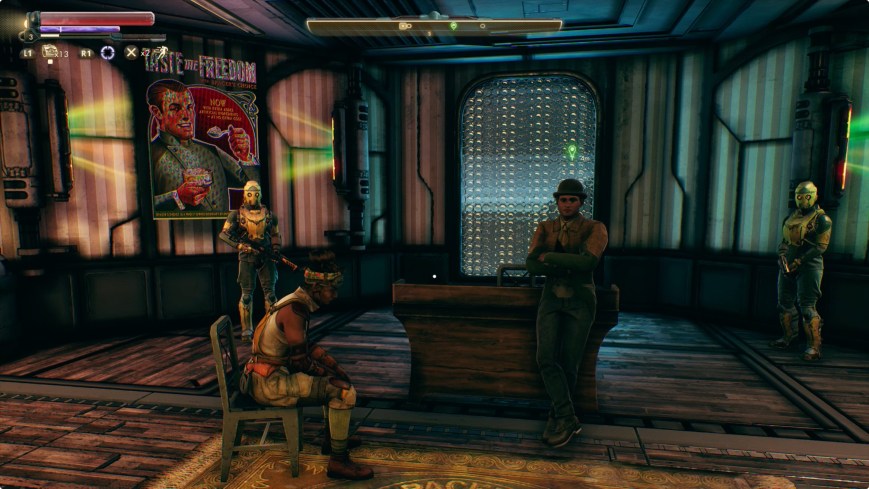
I’m liking it.  It does have a Borderlands feel, but without the black outline on everything.  Characters are smooth enough in animation, except a in direct dialogue.  Maybe it’s a homage to FO, but there’s a lot of “dead eyes syndrome”.  It’s inconsistent though, cause some NPCs look just fine.

the_outer_worlds_edgewater_reed_s_office

Pavarti getting an earful.

Bugs

I’ve never played an Obsidian game that didn’t have game crashing bugs at launch.  Until now.  The entire first planet, not a single one.  I can’t even think of a single one, point of fact.  Wow!

Back to Bethesda here.  That Obsidian could launch this clean with a fraction of the resources within Bethesda… that speaks enough for the state of those two companies.

Forward

I’ve read this is a ~30hrs to complete, and I think I’m about 4 or so in now.  So far, I have only positive to say about it.  Worth buying, and worth supporting Obsidian so they can keep up their solid work.

The Perils of Games as a Service

There are two main benefits for Games as a Service.  Players maintain an investment in the game over time, and it therefore has a very long shelf life.  Companies then can harvest money on the game for longer periods of time.  Very few companies have figured out how to balance those two items.

The more traditional model is simply box games, with a 1 time purchase, and maybe an expansion pack down the road.  With most games being on-line enabled, we got horse armour (and cosmetics in general).  Western players have generally avoided the gatcha/pay-to-win monetization models that dominate the east. Paying a subscription… that lasted about 10 years.  The good/bad of capitalism is that it’s a race to the bottom.  F2P came in, and here we are.

Games as a Service is the new synergy/cloud/blockchain buzzword.  It’s been around for a long time, but in the more explicit sense means a game that continues development long after release, and continues to generate incomes on that new development over time.  The minimum of that time is 1 year (for annualized games), but can go up to an as-yet-unknown number.  You’re looking at something like FIFA compared to something like WoW.

The challenge of this model relates to refresh, or sequels.  In the sports license world, there are arguably minimal improvements from one year to the next (except maybe console generations).  NHL19/20 have marginal changes that could easily have been patches.  The roster updates are already included over the year.  This model is really weird to me – especially FIFA where the MTX only apply to one game, then you need to do the same gambling steps the year following…

Semi-persistent games are the start of the challenge.  Something like Destiny has people sinking a lot of hours of effort to kit up their character, and the developer spending many cycles improving the base game.  After a couple years, the general game is really smooth.  Then a sequel is launched, which always is a downgrade mechanically (more bugs) and erases all player progress.  This is worse when the sequel isn’t easily distinguishable from the original (Division 1/2 here).  This problem gets worse the older the first game gets as compared to the next.  I don’t see how something like For Honor or Rainbow Six could ever have a sequel due to this.  It would have to be an entirely new game.  Ubisoft is public about that learned lesson.  Bethesda sure as heck isn’t.

For fully persistent games, like an MMORPG, it is near impossible to launch a true sequel without cutting your user base.  EQ2 and FF14 are the only ones where this could be considered a success, and for vastly different reasons.  There’s a LONG list of sequels that failed.  It’s not possible for WoW to ever have a WoW2, mainly for the fact that every expansion is in most essence a sequel – 95% of the progress from the previous version is meaningless.  ‘Cept pets – they are forever.  The downside is that the engine behind the game needs either updates or rebuilds (see Cataclysm & Legion), something that’s really only possible on PC only.

Hate on it if you want, but Fortnite here may actually have hit the right spot.  The recent black hole reboot acts as a mini-reboot.  It’s cross platform, rejigged the baselines systems, added new ones, maintained the player identity/investment, and increased players.

Still evolving landscape, makes it really interesting to see how this new game model stabilises.

Back to Arkham City

There’s something about Batman that clicks with me.  A large part of that has to be related to the animated series in the 90s, which still stands shoulders above most others.  Kevin Conroy’s voice is just tatooed in my mind as Batman (as much as Mark Hamill as the Joker).  It helps that there really haven’t been too many clunker Batman video games (hellooooo Superman64!)

I still recall Arkham Asylum when it came out.  I scraped every bit of that game clean, bugs and all.  It had the metroidvania hooks, a decent showing of the Batman villains and setting, and what can only be described as a superb combat system.

If you haven’t played it in the Arkham series, then you may have in the Shadow of Mordor series.  Fast flowing melee combat, quick traversal of distance between enemies, integration of skills, and the feeling of being absolutely surrounded and coming  out on top.  And I don’t mean you’re a lawnmower against grunts.  I mean that you need to pick the targets and pay attention to surroundings.  Dying is always a possibility.  (Side note, if Assassin’s Creed’s engine could put more than 3 people against you, then it would be a close relative.)

Mechanically, there have been some minor tweaks to combat in the 4 Arkham games (Asylum, City, Origins, Knight).  Melee combat stays the same, but the skill sets change, as do enemy types.  The last game added vehicle combat (meh), but the regular fights were much more strategic than the brawls of earlier versions.

The stories inside the games are ok I guess.  Asylum was pretty solid up til the final fight with a super-Joker.  Origins was more like Mega Man in that you’re hunting different enemies without much of an arcing story.  Knight had two stories, only about the actual Arkham Knight destroying things (redemption arc, naturally), and the other about Batman’s psychosis relating to the Joker (this was a knock out).

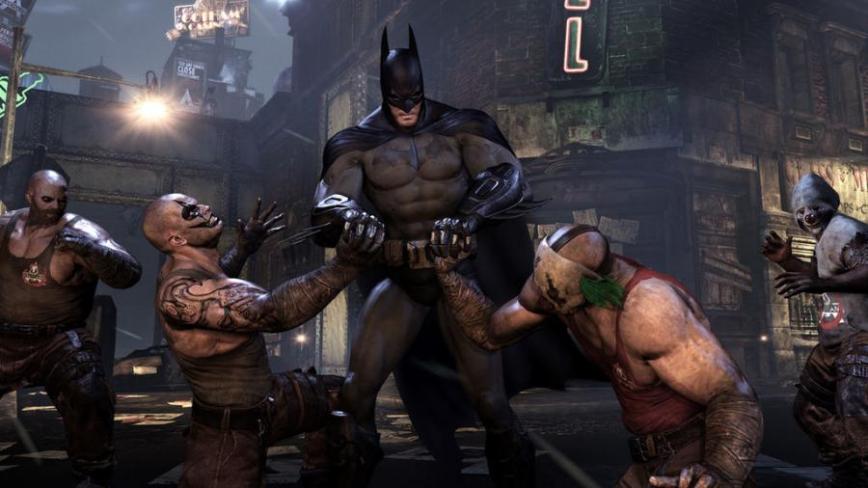
0452a0ee7be944a1cb97450a5fb7f878_batman-arkham-city

Arkham City.  That one was signature Batman.  A puppet villain.  Interesting villains that don’t take up a lot of space. Catwoman.  Vertical gameplay (the floor is lava in quite a few places).  And the Joker twist, all the way to the credits has been etched in my brain for 8 years (launched Oct 18, 2011).  It was also the last time that I considered the Riddler puzzles “reasonable”.

I’ve been somewhat spoiled with AC: Odyssey in terms of game length.  Sure, that’s artificial padding since the content is computer generated, but the minimap icons!  Arkham City’s content is purposefully places, and the minimap icons are pretty much restricted to the Riddler trophies to collect.  The significant benefit here is that the story is paced and managed.  None of this “the end of the world is upon us, but oh, let’s do this 5 hour side quest.”  There’s a sense of urgency, yet at the same time there’s a lot of meat to chew.  In hindsight, it’s a level of balance that’s really hard to compare elsewhere.

The Game of the Year version (with a ton of DLC) is relatively cheap, plays well on any PC, and doesn’t look like/play like a 2011 game.  I’m still a Batman fan, and most games I play will still be compared to this one.

Dauntless Pass Complete

The good thing about Battle Passes is that they make you play the game.  The bad part is that they make you play the game in such a way that your goals don’t always align with what you find fun.  I hit rank 50 in Dauntless a few days ago, it took about a week and a half I guess?  From a pass perspective, there’s nothing more to get.  From a game perspective, I’m full.

Given that this is the first attempt at card draws for the Battle Pass, I do think it had much more positive than negative.  Where I think there are gaps is in the variety of choice.  Selecting a fight is simple enough, you’re always going to need the materials that drop.  Those cards are always useful.  Stagger and Interrupt cards happen all the time.  Wound… not so much.  Only the War Pike does it naturally, you need to slot a specific item in your gear otherwise.  Not too big a deal.

Where things go a bit sideways is on quests that only allow 1 weapon (or sometimes two).  Because it takes such a large amount of material, you’re not exactly running around with one of every top tier weapon until a long ways into the game.  And due to the number mechanics, if you go into a fight with an underpowered weapon, you have a damage penalty to manage.  Might do 100 dmg to a level 8 behemoth, but only 10 against a level 15.  And not all weapon styles are for everyone.  I an not a fan of the War Pike.  The Hammer and Axe are pretty useless against fast moving enemies.

There are some cards that are all but impossible in a group.  Like break all parts before a kill.  I’ve killed the Shroud a few dozen times and only once was I able to break his tail.

Then there’s the item collection cards, used for crafting potions/grenades.  On the surface they seem simple enough, but in practice you’re going to end up not fighting behemoths and instead scouring the map for 5 of the 50 items you need.  It would be like trying to mine ore in a dungeon run, but the ore is 10 miles from where the enemies are.

Still, the fundamentals are there.  These are more wrinkles that can be set about with a few tweaks.  Some need to be removed, others changed in numbers. Frankly, I’m sure they have heat maps of all the cards and the metric around which are top 10 and bottom 10 would be neat to see.  Even more so if that selection was compared to the average item level of the hunters.  New players would certainly favour easier cards than veterans, if they even knew that they were easier.

Still impressed at all this growth from a relatively small group of developers (Path of Exile is similar in my mind).  If a small company can do so much with relatively few assets, really begs the question as to how large studios do so little with so much.

Fallout in Space

There’s a bit of hyper here.  Or maybe it’s hope.  Stars with an H anyways.

Obsidian Games is on my list of “must play” developers.  There’s something about their games that screams “we’re a small shop but big ideas”.  KOTOR2 and Fallout:New Vegas exemplify that.  Awesome ideas, a whole lotta bugs, some interesting cut content.

I’ve had my eye on Outer Worlds for about a year now.  The concept boils down to Fallout in Space.  You get the equivalent of a SPECIAL system, skill checks, melee/ranged attacks, a mini-VATS system, dialogue trees, companions, quests.  Combine that with a dry/sarcastic humour set as a spacer, and you can have my $$$.

I’m not going to pretend that this won’t launch without game breaking bugs.  I don’t recall any Obsidian game that ever has.  It’s also an Epic Store exclusive for the first year on PC (minus the Microsoft store… since Obsidian is owned by Microsoft).  I already have that client for Dauntless and Outer Wilds.  It isn’t as full featured as Steam, but it does offer cross play for Dauntless, has a lot of games, and has way less overlay than say, Origin.

Game launches on Oct 25.  I’ll have my Dauntless pass complete by then (level 41/50 now), and I’m guessing I’ll have some time set to pay this bad boy.

Thinking on Your Feet

Blizzcon is in 3 weeks.  Typically the “hate train” lasts only 2 weeks in the collective consciousness of the internet mob.  Interesting to see where this ends up, and who gets sucked into it.  (Related: I do believe in ethical purchased, but ethics are personal… so to each their own.)

I was at the rink the other day watching some kids take a practice, talking to another coach.  I also played a couple times this week (another tonight), then took a pint with the guys afterwards.  For anyone that’s played any sport at a competitive level, there are points of reference in a game where you know people understand the fundamentals, or they understand the meta.

I’ll use hockey here, but this applies to any sport.  There are rules that govern how the players participate – # of players, positions, timing, offsides, points, and so on.  Anyone can learn those rules.  Then there’s the skill level of the sport, how fast can you move, your level of agility, or reaction time.  Elite athletes spend 12 months a year on this, close to 6 days a week.  It’s a job, and there’s always someone hunting to take it from you, so some motivation!

Then we get to vision.  I’ll take a sidebar here and discuss chess.  The really good chess players have memorized key positions and plays, and they reference them with each turn, selecting the move they think best fits.  It isn’t just one chess piece, they are seeing 5-6 into the future, setting up their long term plays.    It may seem to be a long game, but most times you know who’s going to win after 10 moves and the rest is just playing out the game to it’s natural end.

Back to hockey (or any other group sport).  There are key positions and plays that exist, and the coaching staff has a preference for their team.  Some prefer a stretch pass game, where they beat on speed.  Others prefer a 2-1-2 game of passing for an open one-timer.  Dump and chase.  Drop passes.  The somewhat new 1-3-1 PP.  Then there’s the defensive structure to counter those plays.

Hockey (soccer/rugby/basketball too) are fluid games, in the sense that the amount of time you have to adapt to a play is very small.  This makes the game generally more dynamic, and inserts a level of randomness compared to something like US football.  For people who understand the sport at that level, they can see plays coming well in advance.  Not so much a goal (since the goalies have a say in that) but in the opportunity of scoring.  Without that understanding, people still have a sense of awe to what happened because a clean play transcends a sport.  Who doesn’t appreciate a long-ball alley-oop in basketball?

Gaming

A lot of games have this reactionary model.  It’s why team-based competitions focus so much on practice of plays, and paying attention to their opponents.  True, actions-per-minute have a dramatic impact on success, but the wisdom to read a play, adapt, and execute a counter is amazing to watch.  The hiccup here is that a game has a limited shelf-life, or for the longer-term ones, the rule sets change over time.  The level of expertise/wisdom for a game therefore only lasts a short window (LoL/DOTA are a different conversation.)

It’s hard to build a game with the level of depth required to stand out.  Battle-chess can never really stick around because it’s not player driven, and the strategies are extremely limited.  FPS games have inherent limitations due mainly to map memorization, they need more horizontal options to add that complexity (see Titanfall).

Now there’s a ceiling and a floor for this concept.  The floor is the minimum understanding required to participate.  Games with incredible complexity often require a serious amount of player knowledge to even play (most CCG, EvE, or P&P RPG).  That limits the potential playerbase.  The ceiling is the point at which good players are separated from amazing players.  The closer that spread, the shorter the ceiling.  There aren’t a whole lot of games out there with low floors and high ceilings, which would cast the largest potential net of players and spectators.  Say what you want about Fortnite, but the floor/ceiling in that game is a WIDE spread, and adaptive play is essential for people to success (without aim bots).

Game design is hard.  Great game design is a rare event, that requires a spectacular team and vision.  And like a great sports play, by playing a great game you just know from a quick look that it’s going to be a good time.

Incentivizing Play

This topic has been stirring in my head for a very long time, and at the end of the day way more complicated than this post will do justice.  Attempts will be made!

Design of any consumable service follows the same general themes.  You want the majority of people to take a specific path, allow for some variance, and put in guardrails for the lead chip lovers.  I keep thinking of Lemmings in that sense… rarely will you hit 100%, and most realistic goals are to hit 80%.

In the game design space, this applies in the general sense, then again at the activity level.  You want people to participate along a designed path and reach a designed end point.  You build mechanisms to re-enforce that message, and try to keep people in the same general line.  You launch and use various metrics to measure the success of those mechanisms.  Then re-adjust, launch more mechanisms, and analyze FOREVER.

The trick here is the mechanisms, which typically fall into the carrot/stick archetypes.  Reward good actions and punish bad ones.  The scope of those impact the % of people who follow the line.  Most of the time.  In some games the end point is so poorly planned that players reach it early/late/never and the whole thing falls to pieces.  I can’t say I’m surprised at how quickly Ragnaros dropped in WoW Classic, but I can say I’m  disappointed that people thought that was the actual goal.

Good design has a linear path, appropriate ramps to get people on/off that path, and an end goal that players understand early on.  It appears achievable, and is desirable.  E.g. a car race and you want to be in 1st.

Great design has a non-linear path, and intersects with other systems.  It has layered goals, that are not necessarily linear in structure, but have inter-dependencies.  There’s a continuous feedback loop, and a gradual feeling of progress.  e.g. pretty much any PnP RPG is built on this model.

Content vs Consumption

A big problem as games have become services.  It always takes longer to build something than to break it down.  4 hours of baking and 15 minutes of eating.  Years of research and writing, read in a half day.  Where the wins come is from volume.  If it’s 4 hours of baking, and 20 people take 15 minutes, well that’s a decent exchange.  Sell 10,000 books, ok.  Design for 6 months and 6,000 people play it… uh, maybe not?

Game designers have learned to depend on time-gating mechanics.  Sure, the original reason was to slow down the locusts that broke other systems (gold faucet/sink economies are fragile in that respect) but as time went on, this started applying to everyone.  The fatigue mechanic in nearly all F2P games is a good example, where the drive in monetization (and in a capitalistic sense, reasonable).

The fatigue mechanic in a system that cannot be bypassed… that gets irritating.  Especially if you’re gating a high-volume/fun activity.  But how do you know if that activity is viewed as fun, rather than simply rewarding?  LFR in WoW is free epics, while the original goal was simply to expose raiding design investment to more of the population.  Take out the epics and see how many people do LFR.  I mean really, take out the epics and remove the raid lockout restrictions – see what happens.

Dauntless

It’s F2P and the monetization system is based on 2 streams: battle passes and cosmetics.  From a financial perspective, they want people to take the battle pass, so the pricing structure clearly favors that, rather than 1-off customization options.  But the design of the game is predicated almost entirely on group-based combat, so they need a lot of people to make it attractive.

So they made the battle pass work for both free players and paid players.  Paid players get extra bonuses on that track, and a miniscule amount of extra drops in a fight (you get more if you don’t get knocked out).  Progress on this bar is through 3 methods:

  1. Daily collections in town (for 100 pts)
  2. Random drops from hunts (really random…)
  3. Completing tasks (20, 40 or 100pts)

Tasks used to be assigned with 1 weekly and 3 dailies.  They could be anything – hunt with repeaters, collect flowers, stun 5 times, attack with fire.  If you got bad rolls, then you may end up with objectives you didn’t want to do.  I dislike Pikes, and I really disliked any task that deal with Pikes.  Not to mention the need to actually build a decent Pike first.

The new Bounty system provides 4 slots of tasks.  You need a token (get some per week, as battle pass reward, or random drops) and that gives a random set of 3 tasks to pick from.  In the 50 or so times I’ve done this, only once has there been 3 options I didn’t like – and it made me play the game in a fashion I disliked even more.  In 75% of the cases, it had no impact at all since it mapped to my preferred playstyle. In the rest, it was a minor tweak (e.g. swap to a fire weapon, or focus on stunning rather than breaking) that made the fight marginally more interesting.

Now, clearly there are heatmaps and metrics and data sets that will come from this.  I can’t imagine anyone purposefully selecting “collect 40 rocks” unless the other 2 options were more painful (e.g. use a grenade to stun).  There’s some tweaking that’s left.   Yet, the system itself does work.  It lets you keep playing the way you want, but opens up alternatives that you may not have considered.  It also means that multiple playstyles can all work to the same overall goal – so that a lowly Pike player can get success just as much as an Axe fanatic.

There is however a gap once people complete the battle pass.  Since there’s no real hard time gating (a bit of RNG for extra token drops), entirely possible that people get it all done in a few days of hardcore grinding.  But there’s still the long term mastery system goals, and the weekly time trials to keep folks going.  Whether those two goals are actual things people want… another discussion, for another time.

Group Complexity

There are so many adages when it comes to group play – more than the sum of its parts, there’s no I in team, and do it for the team.  Thematically, they focus on everyone working together for a greater goal.

Frankly, this is the goal of group play.  That some mass of people can complement each other enough to shore up any weakness and strengthen the group.  There’s a fundamental piece here that makes this work – communication.  In sports, that’s basic.  You’re usually right next to the person.  In hockey, I’m always talking.  Incoming pressure, open lanes, double teams, and so on.  You need to quickly adapt.

In games, this is harder.  Older games, you were at a LAN and it was “easy” to shout out some commands.  Then MMOs come around (which were effectively glorified chat boxes) and the games were so slow you could type stuff out.  I mean, who didn’t have debates during Plane of Fear?  I won’t dismiss that getting to these group events was a challenge in itself.  Getting to Scholomance in vanilla WoW was a trek and a half.  You were conscious of the effort.

I won’t say that LFG tools broke this.  I’d argue the opposite actually, in that LFG removed so much spam from the game that I could start to enjoy it again.  What broke the model was a pile of things, though notably three strong ones:

  • Auto-summons to group location.  This is a mindset issue.  DPS queues have always been notoriously long.  Auto-summon lets you stay in the world and play that mode while the other is chugging away.  When you do group, no time lost, you just plop, show up where you need to be.  Odds are in the wrong gear, and wrong skills. There’s a general lack of focus.  (There’s a strong analogy to warm-ups before a sporting event – those are mental warm-ups much more than physical.)
  • Speed mechanics & strobe lights.  I am not advocating a return to tank & spank.  What I am saying is that dungeon builds used to be focused on the trash as much as the bosses, meaning that the path through was a thoughtful one.  Enemy placement & group triggers were with purpose.  Learning which spawns were mandatory was key (Stratholme anyone?).  The game’s focus away from thoughtful play, to reactive play has dropped the skill floor to faceroll levels.  Coincidentally, it’s created a larger gap between dungeons and raids.  The go-go-go mentality (and design) means less overall thinking.
  • Lack of social reward/accountability.  The LFG tool and LFG chat are fundamentally the same, the difference is in the pool of available players.  Many LFG tools nowdays pull from the entire game, not the server, meaning you could go years without seeing the same person again.  Trolls and ninjas used to be blacklisted, and they knew about it.  Healers made friends lists and didn’t even need an LFG tool – they fought through /invite spam.  FF14 has an interesting reward system, where the group votes for best performer.  Not perfect, but it does allow for positive messaging.

Dauntless

Dauntless is at its core an action-RPG.  There are things you have to do in combat to succeed, and you get things that increase numbers, making the next attempt slightly easier.  As a general rule, you should be able to solo a behemoth before taking it on in a group – that way you know you can carry your weight.  The game doesn’t force it, in fact, it allows hunters to progress without a hard measure.  If you can manage to leech (enter a fight and do nothing) your way through the main questline, you’ll be a fly in a hurricane later on.

Behemoths scale in health the more hunters are present.  Every leech is an increase in difficulty for the others.  Every under-powered hunter is an increase in difficulty.  Every under-trained hunter is an increase in difficulty.  Anecdotally, every 5 or so fights, I’ll get a hunter who really should not be there – they die in 1-2 hits, and need a revive within the first 30 seconds.  Every 5 or so fights, I get the complete opposite, and everyone knows what to do and the behemoth is down in 90 seconds or less.

From the points I mentioned earlier – auto-summon, fast mechanics, and accountability – Dauntless has only 2 of them.  Since all you do is hunt, the summon part actually works well enough.  The game even gives you a pre-hunt lobby to swap out gear for the specific behemoth, and suggests what you should use.

It does however require both reflexes to avoid attacks, and memory to remember patterns per behemoth.  There is a world of difference between a Shrike and a Shroud – even if they had similar damage and HP, the Shroud would still be a dozen mechanics more than the Shrike.  I don’t particularly see this part of the game changing much – though some mechanics are much more frustrating than others (Valomyr especially).  This requirement on speed makes it that communication is all but impossible without voice chat.  And if you do manage to type something out, there’s so much going on the screen that no one can actually pause to read it.

The only social construct present is guilds and friend lists, which mechanically are pretty much the same thing.  The toolset doesn’t allow you to easily blacklist someone else – not that it would matter much given the large pool of players.  It also doesn’t allow you to recognise good behaviour.  It’s just a bunch of random faces, that are never going to see each other again.

I will stress that Monster Hunter has these same issues.  The slight difference is that battles are slower and longer.  That gives hunters more time to think, rather than react.  It’s also incredibly hard to leech in that game.

I’m happy to say that this is not a frustrating part of the game.  The occurrence is infrequent, and even when things go really poorly you still get some bits out of it.  Reading a few of the dev posts, they are looking at better tools for social interactions… how that comes about is going to be interesting to see.

Return to Dauntless

A fair chunk of the spring was spent in Dauntless‘ Open Beta.  I opined then that the game had come a tremendously long way from close beta, and that the last “kitchen sink” patch had done a serious job on the systems within the game.  The downside with adding systems is that you have to explain them (*cough*Warframe*cough*).

In early summer Dauntless hit the Epic Game Store.  Chief benefit here is cross-play.  And after a few days of teaming for some runs, I have to say that is entirely a positive.  Anecdotally, there’s a fair share of players from PC, XBOX and PS4 playing at any given time, making hunt matching making go ultra fast.  I can recall quite a few fights in beta where you may wait 5 minutes for a solo fight… not the case here at all.  The game is based around playing with people after all.

On Sept 12, the game fully launched (1.0).  Launch brought a few more tweaks to the game.  Fist weapons were added, and the rest of the weapons were all re-balanced.  Where Hammer was king and guns were trash, the meta order seems to be fists –> guns –> dual blades –> swords –> axes –> hammers.  This is almost entirely due to behemoth attack speed; enemies here are about double the speed seen in something like Monster Hunter.  Slow weapons get the short end of the stick.  Balancing is always a tough one, but there still is a whole lot of build variety. Certainly more balanced than in the spring.

Launch also came with some essential guidepost information.  Every hunt now clearly lists what you should have in terms of offence/defence, the resistances, effects, and drop rates.  No more having to alt-tab to the wiki to remember it all.  It also brought load outs, making gear swaps a much better experience.  Rebuilding a fire-resistant set was a massive pain, but also required to hunt something like a Hellion.

Battle pass is still there (99% cosmetic, gives a single extra drop per hunt).  Still some daily hunts that cycle through.  The main quest line is now ultra obvious.  The town has a better layout.  Interface is generally cleaner.  Bounties get rid of the daily quests (e.g. kill with warpike) and allow more flexibility for the same rewards.  Long and short of it, the game feels like a final release.

I’ll admit I was really unsure if Dauntless could deliver a workable and quality game, based on what I saw last fall.  It was a cool prototype but there’s been a wide gap between that and release that mars a ton of “early access” titles.  I’m rather astounded at what’s delivered here.  Very easy to pick up and play.  The incremental grind that people are always chasing.  An active development team that is liked and respected by the community.  A F2P model that feels both fair and transparent.  I’ll be keeping this on my active play list for a long while…